Automatic acquisition for low frequency lexical items
Núria Bel, Sergio Espeja, Montserrat Marimon
IULA – Universitat Pompeu Fabra Pl. de la Mercè, 10-12. 08002 Barcelona, Spain
E-mail: [email protected], [email protected], [email protected]
Abstract
This paper addresses a specific case of the task of lexical acquisition understood as the induction of information about the linguistic characteristics of lexical items on the basis of information gathered from their occurrences in texts. Most of the recent works in the area of lexical acquisition have used methods that take as much textual data as possible as source of evidence, but their performance decreases notably when only few occurrences of a word are available. The importance of covering such low frequency items lies in the fact that a large quantity of the words in any particular collection of texts will be occurring few times, if not just once. Our work proposes to compensate the lack of information resorting to linguistic knowledge on the characteristics of lexical classes. This knowledge, obtained from a lexical typology, is formulated probabilistically to be used in a Bayesian method to maximize the information gathered from single occurrences as to predict the full set of characteristics of the word. Our results show that our method achieves better results than others for the treatment of low frequency items.
1. Introduction
The work we present here handles a specific case of the task of lexical acquisition understood as the induction of information about the linguistic characteristics of lexical items on the basis of information gathered from their occurrences in texts. Research in lexical acquisition is based on the assumption that lexical items have regular patterns of syntactic behaviour and that these regular patterns distinguish classes that ultimately are semantic classes. Most of the recent work in the area of lexical acquisition has been concerned with the identification and use of such patterns. The way they identify and use such information are the basis of two lines of research: in one line, the induction of these patterns from data helps to predict lexical classes and the words that are members of such classes; in the other one, these patterns are sought in data as evidence for classifying words into pre-defined, linguistically motivated classes.
The contribution of our work is to address specifically the problem of handling the case of low frequency lexical items, because the performance of published methods decreases notably when, for instance, only few examples of a word are available. Both lines of research just mentioned have in common that need to take as much text as possible as source of evidence. But the importance of covering such low frequency items (these patterns and words) lies in the fact that a large quantity of them will be occurring few times, if not just once, in any particular collection of texts. Even more, according to Zipf’s, this will be the case for most of the words, especially nouns, in any length size corpus (Zipf, 1935). Lexical acquisition for NLP must be able to handle these cases too because lexical coverage is crucial to achieve the proper performance of the processing components that rely in lexical information. For instance, Briscoe and Carroll (1993) observed that half of parse failures on unseen test data were caused by inaccurate lexical information, and Baldwin et al. (2004) identified that in parsing 20,000 strings from British National Corpus (BCN) a 40% of
grammar failures were due to missing lexical entries, with a grammar dictionary of about 10,500 lexical entries that time.
Our work proposes two innovative ideas: first, to compensate the lack of occurrences resorting to linguistic knowledge on the properties of lexical classes. The use of knowledge on lexical classes is not new, but our contribution is to propose a way to use it probabilistically extracting it directly from a lexical typology, that is, without deriving the probabilities from a sample of data. To assess the probabilistic model from the data creates problems with low frequency items, not only words, but also patterns of occurrence that show a low frequency. Second, in order to handle the uncertainty of the data (some patterns of occurrence can characterize more than one class, and there is noise in the identification of the patterns), we take advantage of the formulation of lexical classes in terms of combinations of grammatical features in order to build classifiers for each of these features first, and reconstructing the classes in a second stage.
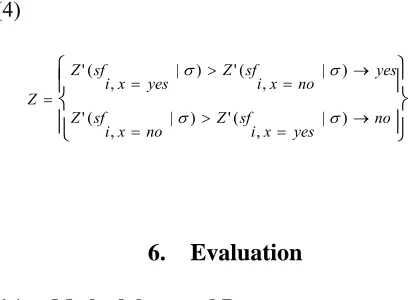
hypothesis about a feature and value. This expectation is obtained, by means of a hybrid method, from structured knowledge, i.e. a linguistic typology of lexical classes. The final decision about a word is determined by averaging the predictions of all hypothesis weighted by their posterior probabilities and summing the predictions made by each occurrence to take eventually the one which has accumulated the maximal value.
As just said, our classifier is crucially based on the representation of lexical knowledge as a system of classes, where classes are defined in terms of particular combinations of grammatical features. Because some of these features characterise more than one class creating uncertainty, our proposal is to classify words first according to these features, leaving for a later task to map the combination of features into classes. The system assigns a positive or negative value for each feature declared in the system, and, depending on these values, the word is assigned a class. The better we assign the feature values, the better we will infer the lexical class.
For evaluating our proposal we have worked with Spanish nouns. Nouns are the part of speech which presents the largest number of low frequency items. The objective of the evaluation was to check whether the system predicts the correct properties for low frequency items. We have worked with nouns because most of them occur few times in a corpus. In our corpus of about one million words, a 16% of our test set of 289 nouns occur just once, an more than a 50% occur from one to ten times. Our results demonstrate that our approach achieves state of the art results with such low frequency nouns, while other methods, as we want to demonstrate, are unable to handle them properly.
The paper is organized as follows. In section 2, we briefly review the state of the art in methods for lexical acquisition in order to motivate and justify the choices of our proposal. In section 3, we introduce the fundamentals of the grammatical feature based lexical typology used for this experiment. There, classes and features used for classifying Spanish nouns are justified. We also describe in detail the patterns used as cues for classification. This information will be used to compute a probabilistic model out of the linguistically formulated information in the terms described in section 4. The way in which we use the probabilistic model to classify words according to the information obtain from occurrences in texts is described in section 5. Section 6 is for presenting the details of the evaluation, the results of the experimentation and a comparison with a similar exercise done with Decision Trees. The conclusions and future work are presented in section 7.
2. State of the art
The task of lexical acquisition is to assign a word certain properties according to the information gathered from its
occurrences in texts. The first problem is to filter noise: most of the techniques for lexical acquisition look for particular patterns of occurrence or cues in texts, but, as Brent’s (1993) pointed out, “the cues occur in contexts that were not aimed at”. This so called noise can come from different sources. Noise can be due to errors in processing the text, but there is a more systematic source of noise, which is characteristic of linguistic data, and that must be taken into account. Most of the methods for lexical acquisition, independently of the level of analysis of the input, base their decisions on counting the observation of particular co-occurrences as cues, i.e. a verb will be transitive if it is observed just before a noun phrase, as in “he saw her daughter”. But in texts, continuity, that is two words occurring one after the other, does not necessarily mean a relationship. This is the traditional object of constituent analysis: to decide whether two continuous elements are directly related or not.
The first idea to distinguish noise from real cues was to discard as noise the cues that do not appear frequently enough, and it is due to Brent (1993), who used the Binomial Test Hypothesis to discriminate noise. The key point of his approach is that if a particular cue is more frequent than other ones, it must be a true property of the word to be acquired and hence it is not noise. The problem of this approach is that some pertinent cues occur too few times to be distinguished from noise. For instance, in a corpus of 3,334,563 tokens, an adjective like ‘applicable’ appears 440 times, and a 37% of these co-occurring with its bound preposition ‘to’. In the same corpus, the adjective ‘favorable’ occurs 60 times, and only a 5% co-occurring with its bound preposition ‘to’, while ‘generous’ that occurs 7 times is never found with its bound preposition ‘with’. Such big differences create real problems to frequency based methods.
as predicted by the Zipf’s principle, linguistic data presents a distribution where there is a long tail of elements showing up very little in every level of representation1.
Another approach has tackled the problem of lexical acquisition by using distribution similarity judgements instead of pure quantitative decisions to decide about what is relevant information and what is noise. The idea behind is that linguistic classes define differences in the distribution of certain cues, i.e. the class of transitive verbs will show up in passive constructions, while the intransitive verbs will not. While most of the frequency based systems just mentioned work in a predictive way: the patterns induced from the data will show a number of different classes made of a set of lexical items, the works we are going to comment work by classifying the data gathered, i.e. the cues that distinguish classes are defined a priori and serve to indicate that an item belongs to a class. These works mostly use supervised methods with machine learning techniques. The learner is supplied with examples of the cues that linguistically motivate a number of proposed classes. The final exercise is to confirm that the data characterized by the linguistically motivated cues support indeed the division into the proposed classes. This is the approach taken by Merlo and Stevenson (2001), who selected very specific cues ad-hoc for classifying verbs into a number of Levin (1993) based verbal classes. Other authors have tried to use more general features, such as the pos tags of neighboring words (Baldwin, 2005), or general linguistic information as Joanis et al. (2007) who used the frequency of filled syntactic positions or slots, tense and voice of occurring verbs, etc., to describe the whole systems of English verbal classes.
The results of these systems based on predefined classes and cues show a better treatment of low frequency items, or at least not a significant difference attributable to differences in the number of occurrences. Merlo and Stevenson (2001) and Joanis et al. (2007) demonstrate that their results are not affected by differences in frequency. They achieved an accuracy, i.e. the number of correct classifications among all the classifications, around a 70%. These results further support the idea that for a proper treatment of low frequency items, we need to base the decisions in information that is independent of its occurrence in a collection of data, because as Korhonen (2002) demonstrated, the probability of a property observed in a corpus is very different to the conditional probability of this property given a particular word. As we explain in section 3, we decided to produce a probabilistic version of the knowledge embodied in a lexical typology by means of conditional probabilities. This information obtained from the symbolic knowledge is not biased by the zipfian distribution, and should overcome the problem
1 Works such as Chelsey and Salmon-Alt (2006) and Preiss et al. (2007) confirm that Zipf’s distribution also characterises different levels of linguistic abstraction: constituents, grammatical relations, etc.
of sparse data, as it happened when Korhonen (2002) used probabilistic information derived from WordNet classified verbs for smoothing probabilities obtained from data and achieved an improvement in recall scores, from 51.8% to 71.2% for English verbs.
The works by Merlo and Stevenson (2001) and Joanis et al. (2007) identified another important aspect that we have introduced in our proposal. In the distribution of cues per lexical class, these authors found that there are classes that share cues. In addition to the uncertainty of deciding whether a cue is noise or not, there is uncertainty in the selection of cues that describe a class. This observation is very much in line with current analysis of lexical classes in terms of combinations of grammatical features, as we will see in the next section. We have addressed this uncertainty by breaking down the classification process. We propose to first classify words into having or not having every grammatical feature. Dorr and Jones (1996) leads us to think that if the features are properly identified, the mapping to classes would be trivial.
3. Classes, features and linguistic cues
According to the linguistic tradition, words that can be inserted in the same contexts are said to belong to the same class. Thus, lexical classes are linguistic generalizations drawn from the characteristics of the contexts where sets of words tend to appear. Lexical acquisition can be approached as a classification of the contexts where words occur as those that characterize a particular class. As said before, some contexts can characterize more than one class, as if lexical classes were defined in terms of orthogonal patterns of properties, those that in several linguistic theories are known as grammatical features.
For the research we present here, we have taken the lexicon of a HPSG-based grammar developed in the LKB platform (Copestake, 2002) for Spanish (Marimon et al. 2007a and 2007b), similarly to the work of Baldwin (2005). In the LKB grammatical framework, lexical types are defined as a combination of properties in terms of grammatical features. The lexical typology for nouns, for instance, can be seen as a cross-classification, comprising noun countability vs. mass distinctions, and subcategorization information also expressed in terms of grammatical features.
A classifier was built for each of the features that form the cross-classified types. For nouns, mass and countable, on the one hand, and, on the other hand, for subcategorization information three further basic features:
(fear) and “adicción” (adiction) will be examples of
countable, trans and pcomp_a. The combination of features assigned will be the final type which is a definition of the complete behaviour of the noun with respect, for instance, optional complements.
As linguistic cues for identifying these features, we have used 23 patterns or contexts that can be indicative. We have followed the methodology of works such as Merlo and Stevenson (2001) and Baldwin and Bond (2003) that based their classifiers in a linguistically motivated cue selection process. The contexts where different types of nouns are expected to occur are less clearly defined than the ones for verbs, in which most of the authors have worked. Linguistic cues, that is, contexts that were taken as the expected syntactic behavior of nouns given a particular feature, are the following.
The most frequent cue that can be related to the feature
countable is plural morphology. We mention frequency because, although some more discriminative contexts can be identified, they will not be very frequent, and thus are not useful. It can happen that a context is clearly a sign of having a particular feature, but if not very frequent, it will not be found, and the system will have no information to decide. Thus, more frequent cues, although less conclusive, can be a better choice than very informative but scarce ones. As for mass, the used cues were to be the head of a noun phrase without determiner occurring immediately after a verb, and the co-occurrence of the noun in singular with certain quantifiers2. Nevertheless, we should mention that mass nouns in Spanish can also appear in the contexts of countable ones, as in the case of “cerveza” (beer) when in constructions such as “tres cervezas, por favor” (three beers, please), and it is reflected in the typology.
To find frequent enough discriminative contexts that could be described at the level of morphosyntactic tags for identifying a noun occurring with its complements was harder and deserved some feature analysis work. For the feature trans, we first introduced nominalization suffixes such as “-ción”, “-sión” and “-miento”, that were, however, not enough. We find out that the results improved when checking the presence of the determiner of the potential complement. More complements were found to be determined, as in “aceleración de la economía” (‘acceleration of the economy’), than not, while modifiers tend to be non determined, that is zero determined, as in “mesa de juego” (‘table of games’). We have also used as a cue for transitive nouns the presence of two PPs introduced by the preposition de (‘of’) as in “la colección de coches de mi hermano’ (‘the collection of cars of my brother’). Finally, to find the bound preposition
2The quantifiers are: más (‘more’), menos (‘less’) and bastante (‘enough’). But these cues, based on a collection of lexical items, are less productive than other characteristics such as morphological number or presence of determiners, as they appear very scarcely in texts.
of complements, we used a pattern for each possible preposition found after the noun in question.
4. A probabilistic version of a lexical
typology
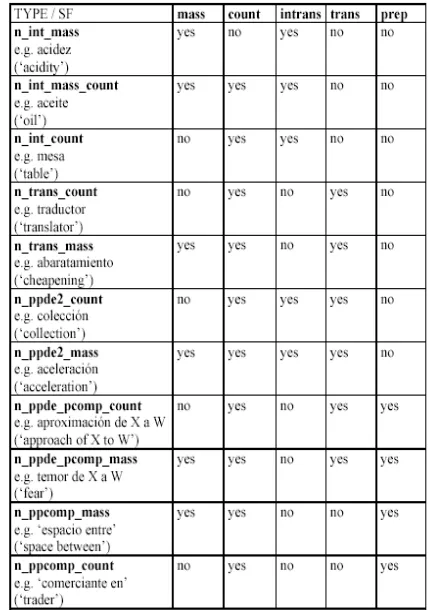
These five features for characterizing nouns we have introduced in the previous section account for eleven types, as shown in Table 1, which conform the typology that we used as the base for the computation of the probabilistic model.
Table 1. The typology of Spanish nouns. A simplified version
If we assume that linguistic cues found in texts are evidence that a noun has a particular feature, we can predict in which contexts the nouns having a certain feature will be likely to occur. Looking at Table 1, we see that we can not only predict the contexts directly related to a feature, but we can also predict the contexts or cues that just coincide when belonging to a particular class. Hence, we can compute the probability of appearing in different contexts, all those that are cues of all the features that conform the classes in the typology. For instance, in Table 1 we can predict that it is more likely that a noun having the feature transitive, occurs with an linguistic cue of the feature countable (plural, for instance) than with a linguistic cue of the feature mass (absent determiner, for instance), as there are 6/6 cases for trans=yes and
count=yes, and only 3/6 cases for trans=yes and
in the Weka (Witten and Frank, 2005) implementation (Bel et al. 2007). In that experiment, we trained a DT with the signatures of 289 words, using the encoding available at the SRG lexica for a supervised experiment in a 10-fold cross-validation testing. This test-set was chosen for specific purposes and contains unbalanced data with respect features and types. This unbalance benefits the DT classifier which takes into account, as we will see, the most frequent items when there is a severe unbalance in the data (Mingers, 1989).
For the experiments we present here, we have used a set of 50 nouns that appeared only once in our corpus of one million words. These nouns were chosen at random. The main characteristics of this test set are: only seven nouns show a cue for the intrans feature, although most of the nouns have this feature. In seven cases, the single occurrence contains noise for any of the features. The feature trans could observe a cue to support this hypothesis in sixteen of twenty cases. As for the feature
mass there were eight cases of possible cues for this feature, but in three cases were noise. As can be noted from the description of the test set, the main problem for lexical acquisition is the lack of positive cues. This was the problem that our approach tried to tackle.
6.2 Results
The goal of the experiment we present in this paper was to confirm our hypothesis that using lexical class based knowledge in the form of probabilistic information will ensure a better treatment of low frequency items (words, cues and lexical properties) than the one achieved by other methods based on the assessment of frequency information from samples of data. To confirm the better behavior of Z with respect to such low frequency items, we experimented with words that appeared only once in the corpus, a case that is more usual for nouns than for other categories.
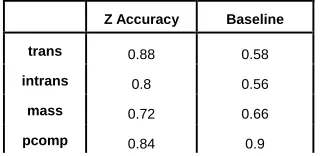
We first compared the total accuracy (for the assignment of yes and no values) achieved by Z with the baseline of the task, as shown in Table 2, and we confirmed that Z gave results above the baseline. The two cases where the baseline delivers better results are for those cases of very unbalanced features: count because almost all nouns are countable and pcomp because only 5 of the 50 have a bound preposition complement. But even in that cases the distances were small and did not prevent the total accuracy of Z from being higher.
Z Accuracy Baseline
trans 0.88 0.58
intrans 0.8 0.56 mass 0.72 0.66 pcomp 0.84 0.9
count 0.98 1.0
Totals 0.844 0.74
Table 2. A majority class baseline for the task of assigning features to 50 Spanish nouns
to compare the results of Z.
In order to compare our approach based in Bayesian methods with Machine Learning methods, as used by Merlo and Stevenson (2001) and Joanis et al. (2007), we compared the results of Z with the ones obtained with the same test set, and the same goal of assigning values to grammatical features as in Bel et al. (2007). Table 3 below shows the details of the results for the same 50 Spanish nouns when using a DT and when using Z. Results are expressed in precision (‘prec’), recall (‘rec’) and F1 for the assignment of the value yes for every grammatical feature of the model. As expected, because of the problems of the DT with data with few occurrences (Mingers, 1989), performance is better with Z, especially in what concerns recall, but in the case of the feature
intrans. An analysis of errors showed that there were cases where noise was not been detected. The noun appeared just before a preposition “de” (of) which was not its complement in four cases. Recall that by means of the conditional probabilities assessed, Z can decide that a word is unlikely to have a complement, because of other information gathered from the occurrence. Z had enough information to do so in two of the four cases.
DT Z
Prec. Rec. F1 Prec. Rec. F1
trans 0.75 0.46 0.57 0.94 0.76 0.84 intrans 0.85 0.95 0.89 0.78 0.89 0.83 mass 0.50 0.16 0.25 0.71 0.29 0.41 pcomp 0.00 0.00 0.00 0.28 0.4 0.33 count 0.97 1.00 0.98 1.0 0.98 0.98
Table 3. Standard measures comparing the results obtained with a DT and with Z for 50 Spanish nouns
occurring just once at the corpus.
The results shown in Table 3 indicate that Z overcomes the problems that DT suffers because of the unbalanced distribution of linguistic items. The most evident case is for pcomp which is a low frequency phenomenon which causes the DT to classify all cases as negative. Z is able to identify some (2/5) of the bound prepositions correctly. The results for the feature mass were also very significant due to the scarcity of cues for this feature. Z achieves better precision and recall than the DT.
significant to assign the value yes. In general, we interpret the higher recall of Z in Table 3 as a confirmation of Z being a method with enough prediction power to induce a correct feature assignment even when no more than one occurrence is available in a significant way.
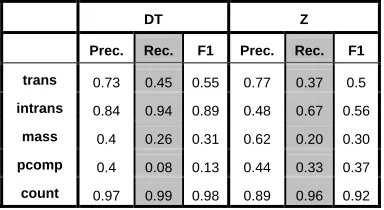
Finally, in Table 4, we present the results of the comparison of the results for the assignment of the value
yes obtained with the test set of 289 nouns both with the DT and with Z. As said before, the results of the DT were obtained in a 10-fold cross-validation testing (Bel et al. 2007).
DT Z
Prec. Rec. F1 Prec. Rec. F1
trans 0.73 0.45 0.55 0.77 0.37 0.5
intrans 0.84 0.94 0.89 0.48 0.67 0.56
mass 0.4 0.26 0.31 0.62 0.20 0.30
pcomp 0.4 0.08 0.13 0.44 0.33 0.37
count 0.97 0.99 0.98 0.89 0.96 0.92
Table 4. Standard measures comparing the results obtained with a DT and with Z for 289 Spanish nouns
randomly chosen.
From these results, we again confirm that features that have cues with lower frequency are better recognized by Z. Besides, with the exception of the feature intrans, the results obtained by both methods are rather similar. This demonstrates that the probabilistic information obtained from the lexical typology can be used as a substitute of the information gathered from labeled examples, used in supervised experiments with machine learning techniques such as DT.
7 Conclusions and future work
The proposed methods for the automatic acquisition of lexical information face problems to handle low frequency items. We have identified how methods proposed in the literature are affected by low frequency items and we have integrated known solutions that have proven to improve the results in the work of other authors into a new proposal.
In particular, we proposed to address the problem of classifying nouns using a lexical typology that defines a lexical class in terms of a number of grammatical features that describe distributional properties of the words that have them. We proposed to develop a classifier for each of these features. In this way, we wanted to reduce the uncertainty caused because there is a property of linguistic data that some of these features define more than one class. The results of such feature classification based approach were positive when using a DT (Bel et al. 2007) and now using Z, which is our second contribution.
The function Z, based on Bayesian methods, is a proposal for tackling the contribution of observed cues and the filtering from noise in different steps. We first have maximized the information gathered from every occurrence by counting the impact of each cue for every feature we want to assign. By means of conditional probability computations, Z can already induce which cues are compatible or incompatible with a given hypothesis when assigning of a feature. In this way, the contribution of the relevant cues is not ignored even although being very sparse. Z handles noise filtering by summing the results of the contribution of every occurrence for each feature and value, and choosing the higher value.
Finally, the impact of cues on the assignment of features could not be assessed from the data, because of the Zipfian distribution of linguistic data. There will always be linguistic items that will show up too little as to be captured by any method that relies on frequency as a way to calculate likelihood of cues with respect to features or classes. Then, our third contribution is a way to convert the symbolic knowledge contained in a lexical typology into probabilistic information that was used successfully instead of the likelihood normally extracted from data in most supervised methods based on Machine Learning techniques. What linguistic knowledge supplied us with is just the patterns were nouns having a grammatical feature are expected to occur. We have converted this knowledge into usable probabilistic data.
The experiments we present in this paper clearly show the benefits of our contributions to the treatment of low frequency items, confirming the hypothesis that relying on likelihood information obtained independently from its occurrence improves the results of the classifiers, specifically in what concerns recall. These improvements are significant in the case of low frequency words, as our experiment with words occurring just once in a one million word corpus show, and also for lexical features and cues that are less frequent, as the case of bound prepositions for Spanish nouns clearly shows.
Our general conclusion, based on these experiments, is that linguistic knowledge, obtained by abstraction and generalization, can be used in conjunction with most powerful methods and techniques based on probabilistic methods to overcome the problem of the distribution of linguistic data in particular, and the acquisition of lexical information in general. Our future work must address the refinement of the proposed function to achieve better results. Our experiments have shown that, when no cue is observed, the uncertainty of it being a null value or an undefined value causes undesired effects.
8 Acknowledgments
and HUM2007-61607 and Ramón y Cajal, Juan de la Cierva Programs as well as Programa de Técnicos de Apoyo PTA-CTE/1370/2003. We are also thankful to Daniel Chicharro and Jordi Porta who contributed with insightful suggestions to the research presented here.
9 References
Anderson, J. R. (1991). The adaptive nature of human categorization. Psychological Review, 98(3):409–429. Baldwin, T. (2005) General-Purpose Lexical Acquisition:
Procedures, Questions and Results, In Proceedings of the Pacific Association for Computational Linguistics 2005, Tokyo, Japan.
Baldwin, T. and F. Bond. (2003). Learning the Countability of English Nouns from Corpus Data. In
Proceedings of the 41st. Annual Meeting of the
Association for Computational Linguistics, Sapporo, Japan.
Baldwin, T.; Bender, E.M; Flickinger, D. (2004). Road-testing the English Resource Grammar over the British National Corpus. In Proceedings of the Fourth International Conference LREC, Lisbon, Portugal. Bel, N.; Espeja, S.; Marimon, M. (2007). Automatic
Acquisition of Grammatical Types for Nouns. In H LT 2007: The Conference of the North American Chapter of the ACL. Companion Volume, Short Papers.
Rochester, New York.
Brent, M. R. (1993) From grammar to lexicon: unsupervised learning of lexical syntax. Computational Linguistics 19: 243-262.
Briscoe, E. & Carroll, J. (1993) Generalised probabilistic LR parsing for unification-based grammars.
Computational Linguistics 19.1.
Briscoe, T. and J. Carroll. (1997) “Automatic extraction of subcategorization from corpora”. In Proceedings of the Fifth Conference on Applied Natural Processing, Washington.
Chesley, P and S. Salmon-Alt. (2006) Automatic extraction of subcategorization frames for French. In
Proceedings.of the Fifth International Conference LREC, Genoa, Italy.
Copestake, A.. (2002). Implementing Typed Feature Structure Grammars. CSLI Publications.
Joanis, E; Stevenson, S; and James, D. (2007). A General Feature Space for Automatic Verb Classification.
Natural Language Engineering.
Korhonen, A. (2002). Subcategorization acquisition. As
Technical Report UCAM-CL-TR-530, University of Cambridge, UK.
Levin, B. (1993). English Verb Classes and Alternations: A Preliminary Investigation. The University of Chicago Press.
Marimon, M.; Bel, N.; Espeja, S.; and Seghezzi, N. (2007a). The Spanish Resource Grammar: Pre-processing Strategy and Lexical Acquisition. In Baldwin, T. et al. (ed.) Proceedings of the ACL2007 Workshop on Deep Linguistic Processing. Prague. CR. Marimon, M.; Seghezzi, N.; Bel, N. (2007b). An
Open-source Lexicon for Spanish in Procesamiento del Lenguaje Natural 39.: Sociedad Española para el
Procesamiento del Lenguaje Natural.
Merlo P and S. Stevenson (2001). Automatic Verb Classification based on Statistical Distribution of Argument Structure, Computational Linguistics, 27:3. Mingers, J. (1989) “An empirical comparison of selection
measures for decision tree induction”. Machine Learning, 3.
Preiss, J., Briscoe, T. and Korhonen, A. (2007). A System for Large-scale Acquisition of Verbal, Nominal and Adjectival Subcategorization Frames from Corpora. In
Proceedings of the 45th Annual Meeting of the ACL. Prague, Czech Republic.
Quinlan, R.J. (1993). C4.5: Programs for Machine Learning. Series in Machine Learning. Morgan Kaufman, San Mateo, CA.
Witten, I.H. and Eibe F.. (2005). Data Mining: Practical machine learning tools and techniques. 2nd Edition, Morgan Kaufmann, San Francisco.
Xu, F. and Tenenbaum, J. B. (2007). Word learning as Bayesian inference. Psychological Review 114(2). Zipf, G. K., (1935) The Psycho-Biology of Language,