New Area Based Metrics for Gait Recognition
J.P. Foster, M.S. Nixon, A. Prugel-Bennett
University of Southampton, Southampton, SO17 1BJ, UK
{jpf99r,msn,apb}@ecs.soton.ac.uk
Gait is a new biometric aimed to recognise a subject by the manner in which they walk. Gait has several advantages over other biometrics, most notably that it is a non-invasive and perceivable at a distance when other biometrics are obscured. We present a new area based metric, called gait masks, which provides statistical data intimately related to the gait of the subject. Early results show promising results with a recognition rate of 90% on a small database of human subjects. In addition to this, we show how gait masks can also be used on subjects other than humans to provide information about the gait cycle of the subject.
Introduction
Gait is a new biometric primarily aimed at recognising a subject by the way they walk. Gait has several advantages over other biometrics. It is difficult to disguise (in fact disguising ones gait only has the effect of making oneself look more suspicious!) and gait can be recognised from a large distance where other biometrics fail and it is a non-invasive technique.
Medical work from Murray [1,2] supports the view that if all gait movements are considered then gait is unique. Psychological research from Johansson [3] shows that humans have a remarkable ability to recognise different types of motion. Johansson performed an experiment with moving light displays attached to body parts and showed that human observers can almost instantly recognise biological motion patterns, even when presented with only a few of these moving dots.
A more recent study by Stevenage [4] again confirmed the possibility of recognising people by their gait, but now using video. The study confirmed that, even under adverse conditions, gait could still be perceived. Psychological and medical studies therefore clearly support the view that gaits can be used for recognition.
Overview
This report will briefly look at previous approaches to gait recognition and present a new area based metric for gathering statistical data intimately related to the nature of gait. The technique will be performed upon both human and animal silhouettes and differences between the two will be examined.
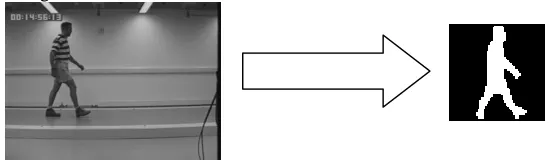
Figure 1 shows an example of silhouette extraction from a human gait sequence.
view. The silhouettes are extracted using a combination of background subtraction and thresholding.
Fig. 1. Single Image from Gait Sequence converted to a silhouette
Previous approaches to gait Recognition
Approaches to gait masks can be divided into two categories, model based and holistic. Holistic approaches aim to derive data from the human walking sequence that is similar for each subject but different for different people. Examples of this type of approach include Murase and Sakai [5], Huang [6] and Little and Boyd [7]. Model based approaches aim to explicitly model human motion and rely on human movement being tracked and a model being fitted to the image data. An example of this approach is by Cunado [8]. Performance of this technique was good with high recognition rates, however the computational costs of this approach are high.
Gait masks using Human Silhouettes
Gait masks are a new approach to gait recognition aiming to combine some of the elements of both the holistic and model based approaches. The disadvantage of traditional holistic approaches is that they simply derive data that is different for each class. They have no “knowledge” of what each class represents; given pictures of an elephant rather than a human subject and a traditional holistic approach would try to classify the subject in the same way. In contrast, model based approaches directly recognise gait by using equations, however this would be difficult to extend to non-human gait.
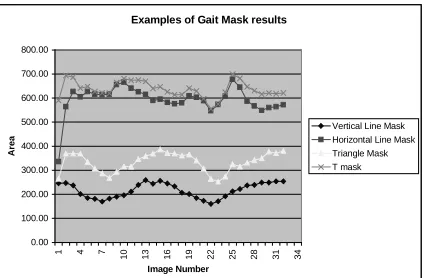
Gait masks aim to combine holistic and model-based approaches by using statistical data that is intimately related to the nature of gait. Gait masks are used to transform human silhouettes into information directly related to the gait of the subject. Figure 2 shows an example of some gait masks.
Fig. 2. Sample gait masks
Examples of Gait Mask results 0.00 100.00 200.00 300.00 400.00 500.00 600.00 700.00 800.00
1 4 7
1 0 1 3 1 6 1 9 2 2 2 5 2 8 3 1 3 4 Image Number A re a
[image:3.612.215.427.122.261.2]Vertical Line Mask Horizontal Line Mask Triangle Mask T mask
Fig. 3. Sample Gait Mask Results from one subject using 4 separate gait masks
The gait masks are combined with the silhouettes using the procedure detailed below. The set C labels each set of sequences of each individual person). Each itemp
in the set ( j
P
S ) represents sequence j of person p.
{ }
pjp
C = S (1)
The set Tpjrepresents the individual images (silhouettes) in each sequence from
each subject. Each member of the set (t)
j
p
S represents a specific image (t) as a vector
from person p sample j.
{ }
(t) Tj j p
p = S (2)
The set K represents the set of gait masks, Mn, where each member represents
each individual gait mask, each represented as a vector.
{ }
nK= M (3)
For each gait mask, n, and each person p, and each sample j, R is the projection of each sample into a new space using gait mask Mn.
) ( )
(t j t
j n p
np M S
R = ⋅ (4)
The “vertical line mask” produces output that is sinusoidal in nature. The peaks in the graph represent when the legs are closest together and the dips represent where the legs are at furthest flexion. The gait masks are therefore providing statistics that are intimately related to the mechanics of gait.
Table 1. Recognition results from various gait masks.
Gait Mask Recognition Rate Horizontal Line Mask 71%
Vertical Line Mask 83%
Top Half Mask 58%
Right Half Mask 42%
Left Half Mask 33%
Bottom Left Mask 42% Bottom Right Mask 38%
Triangle Mask 63%
T Mask 71%
Bottom Half Mask 54% Mid Triangle Mask 83%
The results from the vertical line mask (recognition rate 83% on a database of six subjects with four samples each) were most encouraging as the output from this mask was directly related to the gait of the subject. However, once the input silhouettes were corrupted by even small amounts of noise the recognition rate dropped dramatically. Consequently, we decided to look at the results from this mask in greater detail.
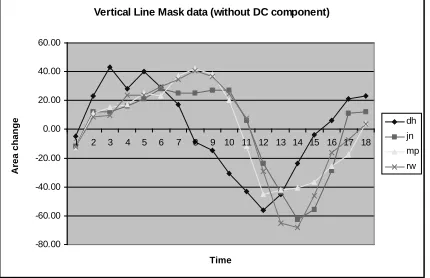
[image:4.612.200.415.454.593.2]To recognise a subject by their gait we are primarily concerned with the AC component of the data, that is the temporal component of the data. The DC component of the data represents static data about the subject; this could easily change due to the subject carrying something for example. The temporal nature of gait should be consistent amongst samples of the same person.
Figure 4 shows the sinusoidal patterns generated using the vertical line mask from
4 different people. Using the least square correlation technique, poor recognition rates were achieved. Using a more sophisticated technique, Canonical Analysis (CA), resulted in a dramatic performance increase.
Vertical Line Mask data (without DC component)
-80.00 -60.00 -40.00 -20.00 0.00 20.00 40.00 60.00
1 2 3 4 5 6 7 8 9 10 11 12 13 14 15 16 17 18
Time
A
re
a
c
h
a
n
g
e dh
jn mp rw
Fig. 4. Sinusoidal Patterns from 4 people using Vertical Line Mask
SOTON database (which consists of 6 subjects with 4 samples each). Initial results were promising with a recognition rate of over 80% and good class separability.
To further evaluate the performance of the new technique the system was also tested on a larger database consisting of the SOTON database and each of the samples corrupted with various amounts of noise (1%, 2%, 4% and 8% noise). Performance remained high with a recognition rate of over 80% even in the presence of noise.
Gait masks using animal data
Gait masks can be used to quickly distinguish between the motion of a biped (e.g. a human) and a quadruped. The single vertical line mask was used to provide data to discriminate between human subjects. Using this technique with animal data yields ineffectual results that provide no information about the gait of the subject. This is simply because the center of a quadruped provides very little temporal information.
Figure 5 illustrates this.
Single Vertical Line Mask data for Quadrupeds
-100 -80 -60 -40 -20 0 20 40 60 80
1 3 5 7 9 11 31 15 17 19 21 23 25 27 29 13 33 35 37 39
Time
A
re
a
C
h
a
n
g
e
[image:5.612.199.416.316.459.2]Horse Elephant
Fig. 5. Vertical Line Mask data using Animal Silhouettes
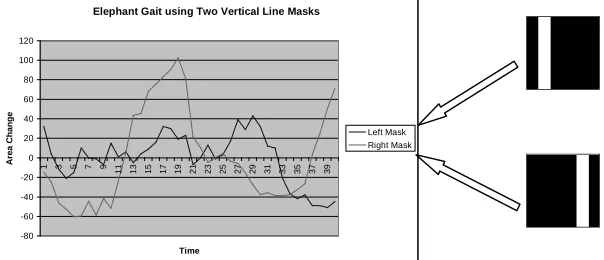
To provide information more relevant to the subject being analysed the gait masks were modified. Two vertical line masks were used, instead of the single vertical line mask used for human gait. By using these new gait masks it is possible to extract information relative to the subject being studied. Figure 6 illustrates this:
Elephant Gait using Two Vertical Line Masks
-80 -60 -40 -20 0 20 40 60 80 100 120
1 3 5 7 9 11 31 15 17 19 21 23 25 27 29 13 33 35 37 39
Time
A
re
a
C
h
a
n
g
e
Left Mask Right Mask
[image:5.612.142.444.517.647.2]By using the right mask the sinusoidal pattern of motion is clearly evident. The left mask data is not of a sinusoidal nature which is due to the trunk of the elephant swinging across the legs. This shows how the gait masks need to be adapted for each animal analysed. It also illustrates how gait masks can be used to provide information about gait for subjects other than humans.
Conclusions
We have presented a new area based metric for gait recognition that produces good results on a small database. We have shown (by removing the DC component of the data) that recognition is possible by only using the temporal components of the silhouette sequence. The technique produces encouraging results on a database of human subjects with recognition rates of over 80% even in the presence of noise.
Additionally we have shown the basic premise of gait masks is applicable to areas other than using human gait as a metric. Gait masks can provide information about the walking cycle that could be used to provide information such as the cadence of the subject.
References
[1] M.P. Murray, “Gait as a total pattern of movement”, American Journal of
Physical Medicine, 46, no. 1, pp. 290-332, 1967.
[2] M.P. Murray, A.B. Drought, and R.C. Kory, “Walking patterns of normal men”,
Journal of Bone Joint Surgery, 46-A, no. 2, pp. 335-360, 1964.
[3] G. Johansson, “Visual perception of biological motion and a model for its analysis”, Perception Psychophysics, 14 (2), pp.201-211, 1973.
[4] S.V. Stevenage and M.S. Nixon and K. Vince, “Visual Analysis of Gait as a Cue to Identity”, Applied Cognitive Psychology, 13 p.513-526, 1999.
[5] H. Murase and R. Sakai, “Moving object recognition in eigenspace representation: gait analysis and lip reading”, Pattern Recognition Letters, 17, pp. 155-162, 1996
[6] P.S Huang, C.J. Harris, and M.S. Nixon, “Human Gait Recognition in Canonical Space using Temporal Templates”, IEE Proc. VISP, 146(2), pp.
93-100, 1999
[7] J. Little and J. Boyd, “Describing motion for recognition”, Videre, 1(2), pp. 1-32, 1998