International Journal of Scientific Research in Computer Science, Engineering and Information Technology © 2018 IJSRCSEIT | Volume 3 | Issue1 | ISSN : 2456-3307
A Machine Learning implementation on Internet of Things’
Smart Meter Operations
SrisudhaGarugu, SrisatyaKalyaniAnala, Bandili Manju Kumari
Assistant Professor Pydah College of Engineering And Technaology, Gambheeram,Visakhaptnam, Andhra Pradesh, India
ABSTRACT
An Internet of Things’ (IoT) attached network and structures reshow an incredible archetype shuffle. We suggest a scheme to get a compromise-support structure (DSS) a well known operates inside the IoT reorganization. The DSS leverages progressed data of electrical resourceful feet (ESM) chain communication-quality testimony to recuperate lose forecasting’s for quick swing field operations and supply tribal resolution recommendations relating to even if to issue a scholar to a patron whereabouts to get to the bottom of an ESM send. The style is temporarily evaluated the use of input sets originating at a monetary net. We teach the competence of our manner having a finish Bayesian Network forecast style and relate with triple neural networks prophecy variety classifiers: Naïve Bayes, Random Forest and Decision Tree. Results testify to who our method generates statistically memorable estimations an d which the DSS determination get better the price competence of ESM web operations and maintenance.
Keywords: Analytics, Bayesian Networks, Cyber-Physical Systems (CPS), Decision Support System, Information and Communication Technologies (ICT), Internet of Things (IoT), Machine Learning, Machine-to-Machine (M2M), Operations and Maintenance, Smart Cities, Smart Grid, Smart Meters, Utility.
I.
INTRODUCTION
The electrical sharp music (ESM) institution piece is all of a sudden expanding in the course of the utilities territory [1], including marked up use of resourceful music’s and crafty grids [2]–[4], in active cities. A up to date Allied Business Intelligence Research find out about [5] means that greater than 1.1 lots quick structure bases can have been equipped globally by 2021. The ESM character take up the most important experience, amidst greater than 70% of all inaugurated resourceful music bases; splits for wet and gas crafty music’s also are spreading. Smart devices are cyber-physical systems that one incorporate the two fixtures and spreadsheet, and describe a in large part complementary ecological community [6]. This environs is convoluted to
tape and net need to impatiently give show guarantees, accuracy, and value readiness [10], [6].
The ought to make sure the lose adaptability of chain operations and sharp piece scope is dynamic check of structure upkeep strategies, this sort ofs much as and station to use requirely return supply wherewithal. Decision modes which are cognizant fleeting organization act would be requisite to help in the aforementioned one process and confirm ESM technique take adaptability. We plan any such form, that is galvanized by stable report of ecoarrangement conversation quality.
A. Current ESM Systems Operations Solutions The manhood of the present practical solutions for practicality systems use usual regulate mechanisms and proper non-automatic movements [6]. System faults are just came upon when they strike, just after a applicant places a benefit require, and in lots of cases the desert isn't followed to the particular authority.
Throughout the mature viable treat, delays in resolving disclosed quits are attend not unusual, and as a result extend viable costs. Accordingly, active operation and alertness of account ESM systems [11] is vigorously required.
B. Paper Overview
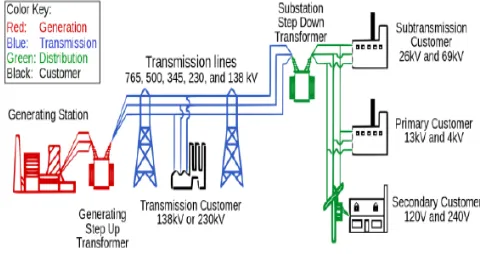
In that study, we study a yielding monetary ESM structure building. Figure 1 depicts the ancient framework style, which is composed of 1 strength glide and one information float.
Figure 1. Traditional Grid Model (Source:
Figure 2. Electric Smart Meter Production System Architecture
HES – Head end system (also known as automated meter reading system)
PLC – Power line communication
P2P – Point-to-point (mobile connection) DC – Data concentrator
The ESM systems chain ―design rest on the quadrivium cornerstones principal to IoT [12]: sensing, computing, communique, and motive‖ [13], conceptually demonstrated in Figure 3.
The aspiration in this regard essay consider design a foretelling partition design for ESM organization operations outcome beef up. The design employs a Bayesian structure [14], [9] and 3 neural network (ML) surmising designs plus Naïve Bayes (NB), Decision Tree (DT) and Random Forest (RF), which will get well ESM systems predictions nearby in case to forward a operator to a consumer whereabouts to unravel an ESM revolt. Therefore, it could cut back trip outlay costs in the course of the ESM net operations and upkeep (O&M) play by deploying care best locus and howbeit it's miles necessary [6].
Our design is really a proposition of alive techniques for finding support—i.e., neural networks to bargaining chip IoT network [15], [16]-[19] and ESM symptomatic message [20], [21]; improved data (e.g., surmising and authoritative analysis); and restrained ESM systems conversation-good quality (CQ) info [12], [15]. Thcan be approach again optimizes commute require hoard according to projected guesss. Next, we on probation justify our form leveraging CQ word processing file coming out of a yielding ESM systems web within a appropriated IoT ecological community [10],
Figure 3. NIST IoT Smart Grid Conceptual Reference Model
(Souce: httpsL//www.nist.gov/)
16]-[19]; results testify to who the form’s estimations are statistically serious.
For the remainder of the report, Section II addresses our probe-related handle and pamphlet, Section III presents a collective synopsis of modeing techniques and an influx to Bayesian netacts and ML NB, RF and DT classifiers, wherein we talk about our spirit for his or her form. Section IV presents our probe procedure, enveloping style issue, design estimate criteria, and the info sets we routine provisionally verify our MO. Section V speak aboutes the result of
our verification, although Section VI presents our conclusions and suggestions for future probe.
II.
IMPLANTATION
In this one part, we approve our manner analytically leveraging the ESM communication-quality goods cool with the manufacture ESM structure (Fig. 2) for instance and try the cage for the ESM operations decision-support arrangement.
Also, we lugged out a number experiments to evaluate 1) the regulation certainty, and a couple of) the contrast and divining style draft according to the ML classifier so much truthful performance.
A. Classification Accuracy
Accuracy quantifies the power of individual classifier to correctly allocate unlabeled testimony. It shows the correlation in the midst of proceeding of as it should be restricted testimony (for the two illegal and proper classifications) and move of provided testimony [37]. The efficiency archaic deliberate having a 10-fold cross-validation search and stratiform sampling that fact constructs aimless batchs although making certain which the category disposal in every single subdivision kind of contains an analogous fraction as inside the wholesome pictureset.
Tables VI, VII, and VIII show the turmoil matrices of NB, DT and RF classifiers, visualizing the efficiency dance of every single separate algorithm.
1) Bayesian Network
For the BN portending design, we initially, study the creative cooperative in the midst of signalize energy and structure transcribe and its accouterments on chain description. Next, we try how plentiful vs. inplentiful web analysis determination have an affect on ESM communication-quality dignity. The recent passion as a result persuade the finding even if to forward a professional to a prospect site—which, in order, impacts operations loses.
off proposal finding enhance plus their amount to expected require nest egg.
a) ESM Communication Quality (Prior) Analysis Based at the ASCII file in Tables II and III deriving out of our ESM net, the ESM Communication Quality presents a Gaussian sharing. The more than a few conversation high quality scenarios sit in Table V.
b) ESM Remote Resolution (Likelihood) Analysis Table IV presents form of concluded client cases upon the ―Field Technician’s stopover at‖ report (e.g., 279 cases) and move of complication cases solved parenthetically (e.g., 149 cases), to get a good fortune consider of 53% in solving proclaimed cases not by design.
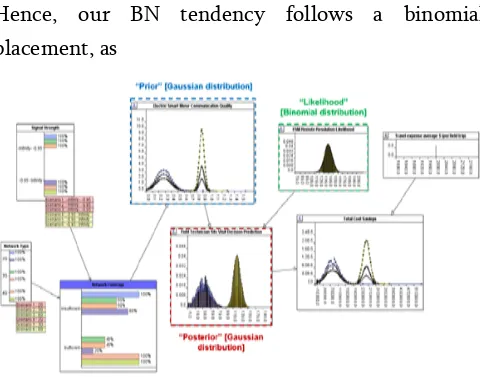
Hence, our BN tendency follows a binomial placement, as
Figure 4. Electric smart Meter Network Operations Remote Resolution decision Support And total Cost Saving Predictions with six scenarios
c) Field Technician Site Visit Decision (Posterior) Analysis
Based on the various communication-quality scenarios, using our BN model, the remote resolution cases decision support is provided accordingly as presented in Table V.
d) Total Cost Savings Analysis and Discussion of Results
Based on the various prediction scenarios regarding remote resolution decision support, we observe the related total cost savings in Table V.
Using the BN to experiment with causal relations between the various variables, we applied the BN model and its benefits for prediction and cost savings, as presented in Table V, to the body of existing empirical research, and specifically within the areas of IoT [56]-[58], and utility electric smart meter systems operations.
2) Naïve Bayes
For the ―Technician Site Visit‖ label or target class, the NB classifier accuracy is 96.57% +/-2.43%, as presented in Table VI. The hit rate or true positive rate (i.e. sensitivity) is 98.85% and fall-out or false positive rate is 92.54%.
3) Decision Tree
4) Random Forest
For the ―Technician Site Visit‖ label or target class, the accuracy is 96.69% +/-1.35%, as presented in Table VIII. The hit rate or true positive rate (i.e. sensitivity) is 99.23% and fall-out or false positive rate is 92.2%.
B. Comparison and Selection of Best ML Model Table IX presents the accuracy performance comparison of the various models. Among these predictive models, RF proved to be a noteworthy method for the analysis of electric smart meter data for large datasets, with the highest accuracy of 96.69%, followed by NB classification with 96.57% accuracy, followed by DT classification with 95.34% accuracy and BN with 54.92% accuracy.
Also, RF proved to be the most stable model with the lowest error rate percentage +/-1.35%, followed by NB with +/-2.43%, followed by DT with +/-2.61% and BN with +/-7.35%.
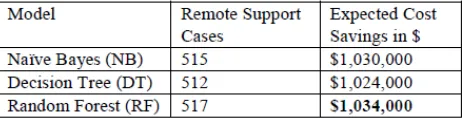
In addition to Table V, Table X presents an overview of the ESM network cost savings.
RF ensures the highest cost savings based on the highest predicted case with remote resolution, followed by NB and DT.
Figure 9. Depicts the ESM ML models Receiver Operating Characteristics (ROC) graph visualizing the NB, DT and RF ML classifiers based on their accuracy performance. Hit rate or true positive rate is represented on the Y-axis, while fall-out rate or false positive rate is represented on the X-axis.
The models with the curves closest to the upper left corner indicates the best performance. The ROC curve shows that RF has the best performance, then NB and at last DT.
III.
CONCLUSIONS
This study presents a picture-driven compromise-improve technique to recover ESM operations inside the IoTecoarrangement.
The planned approach is innovative and economical, since it enables guess compromises nearby in case to circulate a artisan to a customer’s web site or get to the bottom of the fact casually, the use of and comparing quaternity the different mechanical device information performances: generous bayesian organization, naïve bayes, resolution seedling and odd wooded area.
Possible extensions of your current implement are (i) the formation of an extra systematic use claim for ESM maintenance, reminiscent of predicting the solution to a customer crisis, (ii) the generalization of one's style, to address utilities’ additional vertical operations, similar to sharp swings for gas, water, and heat, (iii) the exploration of big info management platform by the use of a MapReduce-based algorithm upon large Hadoopfilestructure (HDFS) clusters, and synthesis amidst assigned input-parallelism (DDP) engines comparable to Hadoop for functioning the appliance in true assigned environments to boost up big picture pre-processing study, howbeit the web starts to extent and big testimonysets acknowledged starting with the a number crafty feets, and (iv) the growth of one's design to work into charge the seasonality in the course of the ESM operations biorhythm, to maybe consider the use of Dynamic Bayesian Netgo for the problem.
IV.
REFERENCES
[1]. Ericsson. (2015). 5G Systems Enabling Industry & Society Transformation, Ericsson White Paper. Stockholm.
[2]. Haben, S., Singleton, C., & Grindrod, P. (2016). Analysis and Clustering of Residential Customers Energy Behavioral Demand Using Smart Meter Data. IEEE Transactions on Smart Grid Journal, 136-144.
[3]. Hussain, G. A., Kumpulainen, L., Kluss, J. V., Lehtonen, M., & Kay, J. A. (2013). The Smart Solution for the Prediction of Slowly Developing Electrical Faults in MV Switchgear Using Partial Discharge Measurements. IEEE Transactions on Power Delivery Journal, 2309-2316.
[4]. Luan, W., Peng, J., Maras, M., Lo, J., & Harapnuk, B. (2015). Smart Meter Data Analytics for Distribution Network Connectivity Verification. IEEE Transactions on Smart Grid Journal, 1964-1971.
[5]. Krishnan, A. (2015, December 8). Smart Meter Rollouts from Water Utilities Gain Momentum as Total Installed Smart Meters Swarm to Reach 1.1 Billion Units by 2021. Retrieved
2016, from ABIresearch:
https://www.abiresearch.com/press/smart- meter-rollouts-water-utilities-gain-momentum/
[6]. Siryani, J., Mazzuchi, T., & Sarkani, S. (2015). Framework using Bayesian Belief Networks for Utility Effective Management and Operations. 2015 IEEE First International Conference on Big Data Computing Service and Applications (p. 7). San Francisco Bay, CA: IEEE.
[7]. Jin, J., Gubbi, J., Marusic, S., & Palaniswami, M. (2014). An Information Framework for Creating a Smart City Through Internet of Things. IEEE Internet of Things Journal, 112-121.
[8]. Smaragdakis, G., Laoutaris, N., Oikonomou, K., Stavrakakis, I., & Bestavros, A. (2014). Distributed Server Migration for Scalable Internet Services Deployment. IEEE/ACM Transactions on Networking, 917-930.
[9]. Stankovic, J. A. (2014). Research Directions for the Internet of Things. IEEE Internet of Things Journal, 3-9.
[10]. Fahrion, M. (2014). Evolving from SCADA to IoT. Quatech .
[11]. ITIL. (2011). ITIL Service Operation Processes. [12]. Lin, Y.-B., Lin, Y.-W., Chih, C.-Y., Li, T.-Y., Tai, C.-C., Wang, Y.-C., et al. (2015). EasyConnect: A Management System for IoT Devices and Its Applications for Interactive Design amd Art. IEEE Internet of Things Journal, 551-561.
[13]. Brown, E. A. (2016, July 28). NIST's Network-of-Things Model Builds Foundation to Help Define the Internet of Things. Retrieved 2016, from
[14]. Darwiche, A. (2009). Modeling and Reasoning with Bayesian networks. Cambridge University Press.
[15]. Mainetti, L., Mighali, V., & Patrono, L. (2015). A Software Architecture Enabling the Web of Things. IEEE Internet of Things Journal, 445-454.
[16]. Pai, G. J., & Dugan, J. B. (2007). Empirical Analysis of Software Fault Content and Fault Proneness Using Bayesian Methods. IEEE TRANSACTIONS ON SOFTWARE ENGINEERING, 675-686.
[17]. Tanju, B. R., Sarkani, S., & Mazzuchi, T. A. (2010). MULTI-SENSOR BAYESIAN ESTIMATION INTERIOR POSITIONING FOR STATIONARY AND MOBILE STRUCTURES. Washington DC.
[18]. Eveleigh, T., Wandji, K. T., Sarkani, S., Holzer, T. H., & Keiller, P. A. (2013). Comparative analysis of Bayesian and classical approaches for software reliability measurement. Washington DC., DC, US.
[19]. Siddharthan, A., Lambin, C., Robinson, A.-M., Sharma, N., Comont, R., O'mahony, E., et al. (2016). Crowdsourcing Without a Crowd: Reliable Online Species Identification Using Bayesian Models to Minimize Crowd Size. ACM Transactions on Intelligent Systems and Technology, 1-20. Framework for Smart Energy Buildings: Designs, Prototype, and Experiments. IEEE Internet of Things Journal, 527-537.
[22]. Cai, B., Liu, Y., & Xie, M. (2017). A Dynamic-Bayesian-Network-Based Fault Diagnosis Methodology Considering Transient and Intermittent Faults. IEEE TRANSACTIONS ON AUTOMATION SCIENCE AND ENGINEERING, 276-285.
[23]. Liu, K., Xi, Z., & Shi, J. (2014). Adaptive Sensor Allocation Strategy for Process Monitoring and Diagnosis in a Bayesian Network. IEEE 452-462.
[24]. Suryachandra, P., & Reddy, V. S. (2016). Comparison of machine learning algorithms for breast cancer. 2016 International Conference on Inventive Computation Technologies (ICICT) (pp. 1-6). IEEE Conference Publications.
[25]. Misirli, A. T., & Bener, A. B. (2014). Bayesian Networks For Evidence-Based Decision-Making in Software Engineering. IEEE TRANSACTIONS ON SOFTWARE ENGINEERING, 533-554.
A.Sri Satya Kalyani , M.Tech, received her MCA from Andhra University and studied M.Tech Computer Science and Engineering from MVGR College of Engineering affiliated to JNTUK. Now she is working as an Assistant professor in Pydah College Of Engineering & Technology, Visakhapatnam, Andhra Pradesh. Her Area Of interest’s are Operating Systems, JAVA, Computer networks, Data Structures and Data Mining.