Copyright 2012 by I Wayan Arka
Developing a Deep Grammar of Indonesian
within the ParGram Framework: Theoretical and Implementational Challenges
I. Wayan Arka
Australian National University/Udayana University [email protected]
Abstract
This paper discusses theoretical and implementational challenges in developing a deep grammar of Indonesian (IndoGram) within the lexical-functional grammar (LFG)-based Parallel Grammar (ParGram) framework, using the Xerox Linguistic Environment (XLE) parser. The ParGram project involves developing and processing computational grammars in parallel to test the LFG’s theoretical claims of language universality, while at the same time testing its robustness to handle typologically quite different languages. Two relevant cases are discussed: voice-related morphosyntactic derivation and crossed-control dependency in Indonesian. It will be demonstrated that parallelism should be taken as a matter of degree, that it cannot always be maintained for good language-specific reasons and that the participation of IndoGram has also contributed to the rethinking and improvement of certain parallelism standards.
1
Introduction
This paper discusses theoretical and implementational challenges to developing a deep grammar of Indonesian (IndoGram) within the Parallel Grammar (ParGram) framework. Using the Xerox Linguistic Environment (XLE) parser (Maxwell and Kaplan 1993; Crouch et al. 2007) with lexical-functional grammar (LFG) (Bresnan 1982, 2001; Dalrymple 2001) as the underlying linguistic theory, the IndoGram project joins the research and development program of broad-coverage grammars from a typologically wide range of languages. The approach (Butt et al 1999, 2002) involves developing and processing computational grammars in parallel to test the LFG’s theoretical claims of language universality, while at the same time testing its robustness to handle typologically quite different languages.
While parallelism is preferred, it is demonstrated that this cannot always be strictly
maintained for good language-specific reasons. It is also shown that the participation of IndoGram has contributed to the richness of linguistic phenomena to be handled within the ParGram project and to the rethinking and improvement of certain parallelism standards. Two relevant cases are
discussed: voice-related morphosyntactic derivation and crossed control dependency.
The paper is structured as follows. An overview of the ParGram project is first presented in section 2. Linguistic analyses of voice alternations and crossed-control constructions and their XLE implementation are given in sections 3 and 4 respectively, followed by some discussion in section 5. Conclusions are given in section 6.
2
The (Indonesian) ParGram project: an overview
The Parallel Grammar (ParGram) project is an international collaborative research project for the development of large-scale computationally tractable grammars and lexicons of the world’s (major) languages. Members include the corporate research laboratories of the Palo Alto Research
Research reported in this paper was supported by the author’s ARC Discovery Grant DP DP0877595 (2009–2011).
Center (PARC) (USA) and Fuji Xerox (Japan), as well as Stanford University, Oxford University, Manchester University, the Universities of Stuttgart and Konstanz, (Germany), the University of Bergen (Norway), the University of Essex (UK) and Langue et dialogue (France).
Current ParGram analyses (Butt et al 1999, 2002) are the result of over fifteen years of research and discussion based on data from a typologically wide range of languages (English, German, French, Japanese, Norwegian, Urdu, Welsh and Malagasy). The approach (Butt et al 1999, 2002) is to develop and process grammars in parallel. Similar analyses and technical solutions, wherever possible, are given for similar structures in each language. Parallelism has the
computational advantage that the grammars can be used in similar applications and that machine translation (Frank 1999) can be simplified. However, ParGram also allows flexibility where parallelism is not maintained when different analyses are desirable and justified for good language-specific reasons. An encouraging result from ParGram work is the ability to bundle grammar-writing techniques into transferable knowledge and technology from one language to another, which means that new grammars can be bootstrapped in a relatively short amount of time (Kim et al 2003).
The underlying syntactic framework for ParGram is lexical-functional grammar (LFG), a stable and mathematically well-understood constraint-based theory of linguistic structure (Kaplan 1982; Dalrymple 2001; Bresnan 2001). Two important structures are assumed in LFG: constituent structure (c-structure; c-str) and functional structure (f-structure; f-str). The c-structure representation
captures surface (overt) linguistic expressions that vary across languages. It is modelled in phrase structure trees that show structural dominance and precedence relations of units. F-structure captures abstract relations of predicate argument structures and related features such as tense. This is where cross-linguistic similarity or universality is represented. Thus, the equivalent sentences of English
Wayan will help Mary in Indonesian and Tagalog are, respectively, Wayanakan menolong Mary and
Tatulong si Wayan kay Mary. Indonesian is more like English in its c-str, whereas Tagalog is quite different, as seen in (1)a-b. However, they all share the same f-str, as shown in (1)b.1
(1). a. c-str: Indonesian b. c-str: Tagalog c. f-str for both (a) and (b)
ParGram is built on the XLE platform (Maxwell and Kaplan 1993; Crouch et al. 2007), developed and maintained at PARC, which implements LFG theory. It outputs c-structures (trees) and f-structures as the syntactic analysis. The actual c-str and f-str output parse of a specific sentence from a given language contains richer information, however, as seen in (2) below.
Since f-str is the locus for cross-linguistic parallelism, it is of great significance in ParGram. It is the f-str that is used in a range of computational applications, e.g. in machine translation, sentence condensation and question answering. The ParGram project dictates the type of f-str
analysis and the form of the features used in the grammars (Butt and King 2007).
1 Abbreviations: 1, 2, 3 (first, second, third person); APPL (applicative); ARG (argument), ART (article); AV (actor
voice); FUT (future); ITR (intransitive); MIDD (middle voice); OBJ (object); OBL (oblique); PASS (passive); PRED (predicate, a semantic form in LFG); pl (plural); PROG (progressive); s (singular), REL (relativiser); SUBJ (grammatical subject), TR (transitive); U (undergoer); UV (undergoer voice).
(2).
3
Morphosyntactic alternations: voice and applicative/causative
alternations
Current research in Austronesian (AN) linguistics has led to good understanding of voice systems in this language family, of which Indonesian is a member. Austronesian voice systems are generally richer than those encountered in Indo-European languages like English. English shows only a two-way system: active-passive alternations, e.g. John kissed Mary vs. Mary was kissed by John. Indonesian, like other AN languages of the Philippines/Taiwan, shows a multi-way system. There is more than one non-actor voice. In the AN languages of the Philippines and Taiwan, there is no clear structure that can be analysed as passive. In Indonesian, however, one of the non-actor voices, namely the structure with di-verb plus a PP agent as in (3)c, can indeed be analysed as a true passive equivalent to the English passive. The agent is grammatically oblique, expressed by a PP (like in English), optional (indicated by the brackets) and pragmatically not prominent.
(3). a. Aku akan menanam pohon itu b. Pohon itu akan ku=tanam
1s FUT AV.plant tree that tree that FUT 1s=UV.plant
‘I will plant the tree’. ‘The tree, I will plant’.
c. Pohon itu akan di-tanam (oleh mereka).
tree that FUT PASS- plant by them
‘The tree will be planted (by them)’.
Unlike Indo-European languages, the voice-system in Indonesian is symmetrical in a morphological and syntactic sense. Morphologically, they are symmetrical, as all voice types – AV (active/actor voice), UV (undergoer voice)2 and PASS (passive voice) – are equally marked, e.g. from the root
tanam ‘plant’, we can derive AV, UV, volitional/accidental PASS verbs and MIDD(le) verbs, as shown in (4). Syntactically, they are symmetrical in the sense that, unlike the voice alternations in English, the system allows both the actor and undergoer of a transitive verb to be equally linked to SUBJ without demoting any of them. Consequently, the voice alternation does not affect the transitivity. Thus, (3)b is as transitive as (3)a, and is syntactically not passive.
2 UV is a type of voice where the Undergoer argument is the grammatical subject (hence, like passive) but the Actor
argument is still highly prominent, obligatorily present showing up as a core argument. Note that in passive the Actor argument is optional and not a core argument.
(6). a. tanam ‘plant<ag , th>’ b. * tanam ‘plant<ag , th>’
tanam-i ‘plant-APPL <ag , loc | th>’ di-tanam ‘PASS-plant<th|agt>’
di-tanam-i ‘PASS-plant-APPL<loc| ag th>’ di-tanam-i ‘PASS-plant-APPL<th, loc|ag>’
SUBJ SUBJ
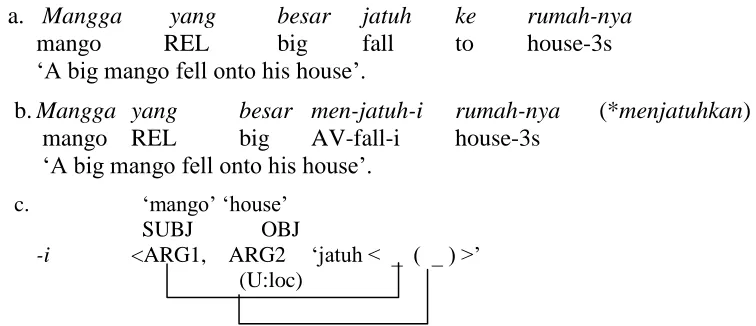
We handle this by proposing an analysis where -i is a three-place predicate, as shown in (7). Affixation with -i involves complex predicate composition, with argument fusion of the matrix and embedded arguments. Importantly, -i comes with a thematically a locative (LOC)-related argument (i.e., possibly goal or source, in addition to locative) in the second argument (ARG2). ARG2 is either new, or fused with the LOC argument of the base wherever possible. ARG1 is thematically higher than ARG2, though not necessarily an agent. This representation allows us to capture both causative and applicative uses of -i, as well as other uses; see the different types of fusion exemplified in (10)– (14).
(7). A-str of -i and its associated semantic roles
‘PRED1 < ARG1 , ARG2 , PRED2 < _ , ...>>’
(A) (U:LOC) where argument(s) of PRED1
fuse(s) with arguments of PRED2
Thus, the root tanam ‘plant’ affixed with -i gives rise to tanami with a-str showing the fusion, as seen in (8). This a-str becomes the input for voice linking. The AV links the most prominent ARG (namely ARG1) to SUBJ (9)a. In contrast, the PASS voice demotes ARG1 to oblique and makes the locative ARG SUBJ (9)b.
(8). ‘3pl’ ‘garden’ ‘mango’ -i <ARG1, ARG2 ‘plant < _ , _ >’>’ (U:loc) (ag) (th)
(9). a. AV: ‘3pl’ ‘garden’ ‘mango’ SUBJ OBJ OBJ2/OBL
-i <ARG1, ARG2 ‘plant < _ , _ >’>’ (U:loc) (ag) (th)
b. PASS: ‘garden’ ‘mango’ ‘3pl’ SUBJ OBJ2/OBL OBL
-i < ARG2 ‘plant < _ , _ > < _ >’
(U:loc) (ag) (th)
Another property of the suffix -i that complicates the analysis is that -i is multifunctional. It shows applicative and causative polysemy. For example, -i in panasi is causative ‘hot-cause’, whereas -i in tiduri is applicative (i.e. ‘sleep on [loc]’). In addition, the stems are possibly intransitive or transitive, not necessarily verbal, as shown in Table 1.
The resulting subcategorisation frames of -i affixation are not uniform. There are at least four types. Each of them is briefly discussed and exemplified below; see Arka et al. 2009 for a detailed discussion.
b.
Type 3. There is no valence change in this type of -i derivation, e.g. pukul ‘hit’ (transitive)
pukuli (transitive) ‘hit repeatedly’, where -i signifies repetition or intensification. (12).a. Ia memukul-i saya
3s AV.hit-i 1s
‘S/he was hitting me, s/he hit me repeatedly’. b.
Type 4. This is the type of -i affixation resulting in causativisation. The -i verbs can be monotransitive (13)b (with the displaced theme showing up as an oblique instrument marked by
dengan), or ditransitive (13)c (with the displaced theme being OBJ2). Type 4 -i structures involve single fusion, as depicted in (13)d, the only difference being the realisations of the unfused
embedded displaced theme4.
(13). a. Air itu sedang meng-alir ke sawah. SUBJ OBJ water that PROG AV-flow to rice.field ‘flow < _ , _ >’
‘The water is flowing to the rice field’. (th) (loc)
b. Dia meng-alir-i sawah=nya dengan air itu.
3s AV-flow-i rice.field=3sg with water that ‘S/he flooded his/her rice field with the water’.
c. Dia meng-alir-i sawah=nya air itu.
3s AV-flow-i rice.field=3sg water that ‘S/he flooded his/her rice field with the water’. d.
Type 4 -i includes those -i verbs with nonverbal roots, e.g. sakit ‘sick’, panas ‘hot’ and kotor
‘dirty’. This is exemplified in (14)a. The fusion of the theme-locative argument shown in (14)b captures the meaning that jalan ‘road’ is understood as the surface of the road.
4
In fact, the a-str of the type (13)d allows for double fusion if ARG1 is not filled in with an agent. Thus, the following is acceptable. The water flows because of its natural force.
Air itu mengalir-i sawahnya
(14). a. Jangan kotor-i jalan itu
NEG dirty-i road that
‘Don’t (you) make (the surface of) the road dirty’. b.
As seen, the types involve different kinds of argument fusion, single or double. They are constrained by the semantics of the root. The general rule for -i composition appears to be that arguments of thematically similar types tend to fuse. Thus, the actor-like ARG1 of the matrix PRED tends to fuse with the actor-like ARG1 of the embedded PRED. Likewise, the undergoer-like ARG2 of the matrix PRED fuses with the undergoer-like ARG2 of the embedded PRED.
The properties of -i are now well understood. We are pleased to report that we have successfully implemented a novel unified argument structure–based analysis to capture those properties. The analysis and implementation make use of the idea of predicate composition (Alsina 1996; Butt 1995) and the restriction operator (Butt and King 2006 ; Butt, King, and Maxwell III 2003; Kaplan and Wedekind 1993). The main components of the implementation in XLE can be briefly described as follows.
The grammar consists of phrase structure and sublexical rules with certain relevant annotations, e.g. showing grammatical functions (SUBJ, OBJ and ADJUNCT) as in (15), or
templates indicated by @ as in (16). The voice and applicative/causative templates are given in (17)a and (17)b, respectively. For the time being, as seen in (17)a, we still maintain the classic (simpler) analysis of voice alternations as lexical rules, rather than principled alternations based on a mapping theory (Arka 1993; Bresnan 2001). Note that the nesting of the templates with the @APPL template inside the @VOICE template in (16) is meant to capture the idea that applicativisation applies before voice alternation. This is to obtain the intended result as discussed earlier (cf. example (5),
representation (6)).
(15).a. S → NP VP b. VP → V’ PP c. V’ → (NP) V (NP) (SUB)= (ADJUNCT) (OBJ)= (OBJ)= (16).a. V V_VOICE_BASE V_ STEM’ V_SFX_BASE
b. V_STEM' V_STEM-APPL_I _ V_I_BASE @(VOICE @(APPL_I VApp_I))
|
V_STEM-CAUS_I V_I_BASE
@(VOICE @(CAUS_I VCaus_I)) }.
(17).
a. Voice template b. Applicative/causative template
The grammar also consists of a lexicon containing both free words and affixes. They are listed with their own entries. Sample entries are given in (18) below.
(18). Sample entries: free forms
a. sawah N XLE @(CN rice field). b. mereka PRON XLE @(PPRO 3 pl).
c. tanam V XLE @(VOICE @(TRANS plant)).
Sample entries: bound forms e. +I V_I .
f. AV+ V_VOICE @(VOICE-TYPE AV).
g. UV+ V_VOICE @(VOICE-TYPE UV).
h. PASSdi+ V_VOICE XLE @(VOICE-TYPE PASSIVE).
The Indonesian grammar is equipped with a tokeniser and morphological analyser (Mistica et al. 2009; Femphy et al. 2008). It was built using XFST (Xerox Finite State Transducer) (Beesley and Karttunen 2003). The grammar can therefore identify morphemes of words with a complex morphological make-up and collect their grammatically relevant information for the purpose of further processing. For example, the sentence Sawah ditanami padi ‘A rice field planted with rice’ consists of three words, with one word, namely ditanami, morphologically complex. The sentence can be correctly parsed. The input string (19)a is first broken into tokens by the tokeniser. The output is then fed into the morphological analyser so that the words sawah, padi and ditanami can be
(23).a. Teman-nya men-coba [ _ membunuh dia].
friend-3POSS AV-try AV.kill 3s
‘His friend(s) tried to kill him’.
b. Dia dicoba [ _ di-bunuh (oleh) teman-nya. 3s PASS-try PASS-kill by friend-3POSS ‘His friend(s) tried to kill him’.
More examples from an online newspaper are given in (24). All the embedded verbs are in the passive, but the agents are understood as the matrix actor. For example, the syntactic subject of
berusaha ‘attempt’ (24)a is inanimate (politik lokal). Its logical subject/actor, the attempter, is the embedded oblique argument (pusat).
(24).a. Politik lokal di Indonesia selalu berusaha dikendalikan oleh pusat.5 politics local in Indonesia always try PASS-control by central ‘The central government always tries to control the local politics’.
b. Ternyata skuter model Eropa nekat dijual disana oleh…Honda6
in fact scooter model Europe insist PASS-sell there by Honda ‘It turns out that Honda insisted on selling the European model of the scooter there’. c. rancangan peraturan daerah …akhirnya di-tolak
bill regulation local finally PASS-reject untuk di-sahkan oleh DPRD Gresik 7
to PASS-pass by loca.legislative.assembly Gresik
‘The DPRD of Gresik finally rejected to pass the local draft bill’.
The crossed-control reading is constrained by voice type, particularly when both matrix and embedded verbs are transitive. First of all, the crossed control reading is not possible when the matrix verb is in AV. Thus, sentence (25) is strange in its ordinary-control reading (i), and it can never mean (ii) (i.e. the crossed-control reading). Any theory or analysis of control constructions should be able to handle the blocking constraint of the crossed-control reading by the AV. This is further discussed in section 5.
(25). Dia mencoba di-cium oleh artis itu. 3s AV.try PASS-kiss by artist that
i) ‘He tried to be kissed by the artist’. (ordinary-control reading) ii) *‘The artist tried to kiss him’. (crossed-control reading)
In addition, for the crossed-control reading to be possible, the verbs should have harmonious non-actor voice types. In (23)b, both have passive di-. In (26)a-b below, both have undergoer voice (UV). Note that the actor pronominal kau appears once, either on the matrix or on the embedded verb. Mixing the non-actor voices, PASS and UV, results in bad sentences (26)c-d.
(26).a. Dia kau=coba [ _ _ bunuh] 3s 2SG=UV.try UV.kill ‘You tried to kill him/her’.
5http://politik.kompasiana.com/2012/04/12/politik-lokal-di-indonesia-dari-otokratik-ke-reformasi-politik/. 6http://fanderlart.wordpress.com/2009/09/24/dual-keen-eyes-ga-laku-ya-di-vietnam/.
7
b. Dia coba [ _ kau=bunuh] 3s UV.try 2s=UV.kill ‘You tried to kill him/her’. c. * Dia dicoba [ kau=bunuh] d. *Dia kau=coba [ _ dibunuh]
The pattern seen in (26) serves as evidence for the analysis that CCCs involve syntactic argument sharing. That is, the two arguments (‘controller’ and ‘controlee’) must be of the same type syntactically. Mixing voice types results in the two having different argument types: OBL in passive and OBJ in UV; (26)c and d are bad due to the violation of this argument sharing constraint.
At first, it might look like a puzzle: How is it possible that the actor of the matrix verb (e.g.
ibu ‘mother’) is not realised on the matrix structure, but rather controlled by the argument of the embedded verb? The reverse is cross-linguistically common. The challenge is to get a precise linguistic analysis of the CCC capturing the properties so far discussed and then to implement this. Any analysis of CCC should be consistent with, or built on, the existing theory of control so that the analysis should also naturally work for the ordinary-control structures. In this paper, the analysis and the implementation stem from a lexically based LFG theory of control, where the notion of syntactic
a-str and argument sharing is important.
The proposal is that the CCC should be analysed as a serial verb construction (SVC), forming a complex predicate, which licenses ‘raising’ and argument sharing; this enables an argument to be realised only once in the surface syntax. Cross-linguistically, this is a well-known property of SVCs. One piece of evidence that the verb ingin/coba and the complement VP form a tight SVC unit and therefore allow crossed-control reading comes from the fact that the reading disappears when some material intervenes (observed by Purwo 1984) as in (27), or else the sentence is ungrammatical, as in (28).
(27). Si Yem ingin supaya dicium si Dul. ART Yem want in.order.to PASS-kiss ART Dul i. ‘Yem wanted to be kissed by Dul’.
ii. NOT FOR: ‘Dul wanted to kiss Yem’. (Purwo XX)
(28). * Politik lokal di Indonesia selalu berusaha agar dikendalikan politics local in Indonesia always try in.order.to PASS-control
oleh pusat.
by central
‘The central government always tries to control the local politics in Indonesia’. (i.e. FOR the same meaning as in (24)a)
The SVC analysis of CCCs can be described as follows. First, verbs come with rich
information in their lexical entries. Some of the information may be by default inherited from their class or type. Control verbs like mau ‘want’ and coba ‘try’ have their entries represented in (29). The SUBJ control equation of (SUBJ)=(XCOMP SUBJ) is the default ordinary control. The equation means that the matrix SUBJ is the same as the embedded clause’s SUBJ. It is a semantically based control relation (Foley and Van Valin 1984; Sag and Pollard 1991). That is, with the orientation verb
mau ‘want’ and commitment verb coba ‘try’, the controller/doer of the action wanted or tried is the wanter/trier. Other types of verbs, e.g. the influence type such as suruh ‘ask’, would have a different specification, namely OBJ control. That is, in the ‘asking’ event, it is the ‘askee’ (OBJ) that is the controller/doer of the action being asked.
(29).a. mau V (PRED) = ‘want<(SUBJ)(XCOMP)>’
‘exp’ ‘proposition’
(SUBJ)=(XCOMP SUBJ)
b. coba V (PRED) = ‘try<(SUBJ)(XCOMP)>’
‘agt’ ‘proposition’
(SUBJ)=(XCOMP SUBJ)
Second, an SVC is a structure with a complex VP with more than one V in it, as shown in (30). It has its own a-str structure specification, which is not always exactly the same as the a-str
specifications of the component predicates that make it up. (30).
The SVC analysis is also implemented in XLE by means of a restriction operator, as is the case of applicativisation discussed earlier.
The mechanism of how the analysis works can be described as follows. When a control verb is inserted into a VP[SVC] structure, the information of the verb’s predicate argument structure is altered due to its composition with other component parts of the SVC. Importantly, the SVC has its own predicate, possibly imposing sharing with raising constraints. The SVC’s predicate restriction is partially shown in the box in (30). The specification says that the SVC’s predicate takes the whole control predicate and possibly allows a nonthematic SUBJ position (indicated by being outside the angle brackets). This allows the control verb’s underlying SUBJ (i.e. the wanter), indicated by (SUBJ), to be shared with the embedded complement (XCOMP)’s agent-OBL (or OBJ). Thus, when the verb mau occupies the terminal note V, the SVC would take the whole PRED mau, but would make the experiencer of mau (i.e. the underlying subject annotated as (SUBJ) in the box) the same as the embedded XCOMP OBL. In addition, the SVC’s SUBJ is a raised argument (i.e.
nonthematic matrix SUBJ, shared with the XCOMP SUBJ).
In what follows, we demonstrate that the grammar can parse sentences with both crossed-control and ordinary-crossed-control reading. The intransitive mau is first exemplified below, followed by the transitive coba.
4.1 Mau ‘want’
The c-str and f-str output parses for the crossed-control reading (b) of sentence (21) with mau
are given in (31). The f-str shows that the SVC takes the whole a-str/subcategorisation (SUBCAT) frame of mau and assigns nonthematic matrix SUBJ, saya (tag 4). This matrix SUBJ is shared with the embedded XCOMP SUBJ. It is a thematic SUBJ (i.e. patient) of the XCOMP; hence, the sharing captures the raising effect. The grammar can correctly identify saya as the subject of the whole SVC
structure, even though saya is not an argument of the matrix verb mau. It also shows that ibu
‘mother’ (tag 39) is the underlying (thematic) subject of mau (i.e. the first argument of mau), not the syntactic (SUBJ) argument of the SVC: It shows up only as the OBL of the XCOMP.
(31). c-str f-str
The grammar can also capture the ordinary-control reading, e.g. (21)b. This is the reading equivalent to the English sentence I want to be kissed by mother, where the wanter is the controller and the kissee. The c-str and f-str parses are shown in (32).
(32). c-str f-str
An important point of analysis and implementation to note here is the status of the wanter argument. Unlike in the crossed-control reading in (31), the wanter saya (tag 4) is syntactically the matrix thematic SUBJ of mau, as well as SUBJ of the SVC controlling the embedded SUBJ, the kissee. That is, there is no raising of the XCOMP SUBJ to a nonthematic position in the ordinary-control reading. This is a critical point not made explicit in the earlier raising analysis of the
Indonesian ‘want’ in Polinsky and Potsdam (2008). As intended, the argument ibu ‘mother’ (tag 40) is parsed by the grammar only as the (agent) argument of the embedded verb cium ‘kiss’, realised as an OBL.
4.2 Transitive coba ‘try’
Unlike mau/ingin ‘want’, which is strictly intransitive, the verb coba is transitive, allowing the possibility of different voice marking: men-coba ‘AV-try’ vs. di-coba ‘PASS-try’ exemplified in (23). It is only when used passively do we find the crossed-control reading, as seen in (23)b. As noted earlier, the AV matrix verb does not allow a crossed-control reading, as shown in example (25).
The c-str and f-str parses of the crossed reading (23)b are given in (33). As shown, the grammar correctly analyses the subject of the matrix verb dia (tag 4) as a non-thematic SUBJ of the verb coba, placed outside the angle brackets in the f-str. That is, dia is not the trier; rather, it is the SUBJ/patient of the embedded verb bunuh, raised to the matrix SVC’s SUBJ. The logical subject
(actor) of the verb coba ‘try’, namely teman, is correctly analysed as OBL, as realised in the embedded verb (tag 29).
For the ordinary-control reading of coba, exemplified by (23)a, the trier is the controller, realised as matrix SUBJ. The analysis is that the SVC just takes the whole SUBCAT frame of
mencoba where the actor/trier is already linked to SUBJ, and there is no need for an embedded argument to raise to a nonthematic argument. In short, a nonthematic argument is not needed. The grammar can capture this analysis as intended, as seen in the f-str parse output in (34). That is, the matrix SUBJ teman (tag 6) is the trier/actor, controlling the SUBJ of the embedded verb membunuh
‘kill’. All arguments are thematic: No SUBJ argument is represented outside the angle brackets.
(33). c-str f-str
(34). c-str f-str
To sum up, our Indonesian grammar has the ability to handle not only the standard or ordinary-control construction of the type found in English, but also the complex crossed-control constructions involving voice alternations.
5
Discussion
The goal of the ParGram project was to have a common grammar development platform and a unified methodology of grammar writing to develop large-scale (parallel) grammars for
typologically different languages (Butt and King 2007). Such an endeavour is, in fact, at the heart of the lively debate in linguistics with respect to the two opposing ideals given in (35), and is therefore a constant challenge both from a theoretical perspective in linguistics and from a practical standpoint in its implementation in ParGram.
(35). a. The generativist-universalist ideal: Having explicit formal representations of universal linguistic properties/features within some kind of generative system;
b. The descriptivist-typologist ideal: Capturing language-specific, possibly distinctive genius and/or typologically different patterns.
In this section, I briefly discuss further theoretical points and challenges on the basis of voice alternations and CCCs in Indonesian presented in this paper.
On voice, grammatical function (GF) and features
The f-str representation is supposed to capture a universal level of language analysis, showing parallelism or universalism. Indonesian grammar has brought in the richness of voice systems of AN languages, and raised theoretical and implementational challenges in incorporating it into the
ParGram framework.
Linguistically, as discussed in section 3, a symmetrical voice system as exemplified by Indonesian is typologically distinct from the nonsymmetrical type shown by English. Any theory of syntax should be able to capture both this distinct property and other shared properties with English. In LFG, the theory of voice adopted in this paper makes use of the notion of a syntactic argument structure distinct from surface grammatical functions (GFs) such as SUBJ and OBJ, and voice alternations are handled by a linking theory (Manning 1996; Arka and Manning 2008; Arka 2003).
(37).a. Kau mau dicium oleh orang itu? (ambiguous:
2s want PASS-kiss by person that both ordinary and crossed reading) i) ‘Did/do you want to be kissed by the person?
ii) ‘Did the person want to kiss you?’
b. Mau=kah kau di-cium oleh orang itu? (unambiguous)
want=KAH 2Ss PASS-kiss by person that (ordinary reading only) ‘Do you want to be kissed by the person?’
We have a good explanation based on the theory of control developed in this paper as to why the crossed-control reading disappears in (37)b: Fronting the matrix verb in effect breaks up the SVC structure. The argument fusion of (SUBJ)=( XCOMP OBL) is licensed only by an SVC structure, and is therefore inapplicable here. The verb mau is the main matrix verb imposing the lexical
semantic control specified in its entry, that is, the experiencer is SUBJ, i.e. (SUBJ)=(XCOMP SUBJ). Our grammar has not yet able to capture this pragmatic-syntactic constraint interaction, however; while we have a good analysis of the disappearance of the crossed-control effect, some more work needs to be done to implement the analysis, and this is not always easy.
6
Concluding remarks
Developing a large-scale, deep, intelligent grammar is expensive in terms of both time and resources, mainly due to the complexity of natural languages. This complexity has been illustrated by discussing how to handle two types of structures – voice alternations and crossed-control
constructions – in our computational development of IndoGram within the ParGram project. We are primarily concerned with theoretically well-grounded analyses of the structures which meet the universalist and descriptivist-typologist ideals in linguistics.
We are also concerned with implementational issues such as efficient and intelligent parsing. We want the grammar to be able to give us the most wanted parse(s), reducing unintended ones. However, at the same time, we want the grammar to be able to recognise and maintain natural ambiguity, as demonstrated in cases of multiple readings associated with control structures. For this, and for other cases such as the causative-applicative polysemy of -i, the grammar needs to able to check the semantics of lexical items.
There is also a challenge to the complexity of the grammar due to its interaction with pragmatics. We have demonstrated that focussing by fronting the control verb renders an unambiguous control reading.
While there has been progress in our understanding of how lexical classes play a role in the grammar, and how the grammar interacts with pragmatics, much of the precise interplay among them is still unknown. This is indeed a real challenge, particularly in a project that aims to produce a deep intelligent large-coverage grammar.
References
Arka, I Wayan. 1993. The -kan causative in Indonesian. MPhil Thesis, University of Sydney, Sydney.
———. 2003. Balinese morphosyntax: a lexical-functional approach. Canberra: Pacific Linguistics.
Arka, I Wayan, Mary Dalrymple, Meladel Mistica, Suriel Mofu, Avery Andrews, and Jane Simpson. 2009. A linguistic and computational morphosyntactic analysis for the applicative -i in Indonesian. Paper read at The Proceedings of the LFG 09 Conference, http://csli-publications.stanford.edu/LFG/14/lfg09toc.html, at Cambridge.