1388
Multilingual Dynamic Topic Model
Elaine Zosa and Mark Granroth-Wilding
Department of Computer Science University of Helsinki
Helsinki, Finland
1 Abstract
Dynamic topic models (DTMs) capture the evo-lution of topics and trends in time series data. Current DTMs are applicable only to monolingual datasets. In this paper we present the multilingual dynamic topic model (ML-DTM), a novel topic model that combines DTM with an existing mul-tilingual topic modeling method to capture cross-lingual topics that evolve across time. We present results of this model on a parallel German-English corpus of news articles and a comparable corpus of Finnish and Swedish news articles. We demon-strate the capability of ML-DTM to track signifi-cant events related to a topic and show that it finds distinct topics and performs as well as existing multilingual topic models in aligning cross-lingual topics.
2 Introduction
Dynamic topic models (DTMs,Blei and Lafferty,
2006) capture themes or topics discussed in a set of time-stamped documents and how the words re-lated to these topics change in prominence over time. Other topic models have been proposed that aim to model time series data (Wang and McCal-lum, 2006; Wei et al., 2007; Hall et al., 2008). These models can be used to explore historical document collections to study historical trends, language changes (Frermann and Lapata, 2016) and track the emergence and evolution of certain subjects (Hall et al.,2008;Yang et al.,2011).
With the internet becoming more multilingual it is increasingly important to build cross-lingual tools to bridge different linguistic groups online. Fortunately, large multilingual datasets such as Wikipedia, the Europarl parallel corpus (Koehn,
2005) and other datasets assembled from crawl-ing the web (Van Gael and Zhu, 2007) are also becoming widely available to researchers. This has led to the development of several
gual topic models to infer topics from multilin-gual datasets. Examples include the polylinmultilin-gual topic model (PLTM, Mimno et al., 2009), mul-tilingual topic model for unaligned text (MuTo,
Boyd-Graber and Blei,2009), and JointLDA ( Ja-garlamudi and Daumé, 2010). What is currently lacking are topic models for multilingual time-stamped data that can model historical and lin-guistic changes in a specific context. Digitaliza-tion efforts in libraries and archives, such as the Europeana collections1, have made available on-line historical document collections from different European countries. Collections such as these are valuable resources for comparing historical trends in different countries. However, scholars and other interested parties may not possess the linguistic skills necessary to explore such data and would benefit from tools to automatically discover con-nections across linguistic boundaries.
In this paper, we present the multilingual dy-namic topic model (ML-DTM), a novel topic model that captures dynamic topics from broadly topically aligned multilingual datasets. We extend a DTM inference method byBhadury et al.(2016) to train this model.
In the following sections, we give a broad re-view of related work, discuss existing dynamic
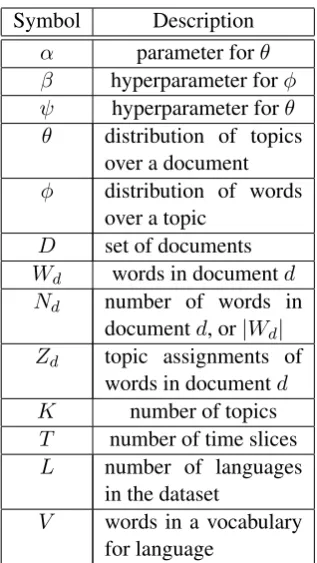
andmultilingualtopic models in more detail, and then give a description of our proposed combined model. We then demonstrate usage of this model on a parallel dataset and a comparable dataset of news articles and present our results. We show that this novel topic model learns aligned bilingual topics as demonstrated by the cosine similarities of learned vector representations of named enti-ties. Table1summarizes the notations used in this paper. Code is available at:https://github. com/ezosa/multilingual_dtm.
Symbol Description
α parameter forθ β hyperparameter forφ ψ hyperparameter forθ θ distribution of topics
over a document
φ distribution of words over a topic
D set of documents
Wd words in documentd Nd number of words in
documentd, or|Wd| Zd topic assignments of
words in documentd K number of topics
T number of time slices
L number of languages in the dataset
V words in a vocabulary for language
Table 1: Summary of notations.
3 Related Work
Topic models capture themes inherent in docu-ment collections through the co-occurence pat-terns of the words in documents. Latent Dirich-let Allocation (LDA, Blei et al., 2003) is a pop-ular method for inferring these themes or topics. It is generative document model where a docu-ment is described by a mixture of different top-ics and each topic is a probability distribution over the words in the vocabulary. In a document col-lection we can only observe the words in a doc-ument. Therefore, training a model involves in-ferring these latent variables through approximate inference methods.
In the case of documents with timestamps cov-ering some time interval, such as news articles, we might want to capturedynamicco-occurence pat-terns that evolve through time. Dynamic Topic Model (DTM, Blei and Lafferty, 2006) divides time into discrete slices and chains parameters from each slice in order to infer topics that are aligned across time. DTM gives us a set of topic-term distributions that evolve from one time slice to the next. There are also other topic models for time-series data such as the Continuous Dynamic Topic Model (cDTM, Wang et al., 2008), a ver-sion of DTM that does not explicitly discretize
time intervals. Dynamic Mixture Model (DMM,
Wei et al., 2007) captures the evolution of doc-uments across time and Topics over Time (TOT,
Wang and McCallum,2006) is a method that mod-els the prominence of topics over time.
A limitation of LDA, as well as these dynamic models, is that it is not applicable to multilin-gual data. LDA captures co-occurences of words in documents and words from different languages would rarely, if ever, occur in the same docu-ment regardless of their semantics, as demon-strated by experiments on the Europarl corpus ( Ja-garlamudi and Daumé, 2010; Boyd-Graber and Blei,2009). Multilingual topic models are devel-oped to capture cross-lingual topics from multilin-gual datasets.
Polylingual Topic Model (PLTM,Mimno et al.,
2009) is a multilingual topic model that extends LDA for an aligned multilingual corpus. Instead of running topic inference on individual docu-ments as in LDA, PLTM infers topics fortuplesof documents, where each document in the tuple is in a different language. PLTM assumes that the doc-uments of a tuple discuss the same subject broadly and therefore share the same document-topic dis-tribution.
Other topic models for multilingual data in-clude Multilingual Topic Model for Unaligned Text (MuTo, Boyd-Graber and Blei, 2009) and JointLDA (Jagarlamudi and Daumé,2010). MuTo attempts to match words between languages in the corpus and samples topic assignments for these matchings. JointLDA is a multilingual model that does not require an aligned corpus but requires a bilingual dictionary and uses concepts, instead of words, to infer topics where concepts can be en-tries in the bilingual dictionary.
In this work we will focus on DTM and PLTM because we want to capture topic evolution in mul-tilingual settings without using additional lexical resources such as dictionaries.
3.1 Dynamic Topic Model
s
at-1 at at+1
qd,t-1 qd,t qd,t+1
y
Zd,n,t-1 Zd,n,t Zd,n,t+1
Wd,n,t-1 Wd,n,t Wd,n,t+1
fk,t-1 fk,t fk,t+1
b
Nd,t-1 D
t-1 Nd,t Dt Nd,t+1Dt+1
K
Figure 1: DTM for three time slices as shown in
Bhadury et al.(2016).
more complicated due to the non-conjugacy of the distributions used in the model. Blei and Lafferty
(2006) use variational Kalman filtering for topic inference, which does not scale well for a large number of topics and documents and large num-bers of time slices (Bhadury et al., 2016; Wang et al., 2008). Bhadury et al. (2016) developed a method for inferring the posterior distributions of DTM with Gibbs sampling. In their method, the parameters α, θ, φ andZ are re-sampled during every iteration of the sampler.
The document-topic proportionsθ, sampled for each document in each time slice, and the topic-term distributions φ, sampled for each topic in each time slice, are updated using Stochastic Gra-dient Langevin Dynamics (SGLD, Welling and Teh,2011) which is based on Stochastic Gradient Descent (SGD). Figure1shows the plate diagram for DTM fromBhadury et al.(2016).
3.2 Polylingual Topic Model
The polylingual topic model (PLTM,Mimno et al.,
2009) is an extension of LDA that infers topics from an aligned multilingual corpus composed of document tuples. Tuples are composed of docu-ments in different languages that are thematically aligned, meaning that they discuss the subject in broadly similar ways. For instance, a news arti-cle in German and another artiarti-cle in English that report on the same event can compose a tuple.
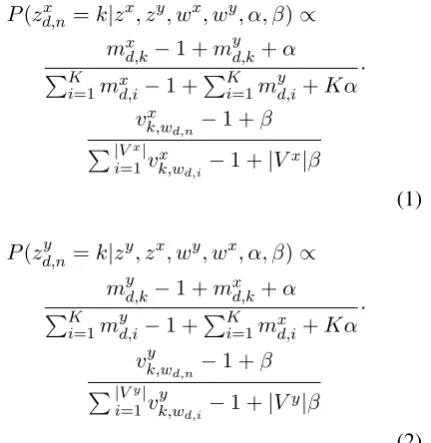
Inference on PLTM can be done via Gibbs sam-pling where the topic assignment of each termzd,nl
is resampled during every iteration. Following
Vuli´c et al.(2015), we provide the update formu-lae for the bilingual case for brevity. The update formulae for documents in languagesxandyare:
P(zxd,n=k|zx, zy, wx, wy, α, β)∝ mxd,k−1 +myd,k+α PK
i=1mxd,i−1 + PK
i=1m y
d,i+Kα
·
vxk,w
d,n −1 +β
P|Vx|
i=1vxk,wd,i −1 +|V
x|β
(1)
P(zyd,n=k|zy, zx, wy, wx, α, β)∝ myd,k−1 +mxd,k+α PK
i=1m y
d,i−1 + PK
i=1mxd,i+Kα
·
vyk,w
d,n −1 +β
P|Vy| i=1v
y
k,wd,i −1 +|V
y|β
(2)
where mx
d,k is the number of times topic k has been assigned to a word in document d written in languagex andvxk,w
d,n is the number of times
wordwd,n, that is, the word at positionnin doc-ument d, has been assigned to topic k. |Vx| is the vocabulary size of languagex. The first part of these formulae links the two languages together and is language-independent while the second part is language-specific.
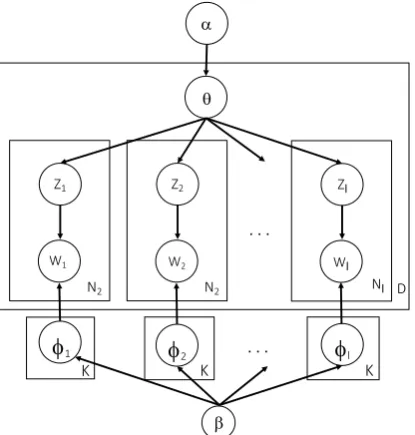
Figure2 shows the graphical representation of PLTM forllanguages.
4 Multilingual Dynamic Topic Model
Here we combine the abovedynamicand polylin-gual models to produce a Multilingual Dynamic Topic Model (ML-DTM). Figure3 shows the di-agram of ML-DTM for two languages and three time slices. Although we show only the bilingual case here for brevity, the model is applicable for any number of languages.
The inference method ofBhadury et al.(2016) was originally motivated by the need to speed up DTM inference for very large datsets. We apply it here to the combined ML-DTM model. We pro-pose the following posterior conditional distribu-tion forθx,twherexis a tuple index in the dataset:
p(θx,t|αt, Zx,t)∝ N(θx,t|αt, ψ2I)× L
Y
l=1 Ndl,t
Y
n=1
For the comparable dataset, we use the YLE news dataset which consists of Finnish and Swedish articles from the Finnish broadcaster YLE, covering news in Finland from January 2012 to December 20183. The Finnish and Swedish articles are written separately and are not di-rect translations of each other. We use exist-ing methods for alignexist-ing comparable news arti-cles (Utiyama and Isahara,2003;Vu et al.,2009). Specifically, we create an aligned corpus by pair-ing a Finnish article with a Swedish article pub-lished within a two-day window and sharing three or more named entities. We want to have a one-to-one alignment in our dataset such that no ar-ticle is duplicated, so we pair a Finnish arar-ticle with the first Swedish article encountered in the dataset that fits the above criteria and remove the paired articles from the unaligned dataset. The un-aligned dataset has a total of 604,297 Finnish ar-ticles and 228,473 Swedish arar-ticles and the final aligned dataset consists of 123,818 articles cov-ering 84 months. A script for aligning articles us-ing the method described is provided in the Github project associated with this work.
We tokenized, lemmatized (using Word-NetLemmatizer for German and English and LAS (Mäkelä, 2016) for Finnish and Swedish) and removed stopwords for these two datasets and then used the 5,000 most frequent words of each language as the vocabulary for that language.
5.2 Cross-Lingual Alignment
We compare the cross-lingual alignment of topics of ML-DTM and PLTM by evaluating the similar-ity of the learned vector representations of named entities (NEs) that appear in both languages of the same dataset. This method is suggested by
Vuli´c et al. (2015) on the basis that NEs tend to be spelled in the same way in different languages and can be expected to have a similar association with topics across languages. TheK-dimensional vector of a NEwfor languagesis thus:
vec(ws) = [P(z1|ws), P(z2|ws), ..., P(zK|ws)] (6) Under an assumption of a uniform prior over topics, this vector can be computed as:
3https://www.kielipankki.fi/corpora/
P(zk|ws)∝
P(ws|zk) P(ws) = φl,zk,ws
N ormφs,.,ws
(7)
N ormφs,.,ws =
K X
k=1
φs,zk,ws (8)
vec(ws) =
[φl,z1,ws, φl,z2,ws, ..., φl,zK,ws]
N ormφs,.,ws
(9)
We then take the cosine similarities between the
L different vector representations of the NE (for both datasets,L= 2).
We evaluate the cosine similarities of NEs that occur five or more times in each time slice. To make the comparison between PLTM and ML-DTM, we train one ML-DTM model on three time slices for 10 topics and three separate PLTM mod-els for each time slice, also capturing 10 topics. We set α = 1.0 and β = 0.08 for PLTM and
α = 0.5 and β = 0.5 for ML-DTM for both datasets, which achieved the best results of a small range of values tried. We did not, for now, perform more extensive optimisation of hyperparameters.
5.3 Topic Diversity
We also measure thediversity of the topics ML-DTM finds by computing the Jensen-Shannon (JS) divergence of every topic pair for each time slice for each language and averaging the divergences.
Wang and McCallum (2006) used this method, though with KL divergence. It is desirable for the model to find topics that are as distinct as possible from each other.
We compare the diversity of the topics found by ML-DTM, trained as in the previous section, with the topics found by DTM. To make this compar-ison we train separate DTM models for each lan-guage in our two datasets, giving us four different models and compare the divergences of the topics found by these models with their ML-DTM coun-terparts. We use the Gensim implementation of DTM4where we set the chain variance to0.1and leave other parameters to be inferred during train-ing. We train both ML-DTM and DTM on 10 time slices for 10 topics.
4https://radimrehurek.com/gensim/
Time slice # of NEs PLTM ML-DTM
Aug 1996 53 0.880 0.692 Sept 1996 65 0.876 0.908
Oct 1996 64 0.840 0.885
Table 3: Average cosine similarity of topic vectors for NEs over three time slices in DE-NEWS.
Time slice # of NEs PLTM ML-DTM
Jan 2012 79 0.800 0.896
Feb 2012 71 0.810 0.796 Mar 2012 72 0.722 0.745
Table 4: Average cosine similarity of the vectors of NEs for three time slices in the YLE dataset.
6 Results and Discussion
Tables3and4show the average cosine similarity between NEs for each language in the DE-NEWS
and YLE datasets, respectively. In the DE-NEWS
data (Table 3), PLTM outperforms ML-DTM in the first time slice but ML-DTM performs better on the succeeding time slices. This is an encourag-ing result, considerencourag-ing that the parameters of ML-DTM at time slice tare estimated from adjacent time slices, adding a large degree of complexity to the model, whereas PLTM estimates parameters based on the current time slice only (PLTM has no concept of time).
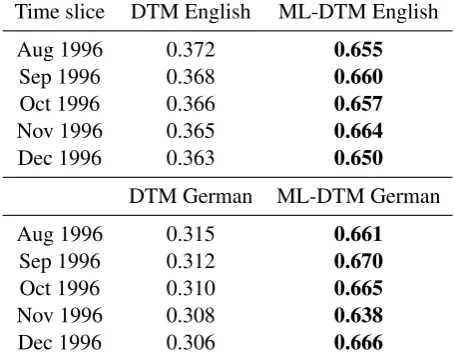
For the YLE dataset (Table4), ML-DTM shows an improvement in the first time and third slices and comparable performance in the second. The comparable nature of this dataset makes aligning NEs a more challenging task for both models. One way to improve performance on this task might be to use stricter criteria in aligning the dataset, such as pairing articles only if they were published on the same day or if they share more named entities. We compare topic diversity of the topics found by DTM and ML-DTM. Tables5and6show the average JS divergence of every topic pair for five time slices in the DE-NEWS and YLE datasets, respectively. ML-DTM consistently learns more diverse topics than DTM for both datasets.
In Figure4, we show the evolution of one topic found by ML-DTM trained on DE-NEWS. We show the top words of a topic about labor unions for the first eight months of the dataset. The En-glish and German words are not exact translations of each other but we see similar or related words
Time slice DTM English ML-DTM English
Aug 1996 0.372 0.655
Sep 1996 0.368 0.660
Oct 1996 0.366 0.657
Nov 1996 0.365 0.664
Dec 1996 0.363 0.650
DTM German ML-DTM German
Aug 1996 0.315 0.661
Sep 1996 0.312 0.670
Oct 1996 0.310 0.665
Nov 1996 0.308 0.638
Dec 1996 0.306 0.666
Table 5: Topic diversity comparison between DTM and ML-DTM: average JS divergences of each topic pair for five months of the DE-NEWS
dataset for English and German.
and NEs in each time slice. For instance, in Au-gust 1996 ‘employer’ and ‘arbeitgeber’ both ap-pear, as does ‘einzelhandel’ and ‘retail’. In Sept 1996, ‘kohl’ is the top term for both languages (referring to former German chancellor Helmut Kohl). There are cases where German terms have no direct translation in English but an equivalent concept appears in the English topic. This is the case with ‘lohnfortzahlung’ (sick-leave pay) where the terms ‘sick’ and ‘pay’ appear on the En-glish side; and ‘steuerreform’ (tax reform) where ‘reform’ appears on the English side as well.
A named entity, ‘thyssen’, appears in March 1997 in both languages but not in other months. This is because of an event that happened around mid-March where the German steel company Thyssen was being bought by competitor Krupp-Hoesch (also a top term in the German topic) prompting concerns about job losses5.
Figure 5 shows the first six months of a topic about political news from the YLE dataset. The first two months has terms related to presiden-tial elections. This refers to the Finnish pres-idential election in 2012, where rounds of vot-ing took place in January and February 20126. These time slices also mention the two candi-dates in the runoff election, Sauli Niinistö and
5https://www.nytimes.com/1997/03/19/
business/krupp-hoesch-confirms-bid-of-8-billion-for-thyssen.html
6https://en.wikipedia.org/wiki/2012_
tional conference on Machine learning. ACM, pages 113–120.
David M Blei, Andrew Y Ng, and Michael I Jordan.
2003. Latent dirichlet allocation. Journal of
ma-chine Learning research3(Jan):993–1022.
Jordan Boyd-Graber and David M Blei. 2009.
Multi-lingual topic models for unaligned text. In
Proceed-ings of the Twenty-Fifth Conference on Uncertainty in Artificial Intelligence. AUAI Press, pages 75–82.
Lea Frermann and Mirella Lapata. 2016. A bayesian
model of diachronic meaning change.
Transac-tions of the Association for Computational
Linguis-tics4:31–45.
Thomas L Griffiths and Mark Steyvers. 2004.
Find-ing scientific topics. Proceedings of the National
academy of Sciences101(suppl 1):5228–5235.
David Hall, Daniel Jurafsky, and Christopher D Man-ning. 2008. Studying the history of ideas using topic
models. InProceedings of the conference on
empiri-cal methods in natural language processing. Associ-ation for ComputAssoci-ational Linguistics, pages 363–371.
Jagadeesh Jagarlamudi and Hal Daumé. 2010. Extract-ing multilExtract-ingual topics from unaligned comparable
corpora. In European Conference on Information
Retrieval. Springer, pages 444–456.
Philipp Koehn. 2005. Europarl: A parallel corpus for
statistical machine translation. InMT summit.
vol-ume 5, pages 79–86.
Eetu Mäkelä. 2016. Las: an integrated language
analy-sis tool for multiple languages. The Journal of Open
Source Software1.
David Mimno, Hanna M Wallach, Jason Naradowsky, David A Smith, and Andrew McCallum. 2009.
Polylingual topic models. In Proceedings of the
2009 Conference on Empirical Methods in Natural Language Processing: Volume 2-Volume 2. Associa-tion for ComputaAssocia-tional Linguistics, pages 880–889.
Masao Utiyama and Hitoshi Isahara. 2003.
Reli-able measures for aligning japanese-english news
articles and sentences. In Proceedings of the
41st Annual Meeting on Association for Computa-tional Linguistics-Volume 1. Association for Com-putational Linguistics, pages 72–79.
Jurgen Van Gael and Xiaojin Zhu. 2007. Correlation
clustering for crosslingual link detection. InIJCAI.
pages 1744–1749.
Thuy Vu, Ai Ti Aw, and Min Zhang. 2009. Feature-based method for document alignment in
compara-ble news corpora. InProceedings of the 12th
Con-ference of the European Chapter of the Associa-tion for ComputaAssocia-tional Linguistics. AssociaAssocia-tion for Computational Linguistics, pages 843–851.
Ivan Vuli´c, Wim De Smet, Jie Tang, and Marie-Francine Moens. 2015. Probabilistic topic modeling in multilingual settings: An overview of its
method-ology and applications. Information Processing &
Management51(1):111–147.
Chong Wang, David Blei, and David
Hecker-man. 2008. Continuous time dynamic topic
models. In Proceedings of the
Twenty-Fourth Conference on Uncertainty in Artifi-cial Intelligence. AUAI Press, Arlington, Vir-ginia, United States, UAI’08, pages 579–586. http://dl.acm.org/citation.cfm?id=3023476.3023545.
Xuerui Wang and Andrew McCallum. 2006. Topics over time: a non-markov continuous-time model of
topical trends. In Proceedings of the 12th ACM
SIGKDD international conference on Knowledge discovery and data mining. ACM, pages 424–433.
Xing Wei, Jimeng Sun, and Xuerui Wang. 2007. Dy-namic mixture models for multiple time-series. In Ijcai. volume 7, pages 2909–2914.
Max Welling and Yee W Teh. 2011. Bayesian learn-ing via Stochastic Gradient Langevin Dynamics. In Proceedings of the 28th international conference on machine learning (ICML-11). pages 681–688.
Tze-I Yang, Andrew Torget, and Rada Mihalcea. 2011.
Topic modeling on historical newspapers. In