International Research Journal of Natural and Applied Sciences Vol. 4, Issue 4, April 2017 Impact Factor- 5.46 ISSN: (2349-4077)
© Associated Asia Research Foundation (AARF)
Website: www.aarf.asia Email : [email protected] , [email protected]STUDY TO ASSESS THE KNOWLEDGE REGARDING MENSTRUAL
HYGIENE AMONG ADOLESCENT GIRLS OF A SELECTED SCHOOL
IN SONEPAT
Rebecca Dillu,
Assistant Professor, (Amity University Manesar, Haryana)
ABSTRACT
Aim:A study was conducted in Geetanjali Senior Secondary School, Gohana Road, Sonepat to
assess the knowledge regarding menstrual hygiene among adolescent girls.
Methodology:Quantitative Research Approach and Descriptive Research Designwas used to
conduct the present study. Purposive sampling technique was used to select the sample size of
100 adolescent girls of age 11-16 years. Knowledge of study sample knowledge regarding
menstrual hygiene was assessed through self-administered questionnaire. A validated
PPT(power point presentation) & video on maintenance of menstrual hygiene were developed
and presented to the study samples to educate them about the physiological process involved in
menstruation and maintenance of menstrual hygiene.
Results:The research findings depict that the majority (81%) of the adolescents have fair
knowledge regarding menstrual hygiene, 11% have poor knowledge and only 8% have good
knowledge. The result further depicts that there was a significant association between the
knowledge score and age, religion, educational status, way of traveling to school and the term
used for menstrual cycle.
Conclusion: Since the study showed that maximum women had inadequate knowledge regarding
educate the adolescent girls using various public awareness programme to maintain the
menstrual hygiene to decrease the morbidity and complications in their reproductive period.
Keywords: Adolescent girls, knowledge, menstrual hygiene.
INTRODUCTION
Adolescence is considered a critical period in human evolution, although it is often not
recognized as such by health care workers and parents as well as professionals in adult medicine
and pediatric disciplines1. The onset of menstruation in adolescence is a phenomenon that signals
reproductive maturity and should not be seen as an abnormal condition or disease.
Menstruation is a phenomenon unique to the females. The onset of menstruation is one of the
most important changes occurring among the girls during the adolescent years. The first
menstruation (menarche) occurs between 11 and 15 years with a mean of 13 years.
Menstruation is a normal physiological process indicating beginning of reproductive life but
sometimes it is considered as unclean phenomenon in the Indian society2. Insufficient, incorrect
information regarding menstruation is often a cause of unnecessary restrictions in the daily
normal activities of the menstruating girls creating various psychological issues. Besides, the
lack of knowledge and awareness also lead to some poor personal hygienic practices during
menstruation leading to many reproductive tract infections2.
Adolescent girls constitute a vulnerable group, particularly in India where female child is
neglected one. Menstruation is still regarded as something unclean or dirty in Indian society. The
reaction to menstruation depends upon awareness and knowledge about the subject. The manner
in which a girl learns about menstruation and its associated changes may have an impact on her
response to the event of menarche. Although menstruation is a natural process, it is linked with
several misconceptions and practices, which sometimes result into adverse health outcomes3.
The varied reactions to menarche may depend on the extent to which the girls have been
prepared regarding the same. Fear, panic and other negative reactions to menstruation by
adolescent girls highlights the fact that girls with no previous knowledge about menstruation felt
because of participants not being psychologically prepared for attaining menarche which is an
important milestone in their life5.
Menstrual hygiene depends upon the educational, socioeconomic, and cultural statuses of family.
School curriculum also has some role in menstrual health6. Today, the number of women who
have regular menstruation periods is increasing in developing countries including India due to
later childbearing and fewer children. But many lack the economic and social conditions to
manage menstruation sanitation satisfactorily. A particularly vulnerable group in this aspect is
young women in poor families. Furthermore, understanding young women’s knowledge and
practices related to menstruation is a central element for designing appropriate education
programs7.
Hygiene-related practices of women during menstruation are of considerable importance, as it
has a health impact in terms of increased vulnerability to reproductive tract infections (RTI). The
interplay of socio-economic status, menstrual hygiene practices and RTI are noticeable. Today
millions of women are sufferers of RTI and its complications and often the infection is
transmitted to the offspring of the pregnant mother.Women having better knowledge regarding
menstrual hygiene and safe practices are less vulnerable to RTI and its consequences. Therefore,
increased knowledge about menstruation right from childhood may escalate safe practices and
may help in mitigating the suffering of millions of women3.
Poor menstrual hygiene causes great impact in increased vulnerability to reproductive tract
infections (RTI). Currently millions of women sufferers from RTI and infection is transmitted to
the offspring. Women having knowledge regarding menstrual hygiene are less vulnerable to RTI
and its consequences. Therefore, increased knowledge about menstruation from adolescent
period help in decreased suffering of millions of women3.
There is very limited social and health related research on menstruation issues in low and middle
income countries including India. There is also limited research on menstruation as a social and
cultural phenomenon or on the technical and hygienic aspects of sanitary protection in various
socio-economic contexts. The reason might be that menarche and menstruation are considered a
taboo and thus rarely discussed7, even between mother and daughter. The reason for mother’s
reluctance to discuss menstruation and related issues with their daughters can be partially related
STATEMENT OF THE PROBLEM
A study to assess the knowledge regarding menstrual hygiene among adolescent girls of a
selected school in Sonepat with the following objectives:
To assess knowledge regarding menstrual hygiene among adolescent girls.
To determine the association level of knowledge regarding menstrual hygiene with the
selected variables.
To develop and validate the PPT(power point presentation) & video on maintenance of
menstrual hygiene.
METHODOLOGY
A descriptive study was conducted to assess the knowledge regarding menstrual hygiene among
100 adolescent girls between the age of 11-16 years, were willing to participate in research study
and who were able to read and write English. The study sample were selected using purposive
sampling technique and the study was conducted in Geetanjali Senior Secondary School, Gohana
Road, Sonepat. A structured self-administered questionnaire i.e. Menstrual Hygiene
questionnaire was used to collect the data related toselected demographic datai.e. age, religion,
residence,type of family, education status,dietary pattern ,personal habits ,age of
menarche,source of information about menstruation,duration of menstrual cycle, term used for
menstrual cycle,pain during menstrual cycle and knowledge regarding menstrual hygiene
consisting of areas i.e. concept, puberty, diet, personal hygiene, menstrual hygiene and myths
related to menstruation.A validated PPT (power point presentation) and video on maintenance of
menstrual hygiene were developed and presented to the adolescent girlsto educate them about the
physiological processinvolved in menstruation and maintenance of menstrual hygiene.
The analysis of data was done using descriptive and inferential statistics. Frequency and
percentage distribution was used to analyze the demographic data of the study sample while
mean, median, standard deviation and mean percentage was used to describe the knowledge
scores of the adolescent girls. The level of association of knowledge regarding menstrual hygiene
RESULT
The study findings indicated that majority(67%) of adolescents come under age group of 11-13
years and 33% were in 14-16 years age group .Majority (95%) of the adolescents belonged to
Hindu religion, 1% belonged to Muslim religion, 0% Christian and 4% belonged to other
religion.Majority (79%) of the adolescents lived in rural locality whereas 21% of the couple
lived in urban locality. Majority (65%) adolescents lived in joint family, 28% lived in nuclear
while 7% lived in extended family. Most (77%) had the educational status till secondary level,
23% had primary level educational status.
Majority (99%) doesn’t have any personal habits and 1% is having smoking. Most (88%) were
vegetarian and 12% were non vegetarian. Majority (56%) have age of menarche from 13-14
years,27% have from 12-13 years,15% have above 15years and 2% have at 10-12 years. Ninety
four percent (94%) of the adolescents travel to school by school transport, 5% by walk whereas
1% travel by their own vehicle. Eighty seven percent (87%) adolescents have knowledge about
menstruation by their parents, 8% by their friends, 3% from others while 2% doesn’t have
knowledge about menstruation.
More than half (52%) adolescent have menstrual cycle for 4-7 days, 38% for 0-3 days, 7%
adolescents have above 10 days whereas 3% have for 6-10 days. More than half (58%) of the
adolescents used the term periods, dates, menses for menstruation, 21% adolescents used the
term periods, 11% used dates and 10% used the term menses for menstruation. 35% adolescents
have moderate pain during menstrual cycle, 25% have mild pain, 22% have severe pain whereas
18% adolescents have no pain during menstrual cycle.
TABLE 1
Frequency and Percentage Distribution of Adolescent Girls According to their
Knowledge Scores
Level of knowledge score
Range of knowledge score Frequency (%)
Good 21-30 08
fair 11-20 81
poor 0-10 11
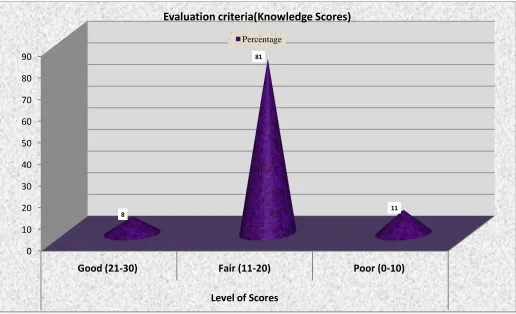
Data in the table 1 indicates that the majority (81%) of the adolescents have fair knowledge
regarding menstrual hygiene, 11% have poor knowledge and only 8% have good knowledge.
[image:6.612.74.590.86.400.2]Figure.1 Cone graph showing comparison of knowledge score of adolescent girls
TABLE 2
Mean, Median and Standard Deviation of Knowledge Score of Adolescent Girls
N=100
Descriptive
Statistics Mean Median S.D. Maximum Minimum Range
Mean
%
Possible
Gain %
Knowledge
Score 15.43 16 4.20 24 5 19 51.43 48.57
Maximum score: 30 ; Minimum score: 0
The data presented in Table 2 reveals that the mean knowledge score of the adolescent girls
regarding menstrual hygiene was 15.43, median was 16 and standard deviation was 4.20 with
0 10 20 30 40 50 60 70 80 90
Good (21-30) Fair (11-20) Poor (0-10)
Level of Scores 8
81
11 Evaluation criteria(Knowledge Scores)
maximum score of 30 and minimum score of 0.
Chi-square value was computed to find the association of knowledge score of adolescent girls
regarding menstrual hygiene and the various selected demographic variables. The table 2 depicts
there was not a significant association between the knowledge score and Residence(5.991),Type
of family(9.488),Personal habits(5.991),Dietary pattern(5.991),Age of menarche(12.592),Source
of information about menstruation(12.592),Duration of menstrual cycle(12.592),Pain during
menstrual cycle(12.592) while there was a significant association between the knowledge score
and Age(5.991),Religion(9.448),Educational status(5.991)and the Term used for menstrual cycle
(12.592)by the adolescent girls at 0.05 level of significance and therefore these variables had the
effect on their knowledge regarding menstrual hygiene.
CONCLUSION
On the basis of findings of the present study, the study illuminates that the knowledge regarding
normal physiological process of menstruation and maintenance of menstrual hygiene was quite
less among the adolescent girls. Menstrual hygiene is an issue needs to be addressed right from
the age of menarche of adolescent girls which is considered as vulnerable group and throughout
their life time till they reach their period of menopause.Awareness regarding the need for
information on healthy menstrual practices is very important because the amount of knowledge
is not good enough.
It is significant to aware and educate adolescent girls for good hygiene practice related to
menstruation in the form of formal education in school curriculum as well as informal education
through mass media so as to enable them to lead a healthy reproductive life and prevent the risk
for various complications such as reproductive as well as urinary tract infections, infertility. So,
nursing professionals are in a key position to guide the adolescents via Power Point
Presentations, video, workshop, seminars, social awareness program etc. A platform should be
prepared by the help of government to bring together individuals, organizations, social
businesses and the media to create a united and strong voice for women and girls around the
ACKNOWLEDGEMENT
It is a great privilege to express my special gratitude to the Principal of Geetanjali Senior
Secondary School, Gohana Road, Sonepat for granting permission to conduct our research study
and thus facilitating the execution of the study.
We wish to extend my heartfelt thanks with much appreciation for all those adolescent girls for
their willingness and full cooperation in participating in my research study and for their honest
information without which it would have been impossible to complete this study.
REFERENCES
1. Salarilak S, Mohadesi H, Nabizadeh M, Motaraggeb F. A Survey on the Rate of
Knowledge, Attitude And Practice Of Hight School Girl To Menstruation Health In
Urmia (1999-2000) J Urmia University Medl Sci.2001;12(2):163–169.
2. Thakre SB, Thakre SS, Reddy M, Rathi N, Pathak K, Ughade S. Menstrual hygiene:
Knowledge and practice among adolescent school girls of Saoner, Nagpur district. J
ClinDiagn Res. 2011;5:1027–33.
3. Dasgupta A, Sarkar M. Menstrual hygiene: How hygienic is the adolescent girl? Indian J
Community Med. 2008;33: 77–80.
4. Deo DS, Ghattargi CH. Perceptions and Practices Regarding Menstruation: A
Comparative Study in Urban and Rural Adolescent Girls. Indian Journal of Community
Medicine. 2005; 30(1).
5. Dube S, Sharma K. Knowledge, Attitude and Practice Regarding Reproductive Health
among Urban and Rural Girls: A Comparative Study Ethno Med. 2012; 6(2):85-94.
6. Dhingra R, Kumar A, Kour M. Knowledge and practices related to menstruationamong
tribal (Gujjar) adolescent girls. Ethno-Med. 2009;3:43–8
7. Singh AJ. Place of menstruation in the reproductive lives of women of rural North
India. Indian J Community Med (2006) 31(3):10–410.
8. Garg S, Sharma N, Sahay R. Socio-cultural aspects of menstruation in an urban slum in