A Study of Machine Learning Algorithms
for Recognizing Textual Entailment
Julio Javier Castillo
Faculty of Mathematic Astronomy and Physics - National University of Cordoba Córdoba, Argentina
Abstract
This paper presents a system that uses machine learning algorithms and a combination of data sets for the task of recognizing textual entailment. The chosen features quantify lexical, syntactic and semantic level by matching between texts and hypothesis sentences. Additionally, we created a filter which uses a set of heuristics based on Named Entities to detect cases where no entailment was found. We analyzed how the different sizes of data sets and classifiers could impact on the final overall performance of the systems. We show that the system performs better than the baseline and the average of the systems from the RTE on both two and three way tasks.
We concluded that evaluating using the RTE3 test set, the model learned using MLP from the RTE3 alone outperforms other models that employed different ML algorithms and additional training data from the RTE1 and RTE 2.
Keywords
Textual entailment, machine learning, rte data sets.
1.
Approach
The objective of the Recognizing Textual Entailment Challenge is determining whether the meaning of the Hypothesis (H) can be inferred from a text (T). Recently the RTE4 Challenge has changed to a 3-way task that consists in distinguish among entailment, contradiction and unknown when there is no information to accept or reject the hypothesis. However the traditional two-way distinction between entailment and non-entailment is still allowed.
In the past, RTEs Challenges machine learning algorithms were widely used for the task of recognizing textual entailment (Marneffe et al., Zanzotto et al.). Thus in this paper we tested the most common classifiers that have been used by other researchers in order to provide a common framework of evaluation of ML algorithms (fixing the features) and showing how the development data set could impact over them.
We generated a feature vector with the following components for both Text and Hypothesis:
- Levenshtein distance,
- Lexical level: a lexical distance based on Levenshtein,
- Semantic level: a semantic similarity measure Wordnet based,
- LCS (longest common substring) metric.
We chose only four features in order to learn the development sets. Larger feature sets do not necessarily lead to improving classification performance because it could increase the risk of overfitting the training data. In section 3 we provide a correlation analysis of these features.
The motivation of the input features:
Levenshtein distance is motivated by the good results obtained as a measure of similarity between two strings. Additionally, we proposed a lexical distance which is based on Levenshtein distance but working to sentence level.
We created a metric based on Wordnet to try to capture the semantic similarity between T and H to sentence level. Longest common substring is selected because is easy to implement and provides a good measure for word overlap. Furthermore, the system uses a NER filter that detects cases where no entailment relation is found. This filter applies heuristic rules over Named Entities found in the text and hypothesis.
The system produces feature vectors for all possible combinations of the available development data RTE1, RTE2 and RTE3. Weka (Witten and Frank, 2000) is used to train classifiers on these feature vectors. We experimented with the following five machine learning algorithms:
- Support Vector Machine (SVM), - AdaBoost (AB),
- BayesNet (BN),
The Decision Trees are interesting because we can see what features were selected from the top levels of the trees. SVM, Bayes Net and AdaBoost were selected because they are known for achieving high performances. MLP was used because has achieved high performance in others NLP tasks.
We experimented with various parameters (settings) for the machine learning algorithm, such like increasing the confidence factor in DT for more pruning of the trees, different configuration(layers and neurons) for the neural network, and different kernels for SVM. Thus, we tested classifiers used by other researchers in order to provide a common framework of evaluation.
For two-way classification task, we used the RTE1, RTE2, RTE3 development sets from Pascal RTE Challenge, and BPI1 test suite.
For three-way task we used the RTE1, RTE2 and RTE3 development sets from Stanford group2.
Additionally, we generated the following development sets: RTE1+RTE2, RTE2+RTE3, RTE1+RTE3, and RTE1+RTE2+RTE3 in order to train with different corpus and different sizes. In all the cases, RTE4 TAC 2008 gold standard data set was used as test-set.
The remainder of the paper is organized as follows: Section 2 describes the architecture of our system, whereas Section 3 shows the results of experimental evaluation and discussion of them. Finally, Section 4 summarizes the conclusions and lines for future work.
2.
System description
This section provides an overview of our system that was evaluated in Fourth Pascal RTE Challenge. The system is based on a machine learning approach for recognizing textual entailment.
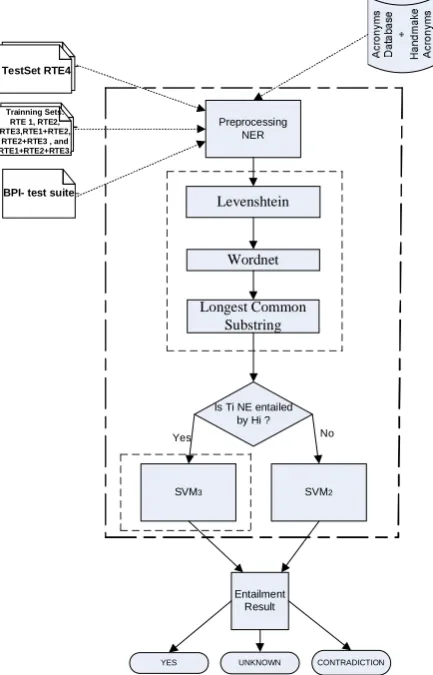
In Figure 1 we present a brief overview of the system.
Using a machine learning approach we tested with different classifiers in order to classify RTE-4 test pairs in three classes: entailment, contradiction or unknown.
To deal with RTE4 in a two-way task, we needed to convert this corpus only into two classes:yes and no. For this purpose both contradiction and unknown were taken as class no.
There are two variants to deal with every particular text-hypothesis pair or instance. The first way is directly using four features: (1) the Levenshtein distance between each
1
http://www.cs.utexas.edu/users/pclark/bpi-test-suite/
2
http://www-nlp.stanford.edu/projects/contradiction/
pair, (2) lexical distance based on Levenshtein, (3) a semantic distance based on WordNet and (4) their Longest Common Substring. The second way, is using the “NER- preprocessing module” to determinate whether non-entailment is found between text-hypothesis, therefore differing only on the treatment of Named Entities.
The Levenshtein distance [5] is computed between the characters in the stemmed Text and Hypothesis strings. The others three features are detailed below.
Text-hypothesis pairs are stemmed with Porter’s stemmer [3] and PoS tagged with the tagger in the OpenNLP3
framework.
Preprocessing NER
Entailment Result SVM3
CONTRADICTION UNKNOWN
YES
Is Ti NE entailed by Hi ?
SVM2
No Yes
TestSet RTE4
Levenshtein
Wordnet
Longest Common Substring
Trainning Sets: RTE 1, RTE2, RTE3,RTE1+RTE2, RTE2+RTE3 , and RTE1+RTE2+RTE3.
BPI- test suite
Figure 1.General architecture of our system.
2.1
NER filter
The system applies a filter based on Named Entities. The purpose of the filter is to identify those pairs where the
3
(Zanzotto et al) shown that RTE3 alone could produce higher results that training on RTE3 merged with RTE2 for the two-way task. Consequently, it seems that it is not always true that more learning examples increase the accuracy of RTE systems. These experiments provide additional evidence for both classification tasks. However, this claim is still under investigation.
Always the RTE1 dataset yields the worse results, maybe because this dataset has been collected with different text processing applications (QA, IE, IR, SUM, PP and MT), and our system do not have into account it.
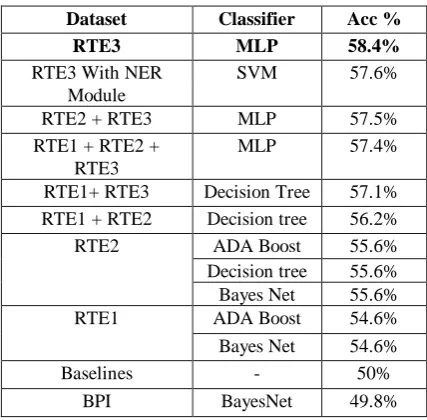
In addition, a significant difference in performance of 3.8% and 8.6% was obtained using different corpus, in two-way classification task (with and without the BPI development set, respectively).
The best performance of our system was achieved with Multilayer Perceptron classifier with RTE-3 dataset; it was 58.4% and 55.4% of accuracy, for two and three way, respectively.
The average difference between the best and the worst classifier of all datasets in two way task was 1.6%, and 2.4% in three-way task.
On the other hand, even if the SVM classifier does not appear as ‘favorite’ in neither classification task, in average SVM is one of the best classifiers.
We have to remark that in two-way task we obtained a difference of 3.8% between the best and worst combination of datasets and classifiers; meanwhile, in three-way task a slight and not statistical significant difference of 1.4% between the best and worst combination of datasets and classifiers is found. So, it suggests that the combination of data set and classifier has more impact over 2-way task than over 3-way task.
The performance in all the cases was clearly above those baselines. Only using BPI in two-way classification we obtained a worse result than baseline, and it is because BPI is syntactically simpler than PASCAL RTE; therefore, it seems that is not good enough training set for machine learning algorithm.
Although the best results were obtained without using the Name Entity Preprocessing module, we believe these results could be enhanced. The accuracy of this module was 71%, but the misclassified instances provide evidence that could be improved almost up to 80% (e.g: improving the acronym database), and having into account the coverage of corpus that was 10%, it could impact positively on the overall performance of the system. While this Name Entity Preprocessing module approach performed reasonably well in these evaluations, we feel
that even better results could be obtained by adding heuristic rules and knowledge base information.
With the aim of analyzing the feature-dependency, we calculated the correlation of them. The correlation and causation are connected, because correlation is needed for causation to be proved.
The correlation matrix of features is shown below:
Features 1 2 3 4
1 - 0,8611 0,6490 0,2057 2 0,8611 - 0,6951 0,0358 3 0,6490 0,6951 - 0,1707 4 0,2057 0,0358 0,1707 -
Table 3.Correlation matrix of features.
The table shows that features (1) and (2) are strongly correlated, so we experimented eliminating feature (1) to assess the effect on the overall performance over cross validation, and we obtained that accuracy slight decreases in 1%. Similar results are obtained by eliminating feature (2).
Additionally, we calculated the Kappa statistics over all development set using WEKA (Witten and Frank, 2000) for both 2-way and 3-way task classification. The average for Kappa measure was 0.138 for two-way task and 0.168 for three-way task.
In general, because of the corpus was incremented we obtained better values for Kappa. Nevertheless, the best value was obtained with RTE-3 two ways using MLP. In this case, the Kappa measure was 0.35 for cross validation experiment (See Tables 4 and 5).
There are two main reasons because of the values were slight: the size of the corpus and the mistakes made in the class contradiction, which was the most difficult class to predict in the 3-way classification.
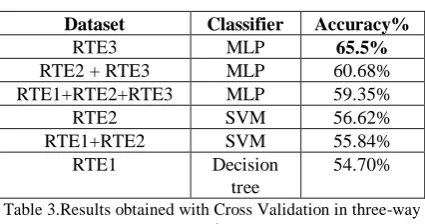
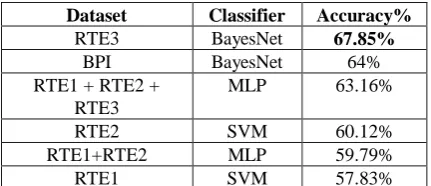
Finally, we assessed our system using cross validation technique with ten folds to every corpus, testing over our five classifiers for both classification tasks.
The results are shown in the tables 4 and 5 below.
Dataset Classifier Accuracy%
RTE3 MLP 65.5%
RTE2 + RTE3 MLP 60.68%
RTE1+RTE2+RTE3 MLP 59.35%
RTE2 SVM 56.62%
RTE1+RTE2 SVM 55.84%
RTE1 Decision
tree
54.70%
Dataset Classifier Accuracy%
RTE3 BayesNet 67.85%
BPI BayesNet 64%
RTE1 + RTE2 + RTE3
MLP 63.16%
RTE2 SVM 60.12%
RTE1+RTE2 MLP 59.79%
RTE1 SVM 57.83%
Table 4.Results obtained with Cross Validation in two-way task.
The results on test set are worse than those obtained on training set, which is most probably due to the overfitting of classifiers and because of the possible difference between these datasets.
4.
Conclusion and Future Work
We presented our RTE system that is based on a wide range of machine learning classifiers. It was a workbench that gave us a vision and knowledge about the structure of the data set and the abilities of different classifiers to learn them.
As a conclusion about development sets, we mention that the results performed using RTE3 were very similar to those obtained by the union of the RTE1 + RTE2+RTE3 for both 2-way and 3-way tasks. Thus, the claim that using more training material helps seems not to be supported by these experiments.
Additionally, we concluded that the relatively similar performances of RTE3 and RTE3 with NER preprocessing module suggests that further refinements over heuristic rules can achieve better results.
Despite not presenting an exhaustive comparison among all available datasets and classifiers, we can conclude that the best combination of RTE-s datasets and classifiers chosen for two way task produce more impact that the same combination for three way task, almost for all experiments that we did. In fact, the use of RTE3 alone improved the performance of our system.
Finally, we conclude that RTE3 corpus for both two and three way outperforms any other combination of RTE-s corpus using Multilayer Perceptron classifier.
Future work is oriented to experiment with additional lexical and semantic similarities features and test the improvements they may yield. Additional work will focused on improving the performance of our NE preprocessing module.
5.
References
[1] Prodromos Malakasiotis and Ion Androutsopoulos. Learning Textual Entailment using SVMs and String Similarity Measures. ACL-PASCAL Workshop on Textual Entailment and Paraphrasing, (ACL 2007), Prague, Czech Republic, 2007.
[2] Julio Javier Castillo, and Laura Alonso i Alemany. An approach using Named Entities for Recognizing Textual Entailment. TAC 2008, Gaithersburg, Maryland, USA, November 2008.
[3] M. Lesk. Automatic sense disambiguation using machine readable dictionaries: How to tell a pine cone from a ice cream cone. In SIGDOC ’86, 1986.
[4] Gusfield, Dan. Algorithms on Strings, Trees and Sequences: Computer Science and Computational Biology. CUP, 1999.
[5] V. Levenshtein. Binary Codes Capable of Correcting Deletions, Insertions and Reversals. Soviet Physics Doklady, 10:707, 1966.
[6] Ian H. Witten and Eibe Frank (2005). Data Mining: Practical machine learning tools and techniques, 2nd Edition, Morgan Kaufmann, San Francisco, 2005.
[7] Alvaro Rodrigo, Anselmo Peñas, Jesus Herrera, Felisa Verdejo. Experiments of UNED at the Third RTE
Challenge. Proceedings of the ACL-PASCAL 2007.
[8] British Atmospheric Data Centre (BADC) acronym database: http://badc.nerc.ac.uk/help/abbrevs.html
[9] D. Inkpen, D. Kipp and V. Nastase. Machine Learning Experiments for Textual Entailment. Proceedings of the second RTE Challenge, Venice-Italy, 2006.
[10]Bill Dolan, Chris Quirk, and Chris Brockett. 2004.
Unsupervised construction of large paraphrase corpora: exploiting massively parallel news sources. In COLING ’04: Proceedings of the 20th international conference on Computational Linguistics, page 350, Morristown, NJ, USA. Association for Computational Linguistics.
[11]F. Zanzotto, Marco Pennacchiotti and Alessandro Moschitti.
Shallow Semantics in Fast Textual Entailment Rule Learners. In Proceedings of the Third Recognizing Textual Entailment Challenge, Prague, 2007.