151
Volume LX 20 Number 2, 2012
SYSTEM FOR AUTOMATIC CRATE RECOGNITION
Kukla, R., Šťastný, J., Kolomazník, J.
Received: November 30, 2011
Abstract
KUKLA, R., ŠŤASTNÝ, J., KOLOMAZNÍK, J.: System for automatic crate recognition. Acta univ. agric. et silvic. Mendel. Brun., 2012, LX, No. 2, pp. 151–156
This contribution describes usage of computer vision and artifi cial intelligence methods for application. The method solves abuse of reverse vending machine. This topic has been solved as innovation voucher for the South Moravian Region. It was developed by Mendel university in Brno (Department of informatics – Faculty of Business and Economics and Department of Agricultural, Food and Environmental Engineering – Faculty of Agronomy) together with the Czech subsidiary of Tomra. The project is focused on a possibility of integration industrial cameras and computers to process recognition of crates in the verse vending machine. The aim was the eff ective security system that will be able to save hundreds-thousands fi nancial loss. As suitable development and runtime platform there was chosen product ControlWeb and VisionLab developed by Moravian Instruments Inc.
computer vision, artifi cial intelligence, Neural networks, VisionLab, WebControl
This paper describes the new methods to improve reverse vending machine. The research team suggested solutions. Current machines equipped digital CCD camera and industrial computer. This proposal made it possible to identify crates with front faces frames for detection was used tool VisionLab. It is part of the WebControl so ware that was used to program the industry computer. This system was based on the principle of pattern matching. As a pattern for identifying have been used unique part of crates and the area where pattern can be fi nd in the image. This system is confi gured to be able to recognize the crates with great effi ciency. Tested samples contained 3 000 scanned crates. The system never accepted the wrong crate, but in 5% refused to accept the right crate. System confi guration has been designed to minimize the system receiving the wrong crates. So o en did not accept right crates. The big disadvantage of the proposed solution was the upper limit to the number crates to be determined. Comparison of each pattern takes an average of 20 ms. Together with the time it means indirect no more than 30 kinds of crates accepted. This number is currently suffi cient, but with view of the long-term trend is too small. This is why we decided to fi nd another method (ŠKORPIL, 2009). We chose to focus on artifi cial intelligence (ŠŤASTNÝ, 2005)
or other methods (KOPRDA, 2011). We have used neural networks to image recognition (ŠKORPIL, 2005). The aim was recognize more types of crates on the required time with the required success.
METHODS AND RESOURCES
Image data were obtained in the company Tomra. Data was created in the machine T-600. Collection crates were used, which is stored for confi guration of new machines. Toscan crates were used DataCam camera with two lighting units DataLight.Camera parameters: • Resolution: 640 × 480
• 16bit AD converter → 8bit image • acceleration on GPUs
• exposure time 0.01s
• Light 2x dataLight fl ash module.
Total scanned 135 kinds, 516 photos. Data were also taken from the operational environment. There were 3000 images obtained 30 major species.
Image pre-processing
Multi-Layer Perceptron neural network
Multi-Layer Perceptron neural network (MLP) is confi gured by the number of input and output neurons, by the number of neurons in the hidden layer, number of hidden layers and the function of neurons. Neural network models are essentially simple mathematical models defi ning by means of a function (Sigmoid, Linear etc.) For automatic crate recognition especially nontraditional methods and algorithms (the MLP neural network with the Resilient Propagation learning algorithm) were tested in simulation environment (FEJFAR, 2001).
Application of neural networks
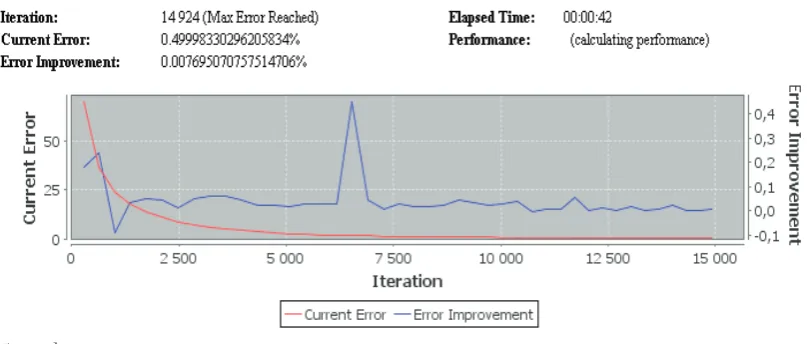
The fi rst method that was used for the detection of crates was the use of multi layer neural networks. The output layer contained 30 neurons each, and most existing neuron determines the type of crates. The input image was divided into areas. Each area represented three numbers (R, G, B). In these experiments tested various confi gurations of multilayer neural networks, which able to correctly learn the training set. Networks showed either retraining or a big mistake on the test set (Fig. 3).
A er analyzing the results of the networks showed that the decision networks have been o en heavily infl uenced by irrelevant data contained in the image. The nets were not able to learn to ignore the background image and location of crates in the image (Fig. 2).
Two level analyze
The initial attempts resulted in the need to cut out crate from the image. The aim was to neural network to receive only relevant data. The problems to determine the type of crates were then transformed to the problem of fi nding a crate in the image.
Finding crates in images by means of OpenCV
The input image was fi rst converted to gray-tonne and by cvSmooth method to free of noise. The best results provide alternatives CV_GAUSSIAN and CV_MEDIAN. The second step was to fi nd edges by cvCanny method. The resulting black-white images were subjected to detection of corners and lines. Lines provide a better result (specifi cally cvHoughLines2 method; KOUBEK, 2011), but it was diffi cult to select right line on the edge, which could be used to calculate the intersections. It was also impossible to fi nd the parameters of methods suitable for all types’ crates. The appearance created by the program and recognition procedure is shown in Fig. 2.
The main problem of this method have been unsuitable colour combinations of crates and background (black crate x black walls, crate green × green belt) and the number of false lines found. If we were able to adjust the crate’s part in the space of machine, so that they contrast crates, this would certainly be the optimal method (PROCHÁZKA, 2011).
1: Images of crates
Finding crates in images by means of neural networks
To fi nd crates were successfully used neural networks. For this purpose we have developed several plug-ins into applications ImageJ. The whole process can be divided into the following steps: • Creating a test kit
• Create test sets for neural network • Learning of neural networks • Test result networks
• Neural network application on real data.
The fi rst step was to manually create the data. Since each type of crates selected two samples, which were stored position in the frame corners crates. This served to create a simple plug-in that allows graphical input of the four corners of the crates in the image and save them. There were used ImageJ environment resources. In this step was needed to save points created in the table along with the name of the picture.
The second step was to process the scanned data to make them suitable for a neural network. This served the second created plug-in that worked with created table. The image of each crate was divided into grids. To this transfer was used objects libraries Encog RGBDownsample SimpleIntensityDownsample. Before the actual transfer the image was cropped and the excess part of applied fi lter defi ned macro. The resulting vector was normalized and normalized coordinates supplemented corners crates. The most successful test set contained roughly trimmed images in which the fi lter was applied to detect edges. These were divided into a grid 50 × 40 The vector contained 2000 numbers coding the luminance component of the 5 × 5 pixels.
For creating and training neural networks were used Encog Workbench environment, which was attached as a ImageJ plug-in in to the applications. Networks were tested with one to three hidden layers that contain 50 to 5 000 neurons. In the hidden layers were used sigmoid or tanh activation functions. The
3: Learning record
output layer was used sigmoid function or linear. Resilient Propagation method was used for learning. That is one of the fastest methods for learning a simple multi-layer network. All networks have learned an average of 50 cycles. They achieve settled error of around 3%. Networks with one hidden layer showed retraining and were able to correctly determine the corners of crates. Networks with more hidden layers showed better results. The most appropriate confi guration was eventually found with two hidden layers of 100 neurons with Tanh activation function and a sigmoid output. Learned network was saved for subsequent use.
Another plug-in allows network create and learn. For proper operation it is necessary to set the same parameters as the transfer of the image when creating the test set. Plug-in graphically a display found points in the image crates, also stores the coordinates in the table of results and allows cropping crates and visualizes the outcome of the process.
The last step was no longer a simple automatic edit pictures using the data stored in the results table. The result of this modifi cation is governed by a set of 496 pictures 62 kinds of crates. Each type is purchased in a set of 8 unique images.
To improve recognition results were found in each frame of the crate. A er the picture was crop and transformed into a resolution of 200 × 200 pixels. The actual procedure to fi nd and fi nal treatment was performed using methods available in the OpenCV library, as well as using neural networks.
RESULTS AND DISCUSSION
There has been tested several combinations of settings of neural network and the size of images. The teachings of neural networks with two hidden layers were always suspended in the event that the network has come under 1% error learning. Then it was possible to perform testing. For networks with one hidden layer was not always possible to achieve the desired error.
The following Table I shows the variants tested and their results. If the input sample size 32 × 32 is the number of input neurons in the network 3072 (32 × 32 × 3), it is 24 × 24 1 728 and for 16 × 16 neurons and is the 768 neurons. The output layer includes 30 neurons, which is the total number of crate types.
Best score is better than the result of original neural network, but the method based on pattern matching is still better. Further improvements could be made by more precise selection of interest areas. The neural network should receive more detailed view of the central part containing the logo. Margins could be only one value because that defi nes only the background.
5: Final train
I: Results of the tested variants
The average number of periods per cycle 29.2 The average error in the last cycles of epoch 0.001% The average number of errors on the test 2.0 The average detection accuracy across tests 93.333%
SUMMARY
Recognition with the aid of neural network algorithm is suitable where high-speed classifi cation with randomly rotated objects is required and where we need to tolerate some diff erences between learned etalons and classifi ed objects. This method can recognize objects with considerably modifi ed shapes but it may identify incorrectly objects of similar shape.
so as to minimize the hidden dependencies between the required solutions. A good example is the position calibration point in the test images.
Another positive aspect of this approach is that partial neural networks are smaller, simpler and faster. The resulting clusters neural networks solved the problem faster and better than the original complicated neural network. This approach can be applied to many other problems.
REFERENCES
ŠKORPIL, V., ŠŤASTNÝ, J., 2009: Comparison Methods for Object Recognition. In Proceedings of the 13th WSEAS International Conference on Systems. Rhodos, GREECE. s. 607–610. ISBN 978-960-474-097-0.
ŠŤASTNÝ, J., 2006: Netradiční metody a algoritmy pro rozpoznávání objektů technologické scény. Vědecké spisy VUT v Brně, edice habilitační a inaugurační spisy, č. 198, s. 1–30. ISSN 1213-418X.
KOPRDA, Š., BALOGH, Z., TURČÁNI, M., 2011: Modeling and comparison of fuzzy PID controller with PSD regulation in the discrete systems. INTERNATIONAL JOURNAL OF CIRCUITS, SYSTEMS AND SIGNAL PROCESSING. ISSN 1998-4464, Vol. 5, Issue 5, pp. 496–504.
ŠKORPIL,V., ŠŤASTNÝ, J., 2005: Neural Networks Learning Methods Comparison. WSEAS Transactions on Circuits and Systems, č. 4, s. 325– 330, ISSN 1109-2734.
PROCHÁZKA, D., KOUBEK, T., 2011: Augmented Reality Implementation Methods in Mainstream Applications, Acta Universitatis agriculturae et silviculturae Mendelianae Brunensis: 2011. sv. LIX, č. 4, s. 257–266, ISSN 1211-8516.
PROCHÁZKA, D., ŠTENCL, M., POPELKA, O., ŠŤASTNÝ, J., 2011: J. Mobile Augmented Reality Applications. In: MENDEL 2011, 17th International Conference on So Computing. Brno University of Technology, 2011, p. 469–476, ISBN 978-80-214-4302-0.
FEJFAR, J., MOTYČKA, A., FILÍPEK, Š., 2011: Algorithms for Time Series Comparison. In Recent Research in Applied Informatics. Prague: WSEAS Press, 2011, ISBN 978-1-61804-034-3.
Address