Comparing the E-Z Reader Model to Other Models of Eye Movement
Control in Reading
Erik D. Reichle University of Pittsburgh
Keith Rayner and Alexander Pollatsek University of Massachusetts, Amherst
Send correspondence to: Keith Rayner
Department of Psychology University of Massachusetts Amherst, MA 01003
413-545-2175
Short Abstract
Abstract
Because of the temporal constraints on word identification and saccadic programming, it has been claimed that lexical access cannot be the “engine” driving eye movements during reading, and that when and were the eyes move are instead primarily determined by visual and oculomotor factors (Reilly & O’Regan, 1998). Our simulation model, E-Z Reader (Reichle, Pollatsek, Fisher, & Rayner, 1998; Reichle, Rayner, & Pollatsek, 1999), falsifies this claim, and provides a theoretical framework for understanding the complex temporal relationships among several basic reading components, including lexical access, visual processing, attention, and oculomotor control. In this article, we first review what is known about eye movement control during reading and describe how the E-Z Reader model accounts for these findings. We then review several alternative models of eye movements in reading, discussing both their core assumptions and their theoretical scope. On the basis of this discussion, we conclude that E-Z Reader provides the most comprehensive account of eye movement control during reading. Finally, we describe several recent attempts to apply the core principles of our model to reading (e.g., lexical ambiguity) and non-reading (e.g., equation solving, visual search) domains to show the generality of these principles. We also provide a brief overview of what is known about the neural systems that support the various components of reading, and suggest how the cognitive constructs of our model might map onto this neural architecture.
Key Words: Attention, Eye-Movement Control, E-Z Reader, Fixations, Lexical Access, Models, Reading, Saccades
1. Introduction
Reading is a complex skill that involves the orchestration of many different stages of information processing. As the eyes move across the printed page, the visual features of the text are converted into orthographic and phonological patterns, which are then used to guide further language processing so that the content of the text can be understood. In this target article, we will compare different models that have been proposed to account for how eye movements are controlled in reading. We will not review all of the models that have been proposed to explain various components of reading. Instead, we will only discuss those models that have attempted to explain the interface between vision and low-level aspects of language processing; that is, models that specify some combination of the following components of reading: Eye movement control, visuospatial attention, and/or the visual processing of words1. Not surprisingly, we will argue that the model that we implemented, the E-Z Reader model (Reichle, Pollatsek, Fisher, & Rayner, 1998; Reichle, Rayner, & Pollatsek, 1999) does a better job of accounting for a wide range of data than does its competitors. However, we will also point out some shortcomings of the model.
2.0 Eye Movements in Reading
Any discussion of models of eye movement control must begin with a brief overview of eye movements during reading. In this section, we will describe what is known about eye movements during reading as background material. The following topics will be discussed: (1.) saccades and fixations, (2.) visual acuity, (3.) saccade latency, (4.) perceptual span, (5.) parafoveal preview effects, (6.) regressions, (7.) eye movement control (where to fixate next and when to move the eyes), and (8.) measures of processing time. It is not our intention to provide a complete and comprehensive review of each of these topics since our primary purpose in this article is to compare different models of eye movement control in reading. The interested reader is invited to consult Rayner (1998) for a more complete review of each of the eight topics discussed in this section.
2.1 Saccades and fixations. Contrary to our subjective impression, the eyes do not move smoothly across the printed page during reading. Instead, the eyes make short and rapid movements, called saccades, that typically move the eyes forward about 6-9 character spaces, although there is considerable variability (Rayner, 1978, 1998). Since saccade size is largely independent of visual angle when the number of character spaces is held constant, virtually all studies of reading use number of character spaces as the appropriate metric (Morrison & Rayner, 1981; O’Regan, 1983). Saccades take 20-50 ms to complete depending upon the length of the movement and virtually no visual information is extracted during eye movements (Ishida & Ikeda, 1989; Wolverton & Zola, 1983). Between saccades, the eyes remain stationary for brief periods of time (typically 200-250 ms) called fixations (Rayner, 1978, 1998). Because visual information is only extracted from the printed page during fixations, reading is similar to a slide show in which short segments of text are displayed for approximately a quarter of a second. It is important to note that, even within a given reader, there is considerable variability in both saccade length and fixation duration. Some saccades only move the eyes a single character and others are as large as 15-20 characters (although such long saccades typically follow regressions and place the eyes beyond the place from where the regression was initiated); likewise, some fixations will be shorter than 100 ms and some will be longer than 400 ms (Rayner, 1978, 1998). Much of this variability apparently is related to the ease or difficulty involved in processing the currently fixated text.
2.2 Visual acuity. Other constraints also severely curtail how much visual information can be processed during each fixation. First, because visual acuity is maximal in the center of the retina and rapidly decreases towards the periphery, fine visual discriminations can only be made within the
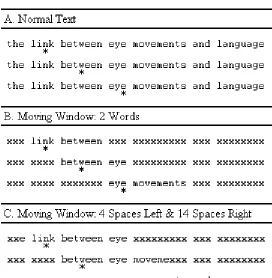
lexical access requires 100-300 ms to complete (Sereno, Rayner, & Posner, 1998; Rayner & Pollatsek, 1989; Schilling, Rayner, & Chumbley, 1998). On first appearances, therefore, it is not immediately obvious how the identification of one word can be the signal to begin planning a saccade to the next. Indeed, early theories of eye movements in reading (Bouma & deVoogd, 1974; Kolers, 1976) posited that word identification was too slow to be the engine driving eye movements. 2.4 Perceptual span. The solution to the quandary mentioned in the previous sentence is that words can be partially processed in the parafovea, or region of the retina that extends 5° on either side of the fovea. McConkie and Rayner (1975) demonstrated the importance of parafoveal processing using an eye-contingent display change technique, called the moving-window paradigm
(illustrated in Figure 1). In this paradigm, the letters outside of a “window” spanning a given number of character spaces is distorted in some way (e.g., replaced with Xs). By varying the size of the window and making its location contingent upon where the reader is looking, it is possible to determine the perceptual span, or region from which useful visual information can be encoded. With English text, readers progress at a more-or-less normal rate when the window is 14-15 character spaces to the right (McConkie & Rayner, 1975; Rayner, 1986; Rayner & Bertera, 1979; Rayner, Well, Pollatsek, & Bertera, 1982; DenBuurman, Boersma, & Gerrissen, 1981) and 3-4 character spaces to the left of the fixation point (McConkie & Rayner, 1976; Rayner, Well, & Pollatsek, 1983). However, word encoding probably does not extend more than 7-8 characters to the right of fixation (Rayner et al., 1982; McConkie & Zola, 1984; Underwood & McConkie, 1985); beyond this distance, only low-spatial frequency information about letter shape (e.g., descenders vs. ascenders; letters vs. blank spaces) is extracted from the page. The left-right asymmetry reflects covert attention and is language specific; with Hebrew text (which is read from right to left), the perceptual span extends asymmetrically to the left of fixation (Pollatsek, Bolozky, Well, & Rayner, 1981).
Insert Figure 1 here
that the span got smaller when the fixated word was difficult to process. Finally, Balota, Pollatsek, and Rayner (1985) found that readers obtained more information to the right of fixation when the upcoming word was highly predictable from the preceding text.
2.5 Parafoveal preview effects. Consistent with the last finding, it has also been found that orthographic (Rayner,1975; Balota et al.,1985; Binder, Pollatsek, & Rayner,1999) and phonological (Pollatsek, Lesch, Morris, & Rayner, 1992) processing of a word can begin prior to the word being fixated. These results suggest that, during normal reading, the parafoveal preview of a word can reduce the duration of the subsequent fixation on the word, which is one measure of the time needed for identification (Schilling et al., 1998). Surprisingly, neither semantic (Altarriba, Kambe, Pollatsek, & Rayner, 2001; Rayner, Balota, & Pollatsek, 1986) nor morphological (Lima, 1987, Lima & Inhoff, 1985) information extracted from the parafoveal appears to be of any benefit when the word is later fixated. However, parafoveal preview can produce skipping because words that can be identified in the parafovea do not have to be fixated and can therefore be skipped. Many experiments (Balota et al., 1985; Binder et al., 1999; Ehrlich & Rayner, 1981; Rayner, Binder, Ashby, & Pollatsek, 2001; Rayner & Well, 1996; Schustack, Ehrlich, & Rayner, 1986) have demonstrated that predictable words are skipped more than unpredictable words and short function words (like “the”) are skipped more than content words (O’Regan, 1979, 1980; Gautier, O’Regan, & LeGargasson, 2000). When words are skipped, the durations of the fixations preceding and following the skip are inflated (Pollatsek, Rayner, & Balota, 1986; Reichle et al., 1998).
2.6 Regressions. One indicator of the inherent difficulty of reading (even for skilled readers) is that 10-15% of the saccades move the eyes back to previous parts of the text. These backward movements, called regressions, are thought to result both from problems with linguistic processing and oculomotor error. This hypothesis is supported by the finding that regressions can be induced with structurally difficult “garden path” sentences; because such sentences often lead to incorrect syntactic analyses, the reader must make a regression and then re-interpret the sentence (Frazier & Rayner, 1982). The idea that regressions are sometimes due to simple motor error is supported by the finding that when the eyes fixate near the end of a word, they often move back a few character spaces (O’Regan, 1990). This presumably happens because the eyes overshot their intended target (near the middle of the word) and a second fixation location affords a better place from which to see the word. This interpretation is consistent with the finding that identification is most rapid if a word is fixated just to the left of its center, on the optimal viewing position (Clark & O’Regan, 1999; O’Regan, Lévy-Schoen, Pynte, & Brugaillère, 1984; O’Regan, 1990, 1992).
length varied accordingly. Thus, if the window on the current fixation was small, the eyes only moved a few characters, while if it was large, the eyes moved further. In their second experiment, they delayed the onset of text in the fovea via a mask that appeared at the beginning of a fixation (with the time the mask was on varying randomly from fixation to fixation) and found that fixation durations were adjusted accordingly. In addition, the manipulations affected saccade length and fixation duration independently; in the first experiment, saccade length was affected, but fixation duration was not, while in the second experiment, fixation duration was affected, but saccade length was not. Thus, while the decisions about where to fixate next and when to move the eyes may sometimes overlap (see Rayner, Kambe, & Duffy, 2000), there is reason to believe the two decisions are made somewhat independently.
2.7.A Where to fixate next. Decisions about where to fixate next seem to be determined largely by low-level visual cues in the text, such as word length and the spaces between words. Five types of results are consistent with this claim. First, saccade length is influenced by the lengths of both the fixated word and the word to the right of fixation (Blanchard, Pollatsek, & Rayner, 1989; O’Regan, 1979, 1980; Rayner, 1979; Rayner & Morris, 1992). Second, when readers do not have information about where the spaces are between upcoming words, saccade length decreases and reading is slowed considerably (McConkie & Rayner, 1975; Morris, Rayner, & Pollatsek, 1990; Pollatsek & Rayner, 1982; Rayner, Fischer, & Pollatsek, 1998). Third, although there is some variability in where the eyes land on a word, readers tend to make their first fixation about halfway between the beginning and the middle of the word (Rayner, 1979; McConkie, Kerr, Reddix, & Zola, 1988; McConkie, Kerr, Reddix, Zola, & Jacobs, 1989; McConkie, Zola, Grimes, Kerr, Bryant, & Wolff, 1991; Vitu, 1991). Recently, Deutsch and Rayner (1999) demonstrated that the typical landing position in Hebrew words is likewise between the beginning (i.e., right-most end) and middle of a word. Rayner (1979) originally labeled this prototypical location thepreferred viewing location. This position where the eyes typically land in a word is different from the optimal viewing location, which is the location in the word at which recognition time is minimized. According to O’Regan and Levy-Schoen (1987), the optimal viewing position is a bit to the right of the preferred viewing location, closer to the center of the word. Fourth, while contextual constraint influences skipping, in that highly predictable words are skipped more than unpredictable words (Balota et al., 1985; Ehrlich & Rayner, 1981), contextual constraint has little influence on where the eyes land in a word (Rayner et al., 2001)2
. Fifth, and finally, the landing position on a word is modulated by the
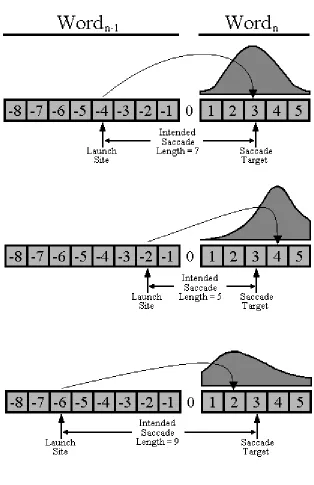
launch site (McConkie et al., 1988; Radach & Kempe, 1993; Radach & McConkie, 1998; Rayner, Sereno, & Raney, 1996) as the landing position varies as a function of the distance from the prior fixation. As the launch site moves further from the target word, the distribution of landing positions shifts to the left and becomes more variable (see Fig. 2).
Insert Figure 2 here
fixation time on the next word is inflated (Rayner & Duffy, 1986). Second, although the duration of the first fixation on a word is influenced by the frequency of that word, the duration of the prior fixation is not (Carpenter & Just, 1983; Henderson & Ferreira, 1993; Rayner et al., 1998). Third, high-frequency words are skipped more than low-frequency words, particularly when they are short and the reader is fixated close to the beginning of the word (O’Regan, 1979; Rayner et al., 1996). A second important finding is that there is a predictability effect in addition to a frequency effect. Words that are highly predictable from the preceding context are fixated for less time than are words that are not so constrained (Altarriba et al., 1996; Balota et al., 1985; Binder et al., 1999; Inhoff, 1984; Lavigne et al., 2000; Rayner et al., 2001; Rayner & Well, 1996; Schustack et al., 1987; Zola, 1984). Generally, the strongest effects of predictability on fixation time are not as large as those of the strongest frequency effects. Also, as we noted above, predictability has a strong effect on word skipping: Words that are highly predictable from the prior context are skipped more than words that are not so constrained.
2.8 Measures of processing time. To investigate the components of reading, researchers typically have subjects read sentences or passages of text while an eye tracker interfaced with a computer records the locations and durations of individual fixations. Because an average college-level reader can read approximately 300 words per minute (Rayner & Pollatsek, 1989), this technique produces a staggering amount of data. Accordingly, the data are usually reduced to word-based measures, which are across-subject averages that reflect how often and for how long individual words are fixated. A number of word-based measures are standard (Inhoff & Radach, 1998; Rayner, 1998; Rayner, Sereno, Morris, Schmauder, Clifton, & Rayner, 1989). The first is gaze duration, which is defined as the sum of all fixations on a word, excluding any fixations after the eyes have left the word (i.e., including only refixations before the eyes move on to another word). Gaze duration is usually averaged only over words that are fixated, and not skipped, during the initial encounter (or first pass) through that region of text. Two other common measures are first-fixation duration and single-fixation duration. The former is the duration of the first fixation on a word (again conditional on the word being fixated during the first pass through the text), while the latter is the average fixation duration on words that are fixated exactly once during the first pass. These indices are typically reported along with indices of how often a word was fixated: The probability of a word being skipped, fixated once, and fixated more than once before moving to another word. Often the total time (the sum of all fixations on the word, including regressions back to the word) is also reported.
The word-based measures provide a complete record of where and when fixations occurred. These two parameters (where vs. when) also provide a useful framework for organizing a discussion of reading models because much of the controversy surrounding reading concerns the determinants of where and how long the eyes remain fixated. The models that have been developed to explain eye movement control can be separated into two classes: Those in which eye movements are determined primarily by oculomotor factors (oculomotor models), and those in which eye movements are guided by some form of cognitive control (processing models). Prior to comparing different models, we will discuss our model, E-Z Reader (Pollatsek, Rayner, Fischer, & Reichle, 1999; Rayner, Reichle, & Pollatsek, 1998, 2000; Reichle et al., 1998, 1999; Reichle & Rayner, 2001) in some detail.
3.0 E-Z Reader
and McConkie (1979). McConkie (1979) suggested that during reading, visual attention progressed across a line of text until the limitations of the visual system made it difficult to extract further lexical information. Once this point of difficulty has been established, attention shifts and an eye movement is programmed and subsequently initiated, sending the eyes to the problematic location. Although elegantly simple, the model was soon discarded due to problems in defining and explaining what the point of difficulty was and how it might be computed and whether it could be computed soon enough to be of any use in skilled reading (Rayner & Pollatsek, 1989).
The limitations inherent in McConkie’s (1979) early model of eye movement control led Morrison (1984) to propose a model in which the movement of the eyes was a function of successful processing. According to Morrison, the identification of wordn (i.e., the word that is currently being
fixated) causes the attention “spotlight” (Posner, 1980) to move to wordn+1, which in turn causes the
oculomotor system to begin programming a saccade to wordn+1. If the program finishes before
wordn+1 is identified, then the saccade will be executed and the eyes will move to wordn+1. However,
if wordn+1 is identified before the program finishes, then the saccade to wordn+1 can be canceled. This
occurs when attention shifts to wordn+2, and the oculomotor system begins programming a saccade
to wordn+2, which overrides the program to saccade to wordn+1. Thus, according to Morrison,
attention moves serially, from word to word, whereas saccades can be programmed in parallel. Morrison’s (1984) assumption about parallel programming of saccades followed Becker and Jürgens’ (1979) demonstration that saccadic programming is completed in two stages: An initial (labile) stage that is subject to cancellation, and an ensuing (non-labile) stage in which the program cannot be canceled. They showed that if the oculomotor system begins programming a saccade while another saccadic program is in its labile stage of development, then the first program is aborted. However, if the second program is initiated while the first saccadic program is in its non-labile stage, then both saccades will be executed, which typically results in a very short fixation between the two saccades.
With these simple assumptions, Morrison (1984) was able to provide an elegant account of both frequency effects and parafoveal preview effects: Because short frequent words are more easily identified in the parafovea than long infrequent words, the former tend to be fixated for less time (and skipped more often) than the latter. Despite its successes, however, Morrison’s model cannot explain refixations because the strictly serial attention shifts cause each word either to be fixated exactly once or to be skipped. More fundamentally, however, because Morrison’s model posits both strictly serial processing of words and that attention shifting is time-locked to word identification, the model is unable to handle some simple, robust phenomena in reading. The first is that one often gets “spillover” effects due to word frequency (e.g., Rayner & Duffy, 1986). That is, lower frequency words often not only cause longer fixations on that word (wordn, but also lengthen either gaze durations and/or first fixations on the succeeding word (wordn+1). According to Morrison’s model, this shouldn’t happen because attention doesn’t shift until wordn has been processed.
Because parafoveal processing on wordn+1 begins after this attention shift, the amount of information
extracted from wordn+1 before it is fixated will only be a function of how long it takes to program and
execute the saccade, and will not vary as a function of the frequency of wordn. As a result,
as above, Morrison’s model predicts that this shouldn’t happen because parafoveal preview time is only a function of the latency of moving the eye after covert attention has shifted.
There are at least three ways to circumvent the limitations of Morrison’s (1984) model. The first is to add the assumption that if word identification is not completed by a processing deadline, attention does not shift to the next word, but instead remains on the current word, resulting in a refixation (Henderson & Ferreira, 1990; Sereno, 1992). This leads to the prediction (which has not been supported; Rayner et al., 1996; Schilling et al., 1998) that the first of two fixations should be longer than single fixations because the former reflect cases in which the processing deadline must have been reached. The second solution is to simply assume that difficulties with higher-order linguistic processing somehow cause the eyes to remain on the current word (Pollatsek & Rayner, 1990; Rayner & Pollatsek, 1989). Unfortunately, how this happens has not been well specified. Finally, a third way to avoid the shortcomings of Morrison’s proposal is to assume that word identification is completed in two stages. This last approach is instantiated by E-Z Reader, which is discussed next.
3.1 Overview of the E-Z Reader model. E-Z Reader, like other processing models, shares the basic assumption that on-going cognitive (i.e., linguistic) processing influences eye movements during reading. Because the model was not intended to be a deep explanation of language processing, however, it does not account for the many effects of higher-level linguistic processing on eye movements (for reviews, see Rayner, 1998; Rayner & Sereno, 1994; Rayner et al., 1989). Although this is clearly a limitation, it should also be noted that many of these effects typically occur when the reader is having difficulty understanding the text that is being read, such as when a reader makes a regression to re-interpret a syntactically ambiguous “garden path” sentence (Frazier & Rayner, 1982). The model should therefore be viewed as the “default” reading process. That is, we view the process of encoding words to be the forward “driving engine” in reading, as the process of knitting the words into larger units of syntax or meaning would be too slow (whether successful or not) to be a signal to decide how and when to move the eyes forward for skilled readers. Hence, we posit that higher-order processes intervene in eye movement control only when “something is wrong” and either send a signal to stop moving forward or a signal to execute a regression. Hence, we view E-Z Reader as a simulation of what happens during reading when higher-level linguistic processing is running smoothly and doesn’t intervene. One implication of this is that the model currently does not explain inter-word regressions.
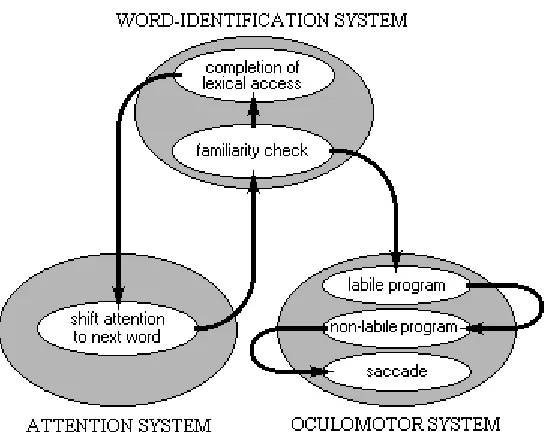
In E-Z Reader, fixation locations are determined by a combination of visual, oculomotor, and linguistic factors, whereas fixation durations are primarily determined by linguistic processing. Five processes determine when and where the eyes move: (1.) a “familiarity check”, (2.) the completion of lexical access, the (3.) labile and (4.) non-labile stages of saccadic programming, and (5.) the actual saccades. Crucially, unlike Morrison’s (1984) model, word identification is completed in two stages. Figure 3 is a schematic diagram that illustrates how these five processes are related to the attention, word-identification, and oculomotor systems, and how control is passed among these processes as they are completed.
Insert Figure 3 here
the familiarity check and the completion of lexical access is broadly consistent with the activation-verification model of lexical access (Paap et al., 1982), with the familiarity check corresponding to an initial, activation stage of lexical access, and the completion of lexical access corresponding to a later, verification stage.
The mean times required to complete the two stages of lexical processing are determined for each word, and are a function of two variables: (1.) each word’s normative frequency of occurrence, and (2.) each word’s predictability within the local sentence context. These two variables determine the mean durations (in ms) of the familiarity check, t(fn), and completion of lexical access, t(lcn), processes as follows:
t(fn) = {fb – [fm * ln(frequencyn)]} * (1 – 2 * predictabilityn) (1)
t(lcn) = ) * {fb – [fm * ln(frequencyn)]} * (1 – predictabilityn) (2) where fb (195 ms) and fm (17 ms per ln[frequency] unit) are free parameters that determine the linear relationship between the process durations and the natural logarithm of wordn’s frequency.
Likewise, 2 (0.5) is a free parameter that attenuates the degree to which predictability shortens the duration of the familiarity check stage, and ) (= 0.85) is a free parameter that makes the duration of the completion of lexical access stage some multiple of the duration of the familiarity check stage. Finally, the actual times that are required to complete t(fn) and t(lcn) are determined stochastically by sampling random deviates from gamma distributions with means equal to t(fn) and t(lcn), respectively, and standard deviations equal to one third of their means.
Because words require more time to identify when they are viewed in the parafovea (Rayner & Morrison, 1981), the rate of lexical processing is also modulated by foveal eccentricity, or the distance between the center of the word that is being processed and the character position that is being fixated. This is done using:
duration(x) = duration0 * ,x (3)
where duration(x) is the time required to complete lexical processing at a foveal eccentricity of x
character spaces, and duration0 is the time required to complete lexical processing when the eyes are fixated on the center of wordn. The free parameters , (1.09 and 1.13 for the familiarity check and
completion of lexical access, respectively) modulate the rate at which increases in foveal eccentricity slows lexical processing3
. It is reasonable that later stages of lexical processing, which probably require more precise information, are slowed down somewhat more than the early stages are when acuity is poorer.
The labile and non-labile stages of saccadic programming refer to the motor commands that are necessary to move the eyes, contingent upon whether or not those commands can be canceled. This distinction is consistent with Becker and Jürgens’ (1979) work, and allows the model to explain skipping. To understand this, imagine the case in which the eyes are fixated on wordn. After a
certain amount of time, the familiarity check on wordn completes, and the oculomotor system begins
programming a saccade to wordn+1. After completion of lexical access, wordn is identified, which causes attention to shift to the next word. At this point, one of two things will happen: (1) if the labile stage of the saccadic program finishes first, a saccade will be executed, and wordn+1 will be
fixated; or (2) if the familiarity check on wordn+1 finishes first, the labile program will be canceled,
and the oculomotor system will instead begin programming a saccade to wordn+2. This second
sequence of events causes wordn+1 to be skipped.
is presumably the optimal viewing location.) A “race” between the familiarity check and the labile stage of saccadic programming, similar to the “race” described above, produces refixations, but only when processing of the word is slow. That is, if this program to fixate the center of wordn completes
before the familiarity check on wordn, then an intra-word saccade will be executed, and wordn will
be refixated (except in those cases where oculomotor error causes the eyes to overshoot their intended target; see below). However, if the familiarity check finishes before the labile stage of programming, then the intra-word saccade program will be canceled, and the oculomotor system will instead begin to program a saccade to the next word. Because the outcome of this “race” is largely determined by how rapidly the familiarity check can be completed, low-frequency words will tend to be refixated more often than high-frequency words. Moreover, because the duration of the familiarity check increases as a function of foveal eccentricity (see Equation 3), the probability of refixating increases as the distance between the location of the initial fixation and the optimal viewing position increases. The model thus provides a mechanism for O’Regan’s (1990, 1992) observation that, if the eyes fail to land on the optimal viewing position, then the oculomotor system will attempt to move the eyes to another position within the word so as to provide a better viewing location from which to identify the word, so that a refixation will be more likely if the initial landing position is “bad”.
Like the word-identification processes, the actual durations of the labile and non-labile programming stages, t(m) and t(M), respectively, are determined stochastically by sampling random deviates from gamma distributions having fixed means and standard deviations equal to 1/3rd of their means. Thus, the mean durations of t(m) and t(M) are free parameters (135 and 50 ms, respectively), as is the time required to complete a saccade (which was set equal to a fixed value of 25 ms).
As Figure 2 indicates, the distinction between the familiarity check and the completion of lexical access is important because the former signals the oculomotor system to cancel any pending saccades and to begin programming a saccade to the next word, whereas the latter causes attention to shift to the next word. However, it is important to point out that, by “attention,” we do not mean those mechanisms that are necessary for the spatial orientation of low-level visual processing; instead, we mean those mechanisms that are used in the service of word identification. The separation between these two types of attention has precedent in the literature (LaBerge, 1990); for example, Treisman (1969) distinguished between input selection, which refers to the mechanisms involved in spatial orientation, and analyzer selection, which refers to the mechanisms that enhance target identification. This distinction is important for several reasons: First, the evidence which suggest that saccades to particular target locations are preceded by attentional shifts to the same locations (Hoffman & Subramaniam, 1995; however, see Stelmach, Campsall, & Herdman, 1997) are not inconsistent with our assumption that saccadic programming (which may require input selection to be moved to a new spatial location) is decoupled from the shifting of attention, or analyzer input.
usually occur in normal reading. Serial processing instead preserves the temporal organization of the text, thereby enabling linguistic processing and comprehension.
Finally, by decoupling eye movements from attention, our model can explain aspects of eye movement control that Morrison’s (1984) model could not. For example, E-Z Reader can explain why parafoveal preview benefit decreases as foveal processing difficulty increases (Henderson & Ferreira, 1990; Kennison & Clifton, 1995). If the eyes are on wordn, parafoveal processing of
wordn+1 begins, not with completion of the familiarity check, but after the completion of lexical
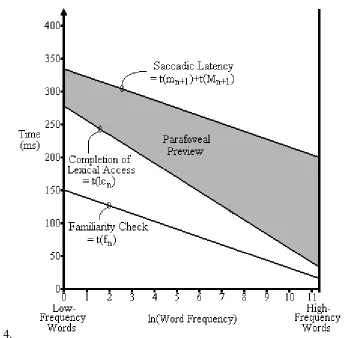
processing of wordn , and ends with the onset of the saccade to wordn+1. As Figure 4 illustrates, the
disparity between wordn’s familiarity check duration and the time required to complete lexical access
increases as the normative frequency of wordn decreases (see Equations 1 and 2). Notice, however,
that the time required to initiate a saccade to wordn+1 is not modulated by word frequency, so that
the saccadic latency will (on average) follow the familiarity check by 185 ms (i.e., the sum of the labile and non-labile saccadic programming durations). Thus, with other things being equal, the amount of time available for parafoveal processing of wordn+1 decreases as the frequency of wordn
decreases (or becomes more difficult).
Insert Figure 4 here
As described thus far, fixation durations are largely determined by lexical processing. Fixation locations on words, however, are largely subject to visual and oculomotor constraints. In E-Z Reader, these factors determine fixation locations in a manner suggested by McConkie and his colleagues (1988, 1991): Saccades are always directed towards the optimal viewing position within the intended word targets (O’Regan, 1990, 1992), but because of both random and systematic motor error, the saccades often deviate from their targets. Thus, occasionally an unintended word may be fixated. The length of the saccade that is actually executed is the sum of three components:
Saccade = PSL + SRE + random error (4)
where PSL is the programmed saccade length (in character spaces), SRE is the systematic range error, and the final term is a random error component. The systematic range error, SRE, is given by:
SRE = (Q – PSL) [Sb – ln(fixation duration) / Sm] (5) where Sb and Sm are free parameters that specify the degree to which the natural logarithm of the launch site fixation duration modulates the size of the systematic range error. The values of these parameters (7.3 and 4.5, respectively) were selected so that the systematic range error would decrease as the fixation duration on the launch site increased. The parameter Q determines the saccade length for which saccades neither undershoot nor overshoot their intended targets. On the basis of previous research (McConkie et al., 1988), the value of Q was set equal to 7. Finally, the
random error component in Equation 4 is sampled from a Gaussian distribution with :random error = 0 and Frandom error given by:
Frandom error = ßb + (ßm * PSL) (6)
where ßb and ßm are free parameters that specify how much the random error component increases with programmed saccade length. The values of ßb (0.85) and ßm (0.11) were also broadly consistent with those that have been reported elsewhere (Kowler, 1990).
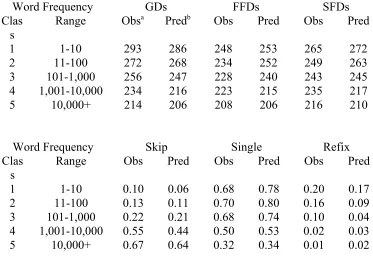
in the sentence corpus. (For example, the word “torpedo” is used very infrequently, and occurs only once per million words of text, whereas “the,” the most frequent word in the English language, has a token frequency of 69,975 per million.) We also completed a separate cloze task experiment (i.e., in which participants had to guess the identity of wordn+1 given the sentence up through wordn) to determine each word’s mean predictability within its sentence context. Finally, the words were divided into five frequency classes (see Table 1).
The first set of simulations (Reichle et al., 1998) evaluated the model’s capacity to predict the temporal dynamics of eye movements during reading. Overall, these simulations were very successful. The model predicted the mean values of six word-based measures (gaze, first-fixation, and single-fixation durations, and the probabilities of skipping, making a single fixation, and refixating) for the five frequency classes of words (see Table 1), and it generated gaze duration and first-fixation duration distributions that closely resembled those that were observed in the data. Although this is not entirely surprising given the prominent role of word frequency in Equations 1 and 2, the model also generated frequency effects that closely resembled those reported by Schilling et al. (1998) on length-controlled target words (see Table 2). Moreover, the model produced both spillover effects and preview effects that were comparable to those reported in the literature (see Table 3). Finally, as Table 3 also shows, the model predicted a processing cost, or gaze duration increase, on wordn for skipping wordn+1, as well as a similar cost on wordn for having skipped word n-1. Although both predictions were confirmed in the data, the latter finding is noteworthy because
it had not been previously reported in the literature.
Insert Tables 1-3 here
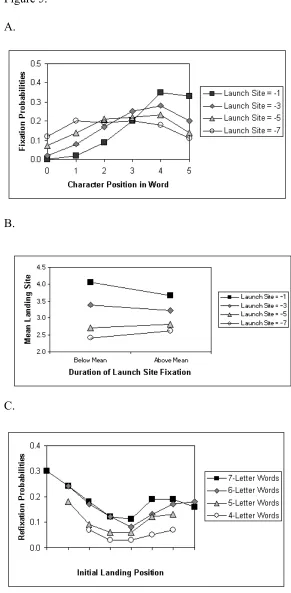
The second set of simulations (Reichle et al., 1999) evaluated the model’s capacity to account for the spatial properties of eye movements during reading. To do this, we examined the landing site distributions that were generated by the model on 4-, 5-, 6-, and 7-letter words (again using the Schilling et al., 1998, sentences). As Figure 5a indicates, the predicted landing site distributions closely resembled those reported by McConkie and his colleagues (1988, 1991; see Fig. 2): The landing sites were normally distributed with means that tended to shift towards beginnings of the words as the distance between the launch sites and landing sites increased. As Figure 5b indicates, the magnitude of this leftward shift was also modulated by the duration of the launch fixation, so that longer fixations on the launch site attenuated the effect of saccade length. These simulation results thus contradict Reilly and O’Regan’s (1998) claim that processing models cannot explain the patterns of landing site distributions that are normally observed during reading. Finally, as Figure 5c shows, the model predicted fewer refixations following initial fixations near the centers of words. As already mentioned, this happens because fixations near the optimal viewing position generally allow the familiarity check to be completed very rapidly, so that the eye movement system begins programming an interword sacccade (to the next word) rather than the default intraword saccade (which would result in a refixation). Such parabolic patterns of refixation probabilities have been reported in the literature (McConkie et al., 1988; Rayner et al., 1996).
Insert Figure 5 here
4.0 Alternative Models of Eye Movement Control
oculomotor systems (e.g., visual acuity, saccade accuracy) largely determine fixation locations. An auxiliary assumption is that fixation durations are largely determined by where the eyes have fixated. 4.1.A. Strategy-tactics. One such account of eye movement control in reading is provided by the strategy-tactics model (O’Regan, 1990, 1992; O’Regan & Lévy-Schoen, 1987). This model originated from two observations: First, words are identified most rapidly if they are fixated slightly to the left of center, on the optimal viewing position; and second, words are also less likely to be refixated if they are initially viewed from this position. These results lead O’Regan to suggest that readers adopt a “strategy” of directing their eyes from word to word, in an attempt to fixate each word’s optimal viewing position. This “risky” variant of the basic reading strategy can also be supplemented with a “careful” variant that includes the following within-word “tactic:” If the eyes do not land near the optimal viewing position, then immediately move them to the other end of the word. Using this tactic ensures that every word will either be viewed from its optimal position (in the case of single fixations) or will be viewed from two different locations (in the case of refixations).
Because the within-word tactics are guided by visual factors (e.g., word length), the model predicts that linguistic variables (e.g., word frequency) (1) should only modulate fixation durations when there is a single long fixation or when the fixation is the second of the two, and (2) should not modulate refixation probabilities. Unfortunately for the strategy-tactics model, neither of these predictions has been confirmed. Rayner et al. (1996) found that word frequency effects were evident in the first of two fixations (see also Sereno, 1992) and that refixations were more likely on low-frequency words than on high-low-frequency words (with length controlled). In addition, Rayner et al. found that neither fixation durations nor frequency effects on single-fixations varied as a function of landing position, which suggests that the optimal viewing position may be much less important in normal reading than in the identification of single words when they are presented in isolation (see also Vitu, O’Regan, & Mittau, 1990).
4.1.B. Word-targeting. A second class of oculomotor theories was largely motivated by the seminal work of McConkie and his colleagues (McConkie et al., 1988, 1989, 1991; Radach & McConkie, 1998). As mentioned previously, they expanded upon the observation that readers typically fixate the preferred viewing location (Rayner, 1979) and found that landing site distributions behaved very systematically with respect to both the saccade length and the launch site fixation duration. These findings led McConkie and his colleagues to conclude the following: First, the shape of the landing site distributions (which resembled truncated Guassian distributions; see Fig. 2) reflects random noise in the oculomotor system, with the missing tails being due to cases in which the eyes under/overshot their intended targets. The oculomotor system is also biased to make saccades approximately seven character spaces in length, so that longer saccades tend to undershoot their targets, while shorter saccades tend to overshoot their targets. This systematic range error causes the distributions to shift towards the beginnings of words as the launch site becomes more distant from the intended saccade target. With longer launch site fixation durations, however, the eye movement system has more time to plan its saccades; the resulting increase in saccadic accuracy, in turn, reduces the systematic range error.
al., 1994; McConkie & Dyre, 2000; see also Brysbaert & Vitu, 1998), these accounts are little more than precise descriptions of the data, and do not attempt to explain how linguistic processing affects fixation durations during reading. Also, because these descriptions address the “where?” and “when?” questions of eye movement control independently, they fail to explain why the durations of fixations are related to their spatial locations.
Recently, however, several word-targeting strategies were implemented as computer simulations (Reilly & O’Regan, 1998) so that various assumptions regarding eye movement control could be evaluated with respect to how well they handle the findings related to landing-site distributions (McConkie et al., 1988). These simulations included several alternative oculomotor (e.g., word-by-word, target long words, and skip short words) and processing strategies (e.g., skip high-frequency words). The results of these simulations indicated that the target-long-words strategy fit the landing-site distributions better than the other strategies, while the language-based strategies fared rather poorly overall. On this basis, Reilly and O’Regan proposed that language-processing models cannot provide an adequate account of eye movement control during reading. However, the language-based model that they implemented was little more than a straw man version of the early Morrison model and, as we indicated earlier, their claim that language-processing models cannot account for eye movement control is contradicted by our demonstration that E-Z Reader can, in fact, generate reasonable looking landing site distributions (Reichle et al., 1999).
4.1.C. Minimal-control. One final oculomotor account of eye movement control is provided by Suppes’ (1990, 1994) minimal-control model. In this model, neither fixation durations nor saccade lengths are affected by linguistic or cognitive factors, but are instead affected only by the physical layout of the text. The model consists of a small number of axioms that describe the fixation duration distributions and a random-walk process that determines where the eyes will move next.
The axioms describing fixation durations are as follows: First, the duration of each fixation is a function of the number of operations (which are never specified) that must be completed during each fixation. Second, fixation durations are stochastically determined by sampling from an exponential distribution if a single operation must be completed; in cases requiring two operations, the durations are described by the convolution of two independent exponential distributions. Finally, fixation times are independent of both earlier processing and the current text content. Thus, the model stipulates that variability in fixation durations is not due to variability in the duration of the underlying cognitive processing, but instead reflects the probabilistic nature of the processing.
Saccades are determined by a similar set of rules. First, if the processing within a region of regard has been completed, then the eyes are moved to the next word; otherwise, they remain in the same location. Second, if processing has not finished and the memory for a prior region of regard has decayed, then move the eyes back to the prior region. Third, if perceptual processing of the upcoming word has finished from the current location, then skip the upcoming word. Finally, each saccade is independent of earlier processing and previous saccades.
(1994) to affect eye movements during reading.
In the final analysis, therefore, it is clear that the oculomotor models have provided important insights into the nature of eye movement control during reading. Moreover, the phenomena that these models have attempted to explain are important benchmarks for evaluating any model of reading. However, the models are limited; because they have focused on the roles of oculomotor and visual determinants of eye movement control, they have generally ignored language processing, which has also been shown (during the past three decades of research) to have important effects. Rather than being incorrect, therefore, the oculomotor models are incomplete because they provide only a limited account of the entire reading process.
4.2 Processing models. As already stated, the processing models differ from the oculomotor models in that they tend to emphasize the role of language processing in influencing eye movements during reading. Generally speaking, the decision about how long to fixate is determined by on-going linguistic processing, while the question of where to fixate is jointly decided by linguistic, visual, and oculomotor factors.
4.2.A. Reader. One of the most widely known processing models is Reader (Carpenter & Just, 1983; Just & Carpenter, 1980, 1987; Thibadeau, Just, & Carpenter, 1982). In contrast to the other models discussed in this article (including E-Z Reader), Reader attempts to explain reading in its entirety, including the low-level encoding of visual features, lexical processing, semantic and syntactic analysis, and the schema-guided comprehension and abstraction of key ideas that normally occurs during reading.
In Reader, eye movements are posited to be tightly linked to cognitive processing. This coupling is based on two assumptions: The first is the immediacy hypothesis, which stipulates that each word is processed to the farthest extent possible when it is fixated. The second assumption is the eye-mind hypothesis, which stipulates that the eyes remain fixated on a word until the processing on that word has been completed. Both the durations and locations of individual fixations are thus determined by the immediate processing of the word that is being fixated.
Reader was implemented as a computer simulation with a production-system cognitive architecture (Anderson, 1983; Anderson & Libiere, 1998; Newell, 1990). Productions are procedural condition-action pairs (i.e., if-then statements) that perform operations on units of declarative knowledge. For example, the production:
If (letter1 = “m” & letter2 = “a” & letter3 = “n”), then (word = “man”)
encodes the percept “man,” so that the meaning of the word can then be retrieved from semantic memory. In Reader, the productions are activation-based; that is, they direct activation towards units of declarative knowledge. These units of declarative knowledge, in turn, have thresholds that must be exceeded if the information is to be “active” in working memory (and thereby satisfy the conditions of other productions). The values of these thresholds are adjusted to modulate the cost associated with using each production. For example, the thresholds of those productions that mediate lexical access are adjusted to reflect each word’s normative frequency of occurrence, so that low-frequency words take longer to identify (and are consequently fixated longer) than high-frequency words. Also, in the most recent version of the model (Just & Carpenter, 1992), the amount of activation that is available to support processing is limited (and is a free parameter) so that individual differences in working memory capacity can be used to simulate individual differences in reading ability.
model attempts to explain the entire reading process. The model therefore does reasonably well simulating a number of language-related reading phenomena, such as word-frequency effects, increased reading times on lexically ambiguous words, and the processing difficulties which are found with syntactically ambiguous sentences. Unfortunately, however, the model is extremely complex (it consists of 225 productions; Just & Carpenter, 1987), and hence lacks the conciseness and controllability of other computational models (e.g., the inner workings of the model are not transparent, and can only be described verbally). It is also difficult to evaluate the model’s performance because it depends upon the complex interplay of productions, many free parameters, and the regression weights on several independent variables (e.g., whether or not a word is the first in a sentence) that are necessary to convert production cycles (arbitrary units of time) into processing time. Furthermore, the model only makes predictions about the locations of fixations at the level of individual words, using a composite measure (gazes) that counts skipping a word as zero duration in the average. This means that the model does not really make precise predictions about which word is fixated. In addition, apart from word-length effects, the model fails to account for any of the phenomena that are explained by the oculomotor models (e.g., landing site distributions).
In addition to the above shortcomings, Reader has been criticized because of the immediacy and eye-mind assumptions. With respect to the former, there is considerable evidence that the lexical processing of a word is often initiated before the word has been directly fixated (i.e., parafoveal preview; Balota et al., 1985; McConkie & Rayner, 1975; Pollatsek et al., 1992; Rayner, 1975). With respect to the eye-mind hypothesis, there is evidence that the normative frequency of wordn can modulate how long the eyes remain on wordn+1 (Rayner & Duffy, 1986; Rayner et al.,
1989). These spillover effects indicate that the eyes often leave a word before the processing of that word is complete, contrary to the eye-mind assumption. Thus, even if eye movements during reading are partially guided by language processing, the Reader model greatly over-simplifies how this occurs. Furthermore, the depth of linguistic processing assumed before the eyes are allowed to move seems somewhat implausible.
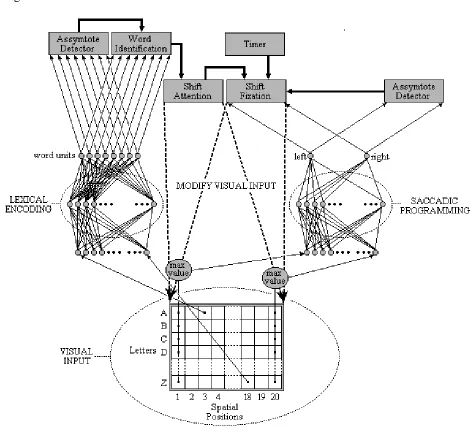
4.2.B. Attention-shift. A second processing model, the attention-shift model or ASM (Reilly, 1993), relaxes the assumption that linguistic processing and eye movement control are tightly coupled. As Figure 6 indicates, ASM is implemented as a pair of interacting connectionist (i.e., PDP; McClelland & Rumelhart, 1986; Rumelhart & McClelland, 1986) networks. The model’s architecture consists of two single-layer networks that were trained using a back-propagation learning algorithm (Rumelhart, Hinton, & Williams, 1986). One network is responsible for word recognition; the other is responsible for programming saccades. As each word is identified, the lexical-encoding network signals attention to shift to the next word, so that it can be processed. The movement of attention, in turn, causes the saccadic-programming network to begin programming a saccade to the next word. In contrast to E-Z Reader, ASM does not allocate attention serially, from one word to the next. The attention “spotlight” is instead fixed in size, so that whatever falls within the spotlight will be the focus of attention. This means that, in cases where two or more short words follow in immediate succession, they both may be in the spotlight and thus more than a single word can be encoded on a given fixation.
Insert Figure 6 here
limitations. Thus, the activation patterns that represent letter features become more “degraded” (i.e., the activation values of the units representing the letters decrease and are more prone to noise) as they are encoded further from the fovea, especially for letters that share many features with other letters. This degradation allows the model to account for the finding that word identification becomes more difficult as the distance between the word and the fovea increases (Morrison & Rayner, 1981).
Although Reilly (1993) does not provide a detailed account of his model’s performance, it does simulate a few of the basic phenomena related to eye movement control in reading. For instance, the model generates mean fixation durations and saccade lengths that are in close agreement to values that have been reported in the literature. In contrast to E-Z Reader, however, ASM is not fitted to the various word-based measures, nor has it been shown to generate means and distributions for the different frequency classes of words. Nonetheless, because the amount of training that the word-recognition module receives on each word is proportional to each word’s frequency of occurrence, the model does predict that low frequency words are fixated longer than high frequency words. Moreover, because two successive short words are sometimes encoded in parallel, the model is able to account for the skipping of short (and typically high frequency) words, as well as parafoveal preview benefit. As mentioned earlier, though, ASM does not account for either of these phenomena the same way that E-Z Reader does. In E-Z Reader, skipping occurs whenever the fixated word has been identified, attention has shifted to the next word, and this word has also been identified (in the parafovea). In contrast to E-Z Reader, there is nothing in ASM to account for how highly predictable words than are not short could be skipped.
Finally, like E-Z Reader, saccadic programming in ASM is prone to noise, so that individual words can be refixated and/or skipped due to simple oculomotor error. Reilly (1993) has not, however, demonstrated that the model can reproduce the complex dependencies between the locations and durations of launch sites and the landing site distributions. We therefore contend that, unlike E-Z Reader, ASM does not provide an adequate account of the visual, oculomotor, and language-processing determinants of eye movement control in reading.
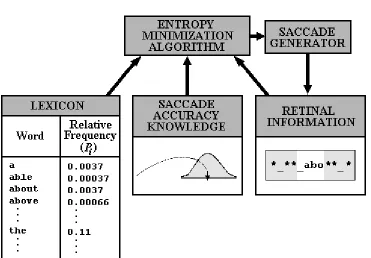
4.2.C. Mr. Chips. A third processing model, Mr. Chips (Legge, Klitz, & Tjan, 1997; Klitz, Legge, & Tjan, 2000), represents a very different approach to understanding the inter-relationships among visual processing, word recognition, and eye movement control during reading. The model was proposed as a means to evaluate how an ideal-observer (i.e., a reader with perfect lexical knowledge and a well specified goal: maximizing reading speed) would move his/her eyes. The model does this using three pieces of information: First, input from a “retina” that encodes a small number of letters in the fovea and indicates whether letters in the periphery are present or absent. The second piece of information is knowledge about the relative frequencies with which words occur in text. Finally, the model knows the likelihood of making a saccadic error of a given size for each given saccade length. These three types of knowledge are depicted in Figure 7.
Insert Figure 7 here
imagine that the model has the following information about a word: It is five letters long and begins with “abo” (see Figure 7). The model uses this information in conjunction with its lexical knowledge to calculate conditional probabilities of the letter string being each of the words that satisfy these constraints. This is done using Equation 7:
pi = PiGjPj (7)
where pi is the conditional probability of the letter string being wordi, Pi is the absolute probability of the letter string being wordi, and the Pjs are the absolute probabilities of the letter string being
each of the other candidate words. In the Figure 7 example, the conditional probability that “abo--" is “about” is p = 0.849.
The conditional probabilities are then used to compute the conditional entropy, or degree of uncertainty, H, that would result from a saccade of length, L, under the assumption that the letter string is wordi:
H(L, wordi) = -Gipi log2 (pi) (8) For example, from the current fixation, the entropy associated with the letter string is H(0, abo--) = 0.613. (Smaller entropy values represent less uncertainty about the identity of a word, so that identification occurs with certainty when the entropy value associated with a letter string equals zero.) A saccade of L = 1 would reveal one letter, which, given the model’s lexical knowledge, must be either “u” or “v.” If the letter is “u,” then the conditional probability of the word being “about” is p = 1, and the conditional entropy would be reduced to H(1, about) = 0. Likewise, if the letter is “v,” then the conditional entropy would also be reduced to H(1, above) = 0.
After the conditional entropies are calculated for each possible saccade length, Mr. Chips computes a probability-weighted average to determine the expected entropy associated with a saccade of each given length. This is done using Equation 9:
H(L) = -Gipi H(L, wordi) (9)
In the example, H(L) = 0 for saccades of lengths 1-5. Because of saccadic error, however, each saccade of intended length L has an associated landing-site distribution, PL(x), which determines the probability of making a saccade of actual length x. The model uses this knowledge to calculate the entropy associated with each saccade length, L, averaged across all of the possible landing sites. This gives the expected uncertainty, HL, associated with making a saccade of intended length L:
HL = GiPL (x) H(x) (10)
Finally, the model makes the saccade that minimizes HL, and thereby maximizes the probability of identifying the word. In cases where more than one possible saccade yields the same expected entropy, Mr. Chips executes the longest saccade possible so as to maximize reading speed.
Because Mr. Chips was only developed with the intent of examining the way lexical knowledge and restrictions on visual encoding affect saccade lengths and fixation locations, the model does not address the “when?” question of eye movement control. Several of the model’s emergent properties, however, are consistent with research findings about where the eyes move. For example, the model predicts that the mean saccade length will be around seven character spaces (McConkie et al., 1988), and that saccades will tend to be directed towards the optimal viewing position (O’Regan, 1990). The model also predicts parafoveal preview effects because the left-most letters of upcoming words are often identified before the words are actually fixated.
maximizes this gain. Klitz et al. (2000) acknowledge this fact, and say that their model “is not intended as an exact model of how humans perform a task, but rather establishes an upper bound (i.e., a level of competence) for human performance.” Furthermore, the Mr. Chips algorithm is well approximated by the simple heuristic of left-justifying the target word in the high-resolution part of vision, so that, on some level, the model is psychologically plausible.
Moreover, it is important to point out that Mr. Chips, unlike the other models discussed in this article, was developed to investigate how visual impairment might affect eye movements during reading. In this capacity, the model has been successful (Klitz et al., 2000). A comparison of the model’s performance to that of a human in a reading task4 with a simulated scotoma (i.e., a blind spot in the visual field) indicated that, in contrast to the model, the human had difficulty integrating information across central scotomas more than a single character-space in size. The human reader appeared to primarily use visual information from one side of the scotoma and use the visual strategy of moving the eyes in order to place the region of normal vision over all of the character spaces in turn, rather than using lexical knowledge to winnow down the possible identities of letter strings from a single fixation. Although the human reader’s natural strategy produced shorter saccades, it markedly increased reading speed over when they tried to execute the Mr. Chips strategy. These analyses, therefore, suggest that, while the seemingly erratic eye movements of readers with scotomas do not allow the maximal amount of information to be extracted from the page during each fixation, they are nevertheless adaptive in that they allow a maximal overall rate of information extraction.
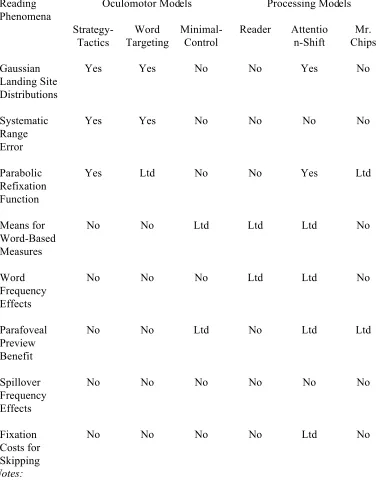
In summary, the processing models extend the theoretical coverage of the oculomotor models by attempting to specify how the key component of reading - word identification - affects (and is affected by) vision and the oculomotor system. This is important because a large number of linguistic variables have well-documented effects on eye movements during reading (for reviews, see Rayner, 1998; Rayner & Duffy, 1988; Rayner & Sereno, 1994). Indeed, much of the interest surrounding the use of the eye-tracking methodology is that it affords a relatively nintrusive, on-line way to study language processing. Of course, the processing models are not equally successful in handling the phenomena addressed by the oculomotor models. Table 4 lists the various eye-movement phenomena that have been observed during reading, and which our model, E-Z Reader (Reichle et al., 1998, 1999), explains. Table 4 also summarizes the performance of the other reading models with respect to these phenomena. On the basis of our analysis, we conclude that E-Z Reader provides the most comprehensive and complete theory of eye movement control in reading. In the final section of this paper, we will briefly discuss the possible roles that E-Z Reader may play in future reading research.
Insert Table 4 here
5.0 Future Research
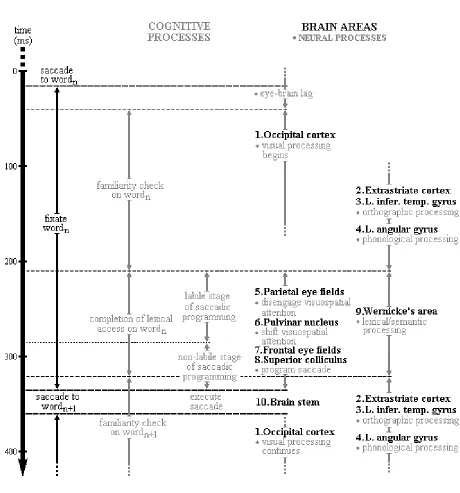
might be used to better understand higher-level linguistic processing in the context of natural reading. Finally, we will consider how recent advances in cognitive neuroscience have influenced our understanding of eye movement control in reading, and then speculate on how the E-Z Reader model might be conceptualized in light of this new information.
5.1 Eye movement control during reading. One virtue of computational models is that they can be used to answer questions that, because of their very complexity, might otherwise be too difficulty to even ask. For instance, Engbert and Kliegl (2001) sought to evaluate the basic assumption in E-Z Reader that lexical processing is the “engine” driving eye movements during reading. That is, they wanted to know if the time course of saccades is always determined by the time course of lexical processing. To answer this question, they implemented a computational model that, like E-Z Reader, accounts for eye movement control during reading in terms of a few assumptions about lexical access and saccadic programming. There are two versions of the model, a two-state and a three-state version. The former is quite similar to a simpler version of E-Z Reader (Model 2 in Reichle et al., 1998), but there is no separate familiarity check stage, and it makes somewhat different assumptions about the variability of processes. The three-stage model is similar to the version of E-Z Reader that we are discussing except that, functionally, the familiarity check is replaced by an all-or-none process. That is, the reader is either assumed to wait until lexical access is completed before programming a saccade or an “autonomous saccade” (i.e., completely independent of lexical processing) is executed. This all-or-none process (i.e., fully process the word before making a saccade or don’t pay any attention to lexical processing) contrasts with E-Z Reader, in which the signal to make the saccade is partial lexical processing of the attended word.
The basic model was first fitted to the same sentences (taken from Schilling et al., 1998) that were used to evaluate E-Z Reader. The model successfully predicted the mean fixation durations and skipping rates for the five frequency classes of words, and in so doing demonstrated that the state transitions can in fact be described using different distributional assumptions (i.e., residence-time dependent probabilities). Because these residence-residence-time dependent probabilities can be implemented as an exact algorithm, whereas sampling from gamma distributions cannot, the model advances our understanding of eye movement control by providing something like a process model of where the variability is coming from. The introduction of autonomous saccades in the three-state model marginally improved the ability of the model to fit frequency effects on both gaze durations and probability of word skipping. It also allows the model to (at least qualitatively) predict other phenomena that the E-Z Reader model can predict such as spillover effects and word frequency effects on preview benefit. However, it is by no means clear that this improvement can be taken as evidence for the existence of autonomous saccades during reading (as Engbert & Kliegl claim) since E-Z Reader predicts the same phenomena by positing the familiarity check stage.
used to inform our understanding of other task domains are discussed next.
5.2.A. EMMA. Salvucci (2000a, 2000b) has recently extended the core principles in E-Z Reader to provide a general theory of the interrelationships among cognition, attention, and eye movements. This model, EMMA (Eye Movements and Movements of Attention), has been implemented within the ACT-R/PM production-system architecture (Anderson & Lebiere, 1998; Byrne & Anderson, 1998). In EMMA, the encoding time for both words and objects, Tenc, is given by Equation 11:
Tenc = K [-log(frequency)] ek,
(11) where the frequency of occurrence is scaled within the range (0, 1), , is the eccentricity of the word or object (as measured by the angular distance between it and the fovea), and K and k are free parameters which scale the encoding time and eccentricity parameter, respectively. EMMA shares the following assumptions with E-Z Reader: First, encoding times are a function of both normative frequency and foveal eccentricity. Second, the actual amount of time that is required to encode a given object or word is determined stochastically by sampling random values from gamma distributions having fixed means (cf. Equations 1 & 2, in E-Z Reader, and Equation 11, in EMMA) and standard deviations. Third, saccadic programming is completed in two sequential stages (the first being subject to cancellation by subsequent programs, the second not), the durations of which are sampled from gamma distributions having fixed means and standard deviations. Finally, although saccades are directed towards the centers of their intended targets, they often deviate from their targets because of Gaussian motor error.
5.2.B. Non-reading tasks. Although EMMA and E-Z Reader share many common
assumptions, there are also a few notable differences. First, in contrast to E-Z Reader, the encoding time in EMMA is not modulated by predictability, so that the model cannot account for predictability effects (Balota et al., 1985; Ehrlich & Rayner, 1981; Rayner & Well, 1986). Second, the distinction between the familiarity check and the completion of lexical access in E-Z Reader corresponds to the encoding and cognitive-processing stages in EMMA, respectively. As cognitive processing completes, it directs the visual system to encode additional information. However, because only the rate of encoding (and not cognitive processing) is modulated by normative frequency, EMMA cannot account for the interaction between parafoveal preview benefit and foveal processing difficulty (Henderson & Ferreira, 1990). Finally, in EMMA, foveal eccentricity is measured in terms of angular disparity rather than character spaces. Although this last difference between the two models is largely cosmetic, it allows EMMA to simulate tasks other than reading.