An Analysis On The Performance Of Dynamic
Adaptive Streaming Over Http By Performing
Diagnostic Analytics On Video Streaming
Features.
A.John Pradeep Ebenezer, Dr. J.Abdul Samath
Abstract:— In this paper a complete analysis on Adaptive bitrate algorithms and its performance is actualized. The core target of adaptive bitrate algorithms is to ensure high quality of experience for the viewers. Normally streaming across networks has to overcome all the network related overheads such as delay, jitter, and bandwidth. Adaptive bitrate algorithm, adapts to the network condition, decides on the bitrate needed to transfer the video segment to the client and also performs efficient management of the cache. Dynamic Adaptive Streaming over HTTP (DASH) is the latest Adaptive bitrate algorithm (ABR) which ensures the viewer the maximum quality of experience. The MPEG-DASH algorithm uses BOLA and DYNAMIC bitrate algorithm. In this paper a complete analysis on the impact of DASH algorithm on video streaming is analyzed. The Speed Video Global Operating Platform (SVGOP) established by Huawei is used to estimate the impact of DASH on video streaming. The research take into account the Mean opinion score, loading of the content, quality of the content, video stalling, initial buffer latency, video initial DL rate and video initial buffer stable rate for analyzing the performance of DASH algorithm. The correlation between these features is analyzed and the future perspective and advancement that can be implemented in adaptive bitrate algorithm is suggested.
Index Terms:— adaptive, bitrate, buffer, dynamic, latency, loading, quality, stalling,
—————————— ——————————
1
I
NTRODUCTION[1]According to cisco of all the multimedia components creating network traffic, video traffic will hold a share of 8 percent in the near future. By the year 2022 live internet video will account for 17 percent of internet video traffic. The video on demand will play a major share in the content that is transferred across network and the traffic created by video on demand will almost double. To improve streaming of video, content delivery networks will be on the rise and it will account for 72 percent of internet traffic. As there is an alarming rise in sharing of video across network, the QoE of the user will be the key factor to be studied upon. Devices used to watch online videos worldwide according to statista are computer or laptop, smart tv, smartphones and tablets. These devices will be operating on very high end networking technologies such as Wi-Fi 6, 5G, digitized spaces, SD-WAN. These latest technologies will be ruled by video providers such as Netflix, amazon prime video, hulu, playstation vue, youtube tv, sling tv, crunchy roll and twitch. The primary concern for these providers will be increasing the quality of experience of the users. [2]The behavior of the user viewing the video changes based on the quality of the video delivered. Factors determining the quality of experience are often in conflicts. The quality of the video, bandwidth, bitrate and buffering doesn’t go hand in hand. Dynamically adapting the bitrate of the video streaming based on the throughput with less buffering is the only option available for maximizing the quality of experience. There is direct relationship between the churn rate and the quality of experience of the user viewing the streaming video.
2
R
EVIEW OF LITERATUREAlmost all video streaming services uses adaptive bitrate techniques to reduce the churn rate. Adaptive video streaming works by adapting the video content with respect to the device and network characteristics. The primary logic behind the adaptive bit rate streaming is, the video is split into segments which corresponds a few seconds of play. Encoding of the segments is done based on different bitrates which will cope with different devices and network connections. The ABR algorithms are throughput based, buffer based and time based (Hybrid). The throughput based algorithm works based on estimating the throughput, smoothing the throughput to reduce estimation errors, quantizing the smoothed throughput with the different video representations and finally scheduling the next segment. [3] PANDA is the throughput based algorithm which is prominently practiced, which probes the throughput and adapts. [4]SQUAD is another throughput algorithm which maximizes the quality of experience based on the number and magnitude of switching between segment quality. [5] A Fair, Efficient, Stable, adaptIVE throughput algorithm called FESTIVE decides on the timing of scheduling the request of the next segment after mapping the bitrate with each chunks. The buffer based adaption algorithm on the context on deciding the bitrate and the segments are scheduled based on the buffer level. [6]BBA is a buffer based algorithm which linearly maps the average segment size with the immediate buffer level talking into considerations the lowest and highest bit rate. [7]BOLA is the buffer based algorithm which implements lyapunov optimization to fix the video bitrate of each segment. This algorithm reduces re-buffering and increase the average quality perceived. Comparing the download time and throughput, the download time is perceived as a higher level parameter. [8]This gives an opening in designing time based adaption algorithm ABMA+. It is an adaption and buffer management algorithm which optimizes the selection of video representation with reference to the predicted probability of video stalling. The downloading time is continuously monitored and the maximum video
————————————————
• A. John Pradeep Ebenezer is currently pursuing Ph.D in Computer Science at Research and Development Centre, Bharathiar University, Coimbatore, India. E-mail: [email protected]
• Dr.J. Abdul Samath, Assistant Professor, Department of Computer Science, Chikkanna Government Arts College ,Tirupur,India.
representation is mapped to the precomputed buffer ensuring smooth play out. [9]ELASTIC, (fEedback Linearization Adaptive STreamIng Controller algorithm, and [10] MPC, Model Predictive Control algorithm is the hybrid algorithms [11]Dynamic Adaptive Streaming over HTTP is a de facto standard for HTTP based streaming, it is also called as MPEG-DASH. The International Organization for Standardization has endorsed DASH as standard for adaptive streaming. Almost all players are now implementing DASH plugins. Akamai, Wowza the leaders in streaming has implemented DASH player which incorporates almost all adaptive bitrate streaming algorithms such as BOLA, Dynamic, and Fast-Switching. [12] BOLA-E algorithm, an improvement of BOLA has also been framed.
3
D
IAGNOSTIC ANALYTICS ON DASH ANDU-
VMOSThe performance of DASH algorithm and its impact on the video streaming performance and maximization of the quality of experience of the user has been analyzed. For this the data provided by (http://speedvideo.huawei.com/) Speed Video Global Operating Platform (SVGOP) established by Huawei
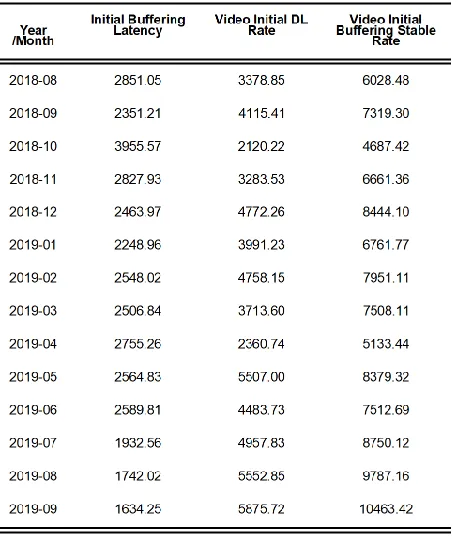
was used to analyze the performance of DASH and whether the quality of experience of the user has increased because of dynamic adaptive streaming. The analyzed data was from august 2018 to September 2019, across 32 countries and 1,81,885 users(2,4 seconds view). The mean values of these data were taken for analysis. (Table 1,2,3,4).
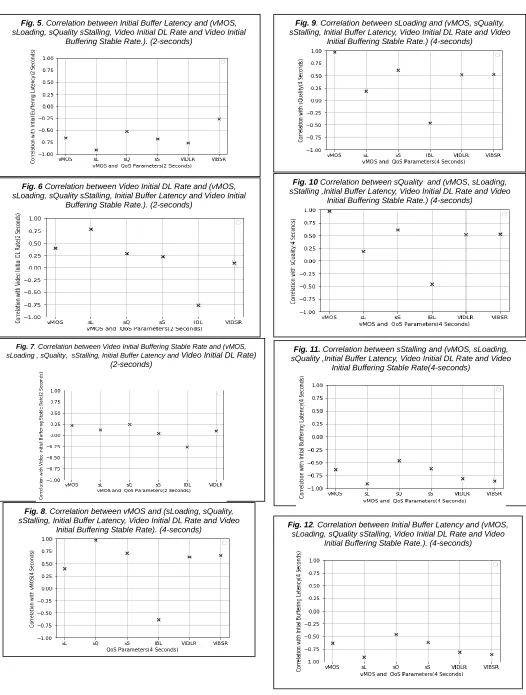
The features that were taken for analysis were vMOS, sQuality, sLoading, sStalling, Initial buffer latency, Video Initial DL Rate, Video Initial Buffering Stable. These features were analyzed for initial 2,4 seconds and correlation between all these features was determined. (Fig 1 to 14). Huawei has developed a standard to measure video experience, which
takes into consideration wide array of video services on mobile
terminals, personal computers and televisions. It has named
TABLE3
TOTAL DATA (GLOBAL APPDASH(ADAPTIVE)
FROM 2018-08 TO 2019-09,32 COUNTRIES/REGIONS)
181885USERS(QOE)(FIRST4SECONDS)
TABLE1
TOTAL DATA (GLOBAL APPDASH(ADAPTIVE)
FROM 2018-08 TO 2019-09,32 COUNTRIES/REGIONS)
181885USERS(QOE)(FIRST2SECONDS)
TABLE2
TOTAL DATA (GLOBAL APPDASH(ADAPTIVE)
FROM 2018-08 TO 2019-09,32 COUNTRIES/REGIONS)
the standard as U-vMOS (User, Unified, Ubiquitous-Mean Opinion Score for Video. Huawei has identified three main factors that have an influence on video experience, they are video quality (sQuality), interactive experience (sInteraction), and viewing experience (sView). The startup factor is a very important factor to be analyzed while measuring the video experience. The video playback startup interaction experience can be determined using the initial buffering delay (sLoading) and the video playback is determined by calculating the video freeze duration (sStalling).
TABLE4
TOTAL DATA (GLOBAL APPDASH(ADAPTIVE)
FROM 2018-08 TO 2019-09,32 COUNTRIES/REGIONS)
181885USERS(QOE)(FIRST4SECONDS)
Fig. 4. Correlation between sStalling and (vMOS, sLoading, sQuality ,Initial Buffer Latency, Video Initial DL Rate and Video Initial Buffering Stable Rate(2-seconds)
Fig. 3 Correlation between sQuality and (vMOS, sLoading, sStalling ,Initial Buffer Latency, Video Initial DL Rate and Video Initial Buffering
Stable Rate.) (2-seconds)
Fig. 2. Correlation between sLoading and (vMOS, sQuality, sStalling, Initial Buffer Latency, Video Initial DL Rate and Video Initial Buffering
Stable Rate.) (2-seconds)
Fig. 1. Correlation between vMOS and (sLoading, sQuality, sStalling, Initial Buffer Latency, Video Initial DL Rate and Video Initial Buffering Stable Rate(2-seconds)
Fig. 12. Correlation between Initial Buffer Latency and (vMOS, sLoading, sQuality sStalling, Video Initial DL Rate and Video
Initial Buffering Stable Rate.). (4-seconds)
Fig. 10 Correlation between sQuality and (vMOS, sLoading, sStalling ,Initial Buffer Latency, Video Initial DL Rate and Video
Initial Buffering Stable Rate.) (4-seconds)
Fig. 9. Correlation between sLoading and (vMOS, sQuality, sStalling, Initial Buffer Latency, Video Initial DL Rate and Video
Initial Buffering Stable Rate.) (4-seconds)
Fig. 8. Correlation between vMOS and (sLoading, sQuality, sStalling, Initial Buffer Latency, Video Initial DL Rate and Video
Initial Buffering Stable Rate). (4-seconds)
Fig. 7. Correlation between Video Initial Buffering Stable Rate and (vMOS, sLoading , sQuality, sStalling, Initial Buffer Latency and Video Initial DL Rate)
(2-seconds)
Fig. 6 Correlation between Video Initial DL Rate and (vMOS, sLoading, sQuality sStalling, Initial Buffer Latency and Video Initial
Buffering Stable Rate.). (2-seconds)
Fig. 5. Correlation between Initial Buffer Latency and (vMOS, sLoading, sQuality sStalling, Video Initial DL Rate and Video Initial
Buffering Stable Rate.). (2-seconds)
Fig. 11. Correlation between sStalling and (vMOS, sLoading, sQuality ,Initial Buffer Latency, Video Initial DL Rate and Video
4
R
ESULTS AND DISCUSSIONA careful observation on the Figures 1 to 14 concludes some very important findings.
a) There is strong positive correlation between the vMOS and sQuality, sStalling, and strong negative correlation between vMOS and initial buffering latency.
b) The initial buffer latency has strong negative correlation with vMOS, sLoading, sQuality sStalling, Video Initial DL Rate.
c) The Euclidean distance between the correlation values for 2 seconds and 4 seconds were calculated. It was found that the vMOS and sLoading correlation values with other features have changed and all other correlation values were similar.
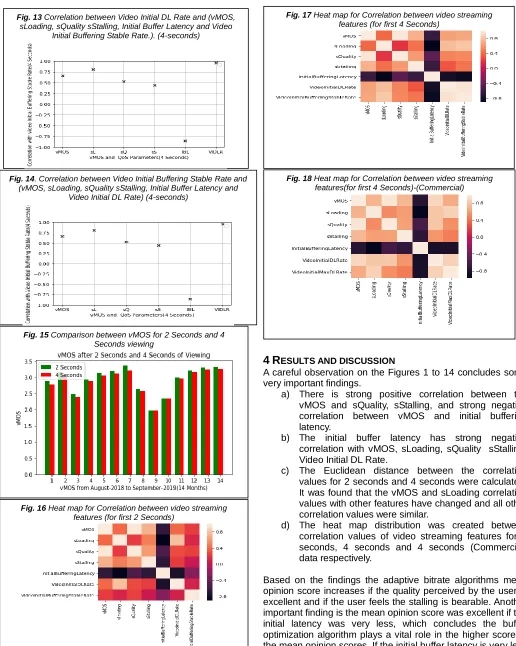
d) The heat map distribution was created between correlation values of video streaming features for 2 seconds, 4 seconds and 4 seconds (Commercial) data respectively.
Based on the findings the adaptive bitrate algorithms mean opinion score increases if the quality perceived by the user is excellent and if the user feels the stalling is bearable. Another important finding is the mean opinion score was excellent if the initial latency was very less, which concludes the buffer optimization algorithm plays a vital role in the higher score of the mean opinion scores. If the initial buffer latency is very less then compromise is done with respect to sLoading, sQuality, sStalling and Video Initial DL Rate. Some very important conclusion can be derived from these findings. Efficient Buffer utilization policy makes the quality of the video delivered with
Fig. 18 Heat map for Correlation between video streaming features(for first 4 Seconds)-(Commercial)
Fig. 17 Heat map for Correlation between video streaming features (for first 4 Seconds)
Fig. 16 Heat map for Correlation between video streaming features (for first 2 Seconds)
Fig. 15 Comparison between vMOS for 2 Seconds and 4 Seconds viewing
Fig. 14. Correlation between Video Initial Buffering Stable Rate and (vMOS, sLoading, sQuality sStalling, Initial Buffer Latency and
Video Initial DL Rate) (4-seconds)
Fig. 13 Correlation between Video Initial DL Rate and (vMOS, sLoading, sQuality sStalling, Initial Buffer Latency and Video
less resolution. To reduce the stalling ratio the buffer should be immediately loaded with the next segment, compromising with the resolution quality of the video segment. sLoading, video intital DL rate is quick if the quality of the video segment is of lesser resolution. The comparison between 2 seconds and 4 seconds video streaming features was done to figure out, whether the adaptive bitrate algorithm is focused on start up or whether it is performing efficiently as viewing time progresses. The comparison between these values was done by calculating the Euclidean distance between the correlated values. The results indicate that the vMOS, sLoading score is decreasing as the viewing time progress. The vMOS values from August,2018 to September,2019 was analyzed and it was found that as time of viewing increases the vMOS score begins to slide down. (Fig 15). The heat map distribution for 2 seconds, 4 seconds and 4 seconds (commercial), video streaming features indicates that 4 seconds (Commercial) sLoading, sQuality, sStalling, Initial Buffer Latency, Video Initial DL Rate and Video Initial Buffering Stable Rate values are excellent and it increases the vMOS score of the video streamed using adaptive bitrate streaming because the quality of service provided for commercial usage is high. (Fig 16, 17, 18)
5
C
ONCLUSIONBased on the outcome of the analysis, the dynamic adaptive streaming over HTTP(DASH), which employs the adaptive bitrate algorithms performs efficiently at the start-up and its performance dips a bit as the viewing progresses. If the quality of service provided for this algorithm is of highest standard then the vMOS is constantly on the higher side. An Optimal buffer management techniques incorporating deep learning, throughput prediction through deep learning can improve the performance of the dynamic adaptive streaming over HTTP(DASH).
R
EFERENCES[1] Cisco Visual Networking Index: Forecast and Trends, 2017–2022.
[2] S Shunmuga Krishnan and Ramesh K Sitaraman, ―Video stream quality impacts viewer behavior: inferring causality using quasi-experimental designs‖, IEEE/ACM Transactions on Networking 21,6 (2013),2001–2014. [3] Z. Li, X. Zhu, J. Gahm, R. Pan, H. Hu, A. C. Begen, and
D. Oran,‖Probe and Adapt: Rate Adaptation for HTTP Video Streaming At Scale‖, IEEE J. Sel. Areas in Communication. 32 (April 2014).
[4] Cong Wang, Amr Rizk, and Michael Zink, ―Squad: A spectrum-based quality adaptation for dynamic adaptive streaming over HTTP‖, In Proceedings of the 7th International Conference on Multimedia Systems. ACM,2016
[5] Junchen Jiang,Vyas Sekar,and Hui Zhang, ―Improving fairness, efficiency, and stability in http-based adaptive video streaming with festive‖, In Proceedings of the 8th international conference on Emerging networking experiments and technologies.ACM,97–108,2012. [6] Te-Yuan Huang, Ramesh Johari, Nick McKeown, Mathew
Trunnell, and Mark Watson, ―A Buffer-based Approach to Rate Adaptation: Evidence from a Large Video Streaming Service‖, In Proc. ACM SIGCOMM,2014.
[7] K. Spiteri, R. Urgaonkar, and R. K. Sitaraman, ―BOLA: Near-optimal bitrate adaptation for online videos‖, In
IEEE INFOCOM, 2016.
[8] A. Beben, P. Wisniewski, J. Mongay Batalla, and P. Krawiec,‖ABMA+: Lightweight and Effecient Algorithm for HTTP Adaptive Streaming‖, In Proc. Int. ACM Conference on Multimedia Systems (MMSys), 2:1–2:11, 2016. [9] Luca De Cicco, Vito caldaralo,Vittorio Palmisano and
Saverio, Mascolo, ―Elastic:A client side controller for dynamic adaptive streaming over http(dash)‖, In Packet Video Workshop (PV), 20th International.IEEE,1–8,2013. [10]Xiaoqi Yin, Abhishek Jindal,Vyas Sekar,and Bruno
Sinopoli,‖A control theoretic approach for dynamic adaptive video streaming over HTTP‖,ACM SIGCOMM Computer Communication Review 45,4,325–338, 2015. [11]T. Stockhammer, ―Dynamic Adaptive Streaming over
HTTP –: Standards and Design Principles‖, In MMSys, February 2011.