IJEDR1401148
International Journal of Engineering Development and Research (www.ijedr.org)821
Power Saving Improved Position Changes Based
Routing Protocol Using Backtracking
For Mobile Ad Hoc Networks
1Manikandan.S, 2Joseph Raymond.V 1M.Tech Scholar, 2Assistant Professor
1Information Technology, SRM University, Chennai, India 2Information Technology, SRM University, Chennai, India 1[email protected] 2[email protected]
________________________________________________________________________________________________________ Abstract— Mobile ad-hoc network is a prioritized mobility based wireless network It can be easily deployed in every
aspect, without underlying foundation and base support. It is a collection of mobile nodes that help and comply with their neighbor nodes to convey packets from source to destination. There is a need to discover a more power efficient technique for gainful network access and to avoid network deficiency. So the existing protocol, an energy adequate AODV protocol is blended for perfect results and the four parameters that are concentrated are Bandwidth, Power, Hop count and Time. A dominant part of the process is changing the route table values using (PCBR) Position Changes Based Routing protocol. Our proposed methods and protocol will give enhanced results than the earlier technique.
Key Terms — Bandwidth, Time, MANET and Residual power, PCBR.
________________________________________________________________________________________________________
I. INTRODUCTION
A MANET is a sort of ad-hoc network that can switch locations and construct itself on the fly. Because Mobile ad-hoc networks are mobile, they handle wireless connections to conjoin various networks. This can be a definitive Wi-Fi connection, or another standard, alike as a cellular or satellite communication. Some MANET’s are diminished to a local area of wireless devices (such as a bunch of laptop computers), while others may be linked to the Internet.
Source Routing is an approach whereby the sender of a packet can enumerate the route that a packet should take through the network, the sender obviously lists this route in the packet’s header, classifying each forwarding hop by the position of the beside node to which to relocate the packet on its fashion to the target. Source routing has been used in a multiple situations for routing in various medium of networks, using either statically or dynamically organized source routes.
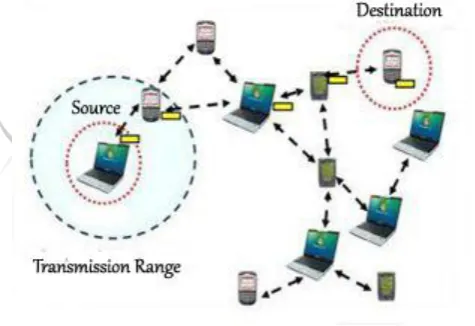
Fig 1 Wireless packet transmission
IJEDR1401148
International Journal of Engineering Development and Research (www.ijedr.org)822
II.DESIGNFIELDANDRELEVANTWORK
The total approach radically involves two important activities first, resolving optimal routing routes and secondly, relocating the information packets via network.
There are various kinds Power-Efficient routing rules of conduct which compromise with the following restraints: Power and topology management by adjusting the transmission region of transmitters
Switching ON or OFF radio transmitters to conserve power Routings depending on the power efficient metrics
A. Ad-Hoc On Demand Distance Vector Routing (AODV)
AODV is an on-claim routing protocol. Mobile nodes are desired to manage route caches that contain unexpired routes and rapidly updated as fresh routes are learned. It has been implemented for the application in mobile ad-hoc networks. This routing protocol is made up of both Proactive and Reactive routing consequently. The route discovery and maintenance measure in AODV is identical to that in DSR, It is quickly responds to topology changes, attempts low processing and memory overhead, low network pursuit, and concludes single transmission routes to target within the ad-hoc network.
The protocol subsists two leading phases: Route discovery
Route maintenance.
Route Discovery is the process when source node has packet to transfer, It broadcasts a RREQ to all neighbors against the destination. A node on getting the RREQ then it verifies if it has not received the identical request earlier, using the Route ID. After favorable outcome of acceptance RREP is generated by destination and send behind to the source. If the origin gets a different RREP from the node, then the route with the precise hop count is chosen. In case a link failure is identified, a RERR request is sent to the source of the data in a hop by hop pattern. Continuous numbers in this protocol play a crucial role in ensuring loop flexibility and freshness of the Route.
Route maintenance is used to provide response about the links of the route and to acknowledge the route to be altered in case of any separation due to movement of one or multiple nodes ahead the route. RERR packet is progressive by a node to the source when any one of the layer encountered by a fatal broadcasting problem. When the route error packet is received, the faulty hop is rejected from the node’s route cache and remaining routes that having the hop are shorten at that location.
Route caching is used for two dominant purposes: firstly, a cached route is willingly available to the requesting node thus reducing the routing abeyance. Secondly , in this route caching moderate discovery process and in that way reduces the congestion that is useful for searching a new route
Limitations of AODV: A vast number of control packets are generated while contracting the route maintenance, which in turn maximize the congestion in the route. So over heading the bandwidth maximizes with the number of control packets created. Eventually delay in the transfer increases.
III. PROPOSED POWER EFFICIENT APPROACH
A. Proposed Model for Route Discovery
The distinct task of this approach is to choose a route that consist of underutilized nodes so that the power usage among all nodes can be managed because underutilized nodes familiarly have more power than utilized nodes. The approach distinctive in not only power but other limitations also for the route selecting methodology. So this may outcome in precise, better and power-rich routing. Thus, make secure durability of network lifetime
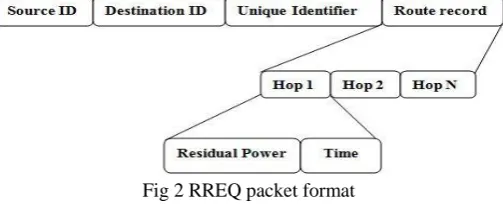
Route Discovery – The measure of forwarding the RREQ for Route detection is alike as the AODV; the deviation in the RREQ
packet layout, exposed in Figure2:
Fig 2 RREQ packet format
RREQ packet pursues the following restraints :
IJEDR1401148
International Journal of Engineering Development and Research (www.ijedr.org)823
b) If the node had previously received the demand with the same Unique identifier, it stops the reached demand packet.
c) If the node figure out its own identification as the target, then the packet grasp the point.
The destination prefers the finest route on the support of different parameters like max Power and Bandwidth, min Time and Hop Count among the whole route requests arrived.
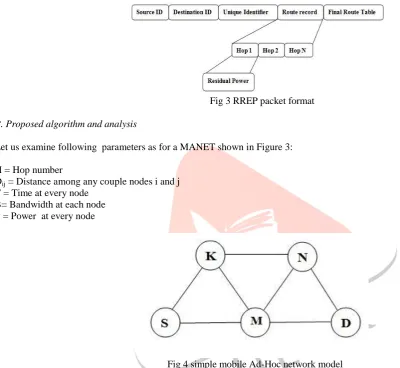
The destination responses to the origin by transmitting a RREP data (Figure 3). The RREP packet goes ahead the backward hop series of the perfect route and likewise contains the Final Route Table (Table 4). The FRT is stored by each emissary node and the origin node in its route cache. The RREP message layout will be as
Fig 3 RREP packet format
B. Proposed algorithm and analysis
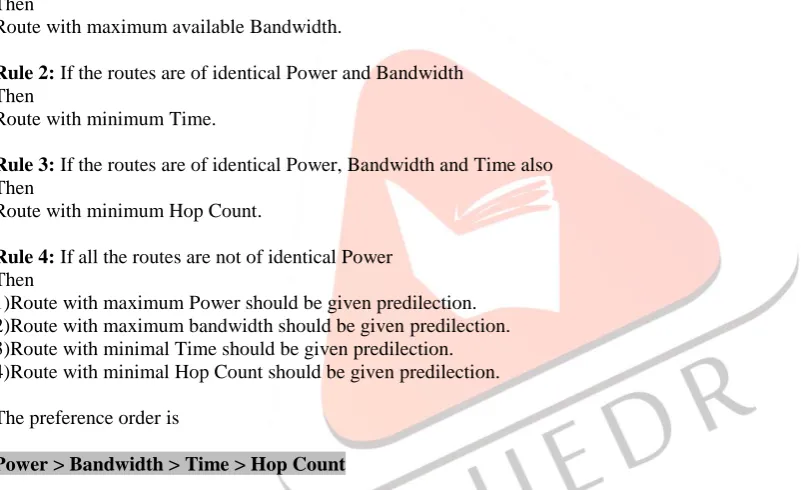
Let us examine following parameters as for a MANET shown in Figure 3:
H = Hop number
Dij = Distance among any couple nodes i and j T = Time at every node
B= Bandwidth at each node P = Power at every node
Fig 4 simple mobile Ad-Hoc network model
Table 1 Expose the total count of routes among origin (S) and Destination (D) with the Hop count values:
Table 1 Routes with their Sequence and Hop count
Routes Complete route sequence Hop count
R1 S-K-N-D 3
R2 S-M-D 2
R3 S-K-M-N-D 4
R4 S-M-N-D 3
R5 S-K-M-D 3
R6 S-M-K-N-D 4
The Time at the individual node (Traffic Time) is: T(S)=50,T(K)=30,T(N)=35,T(M)=40, T(D)=45
The Bandwidth of individual node is:
IJEDR1401148
International Journal of Engineering Development and Research (www.ijedr.org)824
The Power of individual node is:
P(S)=65, P(K)=60, P(N)=55, P(M)=50, P(D)=45
The integrated representation of all the routes with minimal possible values of all the parameters on every route is shown in Table 2.
Table 2: Minimum Value of all framework in each Route
Routes Time Bandwidth Power Hops
R1 30 40 55 3
R2 40 50 50 2
R3 30 40 50 4
R4 35 40 50 3
R5 30 45 50 3
R6 30 40 50 4
For determine an excellent route, following Principle Set must be taken into report:
Rule 1: If the routes are of identical Power Then
Route with maximum available Bandwidth.
Rule 2: If the routes are of identical Power and Bandwidth Then
Route with minimum Time.
Rule 3: If the routes are of identical Power, Bandwidth and Time also Then
Route with minimum Hop Count.
Rule 4: If all the routes are not of identical Power Then
1)Route with maximum Power should be given predilection. 2)Route with maximum bandwidth should be given predilection. 3)Route with minimal Time should be given predilection. 4)Route with minimal Hop Count should be given predilection.
The preference order is
Power > Bandwidth > Time > Hop Count
Alignment of the routes on the basis of superior principle set and their place is expose in Table 3:
Table 3: Position Based Arrangement
Position Hops Time Bandwidth Power
1 R1 R2 R2 R1
2 R3 R1 R5 R2
3 R5 R4 R1 R3
4 R6 R5 R3 R4
5 R4 R3 R4 R5
6 R2 R6 R6 R6
Then computing the sum of positions for all routes using various parameters (Hop Count, Time, Bandwidth and Power) shown in Table3:
For Route 1: 1+2+3+1 = 7 Route 2: 6+1+1+2 = 10
IJEDR1401148
International Journal of Engineering Development and Research (www.ijedr.org)825
Route 5: 3+4+2+5 = 14 Route 6: 4+6+6+6 = 22
The FRT- Final Route Table that will propose the best and all the alternative routes:
Table 4: Final Route table
S.No Routes Route sequence Positions
1 R1 S - K - N – D 7
2 R2 S – M – D 10
3 R3 S – K – M– N – D 14
4 R4 S – K - M – D 14
5 R5 S – M - N – D 17
6 R6 S – M – K –N – D 22
From the Table 4, it is approve that the places count for R1 is littlest. So R1 will be privileged as the best route for hauling data packets and the rest of them will be used as backup routes. This table is send to the source node and will be used to select substitute routes for conveying data packets at any time a link inadequacy occurs in current route.
C. Route maintenance model
The Route monitoring is needed when residual power of any node goes beneath the threshold. After each conveyance of packet, the power factor is calculated.
Power drained in single Transmission = (Available Power before transmission - Remaining power after transmission)
Then Power available for next transmission is calculated,
Residual Power = (Remaining Power after transmission - Power drained in one transmission)
If (Threshold power<Residual Power) Then
{ The node can transmitting the next packet} Else
{ The node cannot carrying the next packet; send a RERR message to origin}
If any node attempts to send the packet even when its power is below threshold of the required power then Packet will absolutely be lost.
D. Proposed model using Back tracking technique for Route Maintenance
This method always auditing a route in use and updates the source for any routing errors. When any node identifies that its power is not adequate and it is not able to transmit the next packet resulting in network deficiency then in such condition subsequent steps will take place.
The time utilization can be reduced if embrace of the alternate path is accomplished by the prior node of the sinking node. This can be concluded in the following approach:
1) The dying node produce and sends a Route error (RERR) packet to its predecessor.
2) The predecessor back tracking the substitute route from its FRT from existing that will not enclose the sinking node and truncate other routes that having sinking node.
a) If found, the predecessor node intimate the source and the other intermediary nodes about the another route: That Contains,
i) Sinking node ID ii) Residual Power, and iii) Another route.
b) Else, informs that no specific path exists that doesn’t have the sinking node.
3) After getting a RERR packet by all neighbor nodes, they update their FRT by rejecting all related sinking node. Thus, the exchanging information between origin node and destination will not cast link deficiency and time latency in next conveyance of data packet due to the node’s drained power.
IJEDR1401148
International Journal of Engineering Development and Research (www.ijedr.org)826
Case — Let us examine, after sending a data packet from R3 (S–K–M –N–D), if node N of route R3 identifies the poor residual power then it will pass RERR report to its predecessor node S. Here node S can find the replacement route R2 & R4 as it consists of Final Route Table. Then S will choose the alternative route from least position count sequence (R2) for further transmission from updated FRT and instruct to all the nodes about the new substitute route and all nodes will update their Route Cache . Here there is no need of rediscovery for all routes. It diminishes the source overhead and the liability of wasting data packet due to link or network deficiency.
Table 5. Table with alternate routes
S. No. Routes Complete sequence Positions
1 2
R2 R4
S – M – D S – K – M - D
10 14
IV.SIMULATION RESULT
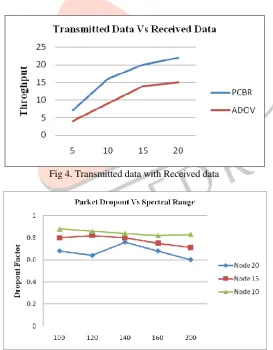
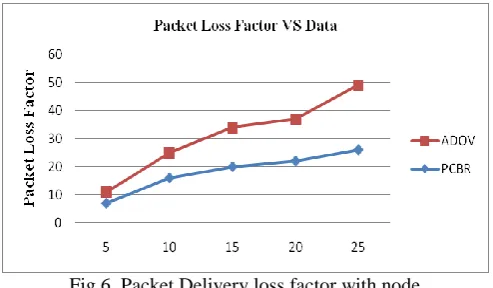
The performance of the protocol is classified using simulation experiments with C++ or Tcl, and Ns-2 simulator. A flat network is recognized as a cluster Network. A Node circulates a packet, to fix (Request to Send) flag to its neighbors and the designated receiver sets CTS (Clear to Send) flags to its neighbors. Nodes with RTS or CTS flag fixed and it cannot relocate data, besides the defined sender. In simulations, Control packets have higher antecedence over data packets. It is concluded that packets always appear without any bit error, So Propagation delay problem is assumed to be imperceptible. Packets are created at the source at a stable rate. Pervasive simulation results are obtained by varying a lot network parameters and work load configuration. The morals of network parameters that are used in simulations are those indicated in the IEEE 802.11. Performance is enhanced in terms of throughput is classified by using a densely populated network. Specifically, we speculate a network of 15 to 50 nodes with a hike number of neighbors from 4 to 10 nodes. Every Node has a congestion flood with endless demands facing with its neighbors. In Figure-4 to Figure-6 shows the throughput of all Congestion flows, with feasible Power and channels Bandwidth.
Fig 4. Transmitted data with Received data
IJEDR1401148
International Journal of Engineering Development and Research (www.ijedr.org)827
Fig 6. Packet Delivery loss factor with node
V. CONCLUSION
We have discussed a new Power efficient routing protocol that trails on AODV. It diminish the overhead of source by circulating its load along the intermediary nodes and giving its authority to finding the best route between source and destination node. It also saves power that is drained in producing RERR by the deadly node and then conveyance to all intermediary nodes to origin for rediscovering route from origin to destination. It scale down network deficiency due to loss of node’s power and diminish the failure of packets. It also balances the consumption of power among utilized nodes and the underutilized nodes
REFERNCES
[1] Supriya Srivastava, A.K. Daniel, R. Singh and J.P. Saini - “Energy-Efficient Position Based Routing Protocol for Mobile Ad Hoc Networks”, International Conference on Radar Communication and Computing (ICRCC), December 2012.
[2] K. Kalyan kumar and A. Chockalingam,, “Energy Efficient Routing in Wireless Ad-hoc”, Proceedings of National Conference on Communications 2002, January 2002.
[3] Morteza Romoozi, S.M. Vahidipour & Hamideh Babaei, “Improvement of Connectivity in Mobile Ad-hoc Networks by Adding Static Nodes Based on a Realistic Mobility Model”, IEEE 2009 Second International Conference on Machine Vision.
[4] IETF Mobile ad-hoc network (MANET) Working Group AODV- Draft- http://www.ietf.org/internet-drafts/draft-ietf-manet-aodv-8.txt
[5] Jorjeta Jetcheva and David B. Johnson, "Routing Characteristics of Ad Hoc Networks with Unidirectional Links", in Ad-Hoc Networks, 4(3):303-325, Elsevier, May 2006.
[6] S.R. Das, C.E. Parkins and E.M. Royer, “Performance Comparison of Two on Demand Routing Protocols for ADHOC Networks”, in Proceedings of IEEE INFOCOM 2000, Tel Aviv, Israel, 2630 Mar 2000..
[7] Jae-Hwan Chang and Lendros Tassiulas, “Energy conserving routing in wireless ad-hoc networking”, Proceedings of the IEEE Infocom, Isrel, march 2000.ACM/IEEE.
[8] Shao-Cheng Wang and Ahmed Helmy, “Effects of Small Transfers and Traffic Patterns on Performance and Cache Efficacy of Ad Hoc Routing”, MOBICOM , California. USA, September 2003.
[9] D. Dube et al.,”Signal Stability-Based Adaptive Routing (SSA) for Ad Hoc Mobile Networks,” IEEE Pers. Communication Feb. 1997, pp. 36-45.
[10]K. Scott and N. Bambos, “Routing and Channel Assignment for Low Power Transmission in PCS,” Proceedings of the ICUPC, Oct. 2002.
[11]S. Singh and C.S. Raghavendra, “PAMAS-PowerAware Multi-Access Protocol with Signaling for Ad Hoc Networks”, ACM Communication Review, July 1998.
[12]K. Kalpakis, K. Dasgupta and P. Namjoshi, “Maximum Lifetime Data Gathering and Aggregation in Wireless Sensor Networks”, Proceedings of the IEEE International Conference on Networking (ICN), Georgia, August 2002.
[13]J. Tian, L. Han, K. Rothermel, and C. Cseh. Spatially Aware Packet Routing for Mobile Ad Hoc Inter-Vehicle Radio Networks, to appear in the IEEE 6th Inter.Conference on Intelligent Transportation Systems (ITSC), Shanghai, China, October 12-15, 2003