O R I G I N A L R E S E A R C H
Determination and Comparison of the Factors
Related to Effective Blended Learning in Medical
Sciences from the Viewpoints of Instructors and
Learners
This article was published in the following Dove Press journal: Advances in Medical Education and Practice
Zohrehsadat Mirmoghtadaie 1 Nooshin Kohan2
Davood Rasouli3
1Department of Virtualization in Medical
Education, Virtual School, Tehran University of Medical Sciences, Tehran, Iran;2Department of Medical Education,
Virtual University of Medical Sciences, Tehran, Iran;3Center for Educational
Research in Medical Sciences (CERMS), Department of Medical Education, School of Medicine, Iran University of Medical Sciences, Tehran, Iran
Introduction:According to rapid growth of innovation in use of technologies in education
and learning, blended learning has become an effective method in the student’s education.
The purpose of this study was to extract the factors related to effective blended learning and compare the viewpoints of students and instructors in this regard.
Methods: Mixed method model was used in this study. A content analysis approach was
employed in the qualitative phase of the study. Seven faculty members and eight master’s
students of medical sciences selected through purposive sampling participated in the quali-tative phase. Individual semi-structured interviews were conducted for data collection. In the quantitative phase, appropriate and relevant items were designed based on the main concepts
of theoretical and practical definitions that were extracted in the qualitative phase.
Results: The results of the qualitative phase were 5 categories and 40 subcategories,
including student’s capabilities, teacher merits, technological aspects, pedagogic topics and
supportive environment.
Discussion: The results of the questionnaire analysis showed no significant difference in student capabilities and supportive environment between the viewpoints of students and
faculty members while there were significant differences in other categories. Although new
technologies have offered promising opportunities, they do not result in effective education. The results of the present study suggest that a major revision in student and instructor admission and provision of required technical facilities can promote the status of this type
of education. On the other hand, instructor empowerment programs in thisfield can enhance
the effectiveness of virtual education.
Keywords:blended learning, online education, e-learning, distance education
Background
The most important mission of education in medical sciences is to train competent and capable individuals who possess the required knowledge, attitude, and skills to preserve and enhance public health. In this regard, along with the goals of sustainable
development, medical education plays a key role in improving the students’
knowl-edge for decision making in the future and developing a global perspective through
effective education that is proportional to the evolution.1,2This area, as part of the
higher education that is responsible for providing students with a massive volume of
knowledge, attitude, and skills for acquiring professional competencies,3is obliged to
Correspondence: Davood Rasouli Center for Educational Research in Medical Sciences (CERMS), Department of Medical Education, School of Medicine, Iran University of Medical Sciences, Tehran, Iran
Email [email protected]
Advances in Medical Education and Practice
Dove
press
open access to scientific and medical research
Open Access Full Text Article
Advances in Medical Education and Practice downloaded from https://www.dovepress.com/ by 118.70.13.36 on 24-Aug-2020
employ modern methods because public health improve-ment depends on high-quality education. Moreover, the ultimate goal of human resources planning in the health
sector is to train efficient and high-quality manpower.4
Blended learning is a relatively new term while its con-cept has been prevailing in areas such as virtual education for decades.5In general, the term“blended learning”refers to the
third generation of distance education defined as a method to
maximize the benefits of face-to-face education and multiple
learning technologies.6In this approach, in addition to
reg-ular classes, some electronic classes are also held during a semester, and the students are not forced to be present at a definite place at a definite time and can interact with their
instructors and other learners via the Internet.7 Providing
pure online education to a heterogeneous group of learners with different intellectual and experience backgrounds may not be effective enough. The aim of blended learning is to create opportunities for students to use both the real and
virtual environments to enhance their learning.8This method
is used to optimize the results of learning and
cost-effectiveness.9 Since blended learning has the benefits of
traditional and virtual education, it is an appropriate method for achieving the training-learning objectives in medical education. The blended learning have been used to develop
competencies in medical sciences.10The results of the
stu-dies conducted by research institutes and universities like Stanford and Tennessee suggest that blended learning has priority over traditional approaches regarding the mechan-isms; Moreover, blended learning not only is capable to transferring the learning material more effectively but also
is a more effective educational method.11 The design and
implementation of blended learning in medicalfields in Iran
showed that this type of education can be cost-effective and recommended to implement. Results of the studies also
showed that the learners were more significantly satisfied
with learning through blended method than the traditional education (face-to-face). Therefore, by considering the valu-able position of blended education in increasing the satisfac-tion and success of learners in medical courses, employing this approach included among the development programs for medical education from 2017.
The term “effectiveness”was first used in the field of
management and different viewpoints and frameworks were
presented for it. Effectiveness is usually defined as the
degree to which the desired objectives are achieved.12 In
general, effective education is achievement of multiple objectives and priorities in the form of a value system, so achievement of goals in terms of cost and time is optimal
and satisfy learners and teachers.13In the process of
educa-tion, teaching and learning are interrelated. Although teach-ing is a teacher’s activity, but the result of learning depends on the student. Effective education is based on participation
and cooperation.14 Therefore, effectiveness should be
assessed based on the viewpoints of the students and instructors to produce comprehensive results. Although some researchers have investigated blended learning and its problems and barriers, we found no studies that com-pared the viewpoints of the stakeholders in this regard. Therefore, we decided to extract the factors related to effec-tive blended learning and compare the viewpoints of stu-dents and instructors in this regard.
The research questions were as follows:
1. What are the most important factors related to effective blended learning from the viewpoints of students?
2. What are the most important factors related to effective blended learning from the viewpoints of instructors?
3. Is there a significant difference between the
view-points of students and instructors regarding factors related to effective blended learning?
Method
The mixed method model, which combines both qualitative and quantitative approaches, was used in this study. By using the mixed method, research strong aspects of quanti-tative and qualiquanti-tative methods can be utilized and its
limita-tions can be minimized.15–18 Particularly, complexity of
social facts is eliminated by bringing different methods together than observing and discussing them, which hereby
contributes to the better understanding of the fact.15In this
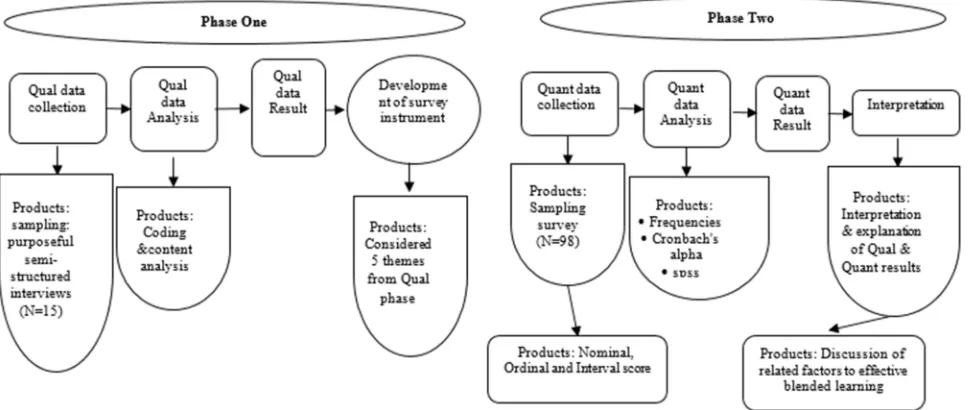
study sequential exploratory mixed method was employed, further described in (Figure 1).
Qualitative Phase
In an exploratory design, qualitative data is first collected
and analyzed, and themes are used to drive the development of a quantitative instrument to further explore the research
problem.16,18,19 As a result of this design, three stages of
analyses are conducted: after the primary qualitative phase, the secondary quantitative phase use and then, at the inte-gration phase two strands of data and extends connects to
create initial qualitative exploratoryfindings.16This article
reports on the final integration phase of the research.
A content analysis approach was employed in the
Advances in Medical Education and Practice downloaded from https://www.dovepress.com/ by 118.70.13.36 on 24-Aug-2020
qualitative phase of the study. Qualitative content analysis is an approach for Subjective interpretation of the textual data through the processes of systematic categorization,
coding, and themes or known patterns design.20 In the
content analysis approach, categories are directly extracted from the textual data to help the researcher achieves
a deeper perception of the phenomenon.21The reason that
this approach was applied in this study was to explore the meaning, priorities, attitudes and perception of the students and instructors of effective blended learning through ana-lyzing their verbal messages.
Participants
The sampling was purposeful. Seven faculty members of Medical Sciences universities of IRAN with at least two consecutive years of experience in the blended learning
system and eight master’s students of medical sciences
selected through purposive sampling participated in the qualitative phase. The inclusion criteria were experience of teaching or learning in the virtual education system, availability, and willingness to participate in the study.
Data Collection and Analysis
Individual semi-structured interviews were conducted for data collection. After obtaining of informed consent from the participant, the interviews begun with unstructured questions, some probe questions were also in the interview
protocol to ensure interviewees’ perceptions regarding
concept of factors related to effective blended learning in
medical sciences. Each interview lasted for 30–45 min. All
interviews were recorded then transcribed for analysis.
The introductory questions were “What do you think
about blended learning and how it should be held?”
“What do you think about the challenges of blended
learn-ing?”and“What are executable solutions to improve this
educational method considering the prevailing context?”
According to the participants’answers, probing questions
were also asked during the interview. The seven–step
Colaizzi’s method was applied for data analysis, including
familiarization with the data by reading importantfindings
and developing empathy with the participants to extract
significant statements, formulating meanings for the
extracted sentences, categorizing identified meanings and
clusters, referring to the original statements and comparing the data, describing the phenomenon under investigation,
andfinally returning the description to the participants for
verification of results. These steps were followed by
cod-ing and extraction of themes and sub-themes.22
Interviewing continued, until the data from the interviews was being consistently duplicated. There appeared to be saturation of data as no new information was gained from the last interviews. The MAXQDA version 12 was used for data analysis.
Trustworthiness of Qualitative Data
Numerous frameworks have been developed to evaluate the rigor or assess the trustworthiness of qualitative data23,24and strategies for establishing credibility, transferability, depend-ability, and Confirm ability. In this study, the credibility of the
qualitativefindings was ensured by using member check and
Figure 1Sequential exploratory mixed-method design.
Advances in Medical Education and Practice downloaded from https://www.dovepress.com/ by 118.70.13.36 on 24-Aug-2020
immersion techniques as well as ongoing engagement of the researchers with the data and also participation in similar congresses.
Then, in order to complete the data and examine the
transferability of the findings, the people who had the
experience of conducting qualitative research were asked (peer check) to review the initial interviews, coding and categories. To increase the reliability of the data, the
long-term work with the research subject, the observers’review
and controlling thefindings with the participants in terms
of the extent of reflecting their experiences were used. The
principles of confidentiality of information and informed
consent for interviewing and recording the conversations were observed as well. The right to withdraw from research at any time was one of the ethical considerations that were observed, too.
Quantitative Phase
In the quantitative phase, appropriate and relevant items were designed based on the main concepts of theoretical
and practical definitions that were extracted in the
qualita-tive phase and preliminary questionnaire was developed in
40 items infive general categories. The validity and
relia-bility of questionnaire was assessed. The face validity, con-tent validity index (CVI) and ratio (CVR) of the questionnaire was examined by 10 students and 10 faculty members and their comments were applied to the question-naire after they were reviewed by the research team. In the
next step, to Compilation of thefinal version, the
question-naire was assessed by a number of e-learning experts in a face-to-face session, and their comments were reviewed
by research team. Finally, thefinal version of the
question-naire was prepared that contained 40 items in 5 general
categories related to effective-blended learning. Thefinal
questionnaire included students’ capabilities (four
ques-tions), teacher merits (11 quesques-tions), technological aspects (9 questions), pedagogic topics (11 questions), and suppor-tive environment (5 questions). The questions of each cate-gory were scored on a 5-point Likert scale from very low (1 point) to very high (5 points). The minimum score of
ques-tionnaire was 40 and maximum was 200. The Cronbach’s
alpha was calculated to assess the reliability of the ques-tionnaire, which was 0.91 for faculty members and 0.86 for students. The questionnaire was forwarded to 105 faculty members and students through email to prioritize effective blended learning indexes that 24 faculty members and 63 students (total=98) completed the questionnaire (Response rate: 93.3%). For data analysis, the total score of each
category was divided by the number of questions, and a mean score was calculated. SPSS version 21 was applied for analysis, using descriptive (mean, and standard
devia-tion) and analytical (independentttest) statistics.
For ethical considerations, the objectives and protocol of the study were explained to the participants and informed consent was obtained from all of them. The participants were assured that participation was voluntary, they could withdraw from the study at any time, and the
audiofiles confidential and anonymous.
Results
The mean age of students and professors participated in the study was 29.31±5.2 and 41.6±4.8 years, respectively. Fifty-two percent of students and 44% of professors were female. The results of the qualitative and quantitative phase are presented in the following.
Qualitative Phase Results
The aim of the qualitative phase was to determine the factors affecting effective-blended learning and to com-pare the viewpoints of faculty members and students in
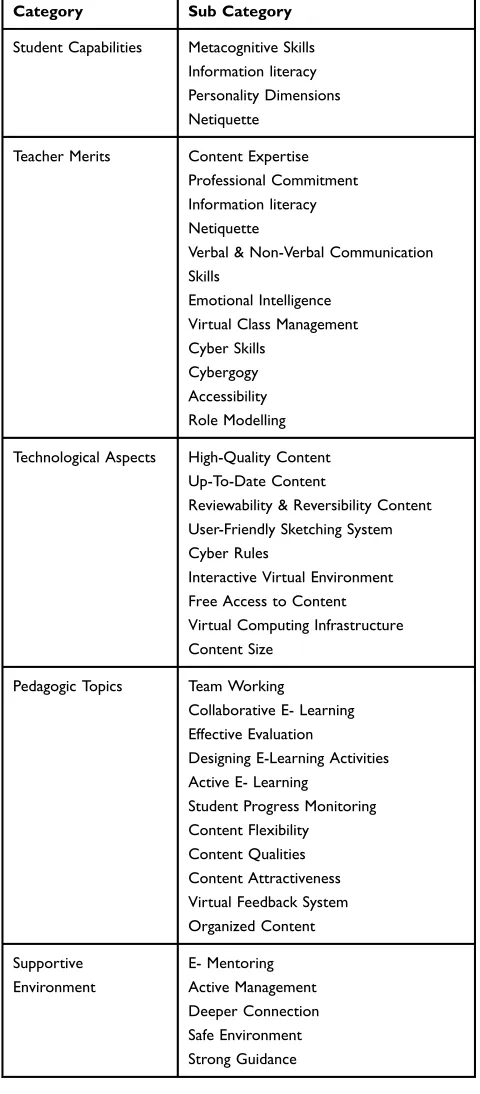
this regard. The results of this phase infive categories and
40 subcategories are presented in (Table 1).
Student Capabilities
According to the interviewees, student capabilities were an important indicator of effective-blended learning, which includes metacognitive skills like creativity, critical think-ing, self-direction, etc., in addition to cognitive skills.
According to participant number 10, “Blended learning
requires personal maturity, critical thinking, creativity,
and self-education.”Moreover, one of the faculty members
(participant number 7) said,
Both the student and the teachers should have the mini-mum information and computer literacy. In addition, their personality is also a key determinant of developing a constructive interaction and effective learning.
Teacher Merits
Teacher merits were another category. Participant number
12 said“Our faculty members neither have the literacy in
such areas nor are they familiar with ethics of this
envir-onment. So how can they deliver effective education?”
Advances in Medical Education and Practice downloaded from https://www.dovepress.com/ by 118.70.13.36 on 24-Aug-2020
Technological Aspects
Another category that emerged in the qualitative phase was technological aspects, including the cyberspace and electronic content. Participant number 52 said,
If the educational content isn’t easy to access, high quality,
and up-to-date, education will not be effective. Blended learning should develop with technological advances and the learning system should be a lovely environment.
Pedagogic Topics
Another category was pedagogic topics, which included the subcategories of team working, effective evaluation, organize content, etc. According to participant number 41,
“Pedagogic topics are important in every teaching-learning
process, and they are much greater importance in blended learning.”
Supportive Environment
According to the participants, a supportive environment could enhance effective-blended learning. This means that, deeper connection and e-monitoring produce a Compatible environment that is interesting for the learners and instruc-tors to embark on teaching and learning. Participant
num-ber 36 said “The students are entitled to educate in
a tension-free environment with the maximum relationship
with the instructor without discrimination and
commotion.”
Quantitative Phase Results
Normality of data was assessed by the Kolmogorov–
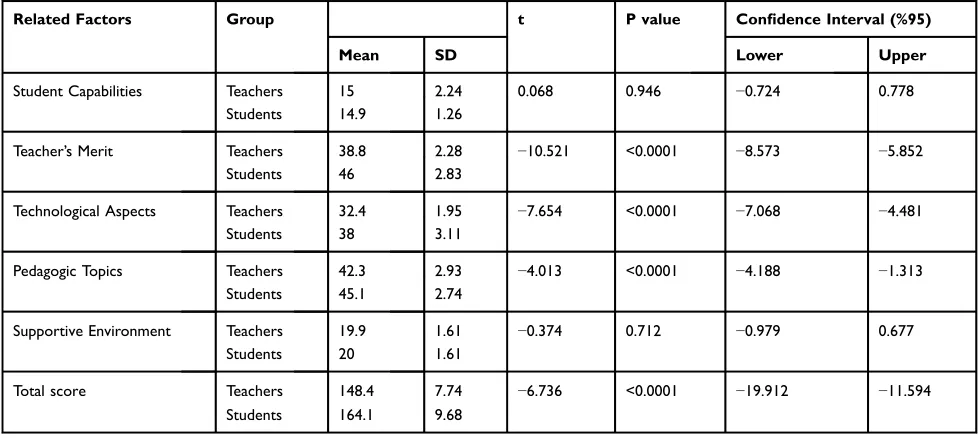
Smirnov test and regarding the normal distribution of data, parametric tests were used. The total mean score of questionnaire for teachers was 148.4± 7.74 and for
stu-dents was 164.1±9.68 that was significant. The results
revealed that no significant difference in student
capabil-ities and supportive environment between the viewpoints
of students and faculty members while there were signifi
-cant differences in other categories (Table 2).
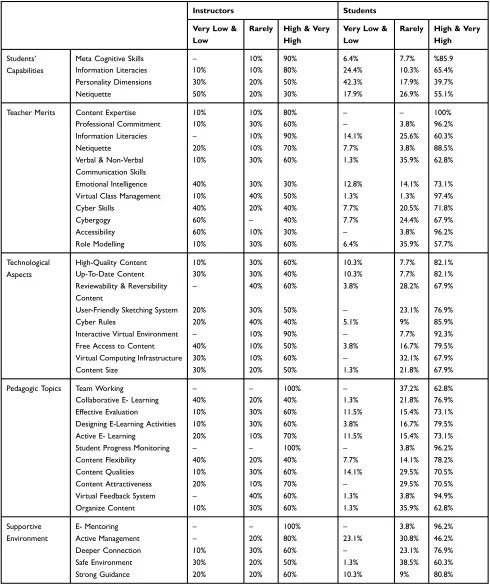
In the student’s capabilities category, metacognitive
skills were the most important factor related to blended learning according to faculty members (90%) and students (85.9%). In the category of teacher merits, the faculty members pointed to information literacy (90%) and the students cited content expertise (100%) as the most impor-tant subcategories. In the category of technological aspects, the interactive virtual environment was the most important determinant of effective-blended learning according to faculty members (90%) and students (92.3%). Faculty members (100%) and students (96.2%) believed that
stu-dent progress monitoring was the most important
Table 1 The Categories and Subcategories of Factors Affecting Effective Blended Learning According to Faculty Members and Students of Medical Sciences
Category Sub Category
Student Capabilities Metacognitive Skills Information literacy Personality Dimensions Netiquette
Teacher Merits Content Expertise Professional Commitment Information literacy Netiquette
Verbal & Non-Verbal Communication Skills
Emotional Intelligence Virtual Class Management Cyber Skills
Cybergogy Accessibility Role Modelling
Technological Aspects High-Quality Content Up-To-Date Content
Reviewability & Reversibility Content User-Friendly Sketching System Cyber Rules
Interactive Virtual Environment Free Access to Content Virtual Computing Infrastructure Content Size
Pedagogic Topics Team Working
Collaborative E- Learning Effective Evaluation
Designing E-Learning Activities Active E- Learning
Student Progress Monitoring Content Flexibility Content Qualities Content Attractiveness Virtual Feedback System Organized Content
Supportive Environment
E- Mentoring Active Management Deeper Connection Safe Environment Strong Guidance
Advances in Medical Education and Practice downloaded from https://www.dovepress.com/ by 118.70.13.36 on 24-Aug-2020
subcategory of pedagogic topics. Finally, in the category of supportive environment, all faculty members (100%) and (96.2%) of the students pointed to e-monitoring as the most
important determinant of blended learning (Table 3).
Discussion
Blended learning encompasses different components. The
results of a study entitled “the Arab union’s E-learning
Effectiveness evaluation framework” showed that a group
of participants only emphasized technological aspects, another group-underlined pedagogic factors, and some
parti-cipants focused on both.25In this study,five categories were
identified for effective-blended learning, including students’
capabilities, teacher merits, technological aspects, pedagogic aspects and supportive environment. The process of teach-ing-learning is a knowledge transfer from the teacher to the learner which both play an undeniable role. Information literacy and metacognitive skills were the most important subcategories of student capabilities. Other experimental studies have also shown that in this type of learning, the learner is self-directed and its effectiveness is increased due
to control over the time and location of learning.26,27
The results of some studies indicate that in blended
learn-ing, the students have more control over the speed andflow of
learning and can achieve their objectives sooner through select-ing proper resources and applyselect-ing metacognitive processes
like time management.28Moreover, it is important to consider
satisfaction and values for measuring the effectiveness of any type of education.29In other words, the student satisfaction is
associated with increased motivation and commitment to the E-learning program, resulting in educational success and
decreased dropout rate.30We found that student knowledge is
a determinant of effectiveness while there was no evidence of the role of attitude on effectiveness. On the other hand, it has been shown that counselling and teaching study and time management skills to students can enhance the effectiveness of this education system, which is almost consistent with the results indicating the role of metacognitive skills.31
Instructors and teachers are the second part in the teaching-learning process that play a crucial role in
effec-tive learning.32Several studies confirm the results of
pre-sent study.33,34Studies claim that the role of instructors in
E-learning Stills more prominent than the new technolo-gies. New technologies do not play an important role in
student satisfaction.35 It should be noted that a teacher
should have special capabilities to leave a positive effect on the teaching-learning process. Content experience and virtual class management were two important subcate-gories of teacher merits. Adams believes that these merits
improve learning significantly. In a study conducted in
South Korea, the experience and expertise of the teachers
and their knowledge of the cyberspace were identified as
important aspects of the quality of online education.36
Studies have shown that the teacher’s attitude is also
a determinant of failure or success because the teacher’s
beliefs are in close association with teaching behavior and
learning objectives;35 however, this finding was not
observed in our study.
Table 2Comparison of Factors Related to Effective Blended Learning According to Students and Faculty Members viewpoints
Related Factors Group t P value Confidence Interval (%95)
Mean SD Lower Upper
Student Capabilities Teachers 15 2.24 0.068 0.946 −0.724 0.778
Students 14.9 1.26
Teacher’s Merit Teachers 38.8 2.28 −10.521 <0.0001 −8.573 −5.852
Students 46 2.83
Technological Aspects Teachers 32.4 1.95 −7.654 <0.0001 −7.068 −4.481
Students 38 3.11
Pedagogic Topics Teachers 42.3 2.93 −4.013 <0.0001 −4.188 −1.313
Students 45.1 2.74
Supportive Environment Teachers 19.9 1.61 −0.374 0.712 −0.979 0.677
Students 20 1.61
Total score Teachers 148.4 7.74 −6.736 <0.0001 −19.912 −11.594
Students 164.1 9.68
Advances in Medical Education and Practice downloaded from https://www.dovepress.com/ by 118.70.13.36 on 24-Aug-2020
Regarding technological aspects, several studies have shown a broad spectrum of factors related to blended learn-ing. Evidence reported that in any electronic education,
aflexible educational design and standard educational
con-tent have a direct effect on the effectiveness and efficiency.37 However, quality problems regarding provision of education
Table 3Perspectives of Research Units Regarding Determinants of Effective Blended Learning in Different Categories
Instructors Students
Very Low & Low
Rarely High & Very High
Very Low & Low
Rarely High & Very High
Students’ Capabilities
Meta Cognitive Skills – 10% 90% 6.4% 7.7% %85.9
Information Literacies 10% 10% 80% 24.4% 10.3% 65.4%
Personality Dimensions 30% 20% 50% 42.3% 17.9% 39.7%
Netiquette 50% 20% 30% 17.9% 26.9% 55.1%
Teacher Merits Content Expertise 10% 10% 80% – – 100%
Professional Commitment 10% 30% 60% – 3.8% 96.2%
Information Literacies – 10% 90% 14.1% 25.6% 60.3%
Netiquette 20% 10% 70% 7.7% 3.8% 88.5%
Verbal & Non-Verbal Communication Skills
10% 30% 60% 1.3% 35.9% 62.8%
Emotional Intelligence 40% 30% 30% 12.8% 14.1% 73.1%
Virtual Class Management 10% 40% 50% 1.3% 1.3% 97.4%
Cyber Skills 40% 20% 40% 7.7% 20.5% 71.8%
Cybergogy 60% – 40% 7.7% 24.4% 67.9%
Accessibility 60% 10% 30% – 3.8% 96.2%
Role Modelling 10% 30% 60% 6.4% 35.9% 57.7%
Technological Aspects
High-Quality Content 10% 30% 60% 10.3% 7.7% 82.1%
Up-To-Date Content 30% 30% 40% 10.3% 7.7% 82.1%
Reviewability & Reversibility Content
– 40% 60% 3.8% 28.2% 67.9%
User-Friendly Sketching System 20% 30% 50% – 23.1% 76.9%
Cyber Rules 20% 40% 40% 5.1% 9% 85.9%
Interactive Virtual Environment – 10% 90% – 7.7% 92.3%
Free Access to Content 40% 10% 50% 3.8% 16.7% 79.5%
Virtual Computing Infrastructure 30% 10% 60% – 32.1% 67.9%
Content Size 30% 20% 50% 1.3% 21.8% 67.9%
Pedagogic Topics Team Working – – 100% – 37.2% 62.8%
Collaborative E- Learning 40% 20% 40% 1.3% 21.8% 76.9%
Effective Evaluation 10% 30% 60% 11.5% 15.4% 73.1%
Designing E-Learning Activities 10% 30% 60% 3.8% 16.7% 79.5%
Active E- Learning 20% 10% 70% 11.5% 15.4% 73.1%
Student Progress Monitoring – – 100% – 3.8% 96.2%
Content Flexibility 40% 20% 40% 7.7% 14.1% 78.2%
Content Qualities 10% 30% 60% 14.1% 29.5% 70.5%
Content Attractiveness 20% 10% 70% – 29.5% 70.5%
Virtual Feedback System – 40% 60% 1.3% 3.8% 94.9%
Organize Content 10% 30% 60% 1.3% 35.9% 62.8%
Supportive Environment
E- Mentoring – – 100% – 3.8% 96.2%
Active Management – 20% 80% 23.1% 30.8% 46.2%
Deeper Connection 10% 30% 60% – 23.1% 76.9%
Safe Environment 30% 20% 50% 1.3% 38.5% 60.3%
Strong Guidance 20% 20% 60% 10.3% 9% 80.8%
Advances in Medical Education and Practice downloaded from https://www.dovepress.com/ by 118.70.13.36 on 24-Aug-2020
material and modifying and updating the courses are
limita-tions of electronic education.38In this category, the
subca-tegories of interactive virtual environment and virtual computing infrastructure had the highest frequency accord-ing to teachers and students. Electronic education required
an interesting mutual interactive environment.39
It is obvious that having the basic infrastructures and equipping it regularly along with technological advances
are important determinants of quality.40 Another category
that emerged in this study was pedagogic topics, which forms the basis of any type of training. A review of the literature about pedagogy suggests that attention should be paid to the principles of Instructional Design, production of appropriate educational content, effective evaluation, and
learning strategies,41which is consistent with the results of
the present study. According to education experts,
pedago-gic topics and process evaluation complement each other.42
However, in the present study, the research units believed that evaluation was less important than other factors, which could be due to the type of learners since they were all adults and practiced self-directed learning, so they did not consider evaluation as an important factor.
The present study showed the significance of virtual
feedback system and student progress monitoring. Many researchers have also reported that feedback is an
impor-tant component of blended learning skills.43 Osguthorpe
and Graham stated that the principle of blended learning
was to improve areas such as pedagogy and interactions.44
Providing prompt constructive feedback enhances the
tea-cher-student cooperation and interaction.45
The last category of effective education was supportive environment. Among its subcategories, strong guidance and e-monitoring have a greater importance. Bouras believes that in a virtual educational environment, educational
objectives are not met if proper guidance is lacking.46The
information era has created dynamic changes in relation-ships and the presence of education in this area required
electronic mentoring. This finding is consistent with the
results of other studies in thisfield.47,48
Conclusion
The importance of “learning-teaching process” and the
increasing demand for access to education on the one hand and emphasis on the effectiveness of education on the other hand are the challenges experienced by all edu-cational organizations. Education used to be at information transfer level and expressing a series of facts as the
neces-sary knowledge in thefield of medical sciences. But in the
world of exploding information how fast and to what extend can we really transfer facts with education? Although new technologies have offered promising oppor-tunities, they do not result in effective education. The results of the present study suggest that a major revision in Student and instructor admission and provision of required technical facilities can promote the status of this type of education. On the other hand, instructor
empower-ment programs in thisfield can enhance the effectiveness
of virtual education. Having a full knowledge of the
fac-tors influencing blended learning in medical sciences from
the viewpoint of medical students, educational authorities can improve the environmental and organizational condi-tions to help medical students prevent Learning defects in order to take steps to improve the health of the community.
Data Sharing Statement
The datasets during the current study are not publicly
available due to confidentiality of the students’ data, but
they will be available upon reasonable request.
Ethics and Consent Statement
Ethics approval was obtained from the Tehran University of Medical Sciences. Written informed consents were obtained from all participants.
Acknowledgment
We sincerely thank all the students and faculty members from medical Universities of Iran who participated in this study.
Author Contributions
All authors contributed to data analysis, drafting or revising
the article, gavefinal approval of the version to be published,
and agree to be accountable for all aspects of the work.
Disclosure
The authors declare that they have no conflicts of interest
in this work.
References
1. Barth M, Rieckmann M. Academic staff development as a catalyst for curriculum change towards education for sustainable development: an output perspective. J Clean Prod. 2012;26:28–36. doi:10.1016/j. jclepro.2011.12.011
2. Fadeeva Z, Mochizuki Y. Higher education for today and tomorrow: university appraisal for diversity, innovation and change towards sus-tainable development. Sustain Sci. 2010;5(2):249–256. doi:10.1007/ s11625-010-0106-0
3. Wood DF. ABC of learning and teaching in medicine: problem based learning.BMJ.2003;326(7384):328. doi:10.1136/bmj.326.7384.328
Advances in Medical Education and Practice downloaded from https://www.dovepress.com/ by 118.70.13.36 on 24-Aug-2020
4. Twomey A. Web-based teaching in nursing: lessons from the literature. Nurse Educ Today.2004;24(6):452–458. doi:10.1016/j.nedt.2004.04.010 5. Kintu MJ, Zhu C, Kagambe E. Blended learning effectiveness: the rela-tionship between student characteristics, design features and outcomes. Int J Educ Technol Higher Educ.2017;14(1):7. doi:10.1186/s41239-017-0043-4
6. Pinto-Llorente AM, Sánchez-Gómez MC, García-Peñalvo FJ, Casillas-Martín S. Students’perceptions and attitudes towards asyn-chronous technological tools in blended-learning training to improve grammatical competence in English as a second language.Comput Human Behav.2017;72:632–643. doi:10.1016/j.chb.2016.05.071 7. Rodriguez Triana MJ, Prieto Santos LP, Vozniuk A, et al. Monitoring,
awareness and reflection in blended technology enhanced learning: a systematic review. Int J Technol Enhanc Learn. 2017;9(EPFL– ARTICLE–216019):126–150. doi:10.1504/IJTEL.2017.084489 8. Henrie CR, Bodily R, Manwaring KC, Graham CR. Exploring
inten-sive longitudinal measures of student engagement in blended learning.Int Rev Res Open Distrib Learn.2015;16:3. doi:10.19173/ irrodl.v16i3.2015
9. Donnelly R. Blended problem-based learning in higher education: the intersection of social learning and technology.Psychosociological Issues Hum Resour Manage.2017;5:2.
10. Rowe M, Frantz J, Bozalek V. The role of blended learning in the clinical education of healthcare students: a systematic review.Med Teach.2012;34(4):e216–e21. doi:10.3109/0142159X.2012.642831 11. Park SY. An analysis of the technology acceptance model in
under-standing university students’behavioral intention to use e-learning. Educ Techno Soc.2009;12(3):150–162.
12. Scheerens J.Educational Effectiveness and Ineffectiveness. A Critical Review of the Knowledge Base. Springer;2016:389.
13. Flórez MT, Sammons P. Assessment for Learning: Effects and Impact. ERIC;2013.
14. Kington A, Sammons P, Day C, Regan E. Stories and statistics: describ-ing a mixed methods study of effective classroom practice.J Mix Methods Res.2011;5(2):103–125. doi:10.1177/1558689810396092 15. Creswell JW, Creswell JD.Research Design: Qualitative, Quantitative,
and Mixed Methods Approaches. Sage publications;2017.
16. Creswell JW, Clark VLP.Designing and Conducting Mixed Methods Research. Sage publications;2017.
17. Johnson B, Christensen L. Educational Research: Quantitative, Qualitative, and Mixed Approaches. Sage;2008.
18. Johnson B, Turner LA, Tashakkori A, Teddlie C.Handbook of Mixed Methods in Social and Behavioral Research. Data Collection Strategies in Mixed Methods Research. Thousand Oaks, CA: Sage;2003:297–319. 19. Onwuegbuzie AJ, Bustamante RM, Nelson JA. Mixed research as a tool for developing quantitative instruments.J Mix Methods Res.
2010;4(1):56–78. doi:10.1177/1558689809355805
20. Denzin NK, Lincoln YS. The SAGE Handbook of Qualitative Research. Sage;2011.
21. Spannagel C, Gläser-Zikuda M, Schroeder U, editors. Application of Qualitative Content Analysis in User-Program Interaction Research. Forum Qualitative Sozialforschung/Forum. Qualitative Social Research;
2005.
22. Colaizzi PF.Psychological Research as the Phenomenologist Views It. Oxford University Press;1978.
23. Guba EG, Lincoln YS. Effective Evaluation: Improving the Usefulness of Evaluation Results Through Responsive and Naturalistic Approaches. Jossey-Bass;1981.
24. Lincoln YS, Guba EG.Naturalistic Inquiry. Sage;1985.
25. AbuSneineh W, Zairi M An evaluation framework for e-learning effectiveness in the Arab world.2010.
26. Bersin J. The Blended Learning Book: Best Practices, Proven Methodologies, and Lessons Learned. John Wiley & Sons;2004. 27. Ostashewski NM, Reid D, Moisey S. Applying constructionist
prin-ciples to online teacher professional development.Int Rev Res Open Distrib Learn.2011;12(6):143–156. doi:10.19173/irrodl.v12i6.976
28. Teräs H, Kartoğlu Ü. A grounded theory of professional learning in an authentic online professional development program.Int Rev Res Open Distrib Learn.2017;18:7. doi:10.19173/irrodl.v18i7.2923 29. Wu J-H, Tennyson RD, Hsia T-L. A study of student satisfaction in
a blended e-learning system environment. Comput Educ. 2010;55 (1):155–164. doi:10.1016/j.compedu.2009.12.012
30. González-Gómez F, Guardiola J, Rodríguez ÓM, Alonso MÁM. Gender differences in e-learning satisfaction. Comput Educ.
2012;58(1):283–290. doi:10.1016/j.compedu.2011.08.017
31. Abrami PC, Bernard RM, Bures EM, Borokhovski E, Tamim RM. Interaction in Distance Education and Online Learning: Using Evidence and Theory to Improve Practice. The Next Generation of Distance Education. Springer;2012:49–69.
32. Wilcock P, Lewis A. Putting improvement at the heart of health care: medical students need to learn continuous quality improvement skills as core skills.BMJ.2002;325(7366):670. doi:10.1136/bmj.325.7366.670 33. Alayyar GM, Fisser P, Voogt J. Developing technological pedagogical
content knowledge in pre-service science teachers: support from blended learning.Australas J Educ Technol.2012;28:8. doi:10.14742/ajet.773 34. Wang Q, Quek CL, Hu X. Designing and improving a blended
synchronous learning environment: an educational design research. Int Rev Res Open Distrib Learn. 2017;18:3. doi:10.19173/irrodl. v18i3.3034
35. Van Driel JH, Bulte AM, Verloop N. The relationships between teachers’ general beliefs about teaching and learning and their domain specific curricular beliefs.Learn Instr.2007;17(2):156–171. doi:10.1016/j.learninstruc.2007.01.010
36. Adams A, Ross D, Swain C, Dana N, Leite W, Sandbach R. Preparing teacher leaders in a job-embedded graduate program: changes within and beyond the classroom walls.Teach Educ Pract.
2013;26(3):581–598.
37. Meher SK, Kurwal NS, Suri A. E-learning through telemedicine in neurosurgical teaching and patient care. Int J Telemedicine Clin Pract.2017;2(1):2–11. doi:10.1504/IJTMCP.2017.082099
38. Ryan S, Scott B, Freeman H, Patel D.The Virtual University: The Internet and Resource-Based Learning. Routledge;2013.
39. Murugaiah P, Thang SM. Development of interactive and reflective learning among Malaysian online distant learners: an ESL instruc-tor’s experience.Int Rev Res Open Distrib Learn.2010;11(3):21–41. doi:10.19173/irrodl.v11i3.842
40. Gordillo A, Barra E, Gallego D, Quemada J, editors. An online e-Learning authoring tool to create interactive multi-device learning objects using e-Infrastructure resources. In 2013 IEEE Frontiers in Education Conference (FIE); Oklahoma City, OK, USA; IEEE;2013. 41. Raisler J, O’Grady M, Lori J. Clinical teaching and learning in midwifery and women’s health. J Midwifery Womens Health.
2003;48(6):398–406. doi:10.1016/S1526-9523(03)00304-0 42. Nicklin PJ, Kenworthy N. Teaching and Assessing in Nursing
Practice: An Experiential Approach. Elsevier Health Sciences;2000. 43. Klein HJ, Noe RA, Wang C. Motivation to learn and course out-comes: the impact of delivery mode, learning goal orientation, and perceived barriers and enablers.Pers Psychol.2006;59(3):665–702. doi:10.1111/peps.2006.59.issue-3
44. Osguthorpe RT, Graham CR. Blended learning environments: defi ni-tions and direcni-tions.Q Rev Distance Educ.2003;4(3):227–233. 45. Knapper C, Cropley AJ. Lifelong Learning in Higher Education.
Psychology Press;2000.
46. Bouras C, Tsiatsos T. Educational virtual environments: design ratio-nale and architecture. Multimed Tools Appl. 2006;29(2):153–173. doi:10.1007/s11042-006-0005-7
47. Perren L. The role of e-mentoring in entrepreneurial education and support: a meta-review of academic literature.Educ Trng.2003;45(8/ 9):517–525. doi:10.1108/00400910310508900
48. Bierema LL, Merriam SB. E-mentoring: using computer mediated communication to enhance the mentoring process.Innovat Higher Educ.2002;26(3):211–227. doi:10.1023/A:1017921023103
Advances in Medical Education and Practice downloaded from https://www.dovepress.com/ by 118.70.13.36 on 24-Aug-2020
Advances in Medical Education and Practice
Dove
press
Publish your work in this journal
Advances in Medical Education and Practice is an international, peer-reviewed, open access journal that aims to present and publish research on Medical Education covering medical, dental, nursing and allied health care professional education. The journal covers undergraduate education, postgraduate training and continuing medical education
including emerging trends and innovative models linking education, research, and health care services. The manuscript management system is completely online and includes a very quick and fair peer-review system. Visit http://www.dovepress.com/testimonials.php to read real quotes from published authors.
Submit your manuscript here:http://www.dovepress.com/advances-in-medical-education-and-practice-journal
Advances in Medical Education and Practice downloaded from https://www.dovepress.com/ by 118.70.13.36 on 24-Aug-2020