1
Academic Advising and Maintaining Major: Is There a Relation?
Abstract
The purpose of this study is to investigate the effect of academic advising on changing or maintaining majors in university degrees. It is also a goal of the study to determine which semester of the course study is most likely or less likely witness the change of major and whether advising contributes to that change. Through this correlational study, the researchers explored students’ perceptions about the academic advising they received and the relationship of its absence on students’ major change. The participants were 1725 undergraduate students from all year levels. One survey is used to collect the data for this study: Influences on Choice of Major Survey. Based on the findings, it is found that university advisors have a very poor effect on students' decisions to select their majors as 45.6% of the 1725 participants indicate NO influence of advising in their survey answers. Whereas career advancement opportunities, students' interests, and job opportunities indicate a strong effect on their majors’ selections as they score the highest means of 3.76, 3.73, 3.64 respectively.In addition, findings show that students are most likely changing their majors in their second year and specifically in the second semester. Second year major change scored 36.9% in the second semester and 30.9% in the first semester. More importantly, results indicate that there is a positive significant correlation between college advisor and change major in the second year (p = 0.000). It is to researchers understanding based on the findings that when students receive enough academic advising in the first year of study and continues steadily to the next year, the possibilities of students changing their majors decreases greatly.
Keywords: academic advising; undergraduate students; major choice; influence, major change Maram S. Jaradat
College of Education, Humanities and Social Sciences
Al Ain University of Science and Technology
P.O. Box 64141 Al Ain, UAE E-mail: [email protected]
Mohammad B. Mustafa College of Education
Jumeira University
P.O. Box: 555532 Dubai, UAE [email protected]
2 1. Introduction on the importance of advising
Many educators and researchers have noted the importance of the relationship between students and faculty advisor to the success of the students (NACADA, 2016; Mohsen, 2013; Al Khateeb, 2012; Bartolj & Polanec, 2012; Anonymous, 2014, 2011; Dickson, 2010; Johnson,; Pargett, 2011 Lafy, 2010; students", 2011; Supiano, 2011; Zafar, 201; Rochkind, Ott, & Dupont, 2009). Looking at academic advising as an educational process, advising plays a critical role in connecting students with learning opportunities to foster and support their engagement success and retention (Pargett, 2011). College major choice and later major change related to academic advising issues has been the subject of research interest for quite some time (Al Khateeb, 2012; Bartolj & Polanec, 2012; Bayomi, 2011; Beffy, Fougere, & Maurel, 2012; Dickson, 2010; Dietz, 2010; Hajar, 2012; Ismael, 2012; Lafy, 2010; Malgwi et al., 2005; Mohsen, 2013; Scott-Clayton, 2011; Simoes & Soares, 2010; Simpson, 1987; John, 2000; Wilcoxson & Wynder, 2010; Zafar, 2011, 2013). Many authors agreed that the difficulty of determining and choosing a major is related to the ambiguity some students have about college majors, their abilities and interests (Anonymous, 2014; Baker & Griffin, 2010; Keshishian, Brocavich, & Boone, 2010; Moore & Shulock, 2011; Wilcoxson & Wynder, 2010; Zafar, 2011, 2013). According to The National Academic Advising Association (NACADA), academic advising has core values that influence individuals, institutions and the society. This association presents academic advising a s a relationship of professional advisors, counselors, faculty, administrators, and students working together to enhance the educational development of students (NACADAM, 2016).
3
institutions suggest that students wait to declare a major in or after the second year of coursework, so they have a better sense of the breadth of options. This absence of information leads them to change majors several times throughout college years.
Smith & Allen (2008) stated in their paper “Importance of, responsibility for, and satisfaction with academic Advising: A Faculty Perspective” that quality academic advising affects student retention. He refers to Pascarella and Terenzini (2005) who claimed that academic advising directly affect students’ probability of graduating, their major change, have indirect effect on grades, and satisfaction with the student role. Johnson-Garcia (2010) conducted a study entitled “Faculty Perceptions of Academic Advising: Importance, Responsibility, and Competence” mentioned that one critical part of student satisfaction can be found in positive academic advising. He continues to state that when institutions meet students’ expectations, including advising, there will be higher chances for them to retain and stay in their current majors.
McFarlane (2013) investigates the responses of 628 first-year students in their attitudes and experience with advising. Results showed that student retention and major change is related to who advises them. Drake (2011) stated that "We have long since left in the dust the notion that simply opening our doors to students is enough, that, once here, they can negotiate their own way through our often byzantine, labyrinthine curriculum, processes, and hallowed halls." He pointed out that the power of advising contributes to student's success and persistence to graduation. It's about establishing relationships with students and locate places where they feel disconnected. It demonstrates a powerful effect to help students sustain their majors and build their success. Drake also stated that in the four decades of research about student persistence and major sustainability there are critical elements which help achieve them: the value of connecting with students in their early years through orientation and individualized learning help, first-year programming, and solid academic advising, with advising as the vital link in student's retention. His paper "The Role of Academic Advising in Student Retention and Persistence" in 2011 referred to conclusions from Joe Cuseo's "Academic advisement and Student Retention" to assert the notion that advising has a very powerful effect on student retention through its positive association with: student satisfaction with college experience, effective educational and career planning decisions, student utilization of campus services, student-faculty communication outside classroom, and student mentoring.
1.1. Factors influence college major choice
4
2000; Zafar, 2013), job characteristics (Arcidiacono et al., 2010; Bartolj & Polanec, 2012; Beffy et al., 2012; Beggs et al., 2008; Carnevale & Melton, 2011; Keshishian et al., 2010; Malgwi et al., 2005; Simpson, 2003; Song & Glick, 2004; Wilcoxson & Wynder, 2010; Zafar, 2011), and fit and interest in the subject (Arcidiacono et al., 2010; Bartolj & Polanec, 2012; Beggs et al., 2008; DeMarie & Aloise-Young, 2003; Dietz, 2010; Galotti, 1999; Keshishian et al., 2010; Malgwi et al., 2005; Scott-Clayton, 2011; Vila et al., 2007; Wilcoxson & Wynder, 2010; Wiswall & Zafar, 2011; Zafar, 2013).
Source of information and influence includes individuals who provide information and influence that affect students’ major choice (Beggs et al., 2008; 2010). Simoes and Soares (2010) believe that providing students with adequate academic information about college and university majors before applying to a higher education institution may greatly recruit majors in specific institutions. The literature suggested that choosing a major is also important for university administrators, recruiters, advisors and instructors to bring to their awareness of the effect that advising might have on major selection and change (Al Khateeb, 2012; Baker & Griffin, 2010; Bayomi, 2011; Hoxby & Turner, 2013; Malgwi et al., 2005; O'Banion, 2012; Pampaloni, 2010).
Umbach & Porter (2006) analyzed college major choice using a multinominal logit model to investigate the factors that affect major choice both at entry and at graduation. The utilized Holland’s theory of careers. They found that Holland personality scales and political views are very strong indicators of student major choice. They furthered argue that academic ability, academic self-concept and demographic attributes of students affect college major choice. Other researchers focused on the importance that social considerations and family conditions have on selecting majors. Moreover, they continue to say that race and gender segregate student majors. For example, representation of women and people of color in engineering and sciences remain below average. Others argued differences in student major as a result of socialization of traditional roles of gender. Women, for example, tend to choose majors like education, nursing and English because of their female leadership roles and which have female role orientation. Lackland (2001) suggested that sex-role reinforcement is the reason for gender differences in major choice. Also, Kanter (1993) implements the theory of proportions and extend the argument to state that people of color are not likely to choose specific majors if they are a minority because as a result attrition will occur.
5
journalism and English. Several studies applied Holland’s theory of careers to help us understand the issue of major selection. The theory emphasizes the importance between personality and environment effect in major selection. The theory suggests that students “choose academic environments compatible with their personality types” and in turn “academic environments reward different patterns of student abilities and interests.”
Keshishian et al. (2010) mentioned in his paper “Motivating Factors Influencing College Students’ Choice of Academic Major” that a study of 385 first-year students in a 5-year pharmacy program found that the most motivating factors in major choice are the desire to earn a high salary, an interest in chemistry, and a desire to help others. Another study comparing 1569 health science majors including 422 freshmen and senior pharmacy students concluded that expectation of economic security, expectation of advancement in position and social prestige, and the opportunity to fulfill one’s financial needs are the most motivating factors for major selection. At last, students’ self-reported racial/ethnic backgrounds influence their decisions of pharmacy major choice.
J. Crampton et al. (2006) conducted a study to examine the factors which influence and impact major selection among business students. They stated that factors related to the profession itself, such as personal interest in the subject, long-term salary prospects, probability of working in the field after graduation, starting salary, and prestige of the profession, all had a deep effect on selecting a major of study. Crampton et al. (2006) mentioned in their paper that a number of studies have been conducted to examine the factors that affect the selection of accounting major in the 1990s. Twenty-one separate studies were reviewed and identified factors like earnings, career opportunities, career characteristics, and characteristics of the major influence major choice. The studies also highlighted that some of the important factors include financial rewards, job availability, and interest in the major or career. Other studies concluded that factors like long-term salary possibilities, prestige of the profession, job security, and starting salary are very powerful determining major selection, while influence of a professor or family members and the difficulty with subject matter have very low effects on major choice.
1.2. Reasons for major change
6
Zafar (2011) found that over time students may change their majors as they learn about their ability, taste and quality of match. Dietz (2010), Mohsen (2013) and others (John, 2000, Malgwi, Howe & Burnaby, 2005; Wilcoxson &Wynder, 2010) stated that students may change majors because of positive factors about their new majors which captured their interest, motivated them and allowed them to use their strength or because of significant disappointment with their previous majors. Wilcoxson and Wynder (2010) stated that when students change their career directions usually they change majors. Office of Academic Assessment and Institutional Research at Ball State University (2002) contacted 75 students over telephone and asked them about the major change they made and the decisions behind it. The interviews indicated that most students changed their majors because of the attractions associated with the new major. The attractions include: career opportunities, more interesting courses, more job opening in the field, faculty seemed interested in students, contact with faculty, easy to relate to other students, advisors are more helpful and well-informed in the new place, and had no difficulty getting into courses in the new major. In addition, the interviews also indicated that a major reason for changing major is that they did not like the potential jobs in the field. One-fourth of students indicated that a major reason for major change is that courses are not interesting.
Another research paper conducted by Marade in (2015) indicated that students and faculty shared similar views regarding changing academic majors due to a change in career goals, but dissimilar in the fact that major change is affected by recommendation by others. In his literature review, Marade stated that students might change their majors if they feel that taking courses is irrelevant to them and to their intellectual growth. Also, he added that students lack enough knowledge when changing majors and become more literate afterwards and hence make the right decision of changing their majors. One of the most interesting findings of his paper is that when students lack a sense of engagement (such as advising) with the faculty and they lack the feel of belonging in the program will be strongly affect their decisions whether to stay or change majors.
2. Theoretical Framework
7
Caring is basic in human life- that all people want to be cared for. Sympathy is to feel with the cared- for and be able to reflect upon it and recognition on the part of the cared- for that an act of caring has occurred (Noddings, 2002; Smith, 2004). Thus, according to Noddings’s care theory: (1) A cares for B; (2) A performs and shows B that s/he cares and (3) B recognizes that A cares for B.
Noddings (2002, 2004, 2006) expreses her view on the importance of caring in schools. She stated: “A caring relation is, in its most basic form, a connection or encounter between two human beings” (p. 15). In this relationship, both the caring person and the recipient of care play important roles. The caring theory is important because today some of the educational institutions are no longer providing enough academic and personal caring for students. Noddings suggests that caring at schools should be accomplished through demonstrating a caring attitude in everything teachers do and giving attention to the needs of the students (Nagy, 2012; Noddings, 2006; Smith, 2004).
Care theory is used to describe an approach to give students personal attention as they decide to choose a major, since academic advising is a central activity in the process of education (O'Banion, 2012; Noddings, 2006). Sharing knowledge about college majors and choosing them may lead into less problem of choosing wrong majors, changing majors or leaving college forever (Al Khateeb, 2012, Najmi, 2014). According to Baker and Griffin (2010), an academic advisor is someone who cares for helping students navigates academic rules and regulation. They are expected to share their knowledge of major and degree requirements (Legutko, 2007), help students schedule their courses, and generally facilitate progress to degree in timely manner (O'Banion, 2012). And one of the most significant roles of the academic advisor is to ask students what majors they are interested in (Baker & Griffin, 2010), encourage them to talk to parents and assist them to select a major. O’Banion (2012) and Baker and Griffin (2010) believe good academic advising and sharing knowledge ensure that students can make good major choice to meet their life goals. Through caring and sharing information students might make different decisions which affect the rest of their adult life (Carnevale & Melton, 2011; Ismael, 2012; Hoxby & Tuner, 2013; Nagy, 2012).
3. Purpose of the Study
8
The following hypothesis was tested:
When students receive academic advising in their first year of study the possibility of changing majors becomes very weak.
4. Methodology
This study used a quantitative design that addresses relationships between academic advising at colleges and universities, students’ major choice and later major change. Data for this study was obtained in the first semester from undergraduate students from a university in the Middle East in 2014.
4.1. Participants
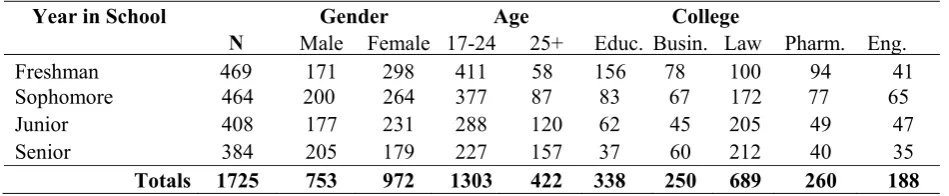
The survey was administered in the Fall Semester of 2014/2015 year and total population of students approached were 2050. Participants who responded were 1725 freshman, sophomore, junior and senior students who enrolled in five colleges in a Middle Eastern University. The distribution of respondents was 469 freshmen, 464 sophomores, 408 junior and 384 senior students. (see Table 1 for the details).
Table 1: Student Demographics
The Participants were 972 female students and 753 male students. There were 469 freshmen, 464 sophomores, 408 juniors and 384 senior students. Their ages ranged between 17 and 50 years (M=22.7). The university has five colleges; College of Education, Humanities and Social Sciences, College of Business Administration, College of Law, College of Pharmacy and College of Engineering and Information Technology. Three hundred and thirty-eight students were education students, 250 were business students, 689 were law students, 260 were pharmacy students and 188 were engineering students.
Year in School
N
Gender Age College
Male Female 17-24 25+ Educ. Busin. Law Pharm. Eng.
Freshman 469 171 298 411 58 156 78 100 94 41
Sophomore 464 200 264 377 87 83 67 172 77 65
Junior 408 177 231 288 120 62 45 205 49 47
Senior 384 205 179 227 157 37 60 212 40 35
9 4.3. Instrument
One instrument was used to collect the data for this study: Influences on Choice of Major Survey. This survey was developed by Malgwi, Howe and Byrnaby (2005). The researchers who developed the survey- used in this study- prepared a pilot study to make sure that the data in the questionnaire were reliable and accurate (Magwi et. al., 2005). They used Perseus survey Solutions software to collect the data and they developed the document in three stages. They used over 500 responses to clarify the questions and instructions. The researchers contacted the authors to use their survey and she received the authors’ approval to use their questionnaire in her study. and it is proved by them to be reliable and valid. To ensure the data gathered from the questionnaire were reliable and accurate, they developed the document in three stages. Then, Malgwi, Howe and Burnaby (2005) pilot tested the instrument using the Perseus survey Solutions software to collect the data. They used over 500 responses to refine the document, clarify the questions and instructions, and develop the final questionnaire.
For this study, the researchers sent the authors email asking if they can use their questionnaire in the study and modify some of the items and rephrase the document to suit the academic situation they are examining. They approved the use of their questionnaire and the modification on the items the researchers need for her study. The survey contains 9 items in which the first 4 represents the students’ demographics. The remain 5 items are corresponding to each of the factors that influence student major choice and student later major change. Items 5 (includes 12 statements) and 8 (includes 9 statements) utilize a (5-point-likert) scale with statements ranging from 1= no influence to 5= major influence. Related to the findings and discussion of this article, the researchers used students’ academic advising, choosing majors, and later major change from the questionnaire.
2.4. Data Collection Procedure
The Data was collected from undergraduate students in a Middle East University after getting the approval from the Dean of the College of Education, Humanities and Social Sciences.
4.4.1. Instructors.
10
researchers and were giving the surveys in envelops. A brief overview about the study was given to them, and the researchers asked the professors and instructors to leave the envelops with the secretaries in each college after collecting them from the students. The secretaries were informed when all envelops were ready to be sent to the researchers.
4.4.2. Students.
At the beginning of each class, a constructed speech that presented a brief idea about the study was given to the students by the instructors or the researchers themselves. Students were given surveys to complete during classes and were asked to return the surveys when finished to the instructors or to the researchers themselves. Students were informed that the survey would take 15 minutes to 20 minutes (during their classes).
5. Results
The results were analyzed to determine the relationship of student academic advising with students’ choosing majors that fit them without changing them many times by using descriptive statistics and correlational analyses. Before presenting the correlational analyses, the means and standard deviations are presented for each of the variables that were correlated.
Table 2: Means and Standard Deviations for the factors that influences the choice of majors by student (N= 1725).
Interest Aptitude reputation College Parents High school guidance University advisor
M (sd) M (sd) M (sd) M (sd) M (sd) M (sd)
Students 3.73 (1.4) 3.47 (1.2) 3.40 (1.4) 3.02 (1.6) 2.38 (1.4) 2.30 (1.4)
Related
subject teacher School advisor School opportunities Job Advanced Career payment Level of
M (sd) M (sd) M (sd) M (sd) M (sd) M (sd)
Students 2.64 (1.46) 2.21 (1.4) 2.08 (1.4) 3.64 (1.3) 3.76 (1.3) 3.54 (1.3)
The means and the standard deviations for high school guidance, university advisor, school teacher and school advisor, in table 2, show that students in this university received less academic advising regarding choosing majors.
11
that presents the factors that influence students’ major choice in the survey (high school guidance, university advisor, high school teacher and high school advisor). The questionnaire employed a 5-point Likert scale to rate each of the four factors influence their major choices, with 5 representing a major influence and 1 indicating no influence.
Statistics in table 2 indicate that high school advisors, school teachers, and university advisors have a very poor effect on their decisions to select their majors as they score 2.08, 2.21, and 2.30 respectively. On the other hand, the highest means which indicate a strong effect on their majors' selections are career advanced, their interest, and job opportunities available upon graduation. These factors score 3.76, 3.73, 3.64 respectively.
Table 3: Factors Influenced Major Chosen for all four years together (related to student academic advising issue N = 1725)
Again, in table 3, students of ALL years shared their perspective about student academic advising and its influence on their selection of majors. It indicates that the four categories (High school guidance, University\college advisor, High school teacher, and high school advisors) have very weak effects on students' decisions of major selections with No influence percentages of (40.9%, 45.6%, 48.4%, and 53.2%) respectively.
To look deeper on student academic advising issue and its influence on first year students and choosing majors, the researchers looked at these four factors regarding first year students alone (N=469).
Factors influenced choice of major
No Influence (1) (N) %
Minor Influence (2) (N) %
Somewhat minor influence (3)
(N) %
Somewhat major influence (4)
(N) %
12
Table 4: Factors Influenced Choosing Major for first year students (related to student academic advising issue)
Table 4 shows that many students in their first year believe the four factors regarding academic advising at schools and universities had almost no influence on their major choice. The table indicates that the four categories (High school guidance, University\college advisor, High school teacher, and high school advisors) have very weak effects on students' decisions of major selections with No influence percentages of (42.6%, 48.4%, 53.7%, and 58.2%) respectively.
In addition, table 5 is introduced to decide on the year and semester which detect majors changes within all year levels in university under investigation.
Table 5: Students Changing Majors (N= 1725)
The data in table 5 shows that students are most likely changing their majors in their second year and specifically in the second semester. Second year major change scored 36.9% in the second semester and 30.9% in the first semester. On the other hand and according to table 5 statistics, students are least likely changing their majors in their first semester in the first year (19.9%) and in their sixth semester (26.0%). Also, changing majors in the fourth year is surprising as the table indicates that almost 28% of students changed their majors as if they discover very late their preference to another major.
To gain more insight into the influence of academic advising, the researchers used two items related to the academic advising issue from section three that presents the positive factors that influence students’ major change in the survey (College advisor and instructors). A 5-point Likert scale was used to rate each
Factors influenced choice of major
No Influence (1) (N) %
Minor Influence (2) (N) %
Somewhat minor influence (3)
(N) %
Somewhat major influence (4)
(N) %
Major Influence (5) (N) % 1. High school guidance (200) 42.6 % (80) 17.1 % (91) 19.4 % (47) 10.0 % (51) 10.9 % 2.University \ college advisor (227) 48.4 % (50) 10.7 % (84) 17.9 % (56) 11.9 % (52) 11.1 % 3.High school teacher (252) 53.7 % (62) 13.2 % (65) 13.9 % (48) 10.2 % (42) 9.0 % 4.High school advisor (273) 58.2 % (63) 13.4 % (61) 13.0 % (35) 7.5 % (37) 7.9 %
Year in School N Semester Changed Major First Second (N) % (N) % Freshman 469 386 83 (77) % 19.9 (25) % 30.1 Sophomore 464 391 73 (121) % 30.9 (27) % 36.9
13
of the two positive factors influenced their major change, with 5 representing a major influence and 1 indicating no influence. The other factors related to this section will be presented and discussed in later article since the focus of this research is on student academic advising and its influence on student major choice and later major change.
Before presenting the correlational analyses, the means and standard deviations are presented for each of the two variables that were correlated in table 6.
Table 6: Means, Standard Deviations, and Numbers for the college advisor positive factor, instructors positive factor and major change
A correlational analysis was created to answer research hypothesis and to meet that end, Person r correlations were used in this study because they enabled the researchers to describe the relationships between the variables used in the survey.
Table 7: Correlations of college advisor positive factor, instructors positive factor and major change
Correlations
Change Major College Advisor Instructors
Change Major/ All years
Pearson Correlation 1 -.042 -.028
Sig. (2-tailed) .357 .528
N 1725 494 494
Pearson Correlation 1 -.118 -.122
Change Major/
First Year Sig. (2-tailed) .240 .224
N 496 101 101
Change Major/ Second Year
Pearson Correlation 1 b b
Sig. (2-tailed) .000 .000
N 494 148 148
Change Major/
Third Year Pearson Correlation 1 -.087 -.087
Sig. (2-tailed) .315 .316
N 408 136 136
Change Major/
Fourth Year Pearson Correlation 1 .091 .134
Sig. (2-tailed) .344 .165
N 384 109 109
**. Correlation is significant at the 0.01 level (2-tailed).
N College Advisor
M (Sd.) Instructors M (Sd.) Change Major M (Sd.)
14
Table 7 presents the correlational analysis of college advisor positive factor, instructors positive factor and major change for all four years together. The researchers noticed that there was no significant correlation between the two factors and change major. For that reason, correlational analysis for the fourth years was conducted separately.
As the data in table 7, there is a positive significant correlation between college advisor and change major in the second year (p = .000). There is also a positive significant correlation too with instructors and positive influence to change to the current majors in their second year (p = .000). This result is supported by Ismael (2012) and Dickson (2010) findings that students usually change majors in their second semester of their first year or in their second year. When presenting the correlational relation between advising and choosing majors, the researchers shed a light on the negative correlation between the two variables since academic advising had no influence on students’ major change. This means that all students chose the factor no influence of advising on their choices of changing their majors.
In sum, researchers can state that the hypothesis is rejected because based on findings, first year major change is high as it scores (50%) of possibility and college major change possibility increases in the subsequent years especially in the second year which scored the highest percentage of major change of 67.8% (30.9%+36.9%).
4. Discussion
The purpose of the study is to research elements that are related to aspects of the problem: Students’ confusion when choosing majors that fit them without changing their majors several times. The focus of the study is to shed light on the importance of academic advising in helping students choose and maintain their majors in whatever year students are enrolled. In fact, students should experience variety of courses to decide on their majors, but this study focuses more on the important role of advisors which guide students to choose their major in addition to courses experience. Through this study, the researchers want to explore students’ perceptions about the academic advising they received and the relationship of its absence on students’ major change.
15
problem regarding choosing majors and later majors change because the academic advising is not activated that too much at schools and colleges. In this study, some students shared that the advising they received had no influence on their decisions to choose or change majors.
Many authors shared that choosing college majors is the biggest problem students face in the Middle East apparently because students follow their friends and they were more restricted and even forced to choose according to their parent's preference who prefer to have more prestigious professions (Al Any, 2013; Al Bawardi & Suliman, 2013; Al Khateeb, 2012; Al Masoudi, 2008; Al Shalwee, 2006; Anonymous, 2011, 2014; Bayomi, 2011; Ismael, 2012; Lafy, 2010; Mohsen, 2013; Najmi, 2014; Rabee', 2003). Evidence suggests that students miss out good major selection that suits them in part because they are unaware of these opportunities (Al Khateeb, 2012; Al Masoudi, 2008; Hoxby & Turner, 2013; Mohsen, 2013). Al Any (2013) argued that our students in the Middle East miss the opportunities to attend colleges and choose “good” majors (Beggs et al., 2008) because simply they did not know how or what to choose. He added students in particular stages need an academic advising regarding attending colleges and universities and choosing majors.
Lafy (2010) added that many students do not select majors they like because of wrong information they received in the first semester of the first year during advising. He added students need sources at schools, colleges and universities that educate them about their academic future including personal abilities, interests, values, major choice and future careers. Beggs, Bantham and Taylor (2008) conducted a study to prove that there is a benefit to making “good” major choices. They defined a “good” major choice as the major best capable of helping students to achieve their educational and post-educational goals (Korscheg & Hageseth, 1997).
Choice is a good thing and it can never be a bad thing (Scott-Clayton, 2011). Usually a choice develops for a reason: to serve a diversity of preferences (Vila et al., 2007). Vila, Aracil and Mora (2007) pointed out that the choice of a major is a personal decision of students that combines individual tastes, preference and prospects related to the working life after graduation. It is also affected by the desires of the parents and society traditions. Vila, Aracil and Moora also pointed out that students choose a major relying on the life goals according to personal values. So, it is good to provide students with adequate information for major selection since it affects their adult future.
16
no influence for high school guidance factor, 787 students (45.6 %) out of 1725 shared that university advisors had no influence in their major choice. Last 917 students (53.2 %) out of 1725 shared with us that high school advisor factor has no influence on their major choice. These findings are consistent with those of earlier research that the reason for this problem is inactivates the role of the academic advisors at schools, colleges and universities.
Ismael (2012) and Dickson (2010) noticed students may change majors between their first semester of study and graduation. They shared students usually change majors in their second semester of their first year or in their second year. They presented the importance of the academic advising at schools and universities to deal with students’ ambiguity about college majors and how to choose majors that fit their personal abilities and interests which lead to students’ stability at the university (Rabee', 2003).
Carnevale and Melton (2011) believe that given such information, students might make different decisions which affect the rest of their adult lives. They argued students deserve to know that the labor market does not treat majors and jobs the same. Students should know how their educational choices will affect the rest of their adult lives, in terms of the career they will have and their expected earnings. Understanding how major choices are made and which factors determine them will enable policy makers to help and support students entering the appropriate major which helps students connect to it in ways that promote completion of the major without changing it several times (Bartolj & Polanec, 2012; Moore & Shulock, 2011). This also will help universities and their faculties understand why some majors are crowded and why others are struggling for students (Bartolj & Polanec, 2012).
Recent research suggests that efforts to increase student awareness of major choice need to focus on helping high school students and new college students choose and enter a major of study (Al Khateeb, 2012; Anonymous, 2011; Baker & Griffin, 2010; Beggs et al., 2008; Dickson, 2010; Dietz, 2010; García-Aracil et al., 2007; Hoxby & Turner, 2013; Moore & Shulock, 2011; Najmi, 2014; O'Banion, 2012; Pampaloni, 2010; Scott-Clayton, 2011; Simoes & Soares, 2010; John, 2000; Zafar, 2013).
17
about their major and increased their confidence to formally declare a major. According to Supiano (2011), students could really benefit from personal attention as they deciding to choose a major. Sharing knowledge about college majors and how to choose them may lead into less problem of choosing wrong majors, changing majors or leaving college forever (Al Khateeb, 2012; Najmi, 2014).
Reviewing this whole literature, there are many reasons support having academic advisors who care about students’ future at schools and universities to help them choose the appropriate major and do not change it after a while. First, academic advisors have the current or comprehensive knowledge of college opportunities and majors (Al Khateeb, 2012; Anonymous, 2011; Baker & Griffin, 2010; Dickson, 2010; Hoxby & Turner, 2013; Ismael, 2012; Lafy, 2010; Najmi, 2014; Noddings, 2006, O'Banion, 2012) . Students will have more information and resources available about college and major options when talking to an academic advisor (Anonymous, 2011; Beggs et al., 2008; Dietz, 2010; García-Aracil et al., 2007; John, 2000; Noddings, 2006; Pampaloni, 2010; Scott-Clayton, 2011; Simoes & Soares, 2010;; Zafar, 2013). Second, advising from advisors is potentially one of the earliest interventions outside of the student’s family (Al Khateeb, 2012; Hoxby & Turner, 2013; Najmi, 2014; Noddings, 2006). Third, students will be less confused with the information provided by the advisors since students can meet them in person any time and ask questions to clarify the unclear ideas or information students may have (Nagy, 2012; Scott-Clayton, 2011; Simoes & Soares, 2010, Smith, 2004).
5. Conclusion
Based on the findings, policy makers and educators need to activate the role of academic advising at schools and universities and give more attention to students’ needs of personal interaction and sharing information regarding their academic future which might lead students to complete their majors without changing them many times. Adding to this, an understanding of how students form their interests regarding a major before they attend the college may be the key to good major choice. It is a good idea to provide better professional development opportunities for academic advising staff to ensure that advisors and educators can provide guidance for students on the full range of major options at the colleges and universities
18
References
Al Any, T. (2013). Students after high school: Are they going to choose their future or they will get confused?
Al Bawardi, R., & Suliman, A. (2013). Obstacles to choose undergraduate majors lead students to lose one academic year. http://demo.alroeya.ae/2013/12/07/108403
Al Khateeb, M. (2012). Choose the appropriate college students dilemma.
http://www.alkhaleej.ae/alkhaleej/page/7ab1df92-fb54-45df-8dd7-2d83ff7d47cc
Al Masoudi, E. (2008). Trouble choosing university specialization. http://almsaodi.com/?p=21
Al Shalwee, F. (2006). Factors associated with the selection of specialization among undergraduate students. http://ncys.ksu.edu.sa/node/1664
Alexander, M.W., D. Kukowski & L. Dexter (2003b). Business students’ perceptions of the academic advising process. Proceedings of the Academy of Educational Leadership, 8(1), 11-16.
Allen, J. M., & Smith, C. L. (2008). Importance of, responsibility for, and satisfaction with academic advising: A faculty perspective. Journal of College Student Development, 49(5), 397-411.
Anonymous. (2011). Workshop guideline for high school students about how to choose a major: Think deeply to choose the best.
Anonymous. (2014). Factors influence the choice of a major. http://www.college-help.org/page.aspx?PageID=2879
Arcidiacono, P., Hotz, J., & Kang, S. (2010). Modeling college major choices using elicited measures of expectations and counterfactuals. Paper presented at the Identification and Decision, Northwestern University.
Baker, V., & Griffin, K. (2010). Beyond mentoring and advising: Toward understanding the role of faculty "developers" in student success.
Bartolj, T. b. i. s., & Polanec, S. (2012). College major choice and ability: Why is general ability not enough? Economics of Education Review, 31(6), 996-1016. doi: 10.1016/j.econedurev.2012.07.010
Bayomi, A. (2011). Students in high schools have trouble choosing college majors. http://www.emaratalyoum.com/local-section/hotline/2011-11-18-1.438056
Beffy, M., Fougere, D., & Maurel, A. (2012). Choosing the field of study in postsecondary education:Do expected earnings matter? The Review of Economics and Statistics, 94(1), 334-347.
Beggs, J. M., Bantham, J. H., & Taylor, S. (2008). Distinguishing the factors influencing college students' choice of major. College Student Journal, 42(2), 381-394.
19
Carnevale, A. P., & Melton, M. (2011). Major differences: Why undergraduate majors matter. Presidency, 14(3), 30-33.
Chapman, D. W., DeMasi, M., & O'Brien, C. (1991). Parents' perceptions of the effectiveness of public school counselors in college advising. School Counselor, 38, 268-278.
DeMarie, D., & Aloise-Young, P. A. (2003). College students' interest in their major. College Student Journal, 37(3), 462-469.
Dickson, L. (2010). Race and gender differences in college major choice. The ANNALS of the American Academy of Political and Social Science, 627(108), 108-124.
Dietz, J. (2010). The myth that college and major choice decides Johnny's future. College Student Journal, 44(2), 234-249.
He, Y., & Hutson, B. (2016). Appreciative Assessment in Academic Advising. The Review of Higher Education, 39(2), 213-240. DOI: 10.1353/rhe.2016.0003
Galotti, K. M. (1999). Making a “major” real-life decision: College students choosing an academic major. Journal of Educational Psychology, 91(2), 379-387. doi: 10.1037/0022-0663.91.2.379
García-Aracil, A., Gabaldón, D., & Mora, J.-G. (2007). The relationship between life goals and fields of study among young European graduates. Higher Education, 53(6), 843-865. doi: 10.1007/s10734-005-7517-3
Howell, N. (2010). Appreciative advising from the academic advisor's viewpoint: A qualitative study. (Doctoral dissertation). Retrieved from ProQuest Dissertations and Theses database.
(AAT3398312)
Hoxby, C., & Turner, S. (2013). Informing students about their college options: A proposal for broadening the expanding college opportunities project.
Ismael, H. (2012). Before choosing your major, listen to miss choosers. http://shabab.ahram.org.eg/News/4423.aspx
Johnson-Garcia, M. (2010). Faculty perceptions of academic advising: Importance, responsibility, and competence (Doctoral Dissertation). Retrieved from
https://une.idm.oclc.org/login?url=http://search.proquest.com.une.idm.oclc.org/docview/ 841634748?accountid=12756 (3434272)
Johnson, j., Rochkind, J., Ott, A., & Dupont, S. (2009). Can I get a little advice here? (pp. 1-42): Institute for Higher Education Leadership & Policy.
Keshishian, F., Brocavich, J., & Boone, T. (2010). Personality characteristics and choice of Academic major: Are traditional stereotypes obsolete? College Student Journal, 47(3), 131-142.
20
Korscheg, A., & Hageseth, J. (1997). Undecided students: How one college developed a collaborative approach to help students choose majors and careers. Journal of Career Planning & employment, 57(3), 49.
Lafy, M. (2010). Students and the problem of choosing the appropriate major. http://www.almoslim.net/node/148672
Legutko, R. S. (2007). Influence of an academic workshop on once-undeclared graduates' selection of a major. College Student Journal, 41(1), 93-98.
Malgwi, C. A., Howe, M. A., & Burnaby, P. A. (2005). Influences on students' choice of college major. Journal of Education for Business, 80(5), 275-282. doi: 10.3200/JOEB.80.5.275-282
McFarlane, B., (2013). Academic advising structures that support first-year student success and retention. Dissertations and Theses. Paper 1044.
Mohsen, M. (2013). Approperate selection of major is a key to a successful life. http://www.alkhaleej.ae/alkhaleej/page/096e5607-20b5-4061-a106-7834cf5e79b7
Moore, C., & Shulock, N. (2011). Sense of direction:The importance of helping community college students select and enter a program of study. California State University: SACRAMENTO Institute for Higher Education Leadership Policy.
NACADA. (n.d.). Retrvied from http://www.nacadad.ksu.edu/Resources/Clearinghouse.aspx
Nagy, A. (2012). A review of:" Noddings, Nel (2006). The challenge to care in schools: An alternative approach to education (2nd Ed.). Journal of Research on Christian Education, 21(1), 91-96.
Najmi, R. (2014). Steps to help you choose an appropriate major.
Noddings, N. (2006). The challenge to care in schools: An alternative approach to education. New York, NK: Teachers College, Columbia University.
Noddings, N. (2002). Starting at home: Caring and social policy. Berkeley: University of California Press.
O'Banion, T. (2012). Be advised. Community College Journal, 83(2), 42-47.
Pampaloni, A. (2010). The influence of organizational image on college selection:What students seek in instituations of higher education. Journal of marketing for Higher Education, 20(1), 19-48.
Pargett,K.(2011). The effect of academic advising on college student development in higher education. Educational Administration: Theses, dissertations and student's researcg. University of Nebraska- London.
Porter, S. R., & Umbach, P. D. (2006). College major choice: An analysis of person-environment fit. Research in Higher Education, 47(4), 429-449. doi: 10.1007/s11162-005-9002-3.
21
Rabee', A. (2003). Regarding the absence of the academic guidance and advising for choosing college majors:High school students dilemma of choosing or changing college majors. http://www.alwasatnews.com/185/news/read/199284/1.html
Scott-Clayton, J. (2011). The shapeless river: Does a lack of structure inhibit students' progress at community colleges? (pp. 1-27): Bill & Melinda Gates Foundation.
Simoes, C., & Soares, A. (2010). Applying to higher education: Information sources and choice factors. Studies in Higher Education, 35(4), 371-389.
Simpson, J. C. (2003). Mom matters: Maternal influence on the choice of academic major. Sex Roles, 48(9/10), 447-460.
Simpson, W. A. (1987). Tracking students through majors: Methodology and applications. Journal of Higher Education, 58, 323-343. doi: 10.2307/1981271
Smith, K. (2004). Nel Noddings, the ethics of care and education. The Encyclopaedia of Informal Education.
Song, C., & Glick, J. E. (2004). College attendance and choice of college majors among Asian-American students. Social Science Quarterly., 85(5), 1401-1421. doi: 10.1111/j.0038-4941.2004.00283.x
John, E. (2000). Do majors matter? Black Issues in Higher Education, 17(4), 20-27.
Supiano, B. (2011). Recent grads advise high school students about college. Condensed with Permission from The Chronicle of Higher Education, 57 (October 1, 2010), A18, 76(7), 35-38.
Vila, L. E., Garcia-Aracil, A., & Mora, J.-G. (2007). The distribution of job satisfaction among young European graduates: Does the choice of study field matter? Journal of Higher Education, 78(1), 97-118. doi: 10.1353/jhe.2007.0006
Wilcoxson, L., & Wynder, M. (2010). The relationship between choice of major and career, experience of university and attrition. Australian Journal of Education (ACER Press), 54(2), 175-189.
Wiswall, M., & Zafar, B. (2011). Determinants of college major choice: Identification using an information experiment (pp. 1-58): Federal Reserve Bank Of New York.
Zafar, B. (2011). How do college students form expectations? Journal of Labor Economics, 29(2), 301-348. doi: 10.1086/658091