Volume 2008, Article ID 378097,9pages doi:10.1155/2008/378097
Research Article
Other-Cell Interference Reducing Resource Allocation in
OFDM-Based Asynchronous Cellular Systems
Jin-Woo Lee, June Moon, and Yong-Hwan Lee
School of Electrical Engineering and INMC, Seoul National University, P.O. Box 34, Kwanak, Seoul 151-600, South Korea
Correspondence should be addressed to Jin-Woo Lee,[email protected] Received 4 April 2007; Accepted 25 September 2007
Recommended by Hikmet Sari
Orthogonal frequency division multiplexing (OFDM) is considered as one of the most promising techniques for next-generation wireless access systems. However, it may suffer from the so-called other-cell interference (OCI) in cellular environments. In this paper, we consider a novel resource allocation scheme to reduce the OCI in OFDM-based asynchronous cellular systems. The proposed scheme can reduce the OCI by exploiting repetitive properties of cyclic prefix of OFDM symbol and asynchronous properties between the user and the base stations in other cells. The proposed scheme can be applied to various types of OFDM-based systems such as orthogonal frequency division multiple access (OFDMA) and multicarrier code division multiple access (MC-CDMA) systems. Simulation results show that the proposed scheme can reduce the OCI by nearly up to 1 dB compared to conventional schemes, yielding an increase of the throughput of about 15% near the cell boundary in OFDM-based asynchronous cellular environments.
Copyright © 2008 Jin-Woo Lee et al. This is an open access article distributed under the Creative Commons Attribution License, which permits unrestricted use, distribution, and reproduction in any medium, provided the original work is properly cited.
1. INTRODUCION
Broadband wireless packet access systems have attracted for the achievement of high-speed transmission capacity. Or-thogonal frequency division multiplexing (OFDM) is known as one of the best transmission techniques for this purpose due to the simplicity of channel equalization even in severely frequency selective wireless channel by converting wideband frequency selective fading into a series of narrowband flat fading [1–3]. However, it may suffer from other-cell inter-ference (OCI) in cellular environments that use the same fre-quency band for all cells [4]. As a consequence, the system capacity is mainly limited by the OCI rather than other noise in interference-limited environments.
A number of researches have been reported on the miti-gation of OCI. They can be classified basically into two cat-egories according to the mitigation strategy of OCI: OCI av-eraging and OCI avoidance. OCI avav-eraging schemes require a simple transceiver structure and can easily control the ra-dio resource with the aid of spread spectrum and/or fre-quency hopping (FH) techniques [5,6]. These techniques have been exploited in multicarrier code division multiple access (MC-CDMA) [7] and frequency hopping orthogo-nal frequency division multiple access (FH-OFDMA)
sys-tems [8]. They can provide a diversity gain as a result of channel and/or OCI averaging effect. However, the perfor-mance of MC-CDMA and FH-OFDMA systems is typically limited by the amount of average OCI. As a result, they may not provide significant performance improvement in cellular environments. On the other hand, OCI avoidance schemes can reduce the interference by dynamically avoiding adja-cent base stations (BSs) to use the same frequency resource used by the target BS. Dynamic packet assignment (DPA) [9] and fractional frequency reuse (FFR) [10,11] are typical ex-amples of OCI avoidance schemes. However, OCI avoidance schemes require a large amount of additional information exchange among the BSs through backbone networks. What is worse, they may not be applicable to OFDM-based asyn-chronous cellular systems due to inherited timing difference among the BSs [12].
(x0
Figure1: OFDM system model.
The remainder of this paper is organized as follows.
Section 2 describes the system model in consideration. In
Section 3, the proposed OCI reducing scheme is described. Then, the proposed resource allocation methods are applied to OFDM-based cellular systems in Section 4. The perfor-mance of the proposed schemes is verified by computer sim-ulation inSection 5. Finally, conclusions are summarized in
Section 6.
2. SYSTEM MODEL
Consider the transmission of the mth OFDM symbol ma-trix from the 0th cell (i.e., the target BS), which is de-fined by X0
in the frequency domain. Figure 1 illustrates the discrete time OFDM sys-tem model in consideration. The OFDM transmitter con-verts X0
by the inverse discrete Fourier trans-form (IDFT)D−1as
whereaTanda−1, respectively, denote the transpose, inverse
of matrixa, andDis an (N×N) discrete Fourier transform
Here,Ndenotes the number of subcarriers (i.e., the OFDM symbol duration in the sample time domain) and j=√−1.
To mitigate the intersymbol interference (ISI) and inter-carrier interference (ICI) due to multipath delay spread, a CP which is a replica of the last portion of the OFDM symbol is inserted at the beginning of each OFDM symbol as [1]
x0
the sample time domain. Assume that the channel impulse response matrixh0
m =
m only by the path-loss propagation (i.e., all the
el-ements ofh0
between the transceivers in the 0th cell, andαdenotes the path-loss exponent). Then, themth received OFDM symbol matrix including the CP from the 0th cell can be represented as
from the cth cell, C is the number of other cells, and symbol “×” denotes group direct product defined by a×
b a1b1 · · · aNbNwhena = a1 · · · aNandb =
b1 · · · bN.
Themth received OFDM symbol matrixy0
mfrom the 0th
cell can be obtained by discarding the firstNg samples (i.e.,
the CP) ofy0
Then, it is demodulated by DFT as
whereDdenotes a DFT processor.
Since the OCI from other cells is not synchronized with the signal from the 0th cell in an OFDM-based asynchronous cellular system, it can be represented as
C
whereΔcdenotes the timing offset between the 0th cell and
thecth cell.Figure 2illustrates the shape of asynchronization between the OCI and the desired signal.
3. CONCEPT OF THE PROPOSED OCI REDUCTION
(m−1)-th DFT window
m-th DFT window
Figure2: OCI distribution in OFDM-based asynchronous cellular systems.
Ng N(OFDM symbol)
CP G=S
(a) Conventional OFDM signal
CP G S
(b) Proposed OFDM signal Figure3: The concept of signal power reduction.
OFDM systems. Since the CP itself is a redundancy requiring additional power, it may be desirable to reduce the power of the CP. If the power of the CP can be reduced, the average transmit power can be reduced and thus the power of OCI to other users can also be reduced in an OFDM-based asyn-chronous cellular system.
In a conventional OFDM system, the CP is generated as a replica of the last portion of the OFDM symbol with the same power and thus it has the same average transmit power as the rest of OFDM symbol, as illustrated inFigure 3(a). To reduce the power of the CP, it is required to design the OFDM sym-bol to have lower power in its last portion corresponding to the CP.Figure 3(b)illustrates the design of OFDM symbols for the proposed scheme.
As illustrated inFigure 3, letGandSbe the average power of the last portion of the OFDM symbol corresponding to the CP and the rest of the OFDM symbol, respectively, as
G= 1
whereadenotes the Euclidean norm ofa. Thus, the aver-age OCI power from thecth cell can be represented as
Pc=
Thus, the total average OCI power can be represented as
P=
Figure 4illustrates the signal distribution when the pro-posed signaling is applied to an asynchronous OFDM cellular system. Since the signals from the target BS are synchronized to the desired signal, the power reduction of the last portion of the OFDM symbol corresponding to the CP does not affect the reception performance. However, it can be seen that the average OCI power from other BSs is reduced in the presence of symbol timing misalignment between the transceivers in this asynchronous cellular system. (In an OFDM-based syn-chronous cellular system, on the other hand, the OCI reduc-tion gain cannot be achieved since the power reduced CP of OCI at the outside of the DFT window is also perfectly re-moved as that of signal from the intra BS (i.e.,P=Pwhen 0≤Δc< Ng).)
The average OCI power from thecth cell can be repre-sented as
(m−1)-th DFT window
Signal
c-th OCI CP
CP S G CP
n Δc
Ng N
CP
m-th DFT window
Figure4: Reduced OCI power in OFDM-based asynchronous cellular systems.
0
−0.2
−0.4
−0.6
−0.8
−1
−1.2
−1.4
−1.6
−1.8
OCI
p
o
w
er
re
d
u
ct
io
n
ra
tio
(
Γ
)(
d
B
)
0 5 10 15 20 25 30
β(dB)
η=2 η=4 η=6
η=8 η=10
Figure5: The average OCI power reduction ratio as a function ofη
andβ.
transceivers, it can be assumed that Δc is uniformly
dis-tributed. Then, the average OCI power is changed by the pro-posed scheme as
Pc=EΔc
Pc
Δc
=2NgG+
N−Ng
S
N+Ng
1
rc
α (12)
and the total average OCI power becomes as
P=
C
c=1
Pc=
2NgG+
N−Ng
S
N+Ng
C
c=1
1
rc
α. (13)
Note that the average power of the OCI in the conventional scheme isP. Lettingηbe the ratio of the OFDM symbol du-ration to the CP dudu-ration (i.e.,η=N/Ng) andβthe ratio of
the average OFDM symbol power to the average CP symbol power (i.e.,β=S/G), define the OCI power reduction ratio by
ΓP
P =
η η+ 1
1 + 1
1 + (η−1)β
. (14)
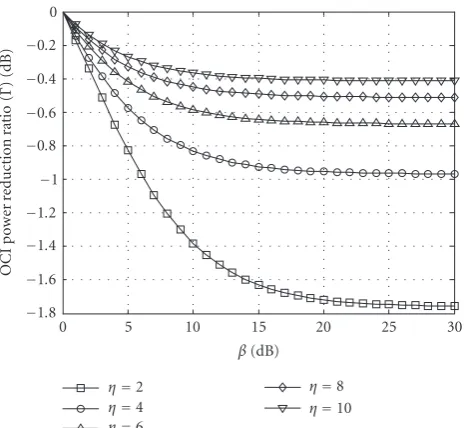
Figure 5depicts the amount of OCI power reduction ac-cording to the values ofηandβ. It can be seen that the gain of the proposed scheme over the conventional one increases as ηdecreases and/orβincreases. In practice,ηis designed by considering the maximum delay and Doppler spread [15]. For example,η = 4 in the radio access system in [16] and η=8 in the mobile WiMAX system in [17]. Sinceηis a fixed parameter in practice, the performance can be improved by increasingβ.
4. PROPOSED RESOURCE ALLOCATION FOR MULTIUSER OFDM SYSTEMS
In this Section, we propose a novel resource allocation rule to increaseβin multiuser OFDM systems such as OFDMA system and MC-CDMA system. Unless all the resources (e.g., subcarriers in the OFDMA and spreading codes in the MC-CDMA) of multiuser OFDM systems are fully utilized for the signal transmission (i.e., no room for the signal design with increasedβ), we can reduce the power of the CP by exploiting the proposed resource allocation scheme.
4.1. OFDMA system
The OFDMA divides the whole frequency band into multiple subcarriers and assigns subcarriers to each user at an OFDM symbol time. It supports flexible data transmission by for-matting the digital modulation on each subcarrier.
4.1.1. Optimum subcarrier allocation
To maximizeβ(i.e., to minimize the average power of the last portion of the time domain OFDM symbolxc
m), we exploit
the reciprocal characteristics between the time domain and the frequency domain. In what follows, the subscriptmand the superscriptcofXc
mare omitted for simplicity of
descrip-tion.
Assume that there areU users. Then,X can be repre-sented as
X=X0 · · · XN−1
=wb0 · · · bU−1 v0 · · · vN−U−1
=w[b v],
10
5
0
−5
−10
−15
−20
−25 N=64
No
rm
ali
ze
d
si
gn
al
p
o
w
er
(d
B
)
10 20 30 40 50 60
Sample time (n)
U=48 U=56 U=64
Figure6: Power of the proposed optimum OFDMA signal when
N=64.
b0 √
2
b1 √ 2
b2 √
2
−bU√−1
2
X0 X1 X2 X3 X4 X5 X2(U−1) X2(U−1)+1
k . . . . . .
b√U−1
2 −√b2
2 −√b1
2
−√b0
2
Figure7: The proposed suboptimum resource allocation scheme.
wherewis a weighting constant for the power normalization determined as
w=
! !
" b2
b2+v2, (16)
bis the data symbol matrix ofUusers, andvis a redundant signal matrix to be designed to make the last portion of the time domain OFDM symbolxzero as
x=x1 x2
=x1 0
. (17)
Herex1=x{0:(U−1)}andx2=x{U:(N−1)}=0.
DecomposeDinto four partial matrices as
D=
#
D1 D2
D3 D4
$
, (18)
whereD1is a (U×U) matrix,D2is a (U×(N−U)) matrix,
D3is a ((N−U)×U) matrix, andD4is a ((N−U)×(N−U))
matrix. Then, we have
XT=DxT,
w[b v]T=
#
D1 D2
D3 D4
$
x1 0
T
. (19)
Since
w(b)T=D1
x1
T
, (20)
(x1)T can be obtained by
x1
T
=wD−11 (b)T. (21)
Since
w(v)T=D3
x1
T
, (22)
vcan be designed by
v=bD−11
T
D3
T
. (23)
LetmF(k) be the data symbol allocated to thekth
sub-carrier. Then, the subcarrier for the OFDMA signal can be allocated as
mF(k)=
wbk, k=0, 1,. . .,U−1,
wvk−U, k=U,U+ 1,. . .,N.
(24)
Note that, whenU≤N−Ng, it can be possible to makeβ
infi-nite by making the average powerGof the CP zero.Figure 6
depicts the average signal power of the proposed OFDMA signal for different values ofUwhenN =64. It can be seen that the power of the last portion of the signal can perfectly be controlled whenU ≤ N−Ng. WhenU > N−Ng, the
resource will be allocated to the last portion of the OFDM symbol in the time domain, yielding somewhat performance degradation.
4.1.2. Suboptimum subcarrier allocation
Although the optimum subcarrier allocation rule can pro-vide significant performance improvement, it may not be ap-plicable in practice due to the implementation complexity. Thus, we consider a simple subcarrier allocation rule to in-creaseβin multiuser OFDMA environments.
10
Figure8: Power of the proposed suboptimum OFDMA signal when
N=64.
kth subcarrier. Then, the subcarrier for the OFDMA signal can be allocated as
mF(k)
Note that whenU ≤ N/2, each pair of symbols allocated to the adjacent subcarriers will have opposite signs. How-ever, whenU > N/2, (U−N/2) pairs of symbols allocated to the adjacent subcarries do not have opposite signs. The proposed resource allocation rule generates an OFDM sig-nal that has a∩-shaped power characteristic in the time do-main as shown inFigure 8(refer to the appendix). Thus, the proposed scheme can increaseβcompared to conventional schemes, reducing the average OCI power without the in-crease of complexity.
Figure 8depicts the average signal power of the proposed OFDMA signal for different values ofUwhenN=64. It can be seen that the OFDM signal has a∩-shaped power
char-10
Figure9: Power of the proposed suboptimum MC-CDMA signal with WH spreading code whenN=64.
acteristic and the average signal power corresponding to the CP is noticeably reduced whenU≤N/2.
4.2. MC-CDMA system
The MC-CDMA system transmits multiuser signals by using orthogonal spreading codes. The use of spreading codes can reduce the fluctuation of channel and/or interference, yield-ing a diversity gain.
4.2.1. Optimum WH code allocation
Real-valued binary codes (e.g., Walsh-Hardamard (WH) codes) are often employed as the spreading code due to their simplicity [18]. If the spreading factorLis equal toN, there can existNspreading codes. The WH code can optimally be allocated for the reduction of βby exhaustive search using the spectral properties of the WH code [19].
4.2.2. Suboptimum WH code allocation
The optimum WH code allocation rule can significantly re-duce the OCI. However, it may not easily be realizable be-cause it is associated with the values ofNandη. Thus it may be desirable to employ a suboptimum allocation rule robust to the variation of these parameters.
The WH codes have a property that each pair of adjacent chips with an odd index and an even index has opposite signs and the same signs, respectively. For example, WH codes of length 4 can be represented as WH4
0 = {1, 1, 1, 1}, WH41 =
{1,−1, 1,−1}, WH4
2= {1, 1,−1,−1}, WH43= {1,−1,−1, 1},
the WH spreading codes with an odd index have preference for the allocation over those with an even index.
When a WH code is used as the spreading code, the re-source can be allocated for the MC-CDMA system as
mWH(k)=
wheremWH(k) denotes the data symbol allocated to thekth
WH spreading code of lengthN(i.e., WHNk).
4.2.3. Optimum DFT code allocation
The OCI can further be reduced by employing a DFT basis as the spreading code. Let DFTlk=e−j2πkn/lbe thekth spreading
code of lengthl[20]. Since the IDFT of DFTNk is an impulse
function located at timekas depicted inFigure 10, the MC-CDMA signal can be allocated using a DFT spreading code as
mDFT(k)=bk, k=0, 1,. . .,U−1, (27)
wheremDFT(k) denotes the data symbol allocated to thekth
DFT spreading code of lengthN. Thus, the power loss due to the CP can completely be eliminated whenU ≤N−Ng
as depicted inFigure 10, yielding substantial reduction of the OCI power.
5. PERFORMANCE EVALUATION
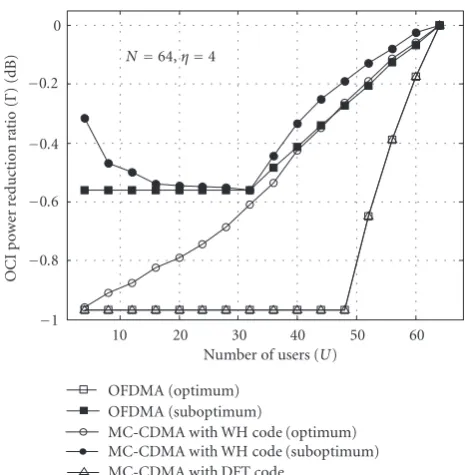
The performance of the proposed resource allocation schemes is verified by computer simulation. Figure 11 de-picts the OCI power reduction ratio Γ as a function of the number of users when N = 64 and η = 4. It can be seen that the proposed resource allocation schemes no-ticeably reduce the OCI unless U is too large. When ap-plied to an OFDMA system, the proposed optimum allo-cation scheme reduces the OCI by nearly up to 1 dB when U ≤ N −Ng. WhenU > N −Ng, the resource will be
allocated to the last portion of the OFDM symbol in the time domain, yielding performance degradation. The pro-posed suboptimum allocation scheme provides a power re-duction gain of nearly up to 0.6 dB whenU ≤ N/2. When U > N/2, Γincreases as U increases because (U −N/2) pairs of symbols allocated to the adjacent subcarriers have the same signs. When applied to an MC-CDMA with the use of WH codes, the proposed optimum WH code allo-cation scheme provides an OCI power reduction of nearly up to 1 dB whenUis very small. In addition, the proposed suboptimum WH code allocation scheme provides an OCI power reduction of nearly up to 0.6 dB. It can be seen that
10
Sample time (n)
DFT64
Figure10: Power of the proposed optimum MC-CDMA signal with DFT code whenN=64.
MC-CDMA with WH code (optimum) MC-CDMA with WH code (suboptimum) MC-CDMA with DFT code
Figure11: The average OCI power reduction associated withU.
the MC-CDMA with the use of DFT spreading codes vides performance better than the use of WH codes. The pro-posed scheme provides an OCI reduction of nearly 1 dB with the use of DFT code whenU ≤ N−Ng sinceβis infinite
(i.e.,Γβ→∞ = η/(η+ 1)). WhenU > N−Ng, the resource
will be allocated to the last portion of the OFDM symbol in the time domain, yielding substantial performance degrada-tion.
1.6
1.55
1.5
1.45
1.4
1.35
N=64,η=4
U
ser
th
ro
ug
h
p
ut
(b
it
/s
/H
z)
0 10 20 30 40 50 60
Number of users (U)
OFDMA (optimum) OFDMA (suboptimum)
MC-CDMA with WH code (optimum) MC-CDMA with WH code (suboptimum) MC-CDMA with DFT code
Figure12: The average user throughput near the cell boundary in a 19-cell configuration.
and η = 4. Here, we assume that 19-cell configuration with cell radius R = 1 km and path loss exponent α = 4 as considered in [21]. It can be seen that when applied to an OFDMA system, the proposed scheme can increase the average throughput of users near the cell boundary by nearly up to 0.21 bit/s/Hz (or increase of the average throughput by approximately 15%) whenU≤N−Ng. It can also be seen
that when applied to an MC-CDMA with the use of DFT spreading codes, the proposed scheme can increase the av-erage throughput of users near the cell boundary by nearly 0.21 bit/s/Hz. This implies the effectiveness of OCI reduction near the cell boundary.
6. CONCLUSIONS
We have proposed novel resource allocation schemes that can reduce the OCI in OFDM-based asynchronous cellu-lar systems by reducing the power of the last portion of the OFDM symbol, corresponding to the power of the CP. The proposed resource schemes can easily be applied to OFDMA and MC-CDMA systems. Simulation results show that the proposed schemes can reduce the OCI power by nearly up to 1 dB, yielding an increase of the throughput of users near the cell boundary by about 15% in MC-CDMA-and OFDMA-based cellular environments. Notice that there may be a slight increase of the peak-to-average power ra-tio (PAPR) due to the use of unequal power for the OFDM signal generation. Further consideration may need to opti-mize the OCI reduction without noticeable increase of the PAPR.
APPENDIX
A. CHARACTERISTICS OF THE PROPOSED SUBOPTIMUM OFDMA SIGNAL
We prove that the proposed suboptimum resource allocation scheme generates an OFDMA signal with a∩-shaped power characteristic. WhenU ≤ N/2,Xk (i.e.,mF(k)) can be
de-composed into two terms by the proposed suboptimum al-location method (25),Xe
nandXno, with odd and even indices
as
Xke=
bk/2/
√
2, evenk,
0, oddk,
Xko=
0, even k,
−b(k−1)/2/
√
2, oddk.
(A.1)
Then, the time domain signal can be obtained by the IDFT operation as
xn=
1
√
N
N−1
k=0
Xkej2πnk/N
= √1
N
N−1
k=0
Xke+Xko
ej2πnk/N,
(A.2)
wherenis the sample time index of the OFDM symbol. Since
Xo
k= −Xke−1, (A.2) can be rewritten as
xn=
1
√
N
N−1
k=0
Xe k−Xke−1
ej2πnk/N
=√1
N
1−ej2πi/N N−1
k=0
Xe
kej2πnk/N.
(A.3)
The average power at symbol timencan be obtained by
Pxn=E %
xn2
&
=ASn, (A.4)
where
A= 1
NE ⎧ ⎨ ⎩ '' '' '
N−1
k=0
Xkeej2πn/N
'' '' '
2⎫⎬
⎭, Sn=''1−ej2πn/N''2.
(A.5)
Note thatAis a constant indifferent from the time indexnin an average sense. Thus, the shape ofPxndepends only on that ofSn. SinceSnhas a∩-shape,Pxn also has a∩-shape. Note thatβcan be obtained by
β= Ng
N−Ng
N−Ng−1
n=0 Sn
N−1
n=N−NgSn
. (A.6)
ACKNOWLEDGMENT
REFERENCES
[1] R. van Nee and R. Prasad,OFDM for Wireless Multimedia Communications, Artech House, Boston, Mass, USA, 2000. [2] J. A. C. Bingham, “Multicarrier modulation for data
transmis-sion: an idea whose time has come,”IEEE Communications Magazine, vol. 28, no. 5, pp. 5–14, 1990.
[3] S. Hara and R. Prasad, “Overview of multicarrier CDMA,”
IEEE Communications Magazine, vol. 35, no. 12, pp. 126–133, 1997.
[4] T. S. Rappaport,Wireless Communications, Prentice-Hall, Up-per Saddle River, NJ, USA, 1996.
[5] S. Haykin,Communication Systems, John Wiley & Sons, New York, NY, USA, 2001.
[6] J. G. Proakis, Digital Communications, McGraw-Hill, New York, NY, USA, 2001.
[7] S. Kaiser, “OFDM code-division multiplexing in fading chan-nels,”IEEE Transactions on Communications, vol. 50, no. 8, pp. 1266–1273, 2002.
[8] Flarion, “The benefits of a packet-switched, ALL-IP mobile broadband network,” Flarion white paper, February 2004. [9] J. C. Chuang and N. R. Sollenberger, “Dynamic packet
assign-ment for advanced cellular Internet service,” in Proceedings of the IEEE Global Telecommunications Conference (GLOBE-COM ’97), vol. 3, pp. 1596–1600, Phoenix, Ariz, USA, Novem-ber 1997.
[10] S. Faruque, “High capacity cell planning based on fractional frequency reuse with optimum trunking efficiency,” in Pro-ceedings of the 48th IEEE Vehicular Technology Conference (VTC ’98), vol. 2, pp. 1458–1460, Ottawa, Ontario, Canada, May 1998.
[11] IEEE 802.20 WG, QFDD and QTDD: proposed draft air inter-face specification, Ocrober 2005.
[12] 3GPP, “Physical layer aspects for evolved universal terrestrial radio access (UTRA),” TR 25.814 V7.0.0, June 2006.
[13] J. Gross, I. Paoluzzi, H. Karl, and A. Wolisz, “Throughput study for a dynamic OFDM-FDMA system with inband sig-naling,”Proceedings of the 59th IEEE Vehicular Technology Con-ference (VTC ’04), vol. 3, pp. 1787–1791, 2004.
[14] A. V. Oppenheim, R. W. Schafer, and J. R. Buck, Discrete-Time Signal Processing, Prentice-Hall Signal Processing Series, Prentice-Hall, Upper Saddle River, NJ, USA, 1999.
[15] A. Hutter, “Design of OFDM systems for frequency-selective and time-variant channels,” inInternational Zurich Seminar on Access, Transmission, Networking, Broadband Communica-tions, pp. 39-1–39-6, Zurich, Switzerland, February 2002. [16] J. Moon, J.-Y. Ko, and Y.-H. Lee, “A framework design for the
next-generation radio access system,”IEEE Journal on Selected Areas in Communications, vol. 24, no. 3, pp. 554–564, 2006. [17] IEEE P802.16e, “Draft IEEE standard for local and
metropoli-tan area networks,” Std., September 2004.
[18] S.-H. Tsai, Y.-P. Lin, and C.-C. J. Kuo, “MAI-free MC-CDMA systems based on Hadamard-Walsh codes,”IEEE Transactions on Signal Processing, vol. 54, no. 8, pp. 3166–3179, 2006. [19] Q. Shi and M. Latva-aho, “Simple spreading code allocation
scheme for downlink MC-CDMA,”Electronics Letters, vol. 38, no. 15, pp. 807–809, 2002.
[20] G. Rath and C. Guillemot, “Performance analysis and recur-sive syndrome decoding of DFT codes for bursty erasure re-covery,”IEEE Transactions on Signal Processing, vol. 51, no. 5, pp. 1335–1350, 2003.