R E S E A R C H
Open Access
A game-theoretic learning approach to
QoE-driven resource allocation scheme in
5G-enabled IoT
Haibo Dai
1, Haiyang Zhang
2, Wei Wu
3and Baoyun Wang
3*Abstract
To significantly promote Internet of Things (IoT) development, 5G network is enabled for supporting IoT communications without the limitation of distance and location. This paper investigates the channel allocation problem for IoT uplink communications in the 5G network, with the aim of improving the quality of experience (QoE) of smart objects (SOs). To begin with, we define a mean opinion score (MOS) function of transmission delay to measure QoE of each SO. For the sum-MOS maximization problem, we leverage a game-theoretic learning approach to solve it. Specifically, the original optimization problem is equivalently transformed into a tractable form. Then, we formulate the converted problem as a game-theoretical framework and define a potential function which has a near-optimum as the optimization objective. To optimize the potential function, a distributed channel allocation algorithm is proposed to converge to the best Nash equilibrium solution which is the global optimum of maximizing the potential function. Finally, numerical results verify the effectiveness of the proposed scheme.
Keywords: Heterogeneous network, IoT, MOS, Resource allocation, Potential game
1 Introduction
The Internet of Things (IoT) is a system of human-to-object or human-to-object-to-human-to-object connection that sensors, con-troller, mechanical and digital machines, objects, animals, or people are interrelated and transfer data over a network by using information technology [1,2]. In IoT, a thing can be a person with wearable devices, an autonomous vehi-cle with sensors, a farm animal with biochip transponders, or any other smart objects (SOs) provided with the abil-ity to transfer data over a network [3, 4]. The concept of IoT is first mentioned by Kevin Ashton in a presenta-tion he made to Procter Gamble in 1999. At that time, the computers use the data they gathered with the help from human beings [5]. However, people have very limited time, attention, and accuracy, which results in that they are not very good at capturing data about things in reality. The enormous potential demand for things connection drive the rapid development of IoT. IoT SOs contain
*Correspondence:[email protected]
3College of Telecommunications and Information Engineering, Nanjing University of Posts and Telecommunications, 66 Xin mofan Road, 210003 Nanjing, China
Full list of author information is available at the end of the article
different types, in which some are sensitive for delay, some are need for high reliability, and some are low-power and low-cost. Moreover, most of the IoT traffic is in the uplink and IoTs’ messages are typically small in size and sparse in time. These characteristics of IoT SOs make their access to the network different from classical users, which brings the network a great challenge [6]. Therefore, providing satisfactory service for IoT applications with differentiated demands is an important field, and the requirement for ultra-reliable low-latency communications of IoT SOs is greatly emphasized.
5G heterogeneous networks are envisioned to play a key role in providing a promising infrastructure for the massive proliferation of IoT SOs and the corresponding services [7–11]. IoT SOs with very limited computing and storage capabilities are associated with access points of 5G network for cloud services and communications [12, 13]. To handle the massive connectivity and satisfy the requirements of ultra-reliable low-latency commu-nications, 5G network supporting IoT communications requires huge spectrum resources or the improvement of spectral efficiency [14]. Moreover, the interference management problem is one of the key challenges in
5G-enabled IoT, since the co-channel model that small cell base stations (SCBSs) overlayed on the covering area of macrocell base station (MBS) share the same fre-quency band is generally adopted in 5G network [15]. The resource allocation strategies are usually optimized to overcome the interference problem [16]. In particular, the requirement of ultra-reliable low-latency communi-cations for IoT SOs is greatly emphasized, and thus, the performance enhancement of quality of experience (QoE) of IoT is a challenging and attractive research area. Moti-vated by achieving a real-time and reliable transmission of IoT, a QoE-driven resource allocation scheme is proposed in this paper.
Next, we give a brief review of the works related to our research. More related works on the efficient IoT sup-port in 5G can be found in [17–19]. Yerrapragada and Kelley [17] investigated a perfect interference alignment scheme for multiple-input multiple-output systems and applied it to a 5G-enabled IoT architecture. Since inter-cell interference significantly degraded the performance of IoT communications, Dao et al. [18] proposed a novel algorithm for finding the most appropriate pair of IoT terminal or its associated BS to provide a relay-assisted communication for the IoT terminal with poor signals in the inter-cell interference area. For IoT in cognitive 5G networks, the multiband cooperative spectrum sensing and resource allocation framework was presented in [19]. IoT communications in 5G network are expected to pro-vide flexible delivery of broad services with a high QoE. Recently, the research on improving QoE of IoT SOs has attracted more and more attention [20–22]. Aminjavaheri et al. [20] presented an underlay control signaling method for ultra-reliable low-latency communication applications in an LTE network and analyzed its performance. Since the satisfaction of QoE becomes the major challenge in content-centric IoT, the authors in [21] have analyzed lots of factors, i.e., content popularity and weight factor, which impact the resource allocation and how they sub-sequently influence the QoE. As a cloud resource, fog computing is rationally used for the delay-sensitive ser-vices of IoT by minimizing resource underutilization and enhancing QoE [22].
Resource allocation in IoT is investigated in many lit-eratures by using game theory [23–27]. Huang et al. [23] employed a cooperative game to model and analyze device-to-device communication for achieving high-performance data transportation in the new cloud-centric IoT paradigm. Device-to-device communication underlaying cellular networks was investigated in [24] to improve spectral efficiency, and a game-theoretic resource allocation scheme was designed by exploring the inherent competition of spectrum resource among users. The authors in [25] proposed Stackelberg game and many-to-many matching to solve the multi-stage problems of
pairing, resource pricing, and purchasing in three-tier IoT fog networks. Although the proposed framework can achieve high performance, the optimal solution is ambigu-ous. In addition, matching theory was also used in [26] to find a stable IoT node pairing. In [27], the problem of efficiently and effectively securing IoT networks was investigated by carefully allocating security tools.
2 Methodology
Bearing the above in mind, we tend to leverage the game-theoretic learning algorithm to solve the resource alloca-tion problem in 5G-enabled IoT network. In this paper, we assume that there are some SOs that access to 5G network, and it is looking forward to achieving the effective deploy-ment of IoT without considering the limitation of distance and location. Certainly, this is confronted with more chal-lenges. SOs are usually sensitive to latency, which raises a higher demand for data transmission. However, the inter-ference, deriving from the reuse of radio resource, greatly affects SOs’ QoE in 5G network. The non-convex and integer optimization objective brings a great challenge to achieve the rational allocation of resource. Moreover, a distributed algorithm is desired for various SOs with dif-ferent service requirements. In this paper, we study the channel allocation problem by applying game theory to analyze the distributed decisions made by SOs, and per-form the learning algorithm to maximize the sum-MOS of SOs in the 5G network. The main contributions of our work are summarized as follows:
• We consider the QoE of all SOs in the 5G-enabled IoT network as the objective function. A MOS standard in terms of the data transmission delay is proposed to measure QoE of various services. Then, an equivalent form is derived to replace the original optimization objective.
• We use the game-theoretic model to formulate the modified optimization problem in which the designed potential function is an approximation of the optimization objective. Then, we prove it to be an exact potential game, whose best Nash equilibrium (NE) point is a near-optimal solution of the original optimization problem.
• To find the best NE point, we design a distributed learning algorithm which can asymptotically converge to the global optimal solution that maximizes potential function with arbitrary high probability.
properties of the equilibrium. In Section5, we propose an algorithm and the asymptotical optimality is verified. Finally, numerical results and discussion are presented in Section6, and Section 7concludes this paper.
3 System model and problem formulation
3.1 System model
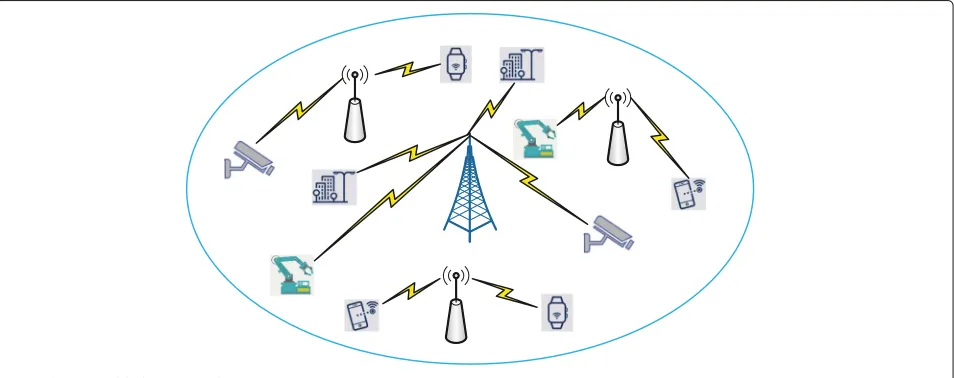
We consider an uplink 5G-enabled IoT network consisting ofBBSs,K diverse SOs (i.e., smart phone, smart meter, wearable device, and monitoring device) andN orthog-onal channels, illustrated by Fig.1. The set of all BSs is denoted by B = {1, 2,. . .,B} and the set of all SOs is represented byK = {1, 2,. . .,K}. Suppose that the asso-ciations between BSs and SOs have been predetermined and letbk ∈ B be the BS at the service of SO k ∈ K.
Moreover, suppose that each SO chooses a channel for data transmission and the bandwidth of each orthogonal channel is the same. We denote the set of the channels by
N = {1, 2,. . .,N}. Letakbe the channel allocation
strat-egy of SOk∈KandAkbe the set of all possible selections
fork. Thus,a = (a1,a2,. . .,aK)is the channel selection
profile for all SOs andA = A1×A2× · · · ×AK is the
space of all possible selections for all SOs.
The channel from SO k ∈ K to BS bk ∈ B is
sup-posed to be flat fading and the channel gain is denoted byhk,bk. Letpkbe the transmit power of SOk. Then, the
received signal-to-interference-plus-noise ratio (SINR) of BSbkfrom SOkis given by:
γk=
pkhk,bk
l∈K\{k}plhl,bk1{al=ak}+σ
2 k
, (1)
whereσk2is the power of the additive white Gaussian noise at the BS associated by SOk, and the indicator variable
1{al=ak} ∈ {0, 1}is used to denote that the channel
allo-cated to SOkis occupied by SOl, i.e.,1{al=ak}=1, or not
occupied, i.e.,1{al=ak}=0.
In IoT, different SOs perform different applications, i.e., picture/video collection, game, file upload, and con-trol information transmission. When performing different applications, SOs need to transfer different sizes of data for purpose of obtaining the same user experience in the same period of time. Mathematically, the set of service types required by SOs is represented asS = {1, 2,. . .,S}, andsk ∈Sis denoted as the performed service type of SO k. LetCsk be the amount of data required from SOk
dur-ing a given period of time. Hence, the uplink transmission time from SOkis described as follows.
Tk= Csk
Rk, (2)
whereRk = Blog2(1+γk)is the achievable rate of BSbk
from SOkandBis the bandwidth of each channel.
3.2 QoE metric
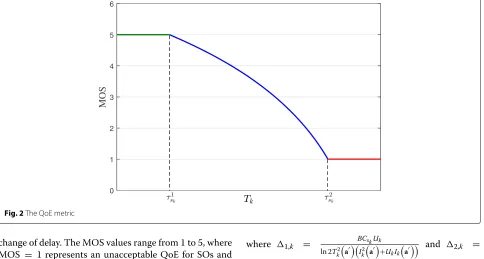
To measure QoE of various services, we propose a mean opinion score (MOS) standard, ranging from 1 to 5, in terms of the data transmission delay. Lettingτ1,skandτ2,sk
be respectively the most satisfied delay and the maximal tolerable delay based on the different service types, the MOS is defined as follows.
MOSk(a)=
⎧ ⎪ ⎨ ⎪ ⎩
5,Tk ≤τ1,sk,
αlnτ1,sk+τβ2,sk−Tk,τ1,sk <Tk< τ2,sk,
1,Tk ≥τ2,sk,
(3)
whereα = lnτ 4
2,sk−lnτ1,sk andβ = τ1,sk
τ1,
sk τ2,sk
1
4
. Figure2 shows the curve variation tendency of MOS with the
0
Fig. 2The QoE metric
change of delay. The MOS values range from 1 to 5, where MOS = 1 represents an unacceptable QoE for SOs and MOS=5 reflects an excellent user experience. In general, SOs have different tolerances for delay with regard to the different services. The application characteristics of SOs are determined byτ1,sk andτ2,sk.
3.3 Problem formulation and transformation
In this paper, to improve the overall transmission perfor-mance of the 5G-enabled IoT network by the optimization of channel allocation, we consider the sum-MOS maxi-mization problem, which is mathematically expressed as:
P: max
a∈A
k∈K
MOSk(a). (4)
The problem P is a non-convex and discrete optimization problem, for which finding its solu-tion is expected to be very challenging. In what follows, We convert it into a tractable form. For notational convenience, we first define Uk = pkgk,bk
a−k is the channel selection profile of all the SOs except
SOk. Then, we have
By using first-order approximation of Taylor expansion at the pointa,Tkis expanded asT˜k, namely, where a∗ is the optimal solution to (4). Therefore, the original problem (4) is equivalently transformed into the following optimization problem.
to model and analyze the channel allocation strategies of SOs inP˜. Furthermore, it is difficult for each SO to obtain other information of SOs with different types, which moti-vates us to propose a distributed learning algorithm for achieving the equilibrium solution of the game modeled from the channel access problem.
4 Game-theoretic analysis
In this section, we study the distributed optimization of the channel access problem by using game theory. Every SO is regarded as a player in the game, and the channel access game is defined as Ga = {K,{Ak}k∈K,{uk}k∈K}, whereKis the player (SO) set,Ak is the action space of
player k, and uk is the utility function of player k. The
action space of each player is exactly the available channel set. To build a bridge betweenGa and problem (8), we give the definition of utility function ofk,k∈Kas follows.
uk=3,kIk(a)+ l∈K\{k}
3,lpkgk,bl1{al=ak}. (9)
Then, we investigate the properties ofGa.
Theorem 1If the variablea is predetermined and the potential functionφ(a) = l∈K3,lIl(a)+4,l
,Ga is an exact potential game which exists at least one NE point
a∗. Moreover, the near-optimal solution to the proposed channel access problem (4) is a pure strategy NE ofGa∗.
ProofThe potential function ofGais defined as follows:
φ(a)=
Suppose that an arbitrary playerkunilaterally changes its strategy from ak to a¯k, we can obtain the following
equation based on (11):
φ(a¯k,a−k)−φ(ak,a−k)=uk(a¯k,a−k)−uk(ak,a−k).
(12)
The equation above shows that the change in any single player’s utility function due to unilateral strategy deviation results in exactly the same amount of change in the poten-tial function. Therefore, according to Definition 2.2 in [24, 28], Ga is an exact potential game with potential
functionφ(a). As a kind of potential games,Ga has some desirable properties, one of which is thatGa exists at least one NE point.
Although each player inGa focuses on maximizing its own utility value, we characterize the achievable perfor-mance of NE points of Ga by exploiting the inherent structure of the exact potential game.
Denoteaoptas an optimal channel allocation profile that maximizes the potential functionφ, i.e.:
aopt∈arg max
a∈Aφ(a). (13)
It has been proved that all NEs are the maximizers of the potential functionφ, either locally or globally, for any exact potential game [28]. The best equilibrium point is aopt. Obviously,aoptis a near-optimal solution of (4) when a =a∗.
Hence, Theorem1is proved.
5 Decentralized algorithm for achieving the best NE
According to the above theoretic analysis of Ga, an approach of achieving the best NE of Ga is also the approach to obtain a near-optimal solution of problem (4). In this section, we propose a distributed channel allo-cation learning algorithm to solve (4) in a distributed manner.
5.1 Algorithm description
Taking into account the above analysis, we give a detailed procedure of solving the channel allocation prob-lem, labeled as Algorithm 1. Algorithm 1 includes two-tier loops of inner loop and outer loop, in which the variable a is updated until the near-optimal solution is achieved in inner loop. Two stages of inner loop in this improved algorithm are presented as follows: (a) In step 1, one player is randomly selected from the set of updatable players to update its strategy. Then, the selected player chooses an action and gets feedback in the form of the resulting state and an associated reward. (b) In step 2, the selected player updates its alternative action selection based on (14). In Algorithm 1, the stop criterion is set to be the case that the change of the potential function is trivial.
The proposed algorithm is not easily trapped in an undesirable NE when the game has multiple NE points because of its some favorable properties: (a) it is an uncou-pled algorithm, namely, each player only needs to acquire the information of channel selection actions; (b) it can achieve the best NE which is the global optimum of maximizing potential function.
5.2 Convergence and optimality analysis
Algorithm 1Distributed channel allocation algorithm
1: Initiating the initial variable aand loop
2: Initialization:Set the initial time indext=0 and let each playerk∈Krandomly select an actionak(0)∈Ak.
3: For every time slott=1, 2,· · ·,
4: Step 1:Randomly select one player, sayk, according to a fixed probability distributionqk = |K1|. Playerk
selects one experiment actionak uniformly from the
player’s action setAk while other players’ selections
remain unchanged, i.e.a−k(t)=a−k(t−1).
5: Step 2:Playerkupdates its selection according to the following rule:
where λ is the learning parameter and γ is the smoothing factor. If the action ak is selected, let
a∗(t)=a(t); otherwise,a∗(t)=a∗(t−1).
6: Step 3:If∀t, there exists a transition probabilitypk(t)
of playerk, for∀k∈K, which is approaching one, e.g., larger than 0.99, stop; otherwise, go to step 1.
7: If a = a∗, end loop; otherwise, return 2 and let a = a∗if a∗is a better channel allocation strategy profile.
Theorem 2If all players perform the proposed dis-tributed channel allocation learning algorithm with the fixed a, the network converges to an unique stationary distribution of players’ strategy profile, which is given by:
π(a¯)= (1+λ) γ φ(a¯)
a∈A(1+λ)γ φ(a)
. (15)
ProofLetz(t)be the state of channel allocations at the
t-th iteration of Algorithm 1 with the fixeda. Obviously,
z(t)is an irreducible and aperiodic Markov process. Then, we will verify that the process determined by the distribu-tion (15) is reversible. It is to say that for ∀a,a¯ ∈ A, we sayk, changes its working channel, which results in that one element of the network state has been changed, i.e., a =(ak,a−k)anda¯ = (a¯k,a−k). It is easy for us to check
According to the symmetry, we have:
π(a¯)P(a|¯a)=c(1+λ)γ (φ(¯a)+uk(ak,a−k)). (18)
By substituting (12) into (17), we can obtain:
π(a)P(a¯|a)=c(1+λ)γ (φ(a¯)+uk(ak,a−k))
=π(a¯)P(a|¯a). (19)
Thus, we can derive that:
a∈A
π(a)P(a¯|a)=
a∈A
π(a¯)P(a|¯a)=π(a¯), (20)
which is the balanced equation of Markov process. Hence, Theorem2is proved.
Theorem 3 If the variablea is fixed, the inner loop of Algorithm 1 converges to the best NE point of Ga with an arbitrarily high probability whenγ is sufficiently large. Therefore, the MOS level of the IoT network is approxi-mately maximized whenais the NE point.
Proof It is noted from Theorem 1 that aopt is repre-sented as an optimal channel allocation profile that max-imizes the potential functionφ, which is also the best NE ofGa.
According to Theorem2, the proposed algorithm con-verges to a unique stationary distribution. When γ is sufficiently large,(1+λ)γ φ(aopt) (1+λ)γ φ(a),∀a∈A\
{a}. According to (15), the unique stationary distribution of players’ strategy profile is (0,. . ., 0, 1, 0,. . ., 0), where 1 denotes the probability of the optimal channel alloca-tion solualloca-tion and the probabilities of other non-optimal solutions are all 0. Thus:
lim
γ→∞π
aopt=1, (21)
which means that the proposed learning algorithm con-verges to the best NE ofGa with an arbitrarily high prob-ability. Whena =aopt, the NE obtained by the proposed algorithm is a near-optimum solution to problem (8). Then, the MOS level of the IoT network is approximately maximized whenais the NE point.
0 20 40 60 80 100 120
Number of Iterations
30 35 40 45 50 55 60
Potential Function
BRD
Our Approach
Fig. 3The comparison results of the convergence performance of Algorithm 1 and BRD with fixeda
6 Simulation results and discussion
In this section, numerical simulations are performed by Matlab software to validate the efficiency and perfor-mance of our proposed algorithm for solving the channel allocation problem of IoT uplink communications over cellular networks.
6.1 Scenario setup
We consider one MBS with a hexagonal coverage area where there are randomly layouts of 2 SCBSs. For conve-nience, we assume that there are 3 SOs randomly located
in each SCBS and the other 10 SOs in the coverage area of MBS. Here, we suppose that each SO has the same uplink transmission power which is set to 23 dBm. Accordingly, suppose that the total 5 MHz bandwidth in this hetero-geneous network constitutesN = 10 channels with each same bandwidth 487.5 kHz. Each SO chooses 1 channel for transmission. Rayleigh fading model is considered in the simulation andhbcis the link gain from SOdto BSbc,
which is expressed ashbc = ξbc
Lbc
−θ
, whereLbcis the
distance between SOdand BSbc,ξbcdenotes the
chan-nel fading component andθis the path loss exponent. The
0 10 20 30 40 50
Number of Iterations
37 38 39 40 41 42 43 44 45 46
Sum-MOS
(a)
0 50 100 150 200
Number of Iterations
20 22 24 26 28 30
32
(b)
1 2 3 4 5 6 7 8 9 10
SO Index
0 1 2 3 4 5 6 7
Value of Each SO's Function
Fig. 5The comparisons of utility,MOS and MOS for each SO obtained by preforming Algorithm 1
noise power is set to σ2 = −174 dBm/Hz. In the
fol-lowing simulations, the simulation results are obtained by 400 independent trials and those parameters involved are optimized by experiments.
6.2 Convergence behavior and optimality of this algorithm
In this subsection, we first investigate the convergence behavior comparison between Algorithm 1 and best response dynamic (BRD). It is shown from Fig. 3 that Algorithm 1 and BRD can respectively converge to two stable points as the number of iterations increases. Com-pared with BRD, Algorithm 1 has a faster convergence
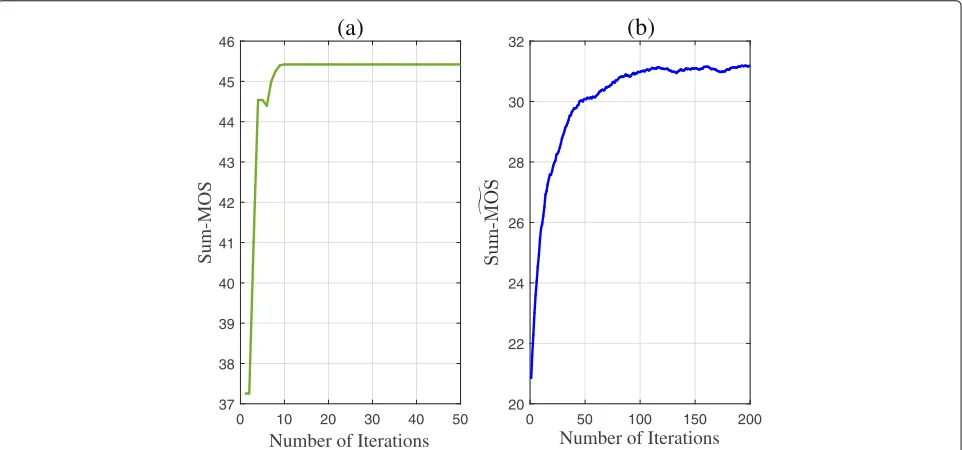
speed and achieves a better solution. It is supported with the proved fact that BRD can only converge to one NE of the potential game which may be not the best NE. Con-versely, our algorithm can find the the best NE which is also the optimal solution of maximizing potential func-tion. Therefore, the proposed algorithm is distributed and can obtain a better convergence performance. Figure 4 plots the changing curves of the optimization objectives in problemsPandP˜as the number of iterations increases by performing Algorithm 1 with fixeda. It is shown from Fig.4that sum-MOS in problemPgradually increases and converges eventually along with the increase of iteration times, which is consistent with the variation tendency of
0 10 20 30 40 50 60
Number of Iterations 35
40 45 50
Sum-MOS
sum-MOS in problem P˜. This indicates that the increase of sum-MOS by selecting better channel allocation strat- egy profile also causes the improvement of sum-MOS. Although sum-MOS continues to increase in the latter process, the value of sum-MOS is unchangeable. Since MOS is a piecewise function, the better solution forP˜ can-not further enhance the performance ofP, which implies that multiple optimal solutions exist.
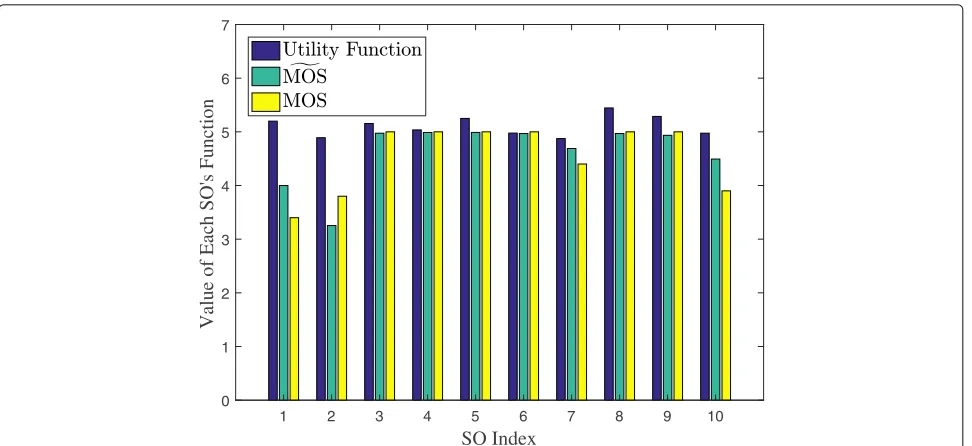
In the following, we evaluate the MOS performance of each SO by preforming Algorithm 1. From Fig.5, it is worth noting that Algorithm 1 can maintain a bet-ter SO fairness with respect to MOS performance by taking into account the impact of the interference gen-erated by each SO on the entire network. Algorithm 1 is proposed to find the best NE of the channel access game Ga, which achieves an approximately equal util-ity value for each SO shown in Fig. 5. Moreover, the fairness among SOs with respect to MOS orMOS perfor- mance is guaranteed. Figure6plots the changing curve of sum-MOS as the number of iterations increases by pre-forming Algorithm 1. It is shown that Algorithm 1 can improve the QoE of SOs. However, our proposed algo-rithm cannot guarantee convergence to the global optimal solution of P˜ since the potential function in Ga is dif-ferent from the optimization objective inP˜ whereMOS is a piecewise function. The best NE a∗ of Ga∗, i.e., the maximum of potential function, is obtained by perform-ing Algorithm 1 which is only the near-optimum of P. It is noted from Fig. 6 that sum-MOS inP can eventu-ally converge to a fixed point as the number of iterations increases and is close to the maximum value of sum-MOS. This indicates that our approach provides high perfor-mance for solving this difficult non-convex optimization problem.
7 Conclusion
In this paper, we investigated the channel allocation prob-lem in 5G-enabled IoT, by using a game-theoretic learning algorithm, to improve the QoE of SOs. In order to mea-sure the QoE of SOs in IoT, we first defined a MOS function. Then, we proposed the exact potential game to formulate this optimization problem, in which the potential function was designed by approximatively con-verting the objective function into a tractable form. It was proved that the exact potential game existed the best NE which was a near optimization solution of the chan-nel allocation problem. Aiming at the proposed game, we designed a distributed learning algorithm and proven it can converge to the best NE with an arbitrarily high probability.
Abbreviations
BRD: Best response dynamic; IoT: Internet of things; MBS: Macrocell base station; MOS: Mean opinion score; NE: Nash equilibrium; QoE: Quality of
experience; SCBSs: Small cell base stations; SINR: Signal-to-interference-plus-noise ratio; SOs: Smart objects
Funding
This work was supported by the National Natural Science Foundation of China (Grant No. 61801243), by the Natural Science Foundation of the Jiangsu Higher Education Institutions of China (Grant No. 18KJB510026), and by the Foundation of Nanjing University of Posts and Telecommunications (Grant No. NY218124).
Availability of data and materials
Mostly, I got the writing material from different journals as presented in the references. A MATLAB tool has been used to simulate my concept.
Authors’ contributions
All authors contributed significantly to the research work presented in this paper. HD had a leading role in the formulation and solution of the considered optimization problem, while performing a detailed evaluation and analysis of the developed algorithm, through conducting an extensive set of simulations. HD and HZ completed the writing and formatting of the paper. WW did the experiments and simulations. BW helped in finalizing the solution and amending the manuscript. All authors read and approved the final manuscript.
Competing interests
The authors declare that they have no competing interests.
Publisher’s Note
Springer Nature remains neutral with regard to jurisdictional claims in published maps and institutional affiliations.
Author details
1School of Internet of Things, Nanjing University of Posts and Telecommunications, 66 Xin mofan Road, 210003 Nanjing, China. 2Engineering Systems and Design Pillar, Singapore University of Technology and Design, 8 Somapah Road, 487372 Singapore, Singapore.3College of Telecommunications and Information Engineering, Nanjing University of Posts and Telecommunications, 66 Xin mofan Road, 210003 Nanjing, China.
Received: 15 June 2018 Accepted: 29 January 2019
References
1. M. A. M. Albreem, A. A. El-Saleh, M. Isa, W. Salah, M. Jusoh, M. M. Azizan, A. Ali, in2017 IEEE 4th International Conference on Smart Instrumentation, Measurement and Application (ICSIMA). Green Internet of things (IoT): an overview, (2017), pp. 1–6
2. W. Tan, M. Matthaiou, S. Jin, X. Li, Spectral efficiency of dft-based processing hybrid architectures in massive mimo. IEEE Wirel. Commun. Lett.6(5), 586–589 (2017)
3. A. Musaddiq, Y. B. Zikria, O. Hahm, H. Yu, A. K. Bashir, S. W. Kim, A survey on resource management in IoT operating systems. IEEE Access.6, 8459–8482 (2018)
4. W. Tan, S. Jin, C.-K. Wen, T. Jiang, Spectral efficiency of multi-user millimeter wave systems under single path with uniform rectangular arrays. EURASIP Wirel, J., Commun. Netw.2017(1), 181 (2017) 5. X. Sun, N. Ansari, Dynamic resource caching in the IoT application layer
for smart cities. IEEE Internet Things J.5(2), 606–613 (2018) 6. Z. Qin, J. A. McCann, in2017 IEEE Global Communications Conference.
Resource efficiency in low-power wide-area networks for IoT applications, (2017), pp. 1–7
7. B. Khalfi, B. Hamdaoui, M. Guizani, Extracting and exploiting inherent sparsity for efficient IoT support in 5G: Challenges and potential solutions. IEEE Wirel. Commun.24(5), 68–73 (2017)
8. C. Li, Y. Li, K. Song, L. Yang, Energy efficient design for multiuser downlink energy and uplink information transfer in 5G. Sci. China Inf. Sci.59(2), 1–8 (2016)
9. J. Yuan, S. Jin, W. Xu, W. Tan, M. Matthaiou, K. K. Wong, User-centric networking for dense C-RANs: high-SNR capacity analysis and antenna selection. IEEE Trans. Commun.65(11), 5067–5080 (2017)
11. W. Tan, D. Xie, J. Xia, W. Tan, L. Fan, S. Jin, Spectral and energy efficiency of massive MIMO for hybrid architectures based on phase shifters. IEEE Access.6, 11751–11759 (2018)
12. H. Ji, S. Park, J. Yeo, Introduction to ultra reliable and low latency communications in 5G (2017). arXiv preprint arXiv:1704.05565 13. C. Li, K. Song, D. Wang, F. Zheng, L. Yang, Optimal remote radio head
selection for cloud radio access networks. Sci. China Inf. Sci.59(10), 102315:1–102315:12 (2016)
14. S. Li, Q. Ni, Y. Sun, G. Min, S. Al-Rubaye, Energy-efficient resource allocation for industrial cyber-physical IoT systems in 5G era. IEEE Trans. Ind. Inform. 4(6), 2618– 28 (2018)
15. C. Li, S. Zhang, P. Liu, F. Sun, J. M. Cioffi, L. Yang, Overhearing protocol design exploiting intercell interference in cooperative green networks. IEEE Trans. Veh. Technol.65(1), 441–446 (2016)
16. H. Dai, Y. Huang, J. Wang, L. Yang, Resource optimization in
heterogeneous cloud radio access networks. IEEE Commun. Lett.22(3), 494–497 (2018)
17. A. K. Yerrapragada, B. Kelley, in2017 12th System of Systems Engineering Conference (SoSE). An IoT self organizing network for 5G dense network interference alignment, (2017), pp. 1–6
18. N. N. Dao, M. Park, J. Kim, Resource-aware relay selection for inter-cell interference avoidance in 5G heterogeneous network for internet of things systems. Futur. Gener. Comput. Syst. (2018)
19. W. Ejaz, M. Ibnkahla, Multiband spectrum sensing and resource allocation for IoT in cognitive 5G networks. IEEE Internet Things J.5(1), 150–163 (2018)
20. A. Aminjavaheri, A. RezazadehReyhani, R. Khalona, Underlay control signaling for ultra-reliable low-latency IoT communications (2018). arXiv preprint arXiv:1711.02248
21. X. He, K. Wang, H. Huang, T. Miyazaki, Y. Wang, S. Guo, Green resource allocation based on deep reinforcement learning in content-centric IoT. IEEE Trans. Emerg. Top. Comput.9(3), 1–15 (2018)
22. M. Aazam, M. St-Hilaire, C. H. Lung, I. Lambadaris, in2016 23rd International Conference on Telecommunications (ICT). MeFoRE: QoE based resource estimation at Fog to enhance QoS in IoT, (2016), pp. 1–5
23. J. Huang, Y. Yin, Q. Duan, H. Yan, in2015 3rd International Conference on Future Internet of Things and Cloud. A game-theoretic analysis on context-aware resource allocation for device-to-device communications in cloud-centric internet of things, (2015), pp. 80–86
24. H. Dai, Y. Huang, R. Zhao, J. Wang, L. Yang, Resource optimization for device-to-device and small cell uplink communications underlaying cellular networks. IEEE Trans. Veh. Technol.67(2), 1187–1201 (2018) 25. H. Zhang, Y. Xiao, S. Bu, D. Niyato, F. R. Yu, Z. Han, Computing resource
allocation in three-tier IoT Fog networks: a joint optimization approach combining stackelberg game and matching. IEEE Internet Things J.4(5), 1204–1215 (2017)
26. S. F. Abedin, M. G. R. Alam, N. H. Tran, C. S. Hong, in2015 17th Asia-Pacific Network Operations and Management Symposium APNOMS). A Fog based system model for cooperative IoT node pairing using matching theory, (2015), pp. 309–314
27. A. Rullo, D. Midi, E. Serra, E. Bertino, in2016 IEEE 36th International Conference on Distributed Computing Systems (ICDCS). Strategic security resource allocation for internet of things, (2016), pp. 737–738