R E S E A R C H
Open Access
Linear precoder design for non-orthogonal
AF MIMO relaying systems based on MMSE
criterion
Yunida Yunida, Nasaruddin Nasaruddin
*, Rusdha Muharar and Yuwaldi Away
Abstract
Multiple-input multiple-output (MIMO) relaying system has attracted the attention of cooperative network researchers, due to its advantage over the conventional single antenna system, in terms of system capacity and spatial diversity. Precoder design is a processing scheme implemented at a source and relay node to improve system performance. We propose a linear precoder design for non-orthogonal amplify-and-forward MIMO relaying systems based on the minimum mean square error (MMSE) criterion. We analyze an upper bound of MMSE using a convenient expression to determine the structure of precoding matrices using the singular-value decomposition technique. Simulation results demonstrate that the proposed precoded scheme outperforms both unprecoded and existing precoded schemes.
Keywords:MIMO relaying, Cooperative network, Precoder design, Non-orthogonal amplify-and-forward, MMSE criterion
1 Introduction
Relaying techniques in cooperative wireless networks in-crease a network’s coverage area and data rate and reduce transmission power [1, 2]. Generally, improving the per-formance of cooperative networks can be achieved by re-laying protocols such as the decode-and-forward (DF) [3,
4] and amplify-and-forward (AF) [5–7] schemes. The DF scheme is complex because the relay node must first de-code the signal received from a source and then transmit the re-encoded signal to the destination. In contrast, the AF scheme is simple to implement because the relay node only needs to transmit an amplified version of the received signal. Among different AF schemes, half-duplex non-orthogonal AF (NAF) relaying [8,9] has been consid-ered a superior scheme. With NAF relaying, received colli-sion and the broadcast range can be maximized because the relay and source nodes can transmit signals simultan-eously in both cooperative and broadcasting phases.
Furthermore, the capacity of cooperative networks can be increased using multiple antennas at the transceiver, i.e., multiple-input multiple-output (MIMO) relaying techniques [10,11]. Recently, seminal studies into MIMO relaying systems have concentrated on a transceiver
precoding design with orthogonal or conventional AF schemes [12–14]. A transceiver precoding design is a pro-cessing technique that exploits channel state information (CSI) by weighting information streams at the transmitter to achieve transmit diversity. Mo and Chew [12] proposed two schemes of precoding design for AF MIMO relay net-works under minimum mean square error (MMSE) criter-ion and QoS requirements, i.e., optimal joint source and relay precoding (OJSRP) and suboptimal relay only pre-coding (SROP) schemes. They proved that the OJSRP scheme outperforms the SROP scheme in terms of MSE performance and capacity, which shows that precoding at both source and relay nodes achieves an improved (higher) performance compared to precoding only at the relay nodes. To optimize the power distribution between the source and relay nodes in the OJSRP scheme, a joint precoder design and node power allocation based on the MSE criterion in AF MIMO relay networks has been con-sidered [13]. This approach demonstrated that the most efficient method to allocate node power is adjusting the noise level of the receiver nodes. A detailed investigation of the diverse linear precoder designs for AF MIMO relay networks based on MMSE, zero-forcing (ZF), and max-imum information rate (MIR) criteria can be found in the literature [14]. In that study, the results showed that the MMSE criterion achieves near-optimal performance * Correspondence:[email protected]
Electrical and Computer Engineering Department, Syiah Kuala University, Banda Aceh 23111, Indonesia
advantage compared to the ZF and MIR criteria when channel coding with a low coding rate is applied jointly across the source antennas.
Motivated by the above advantages of the MMSE cri-terion in AF MIMO networks, we propose a linear pre-coder design for half-duplex NAF MIMO relaying networks based on the MMSE criterion. To the best our knowledge, such a precoder design for non-orthogonal AF MIMO relay schemes has not been proposed. Some studies [15, 16] have investigated precoder designs for three-node NAF relaying systems where all nodes are equipped with a single antenna. The optimal precoder detectors based on MMSE and minimum bit error rate (MBER) criteria have also been proposed in [15]. That study concluded that the proposed detectors outper-formed other optimal detectors, i.e., channel inversion, maximum ratio combining, and biased maximum likeli-hood detectors. Compared to an MBER detector [15], the MMSE detector cannot achieve full diversity; how-ever, the computational complexity of the MMSE de-tector is stable relative to the constellation size of the modulation schemes, while the MBER detector increases significantly [16] in terms of bit error rate (BER) per-formance. Our main contributions and solutions in this paper can be summarized as:
A precoder design for non-orthogonal AF MIMO relay schemes using the MMSE criterion
A simpler suboptimal solution to the optimization problem of the precoder design by optimizing the transmit power from source and destination
An analysis of the system performance of the proposed scheme for unprecoded and precoded NAF MIMO relaying systems.
The remainder of this paper is organized as follows. A system model and the proposed precoder design with NAF relaying are introduced in Sections 2 and 3, re-spectively. Simulation results are provided in Section 4, and a brief conclusion is presented in Section5.
Notations: In this paper, matrices and vectors are in boldface. ()Hand INdenote the Hermitian transpose of a
vector and identity the matrix of sizeN, respectively, while E(.) and tr (.) denote the expectation and trace functions, respectively.
2 Proposed system model and problem formulation
2.1 Precoder for NAF MIMO relaying system
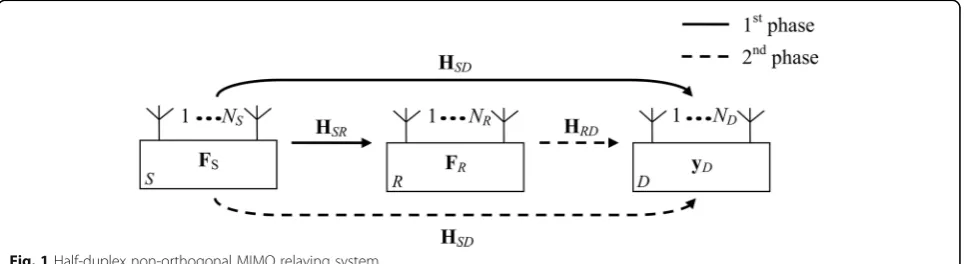
A three-node MIMO non-orthogonal relaying system comprised a source (S), a relay node (R), and a destination (D) shown in Fig.1. This system is equipped with multiple antennas, i.e.,NS,NR, andND, that cannot transmit or
re-ceive signals simultaneously. In other words, each node communicates in half-duplex mode. The transmission process of a non-orthogonal relaying system is divided into broadcasting and cooperative phases.
In the broadcasting phase,Sprecodes the signal vector s1∈£NB1 linearly using a precoding matrix FS∈£NSNB
where NB≤min(NS,NR,ND) is the number of data
streams. Then,Stransmits it toRand toDdirectly. The broadcast signal vector received by bothDandRcan be formulated respectively as follows:
yD;1¼HSDFSS1þnD;1 ð1Þ
and
yR¼HSRFSS1 þnR ð2Þ
Here,yD;1∈ℂND1 andy
R∈ℂNR1are the received signal
vectors atDandR, respectively, while HSD∈ℂNDNS and
HSR∈ℂNRNS are the complex Gaussian random MIMO
channel gain matrices of the S→D and S→R links, re-spectively. The noise vector nD;1∈ℂND1 and nR∈ℂNR1
are the respective additive white Gaussian noise (AWGN) samples at the receiving antennas of D and R, respectively, which are assumed to have independ-ent idindepend-entically distributed (i.i.d) componindepend-ents with zer-o-mean and covariance matrices E½nD;1nHD;1 ¼σ2n;dIND
and E½nRnHR ¼σ2n;rINR, whereσ 2
n;d and σ2n;rare the noise
variances atDandR, respectively.
In the cooperative phase, R linearly multiplies the re-ceived signal in (2) by a precoding matrix FR∈£NRNR
and transmits this amplified signal vector to D. By as-suming a non-orthogonal cooperative system,R commu-nicates with the destination and S transmits the signal vectors2∈£NB1 toD. Thus,Dreceives the signal vectors
fromSandDas follows:
yD;2¼HRDFRyRþHSDFSS2þnD;2
MIMO channel gain matrix of theR→Dlink. The noise vectornD;2∈£ND1is the AWGN samples at the receiving antennas of D with zero-mean and covariance matrix E½nD;2nHD;2 ¼σ2n;dIND. The two received signal vectors at
2.2 MMSE receiver and related MSE matrix
In this subsection, we experimentally investigate a linear precoder design in terms of the MMSE criteria. Here, we consider that a weighting matrix,W∈£NDNB, is used
to detect the received data stream atD.
^s¼WHy
D ð5Þ
Under the assumption that CSI is available at all nodes, FS, FR, andW can be adjusted to each channel
recognition to increase the performance of the NAF MIMO relaying systems. The MSE matrix, which indi-cates the covariance matrix of the symbol detection error of the data streams, is expressed as follows:
M¼Ek^s−sk2: ð6Þ
The transmitted symbol s is assumed to be i.i.d with zero-mean and covariance matrixRss¼E½ssH ¼2σ2
sINB,
with E½s1sH1 ¼E½s2sH2 ¼σ2sINB, where σ 2
s is the power
of the transmitted symbols. The covariance matrix of the equivalent noise vector in (4) can be written as follows:
Rnn¼E nnH
By substituting (5) into (6) and starting with comput-ing the squared error, the optimal estimator can be expressed as follows:
W¼2σ2s 2σ2sHFSFHSHHþRnn
−1
HFS; ð8Þ
where E½yDyHD ¼2σs2HFSFHSHHþRnn is the covariance
matrix of the received symbol vector at D. Given W in (8), the MSE of the estimate symbols in (6) can be writ-ten as:
^s¼2σ2sHHFHS2σ2sHFSFHSHHþRnn−1yD: ð9Þ
By substituting (9) into (6), and minimizing and per-forming the matrix inversion lemma [17], the MMSE is formulated as follows:
The functions AR and AS account for the MMSE in
the relay link and the direct link in both phases.
2.3 Problem formulation
As we can see in (10), the MMSE formula is the function of precoding matricesFRand FS. Our next task is to
A¼
The functionPtotalis the total transmission power atS
and R, whilePS andPRare the respective transmit
pow-ers fromSandRexpressed as follows:
PS¼tr FSE ssH
The inequalities in (13) show that the precoders have to fulfill the transmit power constraints at both the relay and the source node. From (13)–(16), we can immedi-ately conclude that the solution is not a convex optimization. Moreover, the cost function implicates a series of matrix inversions and multiplications; it is a complex and nonlinear function of FS and FR. We will
propose a method, which is depicted below, to resolve these problems.
3 Linear precoder design with MMSE criterion
3.1 Proposed approach
The linear MMSE precoder can be achieved analytically using an MSE matrix diagonalization procedure [18]. In-spired by this procedure, in this section, we propose to carry out similar matrix diagonalization in our design. The trace operation in (13) can be performed easily if error matrixAcan be diagonalized and the entire prob-lem can be shorted. First, we consider singular-value de-composition (SVD) for the MIMO channel matrices in all links:
orthonormal left singular matrices of HSD, HSR,
and HRD, respectively;
P
sd∈iNDND,
P
sr∈iNRNR, and
P
rd∈iNDND are the diagonal singular-value matrices of
HSD,HSR, and HRD, respectively; and Vsd∈£NSNS, Vsr∈
£NSNS, and Vrd∈£NRNR are the unitary right singular
matrices ofHSD,HSR, andHRD, respectively.
By using the procedure described in the literature [18], we can determine the following:
FR¼Vrd
After some calculations and manipulations by substi-tuting (17)–(21) into (14), we obtain the MSE in (13) as
Using the matrix inverse lemma [18] to diagonalize matrixQ, the MSE in (22) is as follows:
R, respectively. The result admits that the upper bound of the MSE function in (25) is a much simpler form than the original MSE in functions (13)–(14). Then, we achieve the precoder design by minimizing (25). Here, let σ2
s;i¼ps;i and σ2r;i¼pr;i, and the optimization of the
min
Furthermore, the optimization problem in (26) is a non-convex problem either, and its optimum solution is difficult to solve. Previously, the iterative water-filling technique was employed to find the optimal solution for the MMSE design [18]. In this paper, we propose a sim-pler suboptimal solution to the optimization problem of the precoder in (26). The proposed precoding method is determined by optimizing the transmit power from S and R, i.e.,ps,iand pr,i, that can satisfy minimization of
the upper bound of the MSE.
To minimize the MSE function in (26), we consider a constant functionλfor different indexes ofi:
λ¼2σ−s2þ ps;iσ
While maximizingλ, the optimal solution to (26) satis-fies (27); therefore, we suggest the relay transmit power as follows:
whereΓ is a coefficient set to satisfy the total transmis-sion powerPtotalin (26). This coefficient can be obtained
by substituting (28) into (26) as follows:
Γ¼ 2ðPtotal−PSÞ
By substituting (28) into (29), we obtain the source transmit power as follows:
The constant in (27) can be rewritten as a function of the total source transmit power by substituting ps, i in
(30) into (26) as follows:
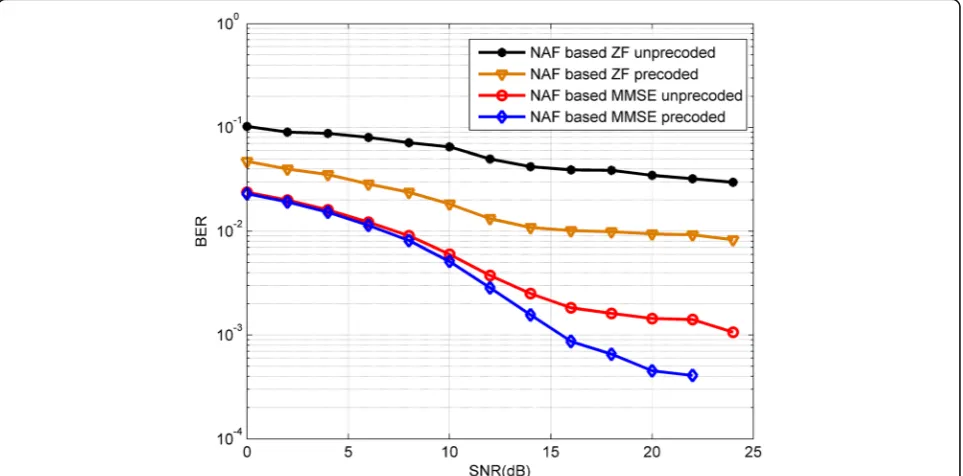
In this section, we discuss the simulations conducted to estimate the performance of the proposed scheme for an NAF MIMO relaying system. To achieve perfect synchronization, we assume that all CSI’s links are known at all nodes with Rayleigh flat fading distribution. Here, we use a quaternary phase-shift keying modulation scheme. Furthermore, we consider a symmetric MIMO relay system, i.e.,NS=NR=ND= 4.
Firstly, we compare the simulation results for AF and NAF MIMO relaying systems. Figure2shows a compari-son of BER for the AF-based MMSE precoded scheme in [18] and the NAF MIMO relaying systems with and with-out precoded MMSE. As can be seen, our proposed scheme, i.e., the NAF-based MMSE precoded, outper-forms both the AF precoded and NAF unprecoded schemes. It was expected because our design for NAF MIMO relaying scheme is determined by optimizing the transmit power from S and R, i.e.,ps, i and pr, i. Besides
that, both source and relay nodes are permitted to trans-mit their precoded signal simultaneously in both the co-operative and broadcasting phases. In contrast, with the AF MIMO relaying system [18], only relay nodes transmit their precoded signal in the cooperative phase.
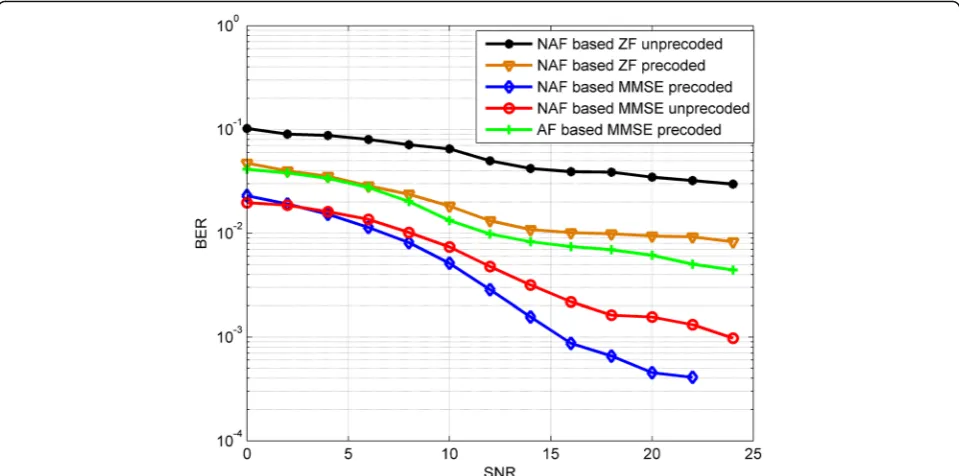
Finally, we combine the curves in previous simulation results for the comparison of the unprecoded/precoded NAF and AF MIMO relaying system performances. Figure 4 shows the BER comparison for (1) an NAF unprecoded scheme with the ZF criterion, (2) an NAF precoded scheme based on the ZF criterion [14], (3) an NAF precoded scheme based on the MMSE criterion, (4) an NAF unprecoded scheme based on the MMSE
criterion, and (5) an AF precoded scheme based on the MMSE criterion [18]. From this figure, we can see that our proposed precoded scheme, i.e., an NAF precoded system based on the MMSE criterion, outperforms not only the unprecoded scheme but also the ZF precoded system in [14]. It is because our proposed scheme incor-porates an optimal MMSE precoder design that per-formance can be enhanced even if the direct link is not
Fig. 2The performance comparison of NAF with MMSE unprecoded/precoded and AF precoded MMSE in MIMO relaying systems
considered. Besides that, the precoded scheme for AF-based MMSE criterion [18] outperforms both NAF-based ZF precoded [14] and unprecoded schemes. It is due to the MMSE criterion used, in this case, to minimize the total power transmit both from the source and the relay node. So, the performance of the precoded systems with MMSE criterion will be the best among all unprecoded and ZF precoded systems with the same total power transmit.
5 Conclusions
In this work, we have proposed a joint design for a linear precoder scheme in a half-duplex non-orthogonal AF MIMO relaying system based on the MMSE criterion. Since MMSE is a detector scheme with high complexity, we obtain an MMSE upper bound using a convenient ex-pression to determine the construction of the precoding matrices using the SVD technique. Simulation results show that the proposed precoded scheme outperforms the unprecoded scheme. By allocating an additional proper power at the source and relay nodes, the proposed scheme increases the performance of the NAF MIMO relaying system compared to ZF and AF precoded schemes.
Abbreviations
AF:Amplify-and-forward; BER: Bit error rate; CSI: Channel state information; DF: Decode-and-forward; MBER: Minimum bit error rate; MIMO: Multiple-input multiple-output; MIR: Maximum information rate; MMSE: Minimum mean square error; NAF: Non-orthogonal amplify-and-forward; OJSRP: Optimal joint source and relay precoding; SNR: Signal-to-noise ratio; SROP: Suboptimal relay only precoding; SVD: Singular-value decomposition; ZF: Zero-forcing
Funding
This work was supported by a scholarship from the“Magister Program of Education Leading to Doctoral for Excellent Graduates,”Ministry of Research, Technology and Higher Education of the Republic of Indonesia, with grant agreement code 67/UN11.2/PP/SP3/2018.
Availability of data and materials
We decided that the data does not need to be shared since all data that has been obtained through the simulation result using the MATLAB program has been represented in Figs.2,3, and4.
Authors’contributions
YY conceived and designed the study. YY performed the experiments and wrote the paper. NN, MR, and AY reviewed and revised the manuscript. All authors read and approved the manuscript.
Competing interests
The authors declare that they have no competing interests.
Publisher’s Note
Springer Nature remains neutral with regard to jurisdictional claims in published maps and institutional affiliations.
Received: 5 December 2017 Accepted: 12 November 2018
References
1. A. Sendonaris, E. Erkip, B. Aazhang, User cooperation diversity part I: system description. IEEE Trans. Commun.51, 1927–1938 (2003)
2. A. Sendonaris, E. Erkip, B. Aazhang, User cooperation diversity part II: implementation aspects and performance analysis. IEEE Trans. Commun.51, 1939–1948 (2003)
3. T. Wang, A. Cano, G.B. Glannakis, J.N. Laneman, High-performance cooperative demodulation with decode-and-forward relays. IEEE Trans. Commun.6, 1427–1438 (2007)
4. J. Luo, R.S. Blum, L.J. Greenstein, A.M. Haimovich, Decode-and-forward cooperative diversity with power allocation in wireless networks. IEEE Trans. Wirel. Commun.6, 793–799 (2007)
5. G. Kramer, M. Gastpar, P. Gupta, Cooperative strategies and capacity theorems for relay networks. IEEE Trans. Inf. Theory51, 3037–3063 (2005)
6. S. Sherstha, K. Chang, Analysis of outage capacity performance for cooperative DF and AF relaying in dissimilar Rayleigh fading channels. IEEE Int. Symp. Inform. Theory, 494–498 (2008)
7. Y. Ding, J. Zhang, K.M. Wong, Ergodic channel capacities for amplify-and-forward half-duplex cooperative systems. IEEE Trans. Inf. Theory55, 713–730 (2009)
8. R.U. Nabar, H. Bölcskei, F.W. Kneubuhler, Fading relay channel: performance limits and space-time signal design. IEEE J Selected Areas Commun.22, 1099–1109 (2004)
9. B. Gedik, M. Uysal, Impact of imperfect channel estimation on the performance of amplify-and-forward relaying. IEEE Trans. Wirel. Commun.5, 1468–1478 (2009)
10. B. Wang, J. Zang, A.H. Madsen, On the capacity of MIMO relay channels. IEEE Trans. Inf. Theory51, 29–43 (2005)
11. H. Bölcskei, R. Nabar, O. Oyman, A.J. Paulraj, Capacity scaling laws in MIMO relay networks. IEEE Trans. Wirel. Commun.5, 1433–1444 (2006) 12. R. Mo, Y.H. Chew, MSSE-based joint source and relay precoding design for
amplify-and-forward MIMO relay networks. IEEE Trans. Wirel. Commun.8, 4668–4676 (2009)
13. A. Danaee, H.R. Bahrami, M. Sadeghzadeh, Precoder design and node power allocation in multi-antenna amplify-and-forward (AF) relay systems. IEEE Int. Conf. on Commun., 5527–5531 (2013)
14. C. Song, C. Ling, On the diversity of linear transceivers in MIMO AF relaying systems. IEEE Trans. Inf. Theory62, 272–289 (2016)
15. Q.Z. Ahmed, K.H. Park, M.S. Alouini, S. Aissa, Optimal linear detector for nonorthogonal amplify-and-forward protocol. IEEE Int. Conf. Commun., 4829–4833 (2016)
16. Q.Z. Ahmed, K.H. Park, M.S. Alouini, S. Aissa, Linear transceiver design for nonorthogonal amplify-and-forward protocol using a bit error rate criterion. IEEE Trans, Wireless Commun13, 1536–1276 (2014)
17. D.S. Bernstein,Matrix mathematics(Princeton Univ. Press, Princeton, NJ, 2005) 18. F.S. Tseng, W.R. Wu, Linear MMSE transceiver design in amplify-and-forward