1
The London School of Economics and Political Science
Imagining the State through Digital Technologies:
A Case of State-Level Computerization
In the Indian Public Distribution System
Silvia Masiero
A thesis submitted to the Department of Management of the London
School of Economics and Political Science for the degree of Doctor of
Philosophy
2 Declaration
I certify that the thesis I have presented for examination for the MPhil/PhD degree of the London School of Economics and Political Science is solely my own work other than where I have clearly indicated that it is the work of others (in which case the extent of any work carried out jointly by me and any other person is clearly identified in it).
The copyright of this thesis rests with the author. Quotation from it is permitted, provided that full acknowledgement is made. This thesis may not be reproduced without my prior written consent.
I warrant that this authorisation does not, to the best of my belief, infringe the rights of any third party.
I declare that my thesis consists of 78255 words.
3 Acknowledgements
My foremost gratitude goes to the people of Kerala, who taught me, one day after the other, their vision of civic engagement as the one key means to build a better future. For the entire duration of my fieldwork, I have witnessed their relentless strength in organizing for their right to food security, and their positive energy in doing so has taught me a life lesson that will stay with me forever. It is to the people of Kerala that this thesis is dedicated.
I would like, as well, to express my deepest gratitude to my supervisor, Dr. Shirin Madon, whose constant presence and encouragement have been invaluable during the years of my PhD candidacy. Her relentless support, proactive help, and moral empathy have made her an irreplaceable point of reference in my life, and it is hard to find the words to express my gratitude to her. I wish I will be able, one day, to be for my students what she has been for me since we first met.
This PhD was possible thanks to all those that helped me accessing the field, and organizing my work in the complex setting of the food security system in Kerala. Dr. Kiran Gopakumar Rajalekshmi, Mr. Manohar Varghese, Ms. Bincy Baby, and Mr. Vinod Kowdiar have made it possible for me to plan my investigation, and to start it when my familiarity with the context of Kerala was very limited. Staff at the Centre of Development Studies in Trivandrum, to which I was affiliated as a visiting researcher, has accompanied me with proactive support for the entire duration of fieldwork: I am most indebted to my local supervisor, Prof. Sunil Mani, for his invaluable help and guidance. I would also like to thank Mr. Korath Mathew, Mr. Reju Tom Lal, and Mr. A. Basheer for their logistical help, and my translators Ms. Noora Farooqi, Ms. Shelly Nabu Kumar, and Mr. Julian Teelar for accompanying me in my visits to the field.
5 Abstract
The study of e-governance in developing nations is informed by the idea that new technologies, reshaping the very nature of public services, can generate better outcomes in their provision. Beyond objective changes in governance infrastructures, the subjective perception of the state, as it is constructed by service recipients, is exposed to a parallel process of change, whose study has generated a novel research domain in the field of e-governance for development. With a view of contributing to this domain, this thesis studies the role of ICTs in processes of image formation on the state, as experienced by citizens in a developing country context.
The theory on which the thesis is developed views technology as embedded in its socio-political context, and conceives e-governance as implicated in the reconstruction of images of the state. This vision is applied to the computerization of the main food security programme in India, the Public Distribution System (PDS), as it has been devised and implemented in the state of Kerala. Through an interpretive case study of the object at the core of computerization, known as the Electronic Public Distribution System or e-PDS, the thesis investigates the ICT-led processes of image construction by the state, and the ways in which citizens, confronted with new images, structure their perception of these.
6 Index
Declaration 2
Acknowledgements Abstract
3 5
Index 6
List of Tables 9
List of Figures 10
List of Acronyms 11
1. Introduction 13
1.1. Motivation and Object of Research 15
1.2. Research Project 16
1.2.1. Theoretical Framework and Research Questions 17
1.2.2. Case Study 18
1.2.3. Contributions 21
1.3. Thesis Outline 22
2. Research Domain 27
2.1. Information Systems in Developing Countries: An Overview 27
2.1.1. What Is Meant by Development? 28
2.1.2. Theories in ISDC: A Synopsis 30
2.2. Sub-Field of Research: E-Governance for Development 34 2.2.1. Governing with New Technologies: Which Rationale? 34 2.2.2. E-Governance for Development: Research Agenda 38 2.3. Image Formation on the State: Implications of ICTs 43 2.3.1. Sociology of Governance and Image Formation 43
2.3.2. Images and E-Governance for Development 48
2.3.3. Problem Area: Back to the State 51
2.4. Summary and Conclusion 52
3. Conceptual Framework 53
3.1. Theory of Action: “Seeing the State” through Technologies of Rule 54 3.1.1. Major Premise: Citizens “See the State” through Encounters with It 55 3.1.2. Minor Premise: Encounters Are Shaped through Anti-Poverty
Programmes
57 3.1.3. Conclusion: Technologies of Rule as Makers of Images 62 3.2. Theory of Technology: Reconstructing the State through ICTs 63
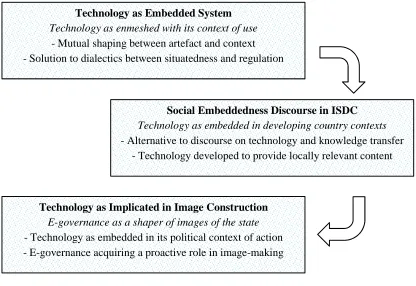
3.2.1. Technology as Embedded System 63
3.2.2. Social Embeddedness of Technology in ISDC 65
3.2.3. Technology’s Implications in Image Construction 67
3.3. Synopsis: A Composite Conceptual Framework 69
3.4. Research Questions 71
7
4. Methodology 73
4.1. Epistemology: Social Constructionism 75
4.2. Theoretical Perspective: Interpretivism and Boulding’s Theory of Cognition
77
4.3. Methodology: Interpretive Case Study Research 80
4.3.1. Choice of the Case Study Method 80
4.3.2. Choice of the e-PDS as Case Study 82
4.3.3. Research Design 82
4.3.4. Research Questions Adapted to the Case Study 88
4.4. Methods: Eliciting Data on Image Formation 89
4.4.1. Narrative Analysis and Social Research 89
4.4.2. Data Collection: A Technique for Narrative Interviewing 4.4.3. Data Analysis: On the Historiography of Images
92 93
4.5. Summary and Conclusion 96
5. Case Study 97
5.1. The Indian Public Distribution System 98
5.1.1. PDS: From Pre-Independence Rationing to Universal Distribution 100
5.1.2. PDS: Targetization and Its Consequences 101
5.2. Kerala: PDS and the Impact of Targetization 103
5.3. E-PDS: Computerizing Food Security in Kerala 108
5.3.1. On Geopolitical Context and E-Governance 109
5.3.2. Database Creation: Computerizing Cardholder Details 112 5.3.3. TETRAPDS: Automatizing the Operations of TSOs 114 5.3.3.1. Module 1: Ration Card Management System (RCMS) 114 5.3.3.2. Module 2: Allocation of Commodities 116 5.3.3.3. Module 3: Inspection Monitoring System 118
5.3.3.4. Module 4: WebPDS 118
5.3.3.5. TETRAPDS – Synopsis 119
5.3.4. Integration with UID/Aadhar: from Ration Cards to Biometric Identification
120
5.3.5. Summary and Conclusion 123
6. Analysis – Part 1:
Technology and the Self-Reconstruction of the State
124 6.1. Image Formation at Work: The State Reconstructing Itself through ICTs 124 6.1.1. Akshaya: Reconstructing the Locus of Interaction with Citizens 125 6.1.2. Integration of UID/Aadhar in e-PDS: The Problem-Solution Nexus 134 6.2. Discussion: On Legitimization of the Mechanisms 140
8 7. Analysis – Part 2:
Image Formation through ICTs – A Citizens’ Perspective
146 7.1. Perception of Images: Three Loci of Image Formation 147
7.1.1. Locus 1: Direct Experience 148
7.1.2. Locus 2: Social Public Sphere 158
7.1.3. Locus 3: Political Circuits 164
7.2. Discussion: On Spaces of Image Formation 171
7.3. Summary and Conclusion 171
8. Discussion:
From Case Study Findings to Theory
173
8.1. A Theory of ICT-Based Image Formation 173
8.1.1. Analytic Generalization – Part 1: Conceptual Claim 176 8.1.2. Analytic Generalization – Part 2: Moving beyond the Case Study 178
8.1.3. Scope and limits of Generalization 181
8.2. E-Governance for Development: A Twofold Enabling Mechanism 183
8.3. Summary and Conclusion 186
9. Conclusion 188
9.1. Summary of the Thesis 188
9.2. Implications 192
9.2.1. Theoretical Implications 192
9.2.2. Methodological Implications 196
9.2.3. Practical Implications 197
9.3. Further Research 204
References 207
Appendices 222
Appendix 1: Affiliation to Centre for Development Studies Trivandrum 222
1.1. Application – Affiliation as Foreign Researcher 222
1.2. Certificate of Affiliation 223
Appendix 2: Collection and Analysis of Narrative Data 225
2.1. Example: Interviewing Technique 226
2.1. Example: Construction of Narratives for Enquiry 234
9 List of Tables
Table 1: Synopsis of Theoretical Approaches in ISDC 33
Table 2: ICT-based Routes to New Public Management Objectives 36
Table 3: Themes in E-Governance for Development 42
Table 4: Gnoseological Structure of the Thesis 74
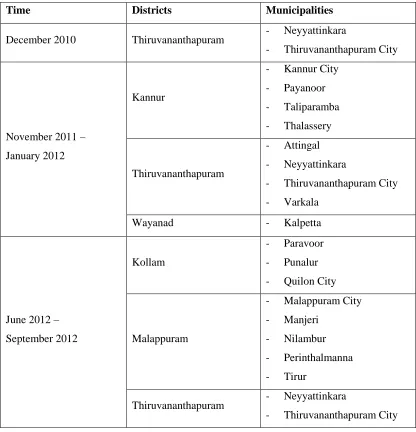
Table 5: Fieldwork – Time and Locations of Visits 83
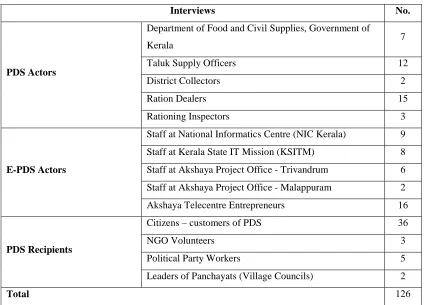
Table 6: Fieldwork – Interviews by Groups of Respondents 86
Table 7: Selected Indicators from the National Family Health Survey (NFHS-3) 99
Table 8: Foodgrain Entitlement under PDS in Kerala 105
Table 9: State and National Level Estimated Diversion of PDS Foodgrains 107
Table 10: Synopsis of Modules in TETRAPDS Software 120
10 List of Figures
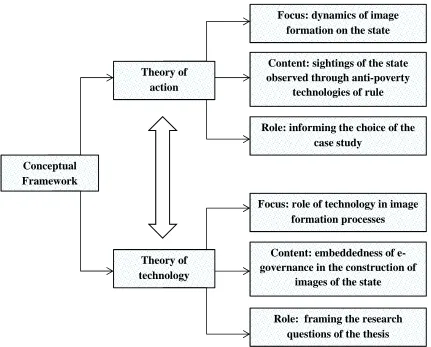
Figure 1: Synopsis of Boulding’s Theory on Image Formation 46 Figure 2: Synopsis – Conceptual Framework: Theory of Action 62 Figure 3: Synopsis – Conceptual Framework: Theory of Technology 69 Figure 4: Composite Conceptual Framework of the Research 70
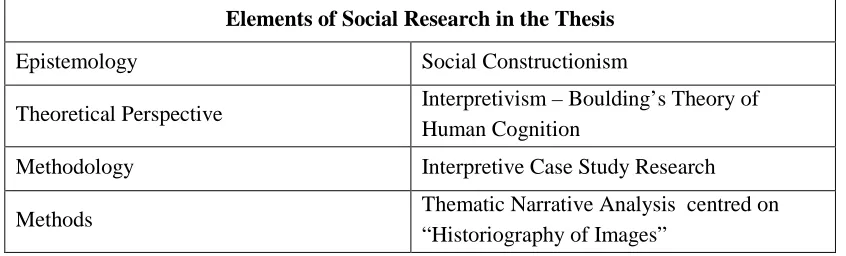
Figure 5: Structuring Elements of Social Research 73
Figure 6: Ration Shops, Taliparamba Municipality, Kannur District 103
Figure 7: Organizational Chart of PDS State Management 108
Figure 8: Barcoded Ration Card, Trivandrum District 112
Figure 9: Entry in the Ration Card Database 113 Figure 10: Workflow of Ration Card Management System (RCMS) 115 Figure 11: Allocation of PDS Commodities by Poverty Status – Prasanth Nagar, Trivandrum
117
Figure 12: WebPDS – Portal of Department of Food and Civil Supplies 119
Figure 13: Integration between RCMS and Aadhar 122
Figure 14: Reconstruction of Image of the State by Inclusion of e-PDS in Akshaya 133 Figure 15: Reconstruction of Image of the State by the Problem-Solution Nexus Inscribed in e-PDS
139
Figure 16: Synopsis of Mechanisms of Image Reconstruction Induced by e-PDS 140 Figure 17: Map of Inputs to Image Formation – Locus 1: Direct Experience 157 Figure 18: Map of Inputs to Image Formation – Locus 2: Social Public Sphere 163 Figure 19: Map of Inputs to Image Formation – Locus 3: Political Circuits 170 Figure 20: Synopsis of Inputs to Image Formation in Narratives 172
11 List of Acronyms
APL Above-Poverty-Line
AAY Antyodaya Anna Yojana
ANT Actor-Network Theory
ARD Authorized Ration Dealer AWD Authorized Wholesale Dealer
BPL Below-Poverty-Line
CDS Centre for Development Studies CPI(M) Communist Party of India-Marxist
CRO City Rationing Office
EAS Employment Assurance Scheme
e-PDS Electronic Public Distribution System FCI Food Corporation of India
FPS Fair-Price Shop
FRIENDS Fast, Reliable, Instant Effective Network for Disbursement of Services GIS Geographic Information System
GDP Gross Domestic Product
ICT Information and Communication Technology
IS Information Systems
ISDC Information Systems in Developing Countries KAVERI Karnataka Valuation and E-Registration Project KSITM Kerala State Information Technology Mission KSWAN Kerala State Wide Area Network
LDF Left Democratic Front
NHFS National Health Family Survey
NGO Non-Governmental Organization
NIC National Informatics Centre
NPM New Public Management
PDS Public Distribution System RCMS Ration Card Management System
SDC State Data Centre
TETRAPDS Targeted, Efficient, Transparent Rationing and Allocation Public Distribution System
TSOs Taluk Supply Offices
12 UID Unique Identification Project
13
1.
Introduction
The topic of e-governance in developing countries, focused on how weaker governance structures can be transformed and strengthened through new technologies, is a central one in the domain of information and communication technologies (ICTs) for development. The potential for new technologies to improve governance has been widely recognized in the literature: as powerfully synthesized by Heeks (2001), e-governance has been viewed as the “ICT-enabled route to good governance”, constructing ICTs as a tool to face the multiple problems generated by governance frailty. It is, in the first place, this problem-solving nature, sought and theorized in the practice of e-governance, that has made it highly studied with respect to developing nations: as a result, in terms of both theory and practice, e-governance lies at the heart of research in the domain of ICTs for development.
Over the last decades, the study of e-governance in developing nations has been informed by the idea that new technologies, through their intervention on government, have changed not only the functioning, but the very nature of public administration. E-governance has acted, as described by Bhatnagar (2004), as a tool for transformation of government, and of its interface with citizens: this transformation has been ruled by a results-oriented perspective, in which governments have sought to use ICTs in order to enact good governance in their administration and services. This focus on the improvement of outcomes, sought and conducted by means of computerization, has led to a vision of e-governance programmes in terms of the objective changes that they generate: the focus has been, in this respect, on how and how much governance structures have changed, in terms of their capabilities to manage internal processes and generate external accountability to citizens. The potential of ICTs to improve the outcomes of governance remains one of the main questions on which this domain has focused.
14 background dynamics into a primary object of study, opens the way for a new stream of literature, in which e-governance is observed through the lens of its effects on citizens’ sightings of the state.
This thesis studies the role of technology in processes of image formation on the state, with reference to their vision through the eyes of citizens in a developing country context. The research is rooted on the recognition of a role for e-governance in this respect, since changes in the citizen-provider interface may affect the subjective sphere of actors’ cognition of each other. To develop an investigation of this domain, the thesis relies on a theory of technology in image formation, which conceives e-governance as a means for governments to “recast their image” towards citizens (Kuriyan and Ray 2009): ICTs are viewed, in this respect, as image-makers embedded in their political context, acting beyond their main function as agents of improvement in governance. Starting from this vision, the thesis is articulated in the study of two parallel processes, i.e. image construction as a state-led dynamics and the perception of these images, reshaped by ICTs, by the citizens to whom they are directed.
To investigate these processes, the thesis studies a case in the southern Indian state of Kerala, where ICTs are utilized to computerize the main Indian food security programme, known as the Public Distribution System (PDS). The PDS is based on the provision of primary necessity items – consisting mainly of rice, wheat, sugar and kerosene – at highly subsidized prices to poorer people: the programme works, as a result, as a nationwide anti-poverty net, articulated through the fair-price shops through which subsidized items are supplied in all states. The technological object of my research, known as the electronic Public Distribution System or e-PDS, has computerized the four main functions of the PDS in Kerala: the management of ration cards (documents of entitlement to the programme), the intra-district allocation of goods, the monitoring of the programme’s supply chain, and citizens’ access to providers on the web (WebPDS). This programme, whose module on ration card management is now being integrated with the biometric identification project known as UID/Aadhar, constitutes one of the first attempts in India to digitize a system that, implemented through the guidelines of the central government, is responsible for the food security of billions of households throughout the nation.
15 but one that affects the reconstruction of images of the state and, in turn, its perception in the eyes of citizens. Madon’s idea, and its utilization in the literature on e-governance for development, provide the gnoseological field in which my work is inscribed: the thesis constitutes, as it is constructed, a journey in the domain of image formation on the state, mediated through the state-level computerization of an Indian food security programme.
1.1. Motivation and Object of Research
Before detailing the structure of the project, focus needs to be set on the motivation of the study, and on the central unit utilized in the articulation of the problem area. The idea that informed the thesis was conceived in the course of fieldwork conducted in Kerala in June-July 2009, for an MSc dissertation in Development Management on the financial and social sustainability of telecentres (Masiero 2010). Work with telecentre users and providers, related to an e-governance project that had deeply modified the local provision of services, led me to identify a change that extended beyond the objective side of infrastructures: modifications, as embodied in respondents’ narratives, were strongly related to their subjective perception of government, as it was newly mediated by telecentre entrepreneurs. It was at that time that my interest for image formation, as experienced by citizens through e-governance, was codified into an actual problem area: the introduction of this theme in the literature, operated by Madon just a few years before, determined an optimal moment to undertake a study of this kind.
16 Kooiman’s Sociology of Governance, with its close examination of the formation of governing images, answers the question on the meaning acquired, in this study, by the very concept of image, which constitutes its central unit of investigation. The use of this notion is ascribed, as it is in Kooiman (1993; 2003), to Boulding’s (1956) theory on human cognition: in providing a structured analysis of image formation processes, Boulding refers to the image as the “subjective knowledge” of the world, as it is continuously reshaped and reconstructed through the subjects’ interaction with it. Working with images, conceived in this way, means assuming that reality does not constitute a fixed entity, amenable to be directly and objectively observed: what is taken to represent reality are, instead, people’s constructions, appraised in the form of their images of things.
This notion is at the root of one key aspect of the research, referred to the close link between the concept of image and the epistemological position that it embodies. Observing the world through people’s images of it, and taking them as the closest means to represent reality, means adopting a gnoseological position of social constructionism: this vision is based on the idea that reality, instead of existing in an objective form, is constructed out of our relations with the world (Sismondo 1993), and therefore, our knowledge of it can only be based on cognitive constructions. Since epistemology, beyond constituting the background of research, directly informs its theoretical and methodological vision (Crotty 1998), a social constructionist perspective has determined the key aspects of my work: it has led me, on the side of theory, to choose an interpretive perspective on information systems (Orlikowski and Baroudi 1991), and to inform my methodology on an interpretive form of case study analysis (Walsham 1995). Therefore the concept of image, as it is referred to here, embodies the perspective on which the thesis as a whole has been grounded.
1.2. Research Project
17 1.2.1. Theoretical Framework and Research Questions
The main object of my work is the role of e-governance in processes of image formation on the state, as it is experienced by citizens in a developing country context. The conceptual framework, devised to conduct this research, consists in the combination of two theories: a theory of action, which explains the processes at the centre of attention, and a theory of technology, which refers to the role played by technology in the processes in point. The two theories, considered in their own domains of origin, have been extensively applied in the respective literatures: the novelty, implicit in my work, lies in my choice to combine them, in a composite theoretical lens utilized for my research objectives.
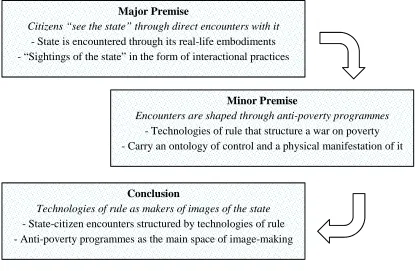
A theory of action on image formation processes is viewed in the formulation by Corbridge et al. (2003a; 2003b; 2005): abandoning the Weberian vision of impersonality and “facelessness” of government, it argues that citizens “see the state” through direct encounters with it, in the form of its localized embodiments and representations. Beyond establishing the relevance of these encounters, the theory goes in detail of how they are structured: based on Rose’s (1999) view of governance, applied to postcolonial development in contemporary India, Corbridge et al. explore the construction of state-citizen interactions through technologies of rule that structure a war on poverty. The discourse on state-citizen encounters as makers of images, coupled with the one on the form of anti-poverty technologies acquired by them, lead to an idea that is key to the research: images of the state, for citizens subjected to anti-poverty programmes, are structured through the means of the programmes themselves, which are a key mode for them to “see the state”. Therefore, studying image formation on the state implies observing the technologies of rule through which encounters with it are devised.
18 is openly theorized: instead, image perception on the part of citizens is contemplated, but not observed through the lens of a structured theoretical framework.
The two theories, combined together, constitute the conceptual framework of my research: yet, they play two different functions in the thesis as a whole. On the one hand, notwithstanding the interdisciplinary nature of the field of e-governance for development, my thesis carries out information systems research: therefore, the theory of technology is the one that directly informs my questions, responded by the analysis of case study data. The problem area outlined here had generated a quite open question, on if and how technology may influence the way in which developing country citizens form images of the state. My theory of technology, structuring the problem area in terms of the construction and perception of images, converts this broader question into the two following ones:
- Do new technologies provide the state, in developing nations, with a way to recast its image? If so, how does this happen?
- How do citizens receive new, technology-induced images of the state?
On the other hand, the theory of action is the one that informed the empirical study at the centre of research. Arguing that images of the state are predicated on encounters with it, structured through anti-poverty technologies of rule, leads to identify these technologies as the key space of image formation processes. This theory constitutes, therefore, the reason why I have chosen to focus on a food security programme, implemented in India at the national level, as a prism through which to observe the construction and perception of images of the state. In the case that I have studied, the anti-poverty programme has been recently computerized, and its digitalization has allowed me to observe the role of e-governance in the processes of interest.
1.2.2. Case Study
19 formation processes of citizens, with particular reference to the poorer strata of the Indian population: that is the Public Distribution System (PDS), a programme based on providing primary necessity goods at subsidized prices, on the basis of rationed quotas. The programme, triggered in pre-independence India by the famines of the early 1940s, is articulated on two levels: first, goods are procured by the central government at below market prices, and second, these are distributed through fair-price shops throughout the whole nation. The central government, on the one hand, dictates general PDS policies and allocates PDS goods to the states: on the other hand, state governments design and implement distribution schemes at the local level.
The PDS was originally conceived as universal, and this exposed the system to two streams of critique: one related to the “urban bias” that excluded most rural areas from the programme (Howes and Jha 1992; Dantwala 2006), and an even stronger one pertaining to the cost of subsidy, which became, in the view of many commentators, unsustainable in the fiscal crisis of the early 1990s (Ahluwalia 1993; Radhakrishna and Subbarao 1997; Dutta and Ramaswami 2001; Umali-Deininger and Deininger 2001; Radhakrishna 2006). For this reason, in June 1997, the PDS was turned into a targeted system: this means that only below-poverty-line (BPL) households remained entitled to the full subsidy, whereas those classified as above-poverty-line (APL) were left with subsidies reduced to a minimum. Another measure, implied by targetization, made the allocation of PDS commodities, from the central government to the states, proportional to relative poverty incidence: the rationale for this was to introduce proportionality in allocations, for poorer states to receive higher quotas of subsidized goods (Tritah 2003).
20 system to stop working properly (Krishnakumar 2000; Nair 2000; Suchitra 2004). The state-level computerization of the programme, which constitutes the technological object of my research, is to be seen in this problematic context, as one of the measures adopted to reconstruct the functioning of the PDS.
The object of my research, known as the electronic Public Distribution System or e-PDS, resulted from a process of computerization, inscribed in the Keralite system of e-governance, which was articulated on three different layers. The first phase, started in 2001, consisted of the creation of a database of all PDS users in Kerala, so that their details could be accessed by administrative offices, known as Taluk Supply Offices (TSOs), throughout the state. The second phase, piloted in 2005 and rolled out to all districts in 2007, consisted of the implementation, in all TSOs, of a suite of software known as the Targeted, Efficient, Transparent Rationing and Allocation Public Distribution System (TETRAPDS): this software digitized the four main functions of PDS in the state, i.e. the management of ration cards (entitlement documents needed to access the programme), the intra-district allocation of PDS goods, the monitoring of the programme’s supply chain, and the communication with users on the web (WebPDS). The third phase, still in course of implementation, consists in the integration of the ration card management system with UID/Aadhar, the national system that should provide unique identification to all Indian citizens, through a unique 12-digit number and biometric details. E-PDS is the artefact resulting from computerization of the biggest Indian food security programme, as it has been interpreted and conducted in the state of Kerala.
21 images”: this consisted in analyzing narratives through their thematic content, organized through the inputs of image formation that appeared in each of them.
1.2.3. Contributions
The nature of this work, as inscribed in information systems research, dictates the nature of the main contribution made by the thesis, which consists in an extension of existing theory of technology. As detailed above, the thesis works through the lens of Kuriyan and Ray’s (2009) vision of ICTs in image construction: this identifies the role of technology as embedded in its political context of use, as a means for reconstruction of images of the state in the eyes of citizens. While detailed on the state-led dynamics of image construction, the theory in point is less specific on the side of image perception: indeed, it does not develop a structured view of this process, and leaves the researcher with a high degree of freedom in making sense of it. On the basis of my case study, informed by the research questions, I find an empiric confirmation on the side of image construction, and extend theory on image perception by structuring a way to study it.
The first research question, and the investigation of the case study through it, lead me to confirmation of existing theory on image construction. This is based on two mechanisms, retrieved in the contents of respondents’ narratives: the first one lies in the inclusion of the front-end modules of TETRAPDS, i.e. the online application for ration cards and WebPDS, in the system of services at Akshaya, the telecentre project which has transformed the key space of state-citizen encounters in all the state. The second one pertains to a problem-solution nexus, embedded in the technology at the core of e-PDS: on the one hand, the behaviour of a specific agent in the programme’s supply chain, i.e. the owners of ration shops, is depicted as the main cause of the illegal market diversion that constitutes the main issue in the programme. On the other hand, the current form of construction of e-PDS – as integrated with biometric identification through UID/Aadhar, and therefore capable of tracking transactions at the shop level – is depicted as the optimal solution to the problem, which unveils a novel image of the state as an efficient and accountable service provider. These two mechanisms, extracted from narratives, lead to confirmation of existing theory, as they portray the state in action while operating self-reconstruction through e-PDS.
22 (messages in Boulding’s theory) to image formation from citizens’ recounts: to structure my study of these inputs, I have classified them through their loci of origin, i.e. the physical and social spaces in which the roots of images are generated. This analytical process has led me to argue that images of the state, reconstructed through the means of e-PDS, do not seem to be taken at face value by recipients: they are, instead, rediscussed and re-elaborated by spaces of image formation that citizens encounter in their daily lives, which belong to the three loci of direct experience, constructions operated in the social public sphere, and mediations produced by local political circuits. This argument, and the classification technique that orders Boulding’s messages on the basis of their spaces of origin, lead me to contribute to theory on image perception: data confirm, indeed, Kuriyan and Ray’s view that the state reconstructs itself through technology, but its power, in doing so, is limited by the spaces of image formation that people encounter in their daily lives.
Doing research in the domain of information systems for development, with the moral and social consequences that this implies for the position of the researcher (e.g. Walsham and Sahay 1999: 45), leads the author to think of the practical implications, which can be extracted from the research, as a deeply important part of it. This is a piece of work that, as of Flyvbjerg (2002), believes in the idea of “making social science matter”, closely observing the practical implications of what has been derived from theory: practical lessons, detailed in the conclusion of the thesis, are drawn with respect to both the PDS, and the domain of e-governance in developing countries at large. With respect to the PDS, the main lesson drawn from the research is that, for the food security system to function properly, the Government of Kerala needs to focus on practically enabling people’s access to subsidized commodities: this involves the development of strong monitoring systems to combat the diversion of foodgrains to the market, which is the primary cause of unviability in the system. E-governance should act, therefore, towards the improvement of existing accountability mechanisms, for these to maximize people’s capabilities to access the goods and services to which they are entitled.
23 existing accountability mechanisms to take place. Second, I dispute the view of “good governance” implying a sheer roll-back of state intervention: in the case observed, “good governance” comes across as the ability of institutions to improve people’s capabilities to access the food security system, which may be, as in the case of Kerala, achieved through strong direct involvement of the state. Finally, the vision of e-governance as an enabler of better institutional behaviour – which in turn is functional to maximize people’s capabilities – is seen under the angle of development practice, and recommendations are given for e-governance design to be carried out with an explicit orientation to human capabilities.
1.3. Thesis Outline
The thesis is articulated in nine chapters. In the present one, I have illustrated the motivation that inspired my work, and the main elements of research design in terms of theory, empirical study and contributions. The thesis, inscribed in the field of information systems for development, investigates the role of ICTs in image formation on the state: this has led me, on the basis of theory, to explore processes of construction and perception of these images, through the prism of state-level computerization of an Indian food security programme. The rest of the thesis is developed as follows.
Chapter 2 positions the thesis in its research domain, that of information systems in developing countries (ISDC). The chapter starts by mapping the field according to the main theories utilized to read it, and then narrows its focus to the sub-field of e-governance for development, to which my contribution is directed. With reference to this, I look at how the Sociology of Governance introduces the theme of image formation on the state: I observe how this process opens a new stream of literature, in which e-governance is observed through the subjectivity of image formation processes. The chapter concludes by stating the problem area at the centre of my work, which the theory of technology, illustrated below, will convert into specific research questions.
24 discourse on ICTs, applied by Kuriyan and Ray to the process of image construction: e-governance is portrayed, in this respect, as a means through which the state can recast its image in the eyes of citizens. This theory has generated my research questions, in terms of the construction and perception of images of the state through e-governance: the theory of action, at the same time, has structured my empirical study, inducing me to choose an anti-poverty technology of rule as a means for observing image formation on the state.
Chapter 4 illustrates the methodology utilized in the thesis, related to the social constructionist epistemology which is embodied in the structure of my work. Starting from this, the chapter explores the interpretivist perspective on information systems adopted here, which is substantiated, at the level of methods, in the choice of answering my research questions through an interpretive case study. On this, I focus on two lines of continuity between parts of the research: the first one goes from the theory of action to the case study selected here, since my choice of e-PDS is a direct consequence of Corbridge et al.’s view of anti-poverty programmes as spaces of image formation. The second one goes from my research questions to the methods utilized for data collection and analysis: the thematic content of narratives is analysed on the basis of inputs to image formation, as they are represented in the recounts of respondents. This method, based on Boulding’s (1956) theory of cognition, allows me to develop a technique based on a “historiography of images”, as represented in people’s narratives.
25 Chapter 6 illustrates my data analysis with reference to the first research question, on the construction of images of the state through e-PDS. This chapter constitutes, as illustrated, a confirmation of the theory of technology that has informed my work: evidence of self-reconstruction, through the means of e-PDS, is found in two mechanisms in which the state engages. The first one consists in including e-PDS front-end services in Akshaya, the telecentre project that has, per se, reconstructed state-citizen relations in the state as a whole. The second one lies in the problem-solution nexus that is embedded in the e-PDS technology, which portrays misbehaviour of ration dealers as the problem, and secure identification through biometric ration cards as the optimal solution to it. These mechanisms, extracted from the narratives of actors around the PDS, constitute the practical channels through which the state goes beyond the use of e-PDS as a sheer device for e-governance, and crafts it as a means for the reconstruction of its own image in the eyes of citizens.
Chapter 7 analyzes my narrative data with reference to the second research question, on citizens’ perceptions of the images reconstructed by the state. On this, differently from image construction, theory does not offer a structured process of understanding: to frame my data analysis, I use the technique of the “historiography of images”, through which inputs to image formation processes can be identified and examined. The numerous inputs, retrieved in the representations of reality provided by citizens’ narratives on e-PDS, have been classified in three loci of image formation: these belong to the direct experience of the programme, but also to its constructions in the social public sphere and political circuits. The main conclusion drawn from this finding is that citizens, in receiving self-reconstructed images of the state, do not take them at face value, but re-elaborate them through the spaces of image formation that they encounter in their daily lives: the real capability of the state, in reconstructing its own image, seems therefore to find a limit in these spaces of image formation.
26 developing country context. A broader theoretical contribution, in terms of the role of ICTs in development, identifies e-governance as a potential enabler of a more accountable institutional behaviour, which can be used in order to maximize people’s capabilities to achieve a better quality of life (in this case, by improving access to the food security system to which they are entitled).
27
2. Research Domain
My research is inscribed in the field of Information Systems in Developing Countries (ISDC), a branch of information systems research concerned with “how developing countries have attempted to benefit from ICTs” (Avgerou 2008: 133). In this section, the literature review that has informed my research is illustrated through a threefold process: first, I provide an overview of ISDC, as the field to which the theoretical contribution developed here is directed. Second, I focus on e-governance for development, the sub-field of ISDC to which my study belongs, and review the main themes explored by the literature in this domain. Then I observe, through theoretical insights from the sociology of governance, the introduction of a new theme in this literature, related to the implications of technology in citizens’ processes of image formation on the state. This theme, as inscribed in ISDC, constitutes the main object of my work: the terms of the research questions, through which this area of interest is operationalized, are articulated in the next chapter, through the theory utilized to read it.
2.1. Information Systems in Developing Countries: An Overview
My research has been informed by literature on ISDC, which looks at new technologies as applied to developing countries, with the purpose of improving their economic and institutional conditions. The rationale according to which developing countries present a common denominator, that makes them systematically different from other nations, is debated in the literature: as noted by Corbridge (2007: 183), in fact, several scholars cast doubt on the need to theorize on the “developing world” as an independent domain of study. This is because, from this perspective, problems occurring in developing nations differ in intensity, rather than in nature, from problems affecting the rest of the world, and therefore lack the pre-requirement for constituting a separate field of analysis.
28 affect postcolonial developing nations (Chatterjee 2004). Chapter 3 details the choice of this theoretical perspective, and its conceptual implications for the study.
2.1.1. What Is Meant by Development?
Before looking at the domain of ISDC, through the main theories utilized to read the field, a space of reflection is dedicated to the highly-debated question on the meaning of development. This issue has been discussed widely, within different branches of the literature, resulting in a debate that has witnessed a significant historical evolution. Yet, as noted by Walsham and Sahay (2006: 15-16), the debate does not seem to be fully mirrored in ISDC, a sphere in which discussion on what is meant by development is often insufficient, and sometimes disconnected from the influences of technology.
As noted by Akpan (2003: 262), “development” means different things to different people. This concept was identified, in early post-colonial times, with a process of “modernization”: this was conceived as the adoption, by less developed nations, of Western patterns of economic growth, which would lead them to economic prosperity. The main tenets of modernization theory were addressed by the “dependency” theory of the late 1970s: this position ascribed underdevelopment to the relation between a developed “core” and a developing “periphery”, which resulted in systematic exploitative behavior of the former towards the latter. Dependency theory emerged, therefore, in response to the perceived incompleteness of modernization theory, which was unable to account for the adverse effects of asymmetries in the international economy towards developing countries.
29 In the aftermath of the diffusion of modernization and dependency theories, the early 1990s saw a strong affirmation of the neoliberal approach, based on economic growth as the one determinant of development (Madon 2005: 407). The recommendations implicit in this approach revolve around specific means for growth to be achieved, identified with measures of economic liberalization and programmes for the structural adjustment of economies. This approach, while adopted by the most relevant institutions of international aid, was challenged by several viewpoints in the field: for example, a basic-needs approach sustained that development should be concerned with satisfying the basic necessities of citizens, rather than with economic growth (Akpan 2003: 264). Another approach observed that neoliberal theory, while looking at national economic systems, did not take into direct account the participation (or, more often than not, the lack of it) of recipient populations to development, and resulted therefore into a partial account of the impact of economic measures on the quality of life of recipients (Chambers 2010).
Another challenge to the neoliberal vision of development comes from the work of Amartya Sen, and from his approach grounded on “development as freedom”: Sen’s view is that maximization of productivity, rather than constituting the main route to development, is just one of the ways for the poor to break down the barriers that constrain their existence. Real freedoms, in Sen’s perspective, are to be achieved in a set of interconnected fields: each freedom stems, almost tautologically, from the removal of a “substantial unfreedom”, in the dimensions of human development embedded in people’s lives. In this perspective, development is equated with a condition in which people are free to develop their own life plans (Sen 2001: 7).
30 The multidimensional vision of development, conceptualized by the capabilities approach, has strong implications for theory and practice in ISDC, as the objective of technology-based interventions shifts from economic to human development. As explained below, the capabilities approach has been introduced in theorization on ISDC, by scholars that openly make the link between technologies and human development, in the pursuit of improvements in people’s quality of life. By showing the relevance of Sen’s approach in ISDC, these contributions illustrate the fact that technology-based development projects are inspired by the meaning of development underpinning them (Prakash and De 2007: 262), which makes the discussion on interpretations of this meaning a paramount one for the field as a whole.
The vision of development adopted in this thesis, through which the case of e-governance in the Indian food security system is examined, subscribes to the capabilities approach, building on the idea that the enhancement of human capabilities is the key means to achievement of a better quality of life. In the case examined here, people’s capability of accessing subsidized food items is pursued through the means of institutional improvement: this is, in turn, achieved by the digitalization of the main functions of the Indian food security system. The core idea of development, lying at the basis of my work, lies therefore in Sen’s vision of capabilities as the key unit involved in this process: it is in the light of this unit that I focus on e-governance, and draw a general contribution to theory on how ICTs may be put at the service of development. Theory on the relevance of ICTs to capabilities has been, therefore, particularly important in my approach to the research.
2.1.2. Theories in ISDC: A Synopsis
ISDC, by virtue of its composite nature, is characterized by coexistence of several theories, utilized to read the multiple links that may exist between technology and development. In order to map the field, and make sense of how it is composed, I provide a synopsis of the main theories within it.
31 public sphere from a stakeholder perspective. The passage of stakeholder theory from e-government in general, to e-e-government for developing nations, has been marked primarily by Bailur (2006), who applies this theory to the governance model of telecentres,1 interpreting an e-kiosk project according to the network of stakeholders around it. Thanks to its analytical power, stakeholder theory provides an important instrument for conceptualizing ICT-based projects in developing nations.
Actor-Network Theory (ANT). The theoretical approach coined by Bruno Latour (1987) has been used for studying information systems (Walsham 1997; Latour 2004), and has been applied to the subfield of ISDC as well. ANT revolves around the notion of “actor networks” centered on technology, and conceptualizes the ways in which network dynamics are conditioned by the influence of technology on them. Examples of ANT usage in ISDC include the work of Walsham and Sahay (1999) on Geographic Information Systems (GIS) in India, as well as those of Sayed and Westrup (2003) and Mosse and Sahay (2003), in which networks are counterbalanced by the concept of “counternetworks”, complementary to the original one. As reminded by Walsham and Sahay (2006: 12), ANT allows conceptualizing technology itself as an actor in the network, which opens up new possibilities for interpretation.
Institutionalism. In North’s definition (1993: 23), institutions are “the humanly devised constraints that shape interaction”: in ISDC, institutionalism implies considering not only institutions per se, but also, and perhaps primarily, the ways in which these are reshaped by technology and the actors using it. One of the key pieces adopting this perspective is Miscione’s (2007) work on telemedicine in the Amazon, where the interplay between two knowledge systems – mainstream healthcare, and local traditional medicine – is reshaped by the influence of technology. Other works ascribing to institutionalism in ISDC are those by Avgerou (2004), Silva and Figueroa (2002), and Madon et al. (2009) on processes of institutionalization in digital inclusion projects.
1
32
Communicative Action Theory. This theory, firstly formulated by Habermas (1981),
focuses on the identity of individuals as a concept in perpetual flow, constructed and reshaped in interpersonal interactions. As a result, the study of identity formation is indivisible from the study of communicative action, and centers on how images – of the self and of others – are constantly reconstructed through this very process. When used in ISDC, this theory leads to a deep exploration of the meaning of ICT-based projects, for the system of actors around them, and for the cognitive processes that occur in the minds of actors. A key example of Communicative Action Theory in ISDC is provided by the work of Kanungo (2003; 2004), where Knowledge Centres (a particular form of telecentres) are constructed as endowed with an “emancipatory nature”, i.e. constitutive of processes of empowerment conducted through informatization. Another example is Puri’s (2003) study on GIS in southern India, where knowledge integration is premised on the self-reconstruction of identity by communities involved in participatory mapping.
Capabilities Approach. Sen’s vision of “development as freedom”, as noted above, is key to contemporary thinking about the meaning of development, and this approach has significant implications for ISDC. These are highlighted, for example, by Madon (2004), who builds a model for the evaluation of projects in ISDC based on the key dimensions of the capabilities approach. Inscribed in the same stream of literature, Lunat (2008) creates a model of analysis of the Internet in the public sphere, which takes an approach to development with “political freedom” at its core. In the same perspective, Zheng and Walsham (2008), Zheng (2009) and Kleine (2010; 2013) use the capabilities approach as a theoretical framework to analyze empirical data, and explicitly introduce this vision as a new paradigm in ISDC. Furthermore, Smith et al. (2011) use the same paradigm to study the use of mobile technologies by developing country citizens: they argue that mobile phones, with their ease of use and massive rates of adoption, constitute a strong basis for achieving human capabilities through new technologies. These works clearly mark the introduction of Sen’s approach as a theoretical tool in the field, rather than just as a background theory illuminating a possible meaning of development.
33 country context, use punctuated equilibrium theory and integrate it with the concept of “deep structure”, on the basis of its suitability for the specific targets of the research. These examples demonstrate the importance of flexibility and adaptation in the use of theory, especially when context-specific phenomena, such as those that pertain to ISDC, are to be analyzed.
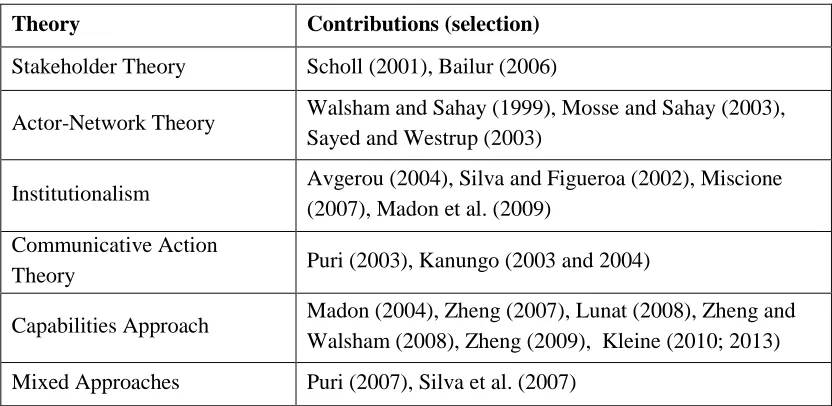
The main theoretical approaches in ISDC, as identified in the present review of the literature, are synthesized in table 1 below. This review confirms one of the main assertions by Walsham et al. (2007): ISDC is a field that, while belonging to the domain of information systems research, relies heavily on external approaches, connected to domains as varied as anthropology, geography and development. Yet, notwithstanding the importance of heterogeneous perspectives, mainstream approaches in management and IS, such as stakeholder theory and ANT, are also highly relevant for exploring dynamics in this sphere.
Theory Contributions (selection) Stakeholder Theory Scholl (2001), Bailur (2006)
Actor-Network Theory Walsham and Sahay (1999), Mosse and Sahay (2003), Sayed and Westrup (2003)
Institutionalism Avgerou (2004), Silva and Figueroa (2002), Miscione (2007), Madon et al. (2009)
Communicative Action
Theory Puri (2003), Kanungo (2003 and 2004)
[image:33.595.113.529.334.537.2]Capabilities Approach Madon (2004), Zheng (2007), Lunat (2008), Zheng and Walsham (2008), Zheng (2009), Kleine (2010; 2013) Mixed Approaches Puri (2007), Silva et al. (2007)
Table 1: Synopsis of Theoretical Approaches in ISDC
34 2.2. Sub-Field of Research: E-Governance for Development
From the overview of the literature on ISDC provided above, the heterogeneity of theories and discourses arises as a main characteristic of the field. At the same time, this domain features multiple objects of analysis: there are, indeed, numerous channels through which technology can foster development, and these can be appropriated in different ways depending on context. Within the macro-sphere of ISDC, my work looks at the sub-field of e-governance for development, centred on the application of technology to state-citizen relations in developing nations.
2.2.1. Governing with New Technologies: Which Rationale?
Several scholars (e.g. Heeks 1999; Ciborra 2005; Bekkers and Homburg 2007) relate e-government directly to New Public Management (NPM), a philosophy that introduces, in public administration, the “managerialist” principles of the private sector. For how it is constructed, New Public Management marks a change in philosophy with respect to Weberian bureaucracy, as, being market-oriented in nature, it focuses on outputs rather than procedures (Hood 1991; Osborne and Gaebler 1992), and entails a conceptual shift that makes the citizen a “customer” of government (Ciborra 2005).
Seeing new technologies, and in particular, information and communication technologies (ICTs) as “carriers” of the objectives of NPM leads to a specific policy agenda of e-government, as synthesized by Heeks (1999). The first objective, for which ICTs are utilized by governments, is that of efficiency, intended as an improvement in the relation between government outputs and the cost and/or time of production. Many governmental operations, through adoption of new technologies, can be carried out in a quicker way, which minimizes human intervention and discretionality: by doing so, new technologies help overcoming the bottlenecks of Weberian bureaucracy, whose rigid procedures, while aimed at ensuring legality, tend to slow down the mechanisms of delivery. A powerful image, in this respect, is that of the efficiency gains introduced by computerization of public services, a field in which informatization has significantly reduced the costs and waiting times experienced by citizens at public offices.
35 to transfer tasks at levels of government that are closer to citizens, and this leads to significant power redistributions within the sphere of public administration. This is one of the aspects in which the literature on e-government reflects, more explicitly, an IS theme, epitomized by the work of Markus (1983): namely, the role of new technologies in redesigning power levels within organizations, and redistributing responsibilities as a result. Indeed, if ICTs are utilized to decentralize responsibilities, what changes is not merely the configuration of technologies, but the distribution of power among different levels of administration (Madon 1993; 2006).
The third objective is that of accountability, interpreted here, with Brett (1999: 54), as a function of the leverage of citizens on government. ICTs, by introducing the traceability of actions to specific individuals and agencies in government (Bhatnagar 2004), and by moving discretionary power from street-level bureaucrats to an impersonal system-level (Bovens and Zouridis 2002), can enable accountability in a strong and durable way: therefore, new technologies are widely used in programmes of institutional amelioration. Furthermore, the emergent phenomenon of governance through mobile devices – or m-governance – is gaining relevance in terms of accountability: by providing information on existing services, and sometimes enabling a two-way relation between government agencies and citizens, mobile phones can be used in order to maximize the responsiveness of the state (Donner 2008; Bhatnagar 2009; Smith et al. 2011). Although the effects of ICTs on government programmes are mixed (Bhatia et al. 2009), their application to accountability has a clear rationale, aimed at leveraging the potential of new technologies to enhance transparency.
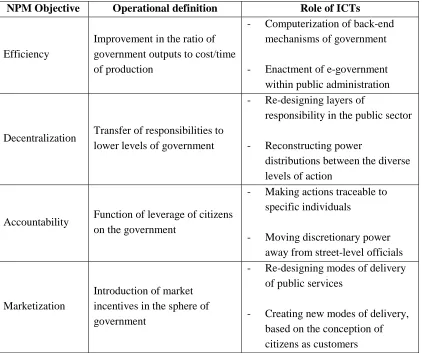
36 NPM Objective Operational definition Role of ICTs
Efficiency
Improvement in the ratio of government outputs to cost/time of production
- Computerization of back-end mechanisms of government - Enactment of e-government within public administration
Decentralization Transfer of responsibilities to lower levels of government
- Re-designing layers of
responsibility in the public sector - Reconstructing power
distributions between the diverse levels of action
Accountability Function of leverage of citizens on the government
- Making actions traceable to specific individuals
- Moving discretionary power away from street-level officials
Marketization
Introduction of market incentives in the sphere of government
- Re-designing modes of delivery of public services
[image:36.595.110.532.71.424.2]- Creating new modes of delivery, based on the conception of citizens as customers
Table 2: ICT-based routes to New Public Management objectives Source: adapted from Heeks (1999: 7-21)
The table above synthesizes the roles of ICTs in public management which have been explained so far.2 These constitute a synthesis of the modes in which technology can be utilized for improving governance, being adapted specifically for the objectives of NPM. In particular, there are two assumptions implicit in a neoliberal understanding of e-government, which can be observed in the perspective provided by these functions:
- That ICTs, utilized in government, can promote an idea of “good governance” (Heeks 2001), and make it come alive in the form of tangible technologies. “Good governance” here is to be intended, as discussed below, in a normative sense: the term refers, in this domain, to a situation in which the state is rolled back, and market mechanisms are free
2 Heeks recognizes a fifth role of ICTs in the pursuit of NPM, i.e. improved resource management.
37 to operate in state-citizen relations. A governance model in which the presence of the state is minimized is enabled exactly by the four principles of NPM: by increasing efficiency, decentralizing its operations, optimizing accountability, and introducing explicit market mechanisms in its functioning, the state adopts the market-based model that NPM prescribes. This model is viewed as optimal to ensure efficient (“good”) governance, and ICTs are conceptualized as functional to this purpose.
- That good governance, in developing nations, does not constitute an end in itself, but a route to development, to be followed by needful nations to obtain better economic and political outcomes. In this respect, minimization of the role of the state is seen as an operational means to development: introducing NPM mechanisms in public administration, to make the efficiency of market mechanisms prevail over the bureaucratic procedures of state, is seen as a way to minimize costs and, at the same time, translate the freedom of the market domain in the context of government. This view is mirrored by the notion of “good governance” implied by international financing institutions, whose policy makes loans conditional to structural adjustments aimed at rolling back the state. In this sense, in developing nations, the use of ICTs for good governance is directly functional to reaching higher and better development outcomes.
Still, these assumptions are not automatic or self-evident: there are, indeed, arguments that cast doubt on their appropriateness, in terms of structuring the dynamics of the public sector. These doubts are summarized by the views of Cordella (2007), concerning the adequacy (or not) of a market-based philosophy for public administration: he observes that the guidelines of NPM, designed for the domain of private organizations, are not necessarily applicable to public management, in which objectives of fairness and equality should be prioritized on sheer efficiency. On the basis of this discrepancy, Cordella (2007: 266) problematizes this conception at its very basis, identifying the bureaucratic organization as the guarantor of equity and impartiality in the public sphere: as a result, ICTs should be used to purport the values of bureaucracy, not to reform the public sector along the lines of private organizations. Therefore, NPM should not be used as a guide to informatization in the public sector, as it is rooted on objectives that do not fit the purposes of public administration.
38 bureaucracy, which display a different conception of government in state-citizen relations. The key point here is that e-government infrastructure, rather than just automatizing existing procedures, constitutes a means to carry specific values, and embed them into public administration: technology is, therefore, a means to convey these values, and make them come alive in the public sector. As I look at e-governance for development, as a sub-field of ISDC, the diversity of rationales, and the consequent diversity of resulting infrastructure, are to be held as key features of the field.
2.2.2. E-Governance for Development: Research Agenda
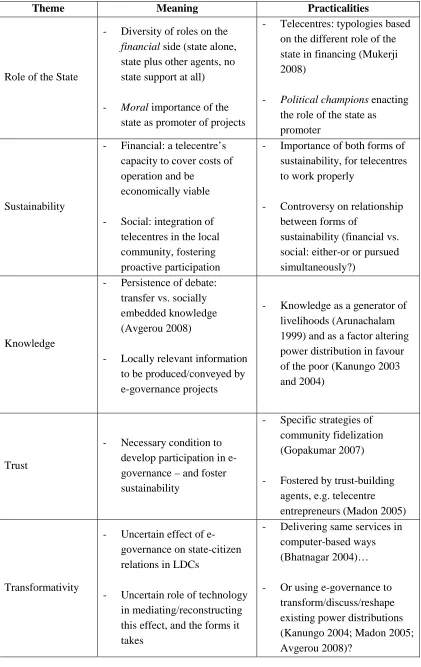
The diversity of rationales for the adoption of technology, reviewed above, is reflected in the applications of e-governance in the developing world, referred to as e-governance for development. The first conceptual shift, with respect to the field reviewed in the previous paragraph, is in the meaning of “e-governance”, which is intrinsically different from that of “e-government” (Bhatnagar 2004; IIITB 2005; Madon 2009). The term “e-government” refers to technologies related to improving government mechanisms, or the interaction between government and the citizenry: as such, it excludes the multiple, non-governmental actors that characterize contemporary politics.
My choice of looking at “e-governance”, a broader term that transcends the strict domain of “government” as such, is predicated on the theoretical perspective of Rose (1999: 28), according to which new actors, blurring the boundaries between “government” and civil society, are acquiring increasing importance in world politics. These players, and the dynamics they follow, transcend the boundaries of “government”, and therefore need to be conceptualized through a specific terminology, which goes beyond previous categorizations. My focus (elaborated in Chapter 3) on state-citizen relations as polymorphous links, inscribed in a “political society” that the term “government” does not encompass, led me to take a broader focus on state-citizen relations, and therefore adopt “e-governance” as my specific domain of interest.
39 - administration, aimed at automatizing the back-end processes of government.
E-administration constitutes the oldest form of e-governance for development (Heeks 2001), and computerizes the internal processes through which the functioning of the state is enabled. For example, in a project named Bhoomi, aimed at computerizing land records in Karnataka, southern India, ICTs have been used to change the mechanisms of issuance of land ownership certificates, enforcing queue discipline and reducing corruption (Bhatia et al. 2009).E-administration projects aim at translating technology into better functioning of government, guaranteeing the responsiveness of the state to its administrative duties.
- E-services, through which mechanisms of interaction between the state and citizens are built, or made easier, by digitalization. In order to maximize public access to government, e-service delivery often happens through a system of Internet kiosks: for example the e-Seva project, in the Indian state of Andhra Pradesh, offers 135 government services, ranging from payment of bills to applications for government schemes. Other e-kiosks focus, instead, on specific services: for example, the Karnataka Valuation and E-Registration project (KAVERI) offers registration of property sale and purchase deeds, issuance of non-encumbrance certificates, and issuance of copies of previously registered deeds. These kiosks, providing e-services in a developing country context, automatize service delivery, enabling significant gains in terms of time optimization and elimination of bribes connected to services (Bhatia et al. 2009).
- E-participation, in which technologies are used to enable participation to government mechanisms, and exploit the democratic potential of ICTs. The shift from “government” to “governance” is epitomized, in the case of e-participation, by new forms of aggregation, belonging to the domain of civil society, which are “in between” government and citizens, and still play a key role in state-citizen relations. An example here is that of the so-called Bhoomi clubs, related to Akshaya, an initiative (reviewed later in the thesis) that brought e-kiosks to the Indian state of Kerala: these clubs, in which farmers discuss matters related to agriculture, are increasingly developed in the premises of Akshaya e-kiosks (Madon 2009). By doing so, they enact new forms of participation to civic life, by clustering farmers’ politics around the telecentres through which they are connected.