R E S E A R C H
Open Access
An efficient anonymous batch
authentication scheme based on priority and
cooperation for VANETs
Tao Jing
1, Yu Pei
1, Bowu Zhang
2, Chunqiang Hu
3, Yan Huo
1*, Hui Li
1and Yanfei Lu
1Abstract
Vehicle-to-vehicle (V2V) and vehicle-to-roadside (V2R) communications have raised a series of challenges due to data security and user privacy. Vehicular ad hoc networks (VANETs) have become the target of malicious attacks.
Authentication has been widely adopted in VANETs to guarantee secure communications. However, existing
authentication schemes have failed to meet stringent time requirements of VANETs leading to information loss. In this paper, we propose an efficient anonymous batch authentication (EABA) scheme aiming to reduce the message loss rate of vehicles and roadside units (RSUs). In the EABA scheme, we introduce a message classification algorithm and allow receivers to authenticate messages based on the classification result so that messages with high priority will be authenticated preferentially. In addition, we propose a cooperative authentication mechanism, where RSUs and vehicles share authenticated messages to reduce the workload on RSUs when the network is saturated. The proposed method is evaluated by extensive simulations, and the results demonstrate that the EABA scheme can reduce the message loss significantly and guarantee information security.
Keywords: VANETs, Message authentication, Message classification, Reverse auction
1 Introduction
A vehicular ad hoc network (VANET) supports direct communication between vehicles and thus has wide appli-cations in an intelligent transportation system (ITS) [1]. Vehicles in VANETs are typically equipped with mobile devices, following the dedicated short-range communica-tion (DSRC) protocol [2–4]. Messages exchanged via the DSRC protocol include road condition [5], traffic events [6], advertisements, and weather condition [7], even video streams [8]. Upon receiving these messages, drivers can get a better understanding of road conditions and traffic reports and adjust their routing and velocity accordingly for safe and fast driving. In addition, messages in VANETs can also deliver value-added services, such as the com-mercials of nearby gas stations and restaurants. Besides the communication between vehicles, additional facili-ties such as a roadside unit (RSU), when connecting to
*Correspondence:[email protected]
1School of Electronics and Information Engineering, Beijing Jiaotong
University, Shangyuancun, Beijing 100044, China
Full list of author information is available at the end of the article
vehicles, can significantly enhance the performance of message exchanging due to its large computing capacity. For example, RSUs can disseminate messages to a large number of vehicles within seconds while it may take a greater amount of time for individual vehicles to receive messages then broadcast. In the presence of a traffic con-trol center, RSUs can help gather messages from vehicles so that the control center has a full understanding of traffic on the road.
However, security concerns pose great challenges on communications in VANETs due to its unique character-istics (e.g., wireless communication, unbounded network size, frequent exchange of information, rapid changing network topology) [9–11]. Malicious users may intercept [12], poison [13], modify, and replay messages to inter-rupt communications or jam traffic. The attackers can even detect the identity of message sender and spoof as a legitimate user [14]. The integrity and authenticity of messages are seriously threatened [15]. To address these issues, some works design a secure routing path to isolate malicious nodes [16]. In addition, message authentication has been widely adopted in VANETs due to its reliability
and easy implementation, where messages received must be authenticated before further being processed [17,18]. While improving the communication security in VANETs, message authentication has introduced extra processing delay. Yet, most information in VANETs is time-sensitive. As vehicles move constantly in VANETs (typically 10 to 40 m/s or 36 to 140 km/h), messages are required to be processed in nearly real time so that drivers can be noti-fied timely, i.e., before they enter the danger zone. As a result, messages in VANETs are often associated with a timer and will be discarded when the timer expires [19]. Consider a scenario that a vehicle receives multi-ple messages from vehicles nearby, and these messages will be placed in a queue based on their arrival time. Upon expiration of the timer, messages would be dropped immediately. Then, important information may be lost due to authentication delay when the network is con-gested. This situation is common in VANETs due to the possible data burst. Attackers may also take advantage and flood receivers with invalid messages [20,21]. A well-recognized solution for authentication in VANETs is to use the public key infrastructure (PKI)[22] to encrypt messages. However, most PKI-based approaches suffer from a significant amount of checking time for certificate revocation list (CRL)[22]. This may cause failure to meet the strict time requirements of VANET.
In order to address the problems outlined above, in this paper, we propose an efficient anonymous authentication scheme for VANETs based on message priority and vehi-cle cooperation. We adopt the elliptic curve digital sig-nature algorithm (ECDSA) [23] for message encryption, as it requires less computation overhead with noticeably smaller keys compared with other existing algorithms. In addition, we employ the batch authentication in the proposed scheme that vehicles can authenticate multiple messages at a time to reduce the time for authentication [24]. We classify all received messages into multi-level priority queue (MLPQ) before authentication. Inspired by the observation that messages from vehicles nearby are more important, as they may contain information that immediately impacts the current vehicle, we group received messages based on the received signal strength. The messages sent from closer vehicles represent higher safety concern for ITS safety applications. Thus, our scheme enables these messages to be authenticated prefer-entially so as to retain important information. Moreover, we introduce a cooperative authentication mechanism, where RSUs and vehicles participate in cooperation, so that authenticated messages can be shared with low com-putation overhead. To encourage vehicles to participate in cooperation, we adopt a reverse auction mechanism to award vehicle participation.
Our contributions of this paper are summarized as follows:
1 We employ the elliptic curve cryptography and the batch authentication in our authentication
algorithm, which can authenticate a set of messages simultaneously rather than one after another with low computational complexity. The proposed authentication algorithm can reduce the message loss rate significantly.
2 We classify received messages into different priority queues based on the received signal strength using Lloyd’s algorithm, to prevent important messages (messages from nearby vehicles) from being dropped when the network is congested.
3 We propose a cooperative authentication method to allow vehicles to share authenticated messages with RSUs. An auction mechanism is included in the cooperative authentication method to encourage vehicles to help RSU select cooperators and calculate the reward for each. We have proven that the auction mechanism can guarantee truthful dealings.
4 The experiments of the proposed authentication scheme are carried out on MATLAB platform. The relevant parameters are set according to the real VANET scenario that is explained in Section6. Simulation results show that the EABA scheme is safe and efficient. It can reduce the message loss rate of both vehicles and RSUs.
The rest of the paper is organized as follows. Section2 reviews related work about message authentication in VANETs. Section3introduces the system model and pre-liminaries. Section 4 describes the cooperative message authentication scheme for VANETs. Section 5 analyzes the security, privacy, bid truthfulness, and authentication efficiency of our scheme. Section6demonstrates the sim-ulation results and discusses the message loss rate of both vehicles and RSUs. Section7presents a conclusion.
2 Related work
recommended for message authentication by the current wireless access in vehicular environment (WAVE) stan-dards. In addition, many authentication schemes have been proposed based on ECDSA. In [27], the authors proposed an efficient conditional privacy preservation (ECPP) protocol, which was a good implementation of ECDSA. However, the computational complexity of ECPP is heavy because of the usage of bilinear pairing. In order to improve the computation speed in message authenti-cation, Zhang et al. introduced an identity-based batch verification (IBV) scheme in [28]. The IBV scheme still needs to use bilinear pairings and requires a special hash function known as the MapToPoint function, which is also time inefficient in VANETs. However, the IBV enables the received messages with signatures to be authenti-cated at the same time such that the total verification time could be reduced. To achieve better performance and reduce the computation cost, He et al. [29] and Lo and Tsai [30] proposed new efficient authentication schemes which did not use bilinear pairing under the premise of ensuring security and privacy. They presented a better performance in terms of computation cost. Shim in [31] proposed a conditional privacy preserving authentica-tion scheme, called as CPAS. It reduced the computaauthentica-tion time by canceling the use of MapToPoint function. In this paper, we mix together the advantages of both batch authentication and ECDSA without bilinear pairing and employ the MapToPoint to construct our authentication scheme.
Message authentication has been universally accepted to address security and privacy issues in VANETs. Based on the abovementioned schemes, they can be further classified into three categories: random authentication, cooperative authentication, and priority-based authen-tication. The most common is random authentication [29,32]. In this way, all received messages with signatures are stored in the storage of queue according to their arrival order. They are picked randomly for authentication. How-ever, a large amount of important messages from nearby vehicles will be lost in such a way because of the limited computational capability of vehicles.
Cooperative authentication has emerged as a promis-ing approach to reduce the authentication overhead on individual vehicles and shorten the authentication delay [33,34]. Vehicles cooperatively authenticate messages and share their authentication results to each other. Thus, the computation burden of them will be alleviated largely. Nevertheless, the implementation of this method is chal-lenging due to the unique features of the VANETs, such as high mobility and real-time quality in data transmission.
Priority-based authentication is a new trend to solve problems in VANETs [20]. The main issue is that many important messages from neighbor vehicles may suffer
from significant authentication delays. Different from pre-vious approaches, all received messages in priority-based authentication schemes can be classified into MLPQ according to their importance. After that, messages will be authenticated in priority. Messages with great impor-tance will be protected from authentication delay, and they will be authenticated in time. Therefore, we propose an authentication scheme based on priority in this paper. Hamida and Javed [23] used a directk-means clustering method to do message clustering, while it is time consum-ing, especially in a dense traffic scenario. We use Lloyd’s algorithm [35] in our paper, which performance is more superior than the directk-means algorithm.
3 System model and preliminaries
3.1 System model
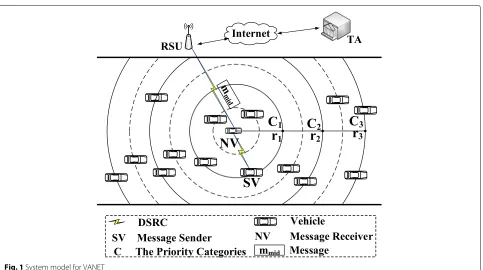
In this section, we present a general model for message exchange in VANETs as illustrated in Fig.1. The notations used in this paper are listed in Table1.
Consider a VANETMthat consists ofnvehicles, where every vehicle is equipped with an onboard unit (OBU) that can send and receive messages. In addition, each vehicle has a tamper-proof device (TPD) for data storage and pro-cessing. In this paper, we assume that the TPD is fully trusted and do not consider attacks towards the TPD. In other words, we believe data stored in the TPD are safe and free from attacks. LetV= {vi,i∈ {1, 2,. . .,n}}be the set of vehicles inM.
Assume that there exists a trusted authority (TA). The TA is a trusted third party with a high level of computa-tion performance. It is in charge of system initializacomputa-tion and the proposed authentication scheme implementation. Assume vehicles have registered at the TA in advance so that each vehicle will be assigned a unique identity (ID) and its account information will be copied and saved in its TPD as well. As a result, the TA has knowledge of the identity of all the vehicles inM. For the sake of simplicity, we assume that the TA is hard to be compromised by any adversary. Therefore, the TA is considered to be free of attacks as well. LetRbe a RSU that works as an interme-diary between the TA and vehicles. It can communicate with vehicles via radio signals and can also communicate with the TA through wired links.
Each vehicle vi can broadcast messages to other vehi-cles when needed. The messages are links between nodes inMfor communication. Denote a message bymmid =
{bmid,SVRID,tmid} where bmid represents the message body,SVRIDrepresents the vehicle ID of a sender, andtmid is the message expiration time.
Fig. 1System model for VANET
Letqit = qit[j]T,j ∈ Z+,qit[j]∈ {mid}be the queue of messages to be processed inviat timet, and let|qit|be the queue length. Letwmidbe the total time that a message
mmidstays inqi(from the time it arrives to the time it gets processed), and it can be expressed as:
wmid=
qi tmid
wqi
tmid[j] (1)
Messages sent from closer vehicles deserve more atten-tion as they may impact the current vehicle immediately. Inspired by this observation, we let vi label messages with different priority tags based on the sender-receiver distance when processing messages.
For a particular messagemmid, the precise location of its senderSVcannot be inferred frommmiditself. But fortu-nately, we can estimate the distance betweenSVandNV roughly by the received signal strength and then classify messages intokcategoriesC1,C2,. . .,Ckby their priority tag. Here,NVrepresents the message receiver. A cluster-ing method [35] is adopted for message classification. Let dtSV,NVrepresent the distance between the senderSVand a receiverNV ∈ V at timet. For example, we can clas-sify all received messages into three categories at 100-m intervals:
• C1: if0<dtSV,NV ≤100m
• C2: if100<dtSV,NV ≤200m
• C3: if200<dtSV,NV ≤300m
Each of the messages inCi needs to be authenticated byvi. The authentication scheme will be described in the following section.
3.2 Security and privacy objective
The proposed cooperative authentication scheme is com-mitted to protecting security and privacy of users in VANETs with a goal to ensure privacy preservation and bid truthfulness.
• Message authenticity and integrity: Due to intensive attacks in VANETs, messages during transmission can be intercepted and corrupted, and false
information may be inserted to disturb traffic. Thus, it is important for receivers to verify the integrity of received messages making sure messages have not been tampered with during transit.
• Identity privacy preservation: As vehicles communicate over a public channel, messages transmitted in VANETs are vulnerable to tracking attacks where attackers could trace the targeted driver’s activities based on the messages it broadcasted. For example, by monitoring
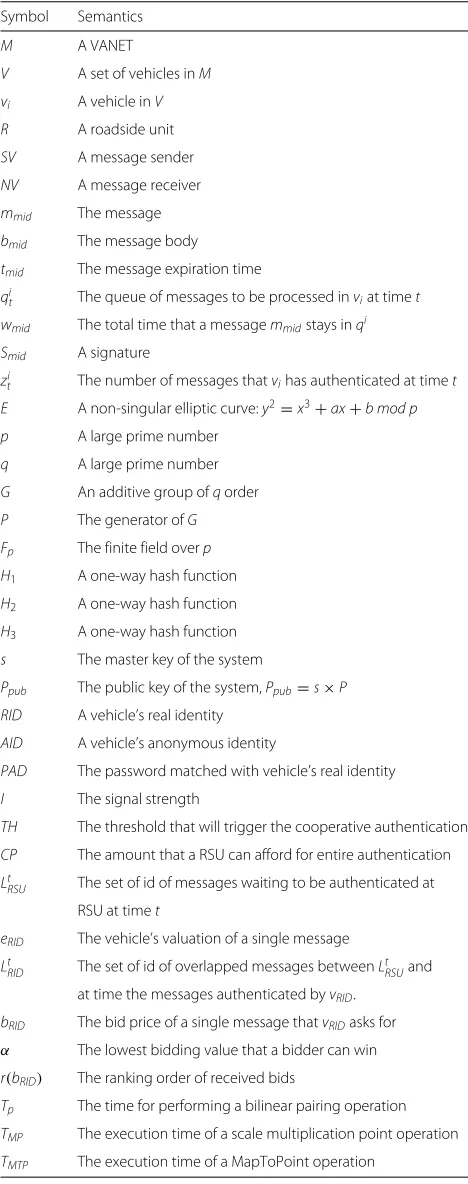
Table 1Notations
Symbol Semantics
M A VANET
V A set of vehicles inM vi A vehicle inV
R A roadside unit
SV A message sender
NV A message receiver
mmid The message
bmid The message body
tmid The message expiration time
qit The queue of messages to be processed inviat timet
wmid The total time that a messagemmidstays inqi
Smid A signature
zi
t The number of messages thatvihas authenticated at timet
E A non-singular elliptic curve:y2=x3+ax+b mod p
p A large prime number
q A large prime number
G An additive group ofqorder
P The generator ofG
Fp The finite field overp
H1 A one-way hash function
H2 A one-way hash function
H3 A one-way hash function
s The master key of the system
Ppub The public key of the system,Ppub=s×P
RID A vehicle’s real identity
AID A vehicle’s anonymous identity
PAD The password matched with vehicle’s real identity
I The signal strength
TH The threshold that will trigger the cooperative authentication
CP The amount that a RSU can afford for entire authentication
Lt
RSU The set of id of messages waiting to be authenticated at RSU at timet
eRID The vehicle’s valuation of a single message
LtRID The set of id of overlapped messages betweenLtRSUand at time the messages authenticated byvRID.
bRID The bid price of a single message thatvRIDasks for α The lowest bidding value that a bidder can win
r(bRID) The ranking order of received bids
Tp The time for performing a bilinear pairing operation
TMP The execution time of a scale multiplication point operation
TMTP The execution time of a MapToPoint operation
• Traceability: Even with identity privacy-preserving methods implemented in VANETs, malicious users could find ways to interrupt traffic and cause information lost. For example, malicious users could send false messages which could result in accidents, and they can escape their punishment by hiding their real identity. To solve this problem, we allow the TA to track malicious vehicles and publish them when necessary. That is, the TA can extract the vehicles’ real identity by analyzing the messages they sent.
4 Cooperative message authentication scheme In this section, we propose a message authentication scheme that aims to reduce message loss rate by intro-ducing cooperative authentication among vehicles and RSUs.
4.1 Scheme overview
In EABA, we adopt the public key cryptography for mes-sage authentication. Note that different from classical public key cryptosystems, all legitimate vehicles in M share the same public key, while each vehicle has a unique private key, and the private key is known only to the vehi-cle itself. This public-key-private-key distribution is made possible thanks to the presence of the TA. In our scheme, the TA is in charge of initializing authentication settings (i.e., choosing the prime number for public key), and keys are generated and assigned to vehicles when they register at the TA. As a result, we can easily let all vehicles have the same public key.
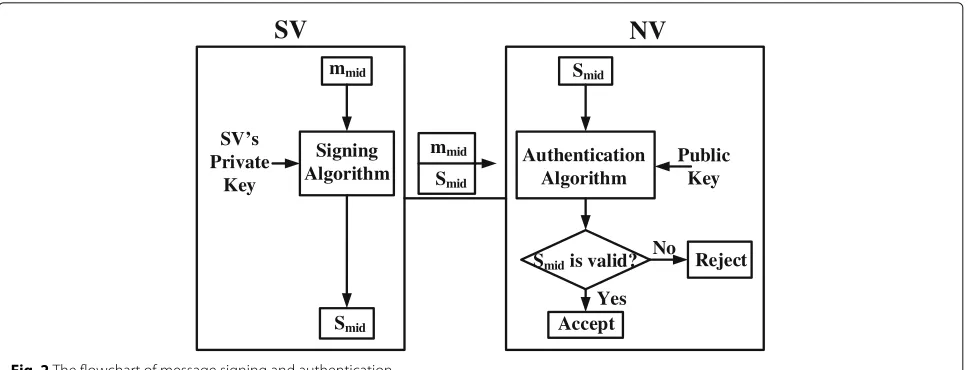
Figure2illustrates message authentication of the pro-posed scheme. Before sending a messagemmid,SVwould sign the message with its private key. The message would then be broadcast withSV’s signatureSmid to other vehi-cles and RSUs inM. Upon receivingmmid,NV and RSUs would use the shared public key to examine the signature to make sure the integrity of the message (i.e., the mes-sage is not altered or tampered with during transmission). A message would be accepted for further applications if it passes authentication, rejected otherwise.
SV
NV
mmid
Signing Algorithm
Smid
SV’s Private
Key
Smid
Authentication Algorithm
Smid is valid?
Public Key
Accept Smid
mmid
No
Yes
Reject
Fig. 2The flowchart of message signing and authentication
with the RSU. The RSU then can notify all the vehicles in Mabout authenticated messages it collects such that vehicles can remove these messages. This is because that they have been proven trusted by some vehicles already and there is no need to verify the message again. As a result, the time that a messagemmid stays inqi (Eq. (1)) would be reduced. The reason is that either there would be less messages before it in the queue or the message mmid itself has been authenticated at some other vehi-cle; in turn, less messages would be dropped due to timer expiration. Specifically, as RSUs are connected via wired links, authenticated messages from different VANETs can also be exchanged. This ensures that vehicles on the bor-der ofMwould not be disadvantaged when exchanging messages with the current RSU.
Note that the RSU needs to authenticate the authenticated messages from cooperating vehicles before broadcasting them to other vehicles. As more vehicles participate in the cooperation scheme, the workload on the RSU rises quickly. Thus, in our scheme, instead of authenticating received messages one by one, the RSU would verify an integrated signature of messages from each participating vehicle so as to improve authentication efficiency.
The proposed EABA scheme consists of seven phases, i.e., system initialization, vehicle registration, key and anonymous identity creation, message signing, mes-sage classification, individual mesmes-sage authentication and batch authentication, and auction-based cooperative authentication. We will describe each phase in detail in the following subsections.
4.2 System initialization
In the first phase of EABA scheme, we let the TA initialize system parameters:
• The TA chooses a large prime numberp and creates a non-singular elliptic curveE on the prime filedFp,
E:y2=x3+ax+b(modp)[36].
• The TA chooses a generating pointP with q order of the groupG. Here, q is a large prime number, G is an additive group that contains all of the points on theE and a point-at-infinityO , and P is used for
generating the public key and private key [36]. • The TA chooses a random numbers∈Z∗qas the
master key of the system and calculates the system public keyPpub=s×Pwhich will be shared by all
the vehicles and RSUs inM.
• The TA chooses tree one-way hash functions: H1:G→Zq,H2:G→Zq,H3:
{0, 1}∗× {0, 1}∗×G× {0, 1}∗→Zq.
During the first phase, the TA will generate parame-ters for message signing and authentication: params =
{p,q,a,b,P,Ppub,H1,H2,H3}, which would be shared with all RSUs and vehicles (these parameters will be loaded into a vehicle when registering).
4.3 Vehicle registration
Every vehicle in the VANETMneeds to register at the TA in order to participate in message exchange. Assume that each vehicle has a TPD installed, and let the TPD serve as a PKG (private key generator) because of its good security performance.
4.4 Key and anonymous identity creation
After registration at the TA, every vehicle will start gener-ating its private key and anonymous identity.
Given RID, the TPD will choose a random number
δi ∈ Z∗q and compute the vehicle’s anonymous identity
AID[29].
AID1=δi×P (2)
AID2=RID⊕H1(δi×Ppub) (3)
The anonymous identity (AID) ofvRIDcan be calculated based on Eqs. (2) and (3), which is expressed as
AID= {AID1,AID2} (4)
We adopt the key generation method in [37]. Let ski denote the private key of vRID. Then, the ski can be computed as:
ski=δi+s×H2(AID) modq (5)
4.5 Message signing
In this phase, we adopt the signature generation method in [37]. A vehiclevRIDsigns a message with
Smid=H3(AIDtmidλibmid)·ri+ski modq (6)
where
λi=ri×P, (7)
andri∈Z∗qis a random number. Then,vRIDwill broadcast the signed messagemmid = {bmid,AID,tmid,λi,Smid}to all vehicles nearby.
4.6 Message classification
We assume that all received messages would be pushed into the message queue. Each queue has a threshold which is relevant to the number of messages. If the number of the messages on the queue is beyond the threshold, we consider that it is beyond the vehicle’s processing capacity, and this phase will be triggered.
Messages sent from closer vehicles deserve more atten-tion as they may impact the current vehicle immedi-ately. For example, in case of accidents, vehicles near the site will be affected right away, while vehicles far away from the site have more time to take actions (e.g., change the route). Inspired by this observation, we can group messages into different categories according the sender-receiver distance and push them into correspond-ing priority queues. We adopt Lloyd’s algorithm for clus-tering. Givennmessages, Lloyd’s algorithm can partition them intokcategories [35]. Assume that the vehiclevRID has a training data set with n received messages’ sig-nal strength, denoted as I = {I1,I2, ...,In}, Ii denotes the signal strength of ith message, (1 ≤ i ≤ n). This
training phase can be performed based on messages received during the last period of time in a dense traffic scenario.
We use Lloyd’s algorithm to classify them intok cate-gories. The objective function is to minimize the mean squared distance from each data point to its nearest cen-ter. It can be denoted as follows [35],
arg min C
k
i=1
I∈Ci
I−wi2 (8)
wherewidenotes the mean value of signal intensity inCi (i.e.,wiis the centroid).
After classification, messages can be authenticated in order of priority, from the highest to the lowest. Note that if received message signal strength Im (1 ≤ m ≤ n) is not within the training set I, we assume that the mes-sage comes from a vehicle far away. This mesmes-sage will be assigned with the lowest priority.
4.7 Individual authentication and batch authentication
In this phase, each vehicle authenticates messages in order of priority independently. Given a received mes-sage mmid = {bmid,AID,tmid,λi,Smid}, a receiver (vehi-cle or RSU) would use system parameters params =
{p,q,a,b,P,Ppub,H1,H2,H3}received during registration, to verify its integrity.
Before authenticating a message, the receiver would examine its expiration timetmidand continue the authen-tication process if it does not expire, otherwise drop the message.
A messagemmidis valid if the following equation holds:
Smid·P=H3(AIDtmidλibmid)·λi+AID1+ H2(AID)·Ppub
(9)
The above equation can authenticatemmidby its signa-tureSmid with authentication parameters obtained from the TA when registered. Using (9), messages that can-not pass authentication will be rejected and the message sender will be reported to the TA.
Furthermore, to speed up message authentication, we adopt a batch authentication method [28] that allows a receiver to authenticate multiple messages simultane-ously. Thus, the total time for a receiver to authenticate all received messages can be significantly reduced.
Givennreceived messages, we extract their signatures Smid =
n
The receiver would accept these messages, if Eq. (10) holds and reject otherwise.
4.8 Auction-based cooperative authentication
In order to ease the heavy burden on the RSU, we intro-duce an auction-based cooperative authentication mech-anism. The cooperative authentication will be triggered once the number of the RSU’s received messages is beyond a thresholdTH. First, the RSU calculates a cost priceCP (CPis the amount that the RSU can afford for the entire authentication service)[38] and then broadcasts a request message to all vehicles inMfor cooperation. Let the set of ID of messages waiting to be authenticated at RSU at time t be LtRSU, LtRSU = {mid}. For the sake of com-munication efficiency, the RSU will only includeLtRSU in the request message instead of the entire message con-tents. Vehicles that have received the request message will decide whether or not to participate in cooperative authentication. Each vehiclevRIDwill cross-check the ID of its authenticated messages and LtRSU to see whether there exists overlap. If there happens to exist messages inLt
RSU authenticated byvRID,vRIDwill calculate a valu-ation priceeRID(eRIDis the vehicle’s valuation of a single message). There are many factors affecting the valuation priceeRIDof a vehicle, such as the resource consuming and privacy exposing. Here, we omit the details of pricing scheme and follow the mainstream work [38,39]. LetLtRID be the set of ID of overlapped messages betweenLtRSUand the messages authenticated byvRID. LetbRID be the bid price of a single message thatvRIDasks for. Thus,vRIDwill participate in auction announcing that it can authenticate messages inLtRIDwith a pricebRIDfor each message. In order to prevent market distortion, we assume that each vehicle uses its true valuation in the auction, i.e.,bRID =
eRID. In addition, we assume that each vehicle can only bid once at an auction. After receiving bids from vehicles, the RSU will select vehicles for cooperation and compute the corresponding payment.
In particular, for each message mid inLtRSU, the RSU sorts received bids in increasing order of bRID if mid ∈
LtRID. The RSU purchases the cooperation service starting with the lowest bid. If the message with the lowest bid has been purchased, the RSU will skip and look for the next lowest bid until the total payment goes overCPor there are no more bids available.
In [40], the critical value α means the lowest bidding value that a bidder can win. Here, the RSU calculates the payments for winners according to the critical value α and the RSU pays α for one of the cooperators. Then, the RSU sends the purchase decision to all participants. Finally, vehicles whose messages are purchased will sign these messages in an integrated signature [33] and send the authentication result to the RSU. The RSU will pay cooperative vehicles after receiving the result.
5 Theoretical analysis
In this section, we analyze the security, privacy, truth-fulness, and individual rationality of our proposed EABA scheme.
5.1 Message authenticity and integrity
In the proposed EABA scheme, the message signing and authentication are based on ECDSA [26], whose security depends on the difficulties of discrete logarithm problem. It has been proven that there does not exist polyno-mial adversary that can forge a valid message and con-vince receivers that a false message is valid [26]. Thus, false messages and tampered messages will be identi-fied by receivers and not be accepted during authenti-cation examining the validity and integrity of messages. Therefore, the message authenticity and integrity can be guaranteed in our proposed EABA scheme.
5.2 Privacy preserving
The EABA scheme can preserve the privacy of message senders. The EABA scheme can protect the identity of message senders from being known by adversaries, while it can also reveal the real identity of vehicles when nec-essary. In the EABA, vehicles sign messages with their anonymous identity so that the real identity can be hidden. Thus, no one can trace a sender’s real identity by analyz-ing its messages due to the anonymous identity except the TA.
The TA holds the master keysand recovers the sender’s true identity by:
RID=AID2⊕H1(δi×Ppub). (11)
δi×Ppub=δi×P×s=AID1×s (12)
As a result, if a malicious user generates false messages deliberately to damage or disturb traffic order, the TA can discover its real identity by using (11) and (12) and make punishment.
5.3 Bid truthfulness
In this subsection, we prove that the proposed EABA scheme obeys bid truthfulness.
Lemma 1The allocation method of EABA is monotonic.
ProofLetr(bRID)be the ranking order of received bids and r bRID be the ranking order of bid bRID. bRID = bRID−σ(σ >0), whereσis a random small value. Obvi-ously,bRID<bRID. We allocate bids in increasing order of bid pricebRID,r bRID
< r(bRID). Thus, ifbRIDis denied by the auctioneer,bRIDmust be also denied by the auction-eer. On the other hand, if vehiclevRIDwins the auction,
vRID must also win the auction. As a result, the auction mechanism in EABA is monotonic.
Theorem 1The EABA is bid-truthful.
ProofIn Lemma1, we have proven that the EABA is monotonic. Since the RSU pays for cooperative vehicles in increasing order, the critical value as a result is the highest bid price that can win the auction.
Therefore, as the EABA both satisfies monotonicity and critical value payment, it is truthful [40].
5.4 Authentication efficiency
In this subsection, we analyze the authentication effi-ciency of the EABA scheme.
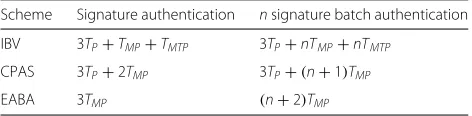
Authentication efficiency is defined as how fast an authentication algorithm runs, and it can be measured by evaluating computation overhead of the authentication algorithm [41]. It is one of the most important perfor-mance indexes, because low authentication efficiency can result in long authentication delay and increase the work-load of vehicles or RSUs. We compare the computation overhead of the EABA with two state-of-the-art works [29–31], IBV and CPAS. The result is shown in Table2. Here, n is the number of signatures,Tp is the time for performing a bilinear pairing operation,TMP is the exe-cution time of a scale multiplication point operation, and TMTP is the execution time of a MapToPoint operation, since the time for performingTporTMTPis typically far greater than that of TMP. Therefore, our EABA scheme works best in terms of authentication efficiency among the abovementioned schemes.
5.5 Computation and communication overhead
In EABA, extra message transmission and cost are intro-duced due to message authentication and exchange. The
Table 2Running time
Scheme Signature authentication nsignature batch authentication IBV 3TP+TMP+TMTP 3TP+nTMP+nTMTP
CPAS 3TP+2TMP 3TP+(n+1)TMP
EABA 3TMP (n+2)TMP
authentication methods used in the EABA including pub-lic key cryptography without certificates and parings, and batch authentication are standard and lightweight [30]. In addition, the majority of authentication computation, such as ID generation and key generation, is done in phase 1, i.e., system initialization by the TA. Thus, we believe that the computation required by the EABA in general is within the RSU and vehicle (OBU)’s capacity.
The communication overhead mainly comes from the message exchange between a RSU and vehicles in auction-based cooperative authentication (Section4.8). Participat-ing vehicles share with RSU their authenticated messages, which later will be sent to all vehicles within RSU’s trans-mission range. To reduce the communication overhead, we let the RSU and vehicles only exchange the id,mid, of authenticated messages rather than the entire message. As a result, the communication efficiency would be greatly improved.
6 Results and discussion
In this section, we validate the performance of our pro-posed EABA scheme in terms of authentication delay through a simulation study.
6.1 Simulation setup
We simulate a VANET that consists ofnvehicles, a RSU, and a TA. Each vehicle is equipped with an OBU that broadcasts messages every 100 ms based on the DSRC protocol [2]. Following the mainstream work [3,42], we set the received messages’ signal strength in our simu-lation between−80 and−55 dBm. Every message sent in our VANET includes a timer, and messages will be dropped if timer expires. In the simulation, we let the expiration time be 5 s, the transmission range of each vehi-cle be 350 m, and the transmission radius of the RSU be 1000 m.
Define vehicle density as the average number of vehicles within a receiver’s (vehicle or RSU) communication range. Intuitively, the higher the density, the more the vehicles nearby. This represents the vehicle will receive more mes-sages. In our simulation, we vary the vehicle density of vehicles between 0 and 300 and the vehicle density of the RSU between 0 and 1000. Also, we define the message loss rate as the fraction of the total received messages that are dropped by the receiver.
Simulations in this section are conducted using MAT-LAB over Windows 7, dual core with 4 G memory. Note that results are average of 50 runs.
6.2 Discussion of vehicle’s message loss rate
0 50 100 150 200 250 300 0
10 20 30 40 50 60 70 80
Number of Vehicles
Message Loss Rate of Vehicle (%)
IBV CPAS EABA
Fig. 3The message loss rate of vehicle
the number of vehicles increases, for each vehicle, it will receive more messages, in turn increasing the waiting time for a message to be authenticated. As a result, more mes-sages will be dropped due to expiration. In addition, we can find that the proposed EABA scheme achieves less message loss than the other two state-of-the-art message authentication methods. This is because the time spent for message authentication in the EABA is less than that for the others.
Next, we evaluate the performance of our EABA scheme under the dense traffic scenario. As mentioned in Section4, in case of burst traffic/messages, the message classification will be triggered in order to authenticate messages more efficiently. In our simulation, we set the threshold of classification to be 224. This means that if a vehicle has more than 224 messages in its queue, the classification will be triggered. Figure4reports the result of message classification when the traffic density is set to be 250. In Fig. 4, every point represents a received message, and different colors represent different mes-sage categories. Mesmes-sages in different categories will be dispatched into different priority queues as described in Section4. We divide messages into five categories. This is because if the number of categories is too small (e.g., 2), there will be a lot of important messages dispatched into low priority at higher risk of being lost. Considering the vehicle’s communication range and vehicle’s distribution in the VANET, we set the range of the number of cate-gories from 3 to 6 (We have tested 3, 4, and 6 catecate-gories too. The results are similar).
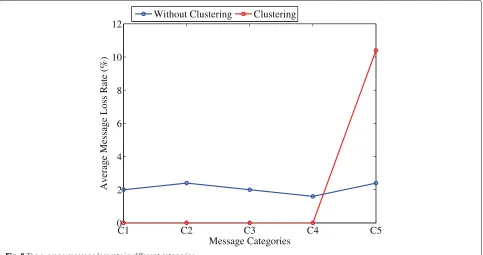
Figure5displays the message loss rate with and without message classification when the vehicle density is 250. In particular,C1,C2,. . .,C5 represent five categories, where messages are clustered based on the signal strength (C1 is centered at−62 dB,C2 is centered at−74 dB, and so on). The centroid value is calculated by Lloyd’s algorithm, and all received messages are directed to corresponding categories. Inspired by the observation that messages sent from closer vehicles deserve more attention as they may impact the current vehicle immediately, we believe mes-sages in C1 are more important than other categories. Thus,C1 should be processed with higher priority. Simi-larly,C2 should be processed beforeC3,C4, andC5 as it contains more important messages. In Fig.5, with classifi-cation, we can see that the loss rate of important messages (C1,C2,C3) is largely reduced, close to zero, compared to that without classification. This is because messages with higher priority are authenticated preferentially, while messages with lower priority will be authenticated lastly. Thus, we can protect the important message from being lost with message classification.
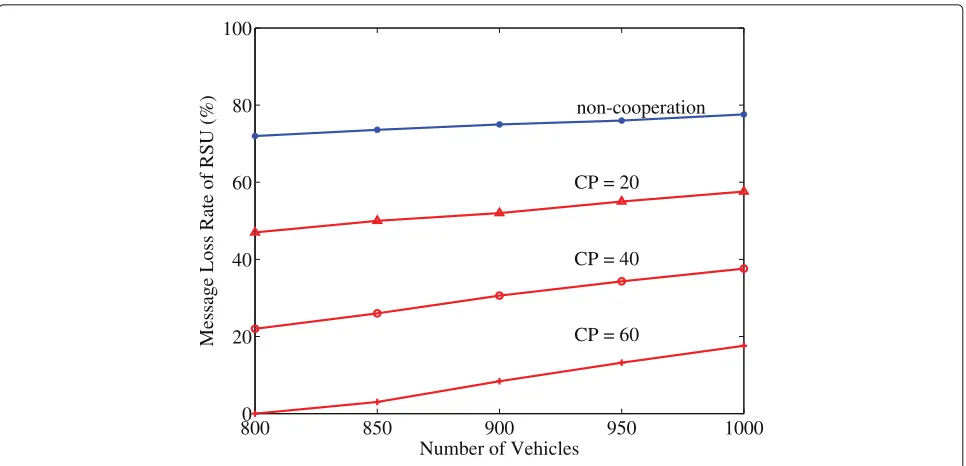
6.3 Discussion of RSU’s message loss rate
0 100 200 300 400 500 -95
-90 -85 -80 -75 -70 -65 -60 -55 -50
Sender-Receiver Distance (m)
Strength of Received Signal(dBm)
center
Fig. 4Message classification
traffic, messages cannot be authenticated timely when the number of received messages is large. Thus, the non-cooperation may result in a large loss rate. In addition, the message loss rate of the RSU is reduced as the coopera-tion authenticacoopera-tion is introduced and decreases as theCP increases. This is because asCPrises, the RSU pays higher. It can purchase more cooperative authentication service and more authenticated messages from cooperative vehi-cles. Therefore, there will be less messages for the RSU to
authenticate. From the above simulations, we can see that our proposed EABA scheme can largely reduce the mas-sage loss rate of both vehicles and RSUs. And it is suitable for VANETs.
6.4 Discussion for the future work
The cooperative authentication may increase the risk of privacy exposure. The reason is that malicious nodes can detect vehicles’ presence and track their locations
C1 C2 C3 C4 C5
0 2 4 6 8 10 12
Message Categories
Average Message Loss Rate (%)
Without Clustering Clustering
8000 850 900 950 1000 20
40 60 80 100
non-cooperation
CP = 20
CP = 40
CP = 60
Number of Vehicles
Message Loss Rate of RSU (%)
Fig. 6The message loss rate of a RSU
by monitoring message flow when vehicles communicate with each other over a public wireless channel. We will target these security concerns in our future work.
In addition, we only employ numerical analysis to evalu-ate the proposed scheme in this paper. An actual VANET system may have many complicated scenarios such as straight roads, corners, intersections, and communication blind spots. How to achieve cooperative authentication for such multi-scenario system is also the main work in the future.
7 Conclusion
In this paper, we propose an EABA scheme based on pri-ority and cooperation for VANETs. In order to improve authentication efficiency, the function of batch authen-tication of multiple messages is included in our EABA scheme. In addition, messages sent from nearby vehicles can be given high priority, such that vehicles can authen-ticate all received messages in priority and the loss rate of important messages can be largely reduced. With the pro-posed cooperation and auction mechanism, the EABA is able to lighten the burden of RSUs. We analytically prove that the EABA not only satisfies the security and pri-vacy requirements of VANETs, but also can guarantee bid truthfulness. Through abundant simulation analysis, we demonstrate that our EABA scheme has low computation complexity on message clustering and message authenti-cation. The authentication delay can be largely reduced, and the message loss rate can be also reduced at the same time.
Abbreviations
CRL: Certificate revocation list; DSRC: Dedicated short-range communication; EABA: Efficient anonymous batch authentication; ECDSA: Elliptic curve digital signature algorithm; IBV: Identity-based batch verification; ITS: Intelligent transportation systems; MLPQ: Multi-level priority queue; OBU: Onboard unit; PKI: Public key infrastructure; RSUs: Roadside units; TA: Trusted authority; TPD: Tamper-proof device; V2V: Vehicle-to-vehicle; V2R: Vehicle-to-roadside; VANETs: Vehicular ad hoc networks; WAVE: Wireless access in vehicular environment
Acknowledgements Not applicable.
Funding
This work was financially supported by NSFC 61571010 and 61471028 and the Fundamental Research Funds for the Central Universities 2017JBM004 and 2016JBZ003.
Availability of data and materials
Data sharing is not applicable to this article as no datasets were generated or analyzed during the current study.
Authors’ contributions
The authors have contributed jointly to the manuscript. All authors have read and approved the final manuscript.
Competing interests
The authors declare that they have no competing interests.
Publisher’s Note
Springer Nature remains neutral with regard to jurisdictional claims in published maps and institutional affiliations.
Author details
1School of Electronics and Information Engineering, Beijing Jiaotong
University, Shangyuancun, Beijing 100044, China.2Department of Computer Science, Marist College, Poughkeepsie, New York 12601, USA.3School of Big
Received: 24 November 2017 Accepted: 12 November 2018
References
1. K. Zheng, Q. Zheng, P. Chatzimisios, W. Xiang, Y. Zhou, Heterogeneous vehicular networking: a survey on architecture, challenges, and solutions. IEEE Commun. Surv. Tutor.17(4), 2377–2396 (2015)
2. J. B. Kenney, Dedicated short-range communications (DSRC) standards in the United States. Proc. IEEE.99(7), 1162–1182 (2011)
3. D. Jiang, V. Taliwal, A. Meier, W. Holfelder, R. Herrtwich, Design of 5.9 GHz DSRC-based vehicular safety communication. IEEE Wirel. Commun.13(5), 36–43 (2006)
4. J. Qian, T. Jing, Y. Huo, H. Li, Z. Li, Energy-efficient data dissemination strategy for roadside infrastructure in VCPS. EURASIP Wirel, J., Commun. Netw.2016(1), 148 (2016).https://doi.org/10.1186/s13638-016-0650-0 5. Y. Liu, X. Weng, J. Wan, X. Yue, H. Song, A. V. Vasilakos, Exploring data
validity in transportation systems for smart cities. IEEE Commun. Mag. 55(5), 26–33 (2017)
6. C. Chen, T. H. Luan, X. Guan, N. Lu, Y. Liu, Connected vehicular
transportation: data analytics and traffic-dependent networking. IEEE Veh. Technol. Mag.12(3), 42–54 (2017)
7. Y. Lu, Z. Zhao, B. Zhang, L. Ma, Y. Huo, G. Jing, A context-aware budget-constrained targeted advertising system for vehicular networks. IEEE Access.6, 8704–8713 (2018)
8. J. Qiao, Y. He, X. S. Shen, Improving video streaming quality in 5G enabled vehicular networks. IEEE Wirel. Commun.25(2), 133–139 (2018) 9. M. A. Elsadig, Y. A. Fadlalla, VANETs security issues and challenges: a
survey. Indian Sci. J. Technol.9(28), 1–8 (2016)
10. A. Boualouache, S. M. Senouci, S. Moussaoui, A survey on pseudonym changing strategies for vehicular ad-hoc networks. IEEE Commun. Surv. Tutor.20(1), 770–790 (2018)
11. H. Li, R. Lu, J. Misic, M. Mahmoud, Security and privacy of connected vehicular cloud computing. IEEE Netw.32(3), 4–6 (2018)
12. J. M. Moualeu, W. Hamouda, F. Takawira, Intercept probability analysis of wireless networks in the presence of eavesdropping attack with co-channel interference. IEEE Access.6, 41490–41503 (2018).https://doi. org/10.1109/ACCESS.2018.2854222
13. Y. Jia, Y. Chen, X. Dong, P. Saxena, J. Mao, Z. Liang, Man-in-the-browser-cache: persisting HTTPS attacks via browser cache poisoning. Comput. Secur.55, 62–80 (2015).https://doi.org/10.1016/j.cose.2015.07.004 14. Y. Huo, C. Hu, X. Qi, T. Jing, Lodpd: A location difference-based proximity
detection protocol for fog computing. IEEE Internet Things J.4(5), 1117–1124 (2017)
15. J. Mao, Y. Zhang, P. Li, T. Li, Q. Wu, J. Liu, A position-aware Merkle tree for dynamic cloud data integrity verification. Soft. Comput.21(8), 2151–2164 (2017).https://doi.org/10.1007/s00500-015-1918-8
16. M. Wang, J. Liu, J. Mao, H. Cheng, J. Chen, C. Qi, Routeguardian: constructing secure routing paths in software-defined networking. Tsinghua Sci. Technol.22(4), 400–412 (2017).https://doi.org/10.23919/ TST.2017.7986943
17. F. Qu, Z. Wu, F. Y. Wang, W. Cho, A security and privacy review of VANETs. IEEE Trans. Intell. Transp. Syst.16(6), 2985–2996 (2015)
18. M. Azees, P. Vijayakumar, L. J. Deboarh, EAAP: efficient anonymous authentication with conditional privacy-preserving scheme for vehicular ad hoc networks. IEEE Trans. Intell. Transp. Syst.18(9), 2467–2476 (2017) 19. M. R. Asaar, M. Salmasizadeh, W. Susilo, A. Majidi, A secure and efficient
authentication technique for vehicular ad-hoc networks. IEEE Trans. Veh. Technol.67(6), 5409–5423 (2018)
20. Z. Li, C. Chigan, inCommunications (ICC), 2010 IEEE International Conference On. On resource-aware message verification in VANETs, (2010), pp. 1–6.https://doi.org/10.1109/ICC.2010.5502129
21. M. U. Tariq, J. Florence, M. Wolf, Improving the safety and security of wide-area cyber-physical systems through a resource-aware, service-oriented development methodology. Proc. IEEE.106(1), 144–159 (2018) 22. A. Wasef, X. Shen, EMAP: Expedite message authentication protocol for
vehicular ad hoc networks. IEEE Trans. Mob. Comput.12(1), 78–89 (2013) 23. E. B. Hamida, M. A. Javed, in2016 IEEE 30th International Conference on
Advanced Information Networking and Applications (AINA). Channel-aware ECDSA signature verification of basic safety messages with k-means clustering in VANETs (IEEE, Crans-Montana, 2016), pp. 603–610
24. J.-L. Huang, L.-Y. Yeh, H.-Y. Chien, ABAKA: an anonymous batch authenticated and key agreement scheme for value-added services in vehicular ad hoc networks. IEEE Trans. Veh. Technol.60(1), 248–262 (2011) 25. M. Raya, J.-P. Hubaux, Securing vehicular ad hoc networks. Comput, J.,
Secur.15(1), 39–68 (2007)
26. S. Lamba, M. Sharma, inMachine Intelligence and Research Advancement (ICMIRA), 2013 International Conference On. An efficient elliptic curve digital signature algorithm (ECDSA) (IEEE, Katra, 2013), pp. 179–183 27. R. Lu, X. Lin, H. Zhu, P. H. Ho, X. Shen, inINFOCOM 2008. The 27th
Conference on Computer Communications. ECPP: efficient conditional privacy preservation protocol for secure vehicular communications (IEEE, Phoenix, 2008).https://doi.org/10.1109/INFOCOM.2008.179
28. C. Zhang, R. Lu, X. Lin, P. H. Ho, X. Shen, inINFOCOM 2008. The 27th Conference on Computer Communications. An efficient identity-based batch verification scheme for vehicular sensor networks (IEEE, Phoenix, 2008).https://doi.org/10.1109/INFOCOM.2008.58
29. D. He, S. Zeadally, B. Xu, X. Huang, An efficient identity-based conditional privacy-preserving authentication scheme for vehicular ad hoc networks. IEEE Trans. Inf. Forensic Secur.10(12), 2681–2691 (2015)
30. N. W. Lo, J. L. Tsai, An efficient conditional privacy-preserving authentication scheme for vehicular sensor networks without pairings. IEEE Trans. Intell. Transp. Syst.17(5), 1319–1328 (2016)
31. K. A. Shim, cal CPAS: an efficient conditional privacy-preserving authentication scheme for vehicular sensor networks. IEEE Trans. Veh. Technol.61(4), 1874–1883 (2012)
32. H. Zhu, T. Liu, G. Wei, H. Li, PPAS: privacy protection authentication scheme for VANET. Clust. Comput.16(4), 873–886 (2013)
33. X. Lin, X. Li, Achieving efficient cooperative message authentication in vehicular ad hoc networks. IEEE Trans. Veh. Technol.62(7), 3339–3348 (2013).https://doi.org/10.1109/TVT.2013.2257188
34. Y. Hao, T. Han, Y. Cheng, inGlobal Communications Conference (GLOBECOM), 2012 IEEE. A cooperative message authentication protocol in VANETs, (2012), pp. 5562–5566.https://doi.org/10.1109/GLOCOM.2012. 6504006
35. S. Lloyd, Least squares quantization in PCM. IEEE Trans. Inf. Theory.28(2), 129–137 (1982)
36. S. Lamba, M. Sharma, inMachine Intelligence and Research Advancement (ICMIRA), 2013 International Conference On. An efficient elliptic curve digital signature algorithm (ECDSA), (2013), pp. 179–183.https://doi.org/ 10.1109/ICMIRA.2013.41
37. C.-P. Schnorr, Efficient signature generation by smart cards. Cryptol, J. 4(3), 161–174 (1991)
38. L. Licai, Y. Lihua, G. Yunchuan, F. Bingxing, inTrust, Security and Privacy in Computing and Communications (TrustCom), 2014 IEEE 13th International Conference On. Bargaining-based dynamic decision for cooperative authentication in MANETs (IEEE, Beijing, 2014), pp. 212–220
39. G. Yunchuan, Y. Lihua, L. Licai, F. Binxing, inINFOCOM, 2014 Proceedings IEEE. Utility-based cooperative decision in cooperative authentication (IEEE, 2014), pp. 1006–1014
40. T. Jing, F. Zhang, L. Ma, W. Li, X. Chen, Y. Huo, TORA: a truthful online reverse auction scheme for access permission transaction in
macro-femtocell networks. Adhoc Sensor Wirel. Netw.28, 347–362 (2015) 41. A. Studer, F. Bai, B. Bellur, A. Perrig, Flexible, extensible, and efficient
VANET authentication. Commun. J. Netw.11(6), 574–588 (2009) 42. M. Boban, W. Viriyasitavat, O. Tonguz, inACM International Workshop on