Applicability of prompt gamma-ray analysis to the initial analysis of the
extraterrestrial materials for chemical composition
Mitsuru Ebihara and Yoshiji Oura
Department of Chemistry, Graduate School of Science, Tokyo Metropolitan University, Hachioji, Tokyo 192-0397, Japan
(Received January 9, 2001; Revised August 31, 2001; Accepted September 7, 2001)
When extraterrestrial materials are returned to the earth by future space missions, these materials are to be sub-jected to the initial examination. For such purposes, measurements are desired to be done non-destructively. In this study, we investigated the applicability of non-destructive prompt gamma-ray analysis (PGA) for determin-ing chemical composition of the returned materials, focusdetermin-ing on levels of induced radioactivities and the effect on isotopic composition by PGA. Under current conditions applied for the PGA facility at the Japan Atomic Energy Research Institute, essentially no residual radioactivities remain after appropriate cooling, making the same spec-imen analyzed by PGA usable for further research without any restriction. The effect on isotopic composition by PGA was examined both for neutron-induced reactions and for neutron-induced nuclear fission of235U. No signif-icant effect can be brought by neutron-induced reactions even for some noble gas nuclides such as80Kr and128I, which can be augmented by (n, γ) reactions on neighboring halogens. Neutron-induced nuclear fission reactions of 235U yield essentially no effect on isotopic composition. In addition, PGA has several advantages over other
non-destructive analytical methods such as instrumental neutron activation analysis (INAA) and synchrotron radiation x-ray fluorescence (SR-XRF); INAA leaves a significant level of induced-radioactivities and SR-XRF yields less reliable and less accurate values for elemental composition. Judging from these features and characteristics, it is concluded that PGA can be one of the most suitable analytical methods potentially applicable for initial analysis of returned samples from space.
1.
Introduction
Through the space mission in 21st century, we will be able to obtain a wide variety of extraterrestrial materials for laboratory studies. The elemental composition can be cru-cial to characterize these materials. When the extraterres-trial materials returned from the space are to be analyzed for their chemical compositions, the following requirements are desired to be fulfilled for analytical methods; (i) high sensitivity, (ii) high accuracy and (iii) non-destructivity for as many elements as possible. In recent years inductively coupled mass spectrometry (ICP-MS) techniques have been increasingly applied in analyzing geochemical samples be-cause of their high sensitivity and rapidness (Lipschutzet al., 2001). They have also become gradually popular in cos-mochemistry (e.g., Shinotsuka and Ebihara, 1997). These techniques, however, are destructive and, hence, are not ap-propriate for the initial examination of extraterrestrial mate-rials returned from space.
Nuclear analytical methods such as neutron activation analysis (hereafter, NAA) and photon activation analysis (hereafter, PAA) can meet some or all of the above require-ments. Instrumental NAA (INAA) (e.g., Konget al., 1996) and instrumental PAA (IPAA) (Ebiharaet al., 2000) are ba-sically non-destructive methods and have high sensitivity for many elements. There is, however, a serious disadvantage
Copy right c The Society of Geomagnetism and Earth, Planetary and Space Sciences (SGEPSS); The Seismological Society of Japan; The Volcanological Society of Japan; The Geodetic Society of Japan; The Japanese Society for Planetary Sciences.
for these nuclear methods. As samples are irradiated with reactor neutrons for INAA or high energy photons produced by an accelerator for IPAA, radioactivity induced in these materials becomes fairly high and prevents the irradiated samples from being subjected for other researches such as petrographic and mineralogical examinations.
Neutron-induced prompt gamma-ray analysis (hereafter, PGA) is broadly grouped into NAA but has fairly differ-ent characteristics in many aspects. In convdiffer-entional NAA like INAA, gamma-rays (called decay gamma-rays) emitted with transition from excited levels to lower energy levels of decayed nuclidesare measured for most cases while gamma-rays emitted by neutron-capturing nuclides are measures in PGA. These gamma-rays named prompt gamma-rays or capture gamma-rays are emitted instantaneously (within 10−14 s) upon capturing of neutrons. In INAA, samples are irradiated in an irradiation tube installed inside the reactor core and, hence, the sample size has a strict limitation. The neutron flux in INAA is rather high, generally in a range of 1012 to 1014cm−2s−1. In PGA, neutrons are guided out of the reactor thorough guide tubes to the beam hall commonly adjacent to the reactor room, which allows large samples to be analyzed (Nakahara et al., 2000). The neutron flux in PGA is considerably low compared with that of INAA, be-ing in 107 to 108 cm−2 s−1 for most cases. Therefore, the induced radioactivity is thought to be low enough for sam-ples to be reused for further investigations. In spite of low neutron flux or fluence in PGA, not a few elements including
Table 1. Induced radioactivity (inBq) for 1 mg of some elements by PGA∗.
Target neutron cross section Produced Half life Induced activity (Bq/mg)
nuclide (10−24cm2) nuclide at the end of irradiation
thermal neu. cold neu. thermal neu. cold neu.
23Na 0.68 1.5 24Na 15 h 19 250
27Al 0.30 0.66 28Al 2.3 min 160 2100
45Sc 45 99 46Sc 84 d 5.0 65
50Cr 21 45 51Cr 27 d 0.27 3.5
58Fe 1.5 3.2 59Fe 45 d 0.00068 0.0088
59Co 48 110 60Co 5.3 y 0.18 2.3
151Eu 520 1100 152Eu 13 y 0.14 1.8
191Ir 1200 2600 192Ir 74 d 13 170
∗Under the following conditions: Irradiation time = 1 h; Thermal neutron flux = 2.4×107 cm−2 s−1; Cold neutron
flux=1.4×108cm−2s−1; Mean energy of thermal neutron=15 meV; Mean energy of cold neutron=3.0 meV.
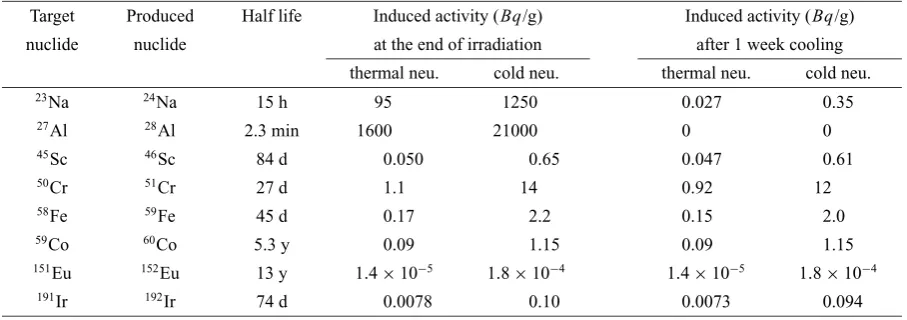
Table 2. Induced radioactivity (inBq) in 1 g of chondritic meteorite by PGA∗.
Target Produced Half life Induced activity (Bq/g) Induced activity (Bq/g)
nuclide nuclide at the end of irradiation after 1 week cooling
thermal neu. cold neu. thermal neu. cold neu.
23Na 24Na 15 h 95 1250 0.027 0.35
27Al 28Al 2.3 min 1600 21000 0 0
45Sc 46Sc 84 d 0.050 0.65 0.047 0.61
50Cr 51Cr 27 d 1.1 14 0.92 12
58Fe 59Fe 45 d 0.17 2.2 0.15 2.0
59Co 60Co 5.3 y 0.09 1.15 0.09 1.15
151Eu 152Eu 13 y 1.4×10⁻⁵ 1.8×10⁻⁴ 1.4×10⁻⁵ 1.8×10⁻⁴
191Ir 192Ir 74 d 0.0078 0.10 0.0073 0.094
∗Under the same conditions as those for Table 1. CI chondrite composition (Anders and Grevesse, 1989) was used.
most major elements (H, B, Na, Mg, Al, Si, S, Cl, Ca, Ti, Mn, Fe, Co, Ni) can be non-destructively determined (Latif et al., 1999; Latifet al., in preparation).
Since PGA is non-destructive and multi-elemental anal-ysis method, it can be one of the most promising methods applicable for the initial analysis of returned samples by fu-ture space missions. Although neutron flux in PGA is much lower than that in INAA, one must be highly concerned with the residual radioactivity after analysis. Another concern is a possible alteration of isotopic composition resulting from neutron capture and neutron fission reactions in PGA. In this study, we aimed to estimate the level of induced radioactivi-ties and effect on isotopic composition in PGA, and evaluate how promisingly PGA can be applied to the initial analysis of the extraterrestrial materials including returned samples by future space missions.
2.
Induced Radioactivity by PGA
The level of induced radioactivity is the most serious con-cern after samples are subjected to PGA. Table 1 shows the calculation result of induced radioactivity for several se-lected elements. In this table, the radioactivity at the end of
irradiation was calculated for 1 mg of each element. Ele-ments chosen in Table 1 are representative eleEle-ments which are easily determined in INAA because of high sensitivity and/or high abundance. Induced radioactivity is calculated as follows;
A=φσN(1−e−λt) (1)
10
00
500
1000
1500
2000
2500
3000
3500
4000
RI0256.CHN
irradiated for 11465 sec by thermal neutrons
cooling time = 50 days collection time = 194438 sec
Fig. 1. Gamma-ray spectrum of the Allende meteorite. The specimen (48.5 g in a lump) was irradiated for 11465 sec with guided beam of thermal neutrons (flux: 2.4×107cm−2s−1) at the PGA facility of JRR-3M reactor, JAERI. Measurement was performed for about 2.5 days after 50 days cooling with 10
cm of Pb shielding. There appeared several gamma-ray peaks in the spectrum. Many small peaks with no assignment of radionuclides are due to natural radioactivity. Remaining radioactivities induced by PGA are low enough for the specimen to be used for other researches without any legal regulation. 1 channel corresponds to 0.5 keV.
end of irradiation. This is because28Al has the shortest half life among them.
For more practical comparison, induced radioactivities of the same suite of nuclides as listed in Table 1 are compared for amounts of elements contained in 1 g of chondrite in Table 2. CI chondritic abundances (Anders and Grevesse, 1989) are used as typical composition of chondrite. Induced radioactivities both at the end of irradiation and after 1 week cooling are compared. Irradiation conditions (irradiation time, neutron flux, peak neutron energy) are the same as those for Table 1. Table 2 shows that only two nuclides,24Na and28Al, are produced with more than 1000 Bq for cold neutron at the end of irradiation. After one week cooling, these nuclides mostly decay and 51Cr becomes the most active instead. Nevertheless, the activity of51Cr after 1 week cooling is much lower than those of24Na and28Al at the end of irradiation. Figure 1 shows a gamma-ray spectrum for a large sample (48.5 g) of Allende meteorite measured after 50 days cooling (Latifet al., in preparation). Radionuclides which show prominent peaks are indicated in the figure.
As recognized in Table 2 and Fig. 1, radioactivities in-duced by PGA remain insignificant even at the end of irradi-ation and become mostly negligibly small for g-size sample of chondrite if the sample is cooled for an appropriate inter-val (say, 1 week). This is in sharp contrast with the case for
conventional INAA. Once samples are irradiated by neutron for INAA, these samples suffer a strict control for their fur-ther use. The samples used for INAA or IPAA cannot be reused for other researches in a regular laboratory from the legal point of view at least in Japan and may only be used for further irradiation for radiochemical NAA study for in-stance. PGA, however, does not place such a legal restric-tion.
3.
Effect on Isotopic Composition Induced by PGA
3.1 Neutron capture reactions for nuclides having largeneutron cross section
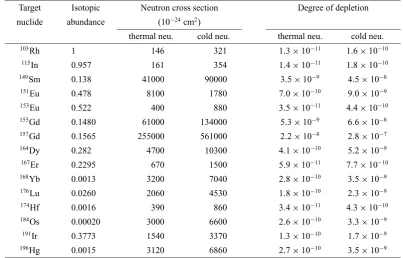
In addition to the induced radioactivity, effect on isotopic composition also has to be considered when nuclear reac-tions are involved in analyses. Especially for neutron cap-ture reactions, effect on nuclides having enormously large cross sections may not be able to be ignored. Table 3 sum-marizes the degree of depletion caused by neutron capture reactions for several nuclides having large cross sections for thermal neutrons. The degree of depletion(= f)is defined as follows;
f =Nφσt/N =φσt (2)
irradia-Table 3. Effect on isotopic composition by neutron-induced reaction by PGA∗.
Target Isotopic Neutron cross section Degree of depletion
nuclide abundance (10−24cm2)
thermal neu. cold neu. thermal neu. cold neu.
103Rh 1 146 321 1.3×10⁻¹¹ 1.6×10⁻¹⁰
∗Under the same condition as those for Table 1.
tion, respectively. Irradiation conditions are assumed to be the same as those for Tables 1 and 2. Some REE nuclides such as155Gd and157Gd have anomalously large values of cross section for neutron capture reactions. Even for these nuclides, however, the degree of depletion induced by neu-tron capture in PGA is smaller than 10−6(0.01), which is too small to be detected by mass spectrometry.
Neutron capture reactions also yield enrichment of corre-sponding nuclides in accordance with depletion of target nu-clides. Here, corresponding nuclides mean neutron-captured nuclides if they are stable, or decayed nuclides if neutron capture nuclides are radioactive. Neutron capture effects leading to both depletion of target nuclides and enrichment of corresponding nuclides are detected for Sm and Gd in lu-nar surface rocks (Hidakaet al., 2000a) and meteorite sam-ples (Hidakaet al., 1999, 2000b). According to these stud-ies, thermal neutron fluence (total neutron flux; φt in for-mula (1)) larger than 1015is necessary for capture effects to be positively detected by thermal ionization of mass spec-trometry. One hour irradiation of cold neutrons at the PGA facility of JRR-3M yields a neutron fluence of 5×10¹¹s−1. Even if a sensitivity is increased by a factor of 2.2 for cold neutrons, there still remain a difference of an order of 3 or more.
3.2 Neutron capture reactions for nuclides producing noble gases
Noble gas abundances in meteorites are generally very low compared with abundances of neighboring elements mainly because of their high volatility. Therefore, if neutron-captured nuclides decay to noble gases, their contri-butions may become relatively more significant than those considered in Table 3. Table 4(a) summarizes the produc-tion rate of some noble gas nuclides contributed by
neu-tron capture (n, γ) reactions on corresponding halogens in PGA. Because of large neutron cross sections of81Br and 127I,82Kr and128Xe are effectively produced compared with
other noble gas nuclides concerned. Combining values in Table 4(a) with halogen and noble gas element contents in meteorites, contributions to noble gases by neutron capture reactions on halogens are estimated for four different types of chondrites in Table 4(b). Although, like noble gas ele-ments, halogens are cosmochemically grouped into volatile elements, their contributions to noble gases are variable; the contribution of F to20Ne is the least significant, which is followed by that of Cl to38Ar. The largest augmentation is found for80Kr by a reaction of79Br(n, γ ). For L chondrites represented by Bruderheim (L6), Kr is relatively depleted compared with Br, which yields 0.05% enrichment of80Kr after 1 h irradiation of cold neutron at a flux of 1.4×108 cm−2 s−1 (fluence: 5.0 ×1011 cm−2). Considering that 80Kr/84Kr ratios are measured with an error of 1–2% (2σ)
for chondritic meteorites samples, an enrichment of 0.05% is much smaller that the detection limit. This contribution seems to become even smaller for unequilibrated ordinary chondrites and carbonaceous chondrites, which have higher abundances of Kr relative to Br than equilibrated ordinary chondrites like Bruderheim. Thus, it is concluded that no detectable effect is cause in isotopic abundances of noble gas elements by PGA. However, a careful examination may be taken place for the study of isotopic composition of noble gases (especially Kr and Xe) when samples once irradiated with neutron are to be used.
3.3 Neutron-induced fission reactions of235U
fragments are decayed. Generally, crustal rocks are enriched in large-ion lithophile (LIL) elements such as REE, Th and U compared with chondritic meteorites. The number of fission fragments from235U (= n
f) can be calculated as
follows;
nf =Nφσt×2 (3)
whereN is the number of235U nuclide,φis neutron flux,σ is cross section for fission cross section by neutron (585× 10−24cm2for thermal neutron) andtis irradiation time.
Let us consider the degree of alteration of isotopic compo-sition caused by neutron-induced nuclear fission of235U for crustal rocks. Here, we assume that 1 g of terrestrial basalt with 1 ppm U is irradiated at the PGA facility of JRR-3M. If this sample is irradiated by thermal neutrons for 1 hour at a flux of 2.4×107cm−2s−1, the number of fission fragments is calculated to be 1800. This number is increased to 23000 for cold neutrons with a flux of 1.4×108 cm−2 s−1. The largest fission yield for 235U by thermal neutron is 7.87% for134Xe. Even with this yield, numbers of fissiogenic134Xe nuclide are 142 and 1810 for thermal neutrons and cold neu-trons, respectively, under the assumed conditions.
For the case of chondritic meteorites, these numbers are decreased considerably, because U contents in chondrites are 2 orders of magnitude lower than those in terrestrial basalts. If the U content is assumed to be 10 ppb for chon-drites, all numbers shown above are decreased by a factor of 100; numbers of 134Xe nuclide added as fission fragments in 1 g of chondrites are 1.42 and 18.1 for thermal neutrons and cold neutrons, respectively. Xe content in Allende me-teorite is 5.6×10⁻¹⁰ ccSTP/g or 1.5 ×10¹⁰ atoms/g. If an isotopic abundance of134Xe (0.104) is considered, these values fall off down to 5.8×10⁻⁹ ccSTP/g and 1.6×10⁹ nuclides/g. It is definitely impossible to detect an addition of 18 to 1.6×10⁹ 134Xe nuclides by mass spectrometry of Xe. As Xe is the most depleted element (in ppt) in chondrites among a group of elements whose fission yields from235U by thermal neutron are larger than 1%, an effect on isotopic composition by neutron-induced fission from235U in PGA is essentially negligible.
4.
Conclusion
Assuming that the extraterrestrial materials are returned to the earth by future space missions, we have investigated the applicability of PGA for determining chemical compo-sition of the returned materials. We have examined the level of induced radioactivities and the effect on isotopic compo-sition by PGA under the practical conditions applied for the current PGA facility at the Japan Atomic Energy Research Institute and obtained the following conclusions;
1. Only24Na and28Al are produced to a significant level for 1 g of chondrite at the end of irradiation. After one week cooling, these nuclides mostly decay. Instead, 51Cr becomes relatively the most active, but its level is compara-ble to those of natural radioactivities such as40K and some daughter nuclides of235U in chondritic meteorites. Thus, no residual radioactivities remain after appropriate cooling, making the same specimen analyzed by PGA usable for fur-ther researches without any restriction from practical as well as legal points of view.
2. The effect on isotopic composition by PGA was ex-amined both for induced reactions and for neutron-induced nuclear fissions from 235U. No significant effect can be brought by neutron-induced reactions even for nu-clides having anomalously large values of neutron capture cross section such as155Gd and157Gd.
3. Some noble gas nuclides can be potentially contributed by (n, γ) reactions on neighboring halogens. Among them, 80Kr and128Xe are augmented most largely by neutron
irra-diation in PGA, but their amounts are much lower than their analytical uncertainties in noble gas spectrometry. There-fore, no detectable effects are caused on isotopic abundances of noble gases by PGA.
4. Neutron-induced nuclear fission reactions by 235U yield essentially no effect on isotopic composition in chon-drite samples. This must be also the case for terrestrial igneous rocks, which have relatively high abundance of U compared with chondritic meteorites.
5. In addition to the above features, PGA has several advantages over instrumental neutron activation analysis (INAA) and synchrotron radiation x-ray fluorescence (SR-XRF); INAA leaves a significant level of induced-radioac-tivities and SR-XRF yields less reliable and less accurate values for elemental composition. Judging from these fea-tures and characteristics, it is concluded that PGA can be one of the most suitable analytical methods potentially ap-plicable for initial analysis of returned samples from space.
Acknowledgments. We are indebted to the reactor committee of the University of Tokyo for cooperative use of the JAERI facility including the PGA facility of JRR-3M. Careful reviews by N. Nakamura and M. E. Lipschutz are acknowledged. This paper was presented at the WPGM meeting held in Tokyo in June, 2000. We are thankful for the session conveners for inviting us to present the paper. This work is supported in part by a Grant-in-Aid of the Ministry of Education, Science and Culture (No. 11440167 to ME).
References
Anders, E. and N. Grevesse, Abundances of the elements: Meteoritic and Solar,Geochim. Cosmochim. Acta,53, 197–214, 1989.
Ebihara, M., Y. Oura, T. Ishii, M. Setoguchi, H. Nakahara, and T. Ohtsuki, How effectively is the photon activation analysis applied to meteorite samples,J. Radioanal. Nucl. Chem.,244, 491–496, 2000.
Hidaka, H., M. Ebihara, and S. Yoneda, High fluences of neutrons deter-mined from Sm and Gd isotopic compositions in abubrites,Earth Planet. Sci. Lett.,173, 41–51, 1999.
Hidaka, H., M. Ebihara, and S. Yoneda, Neutron capture effects on Sm, Eu and Gd in lunar regolith,Meteoritics Planet. Sci.,35, 581–589, 2000a. Hidaka, H., M. Ebihara, and S. Yoneda, Isotopic study for neutron capture
effects on Sm and Gd in chondrites,Earth Planet. Sci. Lett.,180, 29–37, 2000b.
Kong, P., M. Ebihara, and H. Nakahara, Precise determination of 18 siderophile elements including all platinum group elements for chon-dritic metals and iron meteorites by instrumental neutron activation,
Anal. Chem.,68, 4130–4134, 1996.
Latif, S. A., Y. Oura, M. Ebihara, G. W. Kallemeyn, H. Nakahara, C. Yonezawa, T. Matsue, and H. Sawahata, Prompt gamma-ray analysis (PGA) of meteorite samples, with emphasis on the determination of Si,
J. Radioanal. Nucl. Chem.,239, 577–580, 1999.
Lipschutz, M. E., S. F. Wolf, J. M. Hanchar, and F. Bartow Culp, Geochem-ical and cosmochemGeochem-ical materials,Anal. Chem.,73, 2687–2700, 2001. Mason, B., Cosmochemistry, inData of Geochemistry, edited by M.
Fleis-cher, 132 pp., United States Government Printing Office, Washington, D. C., 1979.
Ra-dioanl. Nucl. Chem.,244, 405–411, 2000.
Ozima, M. and F. A. Podosek, Noble Gas Geochemistry, 367 pp., Cam-bridge Univ. Press, CamCam-bridge, 1983.
Shinotsuka, K. and M. Ebihara, Precise determination of rare earth ele-ments, thorium and uranium in chondritic meteorites by inductively
cou-pled plasma mass spectrometry—a comparative study with radiochemi-cal neutron activation analysis,Anal. Chem. Acta,338, 237–246, 1997.