Toward Active Learning in Data Selection:
Automatic Discovery of Language Features During Elicitation
Jonathan H. Clark, Robert Frederking, Lori Levin
Language Technologies Institute Carnegie Mellon University {jhclark,ref,lsl}@cs.cmu.edu
Abstract
Data Selection has emerged as a common issue in language technologies. We define Data Selection as the choosing of a subset of training data that is most effective for a given task. This paper describesdeductive feature detection, one component of a data selection system for machine translation. Feature detection determines whether features such as tense, number, and person are expressed in a language. The database of the The World Atlas of Language Structuresprovides a gold standard against which to evaluate feature detection. The discovered features can be used as input to a Navigator, which uses active learning to determine which piece of language data is the most important to acquire next.
1.
Introduction
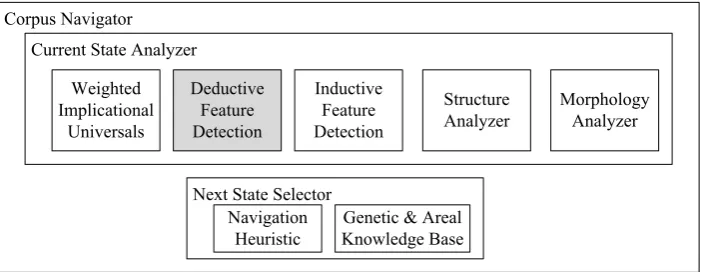
In recent years, Data Selection has become a common issue in many areas of language tech-nologies including speech recognition (Zhang and Rudnicky, 2006), speech synthesis (Black and Lenzo, 2001), and machine translation (Probst and Lavie, 2004). The benefits of data selection become evident at two stages. First, in gathering language data from humans, the devel-opment cost of language technologies is typically increased greatly. Second, in executing training algorithms, time (often on the order of days) is lost due to the mass quantities of data involved. However, much of this data is essentially redu-dant. Data Selection allows for gathering and/or using much less data while still retaining com-parable levels of performance. While previous methods have performed data selection as a static step either before or after the collection of data from human sources, we use active learning to dynamically select data during data collection. This paper describes deductive feature detection, which is one step in our active learning sys-tem. Feature detection answers answers ques-tions such as “Does this language distinguish sin-gular nouns from plural nouns?” It is employs active learning to characterize the current state when determining what data to select.
One might think that because some kind of refer-ence grammar exists for almost every language,
feature detection might be unnecessary. How-ever, in the database of the The World Atlas of Language Structures(WALS) (Haspelmath et al., 2005), a compendium of the types of features we are trying to automatically detect, over 84% of the cells are blank. Haspelmath (Haspelmath, 2008; Haspelmath, 2007) notes that the data re-quired to fill in most of these cells is not easily ob-tainable. Furthermore, reference grammars report on which features aregrammaticalized, but many non-grammaticalized features are expressed. For example, future tense is not grammaticalized in Japanese, but may be expressed by circumlocu-tions such as watashi wa gakoo ni iku yode desu (lit. “I have a plan to go to school.”) forI will go to school.
1.1. Corpus Design and Elicitation
cook-context: Maria bakes cookies often or habitually. srcsent: Maria bakes cookies .
tgtsent: Maria hornea galletas . aligned: ((1,1),(2,2),(3,3),(4,4))
fstruct: [f1]( [f2](actor ((gender f)(anim human))) [f3](undergoer ((person 3))) (tense pres)) cstruct: [n1](S1 [n2](S [n3](NP [n4](NNP Maria))
[n5](VP [n6](VBZ bakes) [n7](NP [n8](NNS cookies))))) phimap: phi(n1)=f1; phi(n3)=f2; phi(n7)=f3;
headmap: h(n1)=n2; h(n2)=n5; h(n3)=n4; h(n4)=n4; h(n5)=n6; h(n6)=n6; h(n7)=n8; h(n8)=n8;
Figure 1: Here, we see a post-elicitation example entry from the elicitation corpus. Note that the target language sentence and alignments were added via a bilingual person’s interactions with a GUI.
Corpus Navigator Current State Analyzer
Weighted Implicational
Universals
Deductive Feature Detection
Inductive Feature Detection
Structure Analyzer
Morphology Analyzer
Next State Selector Navigation
Heuristic
Genetic & Areal Knowledge Base
Figure 2: This figure shows the various components that might eventually be involved in a Corpus Nav-igator. This paper describes thedeductive feature detectioncomponent, which detects how features are expressed by using a set of rules that take annotations of one feature set as input and fire implications of a different feature set as output.
baked cookies / Maria horne´o galletas]}, and the words { [bakes / hornea], [baked / horne´o]}. The remainder of the paper describes the imple-mentation and evaluation of feature detection.
2.
Data
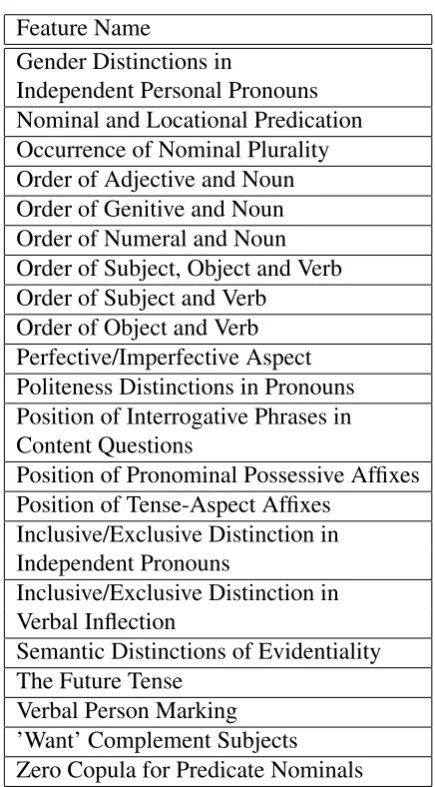
The input for experiments in this paper is a Spanish-English elcitation corpus of 50 sen-tences. We selected 21 features, shown in Ta-ble 1, from WALS for this experiment. The output of feature detection is a value for Span-ish for each of the features. For exam-ple, the value forOccurrence of Nominal Pluralityshould beYes.
The Linguistic Data Consortium now provides Language Packs for Less Commonly Taught Lan-guages (LCTL) for Thai, Bengali, Urdu, each in-cluding 3100 sentences from our elicitation cor-pus (Levin et al., 2006). After alignments have
been obtained for these corpora, they will serve as a primary area of application for feature detec-tion.
3.
Implementation
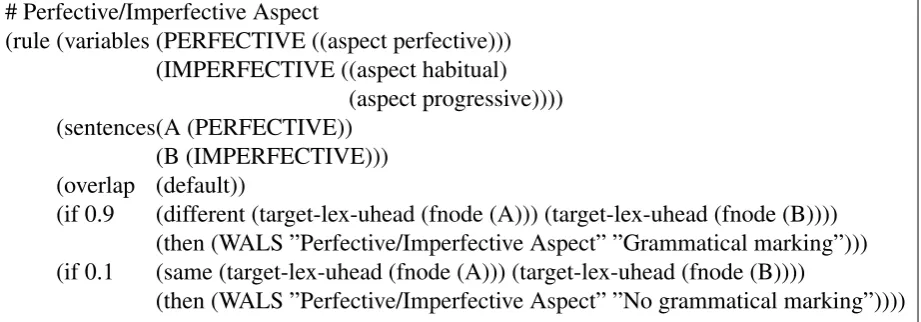
We represent the mapping between example sen-tences and language features by a set of LISP-like production rules, which can be reused for arbi-trary language pairs (Figure 3). These are read by a Java interpreter, which takes as input the rules and the sentences elicited so far.
the head verbs are identical, the proposed value of Perfective/Imperfective Aspect isGrammatical Marking.
Because languages have irregularities and sub-regularities, it is common for several different feature values to be proposed when the rules ap-ply to several sentences. For example, in a lan-guage that optionally marks plurals, bothMarks PluralandDoes Not Mark Plural may be proposed. This ambiguity is resolved by as-signing a λ value (weight) to each condition. For a set of conditions C in a rule with each c∈Cbeing assertednctimes, the condition (fea-ture value) v asserted for a language is given by v = argmaxc∈Cλcnc.
In evaluating each condition, the system also checks for degree of lexical overlap, which may be specified in the rule. This helps ensure that each comparison is really being done on a min-imal pair. For each successful comparison, the system cites the evidence that led to that asser-tation including the matching sentences and their matching constituents.
4.
Results
We evaluated the output of the system by cal-culating the precision, recall, and F1 scores of the output compared to the values recorded in WALS. As a baseline measure, we calculated the scores that would be obtained by choosing the most common value for each feature.
The results of the experiment are presented in Table 2. Since every rule fired exactly one final feature value, the precision, recall and F1 scores are equivalent. As error anal-ysis, we present two of the features that did not fire the values recorded in WALS: Order of Subject and Verb, which fired SV in-stead of the expected No dominant order and Verbal Person Marking, which fired Only the A argument when Both the A and P arguments was expected. In both cases, the values fired by the system are reason-able given the input sentences. Given a larger set of input sentences, it is likely that these values could have also been detected correctly. In the future, we would like to explore methods for de-tecting when we have “enough” data.
In terms of the Corpus Navigation Application (Section 1.2.), these results are promising. Given
Feature Name
Gender Distinctions in
Independent Personal Pronouns Nominal and Locational Predication Occurrence of Nominal Plurality Order of Adjective and Noun Order of Genitive and Noun Order of Numeral and Noun Order of Subject, Object and Verb Order of Subject and Verb
Order of Object and Verb Perfective/Imperfective Aspect Politeness Distinctions in Pronouns Position of Interrogative Phrases in Content Questions
Position of Pronominal Possessive Affixes Position of Tense-Aspect Affixes
Inclusive/Exclusive Distinction in Independent Pronouns
Inclusive/Exclusive Distinction in Verbal Inflection
Semantic Distinctions of Evidentiality The Future Tense
Verbal Person Marking ’Want’ Complement Subjects Zero Copula for Predicate Nominals
Table 1: The 21 features chosen from WALS to evaluate feature detection.
Precision Recall F1 Experimental 85.71% 85.71% 85.71%
Baseline 57.14% 57.14% 57.14%
Table 2: Evalution of the feature detection system on selected features from the WALS database. The baseline was calculated by choosing the most frequent feature value across the languages sur-veyed in WALS.
# Perfective/Imperfective Aspect
(rule (variables (PERFECTIVE ((aspect perfective))) (IMPERFECTIVE ((aspect habitual)
(aspect progressive)))) (sentences(A (PERFECTIVE))
(B (IMPERFECTIVE))) (overlap (default))
(if 0.9 (different (target-lex-uhead (fnode (A))) (target-lex-uhead (fnode (B)))) (then (WALS ”Perfective/Imperfective Aspect” ”Grammatical marking”))) (if 0.1 (same (target-lex-uhead (fnode (A))) (target-lex-uhead (fnode (B))))
(then (WALS ”Perfective/Imperfective Aspect” ”No grammatical marking”))))
Figure 3: This figure shows an example rule from the production system that is used for feature de-tection. The first “if” statement denotes that if the ultimate head of target lexicons mapped to the grammatical aspect being perfective are different than those mapped to imperfective, the value “Gram-matical marking” should be fired. Since Σλ = 1.0 in this case, if 90% of the evidence in this rule suggest (propose) this feature value, then it is asserted as the correct value.
features. Since this process will be used as a search heuristic here, we believe that the reported accuracies are reasonable for this task.
5.
Language Resources
The result of Corpus Navigation is a resource dense with the “right” features, those for which the target language makes distinctions. This cor-pus is also highly structured in that each language feature is linked with sentences illustrating that feature. It is also valuable in that it is word-aligned and each sentence is associated with a a feature structure that expresses the meaning of the sentence. Such a resource can be valuable for studying MT divergences (different ways of expressing the same meaning) and for studying constructions (partially non-compositional form-meaning mappings). In effect, it is a parallel tree-bank annotated with an interlingua of grammar.
6.
Applications
The process of Feature Detection enables us to detect language features and how they are ex-pressed. In learning these morphosyntactic lan-guage features using the Elicitation Corpus, we can learn most of a language’s syntax and struc-ture without a large parallel corpus. We can then leverage alternative language resources by using the hybrid MT System AVENUE, which we say is “omnivorous” in that it can make use of many
different kinds of language resources during sys-tem construction. This enables us to use other lexical resources such as bilingual dictionaries and monolingual corpora to address the issue of lexical coverage. Further, due to the unstruc-tured nature of parallel corpora, there are some tasks (such as automatically annotating closed-classe morphemes with their corresponding lan-guage features) that would be nearly impossible with parallel data. By detecting language fea-tures from an elicitation corpus, we can perform tasks that would otherwise be too difficult, and we leave open our options for how to deal with lexical coverage.
7.
Conclusion
Having developed a system that can automati-cally discover language features during the elic-itation process, we now look toward the develop-ment of a Corpus Navigator. These tools will aid in the economical creation of parallel corpora that are dense with the characteristic features of each target language.
8.
Acknowledgements
Spanish-English test corpus, and to Keisuke Ka-mataki for the Japanese example. Our appre-ciation also goes to Martin Haspelmath for his helpful insights into the nature of the gaps in the WALS database. Finally, we are grateful for the helpful comments of three anonymous reviewers. This work was supported by US National Science Foundation Grant Number 0713-292.
9.
References
Alison Alvarez, Lori Levin, Robert Frederking, Simon Fung, Donna Gates, and Jeff Good. 2006. The MILE corpus for less commonly taught languages. In HLT-NAACL, New York, New York, June.
Alan Black and Kevin Lenzo. 2001. Optimal data selection for unit selection synthesis. In ISCA, 4th Speech Synthesis Workshop, Scot-land.
Jaime Carbonell, Kathrina Probst, Erik Peterson, Christian Monson, Alon Lavie, Ralf Brown, and Lori Levin. 2002. Automatic rule learn-ing for resource limited MT. InAssociation for Machine Translation in the Americas (AMTA), October.
Hal Daum´e and Lyle Campbell. 2007. A Bayesian model for discovering typological im-plications. In Conference of the Association for Computational Linguistics (ACL), Prague, Czech Republic.
Joseph Greenberg. 1963. Universals of Lan-guages. MIT Press, Cambridge.
Martin Haspelmath, Matthew Dryer, David Gil, and Bernard Comrie. 2005. The World Atlas of Language Structures. Oxford University Press, Oxford.
Martin Haspelmath. 2007. personal communica-tion.
Martin Haspelmath. 2008. The typological database of theWorld Atlas of Language Struc-tures. In Martin Everaert and Simon Mus-grave, editors, Typological databases. Mouton de Gruyter, Berlin.
Ronald Kaplan. 1995. The formal architecture of lexical functional grammar. In Mary Dalrym-ple, Ronald Kaplan, J. Maxwell, and A. Za-enen, editors, Formal Issues in Lexical Func-tional Grammar. CSLI Publications.
Lori Levin, Jeff Good, Alison Alvarez, and Robert Frederking. 2006. Parallel reverse tree-banks for the discovery of morpho-syntactic markings. In Proceedings of Treebanks and Linguistic Theory, Prague.
Eva Hajicov´a Petr Sgall, Jarmila Panevov´a. 2004. Deep syntactic annotation: Tectogrammatical representation and beyond. In HLT-NAACL 2004 Workshop: Frontiers in Corpus Annota-tion, Association for Computational Linguis-tics, Boston.
Katharina Probst and Alon Lavie. 2004. A structurally diverse minimal corpus for elicit-ing structural mappelicit-ings between languages. In Proceedings of the 6th Conference of the Asso-ciation for Machine Translation in the Ameri-cas (AMTA-2004), Washington, DC.
Katharina Probst and Lori Levin. 2002. Chal-lenges in automated elicitation of a controlled bilingual corpus. In Proceedings of the 9th International Conference on Theoretical and Methodological Issues in Machine Translation (TMI-02).