© 2017, IJCSMC All Rights Reserved 420
International Journal of Computer Science and Mobile Computing
A Monthly Journal of Computer Science and Information Technology
ISSN 2320–088X
IMPACT FACTOR: 6.017
IJCSMC, Vol. 6, Issue. 6, June 2017, pg.420 – 424
Voice Controlled Wheelchair
using Android Technology
Shahid Hussain Wani
1, Aamir Hilal
2, Mr. Omar Farooq Khan
31,2
Students of SSM College of Engineering and Technology, University of Kashmir, India
3
Assistant Professor of SSM College of Engineering and Technology, University of Kashmir, India
1
Email: [email protected]
Abstract: The motivation behind VOICE CONTROLLED WHEELCHAIR USING ANDROID TECHNOLOGY project is to build an automated wheelchair that helps the physically disabled peoples to locomote from one place to another. As we know that many wheelchairs are available with different running technologies, but the cost is very high and it is not much effective. Mostly, the idea of building VOICE CONTROLLED WHEELCHAIR is to overcome some disadvantages of the existing systems. The wheelchair is controlled with the help of an android mobile application. The purpose of selecting the Android platform is that nowadays Android mobile phones are commonly used. The user has to first get connected with the wheelchair with the help of the application. The user then has the GUI to control the wheelchair. This system allows the user to robustly interact with the wheelchair at different levels of the control (turn left, turn right, go ahead, go back and stop) and sensing. This project uses Arduino kit Microcontroller circuit and DC motors to create the movement of the wheelchair and Ultrasonic Sensors to detect the hurdles in between wheelchair and the way of direction.
Keywords: Android Application, Wheelchair, physically Challenged, Ultrasonic Sensor, Voice Command, HC-05 Bluetooth Module, DC Motors, Arduino UNO Microcontroller
1. INTRODUCTION
The 2011 census reported increase in country's disabled population by 22.4% between 2001 and 2011.
© 2017, IJCSMC All Rights Reserved 421
The disabled population needs a support that is provided by wheelchair. The normal pushing wheelchair is the primitive one in which the user has to push the chair with the hands. It has a stress on the user when traveling for a long distance. So with the help of technology and human intelligence, the idea of an automated wheelchair is evolved. An automated wheelchair based on some inputs interfacing machine which provides inputs to the motor. The motor processes the inputs provided and takes the corresponding action (in terms of movement – move left, forward, backward, right). With the introduction of Android Smartphone in the system, the working becomes less complex. The system becomes quite user-friendly to the user.
2. LITERATURE SURVEY
In the past few years, many projects related to the wheelchair have been developed. Some of the existing systems are based on the input provided by joystick, eyeball movements, gesture-based, voice-based, patterns made by hand In last few years, many projects related to wheelchair and brain signal ( neural ) based etc.
In joystick based wheelchair person with different disabilities may find it difficult to move joystick as it requires the considerable amount of force Moreover it may affect the reaction time of the wheelchair which may be dangerous. [2]
In the eyeball movements [4] controlled wheelchair and head/neck [5-7] movement controlled the wheelchair, the user has more stress on the eyes/head/neck. In this case, the user has restricted sight as the motion of the eyeball/head/neck is taken as an input by the system that can give wrong output for that instance.
Voice controlled system [8] can provide an inaccurate response in the noisy environment and it can become difficult for the user to locomote in such environment.
In an Accelerometer-based controlled system [9], the tilting direction of the mobile phone should be precise to receive an accurate result. And moreover, it will be complex for people with disabilities in wrist movements. And pattern recognition based system [10] will require training of the user as well as the system. The training of the system will vary for different users.
Also in brain signal controlled system [11] acquires and converts the brain signal to give direction signals. These signals are generated due to electrical activity that is stimulated by the brain but brain signal cannot be relied on for motion of wheelchair as in some external electric field the device may not able to capture the accurate signal.
3. PROPOSED SYSTEM
Fig. 3.1 Block Diagram of voice controlled wheelchair
© 2017, IJCSMC All Rights Reserved 422
The provided Android application gives simple user-interface to the user for voice recognition to control the direction of motion of wheelchair. Based on voice recognition the corresponding signal is sent via a Bluetooth controller to the microcontroller, which takes actions as a form of output. If the user voice command is Go-ahead direction, then both the motors are made to move in the same direction and with the same speed. Similarly is the Go-back direction. If the user's voice command is Turn left/right direction than the polarity of both the motors are reversed correspondingly.
4. IMPLEMENTATION
4.1 Implementation Platform:
Hardware Requirement
Arduino UNO.
L293D Motor Shield.
Bluetooth Module HC-05.
Ultrasonic Sensor HC-SR-04.
Wheelchair chassis.
Battery 12 volts.
2 DC Motors (12 V 200 rpm).
Android phone.
Power supply.
Software Requirement
Arduino IDE.
Android Application.
Coding language: Arduino programming (Java & C++).
4.2 Implementation Details
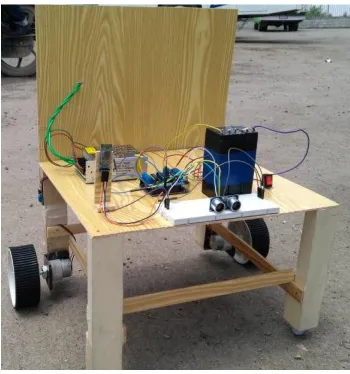
Currently, the prototype of the project has been developed. The figure below depicts the same.
© 2017, IJCSMC All Rights Reserved 423
The above figure shows the prototype model of the Voice Controlled Wheel Chair.
Fig. 4.2.2 User Interface of the application to control Wheelchair
The above figure is the screenshot of the application to recognize the voice and control the wheelchair using voice commands. The user first connects the mobile with the Bluetooth module of the wheelchair. Then, the user can control the wheelchair with the help of various voice commands like Go-ahead, Go-back, Turn right, Turn left and Stop.
5. RESULT & ANALYSIS
The proposed system will have an advantage of efficiency and robustness as the controlling is based on an Android application that provides a GUI to the user.
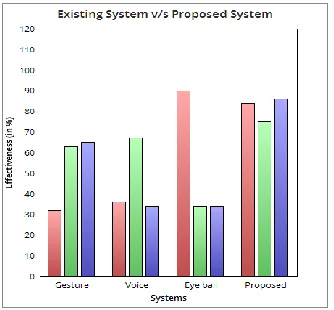
Following are the assumed values for the calculation of effectiveness. 0%-34% - Low
35%-67% - Medium 68%-100% - High
© 2017, IJCSMC All Rights Reserved 424
The above table and graph show the comparison of the proposed system (Voice Controlled Wheel Chair) with the existing system.
The comparison is made on three parameters viz. Response delay, cost and stress factor. It can be seen that the existing system has low response delay, the cost is also reduced and there is no much stress on the user.
6. FUTURE SCOPE
The system can be adapted to make it for the external environment by adapting the GPS location and the user can make the selection to go through it.
The other way is that the path will be stored as the video and the wheelchair can travel automatically by recognizing various past patterns.
7. ACKNOWLEDGEMENT
We are sincerely thankful to Mr. Omar Farooq Khan, Assistant Professor of SSM College of Engineering and Technology, the University of Kashmir for providing us with a golden opportunity to work on this project.
8. CONCLUSION
Using Voice Controlled Wheel Chairdifferent disabled people can locomote from one place to another without requiring help from other person and also without requiring physical stress. The user interface of an Android application is simple and easy to use. Obstacle detection provides ease of navigation without colliding with objects in its way. The response is quick and accurate.
REFERENCES
[1] http://timesofindia.indiatimes.com/india/Disabled-population-up-by-22-4-in-2001-11/articleshow/28072371.cms [2] Thomas Rofer , Christian Mandel, Tim Laue, ” Controlling an Automated Wheelchair via Joystick/Head-Joystick
Supported by Smart Driving Assistance”, 2009 IEEE 11th
International Conference on Rehabilitation Robotics Kyoto International Conference Center, Japan, 9781-4244-3789-4/09 2009IEEE
[3] Holly A. Yanco,” Wheelesley: A Robotic Wheelchair system: Indoor navigation and user interface”, MIT Artificial Intelligence Laboratory 545 Technology Square, Room 705 Cambridge, MA 02139 U.S.A.
[4] Kohei Arai, Ronny Mardiyanto, “Eyes Based Electric Wheelchair Control System”, International Journal of Advanced Computer Science and Applications (IJACSA), Vol. 2, No. 12, 2011.
[5] Mohammed Asgar, Mirza Badra, Khan Irshad, Shaikh Aftab,” Automated Innovative Wheelchair”, International Journal of Information Technology Convergence and Services, vol.3, no.6, December 2013.
[6] Rakhi A. Kalantri, D.K. Chitre,” Automatic Wheelchair using Gesture Recognition”, International Journal of Engineering and Innovative Technology ISSN: 2277-3754, (IJEIT) Volume 2, Issue 9, March 2013.
[7] Vijendra P. Meshram, Pooja A.Rajurkar, Mohini M.Bhiogade, Arundhati C.Kharabe, Dhiraj Banewar , “Wheelchair Automation Using Head Gesture”, International Journal of Advanced Research in Computer Science and Software Engineering, Volume-5, Issue-1, ISSN:2277 128X, January 2015.
[8] Shraddha Uddhav Khadilkar, Narendra Wagdarikar,” Android phone controlled Voice , Gesture and Touch screen operated Smart Wheelchair” Android phone controlled Voice , Gesture and Touch screen operated Smart Wheelchair”, 2015 International Conference on Pervasive Computing (ICPC), 978-1-4799-6272- 3/15 2015 IEEE.
[9] Prof. Vishal Pande, Nikita Ubale, Darshana Masurkar, Nikita Ingole, Pragati Mane, “Hand Gesture Based Wheelchair Movement Control for Disabled Person Using MEMS”, International Journal of Engineering Research and Application, ISSN:2248-9622, Vol.4, Issue- 4(version 4), April 2014, pp.152-158.
[10]Jinhua Zeng, Yaoru Sun, and Fang Wang, “A natural hand gesture system for intelligent human-computer interaction and medical assistance”, 2012 IEEE Third Global Congress on Intelligent Systems.,DOI 10.1109/GCIS.2012.60. [11]Rajesh Singla, Haseena B.A, “BCI Based Wheelchair Control Using Steady State Visual Evoke Potential and Support