IJEDR1502188
International Journal of Engineering Development and Research (www.ijedr.org)1085
An Efficient Way of Scheduling In Dynamic
Environments Using Error Inference Technique
1Neha S Reddy,2Prof.Yogita Patil 1M.Tech Student,2 Associate Professor 1
Dept. of Computer Network & Engineering,2 Dept ofComputer Science and Engineering 1APPA institute of Engineering and Technology, Kalaburgi, Karnataka, India
____________________________________________________________________________________________________
Abstract - Due to self monitoring and dynamic scheduling property of the sensor nodes, these sensor nodes can be deployed in highly dynamic environments. As the nodes are deployed in a network, scheduling among the nodes becomes important in order to save energy, reduce sensing gap and to transfer the sensed data reliably. Due to limited power in sensors dynamic scheduling with data quality management is required in the practical deployment of long-lasting wireless sensor network applications. To achieve proper scheduling among sensor nodes we use an efficient collaborative scheduling approach called as collaborative inferred error sensing called as CIES. Within a node as sensing probability bound is used to control sensing error. Among neighborhood, the nodes can trigger sensing activities when inferred error has exceeded the tolerance. This scheduling mechanism for collaborative sensors is developed to achieve the error bounded scheduling control in monitoring applications.
Index Terms - collaborative scheduling, duty cycle, energy efficiency, error inference
____________________________________________________________________________________________________
I. INTRODUCTION
Recent advances in technology such as wireless communications, digital electronics, MEMS (micro-electro-mechanical systems) have led to the development of low cost, low power, multifunctional sensor nodes. These sensor nodes collaborate with each other to carry out the task of sensing, data processing, communicating etc. Therefore these wireless sensor network have found application in wide range of problems from military surveillance to environmental monitoring, disaster relief and home automation. In spite of their broad utility these sensors exhibit various challenges such as limited battery life, low processing power ,low bandwidth and also sensing errors are introduced due to sensing gap or communication gap between neighbouring sensor nodes.
One of the main sources of power consumption is the energy lost during sensing activities. Therefore unnecessary sensing activities should be avoided. A dynamic sensing and scheduling algorithm is introduced, this focuses on how to schedule sensing activities based on two types of information:
1) Estimation of local error
2) Inferred error estimated from neighbour nodes
Main concept here is the error inference, where the term error is defined as difference, in percentage, between the ground truth environmental data and the corresponding value generated by the predictor of sensor nodes, which is a direct performance indicator of the sensor system. The error information is not only used by the local sensing scheduler, but is also shared among neighbours. Nodes can trigger additional sensing activities of other neighbour nodes when the inferred error has aggregately exceeded the error tolerance. The approach is reffered as CIES.
The main contributions of this work are:
The design of a local error control algorithm to guarantee a specified error bound.
The introduction of a distributed inference model of prediction error for neighbour nodes.
The integration of both local and neighbour error control into a unified architecture to adjust duty cycles of sensor nodes.
The simulated study of the proposed design that conserves as much as 60 percent of energy when compared to existing method
II. OBJECTIVES
The main objective of this work is to develop a generic scheduling mechanism for collaborative sensors to achieve the error-bounded scheduling control in monitoring applications.
reconcile the conflict between energy consumption and error tolerance.
To achieve high accuracy for highly dynamic environments among collaborating sensor nodes, optimized approaches are used to accurately determine the inferred errors between neighbour nodes.
As an enhancement in this proposed system is to design a efficient and secure routing path from source to destination
III. OVERVIEW
IJEDR1502188
International Journal of Engineering Development and Research (www.ijedr.org)1086
control mechanisms are explained.Network Model
Assume a wireless sensor network which consist of N sensor nodes. Each sensor node has got two states: an active state and a dormant state. An active node performs functions, such as sensing, transmitting packets, and receiving packets. A dormant node turns off most of its functional modules except the radio, for listening to incoming traffic. All nodes have their own schedules that are controlled by the duty cycle controller on the nodes. A dormant node wakes up when :
1) It is scheduled to switch to an active state or
2) It receives packets from neighbour nodes and decides to change into the active state.
Asssumptions
off the shelf sensor node products are used.
Sensor nodes are homogenous and can be distributed as a random process.
Here an assumption is made that sensing is much more expensive than communication so that it is necessary to
coordinate sensing activities among neighbour nodes for better energy efficiency. This assumption does no apply for all platforms but it does apply for few existing ones.
Cies Algorithm
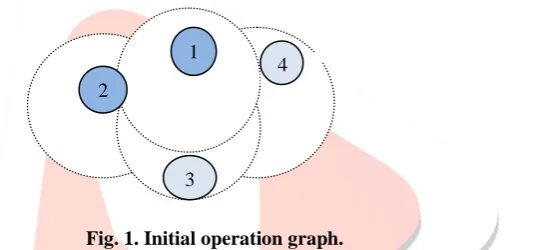
A simple example which illustrates the basic idea of CIES. Fig shows an example with a node set G ={ 1 2 3 4}.
1. After deploying the nodes 1, 2, 3, and 4 firstly initialize their local error control operation processes and neighbour error- control procedures independently. Node 1 has its neighbour nodes as 2, 3, and 4 as shown in Figure below:
Fig. 1. Initial operation graph.
2. In one sampling time duration, nodes 3 and 4 are in full operation ( light colour as shown in Fig. 1). Nodes 1 and 2 are in a sleep mode, but their radio is switching on and off periodically to monitor traffic.
3. When there is a sudden change in the environment, nodes 3 and 4 calculate their inferred errors on node1 to be 90% and 66 %, respectively, as shown in Fig. below. These error estimations from node 3 and 4 are sent to node 1. Because but there is no message exchange between them since, node 3 and 4 are in sleeping mode
nodes neighbours
weight=10
inferred error =90% 1
Weight=6
Inferred error=66%
Fig: The computation of weighted inferred error.
4. After receiving the inferred error messages from nodes 3 and 4, node 1 will calculate the weighted average inferred error to be 80 percent. Then, it determines whether error tolerance is exceeded. If the error tolerance in this simple example is 30%, node 1 is awakened immediately after the sampling time duration because the calculated weighted inferred error is larger than the threshold.
5. The operational modes of these nodes are indicated in Fig below: 2
1
1 2 3 4 2
1
3
IJEDR1502188
International Journal of Engineering Development and Research (www.ijedr.org)1087
Node Initial status Final status1 2 3 4
Off Off On On
On Off On On Fig. 3. The initial and final operational modes
Local Error Control
The design of the local error control is achieved by the observation that a sensor node should be able to achieve the desired sensing fidelity independently in isolation. Therefore, the data detected and stored locally should be fault tolerant, a goal that is achieved by the local error control. For convenience, the local error is referred as Non collaborative IES, which consists of the duty cycle control and local error predictor. To save energy, a sensor node uses its local error predictor to predict the environment status without performing actual sensing operation. When data are obtained through actual sensing, a node compares its predicted sensing values with the actual sensing values, and then stores the prediction errors into the local error data library. Based on the accuracy of the local error predictors, the duty cycle controller adjusts the sensing frequency through error bound control, which serves to confine the system prediction error within a user specified bound.
Network Error Control
Since high prediction error through local error control is noticed which results in high energy consumption therefore an online method to improve error control. Several terms are used to describe the network error control:
Inferred error: Given a node i and its neighbour node j, the node-pair inferred error eij is defined as the inference error at neighbor j from the point view of node i.
Node-Pair Weight wij: The weight is defined as the extent of a node-pair’s data correlation and indicates how similar the sensing observation is between two neighbour nodes i and j.
Error Probability Density Function: The error PDF is a collection of distributions of detection errors in which the previous detection errors for sensors are stored and processed so that the detection errors can be directly linked to corresponding occurrence probability.
Design of Neighbour Error Predictor
The neighbours can change dynamically so there is need to iteratively estimate the neighbours prediction error, given a certain relationship among neighbours.
Step 1: Neighbour Recognition: Here the sensor recognizes as the neighbour which is closer to it and then assigns a table for each neighbour to build graph
Step 2: Weight Graph Construction: Here data correlation between the nodes is calculated were each nodes at the end of each round exchanges its observation with the neighbour node and average sensing correlation between node is calculated.
Step 3: Achieving the inferred error eij for neighbours: we can predict error of neighbour nodes using local prediction errors and
can infer the prediction error of correlated neighbour nodes
Deign of Neighbour Error Control
After estimating the error value for neighbour sensor j, sensor i sends the inferred error eij to neighbour error control
process where the error information is sent and received.
The neighbour error control process monitors the channel through which its neighbours send error information. To minimize the false positive risk, a weighted average approach is adopted in this design.
IJEDR1502188
International Journal of Engineering Development and Research (www.ijedr.org)1088
Adjust duty cycleHardware Layer
Sensing and data storage communication Fig: The local error control layer and network error control layer illustration. IV. SIMULATIONANALYSIS
Based on three metrices the quality of sensor network is evaluated:
Error Rate :It is defined as error rate that the prediction system produces during the same observation window.
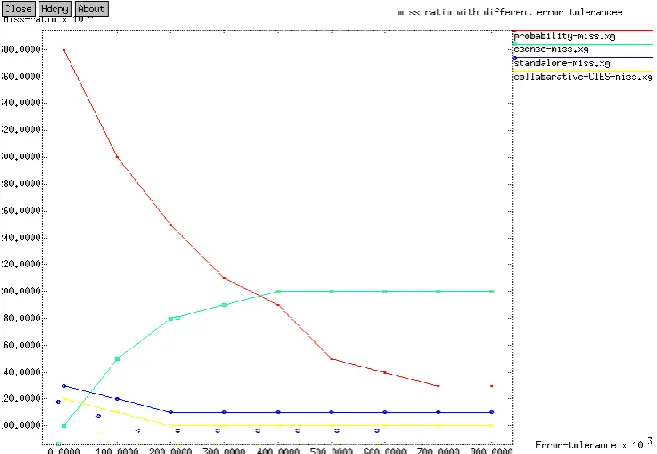
Miss Ratio: It is defined as ratio that the sensor system fails to respond to an event that is rapid changing environment.
Energy Consumption: It is defined as the total energy consumed by the network during operation period. Her a comparison is made on proposed system CIES with existing system eSense through simulation analysis 1.Figure below shows the energy consumption with different error tolerance
Network Error Control Layer
inferred error
Input sensing data adjust sensing
Frequency Local Error
Predictor Prediction
Duty Cycle Controller Error analyzer
Adaptor Local Error
Data Library Neighbour error
Predictor Neighbour table weigh
graph
Neighbour error controller Neighbour inferred
IJEDR1502188
International Journal of Engineering Development and Research (www.ijedr.org)1089
From the simulation analysis of the above graph it can be inferred that the eSense consumes slightly less than 15% of that of the CIES But stability of CIES system is much better than eSense these achievement only cause 20% more energy than eSens which is acceptable in most of the application for example when detection is more important than lifetime management.2.Figure below shows the miss rate with different error tolerance
Figure above shows the graph of miss ratio for eSense it continues to increase with increase in the error tolerance while CIES seems to be stable higher is the error tolerance less sensitive is the eSense towards data change but the CIES is guarantees the absolute error rate and adjust accordingly with the data change
3.Figure below shows the error performance with different error tolerance
Figure above shows the error performance different error rate here it can be seen benchmark is not effected too much by setting the error tolerance eSense error rate does not increase too much due to increase in error tolerance but its error rate is much higher than IES non collaborative approach and CIES collaborative approach. eSense cannot satisfy the specified error boundaries were as our proposed system satisfy.
Trough simulation analysis it can be can concluded that the proposed approach CIES can outperform the eSense with respect to miss ratio and total error rates .the results also confirm that error bounded scheduling is achieved in this approach.
V. CONCLUSION
IJEDR1502188
International Journal of Engineering Development and Research (www.ijedr.org)1090
VI. ACKNOWLEDGEMENTI am thankful to “Prof.Yogita Patil" for her imperative appeal and reinforce contacted me without which i couldn't have had the ability to complete the paper. I thank the baffling judges for their reviews that in a general sense improved the presentation of this paper. Words can't express our gratefulness for each one of those people who helped clearly or by suggestion in my attempt. I take this risk to express my honest to goodness due to all staff people from CS&E division of AIET for the huge suggestion. VII. REFERENCES
[1] Q. Zhang, Y. Gu, L. Gu, Q. Cao, and T. He. Collaborative scheduling in highly dynamic environments using error inference. In 7th International Conference on Mobile Ad-hoc and Sensor Networks, 2011
[2] H. Luo, J. Wang, Y. Sun, H. Ma, and X. Li, “Adaptive Sampling and Diversity Reception in Multi-Hop Wireless Audio Sensor Networks,” Proc. IEEE 30th Int’l Conf. Distributed Computing Systems (ICDCS ’10), 2010.
[3] X. Wang, G. Xing, Y. Zhang, C. Lu, R. Pless, and C. Gill, “Integrated Coverage and Connectivity Configuration in Wireless Sensor Networks,” Proc. First Int’l Conf. Embedded Networked Sensor Systems (SenSys ’03), 2003.
[4] X. Bai, C. Zhang, D. Xuan, and W. Jia, “Full-Coverage and k- Connectivity (k = 14; 6) Three Dimensional Networks,” Proc. IEEE INFOCOM ’09, 2009.
[5] Z. Yun, X. Bai, D. Xuan, T.H. Lai, and W. Jia, “Optimal Deployment Patterns for Full Coverage and k-Connectivity (k leq 6) Wireless Sensor Networks,” Proc. IEEE INFOCOM ’09, 2009.
[6] Z. Zhou, S. Das, and H. Gupta, “Connected k-Coverage Problem in Sensor Networks,” Proc. 13th Int’l Conf. Computer Comm. And Networks (ICCCN ’04), 2004.
[7] H. Liu, A. Chandra, and J. Srivastava, “Esense: Energy Efficient Stochastic Sensing Framework for Wireless Sensor Platforms,” Proc. Fifth Int’l Conf. Information Processing in Sensor Networks (IPSN ’06), 2006.
[8] Q. Zhang, Y. Gu, T. He, and G.E. Sobelman, “Cscan: A Correlation-Based Scheduling Algorithm for Wireless Sensor Networks,” Proc. IEEE Int’l Conf. Networking, Sensing and Control (ICNSC ’08), pp. 1025-1030, 2008.
[9] C. Lin, Y. He, and N. Xiong. An energy-efficient dynamic power management in wireless sensor networks. In Parallel and Distributed Computing, ISPDC’06, 2006.