EHVS
!"# $%$ & '()*+
, - .. !!)*+
- /, 0 1 + 0 1 2 30
/, 1.. !
)*+0 0 0 !"45 !"(+
$%$ .. ! &)*0..& '+6)*
01 +
2 3 -. 71 0 1 /-5)2/)3+ 5 5 8- + $0 0 9":+/-5) + 0 01- 0 -+
1+ /,;"+< => 1 1 ? /, 9 0': 5 0 ++ "6!5"&! @* A!2 ;+"30/,1 9#06: 5 2 ;+"3+ 5 - /, 230;+"+$ 1 -0 /, 11 11 B"6!6!!@*+
10 +
5?)C<D1+
! C
!
""
" ""
""" ""
" ""
" "
#!$%!&
'! (!
)(&
"
*)
;"? /,, -+G H + -2#+60'+(0'+60')*30 05 #+
+
9I: ?
5 0 1 0
2 3 2 ..3
-/) 1+ /) + 1 0 1 1 1 1 0 11 1 + 0 + ?
8-10 J10
@ +
5 0 1 0 + 0 1 J 10
5 8 < 2<3 18 2++ 30 + < 5 +11 ? 0 0 0 J 5 0 1 H 10 1 0 +
;" K 203+
1 H ..B60&+&0""+60"#+60"(+I0 &'()*+$0
6"#+6)*0 !"! !""+"#+6)* 1
!"# + - ..B6)* 1 +1 ;+" 5 0 #+ -20
3 +
$
@* ..B !!)* #!!@* ..B&+&)*+1 + 0 0 $ 5 1+@0 0 +
! "" $% # %$ $ #$# &'()*&'*( +(, '(--. *-/ *0 $ $ $ (1 0 2 3 $ $ $ $ $
$ 1(1
! ! "#$"#%&&''%() ! *+ $ % !
; ?$ $%$ 5 1 +7 2 3?5
0 "!5#!L 0 5 !56L +
2 3? 1 5B )*M1
0 1 10 1 55 6!5I!L +
$ ; + 1 9&:+
$110;+ 01 0 1&+& !!)*+. 0 0 0
+
B"66@*0 ..B &)*0 1 1 + 5 1 2"M35 2"!5#! L 3 1B !6@*21..B"(+I)*3+ 1101 0 1
5 + 5
1 1 2A..3+ 1 B"66@*'"6@* 2..B & ""+6)*31 "M+ ;+ 151$%$ 5A )*M 2..3+ B "66@*2..B &)*3+ 1 1 - 1 ./ 1
+ 1
1 12 3
2 ..3+ 1 + 1 1 5 56!5I!L $%$ 2..3+< 1 @ 0 8- + 1 1 2A ..B&+&)*3+
$ 11 1 0- 1 + 0 00 +. 0 0111 +F 1 <""+65"(+I)* 1 " 0 2 301 01
1 +
+0 $1 /, + - !"45 !"(+ 0 /) 0++ 1.. !)*+
$ 0 $ 5 + 1 1 H 1 A #!! @* A &6!54!! @*0 ..A')*+
H - $%$ ..N !)+8 + 1 1 1 1 1 1 511 +
RHIC was designed and optimized for the luminosity at sNN = 200 GeV. At lower energies, the
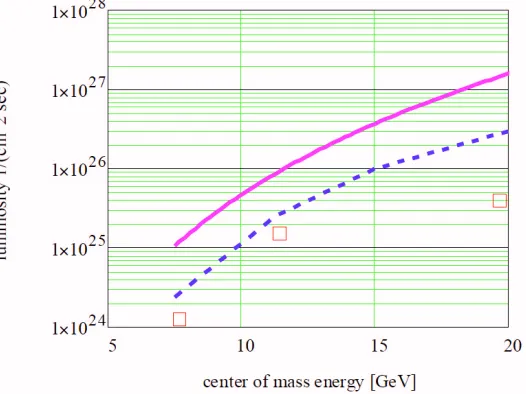
beam is not as well-focused and the collisions rate is low. The above mentioned electron cooling will provide the adequate intensity for BES Phase II. According to simulations, with the proposed electron superconducting RF gun, the luminosity will increase by a factor of 2-5 at sNN = 7.7 GeV and by a
factor of 8-20 at sNN = 20 GeV. Additional luminosity increase will be made possible by stretching
the beam bunches beyond the usual 6 ns length. Figure 3 shows the projection of average store luminosity for Au ions in RHIC. The lines represent the most “optimistic” (red) and the “pessimistic” (blue) scenarios with electron cooling. The open squares show the luminosities of the BES I run.
Figure 3: Projection of average store luminosity for Au ions in RHIC. The red line represents the most optimistic estimates for the luminosity with electron cooling implemented, while the blue one shows the pessimistic scenario. The open squares are the luminosities reached in BES I.
All of these advances will allow achieving the event statistics required for the key measurements of the BES II program.
3.2 Detector upgrades
Parallel with studies on RHIC luminosity increase, the intensive work of getting experiments ready for the challenges of the BES II program is in progress. The STAR experiment will benefit from a number of improvements to various sub-systems. The most important are described below.
3.2.1 Inner Sector TPC upgrade (iTPC)
The main detector of the STAR experiment, the STAR TPC, will be upgraded to increase segmentation of the inner sector’s pad planes and to renew the inner sector wires, which are showing signs of aging.
Unlike the outer TPC sectors, the current inner TPC pad row geometry does not provide hermetic coverage at all radii. About only 20% of the path length of a charged particles path traversing an inner sector of the TPC is sampled by the current pad plane and electronics readout. With the proposed upgrade, the path length coverage in the inner sectors will be increased to 100%.
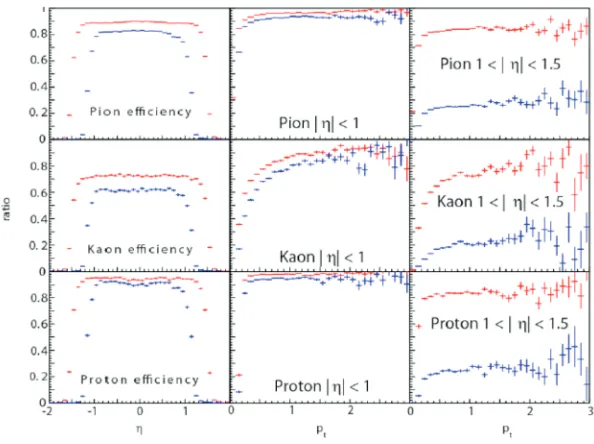
improved tracking and acceptance [(y,pt) coverage] through the entire phase space, the most significant change is observed in simulations of forward/backward direction: 1< |η| <1.5. The blue points in Figure 4 represent the coverage of the original TPC, the red ones the one for the iTPC.
Figure 4. Pseudorapidity and transverse momentum dependence of the detection efficiencies for pions (top panel), kaons (middle panel), and protons (bottom panel). Blue and red points are the results for TPC and iTPC, respectively.
The new measurement capabilities of STAR after the iTPC upgrade are a vital part of the new BES II effort. The iTPC will allow us to study rapidity dependence of freeze-out dynamics, it will extend measurements of v1 beyond the information contained in the slope of v1(y) close to midrapidity (a broader rapidity acceptance will expand our understanding of the role of baryon transport on the v1 measurements), it will allow study of the rapidity dependence of higher moments of net-proton/net-charge distribution to understand the role of net-proton/net-charge/baryon number conservation, and will improve many more observables. It will also improve the low pt acceptance by reducing systematic uncertainties associated with extracting particle yields.
3.2.2 Event Plane Detector (EPD)
The second most important improvement to the STAR detector experimental set-up is an addition of a newly built dedicated event-plane and centrality detector, EPD, which will be placed in the forward rapidity region 2 < | η | < 4. With segmentation in both radial and azimuthal directions, the detector will provide precise measurements of both the event plane and the collision centrality. Measurements of elliptic flow in BES I used the TPC for the event plane determination. Non-flow effects have been reduced by keeping an η gap (currently ~ 0.1 - 0.2) between the particles used for the correlation measurements and the event plane measurement. An EPD centered at a pseudorapidy of 3 units would result in an η gap of about 2 units of pseudorapidity, decreasing the non-flow effects significantly. An EPD would also improve significantly physics performance and facilitate physics interpretation of the direct flow measurements (in direct flow analysis in BES I the BBC detectors were used for the event plane determination, which have rather modest event-plane resolution).
3.2.3 End-Cap Time-Of-Flight (eTOF)
Installation of the End-Cap TOF will enable particle identification in the forward direction. One prototype sector of eTOF will be included in the BES II run. Although the eTOF will have a narrow azimuthal acceptance, this will enable key inclusive measurements.
The enhanced performance made possible by the iTPC, EPD and eTOF will not only benefit the BES Phase II physics program, but will also be crucial for STAR’s future program with p+p/p+A and e+p/e+A collisions at forward higher-rapidity regions.
3.3 Trigger for BES II
The transverse beam size at the lowest RHIC energies was significantly greater than at sNN = 200 GeV, causing collisions of ions in the beam halo with either the beam pipe or support-structure materials. At sNN = 7.7 GeV, 80-98 % of the triggered reactions came from such beam on beam-pipe collisions. The situation will improve with installation of an RF electron cooling system. A total increase in luminosity of about a factor 10 is expected, which will result in a trigger rate of several kHz at the highest BES energy. To exploit this, it is essential to trigger on all good Au+Au collisions with a reconstructable vertex.
4 Fixed target program
Intriguing threshold behaviour was observed in BES I data at the lowest energy of √sNN = 7.7 GeV, see Fig. 5. Similar observations were also made by the NA49 Collaboration at CERN SPS [8].
Center of Mass Collision Energy
√s
NN(GeV)
10 100 1000
)
2
- m (GeV/c
T
m
0 0.1 0.2 0.3 0.4 0.5 0.6 /+
STAR
+ /
-/
STAR
-/
10 100 1000
+ K
STAR + K
-K
STAR -K
STAR Preliminary
Figure 5: Left panel: Center-of-mass energy dependence of <mT> - m of π and K in central Au+Au collisions at
RHIC. Also shown are corresponding results from AGS [9, 10, 11, 12, 13, 14], SPS [15, 16] and LHC [17]. Right panel: The average transverse energy, scaled by the charge particle multiplicity at mid-rapidity, as a function of collision energy observed by PHENIX, STAR, ALICE, NA49, WA 98, E802 and FOPI Collaborations [18].
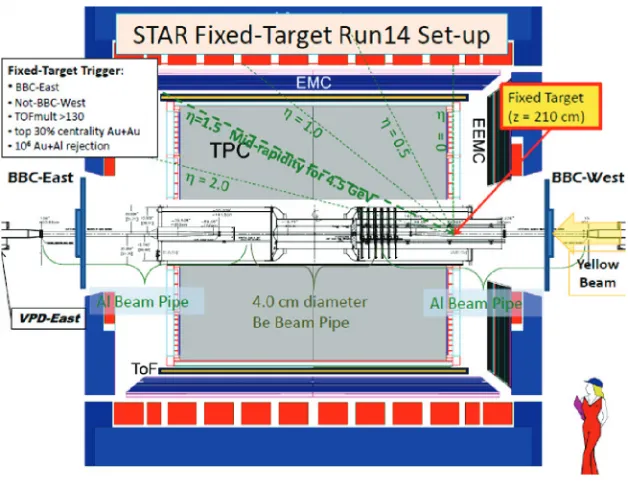
the collider mode (see Fig.1). These energies correspond to collisions between projectiles tuned for collisions at 7.7, 9.1, 11.5, 14.5 and 19.6 GeV respectively and the stationary gold fixed-target. Fixed-target collisions would allow for extension of the range of accessible baryon chemical potential from the current maximum of about μB ~ 400 MeV up to ~ 750-800 MeV in the QCD phase diagram. The proof of principle was already successfully tested in run 14 during the 14.5 GeV Au+Au program. The stationary gold target was mounted at the entry to the TPC as shown in Fig. 6. Preliminary data show that the fixed-target trigger was properly selecting fixed-target events and rejecting beam-beam collisions. Figure 7 shows a display of one of the fixed-target events from run 14.
Figure 6: A schematic diagram of STAR showing the fixed-target location for the test in 2014. The target is a 1mm thick gold foil, the projectiles are ions from the halo of the yellow beam (west side).
It will be possible to cross-check the results of the fixed-target program with those of the collider program. This very important check can be done by tuning the collider for 62.4 GeV collisions and take fixed-target data with one of the beams on the stationary target. These fixed-target datasets will be taken at √sNN = 7.7 GeV, and could be directly compared to the 7.7 GeV collider data.
The primary physics goals of this part of the program will focus on observables, which are sensitive to a softening of the equation of state, as it is expected that the first entry into the mixed-phase will occur at energies below the onset of deconfinement [19, 20, 21].
Figure 7: The reconstructed tracks from an interaction between a nucleus in the beam halo and a gold nucleus in the stationary target positioned at the entrance to the TPC (z=210 cm), see figure 6. This is a central event at √sNN
= 3.9 GeV (Au beams with ETotal of 7.25 GeV on stationary target).
4 Concluding remarks
RHIC “sits” at a ”sweet spot” in energy, in which rapid changes occur in a number of signatures for energies up to approximately 20 GeV, while remaining surprisingly stable over two orders of magnitude to the LHC. The BES I data shows that several observables associated with the formation of partonic phase at the top RHIC energies have been turned-off at lower energies and that there, at the lower energies, hadronic interactions dominate the scene. An important measurement towards establishing a position of the critical point and the location of the 1st
order phase transition has been made. Those results provided clear directions for the second part of the BES program which will cover energies below √sNN = 20 GeV. Collider mode operation will span from √sNN of 20 to 7.7 GeV,
while fixed-target will extend a reach to energies as low as √sNN = ~ 3 GeV. Both collider and experiment are prepared for a challenge. With BES phase II the most exciting physics is still to come.
References
1. STAR White Paper, J. Adams et al., [STAR Coll.], Nucl. Phys. A 757 (2005) 102; J. Adams et al., [STAR Coll.], Phys. Rev. Lett. 92 (2004) 052302; Phys. Rev. Lett. 95 (2005) 122301
2. F. Karsch et al., Nucl. Phys. Proc. Suppl. 129 (2004) 614
3. M. Cheng et al., Phys. Rev. D 79, 074505 (2009) and references therein 4. Y. Aoki et al., Nature 443, 675 (2006)
5. S. Ejiri, Phys. Rev. D 78, 074507 (208); E.S. Bowman and J.I.Kapusta, Phys. Rev. C 70, 015202 (2009)
7. D. McDonald, this proceedings
8. C.Alt et al., [NA 49 Collaboration], Phys. Rev. C 81 (2010) 024911 9. L. Ahle et al., [E866 and E917 Coll.], Phys. Lett. B 476 (2000) 1 10. L. Ahle et al., [E866 and E917 Coll.], Phys. Lett. B 790 (2000) 53 11. L. Ahle et al., [E802 Coll.], Phys. Rev. C 57 (1998) 466
12. L. Ahle et al., [E802 and E866 Coll.], Phys. Rev. C 60 (1999) 044904 13. J.L.Klay et al., [E895 Coll.], Phys. Rev. Lett. 88 (2002) 102301 14. J.Berrette et al., [E877 Coll.], Phys. Rev. C 62 (2000) 024901 15. S.V.Afanasiev, et al., [NA49 Coll.], Phys. Rev. C 66 (2002) 054902 16. C.Alt et al., [NA49 Coll.], Phys. Rev. C 77 (2008) 024903
17. E.O’Brien et al., [PHENIX Coll.], Nucl. Phys. A 904, 905 (2013], 264c 18. B.Abelev et al., [ALICE Coll.], Phys. Rev. C 88 (20130 044910 19. I.C.Arsene et al., Phys. Rev. C 75 (2007) 034902
20. J.Randrup, Phys. Rev. C 79 (2009) 054911 21. J.Randrup, Phys. Rev. C 82 (2010) 034902
![Figure 5: Left panel: Center-of-mass energy dependence of <mTRHIC. Also shown are corresponding results from AGS [9, 10, 11, 12, 13, 14], SPS [15, 16] and LHC [17]](https://thumb-us.123doks.com/thumbv2/123dok_us/8173566.1364935/7.482.45.424.374.514/figure-left-center-energy-dependence-mtrhic-corresponding-results.webp)