1
Microstructure and composition evolution of a fused
slurry
silicide coating on MoNbTaTiW refractory
high-entropy alloy in high-temperature oxidation
environment
Jiesheng Han
a,b, Bo Su
b, Junhu Meng
b,*, Aijun Zhang
b, Youzhi Wu
a,*
a School of Materials Science and Engineering, Lanzhou University of Technology,Lanzhou 730050, China
b State Key Laboratory of Solid Lubrication, Lanzhou Institute of Chemical Physics,
Chinese Academy of Sciences, Lanzhou 730000, China
*Correspondence: [email protected] (Y. Wu), [email protected] (J. Meng).
Abstract
The poor oxidation resistance of refractory high-entropy alloys (RHEAs) is a
major obstacle for their use in high-temperature engineering applications.
Anti-oxidation coating technology is an effective method for improving the oxidation
resistance. In this paper, the Si-20Cr-20Fe coating was prepared on MoNbTaTiW
RHEA by a fused slurry method. The microstructural evolution and compositions of
the silicide coating under high-temperature oxidation environment were studied. The
2
results show that the silicide coating could effectively prevent the oxidation of the
MoNbTaTiW RHEA. The initial silicide coating had a double-layer structure; a high
silicon-content layer mainly composed of MSi2 as the outer layer and a low
silicon-content layer mainly contained M5Si3 as the inner layer. Under
high-temperature oxidation conditions, the silicon element diffused from the silicide
coating to the RHEA substrate while the oxidation of the coating occurred. After
oxidation, the coating was composed of an outer oxide layer and an inner silicide
layer. The silicide layer moved toward the inside of the substrate, led to the increase
of its thickness. Compared with the initial silicified layer, its structure did not change
significantly. The structure and compositions of the oxide layer on the outer surface
strongly depended on the oxidation temperature. This paper provides a strategy for
protecting RHEAs from oxidation at high-temperature environments.
Keywords: refractory high-entropy alloys, fused slurry method, silicide coating,
Si-20Cr-20Fe, high-temperature oxidation
1. Introduction
Refractory high-entropy alloys (RHEAs) are considered to be a new generation
3
alloys (HEAs) and refractory metals (RMs), such as high-temperature strength, high
hardness, and good phase stability at high temperatures [1-7]. They are mainly
composed of Mo, Nb, Ta, and W, while Ti, Cr, V, Si, and Al are usually used as
strengthening alloy elements [8-14]. For example, Mo25Nb25Ta25W25 and
Mo20Nb20Ta20W20V20 are two types of most extensively studied RHEAs [7]. The
neutron diffraction analysis of those alloys after annealing at 1400 oC for 19 h shows
that no changes have occurred to their phase structures. Their compression yield
strengths are much higher than that of Inconel 718 alloy at temperatures above 800 oC.
Furthermore, their yield strengths are still higher than 500 MPa at 1200 oC [15,16].
However, the poor oxidation resistance of RHEAs is a major obstacle for their use in
high-temperature engineering applications, as are RMs. Successful applications of
RMs in various turbines have suggested that their service lives may largely depend on
their high-temperature oxidation resistance rather than their high-temperature
mechanical properties [17]. Therefore, the improvement of their oxidation resistance
is a prerequisite for the successful application of RHEAs in high-temperature
oxidation environments.
The addition of anti-oxidant alloy elements is one of the strategies to improve the
oxidation resistance of RHEAs, but which inevitably diminishes the mechanical
properties . It is necessary to find a balance between the high-temperature mechanical
properties and the oxidation resistance[18]. In the past years, more than 20 types of
4
alloy addition. The alloying elements enable the formation of protective oxide layers
at elevated temperatures [19-23]. Gorr. et al. reported three equiatomic AlCrMoTi-X
(X = Nb, W, or Ta) RHEAs [24]. In their work, the RHEAs sheets were exposed to air
at temperatures from 900 oC to 1000 oC for 48 h. The results showed that the mass of
the RHEAs increased less than those of RMs and TaAlCrMoTi RHEA had the
superior anti-oxidant property. Other studies have also showed that the addition of Ti
is beneficial to the oxidation resistance of RHEAs [20-22, 24].
Preparing anti-oxidation coatings on surfaces is another effective method to
improve the oxidation resistance of RMs, allowing them to be successfully applied in
engineering applications under high-temperature oxidation environments. Among
anti-oxidation coatings, silicide coatings have been widely used to protect RMs and
many studies have addressed on the Si-20Cr-20Fe coating. The technical report
(AFML-TR-68-210) of the Air Force Materials Laboratory (USA) opened up the
possibility of protecting RMs with fused silicide coatings [25]. It suggested that the
Si-20Cr-20Fe coating was very stable in air at 1360 oC, and it was considered as the
best candidate for protecting niobium alloys. The Si-20Ti-10Mo and Si-20Cr-1/2B4Si
coatings were identified as better choices for tantalum and molybdenum alloys,
respectively, because they can be reliably used at 1760 oC. The technical report of the
NASA Contract (NGR-27-003-001) characterized the microstructure of the
Si-20Cr-20Fe coating on a niobium alloy [26]. The technical report (NASA TN
5
different RMs (FS-85, C-129Y, and Cb-752) in stagnation model plasma arc tests[27].
The technical report (NASA TN contractor report 201753) reported that the
Si-20Cr-20Fe coating provided very good oxidation protection for Mo-Re alloys at
1260 oC and Mach 4 in the Hypersonic Materials Environmental Test System at the
NASA Langley Research Center [28]. The Si-20Cr-20Fe coating had very stable
performance in a combustion atmosphere at 1360 oC and could withstand hundreds of
thermal shocks, It has been successfully used as a high-temperature protective coating
for niobium alloy nozzles of F100 rocket engines [29]. Sankar et al. analyzed the
microstructure and composition evolution of the Si-20Cr-20Fe coating on C103 alloy
during oxidation and explained the formation and oxidation resistance mechanisms of
the silicide coating [30].
The aim of this paper is to explore the feasibility of the Si-20Cr-20Fe coating in
improving the oxidation resistance of MoNbTaTiW RHEA. The Si-20Cr-20Fe
coating was prepared on the surface of MoNbTaTiW RHEA by a fused slurry method.
To show the anti-oxidation mechanism of the silicide coating, the evolution of the
structure and compositions of the coating at 1000 oC and 1300 oC were studied.
2. Materials and methods
6
spark plasma sintering. Commercially available Mo, Nb, Ta, Ti, and W elemental
powders were used as raw materials. The purity of all the powders was higher than
99.5%. The particle size of Mo, Nb, Ta and Ti were less than 38 m and that of W
was less than 5 m. After being proportioned in an equal molar ratio, the powders
were mixed by planetary ball milling for 6 h. The mixed powders were put into a
graphite mold and sintered in a spark plasma sintering furnace by vacuum hot
pressing. The sintering temperature was 1500 oC, the pressure was 30 MPa, and the
holding time was 20 min. The as-prepared MoNbTaTiW RHEA was used as the
substrates. The MoNbTaTiW RHEA was cut into 5 mm × 5 mm × 20 mm cuboids
whose surfaces were polished using 2000 mesh sandpaper and cleaned with acetone.
A Si-20Cr-20Fe (wt.%) coating was prepared on the RHEA cuboids by a fused
slurry method. The particle size of Si powder was less than 10 m, and that of Cr
powder and Fe powder was less than 76 m. The purity of those powders was higher
than 99.5%. Firstly the Si-20Cr-20Fe mixed powder was uniformly milled. Then a
polyethylene alcohol aqueous solution with a concentration of 4% that was used as a
binder was added to the slurry. Subsequently, the RHEA cuboids were immersed in
the slurry and lifted at a fixed speed, followed by drying and solidification at 80 oC in
an oven. Finally, the RHEA cuboids coated with slurry were placed in a vacuum oven
under a 5 × 10⁻³ Pa pressure and held at 1430 oC for 1 h to obtain a silicide coating.
7
RHEA, and the XRD diffraction patterns of the RHEA and the coating slurry are
shown in Fig. 1. It can be seen that the RHEA has a single BCC phase and the coating
slurry is a mixture of Si, Cr and Fe.
For oxidation tests, the coated RHEA cuboids were cut into cube slices with a
size of 5 mm × 5 mm × 5 mm. The side surfaces of the cube slices were bare
MoNbTaTiW RHEA without the silicide coating. The cube slices were placed in an
alumina crucible and positioned in a box furnace. The experimental parameters of
oxidation were as follows: the heating rate was 10 oC/min; the oxidation temperature
was set to 1000 oC and 1300 oC; the oxidation time was 1 h; static atmosphere.
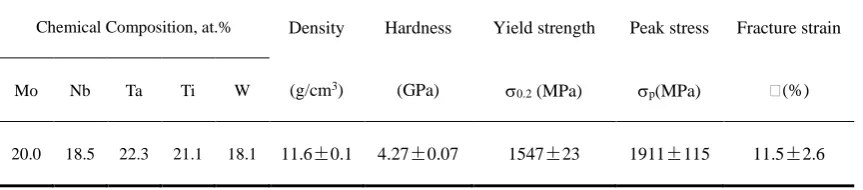
Table 1 Chemical compositions and properties of the MoNbTaTiW RHEA.
Chemical Composition, at.% Density (g/cm3)
Hardness (GPa)
Yield strength
0.2 (MPa)
Peak stress
p(MPa)
Fracture strain (%)
Mo Nb Ta Ti W
8
Fig. 1. XRD diffraction patterns of (a) the coating slurry and (b) the MoNbTaTiW RHEA.
The crystal structures were determined by X-ray diffraction (XRD, Empyrean).
The surfaces and structures of the silicide coating were observed using scanning
electron microscopy (SEM, JSM-5600LV). The chemical compositions of the
samples were examined by energy dispersive spectroscopy (EDS, X-MaxN).
3. Results and discussion
3.1. Morphology and microstructure of the silicide coating
Fig. 2(a) shows the surface morphology of the fused slurry silicide coating
prepared on MoNbTaTiW RHEA. The coating had a rough surface on which holes
and cracks can be found. Fig. 2(b) shows its XRD pattern. As can be seen, the coating
is composed of disilicide (MSi2,M = W, Ti, Mo, and Ta), ternary silicide (Cr4Nb2Si5),
9
Fig. 2. (a) SEM image of the surface of the silicide coating and (b) its XRD pattern.
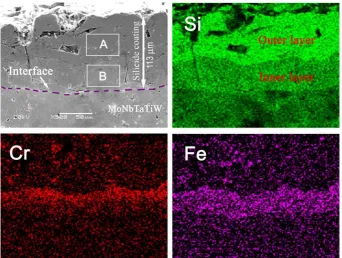
Fig. 3 shows the cross-section of the silicide coating and the EDS elemental
mappings of Si, Cr, and Fe. It can be seen that the silicide coating was about 113 μm
thick. According to the distribution of silicon content, the silicide coating had a
double-layer structure; a thicker outer layer contained a higher content of silicon and a
thinner inner layer had a lower content of silicon. For example, the average atomic
percentages of Si in regions A and B in Fig. 3(a) were 66.2% and 37.9%, respectively.
However, it should be noted that the contents of both Cr and Fe in the inner layer are
much higher than those in the outer layer. It also can be seen that some cracks
propagated from the surface to the inner layer of the silicide coating and even to the
interface between the silicide coating and the RHEA substrate.
Previous investigations of silicide coatings on niobium alloys and tantalum
alloys have shown that the outermost layers of the silicide coatings are disilicide
layers, and the inner layers are low silicide layers [30-32]. In disilicide MSi2 and low
silicide M5Si3, the theoretical percentages of Si atoms are 66.7% and 37.5%,
respectively. Therefore, it can be inferred that the outer layer of the silicide coating
consisted of disilicide (MSi2) while the inner layer was composed of lower silicide
(mainly M5Si3), because silicidation and diffusion reactions occurred on the surface of
the MoNbTaTiW RHEA substrate. This result is consistent with the XRD result as
10
Fig. 3. SEM image of the cross-section of the silicide coating and its EDS elemental mapping.
3.2. Oxidation behavior of the silicide coating
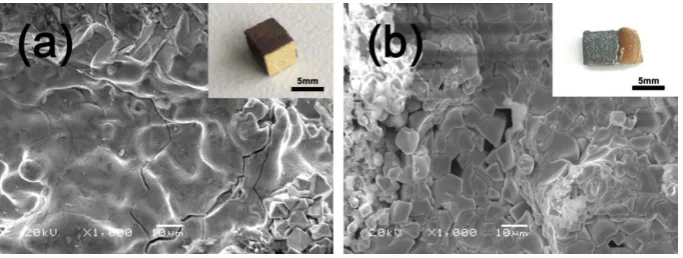
Fig. 4 shows the morphologies of the silicide coating after oxidation at different
temperatures. After oxidation at 1000 oC, the surface of the silicide coating had
characteristics of solidification after melting and oxide crystallization. The silicide
coating became brown and was quite rough, and many cracks were generated on its
surface. The uncoated side surfaces were oxidized to form a yellow oxide scale (Fig.
4(a)). After oxidation at 1300 oC, the silicide coating became gray and an extremely
thick brown oxide coating was formed on the uncoated side surfaces. The surface of
11
Fig. 4. SEM images of the surfaces of the silicide coatings after oxidation at different temperatures: (a)1000 oC and (b) 1300 oC. Inserts are the corresponding coated samples after oxidation.
Fig. 5 shows the XRD patterns of the surfaces of the silicide coating after
oxidation at different temperatures. As can be seen, after oxidation at 1000 oC, the
surface of the coating consisted of SiO2, Ti2O, Cr2SiO4, Ta0.3W0.7O2.85, and
Ti0.67Nb1.33O4 (Fig. 5(a)). After oxidation at 1300 oC, that was composed of CrNbO4,
SiO2, WO3, and Fe2(SiO4) (Fig. 5(b)).
Fig. 5. XRD patterns of the surfaces of the silicide coating after oxidation at (a) 1000 oC and (b) 1300 oC.
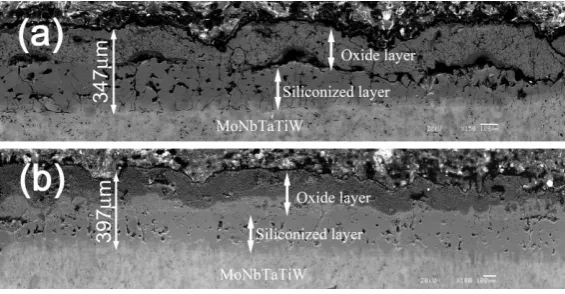
Fig. 6 shows the cross-section of the silicide coatings after oxidation at 1000 oC
12
As shown in Fig. 6, all the oxidized silicide coatings had a multi-layered structure.
The increases in the thickness of the coating were due to the continued diffusion
reaction of Si, Cr, and Fe elements to the RHEA substrate at high temperatures. All
the elements of the outer layer suffered from oxidation. Both the oxidized silicide
coatings maintained good integrity, but the average thickness of the coatings
increased significantly during the oxidation process. The thicknesses of the silicide
coating oxidized at 1000 oC was 347 μm and that was about 397 μm after oxidation at
1300 oC, respectively. Based on the XRD analysis result of the surfaces after
oxidation (Fig. 5) and the EDS mapping, the outer layer was an oxide layer and the
inner layer was a silicide layer. The coating oxidized at 1300 oC was thicker than the
one oxidized at 1000 oC because of the higher diffusion rate of silicon, and the silicon
had a deeper diffusion distance at the higher oxidation temperature [33].
13
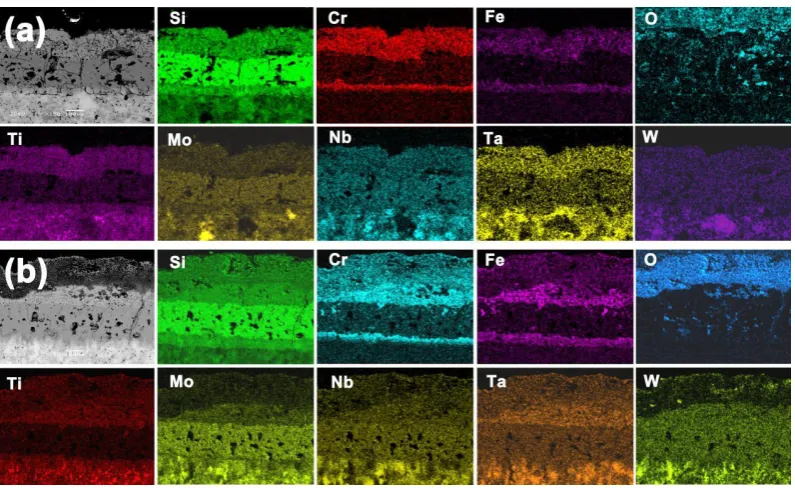
Fig. 7. EDS mappings of the cross-section of the silicide coating after oxidation at (a) 1000 oC and (b) 1300 oC.
However, there were significant differences in the structures of the coatings after
oxidation at 1000 oC and 1300 oC. Fig. 6(a) shows that the oxide layer exhibited a
bulge phenomenon, and a gap appeared between the oxide and silicide layer after
oxidation at 1000 oC. Many holes and cracks were found in the silicide layer. The
cracks were originated from the interface between the silicide and oxide layers and
terminated at the interface between the silicide layer and REHA substrate. According
to the XRD analysis of the coating surface, the oxide scale was composed of silicon
dioxide and complex metal oxides. The swelling of the oxide layer may have been
14
were resulted from the diffusion of a large number of silicon atoms into the RHEA
substrate [34].
After oxidation at 1300 oC, although the thickness of the coating increased, it still
had a double-layer structure containing oxide and silicide layers, as shown in Fig. 6(b).
Compared with the coating oxidized at 1000 oC, there was no gap existed between the
oxide and silicide layers, though there are also many holes and cracks were formed in
the silicide layer. According to the XRD analysis of the outer surface of the coating,
the oxide layer mainly consisted of complete oxides of silicon and other metal
elements, but no oxides of Mo and Ta were detected. The complete oxidation of the
metal and silicon could cause a significant increase in the oxide layer volume,
whereas the volatilization of some oxides (such as MoO3) could cause the loss of the
oxide layer and reduce the volume [34]. Consequently, the volume of the oxide layer
was basically the same as that of the initial silicide layer. Therefore, no bulge
phenomenon and cracks appeared between the oxide layer and the silicide layer.
Comparing Figs. 4 and 7, the silicon element diffused into the MoNbTaTiW
RHEA substrate at high temperatures, and the siliconized layer moved toward the
substrate. The double-layer structure of the siliconized layer oxidized at 1000 oC and
1300 oC was the same as the structure of the initial siliconized layer, containing an
outer high-silicon-content layer and an inner low-silicon-content layer. However,
there were significant differences in the oxygen content and structure of the oxide
15
structure at 1000 oC and a double-layer structure at 1300 oC. The distributions of Si,
Cr, and Fe were significantly different. The outermost layer had a relatively high
oxygen content at the higher oxidation temperature. It is worth noting that the
contents of Cr and Fe in the siliconized layer with a low content of silicon were
significantly higher than those existed in the siliconized layer with a high content of
silicon. Some Cr and Fe elements spread to the RHEA substrate with the Si, but at a
much lower diffusion rate than that of the Si element.
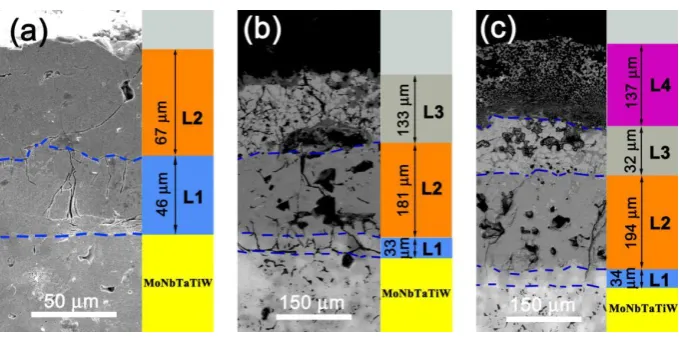
According to the above analysis, the initial silicide coating had a two-layer
structure. After oxidation at 1000 oC, the coating had a three-layer structure of which
two layers were silicide layers and one layer was an oxide layer. After oxidation at
1300 oC, the coating had four layers; two were silicide layers and two were oxide
layers. Fig. 8 shows a structural diagram of the coating in these three states. Based on
the differences in the silicon and oxygen contents in each layer, the four layers were
labeled as L1, L2, L3, and L4, where L1 represents the low-silicon-content siliconized
layer combined with the substrate, L2 represents the high-silicon-content siliconized
layer, L3 represents the low-oxygen-content oxide layer, and L4 represents the
complete oxide layer. The average thickness of the L1 layer in the initial coating was
about 46 µm, and decreased to about 33 and 34 µm after oxidation at 1000 oC and
1300 oC, respectively. As a transition layer between the substrate and the coating, the
thickness of the low-silicon-content silicide layer seemed not to have a significant
16
layer of the initial coating was about 67 µm, and those of the L2 layers after oxidation
at 1000 oC and 1300 oC were about 181 and 194 µm, respectively. Thus, during the
oxidation process, silicon continued to diffuse into the substrate, and the thickness of
the siliconized layer with a high silicon content are more than doubled. After
oxidation at 1000 oC, the average thickness of the oxide layer L3 was about 133 µm.
After oxidation at 1300 oC, the average thickness of the oxide layer was about 169 µm,
which the average thickness of the fully oxidized layer L4 was about 137 µm and that
of the L3 layer was about 32 µm.
Fig. 8. SEM images of the cross-section of the coatings in different states: (a) initial silicide coating, (b) oxidized at 1000 oC, and (c) oxidized at 1300 oC.
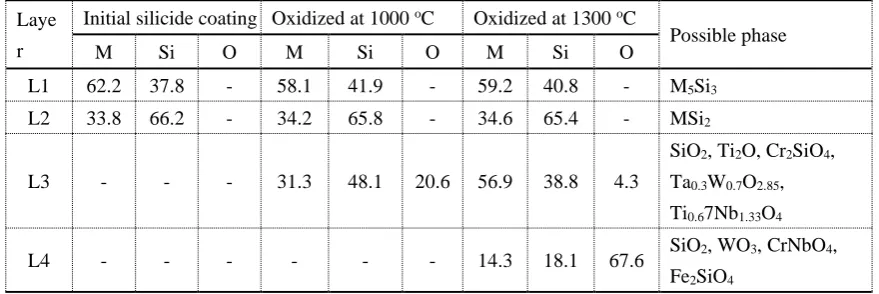
Table 2 summarizes the contents of the metal elements, silicon, and oxygen and
possible phases existed in the L1, L2, L3, and L4 layers shown in Fig. 8. The silicon
content in L1 and L2 had specific values. In the L1 layer, the ratio of the total number
of moles of metal elements to that of silicon atoms was about 5:3, while the ratio was
17
various metals, which is in consistent with the XRD pattern in Fig. 2(b). Therefore, it
can be concluded that L2 with a high silicon content was composed of metal
disilicides. Some studies have shown that the silicide of the transition layer was M5Si3
[25-30,34]. In this work, the atomic ratio of metals to silicon in the L1 layer was
basically the same as that of M5Si3, indicating that the silicide in the L1 layer was
M5Si3. According to the analysis by EDS (see Table 2), L3 consisted of complex
metal oxides and silicon dioxide. L4 consisted of complete oxides of silicon and metal
elements. In L4 layer, because silicon and all the metal elements were completely
oxidized, it had the highest oxygen content.
Table 2. Relative contents of metal, silicon, and oxygen in the different layers measured by EDS, and possible phases for the three states: initial silicide coating, oxidized at 1000 oC, and oxidized at 1300 oC.
Laye r
Initial silicide coating Oxidized at 1000 oC Oxidized at 1300 oC
Possible phase
M Si O M Si O M Si O
L1 62.2 37.8 - 58.1 41.9 - 59.2 40.8 - M5Si3
L2 33.8 66.2 - 34.2 65.8 - 34.6 65.4 - MSi2
L3 - - - 31.3 48.1 20.6 56.9 38.8 4.3
SiO2, Ti2O, Cr2SiO4,
Ta0.3W0.7O2.85,
Ti0.67Nb1.33O4
L4 - - - 14.3 18.1 67.6 SiO2, WO3, CrNbO4,
Fe2SiO4
Note: M is the sum of the atomic ratios of all the metal elements.
3.3. Evolution of the structure and compositions of silicide coating during the
18
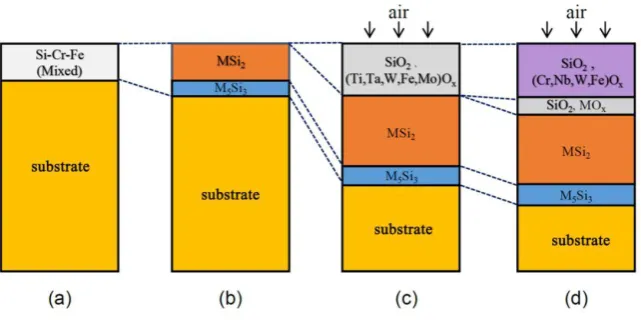
Fig. 9 shows a schematic diagram of the structure and composition evolution of
the Si-20Cr-20Fe coating during preparation and oxidation. Based on the analysis in
Sections 3.1 and 3.2,, in the initial silicide coating and the coatings after oxidation at
1000 oC and 1300 oC, L1 was M5Si3, L2 was MSi2, and L3 was a complex oxide layer
containing SiO2 and metal oxides. L4 was a complete oxide layer that was composed
of SiO2 and metal oxides.
Fig. 9. Schematic diagram of the evolution of the structure and compositions of the silicide coating during the preparation and oxidation processes: (a) slurry state, (b) initial silicide coating, (c) oxidized at 1000 oC, and (d) oxidized at 1300 oC.
At 1430 oC, the MoNbTaTiW RHEA substrate reacted with the molten
Si-20Cr-20Fe slurry to form a double-layered silicide coating (Fig. 9(a),(b)). This
silicidation reaction was quite complicated, all the metal elements including Nb, Mo,
Ta, Ti, W, Cr, and Fe participated the reaction. Samosonov et al. established the
relationship between the enthalpies of silicide formation and the silicon content,
19
increasing silicon content. It indicated that the silicide tended to bind more silicon and
disilicide had the best stability [35]. Therefore, the surface of the initial silicide
coating contained enough silicon atoms to form a disilicide layer, and, the reaction
layer existed in the form of M5Si3 at the interface. The difference of the Gibbs free
energies between MSi2 and 1/5M5Si3 (M = Ta and Ti) was very smaller than those of
other elements [35]. This may lead to the appearance of Ti5Si3 and Ta5Si3 in the
silicide coating. The silicide of Fe could not be detected by XRD. Nb, Cr, and Si
formed a ternary silicide Cr4Nb2Si5 whose silicon content was between those of MSi2
and M5Si3. During the oxidation process of the silicide coating at high-temperature
oxidation environment (Fig. 9(c),(d)), the silicon element diffused into the RHEA
substrate, making the silicided layer move toward the substrate. With the increasing
temperature, the degree of oxidation of metal elements was more complete and the
oxide layer became thicker, and the oxide layer evaluated to a double-layer structure
after oxidation at 1300 oC. There were no significant differences in the thickness,
structure, and chemical compositions of the silicide layer.
4. Conclusions
The Si-20Cr-20Fe coating was prepared on the surface of MoNbTaTiW RHEA
by a fused slurry method. The initial silicide coating had a double-layer structure
20
high-temperature oxidation conditions, the silicon element diffused from the silicide
coating to the RHEA substrate while the oxidation of the coating occurred. After
oxidation, the coating was composed of an outer oxide layer and an inner silicide
layer. The silicide layer with a double-layer structure moved toward the substrate, led
to the increase of its thickness. Compared with the initial silicified layer, the basic
structure did not change significantly. The structure and compositions of the oxide
layer on the outer surface strongly depended on the oxidation temperature. This paper
provides a strategy for protecting RHEAs from oxidation at high-temperature
environments.
Acknowledgments
This work was supported by a grant from Major Programs of the Chinese
Academy of Sciences during the 13th Five-Year Plan Period.
References
[1] M.H. Tsai, J.W. Yeh, High-Entropy Alloys: A Critical Review, Mater. Res. Lett. 2
(2014) 107-123. https://doi.org/10.1080/21663831.2014.912690.
[2] M.C. Gao, Progress in High-Entropy Alloys, JOM. 66 (2014) 1964-1965.
21
[3] J.M. Torralba, P. Alvaredo, A. García-Junceda, High-entropy alloys fabricated via
powder metallurgy. A critical review, Powder Metall. 62 (2019) 84-114.
https://doi.org/10.1080/00325899.2019.1584454.
[4] A.B. Melnick, V.K. Soolshenko, Thermodynamic design of high-entropy
refractory alloys, J. Alloy. Compd. 694 (2017) 223-227.
https://doi.org/10.1016/j.jallcom.2016.09.189.
[5] H.W. Yao, J.W. Qiao, J.A. Hawk, H.F. Zhou, M.W. Chen, M.C. Gao, Mechanical
properties of refractory high-entropy alloys: Experiments and modeling, J. Alloy.
Compd. 696 (2017) 1139-1150. https://doi.org/10.1016/j.jallcom.2016.11.188.
[6] M.C. Gao, C.S. Carney, Ö.N. Doğan, P.D. Jablonksi, J.A. Hawk, D.E. Alman,
Design of Refractory High-Entropy Alloys, JOM 67 (2015) 2653-2669.
https://doi.org/10.1007/s11837-015-1617-z.
[7] O. Senkov, D. Isheim, D. Seidman, A. Pilchak, Development of a Refractory High
Entropy Superalloy, Entropy 18 (2016) 102. https://doi.org/10.3390/e18030102.
[8] J.M. Park, J.W. Kang, W.H. Lee, S.Y. Lee, S.H. Min, T.K. Ha, H.K. Park,
Preparation of spherical WTaMoNbV refractory high entropy alloy powder by
inductively-coupled thermal plasma, Mater. Lett. 255 (2019) 126513.
https://doi.org/10.1016/j.matlet.2019.126513.
[9] H. Dobbelstein, E.L. Gurevich, E.P. George, A. Ostendorf, G. Laplanche, Laser
22
alloys using elemental powder blends, Addit. Manuf. 25 (2019) 252-262.
https://doi.org/10.1016/j.addma.2018.10.042.
[10] S.Y. Chen, Y. Tong, K.K. Tseng, J.W. Yeh, J.D. Poplawsky, J.G. Wen, M.C.
Gao, G. Kim, W. Chen, Y. Ren, R. Feng, W.D. Li, P.K. Liaw, Phase
transformations of HfNbTaTiZr high-entropy alloy at intermediate temperatures,
Scr. Mater. 158 (2019) 50-56. https://doi.org/10.1016/j.scriptamat.2018.08.032.
[11] Z.D. Han, H.W. Luan, X. Liu, N. Chen, X.Y. Li, Y. Shao, K.F. Yao,
Microstructures and mechanical properties of Ti NbMoTaW refractory
high-entropy alloys, J. Mater. Eng. A 712 (2018) 380-385.
ttps://doi.org/10.1016/j.msea.2017.12.004.
[12] O.N. Senkov, D.B. Miracle, K.J. Chaput, J.P. Couzinie, Development and
exploration of refractory high entropy alloys-A review, J. Mater. Res. 33 (2018)
3092-3128. https://doi.org/10.1557/jmr.2018.153.
[13] O.N. Senkov, S. Gorsse, D.B. Miracle, High temperature strength of refractory
complex concentrated alloys, Acta Mater. 175 (2019) 394-405.
https://doi.org/10.1016/j.actamat.2019.06.032.
[14] S. Sheikh, M.K. Bijaksana, A. Motallebzadeh, S. Shafeie, A. Lozinko, L. Gan,
T.K. Tsao, U. Klement, D. Canadinc, H. Murakami, S. Guo, Accelerated
oxidation in ductile refractory high-entropy alloys, Intermetallics 97 (2018)
23
[15] O.N. Senkov, G.B. Wilks, D.B. Miracle, C.P. Chuang, P.K. Liaw, Refractory
high-entropy alloys, Intermetallics 18 (2010) 1758-1765.
https://doi.org/10.1016/j.intermet.2010.05.014.
[16] O.N. Senkov, G.B. Wilks, J.M. Scott, D.B. Miracle, Mechanical properties of
Nb25Mo25Ta25W25 and V20Nb20Mo20Ta20W20 refractory high entropy
alloys, Intermetallics 19 (2011) 698-706.
https://doi.org/10.1016/j.intermet.2011.01.004.
[17] P. Gasson, Encyclopedia of Aerospace Engineering: Volume 4: Materials
Technology.Aeronaut. J. 116 (2012) 326-328.
https://doi.org/10.1017/S0001924000006886.
[18] B. Gorr, F. Mueller, H.J. Christ, H. Chen, A. Kauffmann, R. Schweiger, D.V.
Szabó, M. Heilmaier, Development of Oxidation Resistant Refractory High
Entropy Alloys for High Temperature Applications: Recent Results and
Development Strategy, In: & Materials Society T. (eds) TMS 2018 147th Annual
Meeting & Exhibition Supplemental Proceedings. TMS 2018. The Minerals,
Metals & Materials Series. Springer, Cham
https://doi.org/10.1007/978-3-319-72526-0_61.
[19] P. Zhang, Y. Li, Z. Chen, J. Zhang, B. Shen, Oxidation response of a vacuum arc
melted NbZrTiCrAl refractory high entropy alloy at 800–1200 °C, Vacuum 162
24
[20] L. Rudolf Kanyane, A. Patricia Popoola, N. Malatji, Development of spark
plasma sintered TiAlSiMoW multicomponent alloy: Microstructural evolution,
corrosion and oxidation resistance, Results Phys. 12 (2019) 1754-1761.
https://doi.org/10.1016/j.rinp.2019.01.098.
[21] T.K. Tsao, A.C. Yeh, C.M. Kuo, H. Murakami, High Temperature Oxidation and
Corrosion Properties of High Entropy Superalloys, Entropy 18 (2016) 62.
https://doi.org/10.3390/e18020062.
[22] O.N. Senkov, S.V. Senkova, D.M. Dimiduk, C. Woodward, D.B. Miracle,
Oxidation behavior of a refractory NbCrMo0.5Ta0.5TiZr alloy, J. Mater. Sci. 47
(2012) 6522-6534. https://doi.org/10.1007/s10853-012-6582-0.
[23] C.M. Liu, H.M. Wang, S.Q. Zhang, H.B. Tang, A.L. Zhang, Microstructure and
oxidation behavior of new refractory high entropy alloys, J. Alloy. Compd. 583
(2014) 162-169. https://doi.org/10.1016/j.jallcom.2013.08.102.
[24] B. Gorr, F. Mueller, H-J. Christ, T. Mueller, H. Chen, A. Kauffmann, and M.
Heilmaier: High temperature oxidation behavior of an equimolar refractory
metal-based alloy 20Nb-20Mo-20Cr-20Ti-20Al with and without Si addition. J.
Alloy.Comp. 688, 468 (2016). https://doi.org/10.1016/j.jallcom.2016.07.219.
[25] S. Priceman, L.Sama, Technical report TR-68-210, Development of fused slurry
silicide coatings for the elevated temperature oxidation protection of columbium
and tantalum alloys, AFMLWPAFB , Dec.1968.
25
[26] V. Griffiths, Technical report NGR-27-003-001, A metallographic evaluation of
some coated columbium alloys, NASA, Jan. 1972.
https://ntrs.nasa.gov/archive/nasa/casi.ntrs.nasa.gov/19720022815.pdf.
[27] S.R. Levine, J.P. Merutka, Technical report TN D-7617, Performance of coated
columbium ad tantalum alloys in plasma arc reentry simulation tests, NASA,
May 1974.
https://ntrs.nasa.gov/archive/nasa/casi.ntrs.nasa.gov/19740015000.pdf.
[28] D.E. Glass, Technical report 201753, Oxidation and Emittance Studies of Coated
Mo-Re, NASA, OCT 1997.
https://ntrs.nasa.gov/archive/nasa/casi.ntrs.nasa.gov/19980000283.pdf.
[29] C. Stechman, C. Lawson, Historical Evolution of the Space Shuttle Primary and
Vernier Reaction Control Rocket Engine Designs, in: 42nd
AIAA/ASME/SAE/ASEE Joint Propulsion Conference & Exhibit, Jule 2006.
https://doi.org/10.2514/6.2006-4892.
[30] M. Sankar, V.V. Satya Prasad, R.G. Baligidad, M.Z. Alam, D.K. Das, A.A.
Gokhale, Microstructure, oxidation resistance and tensile properties of silicide
coated Nb-alloy C-103, Mater. Sci. Eng., A 645 (2015) 339-346.
https://doi.org/10.1016/j.msea.2015.07.063.
[31] S. Majumdar, P. Sengupta, G.B. Kale, I.G. Sharma, Development of multilayer
oxidation resistant coatings on niobium and tantalum, Surf. Coat. Tech. 200
26
[32] G.W. Goward, Protective Coatings - Purpose, Role, and Design, Mater. Sci.
Technol. 2 (1986) 194-200. https://doi.org/10.1179/mst.1986.2.3.194.
[33] Novak, Mark D., and Levi, Carlos G. Oxidation and Volatilization of Silicide
Coatings for Refractory Niobium Alloys. Proceedings of the ASME 2007
International Mechanical Engineering Congress and Exposition. Volume 1:
Advances in Aerospace Technology. Seattle, Washington, USA. November 11–
15, 2007. pp. 261-267. ASME. https://doi.org/10.1115/IMECE2007-42908.
[34] A. Mueller, W. Ge, R.A. Rapp, E.L. Courtright, T.A. Kircher, Oxidation
Behavior of Tungsten and Germanium-Alloyed Molybdenum Disilicide
Coatings, Mater. Sci. Eng., A 155 (1992) 199-207.
https://doi.org/10.1016/0921-5093(92)90326-V.
[35] G. V. Samsonov, I. M. Vinitskii, Handbook of Refractory Compounds, Plenum,