Article
1
Heat Pump Dryer Design Optimization Algorithm
2
Bernardo Andrade 1,3, Ighor Amorim 2,3, Michel Silva 2,3,6, Larysa Savosh 4, Luís Frölén Ribeiro 3,5,*
3
1 CEFET-MG – Brazil
4
2 UTFPR – Ponta Grossa – Brazil
5
3 Mechanical Technology Department - Polytechnic Institute of Bragança – Portugal
6
4 Lutsk National Technical University – Ukraine
7
5 Centre for Renewable Energy Research - INEGI – Portugal
8
6 Team4cooling – Portugal
9
10
* Correspondence: [email protected]; Tel.: +351-273303148 (L.F.R.)
11
12
Abstract: Drying food involves complex physical atmospheric mechanisms with non-linear
13
relations from the air-food interactions. Moreover, those relations are strongly dependent on the
14
moisture contents and the actual type of food. Such dependence makes it complex to design
15
suitable machines dedicated to a single drying process. To speed-up and streamline the drying
16
machine design, a heat pump dryer design optimization algorithm was developed. The
17
proposed algorithm inputs food and air proprieties, the volume of the drying container and the
18
technical specifications of the heat-pump off-the shelf components. The heat required to
19
dehumidify the food equals the heat exchange process from condenser to evaporator, and the
20
compressor’s requirements (refrigerant mass flow rate and operating pressures) are then
21
calculated. Compressors can then be select based in the volume and type of food to be dried. The
22
algorithm is shown via a flow chart to guide the reader throughout 3 different stages
23
representing each singular physical phenomenon: analysis of the internal air properties; heat
24
flow analysis between components, air and food; food humidity calculus and verification.
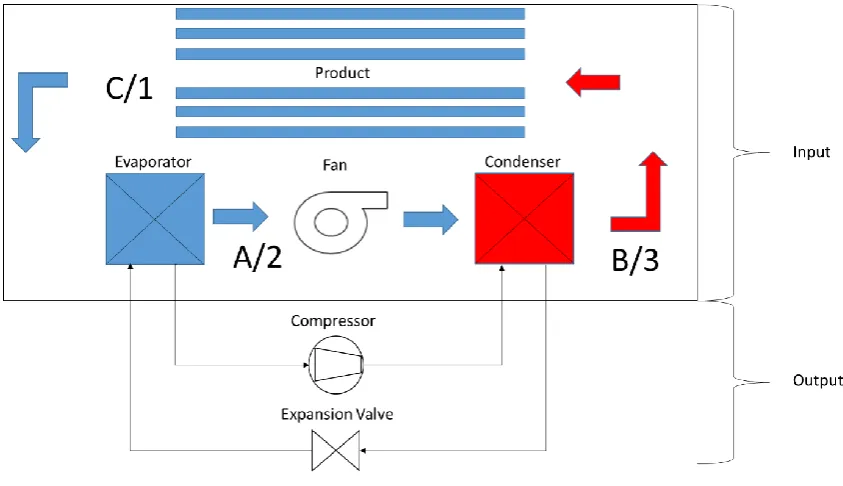
25
Results of the application of the algorithm are presented for the drying of Agaricus Blazei
26
mushroom with 3 different humidity contents (60, 80 and 88% of water) for batches of about 45,
27
123, 200, 277 and 355 kilograms. The results indicate that for the first batch a 610 W compressor
28
will suffice, while for the second one a 990 W compressor will deliver the required work to the
29
refrigerant gas. Further, the last 3 ones would demand for a more potent 1445 W compressor.
30
Keywords: Algorithm; Heat-Pump; Drying; Food; Design; Optimization
31
32
1. Introduction
33
Food drying is one of the most energy consuming processes there exist, corresponding to about
34
10% to 25% of the total energy consumed in manufacturing installations. One type of these food
35
preservation mechanisms is thermal based and is complex. It involves the removal of a solid
36
product`s humidity by the employment of heat. The drying occurs through heat and mass transfers
37
while the properties of the food change throughout the process. There are many different machines
38
that can make this process, one of these is heat-pump based [1].
39
This machine extract energy via a gas compressor from a cold-source and delivers it to a
hot-40
source. It does so by providing work to the refrigerant fluid. The heat-pump provides heat, making
41
it directly useful for heating ventilation and air conditioning (HVAC), but also for drying
42
applications. The machine energy input is the energy received from the compressor and adds it to
43
the amount of energy removed from the cold-source, yielding a higher energy output. As an example,
44
for a compressor yielding 100 W to remove 400 W from a cold-source, the total amount of energy
45
provided to the hot-source will be 500 W. This is a 5-time higher value than the one extracted by the
46
compressor, meaning a 500 W heating service from a 100 W electrical input. This highlights the
47
energy saving feature of this technology. A scheme of the whole machine and its components is
48
shown in Fig 1: compressor, expansion valve and heat exchangers (condenser and evaporator).
49
The work cycle starts with the air being heated at the condenser after being blown towards the
50
product (A to B in Fig.1). When the warm air passes by the food, it removes humidity from the
51
material. Downstream, the air captured the moisture from the food (B to C in Fig.1). It then heads to
52
the evaporator, to partially condense some of its water. This (C to A in Fig.1) is achieved by promoting
53
the heat transfer of the air with colder dew-point surfaces of the evaporator.
54
55
56
Figure 1. Scheme of heat pump for drying food. The thin line represents the refrigerant circuit
57
while the thick arrows represent the air-flow circuit.
58
59
The design of this machine for different purposes, or types of food, can be improved by the
60
application of resources such as the numerical optimization.
61
Improving equipment design takes time and laboratorial costs which are not directly translated
62
towards the manufacturing process, for the material acquired is usually spent on tests. Mathematical
63
models and computational mechanics are effective alternatives to many practical experiments since
64
they provide a prediction of what may happen and what is to be expected. This approach allows for
65
greater comprehension of the transport phenomena involved in the drying of food and improves the
66
testing and production process control which leads to better designing [2].
67
A simulation can also have an edge on normal experiments for it can predict, with virtual
68
sensors, the humidity, air velocity and temperature on points that are normally inaccessible since the
69
presence of the sensors would impact the air circulation inside the drying container. Also, there is no
70
limitation of testing different working conditions, there is no space restriction nor need for trained
71
operators. However, simulations require reliable data and proper modelling, otherwise the quality
72
of results may be questionable. This is true for the case of drying food especially describing the
73
physical/chemical properties and transport phenomena.
74
To achieve better results in energy efficiency and product quality, studies have been performed
75
on this area and new models of heat-pump dryers have been created [2,4]. And so, the use of
76
algorithms comes into play as the driving force of better product design, enabling the creation of
77
products directed to many markets: from food industry to the small-scale farmer.
78
An algorithm is proposed in this article to aid the selection of heat-pump components. It is
79
presented through a flow chart that helps the designer visualize and comprehend the specified
numerical solution`s steps. The article is concluded by an example of inputs and outputs of a code
81
created from the algorithm and it is discussed how these results can help the development of different
82
size drying machines.
83
2. Materials and Methods
84
The design algorithm is a logic map of efficient design of food-drying heat-pump air-based
85
machines. The algorithm inputs are the type of food, the air properties and the dimensions of the
86
food container, as well as the dryer component properties. To guarantee the temperature control
87
throughout the drying process, the working temperature of the air to which the food is being exposed
88
to is used as input. Therefore, it is possible to ascertain the final product quality, since over-heating
89
could cause damage to the product. Meanwhile, the algorithm outputs the mass flow of refrigerant
90
fluid from which the compressor and expansion valve can be selected. The difference of the algorithm
91
inputs and outputs, and their relation to the machine design are depicted in Fig.1. In this figure within
92
the circulating air volume there are 2 different nomenclatures aiming the description of different
93
things: A, B and C that are related only to the air proprieties; 1, 2 and 3 that represents the 3 stages of
94
the algorithm, with the different transport and energy equations.
95
1. Internal air analysis;
96
2. Heat flow analysis between components, air and food / component design;
97
3. Food humidity calculus and verification.
98
2.1. Stage 1 of the algorithm
99
The first stage of the algorithm determines the psychrometric and dynamic states of the air. The
100
literature recommends temperatures for drying each food, and by using them in the following
101
psychrometric and transport equations, one obtains every property necessary to the characterization of
102
the process and posterior steps [5–7].
103
The calculus of the air properties are given by Eq. (1) to (17) while the specific psychometry Eq.
(1-104
8) are recommended by [6]. The psychrometric equations utilized at this stage describe the humid air
105
based on its temperature, amount of water as vapor and the air`s occupied volume [8–10].
106
To provide the readers less clutter information on the variables of the equations, a list of variables
107
and units is shown in the end of the article.
108
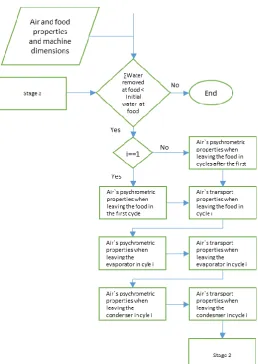
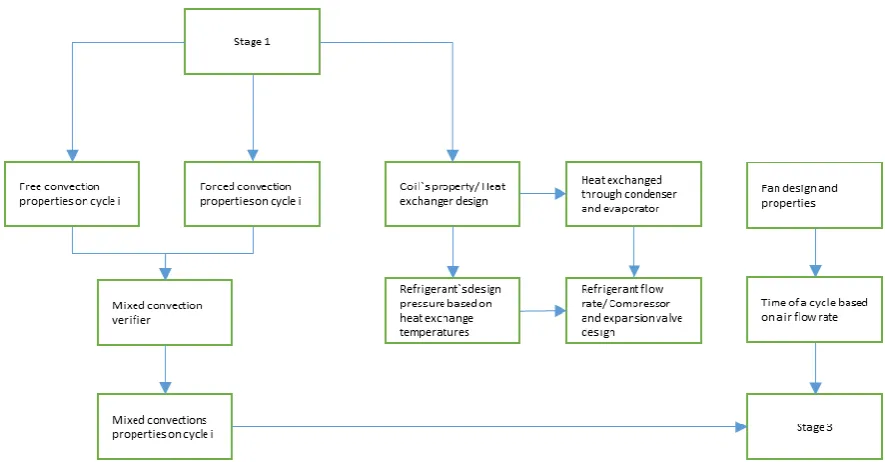
At first it is necessary to obtain the vapor saturation pressure 𝑃𝑣𝑠 and the absolute humidity 𝑤.
109
The air humidity after the contact with the food in the first iteration and after the air leaves the
110
evaporator, corresponding to air process C and A in Fig. 1, are calculated by Eq. (1) and (2):
111
112
𝑃𝑣𝑠 = 6
1025
1000 ∗ 𝑇5∙ 𝑒𝑥𝑝 (−
6800
𝑇 ) (1)
113
𝑤 = 0.622 𝑃𝑣
𝑃𝑎𝑡𝑚− 𝑃𝑣 (2)
In the following iterations, the absolute humidity is obtained by adding the total humidity lost by
114
the food to the air humidity after it left the condenser, process B to C in Fig. 1. The air humidity when
115
it leaves the condenser is equal to the one when it left the evaporator. Therefore, the next step are the
116
calculations of the air`s vapor pressure 𝑃𝑣, and its enthalpy 𝐻, from the absolute humidity Eq.(3) and
117
Eq.(4):
118
𝑃𝑣= 𝑤 ∙
𝑃𝑎𝑡𝑚
0.622 + 0.378 ∗ 𝑤 (3)
With the air`s vapor pressure and the vapor saturation pressure, the relative humidity ∅ and the
119
dew point 𝑇𝑑𝑝 are then calculated for this pressure, Eq. (5) and (6).
120
∅ = 𝑃𝑣
𝑃𝑣𝑠 (5)
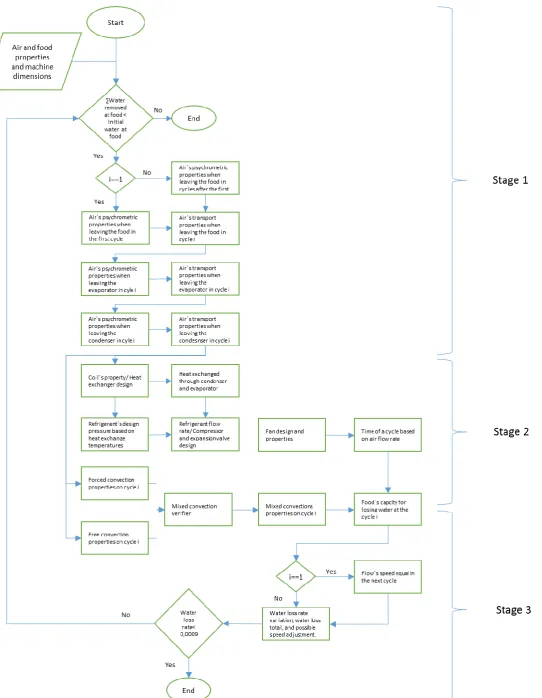
𝑇𝑑𝑝 =
186.4905 − 237.3 log 10 ∙ 𝑃𝑣
log(10 𝑃𝑣) − 8.2859 (6)
121
Also, with the vapor`s pressure and the absolute humidity, the algorithm calculates the specific
122
volume 𝑣, vapor molar fraction 𝑋𝑣 relative to the mixture and molar mass.
123
𝑋𝑣=
𝑃𝑣
𝑃𝑎𝑡𝑚 (7)
𝜈 = 0.28705𝑇 ∙1 + 1.6078𝑤
𝑃𝑎𝑡𝑚 (8)
The determination of the transport properties require the following proportion non-dimensional
124
parameters Φ𝑎𝑣 and Φ𝑣𝑎, as recommended by [7] and presented in Eq. (9) and (10).
125
Φ𝑎𝑣 =
√2 4 (1 +
𝑀𝑎
𝑀𝑣
)
− 12
[1 + (𝜇𝑎 𝜇𝑣 ) 1 2 (𝑀𝑎 𝑀𝑣 ) 1 4 ] 2 (9) Φ𝑣𝑎= √2 4 (1 +
𝑀𝑣
𝑀𝑎
)
− 12
[1 + (𝜇𝑣 𝜇𝑎 ) 1 2 (𝑀𝑎 𝑀𝑣 ) 1 4 ] 2 (10)
The acronyms 𝑀𝑣
and
𝑀𝑎 respectively represent the molar masses of the vapor and dry air while126
the 𝜇𝑣
and
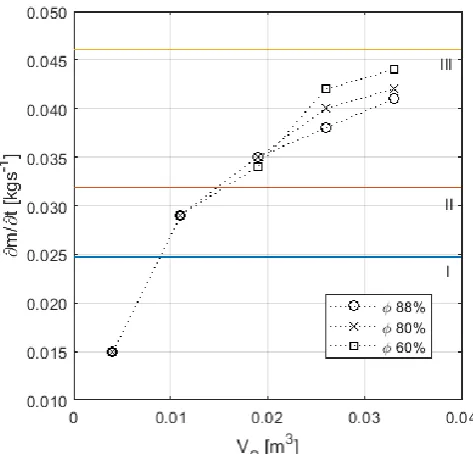
𝜇𝑎represent
their dynamic viscosity. Therefore, with the proportion parameters Φ𝑎𝑣127
and Φ𝑣𝑎defined, the mean thermophysical properties are calculated.
128
Firstly, the thermal conductivity of the humid air k𝑎𝑟 is given by Eq. (11).
129
k𝑎𝑟=
(1 − 𝑥𝑣)𝑘𝑎
(1 − 𝑥𝑣) + 𝑥𝑣Φ𝑎𝑣
+ 𝑥𝑣𝑘𝑣
𝑥𝑣+ (1 − 𝑥𝑣)Φ𝑎𝑣 (11)
And, the specific heat 𝑐𝑝𝑚 of this air is obtained with Eq. (12).
130
cp𝑚= 𝑐𝑝𝑎𝑥𝑎
𝑀𝑎
𝑀𝑚
+ 𝑐𝑝𝑣𝑥𝑣
𝑀𝑣
𝑀𝑚 (12)
These properties are used to obtain the thermal diffusivity α, which is expressed by Eq. (13).
131
𝛼 = 𝑘
𝜌 ∗𝐶𝑝𝑚 (13)
Also, the mixture density 𝜌 for incompressible gases are calculated according to Eq. (14):
132
𝜌 = 𝑃0
𝑅𝑇[1 − 𝑥𝑣(1 − 𝑀𝑣
𝑎 )] (14)
The transport properties that govern the fluid`s movement are calculated from the equations
133
pointed by [7]. The dynamic viscosity 𝜇𝑚𝑖𝑥, of the mixture results from Eq. (15):
134
𝜇
𝑚𝑖𝑥= (1 − 𝑥𝑣)𝜇𝑎𝑟 (1 − 𝑥𝑣) + 𝑥𝑣Φ𝑎𝑣+ 𝑥𝑣𝜇𝑣𝑎𝑝𝑜𝑟
(1 − 𝑥𝑣) + 𝑥𝑣Φ𝑣𝑎 (15)
135
With 𝜇𝑚𝑖𝑥 and 𝜌, the cinematic viscosity 𝜏 then is obtained with Eq. (16):
𝜏 =𝜇𝑚𝑖𝑥
𝜌 (16)
The Prandl number 𝑃𝑟, which is used to determine the water loss, is calculated from Eq. (17):
137
𝑃𝑟 =
𝜇
𝑚𝑖𝑥cp𝑚𝑘 (17)
2.2. Stage 2 of the algorithm
138
The second stage of the algorithm related to the heat flow analysis and component design, uses
139
the data calculated in Stage 1, the pre-determined dimensions and construction parameters of
140
components to calculate results that are essential to the final design of the product.
141
However, the creation of something novel from scratch is very costly so the algorithm uses as entry
142
data for the second stage: the operation temperatures and the catalogued dimensions of off-the-shelf
143
products of both heat exchangers and fans. Because a heat-pump system can be defined by the
144
compressor and the heat exchangers [9], the heat output of this stage will be used on calculating the
145
mass flow rate of refrigerant required to select a fitting compressor.
146
The reasoning behind this is that controlled temperatures are a main focus of the algorithm, to
147
assure product quality. Also, the heat exchangers and fans are parts that affect the final product
148
dimension if changed, and so, by selecting products that are available in the market, the cost of
149
production is expected to drop and the final product construction can be streamlined. Any machine
150
designed through this method will have its power output controlled through the variation of the
151
compressor`s cycle rate.
152
At this stage the fans diameter is used with previously calculated air speed and density to obtain
153
the air mass flow rate, which will be used in the third stage for controlling the removed water.
154
With the combined data from Stage 1 and the dimensions of components, the heat which will flow
155
to the air is calculated. That heat is the same that is removed from the refrigerant fluid, and since the
156
temperatures have been set, the enthalpy variation of the refrigerant expected is known and so its mass
157
flow rate is achieved.
158
To do so, the equations used were the ones that relate to the heat exchangers, such as logarithmic
159
mean temperature difference, Nusselt and Reynolds dimensionless numbers, global heat conductivity
160
and heat flow equation at heat exchangers. These equations are pointed out in [12–15].
161
The logarithmic mean temperature difference ∆𝑇𝑚𝑙 is a variable that accounts for the logarithmic
162
nature of the heat transfer properties and converts the temperatures and the exchanger`s entry and exit,
163
jointly with the external`s fluid temperature to obtain a mean value that can be used in heat transfer
164
equations.
165
∆𝑇
𝑚𝑙=(𝑇𝑚𝑒𝑑− 𝑇𝑒𝑛𝑡) − (𝑇𝑚𝑒𝑑− 𝑇𝑠𝑎𝑖)
log(𝑇(𝑇𝑚𝑒𝑑− 𝑇𝑒𝑛𝑡)
𝑚𝑒𝑑− 𝑇𝑠𝑎𝑖)
(18)
166
These equations also require a mean global heat flux coefficient 𝑈. This has the same principle of
167
the previous Eq. (18), making a mean value that accounts for every heat transfer process. However,
168
unlike the logarithmic mean temperature difference, this equation results in a heat transfer factor.
169
170
𝑈̇ = 1
1 ℎ+
𝑙
𝑘 (19)
171
Where 𝑙 represents the thickness of the heat exchanger’s walls.
172
And so, the required data to calculate such a factor are the conduction heat transfer coefficient for
173
the heat exchanger`s material 𝑘, and the convection heat transfer coefficient for the operating air flow
174
ℎ.ℎ = k𝑎𝑟
𝑁𝑢
𝐷 (20)
Where D equals to the heat exchanger`s cylinder diameter k𝑎𝑟 is the air`s heat conductivity and
176
𝑁𝑢 is a dimensionless number obtained through the following equation:
177
𝑁𝑢 = 1.13 𝑅𝑒𝑀∙ 𝐶 ∙ 𝑃𝑟 (21)
In this equation, the 𝑀 and 𝐶 variables are constants obtained based on the heat exchanger`s
178
dimensions and layout. The 𝑅𝑒 is another number obtained by:
179
𝑅𝑒 =𝜌𝑉𝐷
𝜇 (22)
The 𝑉 in the equation is the air`s speed. Finally, the final exchanged heat value 𝑄̇, equals to:
180
𝑄̇ = 𝑈̇𝐴∆𝑇𝑚𝑙 (23)
Where 𝐴 is the total exposed heat exchanger area. The heat can be used, as previously mentioned,
181
together with the variation of enthalpy ∆𝐻 , to obtain the refrigerant mass flow rate 𝑚̇.
182
𝑚̇ = 𝑄̇
∆𝐻 (24)
2.3. Stage 3 of the algorithm
183
The third stage, the food analysis, is a control stage. This means that in it the algorithm has its
184
control variables calculated to provide the iterative results that make the calculating cycles continue or
185
stop. For this case, the control variable is food`s humidity level, and it is calculated through the use of
186
well-known food-drying models. The Modified Henderson model was selected for its recurring
187
appearance in the literature and consequent versatility. It requires the air`s humidity level, temperature
188
and speed to calculate the water loss variation [4, 5].
189
For the calculus of the water mass transfer and consequently total humidity left in the product, the
190
air diffusion coefficient is cited at [12, 16]:
191
𝐷𝑎𝑏= 1.87 × 10⁻¹⁰
𝑇2.072
𝑃 (25)
With this value, the Graschof 𝐺𝑟 and Schimdt 𝑆𝑐 numbers can be obtained:
192
𝐺𝑟 =𝑔∆𝜌𝑆
3
𝜌𝜏2
(26)
𝑆𝑐 = 𝜏
𝐷𝑎𝑏 (27)
Where 𝑆𝑐 is the characteristic dimension, which in the case of the drying machine are the spaces
193
between the plaques that hold the food. With both Graschof and Schimdt, the Rayleigh 𝑅𝑎 and
194
Sherwood numbers can be obtained, for both natural 𝑆ℎ𝑛 and forced 𝑆ℎ𝑓 convections:
195
𝑅𝑎 = 𝐺𝑟 ∙ 𝑆𝑐 (28)
196
𝑆ℎ𝑛= 0.197 (𝑅𝑎 1 4(ℎ𝑝
𝑆)
1 9
) (29)
197
If Reynolds is inferior to 200.000,
𝑆ℎ𝑓 = 0.664(𝑅𝑒0.5∗ 𝑆𝑐
1
3) (30)
But for a superior value,
199
𝑆ℎ𝑓= 0.0365(𝑅𝑒0.8∗ 𝑆𝑐
1
3) (31)
With Sherwood defined, the mass transfer coefficient is obtained with Eq. (32).
200
ℎ𝑐𝑓 = 𝑆ℎ𝐷𝑎𝑏
ℎ𝑝 (32)
The ℎ𝑝 value is the food containing plaque`s height. The total water mass removed 𝑚𝑙 is
201
calculated by:
202
𝑚𝑙= ℎ𝑐𝑓 ∙ 𝑛𝑠 ∙ 𝐴𝑝 ∙ ∆𝜌 (33)
In Eq. (33), 𝐴𝑝 is the plaque`s area, 𝑛𝑠 is the number of plaques and ∆𝜌 is the difference between
203
density of water in the air and food.
204
The next step of the algorithm compares the value obtained with the mass transfer equation and
205
the Modified Henderson model, and select the most conservative value. This value is removed from
206
the food`s total humidity and accounted for in the control function, restarting the cycle if necessary.
207
3. Results
208
The algorithm can be represented in the form of a flow chart, to illustrate the proposed logic
209
map. The first stage shown in Fig.2 results in the definition of the air`s psychrometric and transport
210
properties throughout the drying process, doing so from the Eq. (1) to (17) and the input data both
211
from the food and from the machine.
214
Figure 2. Stage 1 of the algorithm. The internal air analysis described in Eq. (1) to (17).
215
216
The properties outputs are used mainly as input for other stages. However, the program still can
217
provide this data to guarantee quality control, specifically through the monitoring of the air`s
218
temperature at the exit of each component.
219
The second stage shown in Fig.3 outputs both design and process parameters. By taking the
220
aforementioned properties, it calculates the heat required to change the air`s state at both condenser
221
and evaporator. With it, and the expected enthalpy variation, the refrigerant mass flow rate is
222
achieved. These characteristics allow for an easy selection of the components required to design the
223
heat-pump of the dryer. These components are: compressor, expansion- valve, refrigerant fluid and
224
heat exchangers.
225
Even though the algorithm allows for easier selection of components, there still are some parts
226
that require manual selection. As commented in Section 2, the fans that circulate the air are
pre-227
selected to fit the drying container so that their dimensions are used as input data to calculate the
228
mass flow rate of the circulating air inside the machine.
231
Figure 3. Stage 2 of algorithm. Heat flow analysis between components, air and food.
232
Component design derived from Eq. (18) to (24).
233
234
For the final stage shown in Fig. 4, the results are given as a function of the amount of water in
235
the system. The algorithm outputs the rate of water removal. From it, the algorithm calculates how
236
this rate varies and how it effects the drying food. Finally, the variation of how much water is being
237
removed is used as a parameter for cycle control and break function.
238
239
240
Figure 4. Stage 3 of algorithm. Food humidity calculus and verification as demonstrated from
241
Eq. (25) to (33).
242
243
The whole algorithm is depicted in Fig. 5 showing the 3 stages that correspond, in Fig. 1, to the
244
A-B, B-C and C-A thermal processes.
Figure 5. Heat pump dryer design optimization algorithm
4. Discussion
247
The flow chart allows for an easier overview of the process (Fig. 5). This handy resource guides
248
its user from a basic starting point towards its desired goal which makes designing simpler, since
249
every information required can be traced back to information available in the market.
250
The proposed algorithm is a tool of how to design the heat-pump air-based drier being also a
251
step-by-step guide. Though it may be also used to write a program that will automate the
252
calculations, it is not restricted by the physical models hereby proposed. This is a strong characteristic
253
of the algorithm because it is possible to update the used models of each process to the newest and
254
most sound ones available. Doing so, and using more accurate data will impact on the precision of
255
the final result. Actually, such a practice was used in the development of this algorithm. Data and
256
equations found in earlier versions of established guides and books such as [8] and [10] were
257
posteriorly replaced by newer ones [7].
258
The algorithm specifies each step and allows for the comprehension of the necessary and
259
produced data for that step. Meanwhile, a simulation program takes every step and automates,
260
making the calculation sequence so that it will output a final value, and not clutter the user with
261
processual information.
262
In order to exemplify the application of the proposed algorithm, a code written in GNU Octave
263
simulated the drying of the Agaricus Blazei mushroom for batches of varying volumes that correspond
264
to about 45, 123, 200, 277 and 355 kilograms of product. To simulate the drying, and consequently
265
provide suitable data for the design, it was considered the properties pointed out by [5] related to the
266
product`s fraction of water. Also, the input for stage two related to the heat-exchangers and fan
267
dimensions were based on the ECO coils and coolers of the Luvata Company.
268
269
Figure 6. Relation of volume of product to required refrigerant flow.
270
271
Considering that 90% of the drying container`s volume is filled with food and that the
272
mushroom`s amount of water for 3 different cases is: 60%, 80% and 88%, the humidity removed can
273
be calculated based on the container’s volume. This is used to create a variable parameter from which
274
the power output can be measured. Also, the temperature of drying was set to 80 °C, the superior
275
temperature limit from which this particular mushroom species starts having chemical and
276
organoleptic changes.
277
The algorithm simulated humidity removal for those given conditions and the results are
278
depicted in Fig. 6. The refrigerant mass flow rate is plotted against the volume of food in the drying
279
container, being a critical information for the selection of a suitable compressor. A commercial
280
compressor for nominal power operations yields a maximum mass flow rate. The graph represents
these working limits of 3 types of compressors from a given manufacturer (EMBRACO). The number
282
I, II and III respectively represent increasingly potent compressors of 610, 990 and 1445 W.
283
The simulation results show a clear need to upgrade the compressor from type I to II while
284
increasing the amount of Agaricus Blazei mushrooms from 45 to 123 kg, a 2.73-fold increase in drying
285
needs to a 1.6 increase in compressor power. Furthermore, an increase of 1.6 times, from 123 to 200
286
kg, will require a power increase of 1.46 times. The non-linearity of the drying process is clear, and
287
in this example, for the larger batches, from 200 to 355 kg, only one type of compressor would suffice.
288
For smaller batches the amount of humidity in the food is negligible for design purposes,
289
however for larger batches the power needs are quite different. The dryer the food is, the harder
290
the compressor will have to work as it is depicted in Fig. 6. This is a known result and good indication
291
of the proper response of the algorithm.
292
For further research the authors recommend that future versions of the algorithm, and possible
293
programs, incorporate the use of fuzzy logic in its solving methodology. This is due to the logarithmic
294
nature of both heat and mass transfer processes which make the use of a break function essential as
295
indicated in Fig. 4 related to the end process of Stage 3. Fuzzy logic would make the idea of an ideal
296
stopping point much more graspable and closer to reality.
297
5. Conclusions
298
A flexible optimization algorithm is presented, aimed to help heat-pump air-based dryers design
299
incorporating off-the-shelf components. The algorithm is segmented into 3 parts allowing the
300
modification or upgrade of any one according to new scientific developments. It also allows
301
dedicated solutions for different types and quantities of food because it incorporates their own
302
chemical and organoleptic limitations.
303
With this guide in hand, the selection of components and materials is simpler because the users
304
will have the key parameters of the required components and streamline the iterative process of
305
machine design.
306
307
Appendix A
308
List of variables and units.
309
𝑃𝑣𝑠 Vapor saturation pressure [pa]
310
𝑤 Absolute humidity [kg water/kg air]
311
𝑃𝑣 Air`s vapor pressure [pa]
312
𝐻 Enthalpy [kJ/kg*K]
313
∅ Relative humidity
314
𝑇𝑑𝑝 Dew point [K]
315
𝑣 Specific volume [m³/kg]
316
𝑋𝑣 Vapor molar fraction
317
k𝑎𝑟 Thermal conductivity of the humid air [W/m²*K]
318
𝑐𝑝𝑚 Specific heat [kJ/kg*K]
319
α Thermal diffusivity [m²/s]
320
𝜌 Mixture density [kg/m³]
321
𝜇𝑚𝑖𝑥 Dynamic viscosity [N*s/m²]
322
𝜏 Kinematic viscosity [m²/s]
323
∆𝑇𝑚𝑙 Logarithmic mean temperature difference [K]
324
𝑈̇ Mean global heat flux coefficient [W/m²*k]
𝑙 Thickness of the heat exchanger’s walls [m]
326
𝑘 Heat transfer coefficient of material [W/m²*K]
327
ℎ Convection heat transfer coefficient [W/m²*K]
328
𝑉 Air`s speed [m/s]
329
𝐴 Total exposed heat exchanger area [m²]
330
𝑚̇ or 𝜕𝑚𝜕𝑡 Mass flow rate [kg/s]
331
𝐷𝑎𝑏 Air diffusion coefficient [m²/s]
332
𝑚𝑙 Total water mass removed [kg/s]
333
𝐴𝑝 Plaque`s area [m²]
334
335
References
336
[1] M. Aktaş, L. Taşeri, S. Şevik, M. Gülcü, G. Uysal Seçkin, and E. C. Dolgun, “Heat pump drying of grape
337
pomace: Performance and product quality analysis,” Dry. Technol., vol. 0, no. 0, pp. 1–14, 2019.
338
[2] N. Malekjani and S. M. Jafari, “Simulation of food drying processes by Computational Fluid Dynamics
339
(CFD); recent advances and approaches,” Trends Food Sci. Technol., vol. 78, no. December 2017, pp. 206–
340
223, 2018.
341
[3] Á . Castell-Palou and S. Simal, “Heat pump drying kinetics of a pressed type cheese,” LWT - Food Sci.
342
Technol., vol. 44, no. 2, pp. 489–494, 2011.
343
[4] V. Demir, T. Gunhan, and A. K. Yagcioglu, “Mathematical modelling of convection drying of green table
344
olives,” Biosyst. Eng., vol. 98, no. 1, pp. 47–53, 2007.
345
[5] L. E. Kurozowa, “Efeito das condições de processo na cinética de secagem de cogumelo,” p. 121, 2005.
346
[6] R. P. Lopes, D. C. Lopes, and R. C. Rezende, Secagem e Armazenagem de Produtos Agrícolas. Aprenda Fácil
347
Editora ISBN 978-85-62032-00-4, 2008.
348
[7] P. T. Tsilingiris, “Thermophysical and transport properties of humid air at temperature range between
349
0 and 100 °C,” Energy Convers. Manag., vol. 49, no. 5, pp. 1098–1110, 2008.
350
[8] A. S. of H. R. and A. C. Engineer, 2015 ASHRAE HANDBOOK Inch-Pound Edition. 2015.
351
[9] N. Yamankaradeniz, K. F. Sokmen, S. Coskun, O. Kaynakli, and B. Pastakkaya, “Performance analysis
352
of a re-circulating heat pump dryer,” Therm. Sci., vol. 20, no. 1, pp. 267–277, 2016.
353
[10] F. P. Incropera and F. P. Incropera, Fundamentals of heat and mass transfer., 6th ed. John Wiley, 2007.
354
[11] Y. A. M. A. B. Cengel, Thermodynamcis, An Engineering Approach, 8th ed. Mc Graw-Hill Interamericana,
355
2007.
356
[12] L. J. Goh, M. Y. Othman, S. Mat, H. Ruslan, and K. Sopian, “Review of heat pump systems for drying
357
application,” Renew. Sustain. Energy Rev., vol. 15, no. 9, pp. 4788–4796, 2011.
358
[13] C. O. Perera and M. S. Rahman, “Heat pump dehumidifier drying of food,” Trends Food Sci. Technol., vol.
359
8, no. 3, pp. 75–79, 1997.
360
[14] M. T. . and M. E.A., “Gaseous Diffusion Coefficients,” J. Phys. Chem., vol. 118, 1972.