Essays on the Evaluation of Social
Programmes and Educational Qualifications
Barbara lole Marina Sianesi
September 2002
ProQuest Number: U642531
All rights reserved
INFORMATION TO ALL USERS
The quality of this reproduction is dependent upon the quality of the copy submitted.
In the unlikely event that the author did not send a complete manuscript and there are missing pages, these will be noted. Also, if material had to be removed,
a note will indicate the deletion.
uest.
ProQuest U642531
Published by ProQuest LLC(2015). Copyright of the Dissertation is held by the Author.
All rights reserved.
This work is protected against unauthorized copying under Title 17, United States Code. Microform Edition © ProQuest LLC.
ProQuest LLC
789 East Eisenhower Parkway P.O. Box 1346
Abstract
The first part of the thesis addresses a programme evaluation problem: the estima
tion of the short- and long-term effects of the Swedish active labour market pro
grammes on participants’ subsequent labour market outcomes, in particular indi
vidual employment probability and collection of unemployment benefits over
time.
Exploiting a unique and comprehensive new Swedish dataset with extensive in
formation on more than 110,000 individuals followed for five years, semi-
parametric propensity score matching techniques are adapted to the Swedish insti
tutional context to investigate the overall effectiveness of the ‘Swedish model’ of
labour market policy in the context of the high unemployment atypically experi
enced by Sweden in the 1990s. The performance of the Swedish system is thus
considered in its entirety, combining all the programmes into one and focusing on
the interactions between the unemployment benefit system and the programme
system. Subsequently, the relative performance of the six main types of pro
grammes available to unemployed adults in the 1990s is analysed, both relative to
one another and vis-à-vis more intense job search in open unemployment. The dif
ferential performance of labour market training, workplace introduction, work ex
perience placement, relief work, trainee replacement and employment subsidies is
investigated using a multiple-treatment extension of the propensity score match
ing method.
The second part of the thesis deals with the evaluation problem in the returns to
education framework. Different non-experimental estimation methods to recover
the effect of education on earnings - ordinary least squares, instrumental vari
ables, control function and matching - are reviewed and contrasted in the context
of alternative microeconometric models - single- and multiple-treatment, homo
geneous- and heterogeneous-retums models. The methods are subsequently ap
plied to high quality data - the British 1958 NCDS birth cohort - to estimate pri
vate returns to schooling and to illustrate the sensitivity of the different estimators
Acknowledgements
The person who most of all has encouraged, supported and advised me in my re
search since its very start is my supervisor, Costas Meghir, to whom I owe a huge
debt of gratitude for countless stimulating discussions, suggestions and continuous
guidance. In fact, in order not to forsake his wisdom and kindness in times to
come. I’ve promptly promoted him to Life Coach.
An intellectual debt of great magnitude is of course owed to my second super
visor, Richard Blundell, for numerous fruitful discussions, comments and interac
tions, especially on the second part of the thesis, as well as for constant encour
agement.
Costas’ initial suggestion and the IPS offer to provide me with excellent facili
ties, the perfect human and physical environment to carry out my research as well
as a PhD scholarship - funded by the ESRC Centre for Microeconomic Analysis
of Fiscal Policy - have easily tipped the scales in favour of my starting all over
again with a second PhD, in a completely new but so fascinating a subject. Thanks
are due also to the Economics Department of UCL for encouraging me to take a
place on their doctoral programme.
A very special thanks goes to Susanne Ackum Agell for her enthusiasm in en
couraging my work on the Swedish progranunes all along, as well as for organis
ing financial support through the IFAU.
Funding from the DfES's Centre for the Economics of Education (CEE) for re
search covering the second part of the thesis is similarly gratefully acknowledged.
Special mention as regards IFS should be given to Andrew Dilnot, for his gen
erosity and kindness, to Lorraine Dearden, the perfect Sector Leader, a wonderful
colleague and a dear friend, to Erich Battistin for countless (hopefully mutually)
enriching discussions, and to Tom Clark, Emla Fitzsimons, Hide Ichimura and
Elena Martinez for comments and suggestions.
Special thanks as regards Sweden, in addition to Susanne, go to Kenneth Car
ling, Anders Forslund, Bertil Holmlund, Laura Larsson, Katarina Richardson,
Kerstin Johansson has kindly sent me the municipality-level data, and Helge
Bennmark and Altin Vejsiu and especially Anders Harkman have been extremely
helpful with institutional information and data issues clarifications.
Helge has been patiently dealing with a number of technical questions about
the available data, and Anders H. in particular has provided me with invaluable
programme-insider information and detailed comments.
Hapless IFS visitors Bemd Fitzenberger, Kei Hirano and Jeff Smith deserve
special thanks for very intense and just as beneficial discussions.
Additional thanks go to Edwin Leuven, Astrid Kunze, seminar participants at
IFS, Copenhagen University, IZA and the IVA Stockholm conference, and to the
referees for the Journal o f the Royal Statistical Society for very helpful sugges
tions.
On a more personal front, the “IFS weekend and evening clique” (Elena, Emla,
Erich, Mario, and Renata) has been providing encouragement, entertainment and
emotional support. Edwin, met through serendipity over my p s m a tc h pro
gramme, deserves additional heartfelt thanks for his constant support and sunshine
late-night phone calls to a deserted dark office in the final month of the thesis.
And last, but by no means least, my parents, who have always been there, in
any sense and in any way needed, and to zio Edoardo and zia Barbara, for never
Declaration
1. No part of this thesis has been presented to any other university for any degree.
2. Chapters 4 and 5 were undertaken as joint work with Richard Blundell and Lorraine Dearden; they are under revision for the Journal o f the Royal Sta tistical Society, Series B.
3. A non-technical, policy-oriented summary of the results from Chapters 2
and 3 is forthcoming in the Swedish Economic Policy Review as “Swedish
Active Labour Market Progranunes in the 1990s: Overall Effectiveness and Differential Performance”.
Table of Contents
Abstract
2
Acknowledgements
3
Declaration
5
Introduction
12
PART ONE
Programme evaluation; A Swedish application
I.
Evaluating the Swedish Active Labour Market Pro
grammes: An Overview
16
II.
Overall performance of the Swedish system of active
labour market programmes in the 1990s
21
n.l
Introduction21
n.2
The Swedish labour market policy23
II.
3
Data and sample selection 25n.4
The evaluation problem and propensity score matching26
n.5
Matching in the Swedish institutional set-up29
11.5.1 Treated and non-treated in Sweden and other key choices
29
77.5.2 Methodology 33
77.5.3 Plausibility o f the CIA: Selection into the Swedish pro
grammes and available information 38
n.6 Empirical findings 42
11.6.1 Entitlement status as a determinant o f programme participa
tion 42
77.6.2 Outcomes over time 44
77.6.3 Accounting fo r a partially unobserved outcome variable 49
77.6.4 A summary so fa r 56
77.6.5 Job accession 59
n.7 Unemployment-programme cycling behaviour 62
n.9 Discussion and conclusions
70
n.lO
Appendix73
m . Differential performance of the Swedish active labour
market programmes for unemployed adults in the 1990s
75
m .l
Introduction75
in.2
The Swedish labour market policy78
ni.3
Data, sample selection and a preliminary look at the data82
III.4 Methodology
87
111.4.1 The evaluation problem in a multiple-treatment framework 87
111.4.2 Multiple-treatment matching in the Swedish institutional set- 92 up
III. 4.3 Plausibility o f the matching approach in the Swedish context
in.
5 Empirical findingsIII. 5.1 Employment probability over time
III. 5.2 Unemployment-benefit collection probability over time
HI. 5.3 API versus ALU
95
98
99
105
106
III.5.4 The problem o f the ‘lost' individuals
m .6 Discussion and conclusions
in.7 Appendix
114
Summary and conclusions to Part One
114
References
128
PART TWO
Estimating the returns to education
Introduction
134
IV. Models and methods
137
rv.l
The eamings-education relationship:A
general set-up and alternative modelsIV. 1.1 The homogeneous returns model
rv.2 The eamings-education relationship: Alternative methods 145
rV.2.1 An overview 145
IV.2.2 Least squares 147
IV.2.3 Instrumental variable methods 151
rv.2.3.1 rv in the homogeneous one-factor model 152
IV.2.3.2 rv in the heterogeneous one-factor model: A special
case 153
IV.2.3.3 rv in the heterogeneous single treatment model 154
rv.2.3.4 Some drawbacks to IV 158
IV.2.4 Control function methods 159
rV.2.4.1 The heterogeneous single treatment model 160
IV.2.4.2 The homogeneous returns model 161
rv.2.4.3 The multiple treatment model 162
rv.2.4.4 The heterogeneous one-factor model 163 rv.2.4.5 Some drawbacks to CF 163
IV.2.5 Matching methods 164
rv.2.5.1 General matching methods 165
rV.2.5.2 Propensity score matching 168
rv.2.5.3 Implementing propensity score matching estimators 170
IV.2.5.4 The multiple treatment model 172
IV.2.5.5 Some drawbacks to matching 173
IV. 2.6 OLS, matching, instrumental variables and control function 174
rv.3 Appendix: A balancing score for sequential multiple treatments 176
IV. 3.1 Looking fo r a balancing score 179
IV. 3.2 A balancing score fo r the pairwise comparisons 179
V. An application to the British NCDS
181
V. 1 Introduction 181
V.2 Single treatment model: Higher education 181
V.3 The multiple treatment model 191
V.4 Appendix 198
Summary and conclusions to Part Two
200
List of Tables
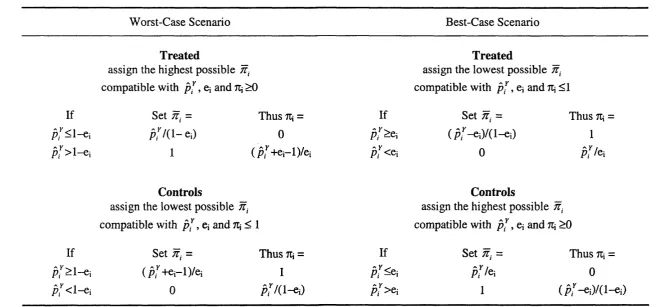
2.1 Computation of Tti to derive worst- and best-case bounds 54
2.2 A crude summary of the effect of participation versus wait
ing: The more permanent treatment effect on the probability of being in the various states, six months after joining a pro
gramme (% points) 58
2.3 Average treatment effects by month of placement into the
programme (averaged over the 5-year horizon since the start
of the programme) 59
2A.I Matching protocol 73
2A.2 Treated and pool of potential controls by time in unemploy
ment 74
2A.3 Matching quality in terms of the propensity score 74
2A.4 Matching quality in terms of imbalance of the most impor
tant covariates between treated and matched controls: stan
dardised differences after matching (% bias) 74
3.1 Synoptic table of the main features of the programmes 80
3.2 Transitions from the first programme onwards (% of respec
tive participants) 84
3.3 Selected individual descriptive statistics, by type of exit
from first unemployment spell 86
3.4 Informal summary of the various conditional average treat
ment effects on employment probability over 5-year horizon
since programme start 102
3 A. 1 Specification chosen and indicators of resulting matching
quality 114
5.1 The returns to higher education compared to less-than higher
education (% wage gain)
-Average treatment effect (ATE), average effect of treatment on the treated (ATT) and average effect of treatment on the
non-treated (ATNT) 183
5.2 Incremental treatment effects (% wage gain) - Matching and
OLS estimates 193
5A.1 Summary statistics, NCDS Men 198
List of Figures
1.1 Swedish total unemployment, broken into open unemploy
ment and programme participation rates, 1985-2000 (per
centage points) 16
2.1 Marginal effect of Ul-status on the probability of joining a
programme (percentage points difference in the treatment probability with respect to non-entitled with the same char acteristics of UI individuals), by time unemployed prior to
programme 44
2.2 Treated and matched controls’ differential probability of (A)
Programme participation and (B) Employment 45
2.3 Treatment effect (% points) on the probability of (A) Pro
gramme participation, (B) Unmployment, (C) Benefit collec tion, (D) Employment, (E) De-registration/Employment, (F)
Regular education, (G) Inactivity and (H) ‘Lost’ 46
2.4 Average treatment effects on employment probability (aver
aged over the 5-year horizon since start of the programme)
by misclassification rate 50
2.5 Average employment effect by cut-off probability (averaged
over the 5-year horizon since start of the programme) 51
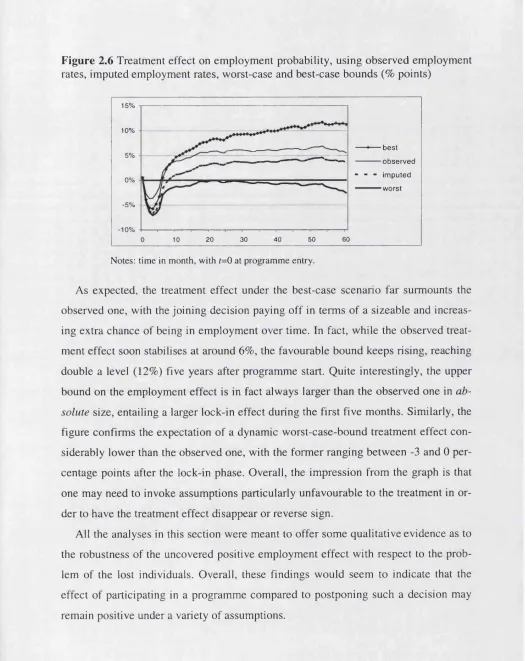
2.6 Treatment effect on employment probability, using observed
employment rates, imputed employment rates, worst-case
and best-case bounds (% points) 55
2.7 Expected labour market status of individuals in the case of
(A) waiting longer in open unemployment and (B) joining a programme, broken down into probability of being on a pro gramme, in employment or in unemployment, the latter in turn broken down into compensated and uncompensated one. (Average over the 5-year horizon since the start of the pro
gramme) 57
2.8 Survival in unemployment for treated and controls (days) 61
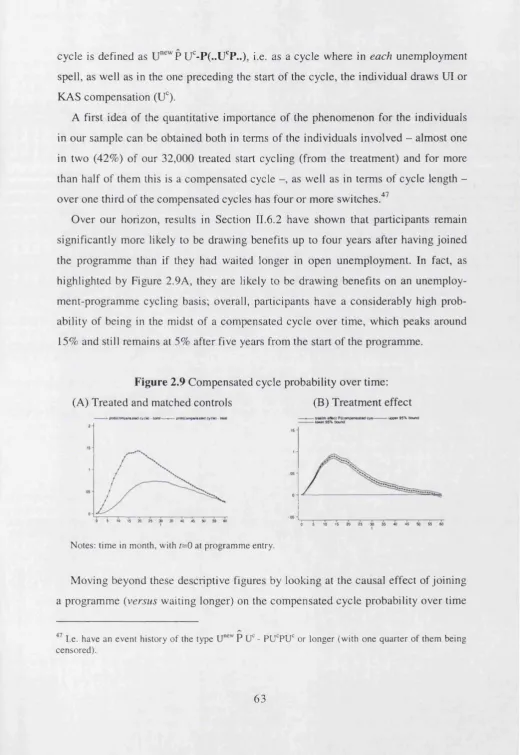
2.9 Compensated cycle probability over time: (A) Treated and
matched controls and (B) Treatment effect 63
2.10 Compensated cycling by month of placement: (A) Average
treatment effect on compensated cycling probability and (B)
Percentage of individuals becoming compensated cyclers 65
2.11 Programme and benefit collection probability over time:
2.12 Average effect for participants of joining any of the programmes compared to waiting longer in open unemployment on employment probability and benefit
collection probability: entitled and non-entitled adults 70
3.1 Raw data: employment probability over time, by type of pro
gramme 85
3.2 Selection process into the Swedish programmes and key
available regressors 96
3.3 Average effect on employment probability over time of join
ing the specified programme compared to waiting longer in open unemployment for participants in the specified pro
gramme 101
3.4 Differential performance of ALU and API 106
3A. 1-5 Differential average effects on employment probability over
time of the specified programme compared to the various
alternatives for participants in the specified programme 115
3A.6-10 Differential average effects on compensated unemployment
probability over time of the specified progranune compared to the various alternatives for participants in the specified
programme 118
3 A. 11 Average effect on employment probability over time of join
ing the specified programme compared to waiting longer in open unemployment for participants in the specified pro
Introduction
The essays in this thesis address evaluation questions. Part One deals with a pro-
granmie evaluation problem: the estimation of the effect of the Swedish active
labour market programmes on subsequent labour market outcomes of participants.
Part Two relates to the returns to education issue: the estimation of the effect of
schooling on earnings.
The first chapter of Part One is an introduction which highlights a series of fea
tures that make the Swedish system of active labour market programmes particu
larly interesting to analyse. It also anticipates the importance of a number of is
sues which cannot be overlooked when performing the evaluation or interpreting
the results.
Exploiting a unique and comprehensive new Swedish dataset with extensive in
formation on the labour market history of more than 110,000 individuals followed
for five years, Chapters 2 and 3 investigate how effective these programmes have
been over the last decade. The effectiveness of the programmes in improving the
labour market prospects of unemployed participants in the short- and long-term is
assessed in terms of a number of labour market outcomes, in particular individual
employment probability and collection of unemployment benefits over time.
Given the richness of the data, semi-parametric matching techniques assuming
selection on observables have been adapted to the Swedish institutional set-up.
Chapter 2 investigates the overall effectiveness of the ‘Swedish model’ of la
bour market policy, in particular how successful it has been in the context of the
high unemployment atypically experienced by Sweden in the early 1990s. The
performance of the Swedish system is thus considered in its entirety, combining
all the programmes into one and focusing on the interactions between the unem
ployment benefit system and the programme system. In fact, a labour market pro
gramme in Sweden effectively comes as a bundle of two conflicting components:
it is intended to equip job-seekers with marketable skills which should improve
eligibility to generous unemployment compensation, thus reinforcing the work
disincentive associated with the unemployment insurance system.
The Swedish active labour market programmes encompass a wide variety of
different interventions, and various programmes may in fact have differential ef
fects. It is thus interesting to evaluate the relative effectiveness of different types
of programmes, ideally with a view of identifying the best performing ones. Fo
cusing on individuals entitled to unemployment benefits - one that group whose
incentives are most likely to be affected - , Chapter 3 evaluates the relative per
formance of the six main types of programmes available to them in the 1990s: la
bour market training, workplace introduction, work experience placement, relief
work, trainee replacement and employment subsidies. The differential perform
ance of the programmes is investigated both relative to one another and vis-à-vis
more intense job search in open unemployment using a multiple-treatment exten
sion of the propensity score matching method.
The overall summary and conclusions to Part One reviews and combines the
results from the two main chapters and discusses their policy implications.
Part Two deals with the evaluation problem in the returns to education frame
work. Its first chapter reviews alternative models and estimation methods to re
cover the causal effect of education on earnings.
As to the specification of the model, the chapter highlights the importance of
distinguishing between models which refer to the impact of a specific educational
level (single treatment models) and models which allow for a number of sequen
tial levels of schooling (multiple treatment models), an issue that the preceding
two chapters have addressed in the Swedish programme evaluation context. A
second crucial choice concerns the nature of the returns to education, in particular
the importance of allowing the returns to vary across individuals for the same
educational qualification.
As to the choice of estimation method, the matching method used in the pre
ceding chapters is discussed both on the methodological and empirical side, adapt
ing it to the returns to education context. The assumptions for its validity as well
as the empirical issues arising in its implementation are contrasted with those for
squares (linear matching), the instrumental variable method and the control func
tion method. For the different model specifications, the chapter highlights the as
sumptions needed for the validity of each method and investigates the estimators’
properties.
The last chapter subsequently applies these methods to high quality data - the
British 1958 NCDS birth cohort - to estimate private returns to schooling and to
illustrate the sensitivity of the different estimators to model specification and data
availability. In particular, the different estimation approaches are applied in the
single and in the multiple treatment framework. The relative magnitude of the dif
ferent estimates is then compared and contrasted to see what can be learnt about
PART ONE
Programme Evaluation:
CHAPTER I
Evaluating the Swedish Active Labour Market
Programmes: An Overview
Sweden occupies a special place when it comes to active labour market pro
grammes (ALMP): a long-standing reliance on such measures has been accompa
nied by traditionally low unemployment rates by European standards, two features
which several observers have often related to one another (e.g. Layard, Nickell
and Jackman, 1991), viewing the ‘Swedish model’ as an example for other coun
tries to emulate.'
The beginning of the 1990s has however witnessed a dramatic change in the
labour market situation in Sweden, hit by its most severe recession since the war:
unemployment swiftly reached unprecedented levels, more than quadrupling be
tween 1990 and 1993, and as a policy response, so too did the offer of labour
market programmes (see Figure 1.1).
Figure 1.1 Swedish total unemployment, broken into open unemployment and progranune participation rates, 1985-2000 (percentage points)
“ Total
Open unemployment Programme rate
Sources: Open unemployment rate is from the Labour Force Survey (LFS). Programme rate is dehned as the number of programme participants over the labour force; the former is from the Na tional Labour Market Board (AMS) register, the latter from the LFS.
This deep and sudden recession has posed new challenges to the Swedish la
bour market policy, when expenditure on the country’s extensive offer of labour
market programmes reached 3 percent of GDP. In the presence of both rising un
employment and expanding budget deficit, the economic justifiability of the ex
pense of the Swedish programmes would in fact hinge on the assessment of their
actual effectiveness. Accordingly, interest has been rising in evaluating how suc
cessful such large-scale measures have effectively been.
The issue of whether the Swedish system was in fact successful in the context
of the high unemployment atypically experienced by Sweden is taken up by Chap
ter 2, which investigates how effective the Swedish ALMPs as a whole have been
in improving the labour market opportunities of unemployed individuals over the
last decade.
A second feature that makes this ‘Swedish model’ particularly interesting to
examine is the wide array of different options among which unemployed indi
viduals can potentially choose. Since different programmes may in fact have het
erogeneous effects, a natural question in such an institutional context concerns the
relative performance of the various programmes. This provides the motivation for
Chapter 3, which quantifies the relative effectiveness of different types of pro
grammes, ideally aiming at singling out the best-performing ones. General lessons
as to which type of programme is more effective could in fact be shared across
countries, in particular those who have recently been expanding their active labour
market policies (cf. e.g. Martin and Grubb, 2001).
The interactions between the unemployment benefit system and the programme
system are a distinctive Swedish feature which should not be ignored when as
sessing the programmes’ effectiveness. In fact, while in principle capped at 60
weeks, eligibility to unemployment compensation can be renewed by participating
in a programme, making it de facto possible to indefinitely extend the period dur
ing which unemployed individuals can receive benefits.^ A labour market pro
gramme in Sweden thus effectively comes as a bundle of two conflicting compo
nents: while intended to equip job-seekers with marketable skills which should
facilitate their re-employability, it allows to renew eligibility to generous
ployment compensation, thus reinforcing the work disincentive associated with
the unemployment insurance system. The next chapter looks at these issues in
considerable detail, while Chapter 3 restricts its analyses to job-seekers entitled to
benefits, that group whose participation incentives are most likely to be affected
by the intertwined unemployment compensation-programme system.
Further general interest in the Swedish case arises from a few features of its in
stitutional set-up which raise several methodological and modelling issues, which
while not previously addressed in the typical US programme evaluation literature
are shared by several Western European labour market policies.^
The object of the evaluation is a system of ongoing programmes which are
open to all registered job-seekers. Unemployed individuals in turn can - and in
fact often do - register repeatedly, and they can participate in various progranunes
at different times during their observed unemployment history. More important
still is the fact that even when focusing on individuals who have just entered un
employment, it can in general be claimed that they will join a programme at some
future point, provided they remain unemployed ‘long enough’; in fact, a stylised
representation of the Swedish system is that if unemployed individuals are not ob
served to go into any programme, it is because they have already found a job.
Since all individuals will eventually enter a programme when they have experi
enced a sufficiently long period of open unemployment, there is no obvious con
trol group whose experience can be used to derive the counterfactual. These diffi
culties in the selection of the group of ‘non-participants’ are further compounded
by the fact that all the programmes take place continuously over time, so that in
dividually differing starting dates make the time before and after the programme
well defined only for a given participant.
The particularly rich and highly representative administrative dataset from
which this analysis of the Swedish labour market programmes benefits may fi
nally give rise to additional general interest in the results.
Often in the literature programme effects are evaluated at a given - and arbi
trary - point in time (e.g. on the last observation day, or after a year). By contrast.
being able to follow up individuals for a relatively long time (five to six years)
allows us to capture both short and long-term effects. In addition, not only does
the data record the programme, unemployment and unemployment benefit receipt
history (to the day) of all unemployed individuals registered at public employment
offices, but it also includes a wide array of demographic and human capital vari
ables, information on previous wage and working hours, as well as the case
worker’s appraisal of various factors relating to the overall situation and needs of
service of the job-seeker.
The end result is thus a very large (110,000 individuals), representative (over
90% of the unemployed register at employment offices) and rich dataset, which
permits both the short- and long-term evaluation of the programmes and with re
spect to a larger number of outcomes than is generally possible.
Despite the richness and thoroughness of the administrative data just described,
the unemployment register does however suffer from an attrition problem, result
ing in unemployed individuals being de-registered with the reason recorded as
‘contact ended’. Such ‘lost’ individuals are problematic, in the sense that the re
searcher is prevented from fully observing their true labour market status: which
of these spells are in reality an employment spell the former unemployed individ
ual failed to report to the agency, and which are by contrast still part of the pre
ceding unemployment spell? The problem is not just how severely under-reported
employment status may be in the data, but also the fact that such under-reporting
may systematically differ between programme participants and comparison group
members. Both of the following chapters are thus careful in checking the results
on programme employment effects in terms of their robustness to these lost spells.
Before moving on to the two main empirical analyses, it may be worth reiterat
ing the important issues that need to be taken into account when setting up the
evaluation framework or interpreting the results: benefit entitlement considera
tions should not be overlooked when assessing the past effectiveness of the Swed
ish programmes; both analyses and interpretation of the results need to take ac
count of the non-standard definition of the ‘comparison group’ in the Swedish
context, and some robusmess checks should try to take account of the ‘lost’ indi
a wide array of demographic and human capital variables, together with informa
tion on unemployment history and unemployment benefit receipt, as well as the
caseworker’s appraisal of various factors relating to the overall situation and
needs of service of the job-seeker. This unusual informational richness by interna
tional standards has motivated the matching approach on which the analyses in the
CHAPTER n
Overall performance of the Sw edish System of
Active Labour Market Programmes in the 1990s
11.1 Introduction
Sweden has traditionally enjoyed low unemployment rates by European standards, a
successful macroeconomic performance which several observers have related to the
country’s extensive offer of labour market programmes. Labour market programmes
are a large-scale undertaking\ representing a sizeable investment for the Swedish
government, which spends over 3% o f GNP on such measures, compared to 2.1% in
Germany and 0.4% in the US (Forslund and Krueger, 1995, Table 1). The unprece-
dently severe recession that hit the Swedish economy at the beginning of the 1990s
has however posed new challenges to the Swedish labour market policy.
This chapter investigates how successful the ‘Swedish m odel’ of active labour
market programmes has been in the context of the high unemployment atypically ex
perienced by Sweden in the 1990s.
In the presence of both rising unemployment and expanding budget deficit^, the
economic justifiability of the expense of the Swedish programmes does in fact hinge
on the assessment of their actual effectiveness.^ Secondly, it may well be that the
bundle of measures that was effective in tackling a certain kind of unemployment is
no longer so successful in a different environment. Since the underlying causes of
' In 1997, for instance, the equivalent of 4.5% of the labour force participated on average in the pro grammes (excluding measures for the disabled). In each month of the same year, 10% of the total yearly stock of unemployed were enrolled in the most expensive programme, labour market training.
In 1993 Sweden’s budget deficit at 13% of GDP is among the highest in the Western world, while the national debt has reached 80% of GDP.
unemployment are diverse and most likely to vary among target groups, geographical
regions as well as over time (see Schmidt, 2000), the developments in the last decade
seem to cast doubts as to the universal cure-all nature of the ‘Swedish m odel’.
Throughout, special attention is devoted to the distinctive Swedish feature
whereby, up to February 2001, participation in any labour market programme for five
months would qualify for a renewed spell of unemployment compensation, thus
likely to reinforce the work disincentives associated with the benefit system.
The unusual richness of the available data allows us to identify a larger number of
destination states and outcomes than generally available. Programmes will thus be
evaluated on several dimensions, in particular in terms of their effectiveness in help
ing participants find a job faster; in endowing them with skills and good working hab
its to enhance their employment prospects; in fostering the further acquisition of hu
man capital in the regular education system; in leading to repeated participation in
subsequent programmes; or in providing incentives for participants to alternate be
tween compensated unemployment and eligibility-renewing programme spells.
The chapter proceeds as follows. After an outline of the Swedish labour market
policy in Section II.2, Section II.3 describes how the data used captures such an insti
tutional framework. Section II.4 highlights the main features o f propensity score
matching in relation to the general evaluation problem, whereas Section
n.5
explainshow these statistical matching techniques have been adapted to the specific Swedish
context. Section II.6 presents the set of empirical results, including some robustness
analyses aimed at addressing the problem of the unobserved outcome variable for the
group of individuals ‘lost’ due to attrition problems in the available database. Section
II.7 focuses on unemployment-programme cycling behaviour, before drawing all the
findings together in the last section of this chapter.
11.2 The Swedish labour market policy
The Swedish labour market policy has two components: a benefit system that sup
ports individuals while unemployed and various active labour market programmes
offered in order to improve the opportunities of unemployed workers.
Unemployment compensation is provided in two forms, the most important one
being unemployment insurance (UI). UI benefits are very generous - the income-
related daily compensation is 80% o f the previous wage^ - and are available for a
long duration - 60 calendar weeks, more than twice the maximum duration of unem
ployment benefits in the US. An (even part-time) unemployed person registered at a
public employment office and actively searching for a job is eligible for unemploy
ment benefits if in addition to a membership condition^, the work condition is satis
fied: the claimant must have been working for at least five months during the twelve
months preceding the current unemployment spell. Until 1996, a 5-month participa
tion in practically any labour market programme would count as employment in al
lowing participants to become eligible for their first time. In addition, an offer of
‘suitable’ work - or of a labour market programme - m ust be accepted; refusal to ac
cept a job/programme might lead to expulsion from compensation.
The second form o f unemployment compensation is cash labour market assistance
(KAS). This supplementary compensation system has been mainly designed for new
entrants in the labour market who usually are not members of any UI fund. Daily tax
able benefits are significantly lower than UI (around half) and are paid out for half the
UI period (30 calendar weeks)^ and claimants are subject to a work condition similar
^ This maximum level of compensation has changed a few times during the 1990s; from 90% of the previous wage, it was reduced to 80% in July 1993, then further to 75% in January 1996, before being restored to 80% in September 1997. Note however that the system has a ceiling in terms of the amount of daily compensation.
^ The claimant must have paid the (almost negligible) membership fees to the UI fund for at least 12 months prior to the claim.
to the one for UI, which can however be replaced by the education condition of hav
ing finished at least one year of school in excess o f the nine compulsory ones.
Turning now to the labour market programmes, their stated overall purpose is to
prevent long periods out of regular employment and to integrate unemployed and
economically disadvantaged individuals into the labour force. There are various kinds
of programmes available, ranging from labour market retraining to public sector em
ployment such as relief work, to subsidised jobs, trainee replacement schemes, work
experience schemes and job introduction projects, to programmes targeted at specific
groups, such as a variety of special ‘youth m easures’, special measures targeted at the
disabled, or self-employment and relocation grants. The different types o f pro
grammes may thus variously benefit participants by either facilitating their job
search, augmenting their human capital with formal teaching or by providing them
with jo b experience, improving their working habits or offering a cheap way for em
ployers to screen their productivity. M ost programmes have a maximum duration of
six months, though participants stay an average of four months.
The passive and active components of the Swedish labour market policy ju st out
lined used to be closely linked: up to February 2001, participation in any labour mar
ket programme for five months would count as employm ent and thus qualify for a
renewed spell o f unemployment compensation. Thus despite the fact that the period
during which an unemployed job-seeker can receive unemployment benefits is fixed,
it used to be in fact possible to extend it indefinitely by using programme participa
tion as a passport to renewed eligibility.
A peculiar type of ‘programme’ (and one which does not allow to renew eligibil
ity) should be mentioned before concluding. Simply being registered as openly un
employed at an employment office gives access to the various employment services
offered by the offices, not only in terms o f the increasingly computerised jo b infor
mation and matching of vacancies to applicants, but also in terms of the ‘job-seeker
activities’, which include search-skill-enhancing activities such as training courses on
how to apply for a job and motivation-raising activities. In Sweden, the state to which
aban-abandoned to fend for oneself, but the baseline services offered by the employment
offices. Since job services are expected to enhance jo b search intensity and efficiency
rather than human capital or working habits, it might be possible that they are more
effective than standard programmes in reducing unemployment duration, but less so
in prolonging job retention. Finally, if such jo b services turn out to be more effective
than standard programmes, they will most likely be more cost-effective as well.
11.3 Data and sample selection
The dataset that has been constructed to capture the institutional framework described
in the previous section is the result o f combining two main sources, which reflect the
programme component (Handel) and the benefit component (Akstat) of the labour
market policy.
Handel is the unemployment register, of which the various databases contain in
formation on all unemployed individuals registered at the public employment offices.
This longitudinal event history dataset, maintained by the National labour M arket
Board (AMS) and available from 1991, provides each individual’s labour market
status information over time (e.g. unemployed, on a given programme, temporarily
employed), together with important personal characteristics of the job-seeker and of
the occupation sought. The information regarding the reason for ending the registra
tion spell (e.g. obtained employment, gone on regular education or left the workforce)
has been used to impute the individual’s labour market status in between registration
periods.
Akstat, available from 1994, originates from the unemployment insurance funds
and provides information on individuals entitled to UI or KAS, in particular on the
amount and type of compensation paid out, on previous wage and working hours.
The end result is a very large, comprehensive and representative^ dataset, which in
addition to being extremely rich in providing information (to the day) about the dura
tion o f stay in a labour market state, includes the necessary array o f demographic and
human capital variables together with information on unemployment benefit recipi
ency and type of entitlement.
From the original dataset, a subset of 116,130 individuals has been selected who
became unemployed for their first^ time in the same calendar year 1994 (when unem
ployment was still at its highest - cf. Figure 1.1). In particular, given that the main
purpose of the programmes is to enhance the re-employability o f the unemployed,
those registering as employed or directly entering as programme participants are ex
cluded from the sample. All our individuals are in the 18-55 age group, have no oc
cupational disabilities and are followed until the end o f N ovem ber 1999.
11.4 The evaluation problem and propensity score
matching
The prototypical evaluation problem '” can be fruitfully fram ed within the potential-
outcome approach." Object of the evaluation is the causal effect of a treatment of in-
terest (treatment 1), relative to another treatment (treatment 0), on the outcome or re
sponse variable Y, which is experienced by individuals in the population of interest.
Let Yi be the outcome that would result if the individual were exposed to treatment 1
and Yo the outcome that would result if the same individual received treatment 0. The
binary indicator of the treatment actually received is De {0,1}. For a given individual
programmes. In fact, over 90% of the unemployed do register at an employment office (from a valida tion study by Statistics Sweden, quoted in Carling, Edin, Harkman and Holmlund, 1996, Footnote 7), making our employment register-based dataset quite representative of the population of interest. ’ Strictly speaking, one cannot exclude that our individuals have had contact with the unemployment office before August 1991, date when Handel starts.
z, the actually observed outcome is then Yi=Yoi+Di(Y]r-Yoi). Finally, let X be the set
of attributes (i.e. characteristics not affected by the treatment, such as time-invariant
or pre-exposure variables).
The parameter which receives most attention in the evaluation literature is the ‘av
erage treatment effect on the treated’ E {Yj-Yo\D = l)}^ In our case, this amounts to
addressing the question of how the post-programme outcome o f unemployed workers
participating in a Swedish programme compares to how they would have fared had
they not taken part in the programme, on average.
For participants we do observe F/, the outcome after the treatment, so that the av
erage observed outcome for participants is an unbiased estimate of the first compo
nent of the effect of treatment on the treated, E(F/|D =1). W e do not however observe
participants’ Yo, the outcome they would have experienced had they not participated.
At the core of the evaluation problem is thus the attempt to estimate missing data - in
this case the counterfactual E(yy|D=0) - to overcome the ‘fundamental problem of
causal inference’ (Holland, 1986a) that no individual can be in two different states at
the same time.
A general issue is that treated individuals may not be a random sample of the
population, but they may receive treatment on the basis of characteristics which also
influence their outcomes. One approach to construct a suitable comparison group is
based on statistical matching, whereby a comparison group from all non-participants
is chosen such that the selected group is as sim ilar as possible to the treatment group
in terms of their observable characteristics.^'* W hen the relevant differences between
At this very general stage, the stable unit-treatment value assumption has to be made. SUT VA (first expressed by Rubin, 1980 and further discussed in Rubin, 1986 and Holland, 1986b) requires that an individual’s potential outcomes depend only on his own participation, not on the treatment status of other individuals in the population (thus ruling out cross-effects or general equilibrium effects) and that whether an individual participates or not does not depend on the participation decisions of others (e.g. thus excluding peer effects in the participation decision).
For the average effect on the non-treated E(Yi~Yo\D=0), a procedure symmetric to the one discussed below applies; while the average treatment effect E {Y ]-Y o ) is simply a weighted average of the other two parameters. In the special case where the effect of the treatment is homogeneous among individu als, the three effects would coincide.
any two individuals are captured in their observable attributes (where ‘relevance’ is in
terms of their potential outcomes), matching methods can yield an unbiased estimate
o f the treatment impact. This underlying identifying assumption, henceforth CIA
( ‘conditional independence assumption’, also called ‘ignorable treatment assignment’
or ‘selection on observables’) requires the evaluator to have access to a set o f condi
tioning observed attributes X such that, for a given value o f the X vector, the distribu
tion of the (counterfactual) outcome Yo in the treated group is the same as the (ob
served) distribution of Yq in the non-treated group, in symbols: Yq± D \ X
Formally, the required counterfactual is identified under CIA as follows:
,CM
£(Ko \ D = l) = E^ [ £ ( 1 ;\ X , D = \ ) \ D = l ] = E ^ [E(Y^ | X ,D = 0 )| D = l]
= £ ; ,[ £ ( y |X ,D = 0)|Z ) = l]
For the matching procedure to have empirical content, it is also required that
P{D=l\X)<l over the set of X values where we seek to make a comparison, which
guarantees that all treated individuals have a counterpart in the non-treated population
for each X for which we seek to make a comparison.
A practical problem in implementation arises if the X’s are highly dimensional,
and especially if they contain continuous variables (which would have to be discre-
tised). A very useful variable to avoid the curse o f dimensionality is the ‘propensity
score’ e(x) = P(D=l \ X=x) - the conditional probability of participation given the
value of a vector of observed characteristics x. As Rosenbaum and Rubin (1983)
show, by definition treatment and non-treatment observations with the same value of
the propensity score have the same distribution of the full vector of regressors X (the
balancing property of the propensity score: X ± D \ e(X)). It is thus sufficient to match
exactly on the propensity score - a single variable on the unit interval - to obtain the
non-treated unit j is in proportion to the closeness o f the observables of iand j (see Heckman, Ichimura and Todd, 1997 and 1998 and Heckman, Ichimura, Smith and Todd, 1998).
For the average effect of treatment on the treated, the weaker version of the CIA in terms of condi tional mean independence suffices: E(To | X, D =l) = E (lo| X, D=0).
same probability distribution of X for treated and non-treated individuals in matched
samples. Consequently, if CIA holds conditional on X, it will also hold conditional on
the propensity score: Y o l . D \ e{X)}^
In a model-free environment, matching methods are general enough to allow for
heterogeneous individual treatment effects without suffering from two of the three
selection-bias sources identified by Heckman, Ichimura, Smith and Todd (1998): the
bias due to the difference in the supports of X in the treated and control groups (fail
ure of the common support condition) and the bias due to the difference between the
two groups of the distribution of X over its common support. The remaining source of
bias is the one due to selection on unobservables. Arguing its importance amounts to
arguing the inadequacy of CIA for a particular problem; this should be done on a
case-by-case basis, with account being taken of the informational richness of the
available dataset (i.e. X) and the institutional set-up where selection into the treatment
takes place. A discussion of how likely the basic matching assumption is to be ful
filled in our case is postponed to Section II.5.3.
11.5 Matching in the Swedish Institutionai set-up
11.5.1 Treated and non-treated in Sweden and other key
choices
As mentioned in the Introduction to Part One, the Swedish institutional set-up poses a
few interesting methodological issues which have to be resolved before applying
matching techniques. Object of our evaluation is a system with a wide array of differ
ent ongoing programmes, which take place continuously over time and are open to all
registered job-seekers; unemployed individuals in turn can - and in fact often do -
register repeatedly, and they can be treated at different times during their observed
unemployment history. In such a context, several choices have to be taken, including
This result holds for a more general ‘balancing score’ b(X), a function of X such that X Y D \ b(X).
how to actually define the treatments, as well as the treated and the non-treated indi
viduals.
Since object of the analysis are those individuals registering as unemployed for
their first time, the focus is on the fir st treatment individuals m ay receive within their
first unemployment experience, so that any subsequent programme participation is
viewed as an outcome of that first treatment. Furthermore, the Swedish active labour
market policy is considered in its totality: the aim o f the present study is to shed some
light on the overall effectiveness of the Swedish unemployment system, a system
comprising both a collection of different programmes and a closely intertwined un
employment benefit component. All the various types of programmes are conse
quently aggregated into one ‘programme’, so that treatment 1 is any programme in
which a first-time unemployed can participate. The next chapter will go a step further
and disaggregate treatment 1 into its main components in order to look at the
differential effectiveness of the various programmes.
The definition of treatment 0 is however considerably less straightforward.^^ The
usual specification of the evaluation problem envisages a situation where individuals
are either treated - participate in a programme - or not treated - do not participate in
any. In the Swedish institutional context, however, an unemployed individual will -
in principle - be treated eventually, if he is unemployed long enough. In fact, bring
ing this reasoning to its limit, one could argue that the reason an unemployed individ
ual has not been observed to go on a programme is because he has found a jo b (be
fore).
W hen considering individuals entering unemployment, it is likely that unemployed
job-seekers (and programme officers) will take their decisions sequentially over time
in unemployment, so that the choice open to them is not whether to participate or not
to participate at all, but whether to participate now or not to participate fo r now. An
unemployed individual may decide to not to join any programme for now, in the
knowledge that the opportunity to participate is potentially only postponed, not
saken for all times. For those finding a jo b before being treated, the waiting choice
has proved successful.
The solution to the absence of an obvious control group is based on noting that the
relevant decision problem faced by all those who are currently unemployed is not
whether to join a programme, but when to join: now o r - provided still unemployed
-later. When looking at individuals flowing into unemployment, the effect one can
thus try to assess concerns the possible benefits from joining a programme at a given
time compared to not joining any programme at least up to then, or in other words
compared to waiting in open unemployment at least some time longer, knowing that
one will always be able to join a programme later on.
While different from the conventional evaluation question, formulating the prob
lem this way offers several advantages. From a practical point of view, it allows us to
address an effect which is at least in principle identifiable. From a conceptual point of
view, it lets the evaluation question mirror the relevant decision problem faced by the
target group. Finally, it is informative about the usual question; if it were to be found
that those who jo in a programme now do worse than those who wait (and possibly
join later), the implication is that it is better to wait. In the limit, it is better to wait
forever, which is equivalent to say that joining a programme has no positive effect.
The average effect of joining now rather than later o r never will be evaluated with
respect to a series o f outcomes, ranging from the duration of the first unemployment
experience (Section
n.6.5),
to the probability of being in a number of labour marketstates over time (unemployment, in particular o f the benefit-compensated type, em
ployment, subsequent programme participation, inactivity and further studies in the
regular education system - Sections II.6.2-6.4; and cycling between unemployment
compensation and programmes - Section II.7). W hen interpreting this results it is al
ways important to keep in mind that the chosen comparison group does not reflect a
no-programme state, but rather a possibly postponed participation. Note also that as
discussed at the end of Section II.2, an essential ingredient of this kind of treatment 0
is the baseline set of services offered by the em ployment offices to individuals
A final difficulty arises from the fact that we are considering a system of ongoing
programmes, taking place continuously over time and with individually differing
starting dates (both in calendar terms and in relative terms, i.e. in terms o f time since
registration at the office). This implies that potentially important variables related to
the distance in time to the beginning o f the programme are only defined for individu
als observed to join a programme. Probably the most crucial of these variables is the
unemployment duration prior to entering a programme.
Since one needs to be (still) unemployed to be enrolled into a programme, all po
tential comparisons to a treated individual should have at least reached a stage where
they could have joined the programme. Secondly, elapsed unemployment duration is
likely to capture some important unobservables; since average unobserved ‘ability’
(standing for any unobserved skill linked to an individual’s ability to exit an unem
ployment spell) declines over unemployment duration, a participant’s observed time
spent in (open) unemployment before entering a programme reveals an upper bound
on his expected unobserved ability. To avoid a clear source of bias, then, a given
treated should not be paired to a non-treated individual who has rem ained openly un
employed for a shorter duration than has the participant at entry into the programme.
Thirdly, there are some (albeit loose) regulations, as well as some particular incen
tives which link elapsed unemployment duration to programme participation^^; un
employment duration is thus an important X variable for explaining not only subse
quent outcomes as discussed above, but also the participation decision (D = l). Finally,
in the presence of individually differing starting dates one needs to set a relative time
scale to begin measuring the effect of the programme. M atched non-participants need
to be assigned a hypothetical unemployment duration prior to the programme, which
splits their observed unemployment duration into a pre-programme attribute and an
outcome sub-spell. The interrupted unemployment duration of their respective
matched participants (i.e. their time to the programme) would seem an obvious can
Ideally, we would then match on t\ the duration of the first unemployment spell interrupted by the programme. The obvious problem is that 7^ for the non-treated is
an unobserved counterfactual (i.e. their waiting time before the start of a programme
had they entered one) and thus cannot be included in the estimation of the propensity
score. Still, for the reasons expounded above, it is essential to impose that all com
parison individuals eligible to be matched to a given treated unemployed for 7^ before
entering the programme have reached an unemployment duration of at least 7^: this
ensures that both treated and control have a ‘complete’ unemployment duration 7^ at
least as long as 7^.
U.5.2 Methodology
The requirement in terms of unemployment duration can be fulfilled in quite a natural
way when implementing our version o f the average effect of treatment on the treated,
i.e. the average effect, for those observed to join a programme, of joining when they
did compared to waiting longer than they have.
The causal inference problem to be addressed here can be formalised as follows.
Let De{J,W ) denote the treatment indicator, where J stands for joining and W for
waiting. The response variable is T(i, D, r), the labour market status of individual i at
time t if individual i were exposed to treatment D. To simplify the notation, in the fol
lowing the fact that the response is a function of time rather than simply a scalar is
ignored and the short-hand notation Yj and Yw is used to denote the potential out
comes corresponding to joining and waiting, respectively. The mean effect of treat
ment on the treated we aim to estimate is thus t= E(Iy - Yw | D=J).
Some programmes for instance formally require 4 months of open unemployment prior to enrol ment, while approaching unemployment benefit exhaustion may make individuals more likely to enter a programme.
This complex problem is subdivided into a sequence of M simpler problems by
discretising unemployment duration and rewriting i as:
M
T = Y ,E ( Y ,- Y y ,\D = J ,T ' = m ) P r ( j ' = m |£ ) = y )
m=l
In concrete terms, the sample is stratified by (discretised) unemployment duration.
For each m = 1, M we then calculate x"*, the effect of treating an unemployed in
dividual in his m'^ month of unemployment compared to not treating him at least un
til the end of his month (in other words, compared to waiting at least m months):
where
• {Yjun), yw(m)] is subsequent labour market status, respectively conditional on J(m) -
joining a programme in one’s month - and on W{m) - waiting longer than m
months; and
• D'”= l if D=J and =m, i.e. for those joining a programme in their month of
unemployment.
Note that the treated group has in fact been divided into M exhaustive and mutu
ally exclusive sub-groups (defined in terms of pre-programme unemployment dura
tion): {D=/} = U {D'"=l}, so that the various t"*’s can be viewed as the treatment
effects for the different subgroups.
The form of CIA we require to identify V" is:
Yw(m) J- D'" I X=x, 7 ^ ^ (m= 1, ..., AT).
In words, given a set of observed characteristics x and having reached at least the
same duration in unemployment^\ the distribution of Yw(m) for individuals joining a
programme in their month is the same as the one for individuals deciding to wait
longer. Say two individuals are observed, with the same characteristics and who have
reached the same unemployment duration, one of which joining a programme now,
while the other deciding to wait longer. For the control, the waiting decision may
prove successful, in the sense that he will subsequently find a job or de-register for
other reasons. Alternatively, he may later decide - or be forced - to join a pro
gramme. W hat the CIA requires in such a context is that the probability distribution
of such outcomes is the same for the observably-similar treated individual had he then
decided to wait longer as well.
The parameter of interest T can finally be calculated as a weighted average of the
t"'’s, weighted according to the observed month o f placement (7^) distribution of the treated:
M M
= = 1) P r iD ” = l\D = J ) = J ^ P r ( D " = i\D = J)-P" .
m=l m=l
In implementation, we set M=18, so that what we will be looking at is the impact
of entering a programme within one and a half year of first registration; 94% of all
treated are however observed to enter a programme within such a time span.^^
This methodology has the rather peculiar feature that in the calculation of the
overall effect a given treated individual (joining a programme in his month) may
also act as control (being a potential control for (m -1) groups of treated). In fact, the
relative time scale, which is implicit in the set-up o f the problem and central in the
way it has been addressed, makes it quite intuitive to think of him as different per
sons, whose contributions start at different origins (i.e. at different T^’s).^^
Following this procedure also allows us to assess whether there is a differential
programme impact according to T \ i.e. to the time the individual has spent in
unem-See Appendix B for the sample sizes of the two sub-groups by unemployment duration and Appen dix A for a detailed description of the matching protocol used.