Factorization of Synchronous Context-Free Grammars in Linear Time
Hao Zhang and Daniel Gildea
Computer Science Department University of Rochester
Rochester, NY 14627
Abstract
Factoring a Synchronous Context-Free Grammar into an equivalent grammar with a smaller number of nonterminals in each rule enables synchronous parsing algo-rithms of lower complexity. The prob-lem can be formalized as searching for the tree-decomposition of a given permutation with the minimal branching factor. In this paper, by modifying the algorithm of Uno and Yagiura (2000) for the closely related problem of finding all common intervals of two permutations, we achieve a linear time algorithm for the permutation factor-ization problem. We also use the algo-rithm to analyze the maximum SCFG rule length needed to cover hand-aligned data from various language pairs.
1 Introduction
A number of recent syntax-based approaches to statistical machine translation make use of Syn-chronous Context Free Grammar (SCFG) as the un-derlying model of translational equivalence. Wu (1997)’s Inversion Transduction Grammar, as well as tree-transformation models of translation such as Yamada and Knight (2001), Galley et al. (2004), and Chiang (2005) all fall into this category.
A crucial question for efficient computation in ap-proaches based on SCFG is the length of the gram-mar rules. Gramgram-mars with longer rules can represent a larger set of reorderings between languages (Aho
and Ullman, 1972), but also require greater compu-tational complexity for word alignment algorithms based on synchronous parsing (Satta and Peserico, 2005). Grammar rules extracted from large paral-lel corpora by systems such as Galley et al. (2004) can be quite large, and Wellington et al. (2006) ar-gue that complex rules are necessary by analyzing the coverage of gold-standard word alignments from different language pairs by various grammars.
However, parsing complexity depends not only on rule length, but also on the specific permutations represented by the individual rules. It may be possi-ble to factor an SCFG with maximum rule length n into a simpler grammar with a maximum of k nonterminals in any one rule, if not all n! permuta-tions appear in the rules. Zhang et al. (2006) discuss methods for binarizing SCFGs, ignoring the non-binarizable grammars; in Section 2 we discuss the generalized problem of factoring tok-ary grammars for anykand formalize the problem as permutation factorization in Section 3.
In Section 4, we describe an O(k · n) left-to-right shift-reduce algorithm for analyzing permuta-tions that can bek-arized. Its time complexity be-comes O(n2) when k is not specified beforehand and the minimal k is to be discovered. Instead of linearly shifting in one number at a time, Gildea et al. (2006) employ a balanced binary tree as the control structure, producing an algorithm similar in spirit to merge-sort with a reduced time complex-ity of O(nlogn). However, both algorithms rely on reduction tests on emerging spans which involve redundancies with the spans that have already been tested.
Uno and Yagiura (2000) describe a clever algo-rithm for the problem of finding all common inter-vals of two permutations in timeO(n+K), where K is the number of common intervals, which can itself be Ω(n2). In Section 5, we adapt their ap-proach to the problem of factoring SCFGs, and show that, given this problem definition, running time can be improved to O(n), the optimum given the time needed to read the input permutation.
The methodology in Wellington et al. (2006) mea-sures the complexity of word alignment using the number of gaps that are necessary for their syn-chronous parser which allows discontinuous spans to succeed in parsing. In Section 6, we provide a more direct measurement using the minimal branch-ing factor yielded by the permutation factorization algorithm.
2 Synchronous CFG and Synchronous
Parsing
We begin by describing the synchronous CFG for-malism, which is more rigorously defined by Aho and Ullman (1972) and Satta and Peserico (2005).
We adopt the SCFG notation of Satta and Peserico (2005). Superscript indices in the right-hand side of grammar rules:
X→X1(1)...Xn(n), Xπ(π(1)(1))...Xπ(π(n(n)))
indicate that the nonterminals with the same index are linked across the two languages, and will eventu-ally be rewritten by the same rule application. Each Xiis a variable which can take the value of any
non-terminal in the grammar.
We say an SCFG isn-ary if and only if the max-imum number of co-indexed nonterminals, i.e. the longest permutation contained in the set of rules, is of sizen.
Given a synchronous CFG and a pair of input strings, we can apply a generalized CYK-style bot-tom up chart parser to build synchronous parse trees over the string pair. Wu (1997) demonstrates the case of binary SCFG parsing, where six string boundary variables, three for each language as in monolingual CFG parsing, interact with each other, yielding an O(N6) dynamic programming algo-rithm, where N is the string length, assuming the two paired strings are comparable in length. For an
n-ary SCFG, the parsing complexity can be as high asO(Nn+4). The reason is even if we binarize on
one side to maintain3indices, for many unfriendly permutations, at most n+ 1boundary variables in the other language are necessary.
The fact that this bound is exponential in the rule lengthn suggests that it is advantageous to reduce the length of grammar rules as much as possible. This paper focuses on converting an SCFG to the equivalent grammar with smallest possible maxi-mum rule size. The algorithm processes each rule in the input grammar independently, and determines whether the rule can be factored into smaller SCFG rules by analyzing the rule’s permutationπ.
As an example, given the input rule:
[X→A(1)B(2)C(3)D(4)E(5)F(6)G(7), X→E(5)G(7)D(4)F(6)C(3)A(1)B(2)] (1) we consider the associated permutation:
(5,7,4,6,3,1,2)
We determine that this permutation can be fac-tored into the following permutation tree:
(2,1)
(2,1)
(2,4,1,3)
5 7 4 6 3
(1,2)
1 2
We define permutation trees formally in the next section, but note here that nodes in the tree corre-spond to subsets of nonterminals that form a sin-gle continuous span in both languages, as shown by the shaded regions in the permutation matrix above. This tree can be converted into a set of output rules that are generatively equivalent to the original rule:
[X→X1(1)X2(2), X →X2(2)X1(1)] [X1 →A(1)B(2), X1→A(1)B(2)] [X2 →C(1)X3(2), X2→X3(2)C(1)] [X3 →D(1)E(2)F(3)G(4),
X3 →E(2)G(4)D(1)F(3)]
whereX1,X2andX3are new nonterminals used to
3 Permutation Trees
We define the notion of permutation structure in this section. We define a permuted sequence as a per-mutation ofn(n≥1) consecutive natural numbers. A permuted sequence is said to bek-ary parsable
if either of the following conditions holds:
1. The permuted sequence only has one number.
2. It has more than one number and can be seg-mented into k′ (k ≥ k′ ≥ 2) permuted
se-quences each of which is k-ary parsable, and the k′
subsequences are arranged in an order identified by one of thek′!permutations ofk′.
This is a recursive definition, and we call the cor-responding recursive structure over the entire se-quence ak-ary permutation tree.
Our goal is to find out thek-ary permutation tree for a given permutation, wherekis minimized.
4 Shift-reduce on Permutations
In this section, we present an O(n· k) algorithm which can be viewed as a need-to-be-optimized ver-sion of the linear time algorithm to be presented in the next section.
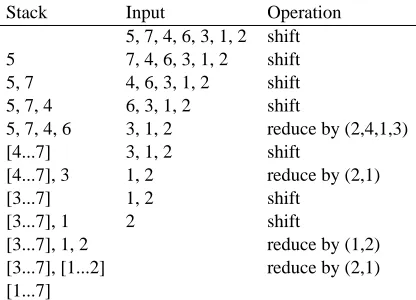
The algorithm is based on a shift-reduce parser, which maintains a stack for subsequences that have been discovered so far and loops over shift and re-duce steps:
1. Shift the next number in the input permutation onto the stack.
2. Go down the stack from the top to the bottom. Whenever the topm subsequences satisfy the
partition property, which says the total length
of them (k ≥ m ≥2) subsequences minus1
is equal to the difference between the smallest number and the largest number contained in the m segments, make a reduction by gluing the m segments into one subsequence and restart reducing from the top of the new stack. Stop when no reduction is possible.
3. If there are remaining numbers in the input per-mutation, go to 1.
When we exit from the loop, if the height of the stack is1, the input permutation ofnhas been reduced to
Stack Input Operation
5, 7, 4, 6, 3, 1, 2 shift
5 7, 4, 6, 3, 1, 2 shift
5, 7 4, 6, 3, 1, 2 shift
5, 7, 4 6, 3, 1, 2 shift
5, 7, 4, 6 3, 1, 2 reduce by (2,4,1,3)
[4...7] 3, 1, 2 shift
[4...7], 3 1, 2 reduce by (2,1)
[3...7] 1, 2 shift
[3...7], 1 2 shift
[3...7], 1, 2 reduce by (1,2)
[3...7], [1...2] reduce by (2,1)
[1...7]
Table 1: The execution trace of the shift-reduce parser on the input permutation5,7,4,6,3,1,2.
a linear sequence of1ton, and parsing is success-ful. Otherwise, the input permutation ofncannot be parsed into ak-ary permutation tree.
An example execution trace of the algorithm is shown in Table 1.
The partition property is a sufficient and neces-sary condition for the topmsubsequences to be re-ducible. In order to check if the property holds, we need to compute the sum of the lengths of subse-quences under consideration and the difference be-tween the largest and smallest number in the cov-ered region. We can incrementally compute both along with each step going down the stack. If m is bounded byk, we needO(k)operations for each item shifted onto the stack. So, the algorithm runs in O(n·k).
We might also wish to compute the minimum k for whichk-arization can be successful on an input permutation ofn. We can simply keep doing reduc-tion tests for every possible top region of the stack while going deeper in the stack to find the minimal reduction. In the worst case, each time we go down to the bottom of the increasingly higher stack with-out a successful reduction. Thus, inO(n2), we can find the minimumk-arization.
5 Linear Time Factorization
is that whenever a new number is shifted in, we have to try out every possible new span ending at the new number. Do we need to try every possible span? Let us start with a motivating example. The permuted sequence(5,7,4,6)in Table 1 can only be reduced as a whole block. However, in the last algorithm, when 4 is shifted in, we make an unsuccessful at-tempt for the span on(7,4), knowing we are miss-ing 5, which will not appear when we expand the span no matter how much further to the right. Yet we repeat the same mistake to try on 7 when 6 is scanned in by attempting on(7,4,6). Such wasteful checks result in the quadratic behavior of the algo-rithm. The way the following algorithm differs from and outperforms the previous algorithm is exactly that it crosses out impossible candidates for reduc-tions such as7in the example as early as possible.
Now we state our problem mathematically. We define a function whose value indicates the re-ducibility of each pair of positions(x, y)(1 ≤ x≤
y≤n):
f(x, y) =u(x, y)−l(x, y)−(y−x)
where
l(x, y) = min
i∈[x,y]π(i)
u(x, y) = max
i∈[x,y]π(i)
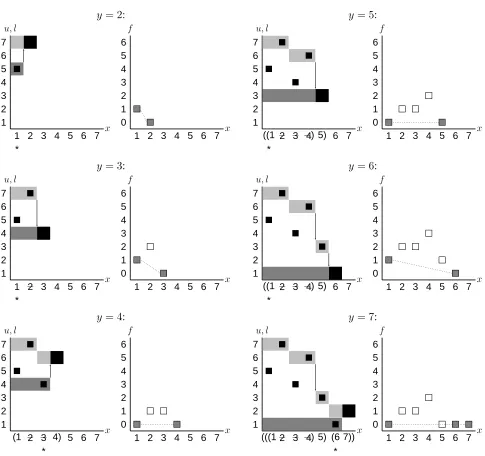
l records the minimum of the numbers that are permuted to from the positions in the region [x, y]. u records the maximum. Figure 1 provides the vi-sualization ofu,l, andf for the example permuta-tion(5,7,4,6,3,1,2). uandlcan be visualized as stairs. u goes up from the right end to the left. l goes down. f is non-negative, but not monotonic in general. We can make a reduction on (x, y) if and only if f(x, y) = 0. This is the mathemati-cal statement of the partition property in step 2 of the shift-reduce algorithm.uandlcan be computed incrementally from smaller spans to larger spans to guaranteeO(1)operations for computingf on each new span of[x, y]as long as we go bottom up. In the new algorithm, we will reduce the size of the search space of candidate position pairs(x, y)to be linear innso that the whole algorithm isO(n).
The algorithm has two main ideas:
• We filter x’s to maintain the invariant that f(x, y) (x ≤ y) is monotonically decreasing with respect tox, over iterations on y(from 1
ton), so that any remaining values ofx corre-sponding to valid reductions are clustered at the point wheref tails off to zero. To put it another way, we never have to test invalid reductions, because the valid reductions have been sorted together for us.
• We make greedy reductions as in the shift-reduce algorithm.
In the new algorithm, we use a doubly linked list, instead of a stack, as the data structure that stores the candidate x’s to allow for more flexible main-taining operations. The steps of the algorithm are as follows:
1. Increase the left-to-right indexyby one and ap-pend it to the right end of the list.
2. Find the pivotx∗
in the list which is minimum (leftmost) amongx satisfying eitheru(x, y−
1) < u(x, y) (exclusively) or l(x, y− 1) > l(x, y).
3. Remove those x’s that yield even smaller u(x, y −1) than u(x∗, y −1) or even larger l(x, y−1)thanl(x∗, y −1). Thosex’s must
be on the right of x∗
if they exist. They must form a sub-list extending to the right end of the originalxlist.
4. Denote thexwhich is immediately to the left ofx∗
asx′
. Repeatedly remove allx’s such that f(x, y)> f(x′, y
)wherexis at the left end of the sub-list ofx’s starting fromx∗extending to
the right.
5. Go down the pruned list from the right end, out-put(x, y)untilf(x, y) >0. Removex’s such thatf(x, y) = 0, sparing the smallestxwhich is the leftmost among all suchx’s on the list.
6. If there are remaining numbers in the input per-mutation, go to 1.
x1, ..., x′,
step4
z }| {
x∗
, ..., xi, ..., xj, ..., xk
| {z }
step3
, y
The steps from 2 to 4 are the operations that main-tain the monotonic invariant which makes the reduc-tions in step 5 as trivial as performing output. The stack-based shift-reduce algorithm has the same top-level structure, but lacks steps 2 to 4 so that in step 5 we have to winnow the entire list. Both algorithms scan left to right and examine potential reduction spans by extending the left endpoint from right to left given a right endpoint.
5.1 Example Execution Trace
An example of the algorithm’s execution is shown in Figure 1. The evolution of u(x, y), l(x, y), and f(x, y)is displayed for increasingy’s (from2to7). To identify reducible spans, we can check the plot of f(x, y)to locate the(x, y)pairs that yield zero. The pivots found by step 2 of the algorithm are marked with∗’s on thex-axis in the plot foruandl. Thex’s that are filtered out by step 3 or 4 are marked with horizontal bars across. We want to point out the in-teresting steps. Wheny = 3,x∗ = 1,x = 2needs
to be crossed out by step 3 in the algorithm. When y= 4,x∗ = 3,x= 3itself is to be deleted by step 4
in the algorithm.x= 4is removed at step 5 because it is the right end in the first reduction. On the other hand, x = 4 is also a bad starting point for future reductions. Notice that we also remove x = 5 at step 6, which can be a good starting point for reduc-tions. But we exclude it from further considerations, because we want left-most reductions.
5.2 Correctness
Now we explain why the algorithm works. Both al-gorithms are greedy in the sense that at each scan point we exhaustively reduce all candidate spans to the leftmost possible point. It can be shown that greediness is safe for parsing permutations.
What we need to show is how the monotonic in-variant holds and is valid. Now we sketch the proof. We want to show for all xi remaining on the list,
f(xi, y) ≥ f(xi+1, y). Wheny = 1, it is trivially
true. Now we do the induction on y step by case analysis:
Case 1: If xi < xi+1 < x∗, then f(xi, y) −
f(xi, y −1) = −1. The reason is if xi is on the
left ofx∗
, bothu(xi, y)andl(xi, y)are not changed
from they−1-th step, so the only difference is that y−xihas increased by one. Graphically, thefcurve
extending to the left ofx∗
shifts down a unit of1. So, the monotonic property still holds to the left ofx∗.
Case 2: If x∗
≤ xi < xi+1, then f(xi, y) −
f(xi, y −1) = c (c ≥ 0). The reason is that after
executing step 3 in the algorithm, the remainingxi’s
have either theiru(xi, y) shifted up uniformly with
l(xi, y)being unchanged, or the symmetric case that
l(xi, y)is shifted down uniformly without changing
u(xi, y). In both cases, the difference betweenuand
lincreases by at least one unit to offset the one unit increase ofy−xi. The result is that thef curve
ex-tending fromx∗
to the right shifts up or remains the same.
Case 3: So the half curve off on the left ofx∗
is shifting down and the half right curve on the right is shifting up, making it necessary to consider the case thatxi is on the left and xi+1 on the right.
Fortu-nately, step 4 in the algorithm deals with this case explicitly by cutting down the head of the right half curve to smooth the whole curve into a monotoni-cally decreasing one.
We still need one last piece for the proof, i.e., the validity of pruning. Is it possible we winnow off goodx’s that will become useful in later stages of y? The answer is no. The values we remove in step 3 and 4 are similar to the points indexing into the second and third numbers in the permuted sequence
(5,7,4,6). Any span starting from these two points will not be reducible because the element5is miss-ing.1
To summarize, we remove impossible left bound-aries and keep good ones, resulting in the mono-tonicity of f function which in turn makes safe greedy reductions fast.
5.3 Implementation and Time Analysis
We use a doubly linked list to implement both theu andlfunctions, where list element includes a span of x values (shaded rectangles in Figure 1). Both lists can be doubly linked with the list ofx’s so that
1
we can access theufunction andlfunction atO(1)
time for eachx. At the same time, if we search for xbased onuorl, we can follow the stair functions, skipping many intermediatex’s.
The total number of operations that occur at step 4 and step 5 isO(n) since these steps just involve removing nodes on the xlist, and onlynnodes are created in total over the entire algorithm. To find x∗
, we scan back from the right end of u list or l list. Due to step 3, each u (andl) element that we scan over is removed at this iteration. So the total number of operations accountable to step 2 and step 3 is bounded by the maximum number of nodes ever created on theuandllists, which is alson.
5.4 Related Work
Our algorithm is based on an algorithm for finding all common intervals of two permutations (Uno and Yagiura, 2000). The difference2 is in step 5, where we remove the embedded reducible x’s and keep only the leftmost one; their algorithm will keep all of the reduciblex’s for future considerations so that in the example the number3will be able to involve in both the reduction([4−7],3)and(3,[1−2]). In the worst case, their algorithm will output a quadratic number of reducible spans, making the whole algo-rithm O(n2). Our algorithm is O(n) in the worst case. We can also generate all common intervals by transforming the permutation tree output by our al-gorithm.
However, we are not the first to specialize the Uno and Yagiura algorithm to produce tree structures for permutations. Bui-Xuan et al. (2005) reached a lin-ear time algorithm in the definition framework of PQ trees. PQ trees represent families of permuta-tions that can be created by composing operapermuta-tions of scrambling subsequences according to any per-mutation (P nodes) and concatenating subsequences in order (Q nodes). Our definition of permutation tree can be thought of as a more specific version of a PQ tree, where the nodes are all labeled with a spe-cific permutation which is not decomposable.
2
The original Uno and Yagiura algorithm also has the minor difference that the scan point goes from right to left.
6 Experiments on Analyzing Word
Alignments
We apply the factorization algorithm to analyzing word alignments in this section. Wellington et al. (2006) indicate the necessity of introducing discon-tinuous spans for synchronous parsing to match up with human-annotated word alignment data. The number of discontinuous spans reflects the struc-tural complexity of the synchronous rules that are involved in building the synchronous trees for the given alignments. However, the more direct and de-tailed analysis would be on the branching factors of the synchronous trees for the aligned data.
Since human-aligned data has many-to-one word links, it is necessary to modify the alignments into one-to-one. Wellington et al. (2006) treat many-to-one word links disjunctively in their synchronous parser. We also commit to one of the many-one links by extracting a maximum match (Cormen et al., 1990) from the bipartite graph of the alignment. In other words, we abstract away the alternative links in the given alignment while capturing the backbone using the maximum number of word links.
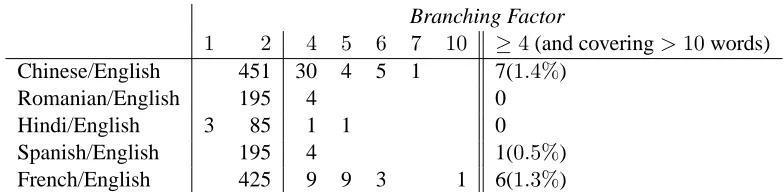
We use the same alignment data for the five language pairs Chinese/English, Romanian/English, Hindi/English, Spanish/English, and French/English (Wellington et al., 2006). In Table 2, we report the number of sentences that arek-ary parsable but not k−1-ary parsable for increasing k’s. Our analysis reveals that the permutations that are accountable for non-ITG alignments include higher order permuta-tions such as(3,1,5,2,4), albeit sparsely seen.
y= 2:
Branching Factor
1 2 4 5 6 7 10 ≥4(and covering>10words) Chinese/English 451 30 4 5 1 7(1.4%)
Romanian/English 195 4 0
Hindi/English 3 85 1 1 0
Spanish/English 195 4 1(0.5%) French/English 425 9 9 3 1 6(1.3%)
Table 2: Distribution of branching factors for synchronous trees on various language pairs.
7 Conclusion
We present a linear time algorithm for factorizing anyn-ary SCFG rule into a set of k-ary rules where kis minimized. The algorithm speeds up an easy-to-understand shift-reduce algorithm, by avoiding unnecessary reduction attempts while maintaining the left-to-right bottom-up control structure. Em-pirically, we provide a complexity analysis of word alignments based on the concept of minimal branch-ing factor.
References
Albert V. Aho and Jeffery D. Ullman. 1972. The
The-ory of Parsing, Translation, and Compiling, volume 1.
Prentice-Hall, Englewood Cliffs, NJ.
Binh Minh Bui-Xuan, Michel Habib, and Christophe Paul. 2005. Revisiting T. Uno and M. Yagiura’s algo-rithm. In The 16th Annual International Symposium
on Algorithms and Computation (ISAAC’05), pages
146–155.
David Chiang. 2005. A hierarchical phrase-based model for statistical machine translation. In Proceedings of
the 43rd Annual Conference of the Association for Computational Linguistics (ACL-05), pages 263–270,
Ann Arbor, Michigan.
Thomas H. Cormen, Charles E. Leiserson, and Ronald L. Rivest. 1990. Introduction to algorithms. MIT Press, Cambridge, MA.
Michel Galley, Mark Hopkins, Kevin Knight, and Daniel Marcu. 2004. What’s in a translation rule? In
Pro-ceedings of the Human Language Technology Confer-ence/North American Chapter of the Association for Computational Linguistics (HLT/NAACL).
Daniel Gildea, Giorgio Satta, and Hao Zhang. 2006. Fac-toring synchronous grammars by sorting. In
Proceed-ings of the International Conference on Computational Linguistics/Association for Computational Linguistics (COLING/ACL-06) Poster Session, Sydney.
Giorgio Satta and Enoch Peserico. 2005. Some com-putational complexity results for synchronous
context-free grammars. In Proceedings of Human
Lan-guage Technology Conference and Conference on Empirical Methods in Natural Language Processing (HLT/EMNLP), pages 803–810, Vancouver, Canada,
October.
Takeaki Uno and Mutsunori Yagiura. 2000. Fast algo-rithms to enumerate all common intervals of two per-mutations. Algorithmica, 26(2):290–309.
Benjamin Wellington, Sonjia Waxmonsky, and I. Dan
Melamed. 2006. Empirical lower bounds on the
complexity of translational equivalence. In
Proceed-ings of the International Conference on Computational Linguistics/Association for Computational Linguistics (COLING/ACL-06).
Dekai Wu. 1997. Stochastic inversion transduction
grammars and bilingual parsing of parallel corpora.
Computational Linguistics, 23(3):377–403.
Kenji Yamada and Kevin Knight. 2001. A syntax-based
statistical translation model. In Proceedings of the
39th Annual Conference of the Association for Com-putational Linguistics (ACL-01), Toulouse, France.
Hao Zhang, Liang Huang, Daniel Gildea, and Kevin
Knight. 2006. Synchronous binarization for
ma-chine translation. In Proceedings of the Human