#"# $ % %#
& ''' (
© 2010, IJARCS All Rights Reserved 1
A Layered Multiagent Core for a Decision Support System
Fahem Kebair*
Laboratoire d’Informatique de Traitement de l’Information et des Systèmes
Le Havre University Le Havre, France [email protected]
Frédéric Serin
Laboratoire d’Informatique de Traitement de l’Information et des Systèmes
Le Havre University Le Havre, France [email protected]
Abstract:Decision Support Systems are powerful tools to help support making decisions. However, they are known to be customized for a specific purpose and can rarely be reused. Moreover, they do not support complex situations sufficiently. Our work addresses this challenge and consists in building a DSS that aims to help emergency managers to manage cases of crisis. The DSS is designed to be flexible and adaptive, so that it may be applied on different subjects of studies and whose behaviour may change with the change of its environment. We endowed it therefore with a multiagent layered core whose role is to represent dynamically and in real time the current situation, to characterize it and to compare it with past known scenarios. The final result of the DSS will help decision-makers to analyse the current crisis and its possible evolution. The RoboCupRescue Simulation System is chosen as a test bed to illustrate and to test this approach.
Keywords:decision support system; dbscan; clusters; factual agents; factual semantic features; multiagent system
I. INTRODUCTION
Preventing and managing crisis is a complex task which requires new efficient approaches and means. This is already realized and accepted as a high priority task by many organizations, governments and companies in Europe and all over the world [1]. Our work addresses this challenge and aims to build a Decision Support System (DSS) that must be able to help emergency managers to deal with crisis and to provide them emergency management plans for avoiding or reducing their consequences. Indeed, DSSs have proved their ability to resolve such kind of problems. However, they are well known to be customized for a specific purpose and can rarely be reused. Moreover, they only support circumstances which lie in the known and knowable spaces and do not support complex situations sufficiently [4]. The approach we propose focuses on this issue. In fact, the system may be used in different subjects of studies. In other words, it operates in a generic manner and relies on specific knowledge related to the studied domain. Furthermore, the system may adapt its behaviour autonomously by altering its internal structure and modifying its behaviour to better respond to the change of its environment. The MultiAgent System (MAS) technology is an appropriate solution to achieve these objectives. Intelligent agents [14] are able to self-perform actions and to interact with other agents and their environment in order to carry out some objectives and to react to changes they perceive.
The proposed system is made up of several agent organizations whose kernel is operating on three levels. A first level, in which a factual agent organisation has as role to represent dynamically and in real time the evolution of the current situation. This step is fundamental in the final assessment of the situation. Indeed, the system creates its own representation of the environment state in order to extract the significant facts that may reveal the existence of risks. It compares therefore the current situation with previous known ones stored as scenarios. That way, the
system may have a generic and adaptive mechanism and may learn during its functioning.
In our approach, it is necessary to test the MAS on several case studies to illustrate it and to validate it. The work presented here is addressed to the RoboCupRescue Simulation System (RCRSS) [7] [9]. We provide here a brief description of this application and we present and discuss the related experimentations.
II. DSS ROLE AND DESIGN
A. DSS Definition and Role
DSSs are interactive, computer-based systems that aid users in judgement and choice activities. They provide data storage and retrieval but enhance the traditional information access and retrieval functions with support for model building and model-based reasoning. They support framing, modelling, and problem solving [2]. More precisely, the purposes of a DSS are the following [6]:
• Supplementing the decision maker
• Allowing better intelligence, design, or choice
• Facilitating problem solving
• Providing aid for non structured decisions
• Managing knowledge
In our context, the DSS could be used either to prevent a crisis or to deal with it. In both cases, the main internal aim of the system is to detect a crucial event. From the system point of view, detecting a crisis implies representing it, characterizing it and comparing it with other crises, permanently stored in scenarios. The result of this comparison is provided to the user as the answer of the global system. The system chooses to highlight parts of scenarios similar to the current situation. The information thus obtained will help decision-makers to analyse the current crisis and its possible evolutions.
evolving situation. This requires a system able to be reconfigured when necessary, thus benefiting from a sufficiently flexible an
and dynamics of the situation to be treated, lead us to choose MAS paradigm for its modelling.
The observed situation generally contains a great number of dynamic parameters, that is to say parameters whose value change
situations must be dynamic in order to be able to handle these evolutions. As a consequence, to design these systems, a flexible and adaptive architecture is needed. Such a system must not only represent t
make it possible to evaluate it. Evaluating the situation can be performed by anticipating its possible consequences. This can be carried out using previous situations whose consequences are used relying on the followin
situation A looks like situation B, the consequences of situation A ought to be similar to those of situation B. This mechanism is similar to a Case
which is a methodology based on the re experiments
B. DSS Architecture and Design
Fig. 1 shows the global architecture of this DSS. The interface
access the DSS and its kernel. This interface also displays the final results p
access outside d
specific information on the domain stores persistent data such as the
also an aspect of this specific inf
C. DSS
We chose the RCRSS in order to apply the proposed approach. The RCRSS is an agent
intends to reenact the rescue mission problem in real world. It reproduces an earthquake scenario which includes various kinds of incidents as the traff
civilians, road blockage, fire accidents, etc. A set of heterogeneous agents (RCR agents) coexist in the disaster space: rescue agents that are fire brigades, ambulance teams and police forces, and civilian agents. A model of th disaster space and the properties of
RCR agents are detailed
to extract knowledge and to formalise information.
evolving situation. This requires a system able to be reconfigured when necessary, thus benefiting from a sufficiently flexible an
and dynamics of the situation to be treated, lead us to choose MAS paradigm for its modelling.
The observed situation generally contains a great number of dynamic parameters, that is to say parameters whose value change over time. Systems allowing the management of such situations must be dynamic in order to be able to handle these evolutions. As a consequence, to design these systems, a flexible and adaptive architecture is needed. Such a system must not only represent t
make it possible to evaluate it. Evaluating the situation can be performed by anticipating its possible consequences. This can be carried out using previous situations whose consequences are used relying on the followin
situation A looks like situation B, the consequences of situation A ought to be similar to those of situation B. This mechanism is similar to a Case
which is a methodology based on the re experiments for solving new problems.
DSS Architecture and Design
Fig. 1 shows the global architecture of this DSS. The interface allows the dialogue between all users authorised to access the DSS and its kernel. This interface also displays the final results provided by the kernel. The latter also needs to access outside distributed information systems
specific information on the domain stores persistent data such as the ontology
also an aspect of this specific inf
Figure 1.
DSS Application: RoboCupRescue Case Study
We chose the RCRSS in order to apply the proposed approach. The RCRSS is an agent
intends to reenact the rescue mission problem in real world. It reproduces an earthquake scenario which includes various kinds of incidents as the traff
civilians, road blockage, fire accidents, etc. A set of heterogeneous agents (RCR agents) coexist in the disaster space: rescue agents that are fire brigades, ambulance teams and police forces, and civilian agents. A model of th disaster space and the properties of
RCR agents are detailed
to extract knowledge and to formalise information.
evolving situation. This requires a system able to be reconfigured when necessary, thus benefiting from a sufficiently flexible and adaptive architecture. Complexity and dynamics of the situation to be treated, lead us to choose MAS paradigm for its modelling.
The observed situation generally contains a great number of dynamic parameters, that is to say parameters whose value over time. Systems allowing the management of such situations must be dynamic in order to be able to handle these evolutions. As a consequence, to design these systems, a flexible and adaptive architecture is needed. Such a system must not only represent the observed situation, but must also make it possible to evaluate it. Evaluating the situation can be performed by anticipating its possible consequences. This can be carried out using previous situations whose consequences are used relying on the followin
situation A looks like situation B, the consequences of situation A ought to be similar to those of situation B. This mechanism is similar to a Case-Based Reasoning (CBR) [8] which is a methodology based on the re
for solving new problems.
DSS Architecture and Design
Fig. 1 shows the global architecture of this DSS. The allows the dialogue between all users authorised to access the DSS and its kernel. This interface also displays the rovided by the kernel. The latter also needs to
istributed information systems
specific information on the domain stores persistent data ontology and scenarios
also an aspect of this specific information.
Figure 1. DSS Architecture
pplication: RoboCupRescue Case Study
We chose the RCRSS in order to apply the proposed approach. The RCRSS is an agent
intends to reenact the rescue mission problem in real world. It reproduces an earthquake scenario which includes various kinds of incidents as the traffic after earthquake, buried civilians, road blockage, fire accidents, etc. A set of heterogeneous agents (RCR agents) coexist in the disaster space: rescue agents that are fire brigades, ambulance teams and police forces, and civilian agents. A model of th disaster space and the properties of
RCR agents are detailed in [11]. We use this model in order to extract knowledge and to formalise information.
evolving situation. This requires a system able to be reconfigured when necessary, thus benefiting from a d adaptive architecture. Complexity and dynamics of the situation to be treated, lead us to choose
The observed situation generally contains a great number of dynamic parameters, that is to say parameters whose value over time. Systems allowing the management of such situations must be dynamic in order to be able to handle these evolutions. As a consequence, to design these systems, a flexible and adaptive architecture is needed. Such a system he observed situation, but must also make it possible to evaluate it. Evaluating the situation can be performed by anticipating its possible consequences. This can be carried out using previous situations whose consequences are used relying on the following hypothesis: if situation A looks like situation B, the consequences of situation A ought to be similar to those of situation B. This Based Reasoning (CBR) [8] which is a methodology based on the re-using of past
for solving new problems.
DSS Architecture and Design
Fig. 1 shows the global architecture of this DSS. The allows the dialogue between all users authorised to access the DSS and its kernel. This interface also displays the rovided by the kernel. The latter also needs to
istributed information systems
specific information on the domain stores persistent data scenarios. Proximity measure
ormation.
DSS Architecture
pplication: RoboCupRescue Case Study
We chose the RCRSS in order to apply the proposed approach. The RCRSS is an agent-based simulator which intends to reenact the rescue mission problem in real world. It reproduces an earthquake scenario which includes various ic after earthquake, buried civilians, road blockage, fire accidents, etc. A set of heterogeneous agents (RCR agents) coexist in the disaster space: rescue agents that are fire brigades, ambulance teams and police forces, and civilian agents. A model of th disaster space and the properties of its components, and the
in [11]. We use this model in order to extract knowledge and to formalise information.
evolving situation. This requires a system able to be reconfigured when necessary, thus benefiting from a d adaptive architecture. Complexity and dynamics of the situation to be treated, lead us to choose
The observed situation generally contains a great number of dynamic parameters, that is to say parameters whose value over time. Systems allowing the management of such situations must be dynamic in order to be able to handle these evolutions. As a consequence, to design these systems, a flexible and adaptive architecture is needed. Such a system he observed situation, but must also make it possible to evaluate it. Evaluating the situation can be performed by anticipating its possible consequences. This can be carried out using previous situations whose g hypothesis: if situation A looks like situation B, the consequences of situation A ought to be similar to those of situation B. This Based Reasoning (CBR) [8] using of past
Fig. 1 shows the global architecture of this DSS. The user allows the dialogue between all users authorised to access the DSS and its kernel. This interface also displays the rovided by the kernel. The latter also needs to istributed information systems (DIS). The specific information on the domain stores persistent data Proximity measure is
pplication: RoboCupRescue Case Study
We chose the RCRSS in order to apply the proposed based simulator which intends to reenact the rescue mission problem in real world. It reproduces an earthquake scenario which includes various ic after earthquake, buried civilians, road blockage, fire accidents, etc. A set of heterogeneous agents (RCR agents) coexist in the disaster space: rescue agents that are fire brigades, ambulance teams and police forces, and civilian agents. A model of the RCR its components, and the in [11]. We use this model in order to extract knowledge and to formalise information.
As in real case, RCR agents play the actors role here, they send their perceiv
get a sequence of actions to perform. The DSS builds, based on these information, an overall knowledge which allows the evaluation of the whole situation. We focus, in this paper, on the fires incidents and their relat
therefore the perception and the representation of both the fires propagation and the behaviours of the fire brigades.
II.
A. Factual Semantic Features
The system receives and analyses permanently elementary information coming from the environment. These information are presented in the shape of a Factual Semantic Feature (FSF). The noun given to this message content provides an explication to our approach: we stress observed and punctual elements t
knowledge or information based on real occurrences; it may be an event, an action, a phenomenon, etc.
Each FSF describes a fact and consequently a state change of an observed object issued from the environment. This may be mo
transition represents an instantaneous transit from a state to another. It is triggered by an event (message), followed by the performance of one or several actions in the new state. The observation of this change is
shape of an FSF. An FSF has a generic structure which is composed of <key, (qualifier, value)
identifier related to the observed object to which are associated some characteristics described by qualifiers a their related values. We associated also time and spatial values to an FSF to describe the temporal and the spatial aspects of the observation. An example of an FSF is the following: <fire#1, intensity, strong, localisation, building#12, time, 10:00 pm>
fire, located in building#12 and which is observed at 10:00 pm.
Dedicated to the observed environment, the ontology serves as a mean for establishing a conceptually concise basis for communicating knowledge. The vector of t communication is the FSF, with the taxonomy structuring and defining the meaning of the observed facts. The measure functions use the ontology to compare FSFs. This comparison is coupled with temporal and spatial data carried by the FSF to obtain a nor
1]. A value of
two compared FSFs. A value of 0 means neutral or not comparable. A value of 1 means identity between the two FSFs and any other value in this interval means a seman connexion in the range from opposite to identical.
B. Factual Agents
The system is permanently fed by information describing the state of the environment. These information are handled thereafter by agents. The system needs knowledge about the environment
proximity measures.
The representation level is made of factual agents whose main aim is to represent the current situation dynamically. A Factual Agent (FA) is a reactive and a proactive agent according to Woo
part of the observed situation. Fig. 2 shows the internal structure of an FA. Each agent has:
•
As in real case, RCR agents play the actors role here, they send their perceiv
get a sequence of actions to perform. The DSS builds, based on these information, an overall knowledge which allows the evaluation of the whole situation. We focus, in this paper, on the fires incidents and their relat
therefore the perception and the representation of both the fires propagation and the behaviours of the fire brigades.
II. PERCEPTION AND
Factual Semantic Features
The system receives and analyses permanently elementary information coming from the environment. These information are presented in the shape of a Factual Semantic Feature (FSF). The noun given to this message content provides an explication to our approach: we stress observed and punctual elements t
knowledge or information based on real occurrences; it may be an event, an action, a phenomenon, etc.
Each FSF describes a fact and consequently a state change of an observed object issued from the environment. This may be modelled as a state
transition represents an instantaneous transit from a state to another. It is triggered by an event (message), followed by the performance of one or several actions in the new state. The observation of this change is
shape of an FSF. An FSF has a generic structure which is composed of <key, (qualifier, value)
identifier related to the observed object to which are associated some characteristics described by qualifiers a their related values. We associated also time and spatial values to an FSF to describe the temporal and the spatial aspects of the observation. An example of an FSF is the following: <fire#1, intensity, strong, localisation, building#12, time, 10:00 pm>
fire, located in building#12 and which is observed at 10:00
Dedicated to the observed environment, the ontology serves as a mean for establishing a conceptually concise basis for communicating knowledge. The vector of t communication is the FSF, with the taxonomy structuring and defining the meaning of the observed facts. The measure functions use the ontology to compare FSFs. This comparison is coupled with temporal and spatial data carried by the FSF to obtain a nor
1]. A value of -1 means a complete opposition between the two compared FSFs. A value of 0 means neutral or not comparable. A value of 1 means identity between the two FSFs and any other value in this interval means a seman connexion in the range from opposite to identical.
Factual Agents
The system is permanently fed by information describing the state of the environment. These information are handled thereafter by agents. The system needs knowledge about the environment such as the ontologies of the domain and the proximity measures.
The representation level is made of factual agents whose main aim is to represent the current situation dynamically. A Factual Agent (FA) is a reactive and a proactive agent according to Wooldridge in [13]. Each FA reflects a partial part of the observed situation. Fig. 2 shows the internal structure of an FA. Each agent has:
An FSF that represents its knowledge
As in real case, RCR agents play the actors role here, they send their perceived information to the DSS in order to get a sequence of actions to perform. The DSS builds, based on these information, an overall knowledge which allows the evaluation of the whole situation. We focus, in this paper, on the fires incidents and their related facts. The work concerns therefore the perception and the representation of both the fires propagation and the behaviours of the fire brigades.
ERCEPTION AND REPRESENTATION
Factual Semantic Features
The system receives and analyses permanently elementary information coming from the environment. These information are presented in the shape of a Factual Semantic Feature (FSF). The noun given to this message content provides an explication to our approach: we stress observed and punctual elements that are the facts. A fact is a knowledge or information based on real occurrences; it may be an event, an action, a phenomenon, etc.
Each FSF describes a fact and consequently a state change of an observed object issued from the environment.
delled as a state
transition represents an instantaneous transit from a state to another. It is triggered by an event (message), followed by the performance of one or several actions in the new state. The observation of this change is sent to the system in the shape of an FSF. An FSF has a generic structure which is composed of <key, (qualifier, value)
identifier related to the observed object to which are associated some characteristics described by qualifiers a their related values. We associated also time and spatial values to an FSF to describe the temporal and the spatial aspects of the observation. An example of an FSF is the following: <fire#1, intensity, strong, localisation, building#12, time, 10:00 pm>. This fact describes a strong fire, located in building#12 and which is observed at 10:00
Dedicated to the observed environment, the ontology serves as a mean for establishing a conceptually concise basis for communicating knowledge. The vector of t communication is the FSF, with the taxonomy structuring and defining the meaning of the observed facts. The measure functions use the ontology to compare FSFs. This comparison is coupled with temporal and spatial data carried by the FSF to obtain a normalised proximity measure in [
1 means a complete opposition between the two compared FSFs. A value of 0 means neutral or not comparable. A value of 1 means identity between the two FSFs and any other value in this interval means a seman connexion in the range from opposite to identical.
The system is permanently fed by information describing the state of the environment. These information are handled thereafter by agents. The system needs knowledge about the such as the ontologies of the domain and the
The representation level is made of factual agents whose main aim is to represent the current situation dynamically. A Factual Agent (FA) is a reactive and a proactive agent ldridge in [13]. Each FA reflects a partial part of the observed situation. Fig. 2 shows the internal structure of an FA. Each agent has:
An FSF that represents its knowledge
As in real case, RCR agents play the actors role here, ed information to the DSS in order to get a sequence of actions to perform. The DSS builds, based on these information, an overall knowledge which allows the evaluation of the whole situation. We focus, in this paper, on ed facts. The work concerns therefore the perception and the representation of both the fires propagation and the behaviours of the fire brigades.
EPRESENTATION
The system receives and analyses permanently elementary information coming from the environment. These information are presented in the shape of a Factual Semantic Feature (FSF). The noun given to this message content provides an explication to our approach: we stress observed hat are the facts. A fact is a knowledge or information based on real occurrences; it may be an event, an action, a phenomenon, etc.
Each FSF describes a fact and consequently a state change of an observed object issued from the environment. delled as a state-transition diagram. A transition represents an instantaneous transit from a state to another. It is triggered by an event (message), followed by the performance of one or several actions in the new state. sent to the system in the shape of an FSF. An FSF has a generic structure which is composed of <key, (qualifier, value)+>. The key is a unique identifier related to the observed object to which are associated some characteristics described by qualifiers a their related values. We associated also time and spatial values to an FSF to describe the temporal and the spatial aspects of the observation. An example of an FSF is the following: <fire#1, intensity, strong, localisation, . This fact describes a strong fire, located in building#12 and which is observed at 10:00
Dedicated to the observed environment, the ontology serves as a mean for establishing a conceptually concise basis for communicating knowledge. The vector of t communication is the FSF, with the taxonomy structuring and defining the meaning of the observed facts. The measure functions use the ontology to compare FSFs. This comparison is coupled with temporal and spatial data carried
malised proximity measure in [ 1 means a complete opposition between the two compared FSFs. A value of 0 means neutral or not comparable. A value of 1 means identity between the two FSFs and any other value in this interval means a seman connexion in the range from opposite to identical.
The system is permanently fed by information describing the state of the environment. These information are handled thereafter by agents. The system needs knowledge about the such as the ontologies of the domain and the
The representation level is made of factual agents whose main aim is to represent the current situation dynamically. A Factual Agent (FA) is a reactive and a proactive agent ldridge in [13]. Each FA reflects a partial part of the observed situation. Fig. 2 shows the internal
An FSF that represents its knowledge
As in real case, RCR agents play the actors role here, ed information to the DSS in order to get a sequence of actions to perform. The DSS builds, based on these information, an overall knowledge which allows the evaluation of the whole situation. We focus, in this paper, on ed facts. The work concerns therefore the perception and the representation of both the fires propagation and the behaviours of the fire brigades.
EPRESENTATION MAS
The system receives and analyses permanently elementary information coming from the environment. These information are presented in the shape of a Factual Semantic Feature (FSF). The noun given to this message content provides an explication to our approach: we stress observed hat are the facts. A fact is a knowledge or information based on real occurrences; it may
Each FSF describes a fact and consequently a state change of an observed object issued from the environment. transition diagram. A transition represents an instantaneous transit from a state to another. It is triggered by an event (message), followed by the performance of one or several actions in the new state. sent to the system in the shape of an FSF. An FSF has a generic structure which is >. The key is a unique identifier related to the observed object to which are associated some characteristics described by qualifiers and their related values. We associated also time and spatial values to an FSF to describe the temporal and the spatial aspects of the observation. An example of an FSF is the following: <fire#1, intensity, strong, localisation, . This fact describes a strong fire, located in building#12 and which is observed at 10:00
Dedicated to the observed environment, the ontology serves as a mean for establishing a conceptually concise basis for communicating knowledge. The vector of this communication is the FSF, with the taxonomy structuring and defining the meaning of the observed facts. The measure functions use the ontology to compare FSFs. This comparison is coupled with temporal and spatial data carried malised proximity measure in [-1, 1 means a complete opposition between the two compared FSFs. A value of 0 means neutral or not comparable. A value of 1 means identity between the two FSFs and any other value in this interval means a semantic
The system is permanently fed by information describing the state of the environment. These information are handled thereafter by agents. The system needs knowledge about the such as the ontologies of the domain and the
•
• •
When a given FSF reaches the system, either an FA whose FSF has the same key
its internal FSF with the new one, or a new FA is created. Thus, at any time, the whole population of FAs with their embedded FSFs reflects the current view of the situation.
We defined two kinds of RoboCupRescue case study:
•
•
FAs represent the dynamic evolution of the situation thanks to their internal indicators. These indicators must reflect as much as possible the reality, their definition therefore on the treated application. We defined two indicators for the RCR case study:
•
•
The acquaintances network of every FA is generic and dynamically constructed. It contains all the other FAs which are semantically connected (proximity n
FA of a given acquaintances network is close when its proximity is positive and is opposite when its proximity is negative. The evolution of the FA is managed by strengthening and weakening mechanisms. Internal indicators reflect this e
An Augmented Transition Newtork (ATN) of four states that describe its behaviour.
carries conditions and actions, and are specific to the FA type
Specific indicators that reflect its dynamics An Acquaintances Network (AN)
When a given FSF reaches the system, either an FA whose FSF has the same key
its internal FSF with the new one, or a new FA is created. Thus, at any time, the whole population of FAs with their embedded FSFs reflects the current view of the situation.
Figure 2.
We defined two kinds of RoboCupRescue case study:
Factual agents managing FSFs that describe phenomena (fires, injuries, building collapses,...). Factual agents managing FSFs that describe the states and the events related to the RCR agents. More precisely, these agents manage the evolution of the states and the actions of the RCR agents.
FAs represent the dynamic evolution of the situation thanks to their internal indicators. These indicators must reflect as much as possible the reality, their definition therefore on the treated application. We defined two indicators for the RCR case study:
Action Indicator (AI):
the efficiency to solve problems for FAs related to RCR agents, and the damage and the hazard degree for FAs related to phenomena.
Plausibility Indicator (PI):
discover new problems in the disaster space for factual agents related to RCR agents, and the solving probability and the worsening impediment for FAs related to phenomena. For phe
agents, PI means the solving probability and the worsening impediment of a phenomenon.
The acquaintances network of every FA is generic and dynamically constructed. It contains all the other FAs which are semantically connected (proximity n
FA of a given acquaintances network is close when its proximity is positive and is opposite when its proximity is negative. The evolution of the FA is managed by strengthening and weakening mechanisms. Internal indicators reflect this e
An Augmented Transition Newtork (ATN) of four states that describe its behaviour.
carries conditions and actions, and are specific to the
Specific indicators that reflect its dynamics An Acquaintances Network (AN)
When a given FSF reaches the system, either an FA whose FSF has the same key – exists and this
its internal FSF with the new one, or a new FA is created. Thus, at any time, the whole population of FAs with their embedded FSFs reflects the current view of the situation.
Figure 2. FA internal structure
We defined two kinds of RoboCupRescue case study:
Factual agents managing FSFs that describe phenomena (fires, injuries, building collapses,...). Factual agents managing FSFs that describe the states and the events related to the RCR agents. More y, these agents manage the evolution of the states and the actions of the RCR agents.
FAs represent the dynamic evolution of the situation thanks to their internal indicators. These indicators must reflect as much as possible the reality, their definition therefore on the treated application. We defined two indicators for the RCR case study:
Action Indicator (AI): represents the potential and the efficiency to solve problems for FAs related to RCR agents, and the damage and the hazard degree
s related to phenomena. Plausibility Indicator (PI):
discover new problems in the disaster space for factual agents related to RCR agents, and the solving probability and the worsening impediment for FAs related to phenomena. For phe
agents, PI means the solving probability and the worsening impediment of a phenomenon.
The acquaintances network of every FA is generic and dynamically constructed. It contains all the other FAs which are semantically connected (proximity n
FA of a given acquaintances network is close when its proximity is positive and is opposite when its proximity is negative. The evolution of the FA is managed by strengthening and weakening mechanisms. Internal indicators reflect this evolution.
An Augmented Transition Newtork (ATN) of four states that describe its behaviour. ATN transitions carries conditions and actions, and are specific to the
Specific indicators that reflect its dynamics An Acquaintances Network (AN)
When a given FSF reaches the system, either an FA exists and this FA will replace its internal FSF with the new one, or a new FA is created.
Thus, at any time, the whole population of FAs with their embedded FSFs reflects the current view of the situation.
FA internal structure
We defined two kinds of factual agents for the
Factual agents managing FSFs that describe phenomena (fires, injuries, building collapses,...). Factual agents managing FSFs that describe the states and the events related to the RCR agents. More y, these agents manage the evolution of the states and the actions of the RCR agents.
FAs represent the dynamic evolution of the situation thanks to their internal indicators. These indicators must reflect as much as possible the reality, their definition therefore on the treated application. We defined two indicators for the RCR case study:
represents the potential and the efficiency to solve problems for FAs related to RCR agents, and the damage and the hazard degree
s related to phenomena.
Plausibility Indicator (PI): means the ability to discover new problems in the disaster space for factual agents related to RCR agents, and the solving probability and the worsening impediment for FAs related to phenomena. For phenomena factual agents, PI means the solving probability and the worsening impediment of a phenomenon.
The acquaintances network of every FA is generic and dynamically constructed. It contains all the other FAs which are semantically connected (proximity not equal to 0). The FA of a given acquaintances network is close when its proximity is positive and is opposite when its proximity is negative. The evolution of the FA is managed by strengthening and weakening mechanisms. Internal An Augmented Transition Newtork (ATN) of four ATN transitions carries conditions and actions, and are specific to the
Specific indicators that reflect its dynamics
When a given FSF reaches the system, either an FA – FA will replace its internal FSF with the new one, or a new FA is created.
Thus, at any time, the whole population of FAs with their embedded FSFs reflects the current view of the situation.
factual agents for the
Factual agents managing FSFs that describe phenomena (fires, injuries, building collapses,...). Factual agents managing FSFs that describe the states and the events related to the RCR agents. More y, these agents manage the evolution of the states and the actions of the RCR agents.
FAs represent the dynamic evolution of the situation thanks to their internal indicators. These indicators must reflect as much as possible the reality, their definition depend therefore on the treated application. We defined two
represents the potential and the efficiency to solve problems for FAs related to RCR agents, and the damage and the hazard degree
means the ability to discover new problems in the disaster space for factual agents related to RCR agents, and the solving probability and the worsening impediment for FAs nomena factual agents, PI means the solving probability and the worsening impediment of a phenomenon.
The acquaintances network of every FA is generic and dynamically constructed. It contains all the other FAs which ot equal to 0). The FA of a given acquaintances network is close when its proximity is positive and is opposite when its proximity is negative. The evolution of the FA is managed by strengthening and weakening mechanisms. Internal factual agents for the
C. Application on a Fire Scenario
We discuss here two different fire scenarios in order to illustrate
representation MAS. In the first one, we have inactivated the police forces who have as goal to clear the b
This made therefore more difficult the moving of the fire brigades to achieve the fires. In the second scenario, we let police forces doing their work, thus the roads are less blocked and the accessibility to the fires is much easier.
In Fig
of the representation MAS during the whole scenario. The activities include the state changes, the indicator values variations and the messages sent by the FAs. The red area
represents the fire spreadi
perceived fires over time. In this scenario the fire brigades could not reach the fires, they still moving to reach them. without being able to achieve them. This is expressed by several oscillations of the FAs activities
Figure 3.
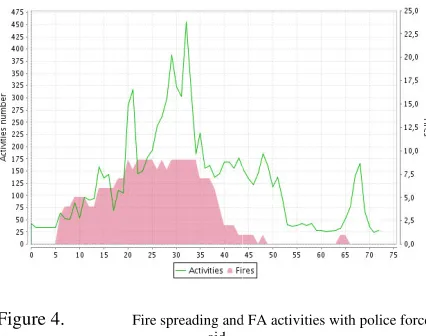
Fig. 4 shows the FA activities and the fire spreading in the second scenario. We note here a smaller area of fires compared to the previous scenario. Moreover, we have less oscillations and a
reflects the system stability on the one hand and the efficiency of the fire brigades on the other hand. Indeed, the system reacts in a moderate way at the beginning of the scenario, in which the fires are isolated
more and more information, describing the fires propagation and the mobilisation of the fire brigades, the factual agents react by intensifying their activities. The values and the oscillations of the activities number depend strongl
behaviours of the fire brigade agents. Indeed, the activities number grows when the fire brigades are fighting fires. Inversely, it drops when the fire brigades are potentially far from fires or are searching new ones. This explains the perfect sy
the fire spreading. To summarize, we can say that there is an activities peak when there is a high level of risk and emergency, due to the rapid spreading of fires and the struggle of the fire brigades tha
Application on a Fire Scenario
We discuss here two different fire scenarios in order to illustrate the functioning and the adapting of the representation MAS. In the first one, we have inactivated the police forces who have as goal to clear the b
This made therefore more difficult the moving of the fire brigades to achieve the fires. In the second scenario, we let police forces doing their work, thus the roads are less blocked and the accessibility to the fires is much easier.
In Fig. 3, the green chart illustrates the activities number of the representation MAS during the whole scenario. The activities include the state changes, the indicator values variations and the messages sent by the FAs. The red area
represents the fire spreadi
perceived fires over time. In this scenario the fire brigades could not reach the fires, they still moving to reach them. without being able to achieve them. This is expressed by several oscillations of the FAs activities
Figure 3. Fire spreading and FA activities without police
Fig. 4 shows the FA activities and the fire spreading in the second scenario. We note here a smaller area of fires compared to the previous scenario. Moreover, we have less oscillations and a higher number of the FA activities. This reflects the system stability on the one hand and the efficiency of the fire brigades on the other hand. Indeed, the system reacts in a moderate way at the beginning of the scenario, in which the fires are isolated
more and more information, describing the fires propagation and the mobilisation of the fire brigades, the factual agents react by intensifying their activities. The values and the oscillations of the activities number depend strongl
behaviours of the fire brigade agents. Indeed, the activities number grows when the fire brigades are fighting fires. Inversely, it drops when the fire brigades are potentially far from fires or are searching new ones. This explains the perfect synchronisation between the activities evolution and the fire spreading. To summarize, we can say that there is an activities peak when there is a high level of risk and emergency, due to the rapid spreading of fires and the struggle of the fire brigades tha
Application on a Fire Scenario
We discuss here two different fire scenarios in order to functioning and the adapting of the representation MAS. In the first one, we have inactivated the police forces who have as goal to clear the b
This made therefore more difficult the moving of the fire brigades to achieve the fires. In the second scenario, we let police forces doing their work, thus the roads are less blocked and the accessibility to the fires is much easier.
. 3, the green chart illustrates the activities number of the representation MAS during the whole scenario. The activities include the state changes, the indicator values variations and the messages sent by the FAs. The red area
represents the fire spreading, expressed by the number of the perceived fires over time. In this scenario the fire brigades could not reach the fires, they still moving to reach them. without being able to achieve them. This is expressed by several oscillations of the FAs activities
Fire spreading and FA activities without police forces aid
Fig. 4 shows the FA activities and the fire spreading in the second scenario. We note here a smaller area of fires compared to the previous scenario. Moreover, we have less higher number of the FA activities. This reflects the system stability on the one hand and the efficiency of the fire brigades on the other hand. Indeed, the system reacts in a moderate way at the beginning of the scenario, in which the fires are isolated
more and more information, describing the fires propagation and the mobilisation of the fire brigades, the factual agents react by intensifying their activities. The values and the oscillations of the activities number depend strongl
behaviours of the fire brigade agents. Indeed, the activities number grows when the fire brigades are fighting fires. Inversely, it drops when the fire brigades are potentially far from fires or are searching new ones. This explains the nchronisation between the activities evolution and the fire spreading. To summarize, we can say that there is an activities peak when there is a high level of risk and emergency, due to the rapid spreading of fires and the struggle of the fire brigades that try to restore the situation.
Application on a Fire Scenario
We discuss here two different fire scenarios in order to functioning and the adapting of the representation MAS. In the first one, we have inactivated the police forces who have as goal to clear the blocked roads. This made therefore more difficult the moving of the fire brigades to achieve the fires. In the second scenario, we let police forces doing their work, thus the roads are less blocked and the accessibility to the fires is much easier.
. 3, the green chart illustrates the activities number of the representation MAS during the whole scenario. The activities include the state changes, the indicator values variations and the messages sent by the FAs. The red area
ng, expressed by the number of the perceived fires over time. In this scenario the fire brigades could not reach the fires, they still moving to reach them. without being able to achieve them. This is expressed by several oscillations of the FAs activities.
Fire spreading and FA activities without police
Fig. 4 shows the FA activities and the fire spreading in the second scenario. We note here a smaller area of fires compared to the previous scenario. Moreover, we have less higher number of the FA activities. This reflects the system stability on the one hand and the efficiency of the fire brigades on the other hand. Indeed, the system reacts in a moderate way at the beginning of the scenario, in which the fires are isolated. By dint of receiving more and more information, describing the fires propagation and the mobilisation of the fire brigades, the factual agents react by intensifying their activities. The values and the oscillations of the activities number depend strongl
behaviours of the fire brigade agents. Indeed, the activities number grows when the fire brigades are fighting fires. Inversely, it drops when the fire brigades are potentially far from fires or are searching new ones. This explains the nchronisation between the activities evolution and the fire spreading. To summarize, we can say that there is an activities peak when there is a high level of risk and emergency, due to the rapid spreading of fires and the
t try to restore the situation. We discuss here two different fire scenarios in order to
functioning and the adapting of the representation MAS. In the first one, we have inactivated the locked roads. This made therefore more difficult the moving of the fire brigades to achieve the fires. In the second scenario, we let police forces doing their work, thus the roads are less blocked and the accessibility to the fires is much easier.
. 3, the green chart illustrates the activities number of the representation MAS during the whole scenario. The activities include the state changes, the indicator values variations and the messages sent by the FAs. The red area
ng, expressed by the number of the perceived fires over time. In this scenario the fire brigades could not reach the fires, they still moving to reach them. without being able to achieve them. This is expressed by
Fire spreading and FA activities without police
Figure 4.
At the end of the scenario. the system knows an evident bending result of the fires extinction. The factual agents become less meaningful since there are not
related to fires that come stimulating them. However, the system still in a warning state in order to alert every notable change in the environment. We may notice this at the 63 second of the simulation, when a fire reappears suddenly. The system reacts immediately to this fact and resumes its activities, then it becomes again stable after the fire were put out.
III.
We used FAs in the representation level to reflect the dynamic change of the situation and
view, agents subsets. The analysis of these subsets is based on geometric criteria, insuring thus the independence of the treatment from the subject of study.
Each FA exposes behavioural activities that are characterised thanks to
a behavioural vector that draws, by its variations, the dynamics of the agent during its evolution. This gives a meaning to the state of the agent inside its organisation and consequently to the prominence of the s
that it carries.
A. Clustering Algorithms for the Chracterisation of the Situation
The goal of our approach is to characterise the FAs organisation by forming dynamically agents clusters and comparing them with stored scenarios. The clusteri algorithms are an appropriate approach to this objective, since they are able to create objects groups in an unsupervised way.
The basic element of these algorithms is the measure of (dis)similarity between the compared objects, that corresponds often
FAs evolve in an
n internal indicators of the FAs. We have therefore a two dimensional space in the current case study. AI and PI are quantitative, hence it is possible to
between agents. We used Cosine Similarity (CS) as (dis)similarity measure. Indeed, this measure is the most suited to our problem since we try to compare vectors that express the changes of the FA activities. The value provided by CS is
perfect equality between the two vectors (consequently the Figure 4. Fire spreading and FA activities with police forces
At the end of the scenario. the system knows an evident bending result of the fires extinction. The factual agents become less meaningful since there are not
related to fires that come stimulating them. However, the system still in a warning state in order to alert every notable change in the environment. We may notice this at the 63 second of the simulation, when a fire reappears suddenly.
e system reacts immediately to this fact and resumes its activities, then it becomes again stable after the fire were put
III. CHARACTERISATION AND
We used FAs in the representation level to reflect the dynamic change of the situation and
view, agents subsets. The analysis of these subsets is based on geometric criteria, insuring thus the independence of the treatment from the subject of study.
Each FA exposes behavioural activities that are characterised thanks to
a behavioural vector that draws, by its variations, the dynamics of the agent during its evolution. This gives a meaning to the state of the agent inside its organisation and consequently to the prominence of the s
that it carries.
Clustering Algorithms for the Chracterisation of the Situation
The goal of our approach is to characterise the FAs organisation by forming dynamically agents clusters and comparing them with stored scenarios. The clusteri algorithms are an appropriate approach to this objective, since they are able to create objects groups in an unsupervised way.
The basic element of these algorithms is the measure of (dis)similarity between the compared objects, that corresponds often to a geometric distance. In our case, the FAs evolve in an
n-internal indicators of the FAs. We have therefore a two dimensional space in the current case study. AI and PI are quantitative, hence it is possible to
between agents. We used Cosine Similarity (CS) as (dis)similarity measure. Indeed, this measure is the most suited to our problem since we try to compare vectors that express the changes of the FA activities. The value provided by CS is included in a range of [0, 1]. A value of 1 means the perfect equality between the two vectors (consequently the Fire spreading and FA activities with police forces
aid
At the end of the scenario. the system knows an evident bending result of the fires extinction. The factual agents become less meaningful since there are not
related to fires that come stimulating them. However, the system still in a warning state in order to alert every notable change in the environment. We may notice this at the 63 second of the simulation, when a fire reappears suddenly.
e system reacts immediately to this fact and resumes its activities, then it becomes again stable after the fire were put
HARACTERISATION AND
We used FAs in the representation level to reflect the dynamic change of the situation and
view, agents subsets. The analysis of these subsets is based on geometric criteria, insuring thus the independence of the treatment from the subject of study.
Each FA exposes behavioural activities that are characterised thanks to its internal indicators. The latter form a behavioural vector that draws, by its variations, the dynamics of the agent during its evolution. This gives a meaning to the state of the agent inside its organisation and consequently to the prominence of the s
Clustering Algorithms for the Chracterisation of the
The goal of our approach is to characterise the FAs organisation by forming dynamically agents clusters and comparing them with stored scenarios. The clusteri algorithms are an appropriate approach to this objective, since they are able to create objects groups in an
The basic element of these algorithms is the measure of (dis)similarity between the compared objects, that to a geometric distance. In our case, the -dimensional space, corresponding to the internal indicators of the FAs. We have therefore a two dimensional space in the current case study. AI and PI are quantitative, hence it is possible to
between agents. We used Cosine Similarity (CS) as (dis)similarity measure. Indeed, this measure is the most suited to our problem since we try to compare vectors that express the changes of the FA activities. The value provided included in a range of [0, 1]. A value of 1 means the perfect equality between the two vectors (consequently the Fire spreading and FA activities with police forces
At the end of the scenario. the system knows an evident bending result of the fires extinction. The factual agents become less meaningful since there are not important facts related to fires that come stimulating them. However, the system still in a warning state in order to alert every notable change in the environment. We may notice this at the 63 second of the simulation, when a fire reappears suddenly.
e system reacts immediately to this fact and resumes its activities, then it becomes again stable after the fire were put
HARACTERISATION AND INTERPRETAION MAS
We used FAs in the representation level to reflect the dynamic change of the situation and to let emerge, from this view, agents subsets. The analysis of these subsets is based on geometric criteria, insuring thus the independence of the treatment from the subject of study.
Each FA exposes behavioural activities that are its internal indicators. The latter form a behavioural vector that draws, by its variations, the dynamics of the agent during its evolution. This gives a meaning to the state of the agent inside its organisation and consequently to the prominence of the semantic character
Clustering Algorithms for the Chracterisation of the
The goal of our approach is to characterise the FAs organisation by forming dynamically agents clusters and comparing them with stored scenarios. The clusteri algorithms are an appropriate approach to this objective, since they are able to create objects groups in an
The basic element of these algorithms is the measure of (dis)similarity between the compared objects, that to a geometric distance. In our case, the dimensional space, corresponding to the internal indicators of the FAs. We have therefore a two dimensional space in the current case study. AI and PI are quantitative, hence it is possible to establish distances between agents. We used Cosine Similarity (CS) as (dis)similarity measure. Indeed, this measure is the most suited to our problem since we try to compare vectors that express the changes of the FA activities. The value provided included in a range of [0, 1]. A value of 1 means the perfect equality between the two vectors (consequently the Fire spreading and FA activities with police forces
At the end of the scenario. the system knows an evident bending result of the fires extinction. The factual agents important facts related to fires that come stimulating them. However, the system still in a warning state in order to alert every notable change in the environment. We may notice this at the 63rd second of the simulation, when a fire reappears suddenly.
e system reacts immediately to this fact and resumes its activities, then it becomes again stable after the fire were put
INTERPRETAION MAS
We used FAs in the representation level to reflect the to let emerge, from this view, agents subsets. The analysis of these subsets is based on geometric criteria, insuring thus the independence of the
Each FA exposes behavioural activities that are its internal indicators. The latter form a behavioural vector that draws, by its variations, the dynamics of the agent during its evolution. This gives a meaning to the state of the agent inside its organisation and emantic character
Clustering Algorithms for the Chracterisation of the
The goal of our approach is to characterise the FAs organisation by forming dynamically agents clusters and comparing them with stored scenarios. The clustering algorithms are an appropriate approach to this objective, since they are able to create objects groups in an
The basic element of these algorithms is the measure of (dis)similarity between the compared objects, that to a geometric distance. In our case, the dimensional space, corresponding to the internal indicators of the FAs. We have therefore a two dimensional space in the current case study. AI and PI are establish distances between agents. We used Cosine Similarity (CS) as (dis)similarity measure. Indeed, this measure is the most suited to our problem since we try to compare vectors that express the changes of the FA activities. The value provided included in a range of [0, 1]. A value of 1 means the perfect equality between the two vectors (consequently the
similarity of the related FAs), whereas 0 means their total divergence (dissimilarity of the FAs).
We experimented tw
algorithms: DBScan algorithm [3] and Kmeans algorithm [5]. However, Kmeans presents an important inconvenient, since it requires to determine beforehand the number of the created clusters, that we do not know in advance. We ke finally DBScan for its concordance with our approach, but also for its efficiency.
B. DBScan Implementation
Fig. 5 shows an example of a DBScan experimentation. A number of parameters should be specified, such as the radios of the neighbourhood and the th
parameters are determined based on pattern scenarios that we define for each case study and on which relies the DSS scenarios base. The two axis of the chart represent AI values and PI values. We have two formed clusters in this exam which are colored by red and blue, and a third set of unclassified agents, called “noise”. At this stage, these agents do not have sufficiently evolved to integrate other clusters, consequently they do not have significant semantic characters.
Clusters are dynamic and change according to information coming from the environment. Indeed, each entering FSF may change the form of the clusters by altering the internal state of one or several agents.
C. Interpretation MAS Acco
interpretation agent is associated to one or several scenarios stored in the SB. The aim of these agents is to identify, among the emergent FA clusters, those which are enough close to the stored scenarios
the new scenarios and to deal with them. The final goal of the interpretation agents is to compare the current situation with past situations and to generate thereafter response elements, that help users to evaluate the
make decisions.
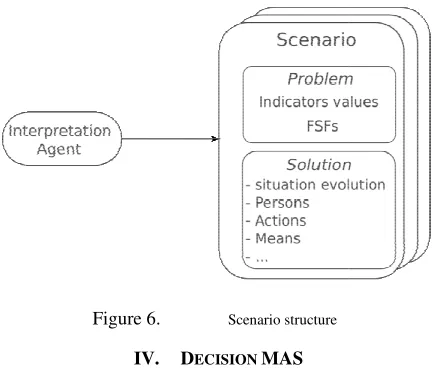
Scenarios are past experimented and memorised situations. They are used by the system to evaluate the treated situation and the potential risks that may produce.
We defined scenarios based provided by [10] and which includes:
similarity of the related FAs), whereas 0 means their total divergence (dissimilarity of the FAs).
(
V
,
V
2)
CS
1We experimented tw
algorithms: DBScan algorithm [3] and Kmeans algorithm [5]. However, Kmeans presents an important inconvenient, since it requires to determine beforehand the number of the created clusters, that we do not know in advance. We ke finally DBScan for its concordance with our approach, but also for its efficiency.
DBScan Implementation
Fig. 5 shows an example of a DBScan experimentation. A number of parameters should be specified, such as the radios of the neighbourhood and the th
[image:4.612.330.549.357.483.2]parameters are determined based on pattern scenarios that we define for each case study and on which relies the DSS scenarios base. The two axis of the chart represent AI values and PI values. We have two formed clusters in this exam which are colored by red and blue, and a third set of unclassified agents, called “noise”. At this stage, these agents do not have sufficiently evolved to integrate other clusters, consequently they do not have significant semantic characters.
Figure 5.
Clusters are dynamic and change according to information coming from the environment. Indeed, each entering FSF may change the form of the clusters by altering the internal state of one or several agents.
Interpretation MAS
According to the type of the treated application, each interpretation agent is associated to one or several scenarios stored in the SB. The aim of these agents is to identify, among the emergent FA clusters, those which are enough close to the stored scenarios
the new scenarios and to deal with them. The final goal of the interpretation agents is to compare the current situation with past situations and to generate thereafter response elements, that help users to evaluate the
make decisions.
Scenarios are past experimented and memorised situations. They are used by the system to evaluate the treated situation and the potential risks that may produce.
We defined scenarios based ded by [10] and which includes:
similarity of the related FAs), whereas 0 means their total divergence (dissimilarity of the FAs).
)
2 1 1
PI
+
AI
AI
AI
=
We experimented two of the most used clustering algorithms: DBScan algorithm [3] and Kmeans algorithm [5]. However, Kmeans presents an important inconvenient, since it requires to determine beforehand the number of the created clusters, that we do not know in advance. We ke finally DBScan for its concordance with our approach, but also for its efficiency.
DBScan Implementation
Fig. 5 shows an example of a DBScan experimentation. A number of parameters should be specified, such as the radios of the neighbourhood and the th
parameters are determined based on pattern scenarios that we define for each case study and on which relies the DSS scenarios base. The two axis of the chart represent AI values and PI values. We have two formed clusters in this exam which are colored by red and blue, and a third set of unclassified agents, called “noise”. At this stage, these agents do not have sufficiently evolved to integrate other clusters, consequently they do not have significant semantic
Display 2D of DBScan algorithm
Clusters are dynamic and change according to information coming from the environment. Indeed, each entering FSF may change the form of the clusters by altering the internal state of one or several agents.
Interpretation MAS
rding to the type of the treated application, each interpretation agent is associated to one or several scenarios stored in the SB. The aim of these agents is to identify, among the emergent FA clusters, those which are enough close to the stored scenarios. They have as role also to store the new scenarios and to deal with them. The final goal of the interpretation agents is to compare the current situation with past situations and to generate thereafter response elements, that help users to evaluate the
Scenarios are past experimented and memorised situations. They are used by the system to evaluate the treated situation and the potential risks that may produce.
We defined scenarios based-ded by [10] and which includes:
similarity of the related FAs), whereas 0 means their total divergence (dissimilarity of the FAs).
2 2 2 1
2 1 2
PI
+
AI
PI
PI
PI
+
AI
o of the most used clustering algorithms: DBScan algorithm [3] and Kmeans algorithm [5]. However, Kmeans presents an important inconvenient, since it requires to determine beforehand the number of the created clusters, that we do not know in advance. We ke finally DBScan for its concordance with our approach, but
Fig. 5 shows an example of a DBScan experimentation. A number of parameters should be specified, such as the radios of the neighbourhood and the threshold density. These parameters are determined based on pattern scenarios that we define for each case study and on which relies the DSS scenarios base. The two axis of the chart represent AI values and PI values. We have two formed clusters in this exam which are colored by red and blue, and a third set of unclassified agents, called “noise”. At this stage, these agents do not have sufficiently evolved to integrate other clusters, consequently they do not have significant semantic
lay 2D of DBScan algorithm
Clusters are dynamic and change according to information coming from the environment. Indeed, each entering FSF may change the form of the clusters by altering the internal state of one or several agents.
rding to the type of the treated application, each interpretation agent is associated to one or several scenarios stored in the SB. The aim of these agents is to identify, among the emergent FA clusters, those which are enough . They have as role also to store the new scenarios and to deal with them. The final goal of the interpretation agents is to compare the current situation with past situations and to generate thereafter response elements, that help users to evaluate the situation and to
Scenarios are past experimented and memorised situations. They are used by the system to evaluate the treated situation and the potential risks that may produce.
-on the characterization ded by [10] and which includes:
similarity of the related FAs), whereas 0 means their total
2 2
PI
o of the most used clustering algorithms: DBScan algorithm [3] and Kmeans algorithm [5]. However, Kmeans presents an important inconvenient, since it requires to determine beforehand the number of the created clusters, that we do not know in advance. We kept finally DBScan for its concordance with our approach, but
Fig. 5 shows an example of a DBScan experimentation. A number of parameters should be specified, such as the reshold density. These parameters are determined based on pattern scenarios that we define for each case study and on which relies the DSS scenarios base. The two axis of the chart represent AI values and PI values. We have two formed clusters in this example which are colored by red and blue, and a third set of unclassified agents, called “noise”. At this stage, these agents do not have sufficiently evolved to integrate other clusters, consequently they do not have significant semantic
lay 2D of DBScan algorithm
Clusters are dynamic and change according to information coming from the environment. Indeed, each entering FSF may change the form of the clusters by altering
rding to the type of the treated application, each interpretation agent is associated to one or several scenarios stored in the SB. The aim of these agents is to identify, among the emergent FA clusters, those which are enough . They have as role also to store the new scenarios and to deal with them. The final goal of the interpretation agents is to compare the current situation with past situations and to generate thereafter response situation and to
Scenarios are past experimented and memorised situations. They are used by the system to evaluate the treated situation and the potential risks that may produce.