
Decision support system to support construction method selection for fiber optic networks
44
0
0
Full text
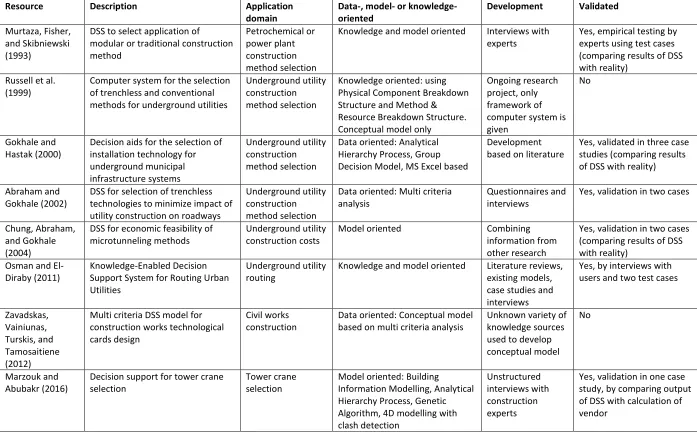
(2) damages and costs of a project. Multiple methods can be used, but all have their advantages and boundary conditions. Determining the most suited construction method for a project depends on several factors. These are, for example, operating costs, the conditions on-site, the required construction speed, and safety risks. To enhance the selection process for construction methods, one needs to capture implicit knowledge. This knowledge is already accessible via expert consultation, since many practitioners have explored various construction methods for fiber optic installation in urban areas in the past few years. This knowledge provides a stepping stone to also generate knowledge for installation of fiber optic cables in new application areas, such as rural environment. The explicated expert knowledge can be captured in a tailored fiber optic Decision Support System (DSS). Such a system should support engineers and foremen in selecting construction methods in various project conditions. In literature, only a small number of DSS have been developed for supporting construction method selection in utility construction. Most of these studies present DSS which are not based on qualitative empirical knowledge, but use quantitative models and/or data to provide insight in a problem and the possible solutions. Also none of these DSS are tailored to optic fiber network construction. This research hence presents a DSS that supports in selecting construction methods for optic fiber networks by providing empirical knowledge to the user. The research also sparks the debate on construction method selection for rural areas. In the next section, relevant literature will be discussed, describing the various categories of DSS and their components. Also an overview will be given of DSS developed for civil engineering and in particular utility construction. Subsequently, the research method will be elaborated, followed by the results, in which the developed decision tree and DSS are presented. This paper closes with a discussion and conclusions concerning the presented DSS.. Theoretical point of departure Since the introduction of the concept of Decision Support Systems (DSS) in the seventies (Keen, 1987), DSS have been introduced in many scientific fields to support decision making in a variety of simple to complex problems (Mackenzie et al., 2006). A DSS can be identified as a system intended to support managerial decision-makers in semi structured decision situations (Turban, Aronson, & Liang, 2007). Most DSS consist of three or four components (Van Herk, 1993): 1) a user-interface that enables communication between user and system, 2) one or more data-subsystems containing the various types of data to be stored, and 3) problem-processing subsystems containing the models and programs that process and generate solutions for the current problem. If necessary a fourth component, a knowledge subsystem, can be attached, especially in cases where an extensive amount of specialist knowledge is required. Besides the distinctive elements, there are several categories of DSS (Castro-Schez, Jimenez, Moreno, & Rodriguez, 2005): 1) data-oriented, which use databases of structured data to provide insight in a problem and therefore support in decision making. 2) model-oriented, which use and manipulate models to calculate and simulate possible solutions to a problem. Or 3), intelligent or knowledgedriven, which focus on a knowledge base or integrate artificial intelligence technologies such as neuronal networks, expert systems and machine learning. The main difference between these types is the information used and provided to the user. Data and model oriented DSS support in decision making by presenting and manipulating (mostly) quantitative data. Knowledge based DSS can provide. 2.
(3) support in decision making by providing knowledge using previous developed solutions. This knowledge can be expressed qualitatively. DSS have been introduced in many scientific fields. Also in the construction industry several examples can be found. Table 1 provides a selection of DSS studies in the construction industry. The selection is made based on the application domain (focused on utility construction) or the type of DSS (data-, model- or knowledge-oriented). Table 1 shows that many of the developed tools in construction studies are data- or model-oriented, especially regarding infrastructure construction. These models mostly use quantitative data in multicriteria decision techniques (Kabir, Sadiq, & Tesfamariam, 2014). A commonly applied technique is the Analytic Hierarchy Process (AHP), a type of multi-criteria decision making in which certain alternatives are weighted on different variables. It is generally an advantage to separate various criteria and use the criteria in a calculation to provide support in decision making (Dziadosz & Kończak, 2016). However, it can be logically assumed that a thorough understanding of the problem to be solved needs to be present when criteria are listed, weighted and assessed. Multi-criteria decision techniques are therefore less useful for ill-structured problems, where key factors have not been explored and identified (Dziadosz & Kończak, 2016). Russell, Udaipurwala, Alldritt, and El-Guindy (1999) argue that AHP is mostly too complex or inflexible for a utility study, because all relevant factors need to be explicated and assessable in a quantitative calculation. Since Russell et al. (1999) argue that AHP is mostly too complex for a utility contractor, their research presents a conceptual framework for the selection of trenchless and conventional methods for underground utilities that does not use AHP. Although the envisioned decision model is not described in the paper of Russell et al. (1999), the researchers mention that the system should be able to work with ‘chunks’ of knowledge. The framework includes a computerized environment with a standards and project level. The standards level contains all documentation about previous projects and construction methods. The project level contains all information about the current project. The system by Russell et al. (1999) distinguishes three pathways between the standards- and project level. Each pathway is a distinct approach to transfer explicit knowledge from the standards level to the current project. One of these pathways is aimed at using chunks of knowledge to support the user in making decisions about repeated work. This knowledge can exist of for example recommended crew size and duration estimation, based on previous projects. In general, literature shows that little attention is given to DSS development in utility construction, especially to DSS for construction method selection for fiber optic networks. Most studies that are conducted about DSS in utilities are dated (more than ten years old) and are model- or data-oriented, thus do not directly use empirical knowledge from experts. Such model- or data-oriented approaches are mostly too complex for unexplored ill-structured optic fiber projects. Also, multiple studies in Table 1 are based on desk research, such as literature studies. Since no knowledge from practice was gathered directly in these studies, these are perhaps less valid. The objective of this research was therefore to develop a DSS for construction method selection for optic fiber network construction. The DSS should use empirical knowledge, in which site conditions determine the recommended construction method. Due to the utilization of empirical knowledge, the DSS applies characteristics of the repeated work pathway of the framework by Russell et al. (1999). Also in line with the practical and theoretical points of departure, the objective can be translated to the following requirements. The DSS should: 1. Support in decision making based on expert knowledge 3.
(4) 2. Be applicable to select a recommended construction method for fiber optic networks 3. Apply characteristics of the repeated work pathway of the framework by Russell et al. (1999). 4.
(5) Table 1: Overview of DSS studies in construction industry. Resource. Description. Murtaza, Fisher, and Skibniewski (1993). DSS to select application of modular or traditional construction method. Russell et al. (1999). Computer system for the selection of trenchless and conventional methods for underground utilities. Gokhale and Hastak (2000). Decision aids for the selection of installation technology for underground municipal infrastructure systems DSS for selection of trenchless technologies to minimize impact of utility construction on roadways DSS for economic feasibility of microtunneling methods. Underground utility construction method selection. Abraham and Gokhale (2002) Chung, Abraham, and Gokhale (2004) Osman and ElDiraby (2011). Zavadskas, Vainiunas, Turskis, and Tamosaitiene (2012) Marzouk and Abubakr (2016). Application domain Petrochemical or power plant construction method selection Underground utility construction method selection. Data-, model- or knowledgeoriented Knowledge and model oriented. Development. Validated. Interviews with experts. Knowledge oriented: using Physical Component Breakdown Structure and Method & Resource Breakdown Structure. Conceptual model only Data oriented: Analytical Hierarchy Process, Group Decision Model, MS Excel based. Ongoing research project, only framework of computer system is given Development based on literature. Yes, empirical testing by experts using test cases (comparing results of DSS with reality) No. Underground utility construction method selection Underground utility construction costs. Data oriented: Multi criteria analysis. Questionnaires and interviews. Yes, validation in two cases. Model oriented. Knowledge-Enabled Decision Support System for Routing Urban Utilities. Underground utility routing. Knowledge and model oriented. Yes, validation in two cases (comparing results of DSS with reality) Yes, by interviews with users and two test cases. Multi criteria DSS model for construction works technological cards design. Civil works construction. Data oriented: Conceptual model based on multi criteria analysis. Combining information from other research Literature reviews, existing models, case studies and interviews Unknown variety of knowledge sources used to develop conceptual model. Decision support for tower crane selection. Tower crane selection. Model oriented: Building Information Modelling, Analytical Hierarchy Process, Genetic Algorithm, 4D modelling with clash detection. Unstructured interviews with construction experts. Yes, validation in one case study, by comparing output of DSS with calculation of vendor. 5. Yes, validated in three case studies (comparing results of DSS with reality). No.
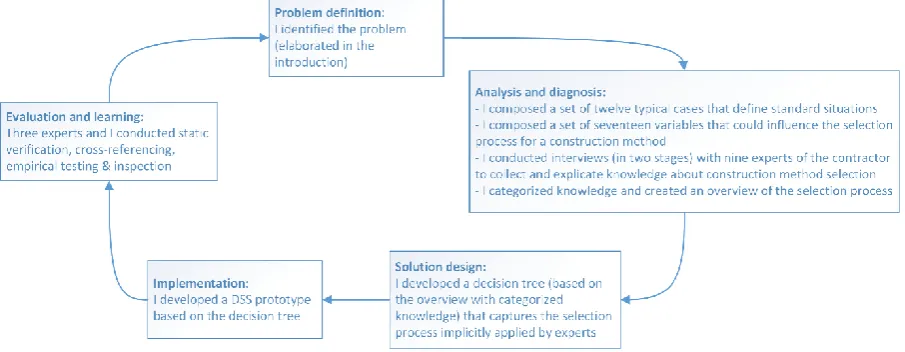
(6) Method This section describes the methods that I used to develop a DSS for fiber optic construction method selection. The contractor in this study is very experienced in construction fiber optic networks in urban areas and has several experts for selecting the most suited construction methods. Constructing fiber optic networks in rural areas is a new domain for the contractor. To improve the construction process in rural areas, the contractor wants to apply knowledge gained in urban areas. During the development of the DSS the knowledge gained in urban areas was made explicit. To develop a DSS, the problem solving cycle from Van Aken, Berends, and Van der Bij (2012) was used as an overall method. This cycle provides a structured process to identify and structure a problem and eventually develop a solution. The cycle was continuously applied and contains five steps: 1) problem definition, 2) analysis and diagnosis, 3) solution design 4) intervention, and 5) evaluation and learning. The five steps are visualized in Figure 1, with a brief description which activities were performed in each step. The next sections contain a detailed explanation of each step.. Figure 1: Problem solving cycle, based on Van Aken et al. (2012). Problem definition The problem in short: contractors for fiber optic networks start constructing in a new domain; rural areas. The knowledge regarding construction method selection present at the contractor is based on construction in urban areas, but this knowledge has never been explicated. A DSS could provide support to construction method selection in urban areas and enables the discussion about and development of such knowledge also for rural areas. Figure 2 shows the desired contribution of the developed DSS to the current decision procedure.. Figure 2: Contribution of DSS to decision procedure. 6.
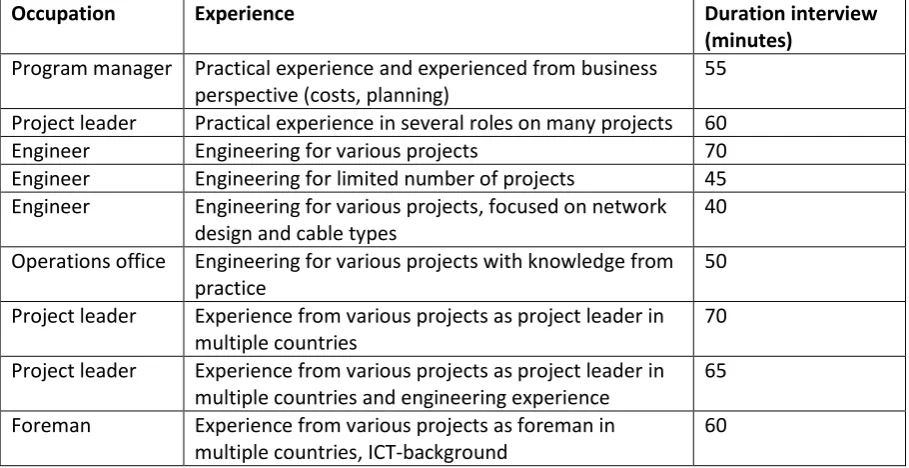
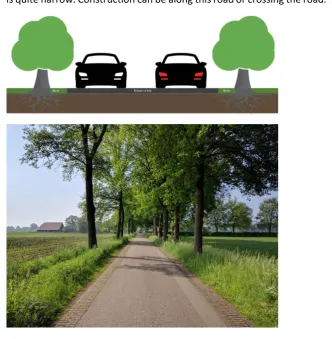
(7) Analysis and diagnosis To collect and explicate knowledge about the application of distinctive construction methods in various situations, nine experts from the contractor were interviewed in two stages. The first stage consisted of an individual in depth interview, in which the experts provided verbally recommended construction methods for several predefined typical cases. In the second stage, the experts participated in a written questionnaire, to provide additional information to the researcher. Table 2 provides the occupation of the interviewees at the time of the interviews, their experience and the duration of the interviews. The table shows that both experts with practical (project leaders and foreman) and with theoretical experience (program manager, operations office and engineers) were interviewed. Table 2: Details of interviewed experts. Occupation. Experience. Program manager. Practical experience and experienced from business perspective (costs, planning) Practical experience in several roles on many projects Engineering for various projects Engineering for limited number of projects Engineering for various projects, focused on network design and cable types Engineering for various projects with knowledge from practice Experience from various projects as project leader in multiple countries Experience from various projects as project leader in multiple countries and engineering experience Experience from various projects as foreman in multiple countries, ICT-background. Project leader Engineer Engineer Engineer Operations office Project leader Project leader Foreman. Duration interview (minutes) 55 60 70 45 40 50 70 65 60. In preparation for the interviews, the researcher composed a set of twelve typical cases that define standard situations in fiber optic construction projects. The typical cases have been described in cooperation with an expert from the contractor. These typical cases are standard situations that are often encountered while constructing an optic fiber network and are described with a cross section and a picture of an example from practice on a card. An example of such a card is given in Figure 3. Appendix I contains all cards of the typical cases and also Table 4 provides a list with all cases. The assumption was made that these typical cases represent a majority of the site conditions encountered during construction projects for fiber optic networks. The interviewed experts support this assumption. Also in cooperation with an expert of the contractor, the researcher composed a list of seventeen factors that could influence the selection process for a construction method. In the results section, Table 3 shows these factors, including the influence these factors have on the construction method. The cards of the seventeen factors, used in the interviews, are shown in Appendix II. Each typical case can be described using the seventeen factors. Discussing cases prove to be more effective than discussing factors only. This approach is similar to Case Based Reasoning, in which generating a solution to a problem is supported by recalling solutions to previous cases (Kolodner, 1993). The researcher argues that experts can better recall and develop solutions to cases from practice than to a set of factors.. 7.
(8) Case 5: Road with trees on both sides Road with rows of trees on both sides. In the exemplar picture, the road is quite narrow. Construction can be along this road or crossing the road.. Figure 3: Exemplar card of typical case. In stage one of the interviews, each typical case was presented with a card (see Figure 3 for an example) to the expert of the contractor. The expert could select the, in his/her opinion, most suited construction method and motivate that choice by explaining verbally the reason for his/her choice. Subsequently, each of the factors was discussed by showing a card with a factor (see Appendix II). The expert could motivate verbally if and why the factor has an influence on the selected construction method in that case. This ensured that the decision process was captured from both the perspective of the typical cases and the factors. An example of the course of the interviews: the researcher presented a case to the expert, for example a narrow road with trees on both sides on the road. The expert argued that excavation with a crane or other machinery is prohibited near the trees. According to the expert, digging by hand or drilling are only possible or allowed near trees. Also he argued that, if in between the trees no connections to houses have to be made, a directional drilling can be made. This could be less costly than making small drillings under each tree. Subsequently, the researcher presented one by one each of the factors, for example soil types: does the recommendation of the expert change if the soil type would differ? The expert then argued that a directional drilling can be carried out through any soil type, but drilling through sand for example requires the use of more bentonite than drilling through peat. This structure was repeated for each of the factors in each of the typical cases.. 8.
(9) After the first stage of interviews, the answers of the experts were categorized and compared with the software application Atlas.ti. This application enables the researcher to code and categorize video fragments. The researcher transcribed the selected construction method and motivation for each typical case and factor on that case, for each interviewed expert. Subsequently, the construction methods and motivation were compared for each typical case and factor. A consensus did emerge on most topics, according to the definition of Gastil (1993): the solution needs to be acceptable for all participants. Since the interviewed group consisted of nine experts, the degree of consensus was determined with a qualitative assessment of the answers given. The researcher compared the recommended construction methods from all experts for each typical case (optionally in combination with a factor). In the second stage, a written questionnaire was presented to the same experts. This questionnaire contained questions about the subjects that did not reach consensus yet among the experts. The experts could choose from the categorized answers given in the interviews in the first stage. This gave the experts the opportunity to adjust their opinion based on input of other experts. The questionnaire is placed in Appendix III: Written questionnaire. After categorization and comparison of the outcome of the questionnaire, all results have been combined in an overview that relates each typical case to each factor. The overview therefore contains the selection process that is implicitly applied by the expert when deciding for a construction method. Solution design The explicated knowledge of the experts could be used to develop a DSS. Based on the information consisting of empirical knowledge, the researcher regarded the knowledge-driven type most fitting for the DSS. Van Aken (2004) stresses the support that can be provided when general knowledge, applicable to many situations, is translated to specific situations. As a first step towards the DSS, the researcher created a decision tree, which was based on the overview containing the decision process provided by the experts. A decision tree divides a complex decision into smaller decisions (Safavian & Landgrebe, 1991). The experts mentioned many of these small decisions during the interviews. Implementation The decision tree was then implemented in a Microsoft Office InfoPath application that forms the actual DSS. Both the decision tree and the DSS are described in more detail in the results section. Evaluation and learning The verification consisted of a combination of four methods, described by Preece (2001). At first, static verification was performed by the researcher by checking the decision tree for redundancy and conflicts. Subsequently, the researcher cross-referenced the DSS with the decision tree. Empirical testing was performed by two experts that did not took part in the interviews. They assessed fictional cases with the software application. After the experts selected the most suited construction method for each case, based on individual experience, the cases were assessed by the expert using the DSS. For a successful verification, the DSS should recommend the same construction method(s) as the expert did based on his experience. In addition, one expert who performed the empirical testing and one other expert inspected the decision tree. The experts checked if the decision tree matched their knowledge. Although inspection is regarded less reliable than empirical testing (Preece, 2001), it covered the entire decision tree, where empirical testing only covered fictional cases. 9.
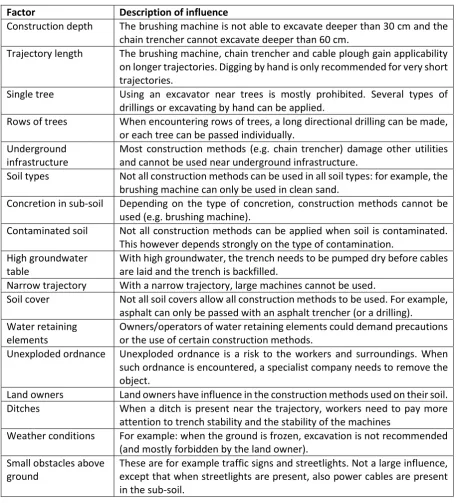
(10) Continuing cycle During the interviews, the researcher performed the problem solving cycle from Figure 1 continuously to achieve the desired outcome. The next section presents results at the end of the first design loop iteration.. Results This section presents more information about the interviews, the developed decision tree and DSS. First a description is given of the seventeen factors that were composed on cooperation with an expert and the influence of each factor (Table 3). In addition, the factors are listed that did not reach a consensus after the first stage of interviews. Subsequently five main situations are defined that cover the twelve typical cases. These main situations are used in a decision tree and finally the DSS. This section closes with the results of the verification and validation of the decision tree and DSS. Table 3: Factors that influence the selection process for a construction method. Factor Construction depth Trajectory length. Single tree Rows of trees Underground infrastructure Soil types Concretion in sub-soil Contaminated soil High groundwater table Narrow trajectory Soil cover Water retaining elements Unexploded ordnance. Land owners Ditches Weather conditions Small obstacles above ground. Description of influence The brushing machine is not able to excavate deeper than 30 cm and the chain trencher cannot excavate deeper than 60 cm. The brushing machine, chain trencher and cable plough gain applicability on longer trajectories. Digging by hand is only recommended for very short trajectories. Using an excavator near trees is mostly prohibited. Several types of drillings or excavating by hand can be applied. When encountering rows of trees, a long directional drilling can be made, or each tree can be passed individually. Most construction methods (e.g. chain trencher) damage other utilities and cannot be used near underground infrastructure. Not all construction methods can be used in all soil types: for example, the brushing machine can only be used in clean sand. Depending on the type of concretion, construction methods cannot be used (e.g. brushing machine). Not all construction methods can be applied when soil is contaminated. This however depends strongly on the type of contamination. With high groundwater, the trench needs to be pumped dry before cables are laid and the trench is backfilled. With a narrow trajectory, large machines cannot be used. Not all soil covers allow all construction methods to be used. For example, asphalt can only be passed with an asphalt trencher (or a drilling). Owners/operators of water retaining elements could demand precautions or the use of certain construction methods. Unexploded ordnance is a risk to the workers and surroundings. When such ordnance is encountered, a specialist company needs to remove the object. Land owners have influence in the construction methods used on their soil. When a ditch is present near the trajectory, workers need to pay more attention to trench stability and the stability of the machines For example: when the ground is frozen, excavation is not recommended (and mostly forbidden by the land owner). These are for example traffic signs and streetlights. Not a large influence, except that when streetlights are present, also power cables are present in the sub-soil. 10.
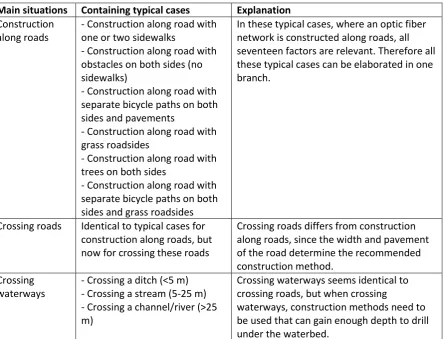
(11) The factors in Table 3 were discussed during the first stage of the interviews. After the categorization and comparison of results of the interviews, eight topics regarding construction methods needed more clarification: 1) application of brushing machine in urban areas, 2) influence of weather conditions, 3) recommended and allowed methods for crossing trees, 4) plowing and chain trenching on short trajectories, 5) high groundwater, 6) possibility to use private property to avoid construction trees or asphalt and 7) usage of present tubes instead of making a new directional drilling. In the second stage, a written questionnaire contained questions to reach a consensus on these topics (Appendix III). The results from the second stage were assessed identical to the results from stage one. The researcher concluded that topics 3, 4, 6, and 7 still did not reach consensus, caused by the lack of extensive experience in construction fiber optic networks in rural areas. Both the results of the first and second stage were summarized in a table, which is provided in Appendix IV: Interview data. In this table, the expert recommendations are presented for each combination of the typical cases and factors. Therefore, this table contains the selection process implicitly applied by the experts. From the data in the table in Appendix IV, the researcher identified five distinctive main situations that cover the twelve typical cases and therefore assumedly a majority of all cases encountered in practice. Each main situation consists of a distinctive decision process and covers one or more typical cases. Table 4 lists these five main situations and shows the typical cases covered by that main situation. Also an explanation is given why these typical cases show similarities. Table 4: Main situations with the covered typical cases. Main situations Construction along roads. Crossing roads. Crossing waterways. Containing typical cases - Construction along road with one or two sidewalks - Construction along road with obstacles on both sides (no sidewalks) - Construction along road with separate bicycle paths on both sides and pavements - Construction along road with grass roadsides - Construction along road with trees on both sides - Construction along road with separate bicycle paths on both sides and grass roadsides Identical to typical cases for construction along roads, but now for crossing these roads - Crossing a ditch (<5 m) - Crossing a stream (5-25 m) - Crossing a channel/river (>25 m). 11. Explanation In these typical cases, where an optic fiber network is constructed along roads, all seventeen factors are relevant. Therefore all these typical cases can be elaborated in one branch.. Crossing roads differs from construction along roads, since the width and pavement of the road determine the recommended construction method. Crossing waterways seems identical to crossing roads, but when crossing waterways, construction methods need to be used that can gain enough depth to drill under the waterbed..
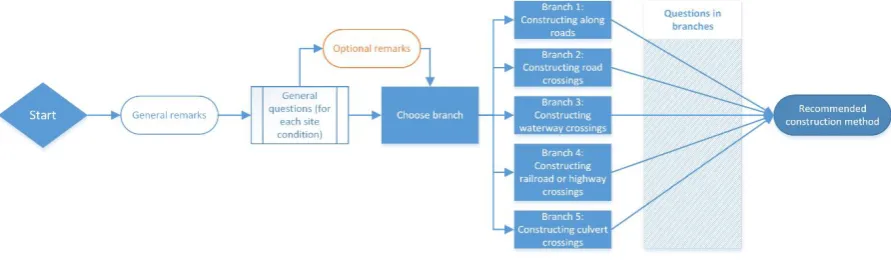
(12) Crossing railroads & highways Crossing culverts. - Crossing a railroad - Crossing a highway (or road with multiple lanes) - Crossing a culvert in the subsoil. These typical cases have in common that mostly only a directional drilling is allowed (or possible). A culvert has similarities with a waterway, but in some situations, the optic fiber network can be constructed on top of the culvert.. Decision tree The five main situations from Table 4 are embedded in separate branches in the decision tree, since this results in the least redundancy. For example: the width of a road is only relevant when the road needs to be crossed. This factor is not relevant for construction along roads (for example), and does not need to be included in that branch. The complete decision tree is given in Appendix V: Decision tree (in Dutch). The abbreviated structure of the decision tree is given in Figure 4. Each element will be explained separately.. Figure 4: Structure of the decision tree. After the start of the decision tree (abbreviated structure given in Figure 4), three general remarks are placed. These remarks were made by most experts and apply to each situation. First, land or network owners have an important influence on the applied construction method. Second, always report excavation activities to the authorities and study the provided maps of already present infrastructure in the subsoil. And last, a (small) selection of project-wide applied construction methods is desired above a different construction method used in each specific situation. The user of the DSS (or the decision tree) should take these remarks into account before a construction method is selected. Subsequently, the decision tree contains general questions for site conditions based on seven factors. Weather conditions, water retaining elements near trajectory, unexploded ordnance, contaminated soil, ditch near trajectory, high groundwater and concretion in the ground have identical influence on the recommended construction method in all situations. The implications of these factors apply to each of the approaches in the five branches. Therefore, questions about the presence of these factors are placed in front of the separation point of the five branches (e.g. is there a high ground water table in the trajectory?). When the user answers positive to one of the factors questions, a recommendation (e.g. the trench needs to be dry before the cables are placed and the trench is backfilled) is presented how to deal with this factor before continuing to the other relevant questions. The user now selects one of the five branches, containing the relevant main situation (see Figure 4 for the main situations in the five branches). In each branch, questions are included determining a recommended construction method. E.g. what is the ground cover on the trajectory? Also, branchspecific remarks are provided, depending on the answers given. E.g. tiling needs to be removed by 12.
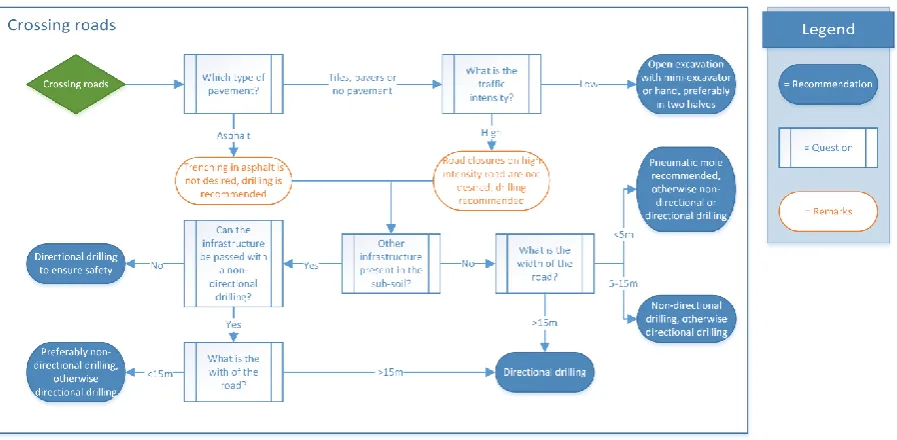
(13) hand first, before the trench can be excavated with for example a compact excavator. To give an example of the content of a branch, Figure 5 shows the branch ‘Crossing roads’. Each branch provides eventually one or more recommended construction methods. The length of each branch varies. For example, selecting a construction method for construction along roads depends on many factors (soil types, ground cover, land owner, above ground obstacles, construction depth, construction length, utilities in trajectory, trajectory length, groundwater table) and could lead to seventeen distinctive recommendations (e.g. apply preferably a chain trencher or cable plough, or else a compact excavator). Crossing a highway or railroad is however mostly only possible or allowed using one specific method (directional drilling). The branch shown in Figure 5 (Crossing roads) can lead to six different recommendations.. Figure 5: Branch 'crossing roads'. DSS The researcher subsequently implemented the decision tree in a MS Office InfoPath form. The result is a DSS, which is embedded in an online SharePoint environment. This environment is accessible for all employees of the contractor. The InfoPath form structure is almost identical to the decision tree. The user can choose one of the branches and depending the answer on the shown question, the system provides a follow up question. After the user answers the last relevant question, the user can select site conditions that are placed in the decision tree under ‘general questions’. The user is lead to the results page that shows the recommended construction method. A screenshot of this results page is placed in Appendix VI: Screenshot user interface (in Dutch). Additionally, the user can read information about the distinctive construction methods and their advantages and boundary conditions. Finally, users can provide feedback on the recommendation by leaving a written message and a photo of the case. The recommendation shown in the decision tree in Figure 5 is an abbreviation of the recommendation provided to the user in the DSS. Verification and validation The decision tree and DSS have been validated and verified using a combination of four methods. During the development of the decision tree, the researcher continuously checked the decision tree for redundancies and conflicts (static verification). Several changes were made during this process as part of the design process, mostly to create the optimal structure with the lowest number of questions. 13.
(14) Also two experts (in this section called expert one and expert two) that did not participate in the interviews verified the decision tree with their knowledge (inspection). Based on their recommendations, the researcher improved the decision tree on two small issues. First, expert two recommended to move the question about concretion in the subsoil from the ‘construction along roads’ branch to the general questions. Concretion can in fact influence the construction method in every situation. Also a recommendation was slightly adjusted: in the situation where a highway or railway needs to be crossed, the recommendation was to perform a directional drilling, with respect to the requirements of the owner/operator. According to expert one, in this case, using an existing tube to cross the obstacle could also be a fitting solution. This was added to the recommendation. During the transition from decision tree to the software application, the researcher continuously crossreferenced the structure to match the structure of the decision tree and software application. Subsequently, expert two and another expert that did not participate in the interviews (called expert three) verified the DSS with their knowledge. During these empirical tests, a technical error was found by expert three, regarding showing a follow up question based on an answer. The researcher corrected this error. Subsequently, expert two suggested changing a recommendation: after selecting tiles as ground cover, the DSS showed the recommendation to first remove the tiles with a compact excavator or by hand. This was changed in the recommendation to remove the tiles by hand.. Discussion This research presents a DSS capturing empirical knowledge about selection of construction methods for fiber optic networks with the aim to support employees of a contractor in selecting these construction methods. Literature concerning development of DSS in the construction industry is available and to a lesser extent for utility construction, but no research was present about DSS tailored for fiber optic construction. This study contributes a DSS that is tailored specifically for fiber optic construction. The DSS from this research is based on qualitative, empirical knowledge, provided by experts who are experienced in selecting construction methods for fiber optic networks. The DSS that have been developed for the utility industry are mostly data- or model-based and use quantitative data to support decision making. This research hence shows the opportunities and limitations of a qualitative knowledge-based DSS. Because of the developed decision tree and software application, this research is an exploration of application of the conceptual framework provided by Russell et al. (1999). Similar to the framework, the DSS provides support for repeated work by providing empirical knowledge to the user. The DSS is therefore an elaboration of the repeated work pathway from the framework by Russell et al. (1999). This research also shows that the repetitive work pathway is a useful means to capture empirical knowledge. In most research about DSS-development for the construction industry, it is unclear how the knowledge was explicated. This DSS is based on empirical knowledge explicated in clear research steps. Empirical knowledge was captured using typical cases that are common to the experts. This enabled case based reasoning (Kolodner, 1993). The decision logic could be translated to a decision tree with minimal formalization. Subsequently, the decision tree could be incorporated identically in a DSS. Thus, the combination of case based reasoning and a decision tree enabled capturing and modelling relevant empirical knowledge and application in a formal system. In future research, application on a wider scale could verify the applicability of this combination of methods.. 14.
(15) In research about construction method selection, decision making based on quantitative information is often desired, because quantitative information seems reliable. Quantitative information is however not necessarily more precise or objective. If not all relevant factors and factors are measured, quantitative data could provide pseudo-accuracy; decision makers could be supported and influenced by incomplete information. Also in this study, not all relevant factors and variables were known and therefore could not be measured. An alternative was to collect qualitative information (empirical knowledge) from experts. The verification and validation steps show that using only empirical knowledge can lead to a successful prototype of a DSS. However, to recommend a construction method based on knowledge from experts that are most experienced in optic fiber network construction in urban areas, two disputable issues arise. First, it is unknown if the presented information from experts is fault free. The researcher argues that current practice at the contractor is also based on the same knowledge. Therefore, application of the DSS is not likely to have a negative influence on the selection of construction methods. A positive influence is however more likely, due to the explicit and analytical decision making, enabled by the DSS. Second, it is unknown if knowledge from optic fiber network construction in urban areas is directly translatable to rural areas. The aim of this research was only to explicate knowledge applied implicitly in urban areas. This research nevertheless sparks a debate on the decision process for construction method selection in rural areas. Also, the researcher expects that project and site conditions in rural areas show enough similarities with the conditions in urban areas to apply parts of the same decision process. During the interviews, several experts expressed the same expectation. When the contractor gains more experience in rural areas, the DSS can be enhanced with the gained knowledge in rural areas. During the interviews, no direct emphasis was put on the costs of each construction method, although costs are an important factor in the selection of a construction method. However, detailed cost information is lacking and the costs of a construction method depend on many factors, such as soil types, cable types, weather conditions, worker skills. When the problem from this research is assessed in the future in a qualitative research design, it is recommended to focus on the costs aspect first. Subsequently, the cost information can be embedded in the DSS, whereafter the DSS could not only recommend a construction method based on the applicability of the method, but also the expected costs in that situation. Also in this issue, the risk for pseudo-accuracy is present. Regarding the practical context, the presented DSS provides a recommendation for a construction method that is only based on the site and project conditions at one location. In actual construction projects, the decision maker takes also the surrounding situations or even the entire project into account when deciding for a construction method. Using different construction methods for every distinctive situation is undesired: since each construction method requires for example different machinery and worker skills, using more construction methods in a project is likely to increase costs and planning difficulties. Therefore, a sub-optimal construction method for a single situation could be the optimal construction method in context of the entire project. To improve the DSS, each separate situation could therefore be assessed in context of the surrounding situations or even the entire project. This can for example be achieved by adding an aggregate DSS module that ranks recommended construction methods for the separate surrounding situations and eventually recommends the overall highest ranked construct methods. When employees of the contractor use the DSS in practice, the user could expect a direct and visible improvement in the selection process. Such an improvement is not likely, since all knowledge in the DSS is gained from experts that make these decisions in current projects. A direct improvement of the 15.
(16) selection process was however not the aim of this study. The aim was to explicate knowledge regarding the selection of construction methods for fiber optic construction. Nevertheless, explicating knowledge is a potential for improvement of the decision process. Since a first step was made in mapping relevant factors and knowledge in the selection process for a construction method, these factors can be discussed and optimized in future. By using the empirical knowledge from the DSS, employees of the contactor can apply a more systematic decision process in contrast to current practice since most relevant factors are part of the DSS. By using the DSS, the employees are expected to be more motivated to perform an explicit analysis of the situation. For less experienced employees of the contractor, the DSS can also provide knowledge that was not known to the employee. With regard to the requirements, listed at the end of the theoretical point of departure, the researcher concludes that all requirements are fulfilled. The DSS 1) supports in decision making based on expert knowledge, 2) can be applied to select a recommended construction method for fiber optic networks, and 3) applies characteristics of the repeated work pathway of the framework by Russell et al. (1999). The fulfillment of the first requirement can be assessed additionally by validation after implementation of the DSS in practice.. Conclusions & future research The motive for this research was the demand for deployment of fiber optic networks in rural areas in the Netherlands. Since distances between dwellings are longer in rural areas compared to urban areas, contractors have the objective to select a suited construction method with high efficiency and low construction time, costs and minimal damages. Most contractors have much experience in construction optic fiber networks in urban areas, but construction in rural areas is a new domain. The objective of this research was therefore to develop a Decision Support System (DSS) for construction method selection for optic fiber network construction, in which site and project conditions determine the recommended construction method. Developing a DSS for urban areas sparks a debate on construction method selection for rural areas. Empirical knowledge was gathered from experts from a contractor to develop a knowledge based DSS. This has been done by conducting interviews, in which twelve typical cases were presented to retrieve the selection process that is applied by experts of the contractor. The experts could provide a recommendation for a construction method for each of the cases. These typical cases were listed in cooperation with an expert of the contractor and are assumed to represent a majority of all cases encountered in practice. Examples are a road with rows of trees on both sides, roads with sidewalks or crossing a river. In addition to the typical cases, the researcher and contractor listed seventeen factors that can influence the recommended construction method. Examples are construction depth, soil types and ground water table. In the interviews, the experts were asked if each of the factors influences their decision for a construction method. Based on the information gathered in the interviews, the researcher developed a decision tree containing the selection process that is implicitly applied by the experts of the contractor. The developed DSS guides the user through the decision tree and eventually presents a recommended construction method based on the answers given in the DSS. Since the decision tree and DSS have been verified and validated by the researcher and three experts, it can be applied in practice to achieve its goal: supporting the employees of the contractor in selecting suitable construction methods for optic fiber networks. 16.
(17) The DSS contributes to literature since it adds a DSS tailored to fiber optics construction. Also, the DSS from this research is based on qualitative empirical knowledge. This knowledge was provided by experts that are experienced in selecting construction methods for fiber optic networks. The DSS for utility industry, developed in other studies, are mostly data- or model-based and use quantitative data to support decision making. Therefore, this research shows the opportunities and limitations of a qualitative knowledge-based DSS. Finally, the DSS is an exploration of application of the conceptual framework of Russell et al. (1999). The DSS is an elaboration of the repeated work pathway from the framework, which provides support to repeated work by providing empirical knowledge to the user. In practice, the DSS could contribute to a more conscious and analytical selection process for a construction method. Also, a substantial amount of empirical knowledge was explicated during this research. This knowledge is a potential for improvement of the decision process whether or not by improving the DSS. The DSS also sparks the debate for construction method selection in rural areas. In future, it is recommended first to implement the DSS in practice and perform a thorough validation, for example by measuring in how many situations the DSS, according to the user, contributed to a more suiting construction method. It can then be concluded if the DSS actually supports the user in selecting construction methods for optic fiber networks. The DSS can be improved continuously, as part of the process shown in Figure 2. The contribution of this research is a first prototype. If desired, the DSS can be improved by incorporating quantitative information. Cost information of each construction method (in distinctive site conditions) is recommended to be incorporated at first. Another improvement would be to base the recommendation not only on a single situation (project and site conditions at one location), but to take into account the construction methods recommended or used in the other parts of the project. After improvements of the DSS, for example regarding quantification of the DSS, the engineering process at the contractor can be automated partially. The researcher envisions an application that combines GIS-data containing for example soil types, locations of trees, road types and locations of dwellings to generate a preliminary design of the optic fiber network, including construction methods and a link to a planning tool. This research gives a first overview of the selection process that is applied currently by the contractor and provides a starting point for future research.. References Abraham, D. M., & Gokhale, S. (2002). Development of a Decision Support System for selection of trenchless technologies to minimize impact of utility construction on roadways. Retrieved from West Lafayette: Agentschap Telecom. (2015). Staat van de Ether. Retrieved from Amersfoort: https://magazines.agentschaptelecom.nl/staatvandeether Castro-Schez, J. J., Jimenez, L., Moreno, J., & Rodriguez, L. (2005). Using fuzzy repertory table-based technique for decision support. Decision Support Systems(39), 293-307. Chung, T. H., Abraham, D. M., & Gokhale, S. B. (2004). Decision Support System for Microtunneling Applications. Journal of Construction Engineering and Management, 130(6), 835-843. Dziadosz, A., & Kończak, A. (2016). Review of Selected Methods of Supporting Decision-Making Process in the Construction Industry Archives of Civil Engineering (Vol. 62, pp. 111-126). Gastil, J. (1993). Democracy in Small Groups: Participation, Decision Making, and Communication. Philadelphia: New Society Publishers.. 17.
(18) Gokhale, S., & Hastak, M. (2000). Decision aids for the selection of installation technology for underground municipal infrastructure systems. Tunnelling and Underground Space Technology, 15, 1-11. doi:http://dx.doi.org/10.1016/S0886-7798(00)00052-3 Kabir, G., Sadiq, R., & Tesfamariam, S. (2014). A review of multi-criteria decision-making methods for infrastructure management. Structure and Infrastructure Engineering, 10(9), 1176-1210. doi:10.1080/15732479.2013.795978 Keen, P. G. W. (1987). Decision support systems: The next decade. Decision Support Systems, 3(3), 253265. doi:http://dx.doi.org/10.1016/0167-9236(87)90180-1 Kolodner, J. (1993). Case-Based Reasoning. San Mateo: Morgan Kaufmann Publishers, Inc. Mackenzie, A., Pidd, M., Rooksby, J., Sommerville, I., Warren, I., & Westcombe, M. (2006). Wisdom, decision support and paradigms of decision making. European Journal of Operational Research, 170(1), 156-171. doi:http://dx.doi.org/10.1016/j.ejor.2004.07.041 Marzouk, M., & Abubakr, A. (2016). Decision support for tower crane selection with building information models and genetic algorithms. Automation in Construction, 61, 1-15. doi:http://dx.doi.org/10.1016/j.autcon.2015.09.008 Murtaza, M., Fisher, D., & Skibniewski, M. (1993). Knowledge-based approach to Modular Construction Decision Support. Journal of Construction Engineering and Management, 119(1), 115-130. Osman, H. M., & El-Diraby, T. E. (2011). Knowledge-Enabled Decision Support System for Routing Urban Utilities. Journal of Construction Engineering and Management, 137(3), 198-213. Preece, A. (2001). Evaluation Verification and Validation Methods in Knowledge Engineering. Microlevel Knowledge Management, 123-145. Russell, A. D., Udaipurwala, A., Alldritt, M., & El-Guindy, K. (1999). Computer system for the selection of trenchless and conventional methods for underground utilities. Tunnelling and Underground Space Technology, 14, 1-12. doi:http://dx.doi.org/10.1016/S08867798(00)00019-5 Safavian, S. R., & Landgrebe, D. (1991). A survey of decision tree classifier methodology. IEEE Transactions on Systems, Man, and Cybernetics, 21(3), 660-674. doi:10.1109/21.97458 Shaddad, R. Q., Mohammad, A. B., Al-Gailani, S. A., Al-hetar, A. M., & Elmagzoub, M. A. (2014). A survey on access technologies for broadband optical and wireless networks. Journal of Network and Computer Applications, 459-472. Turban, E., Aronson, J. E., & Liang, T.-P. (2007). Decision Support Systems and Intelligent Systems. New Jersey: Prentice-Hall. Van Aken, J. (2004). Management Research Based on the Paradigm of the Design Sciences: The Quest for Field-Tested and Grounded Technological Rules. Journal of Management Studies, 41(2), 219-246. doi:10.1111/j.1467-6486.2004.00430.x Van Aken, J., Berends, H., & Van der Bij, H. (2012). Problem Solving in Organizations. New York: Cambridge University Press. Van Herk, E. (1993). A diagnostic decision support system for general practice. Rotterdam: Erasmusuniversiteit Rotterdam. Zavadskas, E. K., Vainiunas, P., Turskis, Z., & Tamosaitiene, J. (2012). Multiple criteria decisions support system for assesment of project managers in construction. International Journal of Information Technology & Decision Making, 11(02), 501-520. doi:10.1142/S0219622012400135. 18.
(19) Appendix I: Cards of typical cases In this appendix, all cards are given of the typical cases that were used in the interviews with experts. Please note that the text in the images is in Dutch.. Case 1: Road with sidewalks on one or two sides Road with at least one accessible sidewalk. Any obstacles are impermeable, for example a building. Construction can be along this road or crossing the road.. 19.
(20) Case 2: Road with obstacles on both sides In this case, no sidewalks are present, due to buildings or other obstacles near the road. Both in urban a rural areas, this case can be encountered. Construction can be along this road or crossing the road.. 20.
(21) Case 3: Road with bicycle path(s) and sidewalks This case has a broad cross profile, due to the separate bicycle paths. Construction can be along this road or crossing the road.. 21.
(22) Case 4: Road with roadsides This is a variant on case 1 (where the roadsides are sidewalks). Construction can be along this road or crossing the road.. 22.
(23) Case 5: Road with trees on both sides Road with rows of trees on both sides. In the exemplar picture, the road is quite narrow. Construction can be along this road or crossing the road.. 23.
(24) Case 6: Road with separate bicycle paths and roadsides in between This case is a variant on case 3, where the roadsides are sidewalks. Construction can be along this road or crossing the road.. 24.
(25) Case 7: Crossing a highway or other road with more than one lane per direction Only rarely an optic fiber is constructed along a highway. However, highways need to be crosses regularly.. 25.
(26) Case 8: Crossing a ditch (width <5 meters) Regularly, small ditches need to be crossed.. 26.
(27) Case 9: Crossing a stream (width 5-15 meters) A wider variant of a ditch, but also needs to be crossed regularly.. 27.
(28) Case 10: Crossing river or channel (width > 15 meters) Crossing a large waterway, with a width of more than 15 meters.. 28.
(29) Case 11: Crossing a culvert Similar to waterways, culverts need to be crossed regularly.. 29.
(30) Case 12: Crossing a railway In this case, one or multiple railways need to be crossed.. 30.
(31) Appendix II: Cards of factors The images in this appendix have been used in the interviews with the experts. Please note that the text in the images is in Dutch. 2. Single tree 1. Construction depth. 3. Row of trees. 4. Underground infrastructure. 5. Soil types 6. Concretion in ground. 31.
(32) 7. Contaminated soil. 8. High groundwater. 10. Trajectory length 9. Narrow trajectory. 12. Water retaining elements nearby 11. Ground cover on trajectory. 14. Land owners. 13. Unexploded ordnance. 32.
(33) 16. Weather conditions 15. Ditch. 17. Small obstacles on the ground. 33.
(34) Appendix III: Written questionnaire In this appendix, the questions from the second stage (written questionnaire) are placed. These questions contain issues that did not reach consensus in the interviews with the experts. The text and questions are not translated, thus still in Dutch.. Inmiddels zijn alle antwoorden en adviezen die ter tafel zijn gekomen tijdens de workshop met elkaar vergeleken. Voor een groot deel is er een consensus als het gaat over de keuze voor een aanlegmethode in verschillende situaties. De conclusies die hieruit te trekken zijn zullen over een aantal weken verspreid worden. Er is echter ook een aantal situaties waarbij verschillende aanpakken zijn benoemd of waar andere onduidelijkheden over bestaan. Hier heb ik een aantal gerichte vervolgvragen over samengesteld. Zo wil ik controleren of dit om verkeerde interpretatie van mij gaat, het nuanceverschillen zijn of dat er daadwerkelijk andere opvattingen bestaan over het gebruik van bepaalde methodes. Mijn vraag aan jou is daarom: zou je onderstaande vragenlijst in kunnen vullen? Meestal kan je keuzes maken uit de meningen die gegeven zijn door je collega’s (en jijzelf) in de workshops. Indien hier nog geen consensus uit voort komt is de conclusie dat er daadwerkelijk verschillende opvattingen bestaan. Dit zou later een reden voor meer onderzoek kunnen zijn. Waarschijnlijk vanzelfsprekend: schrijf je eigen mening/ervaring op, zeker als dit praktijkervaring is! Ook als je iets mist of onduidelijk vindt hoor ik het graag.. Standaard aanlegmethode in stedelijk gebied Bij het graven op een diepte van 60 cm zou iedereen een kraan gebruiken, zeker als er andere infrastructuur aanwezig is. Echter, bij schone zandgrond en graven op een diepte van 30-40 cm kiest een aantal voor het gebruik van de borstelmachine. Vraag:. Is de borstelmachine volgens jou een geschikte optie in deze situatie (schoon zand op 30-40 cm diepte)? ☐ Ja ☐ Nee Toelichting:. Oversteken van een asfaltweg in stedelijk gebied Er bestaat verschil in mening over de mogelijkheid om te persen onder een asfaltweg. Dit wordt door een aantal geaccepteerd, mits je weet waar de andere ondergrondse infrastructuur ligt. Zo kan je de diepte van het riool via putten bekijken. Er wordt echter ook gezegd dat je dit risico niet moet nemen en het asfalt beter openbreekt. Vraag: ☐ ☐ ☐ ☐ Toelichting:. Is een persing een geschikte methode om een weg te kruisen als daar ook bijvoorbeeld een rioolbuis onder ligt? Ja, de riolering ligt altijd op zo’n diepte dat je daar overheen perst Ja, maar alleen als je de diepte van het riool hebt bepaald en hier overheen (of onderdoor) perst. Nee, dit risico neem je niet: je breekt het asfalt open Anders:. 34.
(35) Asfaltzagen vs. Microtrenchen Bij iedereen is asfaltzagen of microtrenchen ter sprake gekomen. Aanvankelijk was voor mij nog niet duidelijk dat dit over verschillende breedtes kan gaan. Vraag: ☐ ☐ Vraag:. Heb je in tijdens workshop onderscheid gemaakt tussen asfaltzagen en microtrenchen? Ja Nee Over welke breedtes hebben we het dan?. Weersomstandigheden De consequenties van regen en vorst zijn duidelijk. Bij sneeuw niet helemaal: door iemand is genoemd dat sneeuw in de geul gevaarlijk/lastig kan zijn aangezien het de grond isoleert. Daarnaast kan de grond, als de sneeuw wel smelt, verzakken. Vraag: ☐ ☐ ☐ ☐ Toelichting:. Heb je ervaring met sneeuw in de geul? Ja, dit leverde geen problemen op Ja, dit leidde tot problemen Nee, geen ervaring mee Anders:. Boom Er is redelijke overeenstemming over de omgang met bomen, maar dit wil ik graag nog iets helderder krijgen. Vraag:. Welke aanlegmethode(s) gebruik je bij een klein boompje?. Vraag:. Bij een middelgrote boom?. Vraag:. En bij een grote boom?. Vraag:. Zijn raketboringen of persingen volgens jou geschikt om onder bomen door te graven, en zijn deze methodes goedkoper of duurder dan handgraven?. Vraag:. Zijn raketboringen en persingen (meestal) toegestaan door de eigenaar van de boom (bijv. gemeente)?. Snijden en frezen Er is geen overeenstemming over het wel of niet snijden en frezen op korte afstanden en in verschillende grondsoorten: Vraag:. Bij een kort tracé (bijv. <20 meter) zonder andere infrastructuur in de grond, welke aanlegmethode heeft dan de voorkeur (meerdere opties mogelijk)? ☐ Snijden 35.
(36) ☐ ☐ ☐ ☐ ☐ Vraag:. Frezen Minikraan Handgraven Borstelen Anders Is dit vanwege de korte afstand of de algemene toepasbaarheid van de aanlegmethode?. Vraag: Kan je snijden in alle grondsoorten en zo nee, welke niet? Vraag: Kan je frezen in alle grondsoorten en zo nee, welke niet? Vraag: ☐ ☐ ☐ ☐. Weet je dit uit ervaring? Ja, praktijkervaring Ja, via andere personen Nee, dit is een vermoeden Anders:. Hoge waterstand Bij een hoge waterstand worden de volgende issues genoemd: kabels kunnen gaan drijven, de geul kan instorten en het verdichten is moeilijk. Vraag: ☐ ☐ ☐ ☐ Toelichting:. Kan je kabels leggen in een geul als hier water in staat? Ja, dat kan altijd Ja, zolang je de geul eerst droog pompt Nee, reden: Geen idee. Bomen lang de weg De situatie waarin langs beide kanten van de weg bomen staan leidde tot verschillende antwoorden. De beschikbare keuzes zijn meestal: . Boomboring onder de weg door Zagen door het asfalt/microtrenchen Graven door particulier terrein. Vraag: ☐ ☐ ☐ ☐ ☐ ☐ ☐. In rangorde, van meest goedkoop naar duurst, zou je deze keuzes zetten? Boomboring – asfalt – particulier terrein Boomboring – particulier terrein - asfalt Particulier terrein – asfalt - boomboring Particulier terrein – boomboring - asfalt Asfalt – particulier terrein - boomboring Asfalt – boomboring – particulier terrein Rangorde is puur afhankelijk van de situatie. Is deze keuze gebaseerd op ervaring? ☐ Ja, praktijkervaring ☐ Ja, via andere personen 36.
(37) ☐ Nee, dit is een vermoeden ☐ Anders:. Graven langs een N-weg met fietspaden Er kan gekozen worden (mits toegestaan) om aan de buitenkant van de fietspaden te graven of in de berm tussen fietspad en de rijbaan. De berm tussen fietspad en rijbaan lijkt voor een aantal een goede keuze vanwege een mogelijk vrij profiel, maar je loopt het risico dat je de rijbaan moet gaan afzetten. De vraag is of infrastructuur in de grond of de noodzaak tot wegafzettingen reden is om er wel of niet te gaan liggen. Stelling: ☐ ☐ ☐ ☐ ☐ ☐ Toelichting:. Zou je tussen de rijbaan en het fietspad willen gaan liggen? Ja, in alle gevallen Ja, alleen als het graafprofiel vrij is en buiten het fietspad niet Ja, alleen als je de weg niet (deels) af hoeft te zetten Ja, alleen als het graafprofiel vrij (en buiten het fietspad niet) is en je de weg niet (deels) af hoeft te zetten Nee Anders:. Kruisen van een snelweg of grote waterweg Door iedereen is gestuurd boren genoemd als enige mogelijke aanlegmethode. Er bestaat echter verschil in mening over het gebruiken van bestaande buizen onder de (water)weg of onder een brug. Vraag:. Is het gebruik van een staande buis (meestal) goedkoper dan het maken van een nieuwe boring?. Vraag: ☐ ☐ ☐ ☐. Weet je dit uit ervaring? Ja, praktijkervaring Ja, via andere personen Nee, dit is een vermoeden Anders:. 37.
(38) Appendix IV: Interview data This table (in two parts) contains the abbreviated results of the interview, shown for each case in combination with a factor. The table is in not translated to English. Variaties (standaardsituatie & 1 t/m 8) Standaardsituaties. 0. Standaardsituatie. 1. Aanlegdiepte. 2. Enkele boom. 3. Bomenrij. 4. Bestaande infrastructuur binnen tracé. 5. Grondsoorten. 6. Verharding in 7. Vervuilde grond de grond. 8. Hoge grondwaterstand. 1. Weg met 1 of 2 trottoirs. Graven met kraan in trottoir (60 cm). Bij 30-40 cm en grondsoort schoon zand, dan eventueel borstelen.. Handgraven, raket, persen of boomboring (afhankelijk van grootte). Benaderen als losse bomen (bij veel aansluitingen) of tracéboring.. Geen infra: snijden/frezen of kraan. Gewone infra is standaard. Veel infra zoveel mogelijk met kraan, rest handgraven.. Borstel alleen in (schoon) zand. Snijden/frezen lastig in klei. Verder alleen invloed op snelheid.. Kraan, eventueel boren. Frezen is een optie, maar meestal niet gebruikt. Geen wijzigingen, maar aanvullende voorzorgsmaatregelen. Borstelen kan niet in hoge grondwater. Liefst smalle geul. Verdichten is lastig. Onduidelijk of en wanneer er afgewaterd moet worden.. 2. Weg met aan beide Zie situatie 1 kanten obstakels. Zie situatie 1. Zie situatie 1. Zie situatie 1. Zelfde als situ 1 (binnenstedelijk). Zie situatie 1. Zie situatie 1. Zie situatie 1. Zie situatie 1. 3. Weg met fietspad(en) en trottoirs ertussen. Zie situatie 1. Zie situatie 1. Zie situatie 1. Zie situatie 1. Zelfde als situ 1 (binnenstedelijk). Zie situatie 1. Zie situatie 1. Zie situatie 1. Zie situatie 1. 4. Weg met 1 of 2 bermen. Snijden, frezen of kraan.. Zie situatie 1. Zie situatie 1. Zie situatie 1. Geen infra: Zie situatie 1 snijden/frezen of kraan. Bij aanwezige infra zoveel mogelijk met kraan, rest handgraven.. Zie situatie 1. Zie situatie 1. Zie situatie 1. 5. Weg met bomen aan beide zijden. Tracéboring, door privéterrein of asfaltzagen (laatste ws. duurst).. Door privéterrein (akker) op ruime diepte liggen, verder n.v.t.. N.v.t.. N.v.t.. Zie situatie 4. Zie situatie 1. Zie situatie 1. Zie situatie 1. Zie situatie 1. 6. Weg met Snijden, frezen of fietspad(en) en berm kraan. Eventueel vrij ertussen tracé zoeken.. Zie situatie 1. Zie situatie 1. Zie situatie 1. Geen infra: Zie situatie 1 snijden/frezen of kraan. Bij aanwezige infra zoveel mogelijk met kraan, rest handgraven.. Zie situatie 1. Zie situatie 1. Zie situatie 1. 7.Kruisen (snel)weg met meer dan één rijbaan per richting 8.Kruisen sloot (<5 meter). Gestuurde boring of bestaande buis. N.v.t.. N.v.t.. N.v.t.. Vrij profiel zoeken. Nog steeds boren. Nog steeds boren. Zie situatie 1. Zie situatie 1. Boogzinker, gestuurde N.v.t. boring of evt. spitten. N.v.t.. N.v.t.. Vrij profiel zoeken. Geen invloed. Gestuurd boren. Zie situatie 1. N.v.t.. 9.Kruisen beek (5-15 meter) 10.Kruisen rivier/kanaal (>15 meter). Boogzinker of boren. N.v.t.. N.v.t.. N.v.t.. Vrij profiel zoeken. Geen invloed. Gestuurd boren. Zie situatie 1. N.v.t.. Gestuurde boring of bestaande buis. N.v.t.. N.v.t.. N.v.t.. Vrij profiel zoeken. Geen invloed. Geen invloed. Zie situatie 1. N.v.t.. 38.
(39) 11.Kruisen duiker. 12.Kruisen spoorweg (of trambaan). N.v.t. Meestal onderdoor boren verplicht. Bij genoeg dek overheen. Gestuurde boring of N.v.t. bestaande buis. N.v.t.. N.v.t.. Vrij profiel zoeken. Geen invloed. Geen invloed. Zie situatie 1. N.v.t.. N.v.t.. N.v.t.. Vrij profiel zoeken. Geen invloed. Geen invloed. Zie situatie 1. Zie situatie 1. Variaties (9 t/m 17 & indien van toepassing oversteken) 12. Nabijheid 13. Niet 14. Grondeigenaar 15. Sloot waterkerende gesprongen elementen explosieven. Standaardsituatie. 9. Smalle berm/trottoir. 10. Tracélengte. 11. Bodembedekking. 1. Weg met 1 of 2 trottoirs. Eventueel handmatig door stoep als kraan niet past en weg asfalt is.. Op korte tracés niet borstelen. Op lange tracés liever snijden/frezen.. Bestrating, grond, gras, geen probleem. Asfalt trottoir -> door de klinker weg, anders zagen.. Eventueel eisen vanuit waterschap.. Aanlegmethode blijft gelijk. Scannen is verplicht en werk stilleggen als er iets gevonden wordt.. 2. Weg met aan beide kanten obstakels 3. Weg met fietspad(en) en trottoirs ertussen. N.v.t.. Zie situatie 1. Zie situatie 1. Zie situatie 1. Zie situatie 1. Zie situatie 1. Zie situatie 1. 4. Weg met 1 of 2 bermen. Afhankelijk van situatie, waarschijnlijk geen consequenties voor aanlegmethode. Op korte tracés niet borstelen. Op lange tracés liever snijden/frezen.. 5. Weg met bomen Afhankelijk van aan beide zijden situatie, waarschijnlijk geen consequenties voor aanlegmethode 6. Weg met Afhankelijk van fietspad(en) en situatie, berm ertussen waarschijnlijk geen consequenties voor aanlegmethode, wel voor afzettingen. 7.Kruisen N.v.t. (snel)weg met. 16. Weersomstandigheden. 17. Kleine bovengrondse obstakels. Oversteken. Liever niet in de buurt graven vanwege veiligheid/instorting. Onduidelijkheid over snijden in talud.. Werken in zware regen is lastig. Sneeuw kan isolerend werken in geul. Vorst meestal breekverbod.. Geen obstakel, maar houd rekening met kabels van OV.. Klinkers openbreken, anders persen, boren bij brede wegen. Zie situatie 1. In principe zelfde methode, eventuele inspraak grondeigenaar. Eventueel diepte aanpassen aan omstandigheden (bijv. akker) Zie situatie 1. Zie situatie 1. Zie situatie 1. Zie situatie 1. Zie situatie 1. Zie situatie 1. Zie situatie 1. Zie situatie 1. Zie situatie 1. Zie situatie 1. Zie situatie 1. Asfalt altijd proberen te vermijden. Zie situatie 1. Zie situatie 1. Zie situatie 1. Zie situatie 1. Zie situatie 1. Zie situatie 1. Gestuurd boren. Persen kan, maar is meestal niet gewenst vanwege overlast en kosten. Raket, persen of gestuurde boring bij brede wegen.. Minimum en maximum lengtes boren. Zie situatie 4. Zie situatie 1. Zie situatie 1. Zie situatie 1. Zie situatie 1. Zie situatie 1. Zie situatie 1. Zie situatie 4. Zie situatie 4. Zie situatie 4. Zie situatie 1. Zie situatie 1. Zie situatie 1. Zie situatie 1. Zie situatie 1. Zie situatie 1. Zie situatie 4. N.v.t.. N.v.t.. Zie situatie 1. Zie situatie 1. Zie situatie 1. Zie situatie 1. Zie situatie 1. Zie situatie 1. -. 39.
(40) meer dan één rijbaan per richting 8.Kruisen sloot (<5 N.v.t. meter). N.v.t.. N.v.t.. Zie situatie 1. Zie situatie 1. Zie situatie 1. N.v.t.. Zie situatie 1. Zie situatie 1. -. 9.Kruisen beek (515 meter) 10.Kruisen rivier/kanaal (>15 meter) 11.Kruisen duiker. N.v.t.. N.v.t.. N.v.t.. Zie situatie 1. Zie situatie 1. Zie situatie 1. N.v.t.. Zie situatie 1. Zie situatie 1. -. N.v.t.. N.v.t.. N.v.t.. Zie situatie 1. Zie situatie 1. Zie situatie 1. N.v.t.. Zie situatie 1. Zie situatie 1. -. Afhankelijk van N.v.t. situatie, waarschijnlijk geen consequenties voor aanlegmethode. N.v.t. N.v.t.. N.v.t.. Zie situatie 1. Zie situatie 1. Zie situatie 1. N.v.t.. Zie situatie 1. Zie situatie 1. -. N.v.t.. Zie situatie 1. Zie situatie 1. Zie situatie 1. Zie situatie 1. Zie situatie 1. Zie situatie 1. -. 12.Kruisen spoorweg (of trambaan). 40.
(41) Appendix V: Decision tree This appendix shows the decision tree. Each element is numbered to check the structure with the DSS.. To page 2. To page 3. 41.
(42) Page 2. 42.
(43) Page 3. 43.
(44) Appendix VI: Screenshot user interface. On the results page, the numbered elements from the decision tree can be found. The results page shows: . A button to return to the question page General remarks, (currently hidden) Remarks based on the general questions An recommendation based on the answers given Multiple fields to provide feedback an save the result Information about distinctive construction methods (currently hidden) 44.
(45)
Figure
+5
Related documents
Digital terrain models from airborne laser scanner data – a grid based approach. Global synthesis of the
Alaska Natives from coastal communities are exempt from the Marine Mammal Protection Act’s general moratorium on the take of marine mammals for non-depleted species such as walrus,
Therefore, unless one is capable of understanding the historically-embedded root causes and broader social patterns that precipitate people’s vulnerability to disaster (these
The samples cooked by microwave and pressure cooking were then dried in a cabinet tray dryer at 85±1°C for 1 hr and 45±1°C, to give approximately 9-10% moisture content (Rewthong
A common point of criticism regarding western definitions of civil society is that precisely those organisations which can mobilise the largest number of people,
O segundo questionário, denominado questionário de opinião, visou recolher informações dos alunos relativamente à qualidade dos podcasts, à audição dos podcasts, aos
Wireless environments have some inherent peculiarities concerning the signal transmission. There is a certain degree of randomness incorporating all those natural and
(i) Funding accountability and transparency Any grant under this section to a grantee by a State or State designated entity, any assist- ance provided to a recipient by a State
