3458
A Review: Machine Learning Algorithms for Analysis
of Smartphone Addiction
Chaitanya V
1, Dr. M. Punithavalli
2, Gayathri S
3Department of Computer Applications1, 2, 3, Bharathiar University1, 2, 3
Email: [email protected] , [email protected] , [email protected]
Abstract- Over the years, Smartphone has become integral part of everyone’s daily life. There was a time when we all used to memorize our best friends' phone numbers and use a pay phone or landline. Also there was a time where we used only landlines. There was no messaging so having a conversation actually required the spoken word. But, now with smartphones how the lifestyle has changed in decades is astonishing. ―Does Smart phones have changed the world, for better or worse?‖ This is the question which arises in everyone’s mind. With the advent of new Smartphone technologies and the widespread utilization of touch screen Smartphones made humans embrace technology more and depend on it extensively and difficult to take their eyes from it. Smartphones have become part of human life, without which they are unable to survive, which is meant to be an addiction. This addiction can be analyzed using many Machine Learning Algorithms. Many studies have examined Smartphone user behaviors and their relation to Smartphone addiction. In this survey, we see an overview of Smartphone addiction using Machine Learning Algorithms and methods are discussed.
Keywords: Smartphone; Addiction; Machine Learning
1. INTRODUCTION
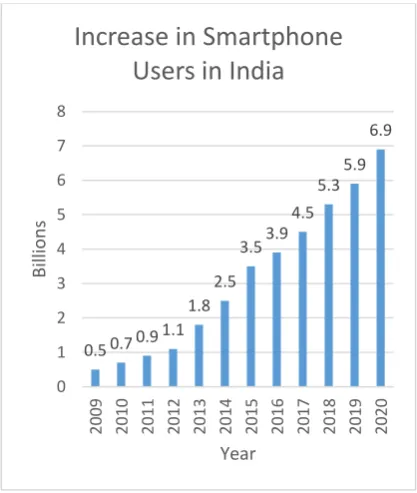
[image:1.595.315.524.369.616.2]Research has shown that how the usage of Smartphone is increasing every year. Machine learning (ML) is a category of algorithm that allows applications to become more accurate in predicting outcomes without being explicitly programmed. Smartphone is defined as a mobile phone with an advanced mobile operating system which combines features of a personal computer or laptop operating system with other features which are useful for handheld use. Smartphone are usually small and pocket-sized, which combines the features of a cell phone such as abilities to place and receive voice calls and create and receive text messages, with those of other popular digital mobile devices like personal digital assistants (PDAs), such as an event calendar, media player, video games, GPS navigation, digital camera and video camera. Today in this growing world the Smartphones has enormous features in it to attract people such as internet, games, chatting apps, browsing applications and so on [3]. Due to this not only adults but even there is a huge impact on today’s kids and teens. Also Smartphone users are increasing every year [Fig.1.].
Fig. 1. Increase in Smartphone Users in India
Smartphone is not just a phone but it’s also the laptop for the developing world which is bringing a radical change in the current generation. Today, technology has no limits and the developing features of smartphone is obvious that the addiction will increase [4]. To identify the addiction level different Machine Learning techniques can be used. ML is an application of ―artificial intelligence (AI)‖ that provides systems the ability to automatically learn and improve from experience
0.5 0.7 0.9 1.1 1.8
2.5 3.5 3.9
4.5 5.3
5.9 6.9
0 1 2 3 4 5 6 7 8
2009 2010 2011 2012 2013 2014 2015 2016 2017 2018 2019 2020
Bil
lion
s
Year
3459 without being unusually programmed. Also
Machine Learning focuses on the development of computer programs that can access data and use it learn for themselves. The popularity of smartphone use among students is quite high. The smartphone addiction level is higher in students who are 20 or less years old. The higher addiction scores negative effect in social life, verbal communication and difficulties to education. Total daily-life disturbance and Cyber-oriented relationship scores of the Smartphone Addiction Scale is high in the ≤20 age group [1]. As for the psychological traits, the respondents with high addiction tendency have higher shyness, loneliness, depression, and a lower self‐esteem. [2]. There are many features in Smartphone which can be used for productive purpose such as emails, reminders, information seeking and social information. If generalizing the concept of poisoning, problematic phenomena are loss of control power, increase of continuing use subject to tolerance, withdrawal symptoms, compulsive obsession or dependency according to what is object of poisoning, and may be regarded as state causing physical, social, psychological problems to the person. [6]
2. PROBLEMATIC SMARTPHONE BEHAVIOURS
Traffic Accidents
Shoulder and neck problems
Digital eye strain which includes Blurred vision, Eye Fatigue, Eyes begin to burn and itch, headaches.
Academic Problems
Poor Physical Fitness
Life-threatening infections in bones, joints, surgical wounds, bloodstream, heart valves, and lungs.
Male infertility.
3. FEW PHSYCOLOGICAL FACTORS
Smartphone addiction has been linked to an increase in sleep disorders and fatigue.
Using Smartphone before bed increases the likelihood of insomnia.
Bright light may decrease sleep quality.
Smartphone use could increase amount of time it takes to fall asleep.
Depression, Anxiety, Stress, Anger, Tension, Restlessness.
Excessive use characterized by loss of sense of time
Light emitted from the cell phone may activate the brain.
Relationship problems.
Increase in the use of smartphones in the current situation, has raised concern about social and psychological effects of excessive use of smartphone's especially among Indian teenagers. Smartphone's have made mobile connectivity so accessible that today's Indian generations are misusing their Smartphone. [8] Few studies have also showed that those who have higher level of addiction use smartphones more positively for bonding and bridging social relationships than those who have less additivity. Exercise rehabilitation is a part of the treatment for such conditions which contains the systematic procedures and comprehensive activities compared to previous addiction treatments. This can treat both physical symptoms at first and mental problems in the next step. So more evidence-based exercise re-habilitation researches need to be done, but it is highly believable that exercise rehab can apply for smartphone addiction. [9]. From Fig. 2 we can know the different diseases caused due to Smartphone Addiction and its percentages.
Fig. 2. Percentage of Different Diseases
4. LITERATURE REWIEW
Meltem and Nevcihan have studied [11] the answers given by students which was used as dataset. Each question was fixed as an attribute and
74%
37%
45% 21%
80%
11% 3%
PERCENTAGE OF DIFFERENT
DISEASES
Brain Tumor Male Infertility
Heart Disease Effect on Fetus
Ear Hearing Function Alzheimer's Disease
3460 attribute names. Nearly 240 samples have a total of
31 attribute is converted to file format .arff in order to use Waikato Environment for Knowledge Analysis (WEKA) (WEKA, 2016). Then by using Apriori Algorithm to find association rules among survey answers best 10 association rules was found separately given for university and high school students. According to the analyzed results the best 250 association rules with minimum confidence value is 0.9 and minimum support value is 0.3. 98 percent of high school students use their mobile phone more than 12 hours in a day to speech and messaging using WhatsApp. Both of university and high school students, who are single, 98 percent of them care price while buying a mobile phone. University students who use wearable technology 95 percent of them use computer which has Windows operating system.
According to this study, [12] smartphone usage patterns is analyzed by combining both self-reporting method and data mining techniques for more accurate results. Also Multiple linear regression analysis and decision tree analysis was used to determine that, which six factors are highly associated with addiction. Findings was higher the ―recurrence,‖ the higher the addiction, and the higher the risk users, the higher the ―withdrawal,‖ ―conflict,‖ and ―Influence‖. ―Influence‖ was the highest for potential-risk users and some ―tolerance‖ items were included. As a result of applying the variables that may affect the addiction, the higher the number of screen turns, the greater the difference between the actual use time and the perceived use time, the higher the risk users. Potential-risk users have a large difference in ―actual use time—perceived use time.‖ The high-risk users were unable to identify the actual smartphone usage time. Smartphone usage patterns is analyzed by combining both the self-reporting method and data mining techniques for more accurate results. Results show that 6.4% of the participants where 9 out of 13 students were female students suffer from the smartphone addiction— high-risk use.
This study [13] provides an interesting discrimination about the relationship between a survey-based approach and a device-based approach on the smartphone addiction. It has tried to reveal the variation between these two approaches. Even though the smartphone usage pattern is more accurate, it is limited in representing the various nature of smartphone addiction. On the other hand, the credibility of the self-diagnosed survey would be postulated because of its subjective nature. Two statistical analyses is carried out to investigate the correlative relationships between smartphone app usage patterns and S scale score, and also between
categorical app usage patterns and S scale score. Also to differentiate between smartphone addicts and normal users is being attempted.
Logistic regression analysis [14] identified six predictors namely gender (female), weekend average usage hours, and scores on BAS-Drive, BAS-Reward Responsiveness, DDII, and BSCS. Women were 1.46 times more probably to be addicted than men. A one-hour increase in weekend average usage caused the probability of SAP to increase by 1.08 times. Higher scores on BAS-Drive, BAS-Reward Responsiveness, DDII, and BSCS also increased the possibility of SAP by 1.10, 1.02, 1.09, and 1.13 times. The area under the ROC curve (AUC) was 0.8279 with a 95 percent confidence interval of ±0.0187. According to the study, about 13.4% (N = 652) of participants were in the SAP group out of which 9.4% of all males and 17.9% of all females. Mean values of variables differed between the SAP and non-SAP groups. Mean K-SAPS scores were 43.0 and 29.6 in the SAP and non-SAP groups. SAP group members scored higher on the BIS/BAS, dysfunctional impulsivity, low self-control and indicated longer mean weekday and weekend usage time.
It is significant to note that the proposed framework [15] is novel and no other comparable framework exists that can be used as a reference. The Machine Learning Processor here relies on k-means clustering technique to create usage profile from the input data. It is being implemented on MLP using Mathworks Matlab 2013a, which provides feature rich Machine Learning library and tools for data analysis and visualization. Absence of a specification implies that this framework can only be validated with data collected during testing. The data collected from the devices was processed and scaled using z-score technique and some variables were transformed. To measure the quality of clustering results, there were two kinds of validity indices: An External index is a measure of agreement between two partitions whereas the first partition is the a priori known clustering structure, and the results from the clustering procedure. The optimal number of clusters is usually fixed based on an internal validity index.
3461 smartphone addiction. The results showed good
opportunities for improvement and execution in the smartphone addiction.
The aim of the study [17] was to examine the relationship between narcissism, personality and smartphone addiction. Regression analysis found positive relationship between narcissism levels and smartphone addiction. This finding supports the research that links narcissism with addictive disorders. These results build upon in the area of smartphone addiction, has shown that 10% of participants were addicted to smartphones and 34% displayed addictive symptoms. A significant positive relationship between daily use and smartphone addiction was also revealed. Results indicated that 13.3 percentage of participants showed a dependence on their smartphone and could be classified as addicted to smartphone. A positive relationship was found between narcissism levels and smartphone addiction. This suggests that the more narcissistic a person is, the more likely they are to be Smartphone addicted.
RapidMiner, a tool [18] is used for mining the data is deployed and the result attribute is kept as the label attribute. This model is applied to the data using RapidMiner tool, with the idea of predicting whether the person is addicted or not. Here few values were found to be missing in the label attribute. RapidMiner tool is used to predict the value of label attributes for new entries. Identification of whether an individual is addicted or not is done and the accuracy of this model is also validated using the x-validation operator and was found to be about 90%. It is found that majority of the users are addicted to WhatsApp and also to it’s the features like calling, transfer of contacts, location and so on. Thus the analysis exposes the positive impacts and the negative impacts of the application that might lead to addiction.
Two sequential linear regression analyses [19] was conducted, one for each of the following dependent variables: a) process usage, and b) social usage. In step 1 of analysis, age and gender was determined.
In step 2, tested the additive effect of the six SAS subscales as predictor variables. Using regression models, after adjusting for other variables, problematic smartphone-related positive anticipation and overuse both were related to process and social smartphone usage – though the effects were smaller for social use. It is also found that daily life disturbances were inversely related to process and social usage. However, one explanation is that people enjoy engaging in more process and social smartphone usage, and thus it does not feel like one’s smartphone interferes with daily life. Finally, problematic smartphone can also be assessed using a measure such as the SAS, in order to capture additional, standardized clinical data.
5. DISCUSSION
In this part of review it picturizes the methods used for finding smartphone additivity level, its conclusion and performance matrix. Through the literature survey algorithms used are discussed along with their findings. Also it is seen that the accuracy level differs for each methods used. Using Data Mining techniques absolute solutions are found and accuracy is determined. Moreover all the survey has come up with different future enhancement ideas which can be taken forward.
REF NO
Title Methods
used
Dataset Conclusion and future enhancement
Performance matrix [11] Analysis of
Technology Addiction of High School and
University Students using Datamining Techniques
Apriori Algorithm
Questioner In the future this survey research can be applied to more individuals so more meaningful rules can be obtained and these results can be analyzed with more datamining techniques.
Minimum confidence value is 0.9 and minimum support value is 0.3
[12] Analysis of Behavioral Characteristics of Smartphone Addiction Using Data Mining
Decision tree
App data In future this survey research can be applied to more individuals so more meaningful rules can be obtained and these results can be analyzed with more datamining techniques.
3462 [13] Measuring
Smartphone Usage Time is Not Sufficient to Predict Smartphone Addiction
Questioner
Smartphone Usage Tracker was used to collect users’ smart phone usage patterns
Current methodology is limited in the variety of smart phone activity variables and the collection duration of
Participants’ activities. In future, this research work will be dedicated to
Employing more smartphone activity patterns and the latent constructs that underlies smart phone-addictive behaviors and their clinical effects with
sufficiently long data collection duration.
Fisher’s Linear Discriminant Analysis 10 factors 79.9 Total smartphone usage time 66.0
[14] Personality Factors Predicting
Smartphone Addiction Predisposition Behavioral Inhibition and Activation Systems, Impulsivity, and Self-Control
Logistic regression
K-SAPS BIS/BAS DDII BSCS
It requires acknowledgment and attention. However, because of the limited findings, a cautious approach should be taken whether or not
smart phone overuse should be grouped together with addiction
Screening tools are limited to inform as an early detection and only clinical studies are proper to uphold that a certain behavior is pathological
Specific region and age range, were not randomized. SAP and the measurement of Personality factors relied on self-administered
questionnaires.
Relatively few personality factors
were measured cross-sectionally
[15] Behavior Based Anomaly Detection for Smartphones Using Machine Learning Algorithm
K-Means Data collection application was developed to accumulate real-life dataset consisting of application usage statistics
Future work SA. Further, calculated cut-off points for key predictors.
74.48%
[16] A Development of Classification Model for Smartphone Addiction
Recognition System Based on
Smartphone Usage
Naive Bayes K-NN (K=5) Decision Tree (J48) SVM
Application on an Android 5.0 (API level 21)
platforms.
The size of the subject was small, and further experiment with larger subject group will provide a classification model that can handle more diverse usage characteristic.
3463 Data
[17] Smartphone Addiction and Associated Psychological Factors
Regression
Online Questionnaire.
There are number of limitations to the present study. The online self-report data used in this study suffers from the issue of reliability; for example, participants may have over-estimated their smartphone use. However, the issue of reliability of
responses is not limited to online studies as it affects all types of self-report research
The results revealed that 13.3% of the sample was classified as addicted to smartphones. Regression analysis revealed that narcissism, openness, neuroticism, and age were linked to smartphone addiction. [18] Analysis on Social
Media Addiction using Data Mining Technique
Decision Tree
Rapid Miner Data set
The analysis exposes the positive impacts and the negative impacts of this application that might lead to addiction. Further analysis will be done to find the segment of population like women, men, college students, business officials that is most addicted to WhatsApp.
The accuracy of this model is also validated using the xvalidation operator and was found to be about 90%
[19] Types of
smartphone usage and relations with problematic smartphone behaviors: The role of content
consumption vs. social smartphone use
Regression Analysis
Limitations in this study include that we did not objectively assess smartphone behavior, but rather used self-report methods. We used a
community sample of Mturk participants, and such sampling may not
representative of the general population.
6. CONCLUSION
In this artefact a comprehensive study is made on Smartphone Addiction using Machine Learning techniques. Also many physiological papers are reviewed for the same. It is manifest that each research has its own opinions and findings. Also different algorithms and techniques are used to find the accuracy which still has limitations. Hence in the future work, these limitations can be overwhelm and the efficiency of the algorithms can be enhanced using different Machine Learning Algorithms.
REFERENCES
[1] Kahyaoglu Sut H et al. Effects Of Smartphone Addiction Level on Social and Educational Life in Health Sciences Students, Euras J Fam Med 2016; 5(1):13-9
[2] Namsu Park, Hyunjoo Lee**. Nature of Youth Smartphone Addiction in Korea, Media Information Research 51 Volume 1, 2014, 100-132 http://icr.snu.ac.kr/jcr Seoul National University Press Information Institute
3464 81, DIP: 18.01.128/20160401 ISBN:
978-1-365-59365-9 http://www.ijip.in | October-December, 2016
[4] Zencirci SA et al Evaluation of smartphone addiction and related factors among university students International Journal of Research in Medical Sciences, 2018 Jul; 6(7):2210-2216 [5] Heejune Ahn, Muhammad Eka Wijaya and
Bianca Camille Esmero. A Systemic Smartphone Usage Pattern Analysis: Focusing on Smartphone Addiction Issue, International Journal of Multimedia and Ubiquitous Engineering Vol.9, No.6 (2014), pp.9-14 [6] Gi-Ryun Park, Gye-Wan Moon, Dong-Hoon
Yang. The Moderation Effect of Smart Phone Addiction in Relationship between Self-Leadership and Innovative Behavior, International Journal of Economics and Management Engineering Vol: 8, No: 5, 2014 [7] Hafidha Suleiman Al-Barashdi, Abdelmajid
Bouazza1 and Naeema H. Jabur. Smartphone Addiction among University Undergraduates: A Literature Review Journal of Scientific Research & Reports 4(3): 210-225, 2015; Article no.JSRR.2015.025 ISSN: 2320-0227 SCIENCE DOMAIN international
[8] Sanjeev Davey and Anuradha Davey. Assessment of Smartphone Addiction in Indian Adolescents: A Mixed Method Study by Systematic-review and Meta-analysis Approach, Int J Prev Med. 2014 Dec; 5(12): 1500–1511
[9] Hyunna Kim. Exercise rehabilitation for smartphone addiction, Journal of Exercise Rehabilitation 2013; 9 (6):500-505
[10] Sahin Geokcearslan et.al. Modelling smartphone addiction: The role of smartphone usage, selfregulation, general self-efficacy and cyberloafing in university students, 2016 Elsevier Ltd.
[11] Meltem Kurt Pehlivanoğlu and Nevcihan Duru.
Analysis of Technology Addiction of high School and University Students Using Data Mining Techniques, International Conference on Education in Mathematics, Science& Technology (ICEMST 2016)
[12] MyungSuk Lee, MuMoungCho Han and JuGeon Pak. Analysis of Behavioral Characteristics of Smartphone Addiction Using Data Mining, Appl. Sci. 2018, 8, 1191 [13] Myuunghee Shin, Kangwoo Lee. Measuring
Smartphone Usage Time is not sufficient to Predict Smartphone Addiction, Journal of Theoretical and Applied Information Technology 15th October 2017. Vol.95. No 19 [14] Yejin Kim and et. al., Personality Factors
Predicting Smartphone Addiction
Predisposition: Behavioral Inhibition and Activation Systems, Impulsivity, and Self-Control PLoS One. 2016; 11(8): e0159788 [15] Khurram Majeed, Dr Yanguo Jing, Dr Dusica
Novakovic, and Prof Karim Ouazzane. Behavior Based Anomaly Detection for Smartphones Using Machine Learning Algorithm, International conference on Computer Science and Information Systems (ICSIS’2014) Oct 17-18, 2014
[16] Worawat Lawanont and Masahiro Inoue. A Development of Classification Model for Smartphone Addiction Recognition System Based on Smartphone Usage Data, Conference Paper in Smart Innovation · May 2018
[17] Claire Pearson and Zaheer Hussain. Smartphone Addiction and Associated Psychological Factors Turkish Green Crescent Society, ISSN 2148-7286, eISSN 2149-1305 http://addicta.com.tr/en/DOI:10.15805/addicta. 2016.3.0103, October 2016 3(2)1‒15
[18] D. Radha, R. Jayaparvathy and D. Yamini. Analysis on Social Media Addiction using Data Mining Technique, International Journal of Computer Applications (0975 – 8887) Volume 139 – No.7, April 2016