Volume 6, No. 5, May - June 2015
International Journal of Advanced Research in Computer Science
RESEARCH PAPER
Available Online at www.ijarcs.info
Example Based Color Transfer with Corruptive Artifacts Suppression
Nasreen Pottammel
Deapartment for computer science,
KMCT College of Engineering, Calicut, Kerala, India [email protected]
Anitha Ambat
Asst.professor
Computer science and engineering
KMCT college of engineering, Calicut, Kerala India
Abstract: Color transfer is an important task in image editing. Among which example based color transfer is used for color transfer and also suppresses the corruptive artifacts during color transfer. In the example based color transfer there exist single or multiple example images as reference and a target image. Color transfer is the process of copying the color appearance of a target image based on reference. In this paper, a novel unified corruptive artifacts suppression color transfer frame work is introduced, which having iterative probabilistic color mapping with self-learning filtering scheme and multiscale detail manipulation scheme in minimizing the normalized kullback-leibler distance. This paper also proposes an automatic color transfer method for processing images with complex content based on intrinsic component. Visual artifacts and color bleeding like artifacts are removed in this paper.Intrinsic component is used for local organization and to remove color bleeding like artifact.
Keywords: color transferring, computational photograph, edge preserving Smoothing, image detail manipulation,multi-reference, region correspondence, and content-based image retrieval
I. INTRODUCTION
Image editing is the common task in image manipulation. The task of example-based color transfer [1] involves the changing color appearances based on the reference image and also transfers the original feel to the target. there exist sudden development in the field of color transfer, such that there exist many representative approaches exist they are , progressive transfer [6], non-rigid dense correspondence transfer [5]classical histogram matching, n -dimensional probability density function transfer [3] ,statistical transfer [2], gradient-preserving transfer [4] etc.
These approaches are good in color transfer but it makessome visual artifacts.Considering the fig. 1 we can understand that unsatisfactory result with artifact are obtained due to the big difference in intensity distribution of target and reference. The remarkable artifact can be listed below.
Loss of details: after color transfer the finest details in the target image are missed.
Grain effect: during stretched mapping enhancing the noise of an image takes place. Some irregular blocks or noises are similar to that of this phenomenon.
[image:1.595.39.279.478.614.2]Color distortion: some unwanted color appears, which are not in the reference image
Fig. 1. Example-based color transfer [7] is an intuitional image manipulation technique, but it would produce some unexpected artifacts due to the complexity of color mapping. Grain effect, color distortion and loss of details appear in the transferred result commonly.
II. LITERATURE SURVEY
In this section state of art of the automatic color transfer is emphasized, and also summarizes its merits and de merits. Edge preserving smoothing filters, multiplereferences and multiple references with complex content are discussed. Color fidelity: the reference and target should have the close color distribution.
Detail preservation. Details of the target should be preserved after color transfer.
Grain suppression: target image should free from visual artifacts
[image:1.595.318.532.546.654.2]Color transfers between two images are become efficient when they satisfy the following goals.
A. Color mapping
Histogrammatching [8] is the classical method in which the target histogram is obtained from the reference histogram.The color component of the color image is processed independently during histogram matching. Relationships of the color component areseparated, such that unsatisfactory result with slight grain effect and serious color distortion are produced. The first method in color transfer is the Reinhardet al. [2],in which the low correlated lαβ color space is used as the color space such that the matches occurs between the mean and variances of the target and reference.Removing dominant and undesirable color cast occurred during color transfer and also the cross-channel artifacts are removed. Believable output images are produced after this method .it is the simple and efficient but two problems exist they are
Unnatural looking results when source and reference images have different color distributions
Results with low fidelity in scene details and color distribution
The Changet al. [9], [10 ]proposed a method to prevent from grain effect, it is a color category-based approach that categorized each pixel as one of the basic categories, thencalculate a corresponding color value for each convex hull of the same category. This methodquickly create a color transformed image or video using one reference image. It can handle images taken under a variety of light conditions and improves the mapping between source and reference colors when there is a disparity in size of the chromatic categories.it also handles achromatic categories separately from chromatic categories. This method produces color distortion. Tai et al. [11] proposed a method to avoid the color distortion by usingEMalgorithm, such that it construct GMM (Gaussian mixture model) with the help ofReinhard‟s approach [2].N-dimensional probability density function transfer approach by Pitié et al. [3],[12] uses radon transform [8] to reduce an N-dimensional PDF matching problem in to one dimension.Transfer the statistics of a target dataset (the example) to a source dataset. It havinglow computation cost but visual artifacts are produced such that the variance of image contents as the pixel intensity changed .to avoid this result Poisson reconstruction is introduced.Gradient-preserving model by Xiao and Ma [4] introduced fidelity both in terms of scene details and colors.Combinethe gradients and a histogram for a gradient-preserving color transfer algorithm.Objective evaluation metric is used for example-based color transfer to measure the fidelity.It needs more computing resources including time and memory .It involves solving a hugescale linear system of equations.
B. Edge-preserving smoothing
The grain effect can be removed by linear smoothing because it is a special type of noise [12]. But the linear smoothing will produce over-blurring, which removes original image details,and the sharpness of the edges are reduced. Edge-preserving smoothing (EPS) filters [13]–[18] are proposed to avoid this problem.Fattal et al. [19] proposed an image- based technique for enhancing the shape and surface details of an object. It contains two phases such as analysis and synthesis phase. The shape and detail enhancement system is composed of two stages; analysis and synthesis. In the analysis stage we compute a multiscale decomposition for each input image and in the synthesis stage we combine information within each scale of the decomposition, but across all of the input images
explored the edge-aware image processing based on the Laplacian pyramid for the decomposition for fine-level detail manipulation.It allows for a wide range of edge-aware filters and produce artifact-free images
C. Multiple references
Wan-chien chiou and chioting hsu[22] proposed an automatic color transfer methodbased on multi-reference and graph-theoretic regioncorrespondence estimation.Content-based image retrieval technique is used to retrieve k set of reference images from the database. After that segment the target image using mean-shift based technique. Thenrepresent each image as an attributed graph and derive a novel region mapping function as the criterion. Finally perform color transfer between the best-matched region pairs. This method produces color-bleeding like artifact. To remove this Wan-chien chiou, yi-lei chen and chiou-ting hsu [23] proposed a method based on intrinsic component. It incorporates the idea of intrinsic component to better characterize the local organization within an image and to reduce the color-bleeding artifact across complex regions.Using intrinsic information, first represent each image in region level and determine the best-matched reference region for each target region. Next, conduct the color transfer between the best-matched region pairs and perform weighted color transfer for pixels across complex regions in a de-correlated color space.
III. PROPOSED METHOD (INTEGRATED COLOR MAPPING MODEL)
In the example based color transfer the color transfer exist between the target and the reference image, such that it should satisfy the three goals of color transfer simultaneously, including grain suppression, detail preservation and color fidelity respectively. The overview of the frame work in Fig. 2 contains the following stages,
Color mapping stage: this stage contains an iterative probabilistic mapping to provide basic colorcategories followed by self learning filtering scheme to remove the grain effect and produce k levels of transferred target.
Detail manipulation stage: in this stage preserve or enhance details by using a multiscale detail manipulation scheme.
Integrated optimization stage: to yield the final result the transferred and modified result are combined such that it will having a minimum K-L distance.
A. K-L distance for color transfer
The Kullback-Leibler distance (K-L) [21] can measure the similarity between two completely determined probability distributions. Here, we are using K-L distance to measure the difference between the reference r and the transferred result g during colortransfer. The color distribution of target is close to that of the reference if there exist a minimum K-L distance.Let p(r) and p(g) denote the distributions of the reference image and the transferred image, respectively, we have
(1)
(2)
Where DKL(.) is the iterative threshold in the solution. Essentially, is a monotonically increasing and non-negative function, therefore it has a limit. ilmitDKL=0 , if the distribution p(r) andp(g) are equal. The K-L distance is having a vital role in the color mapping.
A. Iterative probabilistic color mapping
The probabilistic mapping between the reference and transferred grayscale image can be formulated as
(3)
By using discrete look up tables the mapping relationship can be solved as
(4)
Where Cr and Cg denote the cumulative distribution correspondingto P(r) and P(g) , respectively.
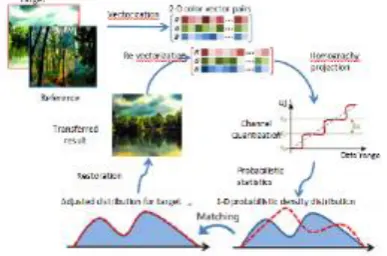
Fig. 3. The probability-based color distribution mapping with minimizing K-L distance. In an iterative cycle, the reference image and the target image are transformed into 2-D color vector pairs. By the homography projection and probabilistic statistics with channel quantization, we obtain the 1-D distribution on directive axes. The probability distribution of the target matches to that of the reference. The restoration is performed to output the transferred result. The iteration would be stopped until reach the preset times or minimized error. The above equation should produce color distortion in the case of color images. Decorrelation is used to solve this issue.This decorrelation would be regarded as a piece-wise homography transformation with an iterative process. It is parameterized as the projectionwith the randomized orthogonal transform in the following
(5)
Where I is a3×3 identity matrix and R is a homography coefficient matrix as a rotation projection. is a randomized orthogonal matrix used for n times iteration.
The Fig. 3 explains the probabilistic color mapping. By the decorrelation, we use the following iterative scheme to solve out the transferred result
(6) B. Self-learning Filtering Scheme
After the probabilistic color mapping there still exist a defect of grain effect. To avoid this problem the self learning filtering scheme is introduced. The transferred result g and filtered result gˆ are divided into series of 9×9 patches such that g and gˆ having the following relationship in patch
(7)
Where and are linear coefficients. Subscripts i and k are used for pixels and patches indexing, respectively. Let mean and variance of g in is , |p|is the pixel amountof . Using the least squares parameter estimation, and can be estimated by
(8)
We presented our result with this scheme and compared it with Pitiè‟s in Fig. 4 and Fig. 5.
If it contains multiple reference images then this method will produce color-bleeding like artifact. To remove this replaces the equation for α and β by using [23]
(9)
[image:3.595.313.560.320.548.2]Where z is the unreliable pixel and r is the reflectance weight
Fig. 4. The comparison of the integrated color mapping model and Pitié‟s approach [14]. (a) Reference. (b) Target. (c) Pitié‟s -dimensional PDF step (n=10 ). There are obvious grain effect and content distortion in (c), e.g. the tone of the clouds. (d) Our improved result (k=8 ,ε=1e-3 ). We obtained a visual satisfactory result under the self-learning filtering scheme. Furthermore, we compared the N-dimensional PDF added Poisson editing [14] in (e)-(f) with our approach in (g)-(h). (e) n=3,λ=1 . (f)n=10 ,λ=1 . (g)k=3 ,ε=1e-3. (h)k=10 ,ε=1e-3 .
C. Multiscale Detail Manipulation Scheme
[image:3.595.42.236.331.459.2](10) Where λ is the adjustment factor, if λ=1 then it represent
preserving, while λ≠1 represent the enhancing of details.The comparison of detail enhancement is shown in Fig. 6.
Fig. 5. Self-learning filtering scheme for grain suppression. Note the grain effect can be smoothed while the edge can be preserved.
Fig. 6. Detail enhancement. (a) Target. (b) Reference. (c) Without enhancing( λ=1). (d) Detail enhancing (λ=3 ). The specified magnified regions correspondingto (c) and (d) are shown in (e) and (f), respectively. Obviously, moredetails are presented in (f) than in (e).
E. Integrated Optimization Framework
The K-L distance can be used to evaluate the efficiency of color mapping. Itrepresents the degree color distribution of similarity between the reference and the transferred result. Normalized K-L distance is used for more robustness.
(11)
The efficient color transfer will having a minimum of normalized K-L distance represented as the following equation. (12) Where S(.)and M(.) denote the detail manipulation operator
and self-learning filtering operator , respectively
By using this framework it can produce a good result with the goals satisfied.The pseudo code of this approach is given in Algorithm 1.and results are presented in Fig. 4.
IV. RESULTS
[image:4.595.49.250.65.129.2]This chapter deals with the integration of the results of each modules such that K-L diatance will be minimum.The color appearances of the reference image is transferred to the traget image by iterative probabilistic method followed by self-learning filtering scheme and multiscale detail manipulation stage ,such that the result is close to that of reference.This color transfer can be applied to the video having a reference image and copying the color appearances of reference image in to the video. Image color mapping contains a reference image and target image such that it performs color transfer by copying color appearances of the reference to the target video color mapping
[image:4.595.41.249.181.240.2] [image:4.595.44.262.279.411.2]The color transfer method can be compared by using different methods.The comparison is done inorder to evaluate the performance of the proposed method. The fig: 7 shows the graphical representation of the elapsed time with respect to the number of iterations. The elapsed time increase with the number of iterations.
Fig. 8 : Performance analysis based on elapsed time
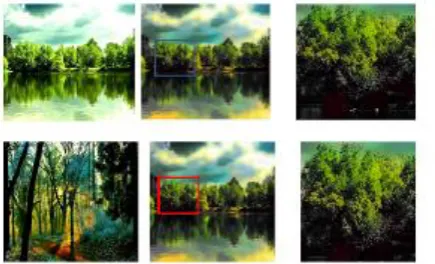
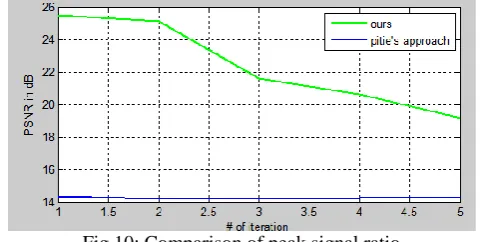
[image:5.595.38.270.135.248.2]The performance of peoposed method can be also determined by comparing the peak signal-noiseratio of the proposed approch and Pitie's approch with respect to the iterations.The graph in Fig: 8 shows the comparison study of the fig:9 .The psnr value of proposed method is higher in all the iterations than pitie's.
Fig. 9 : Visual comparison of ours method with pities The K-L distance can be used to measure the similarity between the result and the reference.The color transfer will be efficient if the K-L distance have a smaller value,while iteratively applying
Fig 10: Comparison of peak signal ratio
the color mapping the K-L distance decreases and the result will be close to that of reference. The fig 10 represents the variation.
[image:5.595.45.280.346.403.2]The histogram of both the reference and the result should be close to each other after the colortransformation. Comparing the three channels in the two histograms will produce the similiarity. The fig: 11 represents the hisogram of both reference and result.
Fig 11: Similarly between reference and result
The histogram of both the reference and the result should be close to each other after the colortransformation. Comparing the three channels in the two histograms will produce the similiarity. The fig: 11 represents the hisogram of both reference and result.
V. CONCLUSION
The color transfer based on the reference image is very important in the image enhancement techniques. How to transfer the colors of the given reference to the target effectively is a challenging problem and is significant in color transfer. Because of the complexity of the color distribution, it is difficult to avoid the corruptive artifacts such as color distortion, grain effect or loss of details in the result of color transfer. The proposed method will remove the corruptive artifacts and also which contain multipple references. The merits of proposed system are,Example based color transfer with high performance, Removes the grain effect during colorIt prevent the color distortion Color bleeding is removed. Example based color transfer with corruptive artifact suppression can be extended in the case of multipple references. And also it can be extended to the video color mapping.
VI. REFERENCES
[1] T. Welsh, M. Ashikhmin, and K. Mueller, “Transferring color to greyscale images,” ACM Trans. Graph., vol. 21, no. 3, pp. 277– 280, 2002.
[2] E. Reinhard, M. Ashikhmin, B. Gooch, and P. Shirley, “Color transfer between images,” IEEE Comput. Graph. Applicat., vol. 21, no. 5, pp. 34–41, 2001.
[3] F. Pitié, A. C. Kokaram, and R. Dahyot, “N-dimensional probablility density function transfer and its application to colour transfer,” in Proc. 10th IEEE Int. Conf. Computer Vision, 2005, vol. 2, pp. 1434–1439.
[4] X. Xiao and L. Ma, “Gradient-preserving color transfer,” Comput. Graph. Forum, vol. 28, no. 7, pp. 1879–1886, 2009.
[5] Y. HaCohen, E. Shechtman, D. B. Goldman, and D. Lischinski, “Nonrigid dense correspondence with applications for image enhancement,” ACM Trans. Graph., vol. 30, no. 4, pp. 70:1– 70:10, 2011.
[6] T. Pouli and E. Reinhard, “Progressive color transfer for images of arbitrary dynamic range,” Comput. Graph., vol. 35, no. 1, pp. 67–80, 2011.
[7] T. Pouli and E. Reinhard, “Example-based color image manipulation and enhancement,” in Proc. ACM SIGGRAPH 2012Courses, ser. SIGGRAPH „12, 2012, pp. 3:1–3:62. [8] R. C. Gonzalez and R. E. Woods, Digital Image Processing, 3rd
[image:5.595.41.284.465.586.2][9] Y. Chang, S. Saito, and M. Nakajima, “Example-based color transformation of image and video using basic color categories,” IEEE Trans.Image Process., vol. 16, no. 2, pp. 329–336, 2007. [10] Y. Chang, S. Saito, K. Uchikawa, and M. Nakajima,
“Example-basedcolor stylization of images,” ACM Trans. Appl. Percept., vol. 2, no. 3,pp. 322–345, 2005.
[11] Y. Tai, J. Jia, and C. Tang, “Soft color segmentation and its applications,”IEEE Trans. Pattern Anal. Mach. Intell., vol. 29, no. 9, pp.1520–1537, 2007.
[12] F. Pitié, A. Kokaram, and R. Dahyot, “Automated colour grading usingcolour distribution transfer,” Comput. Vision Image Understand., vol.107, no. 1-2, pp. 123–137, 2007. [13] S. Paris, P. Kornprobst, J. Tumblin, and F. Durand, “Bilateral
filtering:Theory and application,” in Proc. Computer Graphics and Vision 2008.
[14] Z. Farbman, R. Fattal, D. Lischinski, and R. Szeliski, “Edge-preservingdecompositions for multi-scale tone and detail manipulation,” ACMTrans. Graph., vol. 27, no. 3, pp. 67–76, 2008.
[15] M. Kass and J. Solomon, “Smoothed local histogram filters,” ACMTrans. Graphics (Proc. ACM SIGGRAPH 2010), vol. 29, no. 4, pp.100:1–100:10, 2010.
[16] E. S. L. Gastal andM.M. Oliveira, “Domain transform for edge-awareimage and video processing,” ACM TOG, vol. 30, no. 4, 2011, Proc.SIGGRAPH 2011, to be published.
[17] L. Xu, C. Lu, Y. Xu, and J. Jia, “Image smoothing via l0 gradient minimization,”in Proc. SIGGRAPH Asia 2011, 2011. [18] E. S. L. Gastal and M. M. Oliveira, “Adaptive manifolds for
real-timehigh-dimensional filtering,” ACM Trans. Graph., vol. 31, no. 4, pp.33:1–33:13, 2012.
[19] R. Fattal, M. Agrawala, and S. Rusinkiewicz, “Multiscale shape anddetail enhancement from multi-light image collections,” ACM Trans.Graph., vol. 26, 2007.
[20] S. Paris, S. W. Hasinoff, and J. Kautz, “Local Laplacian filters:Edge-aware image processing with a Laplacian pyramid,” ACM TransGraph., vol. 30, no. 4, pp. 1–12, 2011.
[21] C. M. Bishop, Pattern Recognition and Machine Learning. New York, NY, USA: Springer, 2006.
[22] W.C. Chiou and C.T. Hsu, “Region-Based Color Transfer from Multi- Reference with Graph-Theoretic Correspondence Estimation,” Proc. ICIP, 2009.
![Fig. 1. Example-based color transfer [7] is an intuitional image manipulation technique, but it would produce some unexpected artifacts due to the complexity of color mapping](https://thumb-us.123doks.com/thumbv2/123dok_us/693976.1077002/1.595.39.279.478.614/example-transfer-intuitional-manipulation-technique-unexpected-artifacts-complexity.webp)