Event Detection in Blogs using Temporal Random Indexing
David Jurgens
and
Keith Stevens
University of California, Los Angeles
4732 Boelter Hall
Los Angeles, CA 90095
{
jurgens, kstevens
}
@
cs.ucla.edu
Abstract
Automatic event detection aims to identify novel, in-teresting topics as they are published online. While existing algorithms for event detection have focused on newswire releases, we examine how event detec-tion can work on less structured corpora of blogs. The proliferation of blogs and other forms of self-published media have given rise to an ever-growing corpus of news, commentary and opinion texts. Blogs offer a major advantage for event detection as their
content may be rapidly updated. However, blogs
texts also pose a significant challenge in that the de-scribed events may be less easy to detect given the va-riety of topics, writing styles and possible author bi-ases. We propose a new way of detecting events in this media by looking for changes in word semantics. We first outline a new algorithm that makes use of a temporally-annotated semantic space for tracking how words change semantics. Then we demonstrate how identified changes could be used to detect new events and their associated blog entries.
1
Introduction
Automated event detection is a form of information re-trieval where given a time-ordered set of documents, an al-gorithm must select those which represent recent news or changes to existing information. An automated approach to event detection has many practical applications; given the large amount of text being written daily, readers want to be informed of which developments and topics are the most recent and important without having to manually sift through all the documents written on the topic. In addition, a robust system should be able to detect multiple kinds of events, such as international conflicts, product releases or sports results. The main challenge in automating this task is detecting what makes a new document sufficiently novel to be described as a new event.
Current event detection approaches have focused on identifying concrete events that occur within newswire text[11]. However, in recent years, blogs have become an important source of both news and commentary. Un-like news reports, blog content expresses a wide range of topics, opinions, vocabulary and writing styles; the change in editorial requirements allows blog authors to comment freely on local, national and international issues, while still expressing their personal sentiment. Accordingly, blogs of-fer a rich opportunity for detecting events that may not be covered in traditional newswire text. These forms of self published media might also allow event detection systems to identify developing events before official news reports can be written.
Several forms of event detection have focused on an-alyzing named entities, such as “Bill Clinton” or “Iraq,” and the contexts or documents in which they appear, e.g. [10, 11, 5]. We propose a more general approach that looks at all words and their contexts, rather than a predetermined set of words. Specifically, we argue that event detection can be done by measuring the semantic change in a word or phrase. To track changes in the semantics, we use a seman-tic space model of meaning, which is an automated method of building distributed representations of word meaning.
Semantic space models of meaning offer three notable advantages for event detection. First, the models are capa-ble of automatically determining the semantics of a word by examining the contexts in which the word appears. Such automated understanding of semantics is required for ana-lyzing these new sources of data due to the much wider vocabulary used by authors. Second, the models offer a well defined method for comparing the semantics between words. These semantic comparisons have been shown to be similar to human judgments[13]. We argue that reporting words which have a notable changes in semantics should correlate well with a reader’s expectations of interesting velopments. Third, the models are well-established at de-tecting association such as synonymy among words, which can allow models to detect events that are referred to by multiple names. Given these advantages, we introduce a new semantic space algorithm for assessing how the mean-ing of a word changes through time for the purpose of event detection.
We illustrate our approach to topic detection with a hy-pothetical example of the product release of a toy named “blick.” At the start of the toy’s popularity, the word “blick” has not occurred before and therefore its seman-tics would be undefined. As “blick” appears in more blogs, the word acquires consistent semantics, and the algorithm can report a new event for “blick.” Our approach differs from simple occurrence monitoring in that we require the word to have a consistent meaning; unless the algorithm is capable of determining what concepts the word refers to, knowing that the word relates to an event is impossible.
However, consider detecting a second event for “blick” soon after its release in which the toy is discovered to have toxic properties. Since the toy’s name was already present in the blogs, the novelty of the name is not enough to detect the point at which the toxic chemical was revealed. How-ever, our approach, which looks at the semantic shift of words over time, would detect a shift based on the new kinds of words that would be likely to co-occur with the toy’s name, e.g. toxicity, a toy recall, or lawsuit. Intuitively speaking, this approach associates news events with notice-able changes in bothwhatauthors talk about andhowthey
talk about those subject.
In this paper we present a new algorithm, Temporal Random Indexing, that effectively captures the semantic changes for words and phrases over time. We first briefly review the semantic space model that underlies this ap-proach and then present the algorithm. Following, we demonstrate several examples of semantic change extracted from a large blog corpus and illustrate one method for re-porting the events.
2
Semantic Space Models
Semantic space models of meaning are born from the dis-tributed hypothesis: For two words, their similarity in meaning is predicted by the similarity of their distributions of co-occurring words[6], or as Firth puts it, “you shall know a word by the company it keeps,”[4]. Creating se-mantics from co-occurring words forms the basis for how our algorithm represents changes in semantics.
2.1
Semantics as Co-occurrence
In a semantic space, a word’s semantics are mapped to high dimensional vectors in a geometric space. The dimensions of the space represent distinctions between the meanings of words; accordingly, words with similar semantics have similar vector representations. Semantic space representa-tions have proven effective at a variety of information re-trieval tasks such as identifying synonymous queries[21] and multi-language retrieval[14, 23]. For a recent survey of applications of semantic spaces to information retrieval see Cohen and Widdows[3]. To illustrate the basics of co-occurrence based semantic space models, we can further explore the example of “blick”, the new yet toxic toy.
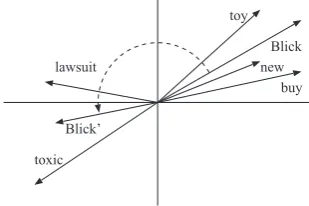
Consider the documents describing “blick” when it is first introduced during a holiday season. A potential line from several blogs might read “A perfect gift this holiday season is blick, one of the newest toys available!” Using a simple co-occurrence semantic space, the semantics of “blick” would be a count of how frequently it co-occurs with key words such as: gift, holiday, perfect and toys. Examining later blog posts written when this same toy is discovered to have toxic elements, several posts might now have the line: “the toxic elements in blick make the toy dangerous.” The semantics of the toy should now focus primarily on the co-occurrence of words such as toxic and dangerous, and should no longer be associated with pos-itive words such as holiday and perfect. Figure 1 illus-trates a simplified two-dimensional semantic space and the changes to semantics that would occur as “blick” begins to co-occur with toxic-related words. A standard semantic space model would define the semantics of the new toy as a combination of all co-occurrences, in this case the positive new semantics and the negative semantics of toxicity.
2.2
Random Indexing
Using simple co-occurrence is rarely done in practice for large corpora. In such models, each unique word would be assigned its own dimension (corresponding to co-occurrence with that word), which results in vectors with hundreds of thousands to millions of dimensions. Basing the number of dimensions on the number of unique words
Blick new toy
toxic lawsuit
Blick’
[image:2.595.337.492.109.212.2]buy
Fig. 1: Word semantics projected into two dimensions, il-lustrating the hypothetical change in meaning for “blick” based on its nearest neighbors
is particularly problematic for blog corpora, as writers fre-quently introduce misspellings, slang, or topic-specific jar-gon. Accordingly, many approaches have focused on re-ducing the dimensionality of the semantic space. Dimen-sionality reduction often has the additional benefits such as making the resulting vector more general, or reducing computation time.
Early successful approaches such as Latent Semantic Analysis[13] use the Singular Value Decomposition (SVD) to reduce the number of dimensions. While the SVD re-sults in significant improvements in information retrieval, the fastest algorithms for the SVD are O(mn2) [7], which make them impractical for large corpora. Moreover, the SVD and other forms of principle component analysis must have the entire corpus present at once, which makes it dif-ficult to update the space as new words and contexts are added. This is particularly problematic for event detec-tion, as the corpus is expected to continuously grow as new events occur.
Random Indexing[9, 18] offers an alternative method for reducing the dimensionality of the semantic space by us-ing a random projection of the full co-occurrence matrix onto a lower dimensional space. Random Indexing oper-ates as follows. Each unique word is assigned anindex vector, which is a random, sparse vector in a high dimen-sional space, often 2000-10000 dimensions. The size of the index vectors sets the number of dimensions used in the resulting semantic space. Index vectors are created such that any two arbitrary index vectors have a high probability of being orthogonal. This property is necessary to accu-rately approximate the original word co-occurrence matrix in a lower dimension. The semantics of each word are cal-culated by summing the index vectors of all co-occurring words within a small window of text. Random Indexing works well in practice as the dimensionality reduction oc-curs as the corpus is being processed, rather than requiring an explicit step after all the corpus has been seen.
More formally, let w be a focus word, wi be a co-occurring word with a word distance ofiandindex(wi) be the co-occurring word’s index vector. For the current word, we define a window of sizenwords before and after, which are counted as co-occurring. The semantics ofware then defined as:
semantics(w) = X ∀c∈D
X
−n≤i≤n
index(wi) (1)
2.3
Adding Time to Semantic Space Models
Augmenting a semantic space with time has been rec-ognized as an effective method for tracking changes in semantics[20]. Two methods have been used to add tempo-ral semantics. The first approach builds a separate seman-tic space for each specific time range. Semanseman-tics are then compared across spaces by defining some common context which occurs in both spaces. The second approach builds a single semantic space but provides the ability to segment it based on time. The key difference between these ap-proaches lies in the meaning of each semantic dimension; when multiple spaces are used, there is no guarantee that the specific semantic meaning associated with some dimen-sioniwill be the same for dimensioniin another space.
Kontostathis et al.[10] and Fortuna et al.[5] have inde-pendently proposed two successful semantic space algo-rithms that use the first approach of processing several distinct corpora. Both approaches collect several corpora which span unique time ranges, and construct a semantic space for each corpus using LSA. Using LSA is a notable challenge as the space defined by LSA is based on the SVD of a word×document matrix; with documents be-ing unique to each time-span’s corpus, direct comparison of vectors between spaces is not feasible.
Kontostathis et al.[10] use data mining to overcome the change in dimension-meaning by first clustering the se-mantics from each year. With this clustering, key attributes are extracted from several time ranges, and significant dif-ferences are used to infer an event or trend. In essence, vector comparisons between the semantic spaces are by-passed by using cross-space meta-statistics for each word generated from each space. This approach is limited to be-ing an offline approach due to the costly machine learnbe-ing techniques, and is further limited by key sets of attributes.
Another approach for comparing semantics from seman-tic spaces has been introduced by Fortuna et al.[5]. Their approach focused on finding key words that existed in mul-tiple spaces, and defining a concrete set of semantics for these landmark words. As semantics from distinct spaces are created, they can be evaluated according to their re-lation to these landmark terms, and at any point in time, the words most closely associated to the landmark provide terms describing events related to the landmarks.
Sagi et al. propose an alternate approach of uses a sin-gle corpus and includes temporal semantics after generat-ing an initial set of semantics[17]. This generates semantic vectors for a corpus spanning many time ranges of inter-est and reducing dimensionality via SVD. Then, to develop temporal semantics for a term, documents from a specific time range are used to generate temporal vectors through a process very similar to Random Indexing; in this process the first set of semantic vectors generated are used in place of index vectors when using equation (1).
While these approaches allow for accurate representa-tions of semantic shifts, they face significant challenges when scaling to a large streaming set of documents, due to a reliance on the SVD for dimensionality reduction. Addi-tionally, none of the algorithms are able to change the time-spans used for analysis without reprocessing some portion of a corpus. Given these limitations, a computationally ef-ficient modification to how a semantic space is produced is necessary to permit more detailed analysis of changing semantics.
words
time
semantics
semantics of a word from time i to j
0 1
3 1 7 0 2
4 5
...
...
...
...
...
...
... ...
... ...
[image:3.595.314.524.106.232.2]0 3 1 7 0 2
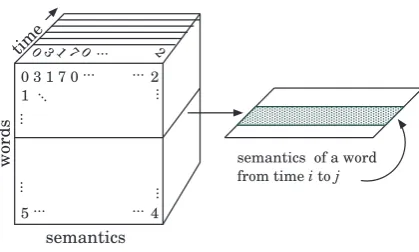
Fig. 2:The tensor representation of the semantic space
3
Temporal Random Indexing
Temporal Random Indexing (TRI) incorporates time by building a single semantic space. However, instead of using a word×semantics matrix, TRI uses a word×semantics
×time tensor. Figure 2 illustrates this change. The time dimension records the semantic vectors of a word for each time unit (e.g. a week or month).
TRI offers three major advantages over existing mod-els. First, the semantic space is built incrementally so new documents may be added at any time. Second, the ten-sor representation allows for arbitrary time-range compar-isons. Third, we use a dimensionality reduction similar to that of Random Indexing, which operates as the documents are processed, rather than all at once. This results in greatly reduced time and memory requirements compared to those methods that rely on the SVD for dimensionality reduction. To associate specific time values with semantics, TRI does not immediately perform the summation as defined in equation (1). Instead TRI only accumulates the semantics for contexts which occur in the same time period. These time period semantics are then stored in chronologically as-cending order to produce a semantic slice for a word. The plane in figure 2 represents the semantic slice of a single word, which covers all the time periods in which that word has been observed.
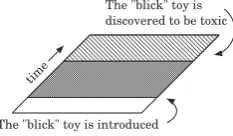
Summing a semantic slice along the time dimension pro-duces a vector equivalent to the results of Random Index-ing, which would simply sum all the values, ignoring time, to create a single vector for the word. TRI, on the other hand, allows for more precise summations to be computed, such as a summation over the entire known time range, a single point in time, or several separate time ranges. Con-sidering the example of a new toy that is first introduced and later found to be toxic, figure 3 shows how one could produce two semantic vectors for the toy “blick“ using a semantic slice. The first semantic vector is a summation of temporal semantic vectors that describe the introduction of the new toy, and the second semantic vector is a summation of temporal semantic vectors that describe the toxic nature of the toy. Using this technique, TRI can produce two dis-tinct semantic representations of the same word, based on a simple partition of the temporal dimension. More over, these two vectors can be still be directly compared because they are built from the same index vectors.
time
[image:4.595.129.246.111.179.2]The "blick" toy is introduced The "blick" toy is discovered to be toxic
Fig. 3: The semantic slice of “blick“ as the meaning changes due to shifts in word co-occurrence patterns
documents D = ((t0, d0),(t1, d1),(t2, d2), ...,(tk, dk)), wherediis the set of documents occurring at timeti. Let
WDbe the set of all unique words in the collection. Just as in Random Indexing, for each wordw∈WD, we assign a unique indexindex(w).
Equation(1) can then be extended to be:
semantics(w, t) = X
ct∈di
X
−n≤i≤n
index(wi) (2)
wheretis a unique timestamp, andctis the context for an occurrence ofwat timet. Using this new definition of semantics, a word slice can be defined as:
slice(w) ={(ti, semantics(w, ti)|w∈di, i= 1, k}
(3) The semantics of a word for some range of time can then easily be computed with:
snapshot(w, ti, tj) =
X
(tm,sm)∈slice(w),ti≤tm≤tj sm (4)
4
Experiments
We applied TRI to the task of detecting events for a man-ually selected set of 199 words from a variety of topics. We selected words based on how frequently it was used in a corpus and knowledge that it would be likely to be dis-cussed in blogs. However, limiting the word selection was done for efficiency, and this approach could be applied to tracking events for a larger set of words. Due to limited space, we illustrate the performance using a set of six word of divergent topics that includes both abstract and specific concepts: college, Lebanon, nuclear, Wii, PS3, and XP.
4.1
The Corpus
Our approach can be applied to any corpus that has a known date of authorship of each article, at the granularity desired for analysis of semantic shifts. For the purpose of detecting changes in public opinion over the course of recent events, and the detection of previously unknown, but still interest-ing, events, we have utilized a portion of an already existing corpus[22].
The corpus comes from a collection of blog postings from 2004 on. These blog postings come from around the world, and in a variety of languages. We view this as an excellent example of an unstructured corpus for event detection since it is composed of blog articles harvested by BlogLines1. The documents come from some standard
1http://www.bloglines.com
news sources, but also from any blogging service which provides rss feeds, such as livejournal, local newspapers, wordpress, and many more.
For this experiment, we collected only English articles from the blog corpus, but the algorithm could be used in practice with any language. The date of authorship for each document in this collection is estimated to be the most re-cent date the document has been updated.
Overall we expect this corpus to be well fitted to the challenge of detecting events while handling multiple view points beyond editorial control. Table 1 provides three sample blog posts which exemplify the issue. Each of the posts were written near the release of the Wii game console, each with a significantly different usage of words, and sen-timent. There is a clear range of styles, from the mechan-ical description of the device, to opinions on the company releasing the system, and finally to adoration of the sys-tem. Beyond this sample set of posts, the corpus meets our expectations in other ways. First, the lack of editorial over-sight in the documents leads to grammatical and spelling errors, and frequently to the introduction of new terms or phrases unique to the author along with other issues2.
Sec-ond, the corpus has a large number of discussed topics, ranging from international events, to product releases, and to personal musings.
Before the corpus is used for performing event detec-tion, the corpus is preprocessed to render it more uniform. Similar to other semantic space approaches that used web-gathered data[16], this pre-processing allows the model to gracefully handle several irregularities in writing style, such as inconsistent use of punctuation and capitalization. Additionally, this process removes many tokens such as html mark-up, which have little or no semantic content in themselves3. The corpus is processed as follows:
1. Replace all numbers with<num>
2. Remove all html mark-up and email addresses
3. Remove unusual punctuation, and separate all other punctu-ation from words
4. Remove words of 20 characters in length 5. Converting all words to lower case 6. Replacing $5 to<num>dollars
7. Discard articles with fewer than some threshold percentage of correctly spelled English words
8. Associate each entry with a numeric timestamp
When computing the semantics, we also impose two fil-ters on corpus during processing: any word in a list of fre-quent closed-classed words and those words not in the most frequent 250,000 words in the blog corpus were removed. This step is both practical and empirically motivated.
Removing closed-class is a common practice in seman-tic spaces models[16, 19], due to the low semanseman-tic value; words such as “the” or “of” so frequently appear that they do not serve to distinguish the meaning of any co-occurring word. Similarly, infrequent words can safely be removed for initial uses due to the small effect they would have on other semantic vectors.
For both stop words and infrequent words, their origi-nal position is preserved after removal. This ensures that the window for counting co-occurrence takes into account
2This may lead to an increase in polysemy and synonomy amongst
words, potentially impacting our approach, but exploration of this topic is left for future work
3We note that the HTML might be interpreted to yield more
For those of you who went, I hope you guys had just as much fun as I did. One of the best parts was actually being able to play the Wii. When I picked up that controller, I was sold instantly. The other awesome part was be-ing able to demo for Enchanted Arms in the Ubisoft area. I have a bunch of pictures up on my Flickr Account if people are interested.
With motion-sensing controls and three-dimensional movements on screen, the upcoming Nintendo Wii game platform is changing the way video game developers think about games.
While I agree that expanding video games beyond its core audience is certainly an intriguing idea (if not necessary), it doesn’t exactly thrill me as a member of said audience. Nintendo has already done a fine job of turning us all into their little marketing minions with the DS. None of this will change with the Wii. I call it exploitation of the weak spot in our hearts for the big N.
Table 1:Contrasting blog entries about the Wii gaming console prior to its release in November 2006
the words originally within the window distance. All re-maining words and tokens are assigned an index vector for computing the semantics.
We limited the analysis to the 2006 postings in the cor-pus; this constituted 15,725,511 blog entries and a total of 2.62 billion tokens (both words and punctuation) after the normalization process.
4.2
Detecting Events using TRI
Events are extracted using a three step process. First, TRI is used to convert the corpus into semantic slices. A month-long time span was selected after an empirical analysis of the particular corpus showed that the the reduced frequency of words in smaller time spans led to semantics that per-formed less well. TRI was configured using 10,000 dimen-sional vectors with a±3word window. Index vectors had the values of 4 dimensions randomly assigned to+1or−1, and the rest to be0. Processing the entire corpus using TRI took approximately 100 minutes on a 2.4GHz Intel Core 2 processor with 8 gigabytes of RAM.
In the second step, the semantic shift is calculated for each word. To detect the shift, a word’s semantic vec-tors for slices at timetiandti+1are compared using the cosine similarity, which measures the similarity in angle between vectors. The cosine similarity ranges between1 and−1, indicating identical and opposing angles, respec-tively. The semantic shift is defined as the1− the cosine similarity. Changes in angle reflect a change in a word’s meaning, which in this system can signify the presence of an event. Changes in magnitude were also tracked but an analysis showed they were not correlated with events. Ta-ble 2 shows semantic shifts for several test words.
The third step selects those topic words that undergo a significant semantic shift and associate the topic words with documents. We define the significance for a shift in terms of its deviation from the mean semantic shift using a simple time series analysis. Specifically, we calculate the mean and standard deviation for the semantic shift of all words in the two slices. If a word’s shift is greater than one standard deviation away from the mean, then it the word is marked as undergoing a significant shift. The bold values in table 2 note these shifts for five example words.
To form the association between documents and topic words, each word that undergoes a significant shift has its nearest neighbors calculated. These neighbors are often words associated with the topic word, but are not neces-sarily synonyms. We posit that the neighbors provide con-text about the nature of an event by virtue of reflecting the frequent co-occurrences in the documents. To retrieve the event-related documents, the topic word and its neighbors are used as query terms to search the corpus during the month that the event occurred. Documents are retrieved us-ing a simple technique that returns the posts containus-ing the
event term and the highest frequency of the related terms. Accurately evaluating event detection requires a set of events that are known a priori to bein the corpus. For large corpora with millions of documents, such as the Bloglines corpus used here, it is infeasible to determine the complete set of events that are present. Furthermore, determining what kinds of events may be present can prove problematic, as blogs frequently discuss many topics outside the range of normal news events. To create a baseline for evaluation, We constructed a limited set of significant news events that were likely to be in the corpus and then manually verified their presence. Descriptive keywords for each event were then to evaluate TRI. Ultimately, the evaluation is an anal-ysis of not only TRI, but also the corpus itself, as some terms, or events, may not be present at all within the cor-pus. We plan to use this initial methodology to identify a better means of analyzing massive corpora and the diverse set of events contained therein.
4.3
Results
Several semantic shifts correlated well with known events of 2006. We discuss the results by analyzing the events detected for the words in table 2. Table 3 lists some of the highest rated blogs associated with specific events our technique detected.
Both the “Wii” and the “PS3” are gaming consoles re-leased in North America in November 2006. However, only the Wii experienced a significant semantic shift. The stabilization of the semantics correlates with the products demonstration at the Electronics Entertainment Expo, a major gaming event. The corpus contained many examples of attendees describing their experiences with both con-soles at the convention. Notably the PS3 underwent only a slight shift, indicating a fairly stable meaning. Further analysis showed that the change in “Wii” was due to the console being renamed from “Revolution” to “Wii” in late April.
The 2006 Lebanon War took place in July 2006, which was detected by a significant shift in meaning and is further supported by a change in the nearest neighbors. In July, the nearest neighbors of “Lebanon” were terms associated with war, such as “Hezbollah”, “soldiers”, and “rockets”. How-ever, before, and after the war, the ten closest neighbors to “Lebanon” in 2006 were names of countries, revealing that during the course of the war, the semantics of “Lebanon” shifted dramaticly to a different class of words, and then returned to it’s original class once the war concluded.
Feb Mar Apr May Jun Jul Aug Sep Oct Nov Dec
college 0.00 0.00 0.00 0.00 0.05 0.05 0.00 0.00 0.00 0.00 0.00
Lebanon 0.04 0.05 0.05 0.06 0.16 0.25 0.01 0.01 0.02 0.03 0.01
nuclear 0.02 0.02 0.02 0.02 0.02 0.02 0.02 0.01 0.11 0.06 0.02
PS3 0.06 0.04 0.06 0.05 0.03 0.04 0.03 0.02 0.02 0.03 0.01
Wii 0.12 0.14 0.15 0.06 0.03 0.04 0.04 0.02 0.01 0.01 0.01
XP 0.03 0.04 0.03 0.03 0.19 0.20 0.02 0.02 0.02 0.02 0.01
Table 2:Semantic shift values for six example words where bold indicates a significant change
Throughout the year, “college” experienced no notice-able semantic shifts, despite the annual events of beginning and graduating college. We view this as example of a con-sistent word which acts as a reference point to other words. An analysis for “XP” showed a semantic shift caused by an unlikely change in corpus content; during the month of June, spammers added such a high number of advertise-ments for Windows XP copies, shifting the semantics to unimportant terms. An examination of the nearest neigh-bors to “XP” showed a dramatic change from related op-erating system terms such as “Windows,” “Linux” and “Vista” to numbers and currency abbreviations.
Overall, using the cosine similarity metric, and then fur-ther examining the sets of nearest neighbors proved to be an effective method of catching semantic shifts. Further-more combining the nearest neighbors with a simple docu-ment retrieval algorithm generated relevant docudocu-ments cor-responding to the events which caused the shift.
5
Related Work
Among the many systems that perform event detection, several use a related technique that maps documents, rather than words, into a vector space. Documents are represented by a vector of their term frequencies, with most approaches using some form of weighting the vectors, such as term frequency-inverse document frequency (TF-IDF) weight-ing. Additionally, many event detection systems restrict themselves to processing newswire text, instead of blogs.
Most document based event detection algorithms extend a core usage of TF-IDF weighting. In the core event de-tection algorithm, each document is analyzed to produce TF-IDF values for each word occurring in the document. This set of values can then be compared against TF-IDF values of other documents using the same similarity mea-sures used in semantic space models, with cosine similar-ity being one of the most common. In general, an event is detected if the current document is significantly different from all other processed documents, based on a threshold of similarity values between documents[1, 11].
Brants et al. introduced some significant improvements to the standard document based model[1]. The first im-provement was to compute the TF-IDF values on a docu-ment by docudocu-ment basis, allowing the system to continu-ously process new documents. The second improvement was computing a set of TF-IDF values which were depen-dent on the source of the document, under the assumption that some words, such as CNN, would be more frequent based on who wrote the document. Beyond modifying the TF-IDF values, the similarity measure was also extended to include some normalization techniques that take into con-sideration the source of the documents, and the average similarity of documents. Finally, their model was extended
to compare segmentations of documents, rather than entire documents. Overall, these modifications showed notice-able improvements over the basic usage of TF-IDF values and similarity metrics.
Kumaran and Allan expand on Brants et al. by consider-ing not only the term frequencies when computconsider-ing the sim-ilarity between documents, but also named entities, such as “President Obama,” in the documents[11]. Two additional vectors are created for each document: One composed of just the named entities occurring in a document, and an-other composed of all words that are not named entities. When comparing the similarity between two documents, the standard vector is initially used, and then the similarity between the additional vectors are used to provide finer dis-tinctions, such as whether two documents refer to the same set of named entities, and the same set of general topics, i.e. all the non named entities.
In [12], Lam et al. extend a document-space approach by associating each document with three vectors: a TF-IDF weighted vector; a TF-TF-IDF score of named entities present in the document, similar to [11]; and a concept vec-tor, which details which abstract concepts are contained in the document, using TF-IDF scores based on the frequency of concepts rather than words. The key terms in a docu-ment are each given a weight based on which key terms the document contains. Event detection is done by clustering documents as they appear. Each cluster is said to repre-sent a specific event; and documents that do not fit into one cluster are said to be new events. Chen et al. use a similar clustering for event detection but use sentences rather than entire document[2].
Makkonen et al. augment the document representa-tion by using an existing ontology to extract out loca-tions, proper names, and temporal references from the document[15]. These three, combined with the remaining terms in the document are used as the basis for comparison. Overall, the current event detection systems that do not utilize a semantic space have the key benefit of being able to process documents continuously, since no reduction step is required for vector representations. But the key differ-ence is the focus on comparisons between documents, and not words that occur in documents. These approaches must handle different challenges, such as documents that discuss multiple events and elements of documents that are vague but important for distinguishing events.
6
Discussion
Lebanon nuclear Wii Exercising great restraint, they instantly
launched airstrikes on Lebanon, damaging critical roads, [...], power stations, etc. Hezbol-lah retaliated with a stream of rockets that penetrated as far Ashaifa, causing a great deal of terror to Israeli civilians.
Pyongyang would not hold negotiations to re-solve the outstanding issues with Washington, [...] “the Americans never recognized our se-curity and we were forced to conduct nuclear test to defend ourselves.”
The Wii was the name of the console.. It was time to see if it could deliver its promise of “changing the way we game.” Their presenta-tion was probably the most “fun,” cutting right to the chase and demonstrating uses of the con-troller in games.
[T]heir goal is to move public opinion in Lebanon against Hezbollah due to the destruc-tion “they” caused the country, establish a strong deterrence for any future attacks, and , of course, destroy as much of Hezbollah’s in-frastructure and weapons as possible.
Korea nuclear test hasn’t tipped military bal-ance [...] hours ago questions surrounding North Korea and its nascent nuclear weapons program took center stage Monday night
It turns out, according to eyewitness reports from the show floor, that we might not have been playing Wii consoles at the Nintendo booth...should I feel betrayed?
Table 3:Blog snippets describing events associated with “Lebanon” in July, “nuclear” in October, and “Wii” in May
manner that exposes events. While our preliminary anal-ysis has shown that events can be detected using TRI, our approach does not currently scale to searching across all terms, nor to identifying events for new words that infre-quently occur. However, we argue that the advantages pro-vided by TRI outweigh the outstanding issues and merits further work to address these limitations.
Event detection systems that use semantic spaces have two notable challenges due to how time is integrated. First, the space must be easily modifiable as new documents are produced. Existing approaches use a single dimensional-ity reduction step after a corpus had been processed to im-prove information retrieval. However this step limits the integration of new documents into the semantic space; to integrate new documents, the space must be completely recomputed. The second challenge stems from compar-ing word meancompar-ings and documents that occur in different times. Approaches such as [10, 5] that arbitrarily segment the corpora used into different semantic spaces artificially limit both the types of comparisons available and the spe-cific time ranges of the semantics. TRI addresses both of these challenges efficiently. By being based on Random In-dexing, dimensionality reduction is done concurrently with developing semantic vectors. Additionally, by utilizing the same set of index vectors over all documents analyzed, ev-ery semantic slice is contained within the same semantic space, avoiding the need for reference only those vectors that are common to several time periods.
Conversely, the document based methods discussed in section 5 provided a means of avoiding a post processing stage by incrementally determining the TF-IDF values for words in the corpus. While these approaches efficiently allow the inclusion of more documents over time, each document vector encounters similar problems seen in ba-sic co-occurrence semantic space models, most notably the requirement that two documents have the same exact words for them to be declared similar.
The introduction of additional vector representations of a document, such as the named entity vectors, or the concept vectors, attempt to address this issue, but these additions allude to benefits provided by a semantic space model. For instance, if two documents describe the same events, but without using the same set of words, and instead use highly similar words to describe the event differently, the doc-ument based event detection methods would either report two distinct events, or rely on some system which can de-termine the similarity between two words. Being based on word semantics, TRI avoids this problem, and provides a way of determining how similar two terms are, or which
concepts a word refers to. With TRI, synonymous key words describing the event are modified in a similar man-ner, and words with similar meanings will have similar ef-fects on the semantics. It may also be possible with TRI to detect synonymous event names by identifying words with similar shifts and similar neighbors. However, further in-vestigation is needed.
While TRI provides elegant solutions to several prob-lems in event detection, significant questions still remain. First, a suitable method of analyzing the semantic shift between vectors is needed. Our initial experiment illus-trates tracking outliers based on cosine similarity works well in practice; however, this does not utilize all the in-formation present and could leave some events undetected. Time series analysis or probability distribution analysis are two techniques which might be well suited for similarity comparisons between semantic slices. However, it remains an open question of what limitations exist to the types of events TRI can be detected, and whether the method of comparison can be targeted to find specific kinds of events. As a second issue, the relationship should be established between the corpus, the duration of a semantic slice, and the types of events that are detected. Our current sys-tem was able to detect changes at a monthly granularity, but real-time event detection must operate on a much finer scale. Further work is needed to determine how brief a se-mantic slice can be while still adequately representing the semantics necessary for event detection.
Regarding the granularity of semantic slices and seman-tic vectors, we suspect that the optimal granularity is highly dependent on how dense documents are with regards to time in the corpus. One drawback of Random Indexing is the need for a large amount of data, and if there is not enough data, semantic vectors become poorly defined and produce weak similarity scores. We found that the cor-pus used in the experiment was sparse enough to produce a degradation in the semantics when our semantic slices were set to a time range shorter than a month. Ideally the corpus should have a dense enough set of topics for very narrow semantic slices.
7
Conclusion
in blog posts. Our approach utilizes simple word co-occurrence and scales well to processing millions of blog posts. Additionally, initial experiments to identify events for specific words proved successful. Further work is needed to identify the strengths and weakness of this ap-proach and quantify its ability to detect events. However, we plan to address these issues in future work. Last we plan to release the implementation of TRI as a part of the S-Space Package[8].
Acknowledgements
We thank John Cho and his lab for access to the blogline corpus used in this work. We also thank the anonymous reviewers for their comments and suggestions.
References
[1] T. Brants, F. Chen, and A. Farahat. A system for new event detection. InSIGIR ’03: Proceedings of the 26th annual international ACM SIGIR conference on Research and development in informaion retrieval, pages 330–337, New York, NY, USA, 2003. ACM.
[2] K.-Y. Chen, L. Luesukprasert, Seng-cho, and T. Chou. Hot Topic Extraction Based on Timeline Analysis and Multidimensional Sentence Modeling. IEEE Transactions on Knowledge and Data Engi-neering, 19(8):1016–1025, 2007.
[3] T. Cohen and D. Widdows. Empirical distribu-tional semantics: Methods and biomedical applica-tions. Journal of Biomedial Informatics, 42(2):390– 405, 2009.
[4] J. R. Firth.A synopsis of linguistic theory 1930-1955. Oxford: Philological Society, 1957. Reprinted in F. R. Palmer (Ed.), (1968). Selected papers of J. R. Firth 1952-1959, London: Longman.
[5] B. Fortuna, D. Mladeni´c, , and M. Grobelnik. Visu-alization of temporal semantic spaces. In J. Davies, M. Grobelnik, and D. Mladeni´c, editors, Semantic Knowledge Management, pages 155–169. Springer Berlin Heidelberg, 2009.
[6] Z. Harris.Mathematical Structures of Language. Wi-ley, New York, 1968.
[7] D. B. III and L. N. Trefethen.Numerical linear alge-bra. Philadelphia: Society for Industrial and Applied Mathematics, 1997.
[8] D. Jurgens and K. Stevens. The S-Space Pack-age: An open source package for semantic spaces. http://code.google.com/p/airhead-research/.
[9] P. Kanerva, J. Kristoferson, and A. Holst. Random indexing of text samples for latent semantic analysis. In L. R. Gleitman and A. K. Josh, editors, Proceed-ings of the 22nd Annual Conference of the Cognitive Science Society, page 1036, 2000.
[10] A. Kontostathis, I. De, L. E. Holzman, and W. M. Pot-tenger. Use of term clusters for emerging trend detec-tion. Technical report, Lehigh University, 2004.
[11] G. Kumaran and J. Allan. Text classification and named entities for new event detection. InSIGIR ’04: Proceedings of the 27th annual international ACM SIGIR conference on Research and development in in-formation retrieval, pages 297–304. ACM, 2004.
[12] W. Lam, H. Meng, K. L. Wong, and J. Yen. Using contextual analysis for news event detection. Inter-national Journal on Intelligent Systems, 16(44):525– 546, 2001.
[13] T. K. Landauer and S. T. Dumais. A solution to Plato’s problem: The Latent Semantic Analysis the-ory of the acquisition, induction, and representation of knowledge. Psychological Review, 104:211–240, 1997.
[14] M. L. Littman, S. T. Dumais, and T. K. Landauer. Automatic cross-language information retrieval using latent semantic indexing. In G. Grefenstette, editor, Cross language information retrieval. Kluwer, 1998.
[15] J. Makkonen, H. Ahonen-Myka, and M. Salmenkivi. Simple Semantics in Topic Detection and Tracking. Information Retrieval, 7:347–368, 2004.
[16] D. L. T. Rohde, L. M. Gonnerman, and D. C. Plaut. An improved model of semantic similarity based on lexical co-occurrence.Cognitive Science, 2009. sub-mitted.
[17] E. Sagi, S. Kaufmann, and B. Clark. Semantic density analysis: Comparing word meaning across time and phonetic space. InProceedings of the Workshop on Geometrical Models of Natural Language Semantics, pages 104–111, Athens, Greece, March 2009. Asso-ciation for Computational Linguistics.
[18] M. Sahlgren. Vector-based semantic analysis: Repre-senting word meanings based on random labels. In Proceedings of the ESSLLI 2001 Workshop on Se-mantic Knowledge Acquisition and Categorisation, Helsinki, Finland, 2001.
[19] M. Sahlgren, A. Holst, and P. Kanerva. Permutations as a means to encode order in word space. In Pro-ceedings of the 30th Annual Meeting of the Cognitive Science Society (CogSci’08), 2008.
[20] M. Sahlgren and J. Karlgren. Buzz Monitoring in Word Space. InProceedings of European Confer-ence on IntelligConfer-ence and Security Informatics (Eu-roISI 2008), Esbjerg, Denmark, 2008.
[21] H. Sch¨utze and J. O. Pedersen. A cooccurrence-based thesaurus and two applications to information retrieval. Information Processing and Management, 33(3):307–318, 1997.
[22] K. C. Sia, J. Cho, Y. Chi, and B. L. Tseng. Effi-cient computation of personal aggregate queries on blogs. InProceedings of the ACM SIGKDD Interna-tional Conference on Knowledge Discovery and Data Mining (KDD), August 2008.