DOI: http://dx.doi.org/10.26483/ijarcs.v9i2.5809
Volume 9, No. 2, March-April 2018
International Journal of Advanced Research in Computer Science RESEARCH PAPER
Available Online at www.ijarcs.info
ISSN No. 0976-5697
CONTENT BASED IMAGE RETRIEVAL USING HYBRID-SVM
Meenakshi Pandey
Dept. of Computer Science & Engineering Adina Institute of Science & Technology
Sagar, India
Rajneesh Pachauri
Dept. of Computer Science & Engineering Adina Institute of Science & Technology
Sagar, India
Abstract: The goal of content based image retrieval is to retrieve the images that users want to search. Content based Image retrieval systems attempt to search through a database to find images that are perceptually similar to a query image. Set of low-Level visual features (Color, Shape and Texture) are used to represent an image in most modern content based image retrieval systems. Therefore, between high-level information and low-level features a gap exists, which are the main reason that down the improvement of the image retrieval accuracy.In this paper Hybrid support vector machine (SVM) method proposed to retrieve several features and shorten the semantic gap between low-level visual feature and high-level perception. Image data set is taken from coral image data set. MATLAB 2009a is used as a simulator to analysis the proposed work.
Keywords: CBIR, hybrid SVM, Semantic gap
I. INTRODUCTION
From the last few years, in the field of searching multimedia content on browsers Content-Based Image Retrieval (CBIR) has gained more attention [1] [2]. Text based searching is become old now a days, because text is alone not sufficient to describe searching queries especially in biomedical field[3]. Images indexing in handbook mannerfor content based retrieval in error prone, bulky, and costly [4]. CBIR system searching gives an advantage to search on the basis of images This kind of searching is increases because of the exponential growth of image records, online searching and vast use of stored images. So if anybody wants a meaningful searching, there is strongly needed a well managed searching scheme to manage the large image database. What is image retrieval? It is a method of searching images from a big database of digital images. Almost all Traditional methods of image retrieving use captioning, keywords, or image explanationmethod so that explanation based retrieval can be performed.
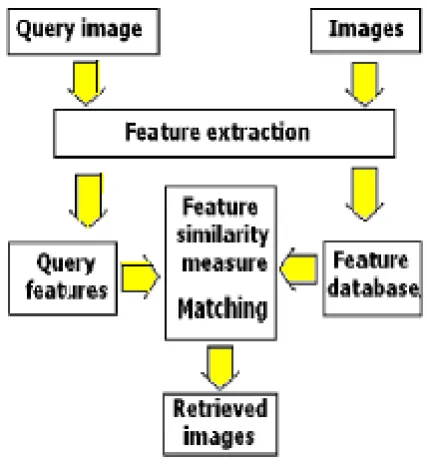
CBIR system is different from anotherconventional search engines. Basically an image with more than one example images used as an input in a CBIR system, CBIR system searches the result by using colour, texture and shape of the input image these features of an image is known as a low level features. For effective searching it is important to classify image features. Image classification is very essential in the field of content based image retrieval. An image is nothing but just a collection of pixels. So it is important that low level features extracted from an input image may define the high-level semantic concepts. The basic block diagram of CBIR system is shown in fig.1. Where a query image is taken as input now CBIR system extract its features based on colour, texture and shape. The input image is matched with the other images stored in database, system matches features of images and display the resultant images.
Several methods are used to narrow the semantic gap between low level features andhigh level features. Narrowing the semantic gap between these two is become the researcher’s interest. Some widely used methods for narrowing semantic gaps are- Relevance feedback, ANN, self organizing map and Support Vector Machine etc. Each method has its own advantages and disadvantage. RF is work on the concept of all
[image:1.595.313.527.393.627.2]positive features are same but the negative [5] is different from each others, so RF is only focused on positive features nevertheless there is so many classes (negative). SVM classified the images in several small pieces and then map the each piece independently. SVN alone can divide an image into pieces but when it is combining with other methods it works more effectively.
Fig. 1 Block diagram for CBIR System
II. RELATED WORK
In earlier, there are so many algorithm has been developed for image retrieval. In this section literature of the related work is described which are developed by different author and researchers:
M.Narayana, SubhashKulkarni [6]. proposed a method which compare Euclidean Distance metric and SVM for CBIR. It is found that performance classification of SVM is superior to Euclidean distance metric forMPEG-7 database.
Lining Zhang, Lipo Wang, Weisi Lin [7]. describe a Semi-Supervised Biased Maximum Margin Analysis for Interactive Image Retrieval.The BMMA differentiates positive feedbacks from negative ones based on local analysis, while the SemiBMMA can effectively integrate information of unlabelled samples by introducing a Laplacianregularizer to the BMMA. EmreComak, AhmetArslan proposed a new SVM method based on k-NN SVM. the training algorithm highly improved efficiency of the SVM classifier via simplealgorithm.
Monika Daga, KamleshLakhwani [8]. proposed a new CBIR classification was being developed using the Negative Selection Le Hoang Thai, Tran Son Hai, Nguyen ThanhThuy et al. proposed a method in which convey mutually two areas in which are Artificial Neural Network (ANN) and Support Vector Machine (SVM) applying for image classification. Firstly, separate the image into many sub-images based on the features of images. Each sub-image is classified into the responsive class by an ANN. Lastly, SVM has been accumulated all the categorize result of ANN. K. Ashok Kumar & Y.V. Bhaskar Reddy [3]. proposed method, multiple feature distances are combined to acquire image resemblance using classification technology. For managing the noisy positive illustration, a new two-step approach is proposed by including the methods of data cleaning and noise tolerant classifier.
V. Karpagam1, R. Rangarajan [4], proposed wavelet histograms are used to intend an uncomplicated and well-organized CBIR system with good performance and without using any intensive image-processing feature extraction technique. The unique indexed color histogram and wavelet decomposition-based horizontal, vertical and diagonal image attributes serve as the main features for the retrieval system. Support vector machine is used for classificationand thereby to improve retrieval accuracy of the system. A CBIR system based on a multi-scale geometric analysis (MGA) tool, called ripplet transform type-I (RT) have been presented by Chowdhury. Laplacian transform of the sharpened grey-scale image is statistically quantized into colour histogram bins in Malik and Baharudin [9].
S. Manoharam, S. Sathappan [10], proposed a method to retrieve images from a collection of database images from variety of domains. In earlier phase this need was satisfied by retrieving the relevant images from different database simply. Where there is a bottleneck that the images retrieved was not relevant much to the user query because the images were not retrieved based on content where another drawback is that the manual searching time is increased. To avoid this (CBIR) is developed it is a technique for retrieving images on the basis of automatically -derived features such as color, texture and shape of images.
D. Xu, S. Yan, D. Tao, S. Lin, H. Zhang [11], Proposed dimensionality reduction algorithms, which aim to select a
small set of efficient and discriminant features, have attracted great attention for human gait recognition and content based image retrieval (CBIR).
J. Laaksonen, M. Koskela, and E. Oja. [12] Proposed a system named PicSOM and it is based on pictorial examples and relevance feedback (RF). The name stems from "picture" and the self-organizing map (SOM). The PicSOM system is implemented by using tree structured SOMs. In this paper, we apply the visual content descriptors provided by MPEG-7 in the PicSOM system and compare our own image indexing technique with a reference system based on vector quantization (VQ)
III. CONTENT BASED IMAGE RETRIEVAL
Often in a CBIR system low level attributes of an image such as color, shape and texture is accordingly extract in the form of features which is stored in image feature database [13] [14].
As compared to image size the low level attributes of each image is very much smaller in size. Image database of the images is an abstraction of the feature database; eachimage feature is defined by the color, texture, shape and spatial information in the form of multi-component, real valued, static length feature signature or vectors. In CBIR system one who wants to perform searching firstly creates a query image and insert into the CBIR system. By the definition of CBIR system, the system extracts the visual attributes of all the images automatically in the same way system extract visual features of input images. After feature extraction system compare the query image features to the all stored image features, find whose features is similar to the query image features and display the best suited result accordingly. The main advantage of feature extraction is that, it is very small in size. So instead of comparing whole image system just compare the small size features. This characteristic of CBIR system makes it cost effective, fast and more accurate and removes all thedisadvantages of text-based retrieval. Generally two methods are used for CBIR classification. The first method is related to imprecise image matching, which find the best suitable match to an input image [15]. The second method is to perform point to point image matching between two images, one is input image and other is image extracted from image database. Two methods which is generally used for searching the images in CBIR system are as follows-
A. Two Approaches
• Text-based approach (Index images using keywords)
• Content-based approach (Index images using images)
1) Text-Based Approach: As we all familiar about text-
based searching. Keyword description is used as an input in text based approach and the output is produced in the same form as the input .Examples:- (Google, Lycos, etc.) but Text Based approach [15]has lots of demerits over its merits.
a) Merits:
• Text based CBIR systems is simple in term of implementation.
• User does not depend on image query he/she can free to write whatever he/she wants to search.
• Search engines are uses this approach like Google, Lycos etc.
b) Demerits:
• Sometime user cannot find the proper words to write so the exact searching is not done.
• Text based description is quite impossible for a large Database.
• Full text based search engine is not accurate.
• Thousand words are not worth full then a picture.
• Text words are not explaining an image properly.
2) Content- Based Approach: In Content based method
[12] image is used as an input query and it generate the output of similar types of images.
a) Advantages
• Low level features, such as color, texture, and shape information, of images are extracted automatically by the definition of content based searching.
• Images are searched on the basis of feature matching. Applications of CBIR system are in medical diagnosis, security check, crime prevention etc.
IV. PROPOSED METHODOLOGY
In this section we discuss about SVM and proposed approach and their steps followed at the classification time and the next chapter will represent the experimental result of the both two methods discussed here.
A. Overview of SVM
In artificial intelligence or machine learning two types of methods that are supervised and unsupervised are widely used. In Supervised learning system is learn by result and in unsupervised learning system is learn by example. In Supervised learning input is inserted in the form of training data set. Example of supervised learning is Support vector machine that analyzes and understand data and identify classification pattern. SVM takes an input set, analyze it and for each input image obtained the appropriate output [16]this kind of process is called as classification, regression performed in the case of continuous output. SVM is used for mapping input features into higher dimension feature space for creating maximum separating hyper-planes. Feature space is nothing but just an input space which is retain for future use for judging resemblance with the help of kernel function. SVM is a high dimension space where input space becomes more complicated than linear separation [17]. In this, staticlength sample vectors are formed by the unformatted and unprocessed data. Feature values and feature vectors are the two idiom used in feature space. Feature value is the attribute of image and the representation of these feature values in the machine is in the form of vectors is called as feature vectors. Categorization, congregate upon different sets of data such as written document, vectors, progression, group of points, image and graphs etc. are some operations performed by the Kernel function used in the kernel method. Data could be easily separated or better structured in higher dimension so SVM focuses on mapping the input image into a higher dimension feature space. Support vectors are some points in the feature space [17] which are separated by some distance. Support
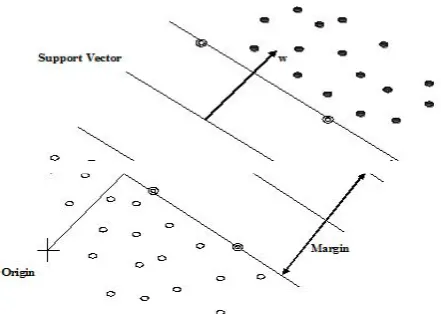
[image:3.595.308.529.119.276.2]vector is the point that demonstrates the separator position and it is the point among origin. The margin of classifier is obtained by the distance calculation from the decision surface to the closest data point.
Fig. 2 Linear separating hyper-planes for two class separation
Reference paper [4] proposed a method of retrieving negative samples from the image database. This selection of choosing negative samples is done randomly. This approach assumes that all the images stored in database are negative example. But it is obvious in practical that notall theimages are negative sample proposed a modified approach for enhancing training set that used the samples from last query whose matching rate were less than a threshold as the negative samples. Threshold values are not same for each image it is different for different queries, the threshold is difficult to decide. In our approach we propose a new method for avoiding threshold choosing problem by attaching negative samples to the training set automatically. The steps can be described as follows:
1) Let Rt denote the result list ranked by similarity score after the tth feedback. There are M records in Rt, and each one is represented as Xi.
Rt = [xt1, xt2… xti… xtM]……… (1)
2) After image query, only top K results are displayed to the user, which is represented as Dt
Dt = [xt1, xt2… xti… xtK]………….... (2)
In addition, we define TSt as the training set.
TSt = TSt.P ᴗ TSt.N……… (3)
Where TSt.P denotes the subset of positive samples in TSt, and accordingly, TSt. N is the subset of negative samples in TSt. Now the user can select the positive samples from Dt and append them into TSt.P. The rest of Dt are put into TSt.N. TSt.P and TSt.N could be represented as (4) and (5).
TSt .P = TSt-1.P {positive samples in Dt}(4)
TSt .N = TSt -1.N {negative samples in Dt}……….. (4.2.5)
We define R as follows:
R=the number of positive samples in TSt
the number of negative sample in TSt………(5)
numT=size (TSt .P
r −size(TSt. N)………(6)
Where size(R) is the number of elements in set R. So the negative samples of training set are updated by (8).
𝑇𝑇𝑆𝑆𝑡𝑡.𝑁𝑁=𝑇𝑇𝑆𝑆𝑡𝑡.𝑁𝑁 ∪ 𝐴𝐴𝑁𝑁
𝐴𝐴𝑁𝑁= {𝑡𝑡ℎ𝑒𝑒𝑙𝑙𝑙𝑙𝑙𝑙𝑡𝑡𝑛𝑛𝑛𝑛𝑛𝑛𝑡𝑡𝑟𝑟𝑒𝑒𝑟𝑟𝑟𝑟𝑟𝑟𝑟𝑟𝑙𝑙𝑖𝑖𝑛𝑛𝑅𝑅𝑇𝑇…….(7) B. Proposed Approach
For supervised learningDecision trees are popular structure. There are various algorithms for constructing a decision tree like C4.5 and CART algorithm [18]. If we are going throw limited amount of records, the basic ID3 algorithm works well but it is unable to handle missing values and also if the data set size is increased the tree is not altered according to the changes. The ID3 algorithm uses the entropy to select a splitting attribute and then construct the tree. There are some other algorithms that consider the gain index and gain ratio to select the splitting criterion and attribute.
The basic steps followed in ID3:
a) Choosing the splitting attribute. b) Ordering of the splitting attribute c) Splits
d) Tree structure e) Stopping criteria f) Training data g) Pruning.
For ID3 decision tree, concept used to quantify information is called entropy. Entropy is used to measure the amount of uncertainty in a set of data. A single class the entropy is zero that is there is no uncertainty. Given the probabilities:
p1, p2…pn where ∑i=1 n pi=1 ……… (8)
Entropy (I) is calculated as
I(p1, p2,…pn)= ∑i=1 n (pi log2(1/pi) …………..(9)
And information gain is calculated as
Gain (D, S) = I (pi) - ∑p (Di) I (Di) ……… (10)
Our current algorithm also makes use of gain values to construct the decision tree.
Weighted Minkowski distance formula is used here to measure distance and divergence among query image, Q and database image, I:
Applying Distance Formula
D(DBF, QF) =�Wi
m
i=1
×�fDBFi−fQFi�
�m−Dimenssion, Wi= Weightofithfeature vector� DBFi = ith feature of DB image
fQFi = ith feature of query image
Where M is the dimension of feature vector, wi is the weight of the ith feature component, DBfi and Qfi is the feature vector of images and query image respectively.
1) Algorithm Steps:
1. Input : Image dataset, Query image
2. Verify image dataset. 3. If available = false Then 4. Insufficient image in database” 5. Else
6. Features extract of all images stored in database
7. {Color feature: color histogram, color
moments………} now stored it in M- dimensioErrorMsg “nal feature vector DBF
8. Query Image : Extract color feature of query image i
9. Stored it in separate variable QF
{Used RGB color model to construct a feature vector} 10. Color co-occurrence matrixes of RGB generate. PRGB=[PRGBij
11. Retrieved pixel information from previous step ]
12. To use all dimensions of CCM 13. Sum average value of row by column
𝑆𝑆𝑛𝑛𝑛𝑛𝑙𝑙𝑎𝑎𝑎𝑎𝑅𝑅𝑎𝑎 =� �(𝑖𝑖+𝑗𝑗)𝑝𝑝𝑖𝑖𝑗𝑗 𝐿𝐿2
𝑗𝑗=𝑖𝑖+1 𝐿𝐿1
𝑖𝑖=1
{i, j are row and columns respectively} 14. Apply distance formula
D(DBF, QF) =�Wi
m
i=1
×�fDBFi−fQFi�
{m−Dimenssion, Wi= Weightogithfeature} DBFi= ith
f
feature of DB image
QFi= ith //Apply ID3 Decision tree
feature of query image
15. Procedure_ID3Tree (DBF, QF, D)
{Calculate probability of each assumed class (P1, P2, P3…. Pn)
𝑃𝑃𝑖𝑖 =� 𝑛𝑛𝑃𝑃𝑖𝑖= 1 𝑖𝑖=1
16. Calculate Entropy
E(P1,P2,….Pn)=∑ 𝑛𝑛(𝑃𝑃𝑖𝑖𝑙𝑙𝑟𝑟𝑎𝑎2(1 𝑃𝑃𝑖𝑖 �
𝑖𝑖=1 )
17. If DBF==NULL¦¦QF==NULL Then Build (DBF) and Build (QF)
18. IF (class value==QF) Then Return N as leaf node
Else { j=1;
19. For i=1:Size(DBF) {
20. IF DBFi //Compute Gain
! Classified Then
21. Gain(D,QF)=E(Pi)-∑P(Di)E(Di }
)
22. IF (Gain>0¦¦Gain> Maximum from Current State) Then
Generate Cj {
;
//The current nodes divide into sub node and marked as Cj+1
23. Divide N into Nk }
and Expand every branch of Node N
Else {
24. Current Node reject Return previous node }
} //else end } // end
NO
Ye
N N
[image:5.595.66.251.106.627.2]YES
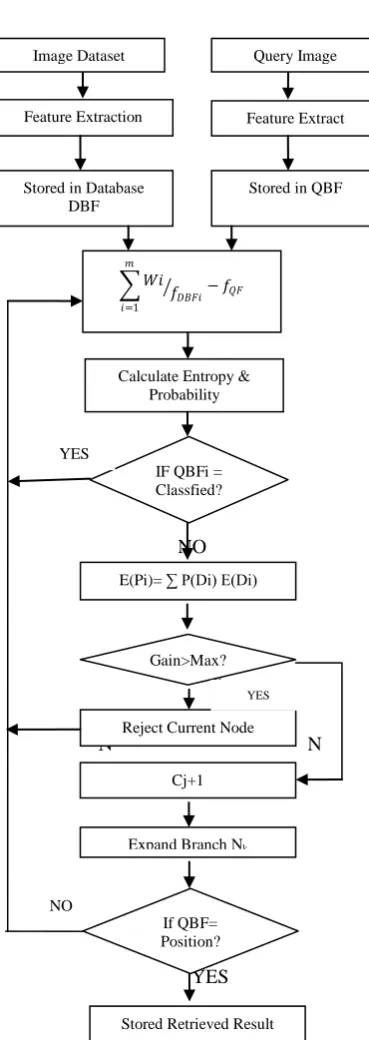
Fig. 3 Flowchart for Proposed work
V. EXPERIMENTAL RESULT
This section presents the simulation results implemented by the proposed method Hybrid SVM and the simulation is done using the best known simulator MATLAB 2009a and some reputed image dataset coral.
A. Image Data Set
The coral image data set is very famous image data set for research purpose of image classification and retrieval, in this experimental data set they used 180 images which contain
total 18 classes and each class have fixed 10 images from out of coral dataset of thousands images.
B. Result Analysis of Classified Images
[image:5.595.317.552.145.304.2]Here in the figure 5.2.1 and figure 5.2.2 compare result for class beach images, where the accuracy measurement of filter based and hybrid-SVM are 80% and 90% respectively.
Figure 5.2.1 Filter based methods for rose image
Figure 5.2.2 Hybrid SVM methods for rose image
Similarly I have tested both method in fourteen different classes, and next section summerized the all classes result.
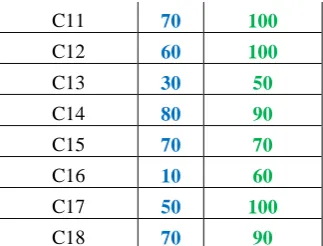
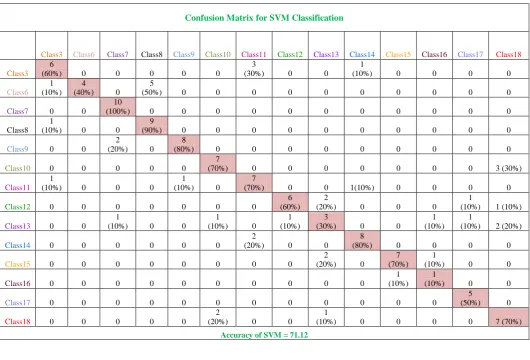
The result analysis of classified images based on compared two methods with retrieved images. The table 5.2.1 and table 5.2.2 shows that the detailed analysis of the both methods with the confusion matrix. The two confusion matrix is shown in table 5.2.1 and 5.2.2 respectively at the last pages, which shows the analysis of the Filter based and Hybrid SVM methods respectively.
Table 5.2.3 Individual Class wise Accuracy
Class wise Accuracy
Image Class SVM
Hybrid SVM
C3 60 100
C6 40 100
C7 100 100
C8 90 100
C9 80 100
C10 70 70
Feature Extraction Feature Extract
Stored in Database DBF
Stored in QBF
Calculate Entropy & Probability
IF QBFi = Classfied?
E(Pi)= ∑ P(Di) E(Di)
Gain>Max?
Cj+1 Reject Current Node
Expand Branch Nk
If QBF= Position?
Stored Retrieved Result
Image Dataset Query Image
� 𝑊𝑊𝑖𝑖 𝑓𝑓�𝐷𝐷𝐷𝐷𝐷𝐷𝑖𝑖 𝑛𝑛
𝑖𝑖=1
− 𝑓𝑓𝑄𝑄𝐷𝐷
YES
NO
[image:5.595.316.553.149.465.2] [image:5.595.344.509.649.783.2]C11 70 100
C12 60 100
C13 30 50
C14 80 90
C15 70 70
C16 10 60
C17 50 100
C18 70 90
[image:6.595.74.236.53.176.2]Here table 5.2.3 shows that the individual comparative class wise accuracy of both method. After that the figure 5.2.3 shows graph analysis of the individual classes accuracy of the both method, where Hybrid SVM shows the better result up to maximum instant when it compared with Filterbased method.
Figure 5.2.3: Individual class accuracies
[image:6.595.43.284.259.421.2]Here table 5.2.4 shows the overall accuracy of the both methods where the result is examined in the bases of 10 classes of the images. And finally produced the output where Filter based method has overall 71.05 percentage and Hybrid SVM has overall 80.56 percentage accuracies. After that in the figure 5.2.4 its shows that the comparatitive graph analysis of the both method with the help of 3D bar graph.
Table 5.2.4 Overall Accuracy
Overall Accuracy
FilterBased HybridSVM
71.12 90.56
Figure5.2.4 Overall Accuracy
VI. CONCLUSION AND FUTURE SCOPE
We proposed a new hybrid support vector machine content-based image classification in this paper and compare this method with previous filter based method. We have taken a image from coral image database and apply our method on it. By which we conclude that our proposed method is far better than the traditional method. Our method content based image retrieval with hybrid SVM give accuracy of about 90.56% which better than the previous method of filter based which gives accuracy of 71.12%. In future work, the proposed method can be used for the online web search, or huge datasets.
VII. REFERENCES
[1] A. W. M. Smeulders, M. Worring, S. Santini, A. Gupta and R. Jain, “Content-Based Image Retrieval at the End of the Early Years, IEEE Trans. Pattern Anal. Mach. Intell., Vol. 22, No. 1, pp. 1349–1380, Jan.2000
[2] R. Datta, D. Joshi, Jia Li, J.Z Wang, “ Image Image Retrieval: Ideas, Influences, and Trends of the New Age. ACM Computing Surveys, Vol. 40, No.2, pp.1–60, Apr. 2008 [3] K. Ashok Kumar & Y.V.Bhaskar Reddy, “Content Based
Image Retrieval Using SVM Algorithm”, International Journal of Electrical and Electronics Engineering (IJEEE) ISSN (PRINT): 2231 – 5284, Vol-1, Iss-3, pp. 38-41, 2012.
[4] V. Karpagam, and R. Rangarajan,” Improved content-based classification and retrieval of images using support vector machine”, CURRENT SCIENCE, vol. 105, no. 9, pp. 1267-1275,10 November 2013.
[5] Jisha.K.P, Thusnavis Bella Mary. I, Dr.A.Vasuki “An image retrieval technique based on texture features using semantic properties” . International Conference on Signal Processing, Image Processing and Pattern Recognition [ICSIPRl. India, 2013.
[6] M. Narayana, Subhash Kulkarni, “Comparison between Euclidean Distance Metric and SVM for CBIR using Level Set Features”, International Journal of Engineering Science and Technology (IJEST) ISSN: 0975-5462, vol. 4, no.01, pp. 56-59 January 2012.
[7] Lining Zhang, Lipo Wang, Weisi Lin “Semi-Supervised Biased Maximum Margin Analysis for Interactive Image Retrieval”, TIP-06850-2010, pp. 2294-2308
[8] Monika Daga, Kamlesh Lakhwani, “A Novel Content Based Image Retrieval Implemented By NSA Of AIS”, International Journal Of Scientific & Technology Research Volume 2, Issue 7, ISSN 2277-8616, pp. 135-139, July 2013
[9] Malik, F. and Baharudin, B. B., “Feature analysis of quantized histogram color features for content-based image retrieval based on Laplacian filter”. In International Conference on System Engineering and Modeling. IACSIT Press, vol. 34, pp. 44-49, Singapore, 2012.
[10] S. Manoharam, S. Sathappan, “A novel approach for content based image retrieval using hybrid filter techniques”. The 8th
[11] D. Xu, S. Yan, D. Tao, S. Lin, H. Zhang, “Marginal Fisher Analysis and Its Variants for Human Gait Recognition and Content-Based Image Retrieval”, IEEE Trans. On Image Processing,vol.16, no, 11, pp 2811-2821, November 2007. International Conference on Computer Science & Education (ICCSE 2013), pp. 518-524, 26-28 April 2013, Colombo, Srilanka.
[12] J. Laaksonen, M. Koskela, and E. Oja. Picsom, “Self-Organizing Maps for Content-Based Image Retrieval”. In Proceedings of International Joint Conference on Neural Networks (IJCNN'99), pp. 1199-1207 Washington, DC, USA, 2000.
0 100 200
C3 C6 C7 C8 C9 C10 C11 C12 C13 C14 C15 C16 C17 C18
Individual Class
Accuracy
SVM
Hybrid SVM
0 20 40 60 80
100
71.12
90.56
Accura
cy
%
Overall Accuracy
[13] Simon Tong and Edward Chang.” Support vector machine active learning for image retrieval”. in Proceedings of the ninth ACM international conference on Multimedia, Newyork USA, pp. 107–118. October-2001.
[14] I. Felci Rajam, and S. Valli, “ A Survey on Content Based Image Retrieval” Life Science Journal 2013; vol.2, no.10, ISSN: 1097-8135, pp 2475-2487.
[15] Patheja P.S., Waoo Akhilesh A. and Maurya Jay Prakash, “An Enhanced Approach for Content Based Image Retrieval”, International Science Congress Association, Research Journal of Recent Sciences, ISSN 2277 – 2502, vol. 1(ISC-2011), pp 415-418, 2012.
[16] Sandeep Kumar, Zeeshan Khan, Anuragjain, “A Review of Content Based Image Classification using Machine Learning Approach”, International Journal of Advanced Computer [17] Research (ISSN (print): 2249-7277 ISSN (online): 2277-7970)
vol.2, no.3, Issue-5, pp. 55-60September-2012
[18] T. Jyothirmayi, Suresh Reddy, “An Algorithm for Better Decision Tree”, (IJCSE) International Journal on Computer Science and Engineering, vol. 02, no. 09,pp. 2827-2830, 2010. [19] Emre Comak, Ahmet Arslan “A new training method for
support vector machines: Clustering k-NN support vector machines” Expert Systems with Applications 35 (2008) pp. 564–568.
Confusion Matrix for SVM Classification
Class3 Class6 Class7 Class8 Class9 Class10 Class11 Class12 Class13 Class14 Class15 Class16 Class17 Class18
Class3 6
(60%) 0 0 0 0 0
3
(30%) 0 0
1
(10%) 0 0 0 0
Class6 1 (10%)
4
(40%) 0
5
(50%) 0 0 0 0 0 0 0 0 0 0
Class7 0 0
10
(100%) 0 0 0 0 0 0 0 0 0 0 0
Class8 1
(10%) 0 0
9
(90%) 0 0 0 0 0 0 0 0 0 0
Class9 0 0
2
(20%) 0
8
(80%) 0 0 0 0 0 0 0 0 0
Class10 0 0 0 0 0
7
(70%) 0 0 0 0 0 0 0 3 (30%)
Class11 1
(10%) 0 0 0
1
(10%) 0
7
(70%) 0 0 1(10%) 0 0 0 0
Class12 0 0 0 0 0 0 0
6 (60%)
2
(20%) 0 0 0
1
(10%) 1 (10%)
Class13 0 0
1
(10%) 0 0
1
(10%) 0
1 (10%)
3
(30%) 0 0
1 (10%)
1
(10%) 2 (20%)
Class14 0 0 0 0 0 0
2
(20%) 0 0
8
(80%) 0 0 0 0
Class15 0 0 0 0 0 0 0 0
2
(20%) 0
7 (70%)
1
(10%) 0 0
Class16 0 0 0 0 0 0 0 0 0 0
1 (10%)
1
(10%) 0 0
Class17 0 0 0 0 0 0 0 0 0 0 0 0
5
(50%) 0
Class18 0 0 0 0 0
2
(20%) 0 0
1
(10%) 0 0 0 0 7 (70%)
Accuracy of SVM = 71.12
Confusion Matrix for SVMID3 Classification
Class 3 Class 6 Class 7 Class 8 Class 9 Class1 0 Class1 1 Class1 2 Class1 3 Class1 4 Class1 5 Class1 6 Class1 7 Class1 8 Class3 10 (100 %)
0 0 0 0 0 0 0 0 0 0 0 0 0
Class6 0
10 (100 %)
0 0 0 0 0 0 0 0 0 0 0 0
Class7 0 0
10 (100 %)
0 0 0 0 0 0 0 0 0 0 0
Class8 0 0 0
10 (100 %)
0 0 0 0 0 0 0 0 0 0
[image:7.595.31.562.230.590.2]Table 5.2.1 Confusion Matrix of filter based retrieval
Class9 0 0 0 0
10 (100 %)
0 0 0 0 0 0 0 0 0
Class1
0 0 0 0 0 0
7
(70%) 0 0 0 0 0 0 0
3 (30%)
Class1
1 0 0 0 0 0 0
10 (100%
)
0 0 0 0 0 0 0
Class1
2 0 0 0 0 0 0 0
10 (100%
)
0 0 0 0 0 0
Class1
3 0 0 0 0 0 0 0
2 (20%)
5
(50%) 0 0
1
(10%) 0
2 (20%)
Class1
4 0 0 0 0 0 0
1
(10%) 0 0
9
(90%) 0 0 0 0
Class1
5 0 0 0 0 0 0 0 0
2
(20%) 0
7 (70%)
1
(10%) 0 0
Class1
6 0 0 0 0 0 0 0 0
1
(10%) 0
2 (20%)
6 (60%)
1
(10%) 0
Class1
7 0 0 0 0 0 0 0 0 0 0 0 0
10 (100%
)
0
Class1
8 0 0 0 0 0
1
(10%) 0 0 0 0 0 0 0
9 (90%)