DOI: http://dx.doi.org/10.26483/ijarcs.v9i2.5793
Volume 9, No. 2, March-April 2018
International Journal of Advanced Research in Computer Science
RESEARCH PAPER
Available Online at www.ijarcs.info
ISSN No. 0976-5697
ROLE OF IMAGE PROCESSING AND MACHINE LEARNING TECHNIQUES IN
DISEASE RECOGNITION, DIAGNOSIS AND YIELD PREDICTION OF CROPS: A
REVIEW
Mayuri K P
Department of Computer Science and Engineering SIM M Visvesvaraya Institute of Technology
Bangalore, India
Dr. Vani Priya CH
Department of Information Science and Engineering SIM M Visvesvaraya Institute of Technology
Bangalore, India
Abstract: Agriculture planning plays a significant growth and food security of an agro-based country like India. In this Review we present a comprehensive and critical survey on current challenges and methodologies applied for various image processing and Machine learning approaches on variety of crops in their productivity increase, considering the following measures: Early detection/recognition of crop diseases, diagnosing methods and crop selection method in yield prediction. This paper presents an overview of existing reported techniques useful in detection of diseases in variety of crops. Finally we identify the challenges and some opportunities for future developments in this area.
Keywords: Image processing; Machine Learning; smart-phones; classification; Multispectral image sensor; remote sensing.
1. INTRODUCTION
The agriculture and land mass is more than just being a feeding source in today’s world. Indian economy is highly dependent of agricultural productivity. Hence it is vital to use advanced techniques to increase the productivity of the agricultural products and thereby increase financial income of farmers. Despite of variations in crop cultivations, crop yield in India were generally low compared to International standards [2]. The crop losses occur due to three factors: soil nature and quality, plant stresses due to drought and plant pathogens such as fungi, bacteria, viruses and nematodes.
Figure 1. Stress factors of Crop [16]
Availability of most minerals is essential for plant growth and is strongly affected by soil PH [12]. As this PH range increases, bio availability of nutrients such as P, K, Fe, Mn, Zn, Cu decreases. Plant stresses can be biotic or abiotic. The biotic stress factors are: infection, herb ivory and competition where in abiotic stress factors include: temperature, water, radiation, chemical stress, mechanical stress etc. These parameters are interrelated with each other. As the environment conditions are beyond human control, hence methods to detect diseases affecting quality and quantity of crops has gained wide focus. Traditionally an
onsite continuous observation of agricultural products, either by farmers or by agricultural experts is utilized. But the process consumes large amount of time and cost, along with extra manpower.
[image:1.595.36.279.487.645.2]Intelligent monitoring systems with advanced sensor technology are required to monitor and collect the field data, then this data can be analyzed and classified using Image Processing and Machine learning techniques for better results in prediction process, which can detect the diseases on plants in earlier and thereby increase the quality productivity with less efforts is possible. The crop/plant leaves images were processed in the following stages [4][5].
Figure 2. Disease detection process on plant leaf images [5]
from a simple threshold level to more advanced colour segmentation methods, generally used to obtain the useful segments to classify the leaf diseases. Genetic algorithms are the popularly used algorithms in image segmentation process. Feature extraction is related to position and dominant edges of images are selected.
In the past different automatic classification methods have been used to classify remote sensing data and plant observations. There exists several Machine learning, Image processing and Internet of Things methods, applied in agricultural research for the quality and quantity improvement of agricultural products. There is an extensive potential of automatic classification methods. Furthermore, SVMs turned out as a powerful machine learning technique for general-purpose supervised prediction in biological research like, for example, in the classification of proteins or gene expression levels, prediction of yield etc. For precision plant protection new disease detection methods must facilitate an automatic classification of the diseases. Data mining techniques, the process of extracting important and useful information from a large set of data seems to solve this complex agricultural problem.
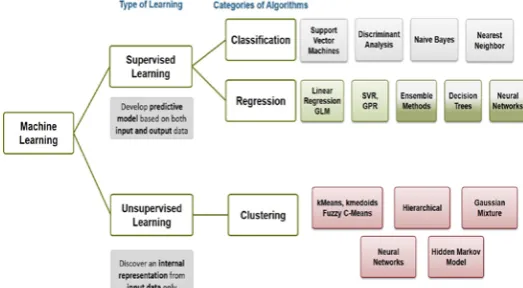
Machine learning algorithms are classified into supervised, Unsupervised and Reinforcement learning algorithms, supervised algorithms are task driven, the regression and classification models come under this category. Supervised learning is the Data mining task of inferring a function from labeled training data. The training data consist of a set of training examples. In supervised learning, each example is a pair consisting of an input object (typically a vector) and a desired output value (also called the supervisory signal). A supervised learning algorithm analyzes the training data and produces an inferred function, which can be used for mapping new examples. An optimal scenario will allow for the algorithm to correctly determine the class labels for unseen instances. This requires the learning algorithm to generalize from the training data to unseen situations in a “reasonable” way. The following are the supervised learning algorithms: Support vector machines,
[image:2.595.314.576.57.201.2]The Unsupervised learning algorithms usually try to obtain the hidden structure of unlabeled data, Since the examples given to the learner are unlabeled, there is no error or reward signal to evaluate a potential solution which is a complex process and allow the reuse of a classification model for the early detection of physiological plant processes from the hyperspectral leaf images. K-means clustering and apriori association learning are the few popular unsupervised learning algorithms.
Figure 3.Types of Machine learning methods [ref:
part-2-developing-analytics-and-prescriptive-controls] Reinforcement learning is teaching a behave in an environment by telling it how good it's doing. It is an area o from outputs are never shown. Also, reinforcement learning usually learns as it goes (online learning) unlike supervised learning. This means an agent has to choose between exploring and sticking with what it knows best. These are the algorithms that learns to react to an environment: Associative reinforcement learning algorithms, Q-learning, Real time dynamic programming etc.
2.LITERATUREREVIEW
P. Schmitter, J steinrucken .et al [1] proposed an unsupervised domain adaptation approach for the early detection of drought stress in the hyperspectral images. They focussed on the automated detection of drought stress induced changes in leaf pigments and structure. Labelled data has been used for invisible stages of drought stress in the derivation of the source model. The authors demonstrated the applicability of the proposed approach on three sets of images. Two sets were measured in drought stress experiments on single barley plants. The third data set was collected on maize grown up in the field under different treatments. The lack of labels in target domain was tackled by introducing an objective function which evaluated the transformation. The objective function evaluates previous knowledge about similarities in the occurrence of the same process from different plants in different environments under different conditions. The knowledge was represented by four criteria: Mixing (mix), Deviation (D), smoothness(S), Mightiness (M).
According to paper [3] an algorithm for image segmentation technique was introduced for automatic detection and classification of plant leaf diseases also covered a survey on different diseases classification techniques that can be used for plant leaf disease detection. Genetic algorithm was used for leaf color image segmentation process and the classification was done in two phases. In the first phase MDC with K- means clustering with the accuracy of 93.63% and in the second phase the accuracy is improved to 95.71% by SVM classifier.
Mukesh Kumar Tripathi, Dr. Dhananjay D [4]. Presented an overview of existing reported techniques useful in disease detection of agricultural products. The authors also included a comparative study of different methods based on the type of agricultural product, methodology and its efficiency together with the advantages and disadvantages. Paper [5] introduced an adaptive approach to increase the prediction accuracy of the disease levels in plants, the destruction levels that helps to check whether the disease can spread or not and diagnosis methods which will help the farmers to take better measures in right time.
The authors of [6] introduced a novel method to detect and classify the severity of bacterial spot in tomato fields, visible spectrum images were used as input. Clustering and classification of healthy and unhealthy leaves, ground were performed automatically without supervision. Paper [7] presented a comprehensive and critical survey on image based plant segmentation techniques. The authors discussed three types of segmentation approaches namely color-index based, threshold based, learning based with suitable conditions of using the respective method their advantages and disadvantages.
Shanwen Zhang et al [8] proposed Global-Local SVD method to improve the cucumber disease recognition rate. The proposed method can extract key point features from the spot image whose dimension was significantly lower than that of original space. The approach was tested on three kinds of cucumber leaf images; SVM classifier was
effective and feasible with the highest recognition rate and more practical value. Jayme Garcia et al [9] proposed a method with digital image based algorithm for plant disease identification based on biotic and abiotic stresses using color transformations, histograms and Pair wise based classification.
Paper [10] presented a smart phone based system i.e. a client server architecture with an Android App as the client and a falcon rest backend python framework acting as the server that provides the diagnosing methods based on the disease severity levels of the cassava crop. The authors trained and used 3 classifiers using scikit learn tool box. Disease severity levels were assigned from 1-5 classes. The authors of [11] demonstrated the detection of cucumber mosaic virus on multispectral and multimode leaves imagery combined with ANN. After pre-processing the input samples were extracted in 3 geometries and concatenated them into one vector. In the next step the variables were reduced by PCA and then ANN applied for classification learning, based on that produced a mathematical equation to predict the CMV.
[image:3.595.35.565.524.783.2]The authors of [12] conducted an experiment on determining the plant stress based on soil quality, they used two kinds of soils and plants each grown for three months period with in house lab setup, designed random forest based algorithm to detect the plant stress by color features, cross validation used for validating the approach. According to paper [13] the crop yield can be predicted by using Crop Selection Method (CSM).The seasonal crop information with the time stamps of various periods or stages of crop life cycle were considered as inputs to the CSM algorithm to predict the yield of the crop. The authors of [14] outlined the goals, methodology, content and results in each of the existing work and also identified the future research directions for the improvements in the previous research work of detecting diseases in vegetables using image processing techniques.
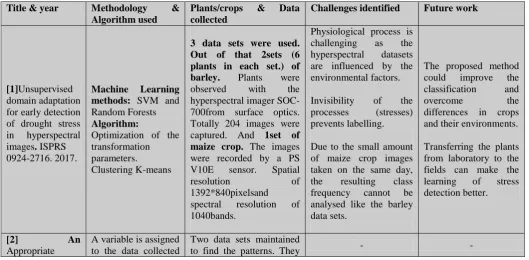
Table 1: Analytical Review of various existing works:
Title & year Methodology & Algorithm used
Plants/crops & Data collected
Challenges identified Future work
[1]Unsupervised domain adaptation for early detection of drought stress in hyperspectral images. ISPRS 0924-2716. 2017.
Machine Learning methods: SVM and Random Forests Algorithm:
Optimization of the transformation
parameters.
Clustering K-means
3 data sets were used. Out of that 2sets (6 plants in each set.) of
barley. Plants were
observed with the hyperspectral imager SOC-700from surface optics. Totally 204 images were captured. And 1set of maize crop. The images were recorded by a PS V10E sensor. Spatial
resolution of 1392*840pixelsand
spectral resolution of 1040bands.
Physiological process is challenging as the hyperspectral datasets are influenced by the environmental factors.
Invisibility of the processes (stresses) prevents labelling.
Due to the small amount of maize crop images taken on the same day, the resulting class frequency cannot be analysed like the barley data sets.
The proposed method could improve the classification and overcome the differences in crops and their environments.
Transferring the plants from laboratory to the fields can make the learning of stress detection better.
[2] An Appropriate
A variable is assigned to the data collected
Two data sets maintained
Model Predicting Peat/Diseases of Crops Using Machine Learning Algorithms. 2017.
from the field, the null, over range, under range variable is deleted in the pre-processing stage
WSN Architecture developed in the test bed field of battery-powered nodes embedded with wireless sensors connected to Raspberry Pi computational board that will be used to monitor sensory soil parameters and a main node above all connected to internet via GSM module and thus will be transmitting data from field test bed to lab PC.
Algorithm:Navie Bayes Kernel.
are
Flow of plant diseases: cropname, soil nutrients, temperature and humidity required.
(ii) Flow of pest control: pest name, optimum temperature of soil and atmospheric temperature. Components used for data collection in WSN test bed:
Raspberry Pi, Air Pi, Grove sensor, Mics-2714 sensor, VG400 Sensor, THERM200 sensor, CC2530 zigbee, GSM data modem.
[3] Detection of Plant leaf diseases using image segmentation and soft computing techniques 2017
Image acquisition was done with digital camera.
Pre-processing (clipping, smoothing, image enhancement, masking) of image to improve the image quality and to avoid the noise kind of distortion. Removal of masked cells.
Useful segments were obtained by applying the genetic algorithm.
Feature extraction using color- co-occurrence
methodology,
At last classification of diseases using SVM classifier.
Disease samples of
Banana leaf images 15 for training and 10 for testing.
Beans (15, 14).
Lemon (15,10)
and rose (15,12)
More optimization is needed.
Priori information is
required for segmentation.
Work needs to be extended to cover more diseases.
More training samples are required to predict the diseases accurately.
Disease recognition rate can be improved in classification process by using the Artificial neural network, Bayes classifier, Fuzzy logic and hybrid algorithms.
[4] Recent Machine Learning Based
Developed An improved disease detection robotic
System was tested with 269 images of vegetables divided into 8 classes. To
Accuracy of the disease identification is the major criteria in disease
Approaches for Disease Detection and Classification of Agricultural Products. 2017
system in green houses.
This system focussed on two major diseases: powdery mildew and spotted wilt virus on tomato.
PCA (Principle Component Analysis) and CV (coefficient of variation) were used by the system for the diseases detection.
Decision Tree Classifier was used for classification on the features of Red
and Green component,
skewness, kurtosis, variance and energy etc.
improve computation images are resized into 300*300 dimensions.
The following common types of diseases were identified on vegetables:
Spotted wilt of tomatoes and peppers
Stem Anthracnose of Lima beans
Powdery Mildew Fusarium wilt Fruit rot etc.
detection system. diseases on all kinds of plants, fruits and vegetables.
[5] Image
Processing system for plant disease Identification by using FCM- clustering
technique. 2017.
Procuring the image Pre-processing Image segmentation Feature extraction
Classification of fungal, viral and bacterial diseases
FCM Clustering technique
SVM Classifier.
Few species of plants are tested on 3 types of pests and 3 forms of pathogen symptoms.
The color features are influenced largely by outside light, shape and texture features are of disease spot are selected as characteristic values of classification.
Large databases and advanced features of color extraction provide better results of detection.
Suitable prevention measures to be provided to farmers on the basis of disease detection.
Training samples need to be increased to attain
the maximum efficiency.
[6] Detecting and grading severity of bacterial spot caused by Xanthomonas
spp. in tomato (Solanum
lycopersicon)
fields using visible spectrum images. 2016.
A method to work in field- based conditions was presented.
Image Acquisition, pre-processing
(gamma correlation, color conversion from RGB to CIELab, down sampling, cutting of image borders), segmentation
(features and chromatic clustering,
post filtering), disease presence and severity evaluation,
The tomato fields of two hybrids: Hypeel 108 and U2006 were considered for data collection.
10 major areas of plantation were received different treatments, each major area has 6 sub divisions and 3 samples of images were taken at each subdivision. (10*6*3). So totally 180 pictures were taken using a digital camera
Sony Cybershot DSC- S700. The shooting position is 1.8m above the canopy.
There is a need for cheaper, handheld systems that could be used in field conditions for evaluating the diseases stage in crops.
Molecular methods are precise, not fast and have limited capacity for automation in the fields.
data analysis and classification.
[7] A survey of image processing techniques for plant extraction and segmentation in the field. 2016
Segmentation Algorithms suggested in review based on the day lighting conditions: (for cloudy day it was effective)
Colour index based approach: CIVE, COM1.
Threshold based approach: Otsu. Learning based approach: EASA
Segmentation of crop canopy images in existing works was mentioned.
limitations of Colour index-based methods: Segmentation Cannot be performed in a better way when the light is neither very high nor very low.
dominant green colored Plant is highly suitable for segmentation Require threshold optimization to meet particular target for final segmentation.
Lighting conditions, shadow, complex back grounds still remain as Challenges for the available segmentation approaches.
This paper suggests the segmentation methods that are suitable in different conditions. Colour index based segmentation, threshold based segmentation and learning based
segmentation methods.
[8]Cucumber disease
recognition based on Global-Local Singular value decomposition. 2016.
Original image is divided into 16 blocks
Decomposition by SVD
Reconstitution.
Computing a key point vector for each image
Adjust
dimensionalities till two classifying vectors become equal each other.
Apply SVM
classifier to
recognize the class of the unknown key point vector.
100 diseased leaf images(50 images were randomly selected as the training set to train the SVM classifier and remaining to test the algorithm’s performance)
Each image is normalized to 128*128 and segmented by Otsu algorithm.
Each spot image is divided into 16 blocks. Each block with spot image is decomposed by SVD.
It requires more computation effort to extract the singular values of a few sub blocks.
Deployment of this method in large scale image processing applications.
Large database and advanced features of color extraction results in better recognition rates.
[9] Identifying multiple plant diseases using digital image processing. 2016
Digital Image based method on:
Color transformations Intensity histograms Pair wise based classification
82 images of different disorders distributed over 12 plant species: common bean, cassava, citrus, coconut tree, coffee, corn, cotton, grapevines, passion fruit, soy bean, sugar cane and wheat.
Image resolution: 1 to 24MPixels
15% of images were taken
Good resolution and optics need to be maintained for capturing images, so that specular and light shadow conditions can be avoided.
Large no. of existing disorders, heterogeneity of symptoms associated with the same disease
Adding of new images both for the diseases already present in the data base and other disorder that were not considered in the previous work
under controlled conditions and 85% of the
images were taken in real conditions.
and symptom similarities between different disorders may require the adoption of hybrid approaches.
[10] Machine learning for plant disease incidence and severity measurements
from leaf images. 2016
Feature Extraction (color feature extraction, ORB feature extraction), classification of disease incidence. And severity.
Algorithm: Linear SVC, KNN, Extra trees.
7386 leaf images of cassava plant. 5 classes of images were collected. Healthy class, 4 classes of diseased images. CMD, CBSD, CBB, CGM.
Labelled Data samples were collected from National Crops Resources Research Institute using smartphones.
Vast performance variation between color and ORB feature sets, because color based performance varies when most of the diseases present with yellowish color.
ORB on the other hand offers much better performance.
Duplicated images need to be removed; else results of cross validation and different classifiers look similar.
To implement a low power first pass offline version on the smartphone to get the preliminary diagnosis once the device gets online.
[11] Cucumber mosaic virus detection by artificial neural network using multi spectral and multi modal imagery. 2016
Cucumber Mosaic virus detection process:
Multi spectral images collected, pre-processing, spectrum extraction, PCA for simplifying
multidimensional
data, ANN classification,
Mathematical Prediction equation.
380 cucumber leaves (200 healthy, 100 infected by CMV not have symptom of infection, 80 have infected with symptoms) collected from laboratory experimental setup.
13 LED’s with wavelengths range from 375nm to 940nm.
Attention required in managing the biological samples from sowing period till the growth stages in the lab experiment set up.
The system is limited to lab samples not experimented on farming land.
To apply the experiment on fields of large samples for the better detection of pests.
[12] Determining the effectiveness of soil treatment on Plant stress using smartphone cameras. 2016.
Image Pre-processing(noise
removal using sharpening filter, mean filter, median filter)
Segmentation(for the better representation of the image: Gaussian filter, Intensity gradient of the image, sobel operator)
Feature
Selection(three fold of data using RGB,HSV,etc)
Classification method Algorithm: Random forest
Two types of soils used: 1.tailing soil from lead mine, 2.tailing soil treated with bio solids
Two types of plant species used:
1. laurel leaf willow 2. poplar
Both were grown for three months in separate soils.
34 images collected from Samsung Galaxy S4 smartphone with sensor resolution 13 pixels, flash light source.
Over fitting and under fitting problems in deciding the optimal number of training images.
Lack of labelled data to train the classifier in supervised learning for nutrient deficiency
To evaluate the application of this work to urban farms.
To design smartphone app to further outreach the contributions to the society.
[13] Crop selection method to maximize crop yield rate using Machine Learning technique, 2015.
Crop Selection Method (CSM) algorithm.
Crops were classified into: Seasonal crops (wheat, cotton), Whole year crops (vegetable, paddy, Toor), short time plantation crops (potato, vegetables, ratio),
Managing time stamp for different types of crops in different seasons is a complex task
long time plantation crops (sugar cane, canda). Time stamp maintained for the crops based on sowing period, harvesting period, growing period etc
[14] Disease detection in vegetables using Image processing techniques: A Review, 2015.
A Review on related works was proposed.
Most of the existing works collected the images of diseased vegetables. soy bean rust severity, potato late blight tuber tissue etc.
Digital and visual methods provide two different assessments in disease development.
Due to illumination and noise, the size and color of pest model lead to measurement errors
Verification of correlation between DVI and rust severity. Defected Leaf images need to be captured under multiple light source conditions for the estimation of Refractive index.
[15] Digital image processing
techniques for detecting,
quantifying and classifying plant diseases, 2013.
A Review on the concepts proposed: Detection, Neural networks,
thresholding,
regression analysis, color analysis, fuzzylogic etc.
-
Lack of technical knowledge about more sophisticated technical tools.
-
3. CONCLUSION AND FUTURE WORK
Automatic detection of diseases is essential, as it provides more benefits in large area of fields. Work need to be extended to cover more diseases or pathogens, number of features to be considered should be more for the accurate prediction of diseases and for the better feature optimization. There is a requirement of embedding these automated existing services into a smartphone based diagnostic system for farmers in remote places, such that he/she by uploading infected crop images can obtain health status of the field/garden as well the disease score and respective diagnostic measure from the remote server.
REFERENCES
[1] P. Schmitter, J steinrucken, C. Romer, A. Ballvora, J. Leon, U.Rascher, L. Plumer. Unsupervised domain adaptation for early detection of drought stress in hyperspectral images.ISPRS 0924-2716. 2017.
[2] HemantKumar Wani, Nilima Ashtankar. An Appropriate
Model Predicting Pest/Diseases of Crops Using Machine Learning Algorithms. ICACCS-2017. Jan 06-07.
[3] Vijai singh, A.K. Mishra. Detection of Plant leaf diseases using image segmentation and soft computing techniques. Information processing in agriculture 4 (2017) 41-49, Elsevier.
[4] Mukesh Kumar Tripathi, Dr. Dhananjay D. Maktedar.
Recent Machine Learning Based Approaches for Disease Detection and Classification of Agricultural Products. IEEE Xplore. Feb 23-2017.
[5] Megha. S, Nivedita CR, SowmyaShree N, Vidhya K. Image
Processing system for plant disease Identification by using FCM- clustering technique.IJARIIT, ISSN: 2454-132X, vol3, issue2, 2017.
[6] Dibio L. Borges, Samuel T. C, Abadia R, Pedro Melo-pinto. Detecting and grading severity of bacterial spot caused by Xanthomonas spp. in tomato (Solanum lycopersicon) fields
using visible spectrum images. Elsevier, Computers and Electronics in Agriculture 125(2016) 149-159.
[7] Esmael Hamuda, Martin Glavin, Edward Jones. A survey of image processing techniques for plant extraction and segmentation in the field. Elsevier, Computers and Electronics in Agriculture 125(2016) 184-199.
[8] Shanwen Zhang, Zhen Wang. Cucumber disease recognition based on Global-Local Singular value decomposition. Neurocomputing 205(2016), 341-348, Elsevier.
[9] Jayme Garcia, Luciano Vieira, Thiago Teixeira Santos.
Identifying multiple plant diseases using digital image processing. Biosystems Engineering 147(2016) 104-116, Elsevier.
[10] Godliver Owomugisha, Ernest Mwebaze. Machine learning for plant disease incidence and severity measurements from leaf images. ICMLA, 2016 IEEE.
[11] Ancient K. Kouakou, Olivier K Bagui, Therese Atcham Agneroh, Adama P Soro, Jeremie T Zoueu. Cucumber mosaic virus detection by artificial neural network using multi spectral and multi modal imagery. Optik 127(2016) 11250-11257, Elsevier.
[12] Anurag Panwar, Mariram Al-Lami, Pratool Bharti, Sriram Chellappan, Joel Burken. Determining the effectiveness of soil treatment on Plant stress using smartphone cameras. MOWNET, IEEE conference, 2016.
[13] Rakesh Kumar, M P Singh, Prabhat kumar and J P Singh. Crop selection method to maximize crop yield rate using Machine Learning technique. ICSTM, PP 138-145, IEEE conference, May 2015.
[14] Gouri C. Khadabadi, Vijay S Rajpurohit, Arun kumar, V B Nagund. Disease detection in vegetables using Image processing techniques: A Review, IJETCSE ISSN: 0976-1343, Volume 4 Issue 2- April 2015.
[15] Jayme Garcia Arnal Barbedo. Digital image processing techniques for detecting, quantifying and classifying plant diseases. Barbedo Springer Plus 2:660, 2013.
![Figure 2. Disease detection process on plant leaf images [5]](https://thumb-us.123doks.com/thumbv2/123dok_us/678601.1075175/1.595.36.279.487.645/figure-disease-detection-process-plant-leaf-images.webp)