Scholarship@Western
Scholarship@Western
Electronic Thesis and Dissertation Repository
4-17-2014 12:00 AM
Quantification of Axial Solids Mixing and Impacts of Internals in a
Quantification of Axial Solids Mixing and Impacts of Internals in a
Liquid-Solids Circulating Fluidized Bed Downer
Liquid-Solids Circulating Fluidized Bed Downer
Ha Doan
The University of Western Ontario
Supervisor Jesse Zhu
The University of Western Ontario
Graduate Program in Chemical and Biochemical Engineering
A thesis submitted in partial fulfillment of the requirements for the degree in Master of Engineering Science
© Ha Doan 2014
Follow this and additional works at: https://ir.lib.uwo.ca/etd
Part of the Chemical Engineering Commons
Recommended Citation Recommended Citation
Doan, Ha, "Quantification of Axial Solids Mixing and Impacts of Internals in a Liquid-Solids Circulating Fluidized Bed Downer" (2014). Electronic Thesis and Dissertation Repository. 2029.
https://ir.lib.uwo.ca/etd/2029
This Dissertation/Thesis is brought to you for free and open access by Scholarship@Western. It has been accepted for inclusion in Electronic Thesis and Dissertation Repository by an authorized administrator of
(Thesis format: Monograph Article)
by
Ha Doan
Graduate Program in Chemical and Biochemical Engineering
A thesis submitted in partial fulfillment of the requirements for the degree of
Master of Engineering Science
The School of Graduate and Postdoctoral Studies The University of Western Ontario
London, Ontario, Canada
ii
Abstract
Liquid solids circulating fluidized beds have great potential to be utilized in many chemical
processes for their tremendous advantages. There are many studies about the riser but there
is not any information on the downer as yet. This research is devoted to study the axial
solids mixing in the downer. A new methodology was developed based on the concept of
ion-exchanging ability of resins and the residence time distribution measurement. Resin
particles were loaded with calcium ion as the tracer and Peclet number and the axial
dispersion coefficient were determined for each set of operating conditions. Different
designs of baffles were implemented in order to examine their effects on the axial solids
dispersion. The results show that the baffles reduce the mixing substantially and their
suppression effects increase with liquid velocity, except at very low liquid velocity where the
presence of the baffle increases the mixing. Among the three designs – louver, mesh, and
vertical plane, the louver has the most influence as it reduces the mixing coefficient by 60%
when Ul = 3.86Umf. Under the same conditions, the mesh and vertical plane reduce the
mixing coefficient by 46% and 32% respectively.
Keywords
Liquid-Solids Fluidization, Downer, Counter-Current, Axial Solids Mixing, Dispersion,
iii
I would like to express the deepest appreciation to my supervisor, Dr. Zhu who is
well-known for his knowledge as a researcher, and for his supportive attitude as a professor. He
has set a bright example of a successful academic professional. I did not have him in my
undergrad, and it is my honour to be his student now. Despite his busy schedule, my
supervisor always makes himself available for weekly meetings with students. I am grateful
for his time, for him always being smiling and positive, and giving me many insightful
counsels. Without his encouragement and guidance, this thesis would not have been
possible.
It is with immense gratitude that I acknowledge the support and help of my industrial partner,
Renix Inc. and its president, Ms. Christine Haas. Ms. Haas and her colleagues have provided
me many useful ideas and advices, and given me a chance to work in their facility and use
their lab equipments. I am indebted to the colleagues who had helped me develop my
methodology and repair the lab apparatus. I owe my deepest gratitude to Ms. Haas for her
financial and intellectual supports to my research. This opportunity is an invaluable
experience to me.
In addition, I would like to thank Dr. Gomaa for his valuable input which helped me find a
way to interpret my experimental data. I thank Mr. Wen and Mr. Li – the technicians in Dr.
Zhu's group, for their work getting the pilot scale unit ready. The financial support was
provided by the University of Western Ontario, Renix Inc., MITACS and the Ontario Centres
iv
Table of Contents
Abstract ... ii
Acknowledgments... iii
Table of Contents ... iv
List of Tables ... vii
List of Figures ... viii
List of Appendices ... xiv
Chapter 1 ... 1
1 Introduction ... 1
1.1 First Description of Fluidization ... 1
1.2 Objectives ... 4
Chapter 2 ... 7
2 Literature Review ... 7
2.1 LSCFB System Details ... 7
2.2 Fluidization Regimes ... 9
2.3 Liquid-Solid Circulating Fluidized Bed Riser ... 17
2.3.1 Axial Hydrodynamic Behaviour ... 17
2.3.2 Radial Hydrodynamic Behaviour in LSCFB ... 22
2.3.3 Phase Mixing ... 31
2.4 Conventional Liquid-Solid Fluidized Bed ... 37
2.4.1 Bed Expansion ... 37
2.4.2 Axial Hydrodynamic Behaviour ... 41
2.4.3 Radial Hydrodynamic Behaviour ... 41
v
3 Experimental Methods ... 54
3.1 Materials ... 54
3.2 Apparatus ... 55
3.3 Procedure ... 58
3.3.1 Tracers Preparation ... 58
3.3.2 Experiments in Lab Scale ... 60
3.3.3 Experiments in Pilot Scale ... 61
3.4 Analytical Methods and Calibration Curves ... 62
3.5 Mathematical Treatment ... 66
Chapter 4 ... 69
4 Preliminary Results ... 69
4.1 Impact of Solids Superficial Velocity on Axial Solids Dispersion... 69
4.2 Impact of Bed Height on Axial Solids Dispersion... 71
4.3 Impact of Liquid Superficial Velocity on Axial Solids Dispersion ... 72
Chapter 5 ... 74
5 Internals Design ... 74
5.1 Louver ... 74
5.2 Mesh ... 76
5.3 Vertical Plane ... 76
Chapter 6 ... 79
6 Formal Results ... 79
6.1 Development of Methodology ... 79
6.1.1 Ion-exchange Resin ... 83
6.1.2 Procedure ... 84
vi
l mf
6.3 Operating at Ul = 2.66Umf ... 89
6.4 Operating at Ul = 3.86Umf ... 91
6.5 Repeatability of the Method... 95
Chapter 7 ... 97
7 Conclusions and Recommendations ... 97
7.1 Conclusions ... 97
7.2 Recommendations ... 97
Nomenclature ... 99
References ... 100
A.Appendices ... 105
B. Appendices: Lab Scale Testing Data ... 114
vii
Table 2.1: The onset and critical transition velocities for different particles (Zheng & Zhu,
2001) ... 15
Table 2.2: Mixing parameters from solids RTD (Roy & Dudukovic, 2001) ... 36
Table 2.3: Particles used in Tong and Sun's study (2001) ... 43
Table 2.4: Comparison of mixing coefficients in different expanded bed modes (Chang & Chase, 1996) ... 46
Table 2.5: Liquid distributor design parameters (Asif et al., 1991) ... 46
Table 3.1: Properties of the resins... 55
Table 4.1: Impact of solids superficial velocity on solids dispersion ... 69
Table 4.2: Impact on solids dispersion when bed height changes ... 71
Table 4.3: Impact on solids dispersion when liquid velocity changes ... 72
Table 6.1: Result summary (Ul = 1.45Umf) ... 88
Table 6.2: Result summary (Ul = 2.66Umf) ... 90
Table 6.3: Result summary (Ul = 3.86Umf) ... 93
viii
List of Figures
Figure 1.1: Fluidized particles behave like liquid ... 2
Figure 2.1: Schematic diagram of a typical (G-)LSCFB system (Razzak et al., 2009) ... 7
Figure 2.2: Schematic diagram of liquid distributors in a LSCFB a) riser (Razzak et al., 2009)
b) downer ... 8
Figure 2.3: Variation of the axial liquid holdup distribution in the conventional and
circulating regimes for 0.405mm glass beads (Liang et al., 1997) ... 10
Figure 2.4: Circulation rate versus liquid velocity for three types of particles (Zheng et al.,
1999) ... 11
Figure 2.5: Determination of liquid transition velocity for the three types of particles (Zheng
et al., 1999) ... 12
Figure 2.6: The effect of total solids inventory (expressed as the static bed height in the
storage vessel before the start of solids circulation) on the critical transition velocity for
plastic beads, glass bead I and steel shots (Zheng & Zhu, 2001) ... 13
Figure 2.7: Time required for all the particles to be entrained out of the bed, as a function of
liquid velocity for glass beads I and plastic beads (Zheng & Zhu, 2001) ... 14
Figure 2.8: Flow regime map for liquid-solid circulating fluidized bed (Zhu et al., 2000) .... 16
Figure 2.9: Variations of the solids circulation rate with the total liquid flowrate (Zheng et al.,
1999) ... 18
Figure 2.10: Variation of the axial solids holdup distribution with liquid velocity in the
circulating fluidization regime for glass beads and steel shots (Zhu et al., 2000) ... 19
Figure 2.11: Average solids holdup versus liquid velocity at different solids circulation rates
ix
all three types of particles (Zheng et al., 1999) ... 21
Figure 2.13: Variation of solids holdup with the primary and auxiliary liquid velocities
(Palani & Ramalingam, 2008) ... 21
Figure 2.14: Radial distribution of liquid velocity under Gs = 5 (a) and 10 (b) kg/m2s and
different liquid velocities for glass beads (Zheng & Zhu, 2003) ... 23
Figure 2.15: The radial distribution of the liquid velocity under different particle circulating
rates (Zheng & Zhu, 2003) ... 24
Figure 2.16: The radial distribution of solids holdup at four bed levels at (a) different
superficial liquid and (b) solids velocities for glass beads (Zhu et al., 2000) ... 25
Figure 2.17: Comparison of the radial solids holdup profiles for glass beads and plastic beads
under the same cross-sectional average solids holdup ( ) at H = 0.8m (Zheng et al., 2002) ... 26
Figure 2.18: Radial profiles of solids holdup at the level H = 0.8m for different solids
flowrates for (a) glass beads and (b) plastic beads at the same normalized liquid velocity,
(Zheng et al., 2002) ... 27
Figure 2.19: The radial distributions of particle velocity at different superficial liquid
velocities for glass beads averaged axially over the riser (Roy et al., 1997) ... 29
Figure 2.20: Variation of superficial solid velocity with the superficial liquid velocities at
different auxiliary liquid velocities for glass beads (500 and 1290 μm) (Razzek et al., 2009)
... 30
Figure 2.21: Radial distribution of solids holdups for glass beads (500 and 1290 μm) at axial
location h = 2.02 m and Ul = 22.4 cm/s (Razzak et al., 2009) ... 31
Figure 2.22: Typical tracer concentration distribution profiles (Ul0 = 0.072 m/s, ε = 0.9, Gs =
7.5 kg2m-1s-1) (Chen et al., 2001) ... 32
x
Figure 2.25: Effects of superficial liquid velocity on liquid radial mixing (Chen et al., 2001)
... 34
Figure 2.26: Effects of solid holdup on liquid radial mixing (Chen et al., 2001) ... 35
Figure 2.27: Residence time distribution calculated from CARPT data (Ul = 20 cm/s; S/L =
0.10) (Roy & Dudukovic, 2001) ... 36
Figure 2.28: Pressure drop - velocity relationship (Couderc, 1985) ... 38
Figure 2.29: Bed height - velocity relationship (Yang, 2003) ... 38
Figure 2.30: (a) Pressure drop and (b) bed expansion of resin bed as a function of vessel
diameter. Water velocities (mm/s) 1) 0.5; 2) 1.2; 3) 1.9; 4) 5; 5) 6; 6) 9 (Nikitina et al., 1981)
... 39
Figure 2.31: Superficial velocity - bed voidage relationship (Chhabra, 2007) ... 40
Figure 2.32: Radial particle holdup distribution under different operating conditions and at
different bed sections for 0.405 mm glass beads. (●) Ul = 0.034 m/s, Us = 0; (∆) Ul = 0.078
m/s, Us = 0.0019 m/s; (◊) Ul = 0.078 m/s; Us = 0.0011m/s (Liang et al., 1997) ... 42
Figure 2.33: Effects of flow velocity on (a) the axial mixing coefficient and (b) the
Bodenstein number (Tong & Sun, 2001) ... 43
Figure 2.34: Axial mixing coefficient as a function of degree of bed expansion (Tong & Sun,
2001) ... 44
Figure 2.35: Effect of liquid viscosity on axial mixing coefficient: (ᴏ) NFBA-S / water; (●)
NFBA-S / 10%(v/v) glycerol; (∆) NFBA-L / water; (▲) NFBA-L / 10%(v/v) glycerol; (□)
Streamline SP / water; (■) Streamline SP / 10% (v/v) glycerol (Tong & Sun, 2001) ... 45
Figure 2.36: Effect of distributors on the response of the liquid fluidized bed at different
xi
velocities (Asif et al., 1991) ... 48
Figure 2.38: Effect of column size on (a) axial mean solids velocity, (b) dispersion coefficients (Limtrakul et al., 2005) ... 49
Figure 2.39: Effect of distributor type on (a) axial mean solids velocity, (b) dispersion coefficients (Limtrakul et al., 2005) ... 50
Figure 2.40: Effect of superficial liquid velocity on (a) axial mean solids velocity, (b) dispersion coefficients (Limtrakul et al., 2005) ... 51
Figure 2.41: Effect of particle size at Ul/Umf = 1.7 (Ul = 7 cm/s for 0.003 m; Ul = 2.4 cm/s for 0.001 m) on (a) axial solids velocity and (b) dispersion coefficients (Limtrakul et al., 2005) 52 Figure 2.42: Effect of particle density at Ul/Umf = 1.7 (Ul = 7 cm/s for glass beads; Ul = 2.4 cm/s for acetate) on (a) axial solids velocity and (b) dispersion coefficients (Limtrakul et al., 2005) ... 53
Figure 3.1: 5-cm column apparatus ... 56
Figure 3.2: Liquid distributor used in lab scale ... 57
Figure 3.3: Schematic diagram of the downer ... 58
Figure 3.4: Loading Ca2+ onto resin ... 59
Figure 3.5: Calibration curve for S 1668 resins ... 64
Figure 3.6: Calibration curve 1 for SGC 650 resins ... 65
Figure 3.7: Calibration curve 2 for SGC 650 resins ... 66
Figure 4.1: Comparing RTD at different solids velocities ... 70
Figure 4.2: Comparing RTD when bed height changes ... 71
xii
Figure 5.2: Mesh baffle ... 76
Figure 5.3: Vertical plane ... 77
Figure 5.4: Positions of the baffles in the downer ... 78
Figure 6.1: Residence time distribution graph ... 79
Figure 6.2: Illustration of the phosphorescent tracer method (Wei & Zhu, 1996) ... 81
Figure 6.3: Particle velocity measurement by using two-fiber sensor (Nieuwland et al., 1996) ... 82
Figure 6.4: RTD graphs in baffle-free setup at Ul = 1.45Umf ... 86
Figure 6.5: RTD graphs in louver baffle setup at Ul = 1.45Umf ... 87
Figure 6.6: RTD graphs in mesh baffle setup at Ul = 1.45Umf ... 87
Figure 6.7: RTD graphs in vertical baffle setup at Ul = 1.45Umf ... 87
Figure 6.8: RTD graphs in baffle-free setup at Ul = 2.66Umf ... 89
Figure 6.9: RTD graphs in louver baffle setup at Ul = 2.66Umf ... 89
Figure 6.10: RTD graphs in mesh baffle setup at Ul = 2.66Umf ... 90
Figure 6.11: RTD graphs in vertical plane baffle setup at Ul = 2.66Umf ... 90
Figure 6.12: RTD graphs in baffle-free setup at Ul = 3.86Umf ... 92
Figure 6.13: RTD graphs in louver-baffled setup at Ul = 3.86Umf ... 92
Figure 6.14: RTD graphs in mesh-baffled setup at Ul = 3.86Umf ... 92
Figure 6.15: RTD graphs in vertical plane setup at Ul = 3.86Umf ... 93
xiii
xiv
List of Appendices
Appendix A-1: Maximum capacity of SGC 650 resins for calcium ... 105
Appendix A-2: Maximum capacity of S 1668 resins for calcium ... 107
Appendix A-3: Calculate mass rate of solids circulation ... 108
Appendix A-4: Mole ratio between sodium and calcium in a sample desorption ... 109
Appendix A-5: Calibration curve for S 1668 resins ... 110
Appendix A-6: Calibration curve for SGC 650 resins ... 111
Appendix A-7: Verification of calibration curve ... 113
Appendix B-1: Data for lab-scale run 1 ... 114
Appendix B-2: Data for lab scale run 2 ... 117
Appendix B-3: Data for lab scale run 3 ... 119
Appendix B-4: Data for lab scale run 4 ... 121
Appendix B-5: Data for lab scale run 5 ... 124
Appendix C-1: Data for the baffle-free trial at Ul = 1.45Umf ... 126
Appendix C-2: Data for the louver trial at Ul = 1.45Umf ... 130
Appendix C-3: Data for the mesh trial at Ul = 1.45Umf ... 133
Appendix C-4: Data for the vertical plane trial at Ul = 1.45Umf ... 136
Appendix C-5: Data for the baffle-free trial at Ul = 2.66Umf (Run #1) ... 139
Appendix C-6: Data for the baffle-free trial at Ul = 2.66Umf (Run #2) ... 142
xv
Appendix C-9: Data for the vertical plane trial at Ul = 2.66Umf ... 151
Appendix C-10: Data for the baffle-free trial at Ul = 3.86Umf ... 154
Appendix C-11: Data for the louver trial at Ul = 3.86Umf ... 157
Appendix C-12: Data for the mesh trial at Ul = 3.86Umf ... 160
Chapter 1
1
Introduction
Fluidization is a process that involves contact of suspended solid phase with liquid and/or
gas phase. The technology has been utilized in many various fields and becomes more
and more important from industrial point of view.
1.1 First Description of Fluidization
When a bed of solid particles comes in contact with and is suspended in an upward fluid
flow, the solid bed is said to be in fluidization and the fluid is called fluidizing fluid.
Fluidizing fluid could be either liquid, or gas, or combination of both. The reason for the
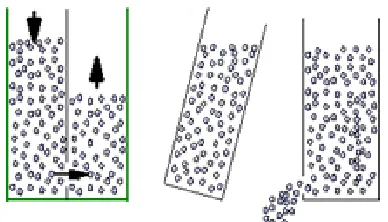
name fluidization is that the solids bed gains a number of properties of liquid:
Surface of a fluidized bed always maintains horizontal even if the bed is
positioned on an inclined plane.
Solids can be poured out of the vessel through an opening without requiring any
mechanical device.
A fluidized unit also exhibits a static pressure head due to gravity, given by
, where is density of the bed.
When a number of units are connected, particles in the one with higher bed level
will flow to the more shallow one until the bed levels are the same, in order to
equalize their static pressure heads.
If the bed is constituted of two types of particles with different densities, the layer
of the lighter particles floats on top while layer of the denser particles sinks at the
Figure 1.1: Fluidized particles behave like liquid
Depending on the phase of fluidizing fluid, fluidization is classified into three types:
gas-solids, liquid-gas-solids, and three phase gas-liquid-solids. Gas-solids was the first form of
this technology, born in 1920s and found its first application in coal gasification by
Winkler. The first large scale implementation was in 1940s in fluid catalytic cracking
process (Anon, 1962). In 1950s was the emergence of liquid-solids fluidization. Over
the decades, intensive studies have been done to understand the hydrodynamic
behaviours of both gas-solids and liquid-solids fluidization systems due to their great
advantages:
Efficient interphase contact
High mass transfer rate
Even distribution of temperature
Easy handling of large solids quantity
In some applications, particles lose their capacity over time as the process proceeds. For
instance, solid catalysts become deactivated in metallurgical or petrochemical operations,
or solid adsorbents are fully loaded in adsorption processes. As a result, they require a
new batch of particles. In the past, to accommodate this demand, a number of vessels
were built. When solids in a vessel became inactive after a period of time, a new unit
took the position to continue the operation while the former one was being regenerated.
Even though this method could provide a continuous process, batch operation still poses a
Possible inconsistency in product grades from batch to batch
High labour cost
Low throughput
Low productivity
High back-mixing of phases
These limitations motivated the invention of an uninterrupted system: circulating
fluidized beds. The inception of liquid – solids circulating fluidization in 1960s (Zhu et
al., 2000) has become useful and been implemented in many areas. Some of them
employ circulating fluidized units because their applications constantly require fresh
particles like aforementioned examples. They need to have a continuous system to
remove inactive solids and feed in the regenerated ones. Some others utilize this
circulating fluidized bed technology because they operate liquid feed at high flowrate.
The particles used are light and small, thus get entrained out of the column.
Consequently, it is essential to keep feeding the particles into the column. With the
advantages of the uninterrupted operation, liquid-solids circulating fluidization is widely
used in many fields such as in food processing, water treatment, and metallurgical
industries.
One example is the application of a liquid solids circulating fluidized bed (LSCFB) to
recover proteins from waste streams which contains low protein concentration. The
adsorption and desorption of proteins are accomplished separately in the two parallel
columns: downer and riser, respectively. The solids used are ion-exchange resins which
are circulated between these two columns. The feed broth is introduced from the bottom
of the downer. The protein in the liquid phase is adsorbed onto the resins. While the
de-proteinized liquid stream is discarded from the top of the downer, the loaded particles
exit the bottom of the downer to enter the riser. Desorption buffer is fed via a liquid
distributor placed at the bottom of the riser, and carries the resins upward while
desorbing protein out of the resins. After releasing the proteins, the resins are considered
fresh, or regenerated. The regenerated particles are then separated from the buffer
circulation cycle (Zhu et al., 2000; Zheng et al., 2002). (More details about system
configurations can be found in Section 2.1)
The performance of an LSCFB relies on the two key factors: the chemistry aspect and the
hydrodynamics aspect. The chemistry varies from application to application since it
depends on the type of solids used, the treating liquid stream, and their reaction kinetics.
As a result, this aspect cannot be generalized but needs to be considered for each
individual case. In contrast, the hydrodynamics knowledge can be applied into design
and scale-up in most cases. Even though this is an area of research since 1990s and
becomes more and more popular over the years, some information is still incomplete.
One of the missing pieces on this hydrodynamics picture is the longitudinal dispersion of
solid phase in the downer.
1.2 Objectives
In order to properly design and scale up a LSCFB, it is important to understand the
hydrodynamics behaviour of the system, such as phase holdups and their distributions,
flow patterns and mixing levels of each phase (Limtrakul et al., 2005). A lot of studies
have been reported for the riser exploring all the areas mentioned above. However, there
is absolutely no available data on the downer. Often the fluid dynamics in the downer is
presumed to be similar to conventional fluidized beds where there is no net flow of solid
phase. This might be premature assumption for the downer at least about the mixing
levels. In conventional fluidized beds, there is only upward flow of liquid whereas in
downer the liquid and solids flow counter-currently, so that a conventional fluidized bed
and a downer bed are incomparable. In other words, mixing levels in conventional
fluidized beds cannot be representative for ones in downer. To avoid the same
presumption, this project is designed to investigate mixing level of solid phase in the
axial direction in the purpose of providing some insight about what is happening within
the downer bed.
To conduct this study, a new method for particle tracking is developed since all other
tracking techniques for solid phase are either inapplicable or unavailable. The new
method at this point because no data is reported in this area as yet. However,
demonstration of the method can be performed within the scope of this study.
Longitudinal solids dispersion, also termed as back-mixing, is an important parameter to
evaluate performance of a fluidized bed. It describes the random motion of particles in
the axial direction and is driven by the diffusion force. In mixers, this type of motion is
desirable since it promotes mixing. However, in fluidized beds, longitudinal dispersion
of solids is better to be constrained. Large dispersion is an indication of broad
distribution of solids residence time. On one side, some particles exit the system earlier
than the expected time. In other words, the contact time between liquid and solid phases
is not long enough, leading to part of their capacity is unused. On the other side, some
particles exit the system much later than the designed contact time. This may cause two
problems. One is if the process involves catalysts or adsorbents that are heat-sensitive
and the reaction is exothermic, extended residence time may cause the damage to the
solid particles. The other is when the catalysts are deactivated or when the adsorbents are
fully adsorbed, their extra time residing in the bed does not results in a higher production
but only means process delay. For these reasons, for the best interest, axial solids mixing
should be minimized in the interest of obtaining the best performance.
Axial mixing of phases is often expressed as axial mixing coefficient, or Peclet number.
In an ideal case where there is absolutely no axial dispersion, the particles exit a column
in exact order as they have entered, the mixing coefficient would be zero and the Peclet
number is infinity. The increasing of the mixing coefficient, or the decreasing of Peclet
value indicates the distribution of particles is getting broader and the state of the fluidized
bed is further away from the ideal plug flow. There are many factors effecting
back-mixing of solids including but not limited to particle-particle collision, particle-wall
collision, turbulence due to liquid flow, also not perfectly vertical column setup,
non-ideal liquid distributor. The former three are infeasible to avoid as they are nature of
phase interaction; the latter two are possible to be improved. Nevertheless, making an
ideal distributor is extremely challenging because it has to provide equivalent hydraulic,
which means equivalent flowrate, equivalent time of passage and equivalent pressure
limited. To achieve the goal of restricting axial solids mixing, one could attempt to make
an ideal distributor facing those challenges and risking patent violation issues. In the
same purpose, this project demonstrates an alternative to constrain the random motion of
particles by inserting internals inside the downer fluidized bed. Different designs of
Chapter 2
2
Literature Review
In this chapter available data on the liquid-solids fluidization will be presented. The first
sections will cover the circulating fluidization hydrodynamics since the project is aimed
to study the downer of a liquid-solids circulation system. The later sections cover the
conventional fluidization hydrodynamics because no data is available for the downer as
yet, and downer is in the same fluidization regime as conventional beds. The literature
review for the circulating systems and the conventional systems are categorized into three
topics: axial profiles, radial profiles and phase mixing. The focus of this project is on
solids phase mixing, not liquid mixing or the axial and radial profiles, but all of them are
essential to understand the dynamic behaviours of a particular system, therefore the
discussion will be on all those topics.
2.1 LSCFB System Details
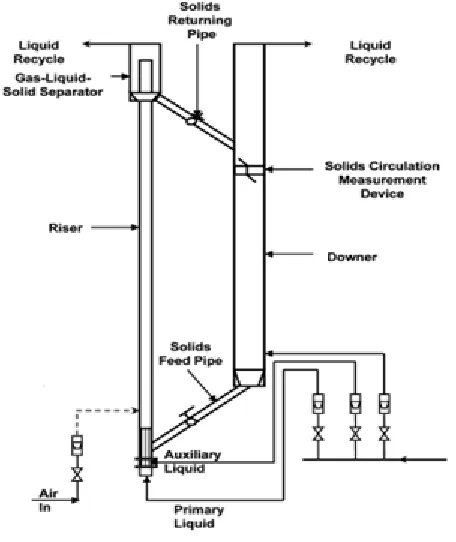
Figure 2.1 shows the schematic diagram of a typical (G-)LSCFB system.
The setup consists of two main parallel cylindrical vessels called riser and downer. The
processes taking place in these two reactors are often the reverse of each other, either
adsorption / desorption processes or reaction / regeneration processes. Therefore, they
are fluidized by two different fluidizing liquids. Liquid injected into the riser is divided
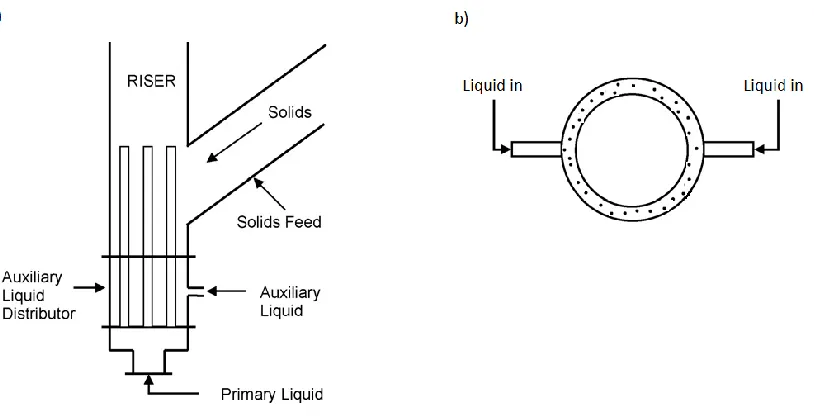
into two streams: primary liquid and auxiliary liquid. There is distributor for each
stream. The main liquid distributor is made of one or multiple stainless steel tubes,
depending on the size of the vessel itself and the second liquid distributor is a porous
plate. Both are placed at the base of the riser (Figure 2.2a). There is also a distributor at
the conical bottom of the downer, which is a ring shape with multi-openings at different
locations and in different angles (Figure 2.2b).
Figure 2.2: Schematic diagram of liquid distributors in a LSCFB a) riser (Razzak et
al., 2009) b) downer
Particles are carried upward in the riser by conjunction of primary and auxiliary liquids.
The existence of the auxiliary stream is to mobilize the solids as they exit the feeding
pipe. In feeding pipe and returning pipe, solids travel like a packed bed. As they flow
down from the feeding pipe, they come in contact with the secondary liquid, and are
loosened up. The auxiliary stream works as a non-mechanical device to facilitate
particles to enter the riser, therefore controls how much or how fast solids entrance is.
liquid streams, solids circulation and total liquid velocity for the riser can be obtained
independently.
Both solids and liquid phase flow upward in the riser, and enter the liquid-solids
separator. The liquid-solids separator has conical bottom which allows solids to settle
and form a packed bed more easily while the liquid floats on top and exits via the liquid
outlet. The solids then return to the downer, passing through a solids circulation
measurement device. The device is positioned slightly below the returning pipe, and is a
vertical plate. It is divided by halves and equipped with two half butterfly valves at the
ends of the plate. To measure solids circulation rate, these two butterfly valves are
flipped to opposite direction for a short time interval, about a minute. As the top valve
blocks one side, then particles come to the other side only; the lower valve blocks that
side and captures the particles. By measuring the solids accumulation and knowing the
time taken, solids circulation rate can be calculated.
Particles enter the downer from the top and travel counter-currently to the liquid flow
which is upward. The downer has much higher solids concentration compared to the
riser because they are in different fluidization regimes. Their fluidization regimes will be
discussed in the following section of this chapter.
2.2 Fluidization Regimes
Fluidization of liquid-solids beds is controlled by superficial velocity of liquid. When
liquid velocity is low, the solid particles remain static, and they are considered in the
fixed state. When the fluid flowrate is high enough, the bed height starts to rise, and each
individual particle becomes suspended in the fluid. The bed is now considered in the
conventional fluidization regime. The value of liquid velocity that demarcates these two
states is called the minimum fluidization velocity, Umf, and can be calculated using Ergun
equation:
In both regimes, a clear boundary between the dense phase and freeboard phase is
observed. When the liquid velocity is increasing, the dense phase continues to expand.
Because the particles occupy a larger bed volume, the solids concentration becomes
lower. With further increase of liquid flow, the boundary between the two phases
becomes unclear. At sufficiently high liquid velocity, some particles start to get
entrained out of the column, suggesting the transition of fluidized beds from the
conventional regime to the circulating regime.
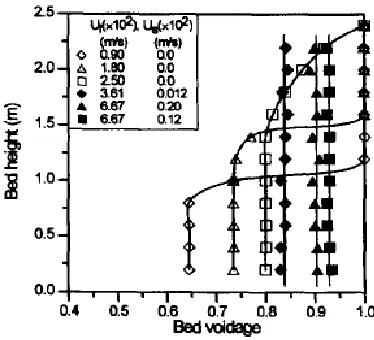
Figure 2.3 depicts dense phase, freeboard phase, and how dense phase expands with
liquid velocity increase. Looking at the two curves whose velocities are the lowest (Ul =
0.90 and 1.80 cm/s), which are the farthest left, all solids settle at the bottom of column.
In this dense phase, it is noted that the voidage is the same at all axial locations. Above
the dense phase, the voidage is 1.0, it means there is no solids in the higher region –
freeboard phase. When liquid velocity increases to 2.50 cm/s, the dense phase expands.
There is a dense zone up to bed height of 1.5 m, then dilute phase above that point. There
is no longer a clear boundary between dense phase and freeboard. At liquid velocity of
3.61 cm/s or higher, it can be seen from the legend box that Us is now above zero,
indicating the formation of solids circulation. The bed is in the circulating regime, and
there is only dilute zone. Bed voidage is constant along the bed height.
Figure 2.3: Variation of the axial liquid holdup distribution in the conventional and
The critical transition velocity
The point where particles start to get entrained out of the bed is termed as critical
transition velocity, Ucr. Liang et al. (1997) established a way to determine this value by
decreasing liquid velocity to the point where solids circulation stops and defined this
point as Ucr. It is confirmed that the critical transition velocity and the transition state are
affected by particle density. Shown in Figure 2.4, with increasing particle density, the
value of Ucr is higher and the transition becomes gradual. For example, for plastic beads
whose density is very low, solids circulation is formed at 0.01 m/s and the transition is
sharp, almost at a single liquid velocity. Contrarily, for steel shots, which are very heavy
particles, the transition starts much later at 0.21 m/s, and the range of liquid velocity for
transition is widened.
Figure 2.4: Circulation rate versus liquid velocity for three types of particles (Zheng
et al., 1999)
Zheng et al. (1999) further found the relation of transition velocity with particle terminal
velocity. Figure 2.5 shows that solids circulation stops as normalized liquid velocity
Ul/Ut approaches values between 1.0 and 1.1 for all 3 types of particles. That means
fluidization enters the circulating regime at transition velocity of equal or slightly higher
than the terminal velocity of particles. This information is quite appreciable for system
operation since solids terminal velocity can be calculated mathematically, and so the
Figure 2.5: Determination of liquid transition velocity for the three types of particles
(Zheng et al., 1999)
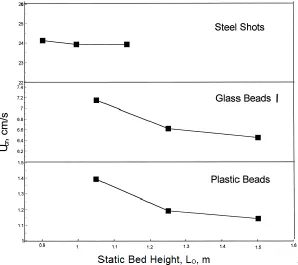
However, the critical transition velocity is found to be system operation dependent.
Zheng and Zhu (2001) reported this lower boundary limit of circulating regime varies
with the total solids inventory, which certainly affects the system pressure balance and
the pressure difference across the solids feeding pipe particularly. When the bed height in
the solids storage is increased, the pressure head at the base of the downer becomes
higher, leading to the pressure difference across the non-mechanical valve is also higher.
In turn, solids are fed to the riser faster. In other words, solids circulation increases at the
same liquid velocities. It also means the same solids circulation rate can be achieved at
lower liquid velocities when solids inventory is higher. Therefore, in identifying the
critical transition velocity by reducing liquid velocity until the solids velocity reaches
Figure 2.6: The effect of total solids inventory (expressed as the static bed height in
the storage vessel before the start of solids circulation) on the critical transition
velocity for plastic beads, glass bead I and steel shots (Zheng & Zhu, 2001)
The authors also noted how the critical transition velocity at first decreases drastically,
then gradually when static bed height is increased. It is explained that when back
pressure is high enough, the pressure distribution within the system has less influence on
the transition velocity. This observation is more discernible in the case with lighter
particles. The change in the transition velocity is hardly recognized in the steel shots
system over the experimental range due to equipment limitation and high particle density.
Overall, it is suggested to have a very high solids inventory when determining the value
of the critical transition velocity in order to minimize the system configuration
dependency and have the most accurate result.
The onset velocity
Since the critical transition velocity is intrinsically system dependent, it poses uncertainty
in defining the lower boundary of circulating fluidization regime. Zheng and Zhu (2001)
method is to measure how long it takes to empty a solids bed when there is no solids feed
from the storage vessel at a particular fluidizing liquid velocity. When the liquid flowrate
is slow, the time it takes for all particles to entrain out of the bed is very long. When the
flowrate is higher, this process certainly takes less time. Zheng and Zhu observed that
with increasing liquid velocity, the bed-emptying time is shortened drastically. Yet, to a
certain point, further increase of liquid flow does not affect the emptying time as much.
This turning point is marked as the onset velocity, Ucf. This phenomena is presented
graphically in Figure 2.7. A steep line and a flatter line are seen and their intersection
locates the onset velocity. The location of the onset velocity does not change with the
initial bed volumes (486 and 811 cm3). In addition, the method does not involve solids
feeding. Therefore it is independent of solids storage volume and the configuration of the
feeding system.
Figure 2.7: Time required for all the particles to be entrained out of the bed, as a
function of liquid velocity for glass beads I and plastic beads (Zheng & Zhu, 2001)
Onset velocity versus critical transition velocity comparison
Table 1 shows the determined onset velocity and critical transition velocity for 4 types of
particles, including their terminal velocity. Recalled from the previous discussion, the
is high enough, this influence becomes less noticeable. That means the transition
velocity determination is less varying when the storage static bed height is large. For the
reason, the values presented in Table 1 are obtained under the highest bed height tested
Lo = 1.5 m.
Table 2.1: The onset and critical transition velocities for different particles (Zheng
& Zhu, 2001)
The results show both the onset and the critical transition velocities are higher than the
terminal velocity. It is reasonable since system has to operate at a liquid velocity higher
than the particle terminal velocity in order to transport particles out of the bed. The onset
is slightly lower than the critical velocity. Another note should be taken from the table
above is that the ratios Ucf/Ut for various particle types are all about 1.1. Since Ucf is not
affected by the geometrical conditions, it only depends on liquid and solids properties.
Zheng and Zhu (2001) suggested a correlation for Ucf as following:
where a is a function of liquid properties such as density and viscosity. Based on the
experimental results, for tap water a is approximately 1.1 when operation is at room
temperature.
To summarize, the critical velocity is the true value defining the transition from the
conventional to the circulating fluidization regime and it varies with the operation setup.
The onset velocity is the lowest Ucr and a convenient way to demarcate the two regimes
independently from the geometry of the system. Therefore, it is accepted as the absolute
Beyond the circulating fluidization regime is the transport/hydraulic regime. In this state,
the particles continue to be carried out of the column. The only distinction between the
circulating and the transport regime is the radial profile of solids holdup. In the
circulating regime, solids concentration is higher near the wall and more dilute at the
center; whereas in the transport regime, the radial solids holdup is uniform. The
transition velocity between the two regimes is defined as Ucv (Liang et al., 1997). It is
expected that Ucv would increase with solids circulation rate. When solids feed is fast,
solids concentration is higher, leading to a solids concentration profile that is more
non-uniform. As the result, it requires higher liquid input to "smooth" out this non-uniformity
of radial solids profile, and enters the transport regime.
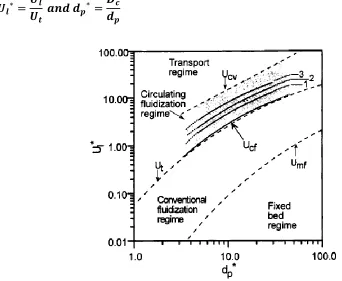
All fluidization regimes and transition velocities are summarized and presented in the
regime map below. The axis are dimensionless liquid velocity and dimensionless
particle size
Figure 2.8: Flow regime map for liquid-solid circulating fluidized bed (Zhu et al.,
2.3 Liquid-Solid Circulating Fluidized Bed Riser
The riser of a LSCFB system is fluidized by a fast flowing liquid. The liquid velocity is
so high that it transports the solid particles out of the bed. The riser bed is in co-current
circulating fluidization state.
2.3.1
Axial Hydrodynamic Behaviour
The Initial Zone and the Developed Zone
As liquid velocity reaches the transition velocity, Ucr, the fluidized bed enters the
circulating regime. In this regime, there exists two zones: initial zone and developed
zone. In the initial zone, solids circulation rate increases substantially with increase of
total liquid velocity. Shown in Figure 2.9 below, the initial zone occurs in a very narrow
range of liquid velocity to a point of being negligible for light particles such as plastic
beads, but this range of liquid velocity becomes much widened as particle density
increases. In the developed zone, the increase of liquid velocity affects solids circulation
insignificantly for all particle densities. The liquid velocity that marks the transition from
the initial circulating fluidized zone to the fully developed zone is the critical liquid
velocity, Ulc (Palani & Ramalingam., 2008; Natarajan et al., 2007). Natarajan et al.
(2007) proposed its value is 1.3 times the particle terminal velocity. It is suggested to
operate a system at a lower liquid velocity than the critical velocity if high solids holdup
is desired. Oppositely, liquid velocity should be higher than Ucr if a dilute phase and high
Figure 2.9: Variations of the solids circulation rate with the total liquid flowrate
(Zheng et al., 1999)
For heavy particles, such as steel shots with density of 7000 kg/m3, the axial profile of
solids holdup is not uniform in the initial circulation zone when the liquid velocity is low
(Ul = 26 and 28 cm/s). Recall from Table 1 the critical transition velocity of steel shots is
24.84 cm/s. When liquid velocity is 26 or 28 cm/s (Figure 2.10), it is the beginning of
circulating fluidization. Solids entering the riser from the bottom are usually in
downward or horizontal direction, they have zero or negative velocity. They need some
time to accelerate; therefore solids holdup tends to be denser at the lower region than at
the higher region. When particle density is low, the accelerating time is very short but for
high density particles, their development is much slower, leading to longer accelerating
distance. With further increase of liquid velocity (Ul = 35 cm/s), fluidization enters the
developed zone and axial solids holdup is uniform throughout the column. For glass
beads, the system is in developed circulating fluidization zone at lower liquid velocity (10
Figure 2.10: Variation of the axial solids holdup distribution with liquid velocity in
the circulating fluidization regime for glass beads and steel shots (Zhu et al., 2000)
The initial zone and developed zone are distinct from one another not only in terms of the
variation of solids circulation (Figure 2.9) and axial solids distribution (Figure 2.10) with
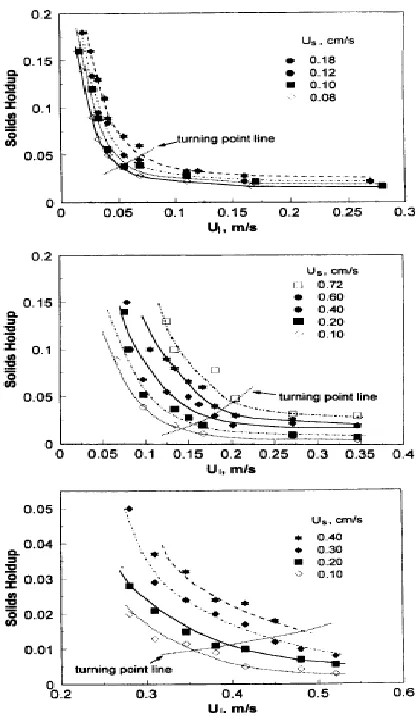
change in liquid velocity, but also in term of average solids holdup. Figure 2.11
expresses how average solids holdup changes with total liquid velocity. The graphs show
different trends in the initial zone and developed zone. In the initial zone, the graphs are
very steeply downward for all three types of particles. The indication is that the average
solids holdup decreases drastically with increasing liquid velocity. This is because when
liquid flows fast, it carries solids out of the riser quickly. Consequently, solids residence
time is shortened, leading to less solids holdup. In contrast, the graphs show a plateau in
the developed zone. Solids holdup is reduced much more slowly in this zone. It can be
explained that at a certain point, the increase in liquid velocity does not affect solids
circulation rate, as seen in Figure 2.9. As the result, the decrease of average solids
holdup with liquid velocity becomes less noticeable. Also seen in Figure 2.11, when
solids circulation rate increases, more solids are fed into the column, hence solids holdup
Figure 2.11: Average solids holdup versus liquid velocity at different solids
circulation rates for (a) plastic beads, (b) glass beads, and (c) steel shots (Zheng et
al., 1999)
Another note taken from Figure 2.11 is that particles density has strong influence on
hydrodynamic behaviour in the initial and developed zone. For light particle (plastic
beads), solids holdup decreases quickly, from 0.15 to 0.05. For heavy particle (steel
shots), solids holdup decreases very slowly, from 0.04 to 0.01. Yet, when fluidization is
fully developed, solids holdup profile reaches the same value 0.01 for all three types of
particles if under the same solids circulation rate (Figure 2.12). Therefore,
hydrodynamics in the initial zone varies by particle density, sharp for light particles and
gradual for heavy particles. When it reaches full development, they all experience the
Figure 2.12: Average solids holdup versus liquid velocity at a given solids circulation
rate for all three types of particles (Zheng et al., 1999)
Variation of Solids Holdups with Liquid Velocities
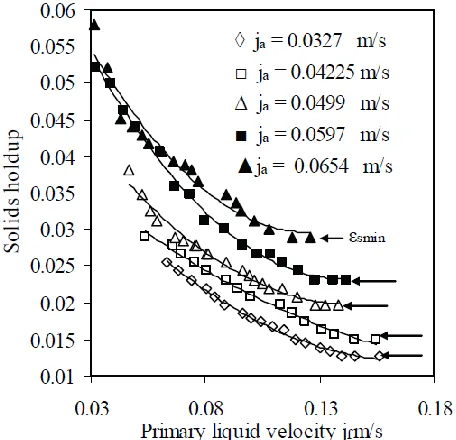
Palani and Ramalingam (2008) conducted their experiments to relate solids holdup with liquid velocity. In their study, they used sand whose diameter is 550 μm and the result is shown in the graph below.
Figure 2.13: Variation of solids holdup with the primary and auxiliary liquid
It is seen that when fixing the auxiliary velocity and turning up the primary liquid
velocity, the solids holdup is decreased. When liquid is fed into the riser at a faster rate,
more particles are transported out, as a result, less particles are present inside the column.
Oppositely, if one looks vertically, across the drawn lines, the data points show how
solids holdup in the riser changes when the primary is constant and the auxiliary varies.
The solids holdup increases with the auxiliary velocity. This can be explained by the
function of the auxiliary stream to loosen up the plug flow in the returning pipe and to
mobilize the particles as they are emerging the flow in the unit. In conclusion, the main
liquid stream is to carry the solid particles upward and entrain them out of the riser;
whereas the secondary stream is to aid the solids feeding system. Therefore the solids
holdup in the riser increases with increase of the secondary stream but with decrease of
the main stream. The knowledge of this variation is definitely beneficial for optimizing
operating conditions.
2.3.2
Radial Hydrodynamic Behaviour in LSCFB
Unlike conventional fluidization regime and transport regime, radial profiles of liquid
velocity, solids velocity and solids holdup in liquid - solids circulating regime are
non-uniform. The non-uniformity may have negative effects on the productivity of fluidized
beds since it causes uneven interphase contact. Therefore, understanding radial flow
structure is crucial to design reactors and to optimize processes.
Radial Distribution of Liquid Velocity
The radial distribution of liquid velocity presented in Figure 2.14 is at solids circulation
flux of 5 and 10 kg/m2s and different liquid velocities. The liquid velocity profile under
conventional fluidization regime, which means no solids circulation Gs = 0, is also
Figure 2.14: Radial distribution of liquid velocity under Gs = 5 (a) and 10 (b) kg/m2s
and different liquid velocities for glass beads (Zheng & Zhu, 2003)
When fluidization is in the conventional regime, the radial profile of liquid velocity is
uniform. The profile becomes non-uniform once solids circulation starts. Higher liquid
velocity occurs at the center (r/R = 0) and lower velocity is near the wall (r/R = 1.0).
This non-uniformity increases when liquid flows faster. For example, when Gs = 10
kg/m2s, graph is steeper when liquid velocity changes from 10 to 15 cm/s. With further
increase of liquid velocity (Ul = 28 cm/s), the graph flattens out, indicating the transition
from the circulating regime to the transport regime. In the dilute transport regime, solids
concentration is very low, thus the impact of solids presence on liquid profile is small. In
addition, when liquid velocity is quite high, liquid profile tends to distribute more
The effect of change in solids circulation on liquid velocity profile is also studied by
Zheng and Zhu (2003). At a fixed liquid velocity (Ul = 15 cm/s), the radial distribution
graph is steeper, means more non-uniformity, as solids circulation flux increases. A
possible explanation for this phenomenon is that when more solids are fed into the riser,
solids accumulation near the wall is greater than at the center. To accommodate this
variation, liquid flows more slowly near the wall than at the center.
Figure 2.15: The radial distribution of the liquid velocity under different particle
circulating rates (Zheng & Zhu, 2003)
Radial Solids Holdup Distribution
A typical radial distribution of solids holdup is plotted in Figure 2.16. It is seen that the
profile is not uniform. The solids concentration is higher at the wall (r/R = 1) than at the
center (r/R = 0). Measurements were done at 4 different heights along the riser: one in
the lower region (h = 0.3m), two at the middle region (h = 0.8 and 1.2 m) and one at the
upper region (h = 1.7 m). The data points at the same radial position are very close to
each other. It again proves that in liquid - solids circulating fluidization, the axial solids
Figure 2.16: The radial distribution of solids holdup at four bed levels at (a)
different superficial liquid and (b) solids velocities for glass beads (Zhu et al., 2000)
With an increase in liquid velocity from Ul = 10 to Ul = 14 cm/s (Figure 2.16a), the graph
gets steeper near the wall, indicating an increase in non-uniformity. As a natural
phenomenon, liquid flowing in a cylindrical pipe tends to flow faster at the center than at
the wall due to wall friction. Faster moving fluid at the center carries solids out more,
consequently makes solids holdup less at the core. When liquid velocity increases further
to 28 or 42 cm/s, the graphs flatten out. In other words, solids holdup is distributed
uniformly in the radial direction, indicating the transition to the transport regime. In
addition, a liquid velocity increase shifts the graph down, means solids holdup is reduced
at all radial positions. When liquid travels fast inside the riser, it entrains solids more
quickly, hence shortens solids retention time. As the result, solids holdup is overall less
at high liquid flowrate.
In Figure 2.16b, liquid velocity is fixed while solids velocity varies. It shows that when
solids circulation rate, which is expressed as solids velocity, increases, average solids
unchanged, the more solids are fed, the more solids are present in the column. Therefore,
solids holdup increases. In a denser zone, solids tend to accumulate at the wall even
more, leading to the difference in solids concentration at the wall and centre is widened.
This explains how the non-uniformity increases with solids velocity.
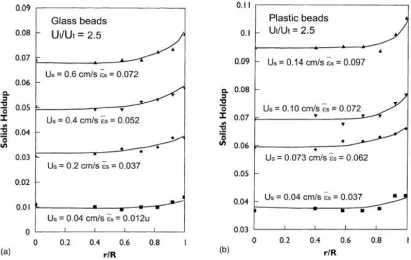
Non-uniformity in radial distribution of solids holdup is also affected by particle density.
The statement is demonstrated in the Figure 2.17 where the radial profiles of solids
holdup for glass beads and plastic beads are plotted. The two types of particles have
similar size and are fluidized in operating conditions that give the same average solids
holdup ( . The profiles for each type of particles under two different operating conditions almost coincide with each other when the cross-sectional average
solids holdups are the same. Comparing the profiles of the two particles types, the lighter
particles (plastic beads) have more uniform distribution, giving flatter parabolic curve.
This phenomenon is possibly due to the lower value of the ratio . When the density ratio is large, solids have a tendency to agglomerate at the wall more. For example in gas
- solids fluidization, the density ratio is very high, and significant cluster agglomeration is
seen. A conclusion that may be drawn here is that high density ratio worsens uniformity in radial solids holdup distribution.
Figure 2.17: Comparison of the radial solids holdup profiles for glass beads and
In the previous case, the average solids holdup is kept constant. In the following study,
the normalized liquid velocity remains unchanged and the impact of particle density on
solids holdup is investigated. Figure 2.18 presents radial profiles of solids holdup for
glass beads and plastic beads under different solids circulation rates. For light particles
(plastic beads), small increment of solids velocity, from 0.04 to 0.14 cm/s, increases
average solids holdup substantially. In contrary, for heavier particle an increment of
solids velocity, for instance from 0.04 to 0.2 cm/s, does not affect average solids
concentration greatly. Additionally, at the same solids velocity , plastic beads experience more solids holdup non-uniformity compared glass beads.
Again, this is because a higher concentration of solids always leads to more uneven
distribution.
Figure 2.18: Radial profiles of solids holdup at the level H = 0.8m for different solids
flowrates for (a) glass beads and (b) plastic beads at the same normalized liquid
Solids Acceleration
When solids enter the column from the returning pipe, they have velocity of zero or even
negative due to their direction either horizontal or downward at the entrance. They need
to be accelerated by the drag force that the liquid exerts on them. After this point, their
velocity is constant. Therefore there exist two regions: initial region, where particles
accelerate, located at the bottom of riser, and fully developed region, where particle
velocity is unchanged.
The length of the developing region, also called acceleration length, depends on liquid
and solids velocity and also density ratio. When liquid velocity is high, this length is
shortened because the drag force is higher. In opposite, an increase of solids circulation
rate makes this region extend longer since the same drag force supports a heavier mass.
Another factor impacting the acceleration length is the ratio ρs/ρl. The larger the ratio is,
the longer the length is. For example, in gas - solids fluidized beds, the density ratio ρs/ρg
is very high. For this reason, the developing region extends and could even takes up the
entire column, leading to non-uniformity in axial direction throughout the column in
gas-solids fluidization. For liquid - gas-solids fluidization, the density ratio ρs/ρl is much smaller,
especially for light particles for which the density ratio is close to unity. Consequently,
the developing region sometimes does not seem to exist.
Radial Distribution of Particle Velocity
There is limited study on radial distribution of particle velocity in liquid - solids fluidized
beds. Roy et al. (1997) employed large and dense particles (dp = 2.5 cm and ρs = 2500
kg/m3) to conduct their experiments measuring local solids velocity. Figure 2.19 shows
that increasing liquid velocity steepens the parabolic curve of particle velocity profile. It
was also found that there is no significant difference in local particle velocities at
different axial locations. Noticeably, the profile for particle velocity is more non-uniform
than for liquid velocity. Perhaps it is because the friction force between solids and wall is
higher than the one between liquid and wall. The friction force makes movement of
Figure 2.19: The radial distributions of particle velocity at different superficial
liquid velocities for glass beads averaged axially over the riser (Roy et al., 1997)
Particle Size Effects
A study of effects of particle size on hydrodynamics of LSCFB was done by Razzak
group (2009). They conducted experiments using two types of glass beads with
diameters of 500 μm (GB-500) and 1290 μm (GB-1290), both having the same density of
2500 kg/m3. Figure 2.20 shows the variation of solids circulation rate, expressed as
solids velocity, with the change in superficial liquid velocity for the two types of glass
beads. It is clearly seen that under the same auxiliary liquid velocity and total liquid
velocity, the smaller particles (GB-500) have higher solids circulation rate. Recall that
particles are fluidized by exertion of drag force and buoyant force which are calculated as
following:
Buoyant force:
It is seen from equations (4) and (5) that buoyant force per volume is independent of
particle size. Yet, drag force per volume is inversely proportional to particle diameter.
Consequently, the larger beads have less drag force per volume than the smaller beads. It
leads to slower solids velocity for GB-1290 when being fluidized by the same amount of
liquid compared to GB-500.
Figure 2.20: Variation of superficial solid velocity with the superficial liquid
velocities at different auxiliary liquid velocities for glass beads (500 and 1290 μm)
(Razzek et al., 2009)
Studies have also been done to examine the impacts of particle size on the radial
distribution of solids holdup. Under the same operating conditions, e.g. same superficial
liquid velocity 22.4 cm/s, same superficial solids velocity 0.95 cm/s, measurements
were taken at different radial locations at the elevation H = 2.02 m (Figure 2.21). Radial
non-uniformity and local solids concentration for the smaller particles are consistently
higher than for the larger particles. This phenomenon can be explained by two reasons.
resulting in a lower drag coefficient. Second, larger particles also have higher settling
velocity, therefore lower slip velocity. For these two reasons, although the projected area
of GB-1290 is larger, the effects of drag coefficient and slip velocity are more prominent,
resulting in a lower drag force for the larger glass beads. That is why solids holdups for
GB-1290 is less compared to the GB-500 at a constant solids velocity.
Figure 2.21: Radial distribution of solids holdups for glass beads (500 and 1290 μm)
at axial location h = 2.02 m and Ul = 22.4 cm/s (Razzak et al., 2009)
2.3.3
Phase Mixing
In the previous sections, phase holdups, their distribution and flow patterns of both solids
and liquid phase have been presented. The following discussion will cover mixing levels
of the two phases.
Liquid Mixing
The liquid mixing study commonly utilizes the pulse response technique and saturated
solution such as KCl or NaCl as tracer. The concentration of tracer in downstream at
different radial positions is recorded. A typical tracer concentration profile as shown in
Figure 2.22: Typical tracer concentration distribution profiles (Ul0 = 0.072 m/s, ε =
0.9, Gs = 7.5 kg2m-1s-1) (Chen et al., 2001)
When tracer is injected at the center of the riser, it is reasonable to expect the highest
reading at r/R = 0. The bell-shaped profiles indicate the spreading of particles over time,
which is caused by dispersion in the longitudinal direction. Additionally, tracer is
detected at other radial locations as well, indicating the radial dispersion of liquid
molecules. Chen et. al. (2001) successfully measured the extension of liquid mixing in
both axial and radial directions. They further investigated the impacts of superficial
liquid velocity and solids holdup on the mixing. Recall that radial distribution of liquid
velocity is non-uniform. Liquid flows faster at the center and slower near the wall. The
profile non-uniformity becomes more pronounced when superficial liquid velocity
increases, or solids circulation rate increases, which is accompanied with denser solids
concentration. Since superficial liquid velocity and solids holdup have impacts on the
distribution of local liquid velocity, they are expected to influence liquid mixing as well.
Understanding the effects of these parameters on liquid mixing is definitely advantageous
Figure 2.23: Effects of superficial liquid velocity on liquid axial mixing (Chen et al.,
2001)
Figure 2.24: Effects of solid holdup on liquid axial mixing (Chen et al., 2001)
Figure 2.23 shows how the axial mixing coefficient, Da, and dimensionless Peclet
number, Pea change when liquid velocity increases, yet the bed voidage is maintained at
0.90. Peclet number is defined as:
Both mixing coefficient and Peclet number are in proportional relation with liquid
velocity. The increase of mixing coefficient can be explained that when liquid flows
more rapidly, it creates more turbulence diffusion inside the bed (Chen et al., 2001). The
Peclet number is inversely proportional to mixing coefficient. Therefore, when Da
increases, Peclet number should decrease. However, Peclet number increases with liquid
velocity, also from its definition. This increase compensates for the decrease due to
mixing coefficient, leading to the overall increment of Pea.
Following, effects of solid holdup on liquid axial mixing are also considered (Chen et al.,
2001). While the liquid velocity is kept constant at 0.085 m/s, solids circulation rate is
adjusted to obtain different solids concentration. The trend of Da increasing with solid
holdup are depicted in Figure 2.24. This agrees well with the results shown on Zheng's
paper (Zheng et al, 2001). In this case, the liquid velocity is unchanged, hence Pea is
simply inversely proportional to Da. The fluidized bed experiences more mixing when
denser because high solids concentration promotes non-uniform distribution of radial
local liquid velocity, in turns enhances axial back-mixing of liquid.
Figure 2.25: Effects of superficial liquid velocity on liquid radial mixing (Chen et al.,
Figure 2.26: Effects of solid holdup on liquid radial mixing (Chen et al., 2001)
The effects of superficial liquid velocity and solid holdup on the radial mixing of liquid
phase are presented in Figure 2.25 and Figure 2.26. The trends observed are the same as
for the axial mixing. Additionally, it should be noted that radial mixing is less than axial
mixing by an order of magnitude.
Solids Mixing
Solid phase exhibits severe mixing, especially in the axial direction compared to the
liquid phase as it is being fluidized upward by the liquid. The liquid eddies containing
energy catch some particles and carry them up for some distance. The interactions
between liquid-solid, solid-solid, and solid-wall extract the energy from the eddies,
resulting in the shedding of particles. The particles fall downward until they meet other
liquid eddies with sufficient energy. This mechanism may happen for several times until
the particles exit the riser to the separator. For these reasons, solids undergo very intense
back-mixing even if the liquid is close to ideal flow (Roy & Dudukovic, 2001).
To track the trajectory of the tracer particle, the computer-automated radioactive particle
tracking (CARPT) technique is used. The tracer encapsulates radioactive Sc-46 which
allows it to emit gamma radiation. Multiple detectors are positioned along the riser.
When the detector near the solids feeding pipe realizes the entrance of the tracer, it sends
signals to the rest of the detectors to start data acquisition. They record the positions of
difference from the entrance to the exit is the residence time of a typical particle inside
riser bed. At a set of operation conditions (fixed liquid velocity and fixed solid to liquid
ratio), massive number of trajectories are recorded. The fraction of trajectories that fall
under the same range of residence time is called frequency. A typical residence time
distribution is shown below:
Figure 2.27: Residence time distribution calculated from CARPT data (Ul = 20 cm/s;
S/L = 0.10) (Roy & Dudukovic, 2001)
From the residence time distribution, Roy and Dudukovic calculated the time average,
variance, equivalent number of tanks, and axial Peclet number. Table 2.2 lists those
values obtained at different solid to liquid ratios while Ul is kept constant.
Table 2.2: Mixing parameters from solids RTD (Roy & Dudukovic, 2001)
S/L Solids mean residence time (s)
Variance (s2)
Dimensionless variance
Equivalent number of tanks in series
Axial Peclet number
Dax
(cm2/s)
0.10 19.3 108 0.29 4 6.9 245
0.15 13.2 67.9 0.39 3 5.1 444
0.20 12.5 95.3 0.61 2 3.3 564
Beside mixing coefficient and Peclet number, equivalent number of tanks in series, N, is
also a measurement of phase mixing. Like Peclet number, it is more favorable to have