www.euacademic.org
Exploring the Connection Efficiency of a Single
Basic Service Set Wireless Local Area Network
Using D-Link DWA 525 N-150 Desktop Adapter and
Ruckus 7782 Access Point
FLORETO B. QUINITO, JR.
Professor, Department of Information Technology University of Science and Technology of Southern Philippines Jasaan Campus
Abstract
This study aimed to examine the actual network connection efficiency of a single basic service set Wireless Local Area Network (WLAN) with 31 desktop computers installed with D-Link DWA-525 PCI adapter which access the network through Ruckus 7782 access point. This study conducted an experiment composing of 12 run tests. The number of stations for each test varies. Data were recorded, analyzed using statistical software and visualized using the graphical attributes of a Spreadsheet software. Result shows that the network connection efficiency is very low, with only 10 stations. Increasing the number of stations from this level revealed a direct proportional effect in terms inability of other stations to connect to the network and the tendencies of disconnection for those connected stations.
Keywords: Basic Service Set (BSS), Connection, Efficiency, Wireless,
Local Area Network
INTRODUCTION
utilized such topology. In many occasions, the budget constrains in setting up WLAN have direct effect in the overall performance of the network. Thus, compromising the quality of service the WLAN provides to the users. WLAN has disadvantages in terms of signal collision (Crow et al., 1997), interference (Shukla, et al., 2017), speed (Crow, et al., 1997), bandwidth (Khayat, 2002), and security (Dhanalakshmi & Sathiya, 2015). The organization should be knowledgeable enough to determine the appropriate type of network infrastructure and devices to use. Such disadvantages may be put as major consideration by the users before setting up an WLAN in their organization.
Two wireless computer laboratories, with 31 desktop computers each, at University of Science and Technology of Southern Philippines – Jasaan Campus were observed to have network connectivity problems. During laboratory activities, many of the students complained that their computers cannot connect to the network. Some encountered disconnection and others experienced very slow content loading. Technically, all of the computers in each laboratory were supposed to be connected during laboratory activities. The general aim of this study is to examine the actual performance of the wireless laboratory in terms of connectivity of stations to the network. The result of this study may provide valuable insights for the school administration for appropriate action plan in order to address the problem at hand.
LITERATURE
Wireless Network
with the publication of the IEEE 802.11g or “Wireless-G” standard (IEEE, 2003). The latter provides the data rates of IEEE 802.11a at the 2.4 GHz band, thus allowing interoperability with older IEEE 802.11a and IEEE 802.11b devices (Vassis et al., 2005) . The latest standard being developed is the IEEE 802.11n or the “Wireless-N” with a promise of transfer rate of up to 600 Mbps.
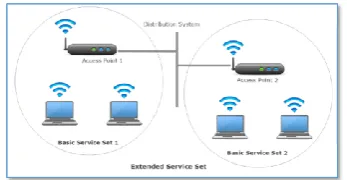
Wired networks are deployed as an extension to the existing wired LANs and due to the fact that the nature of wired networks is different from their wired counterparts, it is important to raise the security of WLANs to levels closer or equal to the wired LANs. In general IEEE 802.11 can operate in two network topology modes, Ad hoc and Infrastructure modes. In an Ad Hoc mode, also known as Independent Basic Service Set (IBSS) or peer-to-peer mode, all workstation and computers connected with a wireless Network Interface Card (NIC) can communicate with each other without an access point. Basic Service Set (BSS) is the fundamental building block of the IEEE 802.11 architecture (Crow, Widjaja, Kim, & Sakai, 1997). On the other hand, in the Infrastructure mode, all mobile devices and computers communicate with each other via an access point. A basic wireless infrastructure with a single access point is called Basic Service Set (BSS). Extended Service Set (ESS) uses more than one access point to form a single sub-network (Dhanalakshmi & Sathiya, 2015).
Fig. 1. Diagram of an Extended Service Set (ESS)
(WLANs). It operates in two network topology modes, Ad hoc and Infrastructure modes.
Dhanalakshmi and Sathiya (2015) highlighted the benefits and advantages of WLAN. WLAN simplified implementation and maintenance. Users enable to access the network from any location within the range of the access point which increase the users’ mobility (Shukla, et al., 2017) (Khayat, 2002) (Crow et al., 1997). Furthermore, WLAN designed to operate in license-free bands thus, minimizing the total cost of operation (Shukla et al., 2017) (Dhanalakshmi & Sathiya, 2015). WLAN equipment is mostly plug-and-play (Khayat, 2002). This helps reduce cost of technical installation, easy maintenance and eliminates equipment redundancy.
WLAN has limited bandwidth (Khayat, 2002). It has limited capability to download and upload large data files. This technology has also very little support to video teleconference (VTC). Moreover, WLAN has issues in security (Dhanalakshmi & Sathiya, 2015) (Crow, et al., 1997). As the number of nodes increases in WLAN, the more chance of interception (Deotare, et al, 2014). Another downside of WLAN is the low speed. It can only operate up to 54 mbps compare to the 100 Mbps LAN. Another challenge is the frequency allocation (Crow, et al., 1997). Operation in WLAN requires all users to operate on a common frequency band which need to be approved and licensed in each country.
Crow et al. (1997) presented that WLAN is a low power networking. Wireless devices are meant to be portable and mobile and are typically battery powered. Such devices must be designed to be energy-efficient, especially the smaller devices (Feeney & Nilsson, 2001). Issues like radio signal interference is one of the hurdles of wired networks (Shukla, et al., 2017). Interference can be caused by simultaneous transmissions by two or more nodes sharing the same frequency band, thus creating a signal collision (Crow et al., 1997).
The Ruckus 7782 Series
signals and more resilient mesh connections that automatically adapt to interference and changing environmental conditions. This device has both Standard 802.3 af/at Power over Ethernet (PoE). It provides 32 Basic Service Set (BSS) IDs with unique Quality of Service (QoS) and security policies. (Ruckus Wireless Inc., 2014).
The D-Link DWA-525 Wireless Adapter
The D-Link DWA-525 PCI adapter operates in a frequency range from 2.4 GHz to 2.4835 GHz with three wireless standards, 802.11n with a transfer rate up to 150 mbps, 802.11b at up to 11 Mbps and 802.11g at up to 54 Mbps. It has a detachable 2 dBi dipole antenna. This adapter card has 32-bit PCI Local Bus and is compatible in computers running 32-bit or 64-bit Windows 7.0 and up Operating Systems (D-Link Corporation, 2010).
METHODS
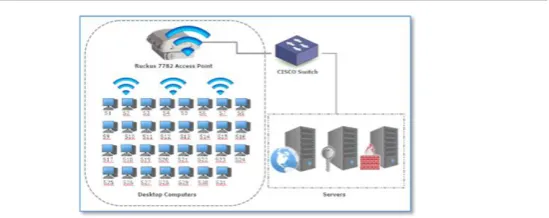
Setting of the Study
Fig. 2. The wireless computer laboratory network architecture
Data Collection
The experiment was conducted using 12 run tests. The time duration of each test lasted for at least three minutes. The time duration increased by one minute as the number of computer increases by ten. Each computer was given a station number for the purpose of identification. The maximum number of computers used was 31. Each run test had different number of users and set of computers. The first run test utilized three computers while the last run test utilized all the computers. Table 1 below shows the number of computers being utilized for each test.
Tab. 1. Distribution of Stations in the Experiment
Test No. No. of Stations
Duration (minutes)
Station ID
1 3 3 1,3,5
2 5 3 4,8,6,10,12
3 7 3 11,13,15,17,22,30,31
4 10 4 12, 14,16,18,20,22,24,26,28,30
5 12 4 21,23,25,27,29,31,1,3,5,7,9,11
6 15 4 4,6,8,10,12,14,16,18,7,9,11,13,15,17,21
7 18 4 18,22,24,26,28,21,23,25,
27,29,31,1,3,5,7,9,11,13
8 21 5 All except: 18,20,21,22, 23,25,27,29,30,31 9 23 5 All except: 1,2,3,7,8,18,20,22
10 26 5 All except: 31,25,21,17,13
11 28 5 All except: 1,3,5
After every run test quantitative data were collected. The following data will be required for each test:
1) number of computers successfully connected to the network without experiencing disconnection,
2) number of computers that did not connect,
3) number of computers that connected but experienced disconnection, and
4) number of computers that connected and experience very slow content loading.
Data Analysis
The numerical data that were collected through the experiments were plotted using the graphical features of a Microsoft Excel Spreadsheet software. The purpose of plotting was to visualize at which number of computers used in the network that the problem started. The graph will display the particular point in the experiment that computer’s inability to connect and the occurrence of disconnection were encountered. Furthermore, the data were analyzed using available statistical software.
RESULTS
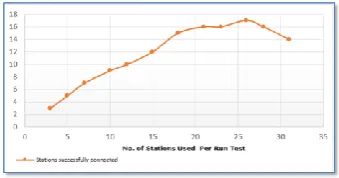
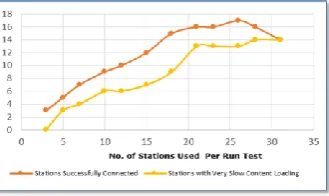
The experiment revealed that the wireless network connection with 31 computers using D-Link DWA-525 PCI adapters each which access the network through Ruckus 7782 access point can only effectively connect 17 (54.8%) computers. As the number of computers access the network increases, the efficiency of connection decreases. Figure 3 shows the number of computers successfully connected to the network in relation to the number of stations trying to access the network.
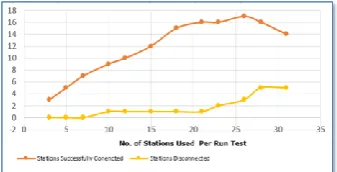
The result of the experiment showed that the inability of stations to connect to the network occurred when the stations accessing the network is between 10 to 20 stations. The increase of number of stations unable to connect to the network was consistent when the number of stations accessed the network was more than 20 and it was noted that there was an abrupt increase when the stations reached more than 30. Figure 4 below shows the trend of stations unable to connect to the wireless network.
Fig. 4. Stations unable to connect to the wireless network
Another interesting result in the experiment was the point where stations started to experience disconnection from the wireless network. Such tendency occurred when the number of stations accessing the wireless network reaches between 10 to 20 stations. When the number of stations was increased beyond 20 a consistent increase of the number of stations experienced disconnection from the wireless network. Figure 5 shows the tendencies of the stations to be disconnected to the wireless network.
Fig. 5. Stations disconnected to the wireless network
experiencing very slow content loading. Although the first run test shows no stations experienced delay, in average, 49% of connected stations experienced very slow content loading for every run test. But all stations experienced very slow content loading as the maximum number of stations was reached. Figure 6 shows this relationship.
Fig. 6. Stations which experienced very slow content loading
CONCLUSION AND RECOMMENDATIONS
This study concluded that the network connection efficiency of a WLAN in a basic service set infrastructure with 31 desktop computers installed with D-Link DWA 525 N-150 PCI adapter which accessed the network through a Ruckus 7782 access point is very low. The maximum number of stations that effectively accessed the network was less than or equal to 10. More than this number, many of the stations were unable to connect to the network and several of those that were able to connect had the tendency to disconnect from the network. In this study, the ideal number of stations for each basic service set is at most five stations in order not to compromise the bandwidth of the entire network.
REFERENCES
2. Deotare, V., Wani, S., Shelke, S., (2014) “Wired Equivalent Security Algorithm for Wireless LAN” International Journal of Emerging Technology and Advanced Engineering.
3. Dhanalakshmi, S., & Sathiya, M. (2015). An Overview of IEEE802 . 11 Wireless LAN Technologies. International Journal of Computer Science and Mobile Computing, 4(1), 85– 93.
4. D-Link Corporation. Wireless N-150 Desktop Adapter DWA-525. 2010
5. Feeney, L. M., & Nilsson, M. (2001). Investigating the energy consumption of a wireless network interface in an ad hoc networking environment. INFOCOM 2001: Twentieth Annual Joint Conference of the IEEE Computer and Communications
Societies, 3, 1548–1557.
https://doi.org/10.1109/INFCOM.2001.916651
6. IEEE Std. 802.11, “Wireless LAN Medium Access Control (MAC) and Physical Layer (PHY) Specification,” 1999.
7. IEEE Std. 802.11b, “Higher-Speed Physical Layer (PHY) Extension in the 2.4 GHz Band,” 2001.
8. IEEE Std. 802.11a, “High-Speed Physical Layer in the 5 GHz Band,” 2000.
9. IEEE Std. 802.11g, “Further Higher-Speed Physical Layer Extension in the 2.4 GHz Band,” 2003.
10. IEEE Std. 802.3, IEEE Standard for Ethernet. IEEE Computer Society. 2012
11. Khayat, M (2002). Wireless Local Area Network. Wireless Advantages versus Disadvantages
12. Rukus Wireless Inc. ZoneFlex 7782 Series Dual Band Smart WiFi Outdoor AP. 2014.
13. Shukla, S., Meghana K.M., Manjunath, C.R., Santosh, N., (2017). Comparison of Wireless Network Over Wired Network, 5, 14–20.