ISSN 2286-4822
www.euacademic.org DRJI Value: 5.9 (B+)
A research note on knowledge-uncertainty-based
learning (KUBL), using Total Quality Management
(TQM) subject as an example
JOSEPH KIM-KEUNG HO Independent Trainer Hong Kong, China
Abstract:
Management subject learning can only be effective by jettisoning the restrictive reliance on learning only knowledge that has been scientifically validated (i.e., knowledge-certainty-based learning (KCBL)). Instead, management subject learning has to also embrace knowledge-uncertainty-based learning (KUBL) in order to be useful. This article postulates (i) the six underlying thinkings of KUBL and (ii) the literature review required to produce KUBL study materials, using the subject of Total Quality Management as an illustrative example. The proposed KUBL ideas should be of use to those who study management subjects and do literature review for management dissertation projects.
Keywords: Academic literature, knowledge-certainty-based learning (KCBL), knowledge-uncertainty-based learning (KUBL), KUBL thinkings, management knowledge, management subject learning, Total Quality Management (TQM).
INTRODUCTION
examples for illustration. Normally, the conveyance of the management subject knowledge to management students stresses what is valid and clear about the management subject. In this regard, it endorses knowledge-certainty-based learning (KCBL). That is, management students learn management subjects that have knowledge certainty claims, validated as scientific research findings. At the same time, management education, unfailingly, endorses critical, reflective and high-level learning, as exemplified in conceptual frameworks such as Gibbs‟ Reflective Cycle (Mulder, n.d.; Finlay, 2008) and Bloom‟s Taxonomy (Armstrong, n.d.; Vieyra, 2006). Specifically, in doing literature review in management dissertation projects, students are required to examine debating points and knowledge gaps in the academic literature, notably academic journal articles. Thus, other than KCBL, there is such a thing of knowledge-uncertainty-based learning (KUBL). This article postulates the notion of knowledge-uncertainty-based learning (KUBL) and offers an illustrative example with the subject of Total Quality Management (TQM).
The nature of knowledge-uncertainty-based learning (KUBL)
Knowledge-uncertainty-based learning accepts the knowledge-uncertainty essence of management knowledge in management subject learning. Why this is sensible to do so can be explained by the six underlying KUBL thinkings as follows:
Thinking 1 (the life-history view): Management knowledge on a particular subject has its history; along the trajectory of its historical development, it inevitably gathers more and more ideas and findings on the subject matter in a co-evolutionary way with other management subjects; there are always uncertainty, contention issues, knowledge fragmentation and imaginative viewpoints in this life-history of the management subject concerned.
knowledge, notably advices from management subject gurus and consultants, can be incompatible among themselves.
Thinking 3 (the socially constructed knowledge nature idea): Management knowledge is socially constructed; it is subjected to various technological, personal, organizational and societal influences in its construction. It can be interpreted in multiple ways, not value-free and not homogenous over space and time.
Thinking 4 (the problematic world context view): Management knowledge, which is practice/ application-oriented, is employed in a problematic world; inevitably, when applied, management knowledge is conceived and reacted differently by diverse stakeholders with different worldviews. As a result, management knowledge is unavoidably contentious and localized in its application.
Thinking 5 (the multiple underlying research paradigms view): Specific management knowledge can be grounded on different theoretical perspectives; such theoretical grounding can be explicit and clear, or implicit and ambiguous. The theoretical grounding of specific management knowledge could also migrate to a very different theoretical grounding over time as a result of intellectual works from some imaginative theorists. This makes the management knowledge very difficult to be standardized and bounded in content.
These six KUBL thinkings underscore the messy, provisional, ambiguous, contentious, applied and co-evolutionary nature of management subjects, which are employed in a problematic world. The thinkings are very much in line with the theoretical standpoint of critical systems thinking-based managerial intellectual learning of Ho (re: the managerial intellectual learning Facebook page). These thinkings, in turn, justify the adoption of KUBL as holding a realistic understanding of management subjects and their contexts of practice. Taking into consideration the six thinkings of KUBL, the writer postulates that KUBL is essential for effective learning on management subjects. Nevertheless, it should be done with KCBL at the same time. To put it in a more intelligible way, KCBL is primarily about studying management subject textbooks (which focus on explaining ideas that are already known and considered unproblematic) whereas KUBL is chiefly about studying academic journal articles on management subjects (which are more preoccupied with critical and imaginative intellectual endeavours to generate new knowledge). Because of that, management educators should spare more effort to produce study materials for management students specifically for KUBL. Without KCBL, management knowledge remains too abstract to apply in the real-world, albeit such knowledge being conveyed in an assured tone. Very often, KCBL is weak in fostering critical and imaginative learning so as to generate sufficient variety to absorb the variety as exhibited in real-world problem-situations. In a nutshell, KUBL comprises six underlying thinkings and the study of KUBL-specific learning materials. KUBL endorses a critical systems thinking-based approach on intellectual learning, an approach that has been more fully developed by the writer (re: Facebook page of Managerial intellectual learning). In the next section, the writer offers an illustrative example of KUBL study materials on the management subject of Total Quality Management (TQM).
Examining the TQM literature to come up with KUBL-specific learning materials
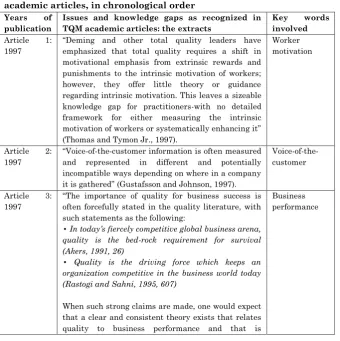
kind of KUBL literature review is academic journal articles as they are forthcoming with identification of contention issues and knowledge gaps in the management subjects and topics under review. Unswervingly, these academic articles are critical, imaginative and conceptually sophisticated in discussing the management subjects and topics with much clearer line of reasoning and referencing. As such, they achieve the status of publishable quality in reputable academic journals. Here, the writer offers, via literature review on the journal of Quality Management Journal (Taylor & Francis), a list of issues and key words in TQM research which serves as an illustrative example of study materials for KUBL. The list is shown in Table 1 as follows:
Table 1: Issues and related key words in TQM research: a sample of academic articles, in chronological order
Years of
publication
Issues and knowledge gaps as recognized in TQM academic articles: the extracts
Key words
involved
Article 1: 1997
“Deming and other total quality leaders have emphasized that total quality requires a shift in motivational emphasis from extrinsic rewards and punishments to the intrinsic motivation of workers; however, they offer little theory or guidance regarding intrinsic motivation. This leaves a sizeable knowledge gap for practitioners-with no detailed framework for either measuring the intrinsic motivation of workers or systematically enhancing it” (Thomas and Tymon Jr., 1997).
Worker motivation
Article 2: 1997
“Voice-of-the-customer information is often measured and represented in different and potentially incompatible ways depending on where in a company it is gathered” (Gustafsson and Johnson, 1997).
Voice-of-the-customer
Article 3: 1997
“The importance of quality for business success is often forcefully stated in the quality literature, with such statements as the following:
• In today’s fiercely competitive global business arena, quality is the bed-rock requirement for survival (Akers, 1991, 26)
• Quality is the driving force which keeps an organization competitive in the business world today (Rastogi and Sahni, 1995, 607)
When such strong claims are made, one would expect that a clear and consistent theory exists that relates quality to business performance and that is
supported by a considerable body of evidence. The data that have been gathered, however, indicate a great diversity of possible outcomes from the achievement of product quality. Examples of the diversity of outcomes include higher prices and reduced market share (Anderson, Fornell, and Lehmann 1994); increased market share (Buzzell andGale 1987); and reductions in cost (Ittner 1996). Some studies found that increased quality has no effect on business performance (Yavas andBurrows 1994; Cottrell 1992). Other studies indicate that increased quality can have even a negative effect (Fisher 1992)” (Hardie,1997).
Article 4: 1998
“To solve the defect problem, the underlying problem that is causing it must be identified. But obvious problems/symptoms are no less real than the underlying problems/causes that generate them” (Smith, 1998).
Quality problem causes
Article 5: 1998
“Many definitions of TQM have been developed. Most exist in the form of programs provided by consultants or consulting firms. While the common theme of continuous improvement, employee involvement and teams, long-term thinking, and the use of statistical measures are emphasized to one degree or another by all of them, each claims to have some special key to success that is its competitive advantage. None of this is based on objective evidence. and the anecdotal or experiential evidence supporting the many conflicting claims is razor thin at best” (Grandzol and Gershon, 1998).
Evidence of TQM claims
Article 6: 1999
“Although a significant amount of attention has been given to identifying the key dimensions of TQM in the literature, agreement still has not been reached” (Kim and Wesley, 1999).
TQM dimensions
Article 7: 1999
“Customer feedback is an important element of quality management, particularly in service industries (Chase and Hayes 1991). It makes sense that investments In customer feedback systems should generate a return. Many companies collect feedback from customers; however, it appears that surprisingly few expect or require the collection effort to bring substantial benefits to the organization” (Sampson, 1999).
Customer feedback
Article 8: 2001
“As Baldrige Award-based self-assessments represent a catalyst for change, organizations need a clearly defined approach for effecting change to its key management processes that result from
assessments” (Ford and Evans, 2001). Article 9:
2001
“The ways in which product and service quality are measured and evaluated differ between the two industries. Products from manufacturing industries are tangible and visible, while services are intangible and invisible. As a result, service quality is difficult to measure and depends upon the perception of customers” (Sun, 2001).
Product and service quality
Article 10: 2001
“... although it is clear, from the research reviewed on business performance factors that quality does have a consistent positive relationship with better performance, the research reviewed on the link between quality certification and business performance suggests that no link is proven” (Dick, Gallimore and Brown, 2001).
Quality certification; business performance
Article 11: 2001
“For researchers, the bulk of the quality management research relies on data from company managers. If managers are not knowledgeable about the firm's quality programs or if they feel compelled to present an image about the firm's quality that is more positive than real, then the research conclusions drawn from those data will be inaccurate. Practitioners relying on these inaccurate statements to design their own quality management programs or to replicate (what they believe to be) best industry practices will be misled in their efforts” (Michalisin and White, 2001).
Evidence of TQM claims
Article 12: 2001
“... product development in a turbulent environment requires a nonlinear process, with both backward and forward movement occurring as the development team often revisits past decisions based on new information and changing circumstances (Hargadon and Eisenhardt 2000) . These conceptions suggest that the task of infusing continuous innovation into the processes of discontinuous change goes well beyond the traditional approach of quality experts, which is to figure out how to apply conventional quality improvement tools to rationalize and streamline the discontinuous change process” (Cole, 2001).
Continuous improvement; continuous innovation
Article 13: 2001
“As quality awareness has grown, quality management efforts at some companies have resulted in improved competitiveness (Hendricks and Singhal 1996),while similar results in other organizations have remained elusive (Tan, and Wisner, 2001).
Quality management impacts
Article 14: 2004
“As organizations strove to implement quality management They found that their existing
remuneration systems did not seem to reinforce quality management goals and even thwarted them” (Bickley and Whiteley, 2004).
Article 15: 2005
“While the role of leadership is recognized as critical To the success of quality initiatives (Cole, Barcdayan, and White 1993; Krantz 1989; Deming 1986;Juran 1989; Dale and Duncalf 1984: Ebrahimpour 1985; Lascelles and Dale 1989; 1990), there is little empirical work on the leadership styles that support quality initiatives” (Jabnoun and Al-Ghasyah, 2005).
Leadership styles
Article 16: 2008
“Although quality management is commonly viewed as a rational, process-oriented approach to control and improvement ...., an organization‟s environment may influence managers to adopt quality practices in ways that do little to promote long-term internalization .... For example, practices that are viewed as socially acceptable may be adopted for legitimacy reasons rather than for motives that promote efficiency” (Ford, 2008).
Organization environment
Article 17: 2009
“The basic rationale for the importance of leadership to QM is that leaders influence the motivation of a system‟s members and motivated members help to improve quality performance (Waldman 1994). Existing leadership theory has not used either quality improvement or firm performance as criteria for leadership effectiveness” (Laohavichien, Fredendall and Cantrell. 2009).
Leadership
Article 18: 2009
“The importance of HRM to Six Sigma implementation has been recognized in the literature (for example, Breyfogle, Cupello, and Meadows 2001; Lee and Choi 2006; Motwani, Kumar, and Antony 2004), but little research has been done to empirically examine the relationship between HRM and Six Sigma implementation” (Zu, and Fredendall, 2009).
Human resource management; Six Sigma
Article 19: 2012
“Research estimates the failure rate of organization transformation initiatives at somewhere between 70 and 80 percent (Miller 2002). In fact, while there have been more than 1,000 applicants for the Baldrige Award, fewer than 10 percent actually received the award” (Larson, Latham, Appleby and Harshman, 2012).
Malcolm Baldrige Award
Article 20: 2012
“With the spreading of the supplier base across geographies, the risks of poor quality supplies have also increased. In order to mitigate the risks of producing poor quality products, organizations are forced to commit substantial resources for managing quality in the supply chain. As a result, supply chain
quality management (SCQM) has emerged with various management-driven efforts aimed at enhancing the overall quality performance of an organization through the effective management of quality on the supply side (Lo and Yeung 2004)” (Aravindan and Maiti, 2012).
Article 21: 2013
“One of the major challenges in managing service quality is the lack of a common definition of services and a general lack of a standard measurement system originating from the intangible nature of services” (Tyagi, Varma and Vidyarthi, 2013).
Service quality
Article 22: 2013
“Despite the popularity of Deming‟s ideas, evidence of their efficacy has been lacking. A number of researchers have attempted to provide a more rigorous and systematic assessment of the DMM [Deming Management Method] by analyzing the theoretical bases of Deming‟s ideas (Anderson, Dooley, and MIsterek 1992)” (Prakash, Chua and Sum, 2013).
Deming management method
Article 23: 2013
“Whereas academics and managers consider customer perceptions of quality as crucially important, front-line employees‟ (FLEs) perceptions of quality do not appear to have been sufficiently studied” (Julien and Tsoni, 2013).
Employees‟ perception of quality
Article 24: 2014
“Though quality and radical innovation are both essential for an organization‟s survival, studies suggest they compete for scarce resources and thus emphasize organizational activities that lead one of them to harm the other (Benner and Tushman 2002; Gupta, Smith, and Shalley 2006; Lavie, Stettner, and Tushman 2010; March 1991)” (Blank and Naveh, 2014).
Radical innovation
Article 25: 2014
“Support for a significant positive relationship between ISO 9000 certification and business performance is high, but there are contradictory findings (Sampaio et al. 2012). It is not certain that certified companies would be less profitable without implementing ISO 9000 (Sampaio et al. 2012)” (Fatima, 2014).
ISO 9000 certification; business performance
Article 26: 2014
“Although recent research on administrative process innovation has found that practices designed to capture and create knowledge resources during Six Sigma projects can improve the performance of process innovation projects (Anand, Ward, and Tatikonda 2010), the link between knowledge resources and general administrative process innovation initiatives has not been well examined”
(McFadden, Lee, Gowen III and Sharp, 2014). Article 27:
2014
“Leadership continues to be a popular topic for quality professionals, organizational leaders, researchers, consultants, and a variety of commentators. Unfortunately, there are numerous examples of leadership failures, ranging from ethical disasters to the workers who hate their boss and their job. Both reduce individual engagement and reduce organizational performance. However, after years of practicing and researching leadership, there is still no reasonable number of cogent and coherent theories for leaders to follow that will predict success” (Latham, 2014).
Leadership
Article 28: 2015
“... to be efficient, ISO 9001 standards must be considered as a process of continual improvement and perceived as such by all external stakeholders, including customers and partners, as well as in-house stakeholders, namely employees. In the literature, most of the empirical data regarding the evaluation of certifications were collected from managers and rarely from employees (Kuo et al. 2009; Larson and Sinha 1995)” (Marde, 2015).
ISO 9000 certification
Article 29: 2015
“Most literature on total quality management (TQM) establishes the existence of a positive relationship between TQM adoption and performance (Ebrahimi and Sadeghi 2013). However, developing sound empirical and theoretical models that describe cause-and- effect relationships and provide managers with a better understanding of the impact of their decisions throughout an organization remains a significant research opportunity (Evans, Foster, and Linderman 2014). Specifically, researchers disagree on why and how improvements derived from TQM occur and who really benefits from them” (García-Bernal and Ramírez-Alesón, 2015).
Business performance
Article 30: 2019
“...achieving perceptual congruence is paramount to improving quality in a co-production environment. However, the extant literature is silent on prescribing various service designs and how perceptual biases interact to influence perceptual congruence” (Ozkul, Damali, Nandialath and Stapleton, 2019).
Perceptual congruence
activity, and involving each individual at each level... TQM ensures that management adopts a strategic overview of quality and focuses on prevention, not detection, of problems” (Oakland, 2003). Typically, a TQM textbook covers topics of TQM foundation, planning, performance, processes, people, implementation and case studies (Oakland, 2003). Nonetheless, as Flood (1993: xii) reminds us, TQM “is not a single philosophy with a clear line of reasoning. There is much competition over the claim of ownership over the right approach to quality management”. For this literature review exercise in this article, the writer gleaned the Quality Management Journal, published by Taylor & Francis, as the sole source of academic ideas on the TQM subject to come up with Table 1. These articles were published in the period of 1997 to 2019. Altogether, there are 30 articles utilized in this review exercise. The extracted findings on TQM issues are listed in chronological sequence in the table. Table 1 also indicates the key words related to these research issues. The table gives a sense of evolving academic interest in TQM research issues over this period of time. Briefly, some research issues echo those that have been recognized in other subjects, e.g., how to identify problem causes (re: Table 1: article 4); some extracts express the difficulties on gauging TQM impacts on business performance (re: Table 1: articles 3, 13, 25, and 29); some extracts recognize the soft issues of TQM in topics such as leadership (re: Table 1: articles 15, 17 and 27) and stakeholders‟ perceptions and feelings (re: Table 1: articles 1, 2, 7, 23, 28 and 30); some query the validity of certain TQM claims (re: Table 1: articles 5, 11 and 22); lastly, there are issues on TQM notion clarity and approach development in response to evolving and increasingly demanding environmental situations and organizational TQM applications (re: Table 1: articles 8, 9, 12, 14, 16, 18, 19, 20, 21, 24 and 26). Similar issues had indeed been encountered by the writer‟s MA project on a TQM case study back in 1986 (Ho and Jackson, 1987). Taking a chronological perspective, none of the various TQM topics (re: “key words involved” in Table 1) appears to have fizzled out during the period covered in this literature review exercise.
ways by academics to explore and respond to the issues with the aim of contributing new and useful knowledge to the management subject in an evolving real-world context. Meanwhile, quite a number of these TQM issues resonate with those in other management topics, e.g., motivation, leadership, change management and innovation management. This is to be expected since the six KUBL thinkings are also applicable in other management subjects1. In short, the extracted ideas in Table 1 have been chosen for their relevance for knowledge-uncertainty-based learning (KUBL); the table serves as KUBL-specific reading materials on the TQM subject.
CONCLUDING REMARKS
Effective learning of management subjects, such as Total Quality Management, calls for recognition of (i) the provisional, time-/ space-specific and sometimes non-scientific nature of the management knowledge concerned as well as (ii) the problematic nature of the social world in which management practices take place. Because of that, sole reliance on knowledge-certainty-based learning (KCBL) is restrictive and insufficient. In this regard, knowledge-uncertainty-based learning is critical for effective management subject learning and practices to take place. The article uncovers the KUBL nature and KUBL-specific study materials involved. Nevertheless, KUBL is challenging to adopt as it demands a critical, entrepreneurial, reflective and engaging mindset on management subject learning. The KUBL ideas proposed in this article should be of value to those interested in management subject learning as well as those doing literature review in management dissertation project works.
REFERENCES
1. Aravindan, S. and Maiti, J. 2012. “A Framework for Integrated Analysis of Quality Defects in Supply Chain” Quality Management Journal, 19:1, 34-52, DOI: 10.1080/10686967.2012.11918526.
1 There is a need to conduct KUBL-based literature review on other management
2. Armstrong, P. n.d. “Bloom‟s Taxonomy” Centre for Teaching, Vanderbilt University (url address: https://cft.vanderbilt.edu/guides-sub-pages/blooms-taxonomy/) [visited at October 24, 2019].
3. Bickley, M.J. and Whiteley, A. 2004. “Can You Pay for Quality Work? A Government Case Study” Quality Management Journal, 11:4, 8-19, DOI: 10.1080/10686967.2004.11919129. 4. Blank, T.H. and Naveh, E. 2014. “Do Quality and Innovation
Compete Against or Complement Each Other? The Moderating Role of an Information Exchange Climate” Quality Management Journal, 21:2, 6-16, DOI: 10.1080/10686967.2014.11918382.
5. Cole, R.E. 2001. “From Continuous Improvement to Continuous Innovation” Quality Management Journal, 8:4, 7-21, DOI: 10.1080/10686967.2001.11918977.
6. Dick, G., Gallimore, K. and Brown, J.C. 2001. “Does ISO 9000 Give a Quality Emphasis Advantage? A Comparison of Large Service and Manufacturing Organizations” Quality Management Journal, 8:1, 52-61, DOI: 10.1080/10686967.2001.11918937.
7. Fatima, M. 2014. “Impact of ISO 9000 on Business Performance in Pakistan: Implications for Quality in Developing Countries” Quality Management Journal, 21:1, 16-24, DOI: 10.1080/10686967.2014.11918373.
8. Finlay, L. 2008. “Reflecting on „Reflective practice‟” Practice-base Professional Learning Centre, The Open University, UK.
(url address:
https://www.open.ac.uk/opencetl/sites/www.open.ac.uk.opencet l/files/files/ecms/web-content/Finlay-(2008)-Reflecting-on-reflective-practice-PBPL-paper-52.pdf) [visited at October 24, 2019].
9. Flood, R.L. 1993. Beyond TQM, Wiley.
10. Ford, M.W. 2008. “Adoption of Quality Practices in a Multidivisional Environment: A Longitudinal Study” Quality Management Journal, 15:4, 7-17, DOI: 10.1080/10686967.2008.11918201.
Quality Management Journal, 8:3, 9-25, DOI: 10.1080/10686967.2001.11918963.
12. García-Bernal, J. and Ramírez-Alesón, M. 2015. “Why and How TQM Leads to Performance Improvements” Quality Management Journal, 22:3, 23-37, DOI: 10.1080/10686967.2015.11918439.
13. Grandzol, J.R. and Gershon, M. 1998. “Which TQM Practices Really Matter: An Empirical Investigation” Quality Management Journal, 5:3, 43-59, DOI: 10.1080/10686967.1998.11919147.
14. Gustafsson, A. and Johnson, M.D. 1997. “Bridging the Quality-Satisfaction Gap” Quality Management Journal, 4:3, 27-43, DOI: 10.1080/10686967.1997.11918801.
15. Hardie, N. 1997. “The Effects of Quality on Business Performance” Quality Management Journal, 4:4, 65-83, DOI: 10.1080/10686967.1997.11918816.
16. Ho, J.K.K. and Jackson, M.C. 1987. “Building a “rich picture” and assessing a “quality management” program at Thornton Printing Company” Cybernetics and Systems: an International Journal, 18, 381-405.
17. Jabnoun, N. and Al-Ghasyah, H.A. 2005. “Leadership Styles Supporting ISO 9000:2000” Quality Management Journal, 12:1, 21-29, DOI: 10.1080/10686967.2005.11919236.
18. Julien, A. and Tsoni, C. 2013. “Front-line Employee versus Customer Perceptions of Quality Attributes” Quality Management Journal, 20:2, 48-59, DOI: 10.1080/10686967.2013.11918097.
19. Kim C. and Wesley, S. 1999. “A Framework for Organizational Quality Culture” Quality Management Journal, 6:4, 7-25, DOI: 10.1080/10686967.1999.11919208.
20. Laohavichien, T., Fredendall, L.D. and Cantrell, R.S. 2009. “The Effects of Transformational and Transactional Leadership on Quality Improvement” Quality Management Journal, 16:2, 7-24, DOI: 10.1080/10686967.2009.11918223. 21. Larson, M.D., Latham, J.R., Appleby, C.A. and Harshman,
Management Journal, 19:4, 55-69, DOI: 10.1080/10686967.2012.11918083.
22. Latham, J.R. 2014. “Leadership for Quality and Innovation: Challenges, Theories, and a Framework for Future Research” Quality Management Journal, 21:1, 11-15, DOI: 10.1080/10686967.2014.11918372.
23. Managerial intellectual learning, Facebook page maintained
by J.K.K. Ho (url address:
https://www.facebook.com/managerial.intellectual.learning/).
24. Marde, S. 2015. “The Contribution of ISO 9001 to Certified Companies: Manager and Employee Perceptions” Quality Management Journal, 22:1, 47-60, DOI: 10.1080/10686967.2015.11918418.
25. McFadden, K.L., Lee, J.Y., Gowen III, C.R. and Sharp, B.M. 2014. “Linking Quality Improvement Practices to Knowledge Management Capabilities” Quality Management Journal, 21:1, 42-58, DOI: 10.1080/10686967.2014.11918375.
26. Michalisin, M.D. and White, G.P. 2001. “An Empirical Study of the Posturing-Implementation Gap in Quality Management” Quality Management Journal, 8:1, 34-51, DOI: 10.1080/10686967.2001.11918936.
27. Mulder, P. n.d. “Gibbs Reflective Cycle by Graham Gibbs”
Toolshero.com (url address:
https://www.toolshero.com/management/gibbs-reflective-cycle-graham-gibbs/) [visited at October 24, 2019].
28. Oakland, J.S. 2003. Total Quality Management: text with cases, Butterworth Heinemann, Amsterdam.
29. Ozkul, A.S., Damali, U., Nandialath, A.M. and Stapleton, A. 2019. “Customer and employee perceptual congruence in service co-production” Quality Management Journal, 26:1, 2-17, DOI: 10.1080/10686967.2018.1542286.
30. Prakash, J.S., Chua, M.W.D. and Sum, C.C. 2013. “Deming Management Method: Subjecting Theory to Moderating and Contextual Effects” Quality Management Journal, 20:3, 41-69, DOI: 10.1080/10686967.2013.11918355.
32. Smith, G.F. 1998. “Determining the Cause of Quality Problems: Lessons from Diagnostic Disciplines” Quality Management Journal, 5:2, 24-41, DOI: 10.1080/10686967.1998.11918852.
33. Sun, H.Y. 2001. “Comparing Quality Management Practices in the Manufacturing and Service Industries: Learning Opportunities” Quality Management Journal, 8:2, 53-71, DOI: 10.1080/10686967.2001.11918952.
34. Tan, K.C. and Wisner, J.D. 2001. “A Framework for Quality Improvement in the Transportation Industry” Quality Management Journal, 8:1, 9-22, DOI: 10.1080/10686967.2001.11918934.
35. Thomas, K.W. and Tymon Jr., W.G. 1997. “Bridging the Motivation Gap in Total Quality” Quality Management Journal, 4:2, 80-96, DOI: 10.1080/10686967.1997.11918787. 36. Tyagi, R.K., Varma, N. and Vidyarthi, N. 2013. “An Integrated
Framework for Service Quality: SQBOK Perspective” Quality Management Journal, 20:2, 34-47, DOI: 10.1080/10686967.2013.11918096.
37. Vieyra, G. 2006. “A dialectical interpretation of factual knowledge in Vygotskyan Terms” Gestaltdialektik.com
August 21 (url address:
https://gestaltdialektik.com/content/Factual_Knowledge_in_Vy
gotskyan_Terms.pdf) [visited at October 24, 2019].