263 Address for correspondence
Dr. Asma Nasir
Department of Dermatology,
Post Graduate Medical Institute/Ameer-ud-in Medical College, Lahore General Hospital, Lahore
Email: [email protected]
Original Article
Dermatological manifestations in patients with
chronic kidney disease on regular hemodialysis
Introduction
Chronic kidney disease (CKD) is a progressive, usually irreversible loss of renal function through months or years classified into five stages from 1 (mild) to 5 (severe) and is
identified from estimated glomerular filtration rate (eGFR).1,2The incidence of CKD is higher in Indo-Asians than in European populations. The number of patients with end-stage renal disease (ESRD) in Pakistan is continuously increasing with estimated annual incidence of 100 per million populations.3
Cutaneous examination of patients with end stage renal disease (ESRD) have shown that 50-100 percent patients have at least one dermatologic disorder, this disorder may be the Asma Nasir, Atif Shehzad
Department of Dermatology, Post Graduate Medical Institute/Ameer-Ud-Din Medical College/Lahore General Hospital, Lahore
Abstract Objective To determine the frequency of different dermatological manifestations in patients of chronic kidney disease on regular hemodialysis.
Methods In this descriptive cross-sectional study, 160 patients were included from October, 2014 to
April, 2015. Dermatological examination was performed and investigations were carried out where required to diagnose. Data was stratified for age, gender and duration of disease. Poststratification chi square test was applied. P value ≤ 0.05 was considered significant.
Results Mean age of the patients was 43.93±12.12 years. Out of 160 cases, 90 (56.2%) patients were males while remaining 70 (43.8%) patients were females. Mean duration of chronic kidney disease was 2.54 years with minimum 3 months and maximum 14 years. Patients were on hemodialysis, duration ranging from 3 months to 9 years. Distribution of dermatological lesions were as follows: pallor was present in 119 (74.4%) patients, hyperpigmentation in 115 (71.9%) patients, xerosis in 96 (60%), pruritus in 91 (56.9%), ecchymosis and petechiae in 28 (17.5%), fissured tongue in 18 (11.3%), angular cheilitis in 3 (1.9%), ulcerative stomatitis in 22 (13.8%), half-and-half nails in 55 (34.4%) and koilonychia was present in 5 (3.1%) patients. Other manifestations seen were reactive perforating collagenosis in 4 (2.5%) and onychomycosis in 6 (3.7%) patients. Out of 91 (56.87%) pruritic patients, mild pruritus was observed in 27 (16.9%) patients, moderate in 36 (22.5%), intractable and severe pruritus in 14 (8.8%) patients. Out of total 96 xerotic patients, xerosis was mild in 35 (21.8%) patients, moderate in 38 (23.8%), severe in 23 (14.4%) patients.
Conclusion Pallor, hyperpigmentation and xerosis were most common in CKD patients on
hemodialysis, so early recognition of cutaneous signs can relieve suffering and decrease morbidity.
Key words
264 result of uremia, underlying etiology or various
treatment modalities.4,5
Xerosis, pruritus, half-and-half nails, cutaneous hyperpigmentation, pallor and perforating disorders are common manifestations of ESRD.6 The dermatological findings can precede or follow initiation of hemodialysis and there are more chances to develop newer cutaneous findings with hemodialysis, as this treatment modality increases life expectancy in ESRD.7,8
Very few regional studies were conducted to evaluate the skin changes in CKD patients on hemodialysis. The purpose of this study was to determine the frequency of different dermatological findings in CKD patients on regular hemodialysis in a developing country, who are not on renal replacement therapy secondary to renal transplant dysfunction and do not have coexisting chronic liver disease. The later two factors can cause many new, unrelated manifestations, as well as, increase the severity and frequency of many dermatological manifestations known to occur in CKD9,10,11 a factor which is not clearly stated in previous studies. Physicians if aware of the cutaneous findings can significantly decrease the morbidity associated with the disease by reassurance, education and proper treatment. Consequently, it will improve the quality of life. Further, for preventive measures accurate knowledge of dermatological problems in uremic patients in local circumstances is a pre-requisite.
Methods
This descriptive, cross-sectional study was done in the Department of Dermatology, Department of Urology and Dialysis Centre of Lahore General Hospital, Ameer-Ud-Din Medical College/Post Graduate Medical Institute, Lahore. Study was carried out over a period of six months from October, 2014 to April, 2015.
Total of 160 patients were enrolled through nonprobability purposive sampling technique. Patients undergoing regular hemodialysis at least twice a week for a minimum of three months. Individuals with ages 25-60 years, from both genders were included. However females who were pregnant, patients with chronic liver disease and patients undergoing hemodialysis secondary to ESRD following graft dysfunction were excluded.
Chronic kidney disease was defined as a glomerular filtration rate (GFR) < 60ml/min/1.73m2 for three months. End stage renal disease was stage 5 (severe) of CRF with GFR <15ml/min/1.73m2 and when death was likely without renal replacement therapy (i.e. hemodialysis, peritoneal dialysis or renal transplant.
The study was approved by the hospital ethical committee. After taking informed consent, demographic data including age (in years) and sex (male or female) were taken. A detailed dermatological examination was performed including scalp, hair, oral cavity and nails. Pruritus was assessed clinically as mild (pruritus relieved by rubbing), moderate (relieved by scratching), severe (accompanied by marks of excoriation) and intractable (irresistible desire to scratch leading to disturbed sleep). Xerosis and ichthyosis were diagnosed clinically as mild (only on legs), moderate (all the extremities) and severe (generalized). Pallor, hyperpigmentation, ecchymosis and petechiae, fissured tongue, angular chelitis, ulcerative stomatitis, half and half nails and koilonychia were also assessed clinically.
265 All the collected data was entered into SPSS
version 17 and analyzed. The qualitative data like demographics (sex; male or female), presence of different cutaneous lesions were presented as frequency distribution and percentages. Quantitative data like age (in years) was presented as means and standard deviations. Data were stratified for age, gender and duration of disease. Poststratification chi-square test was applied. P value ≤ 0.05 was considered significant.
Results
In this study we included total 160 patients. The mean age of the patients was 43.93±12.13 years with minimum and maximum ages of 25 and 60 years respectively. 56.2% patients were males whereas 43.8% patients were females. The mean duration of CKD was 2.54±2.70 years with minimum and maximum duration of 0.03 and 14 years, respectively. The male to female ratio was 1.2:1. The mean duration of dialysis of the patients was 1.79±1.82 years with minimum and maximum duration of 0.03 and 9 years, respectively.
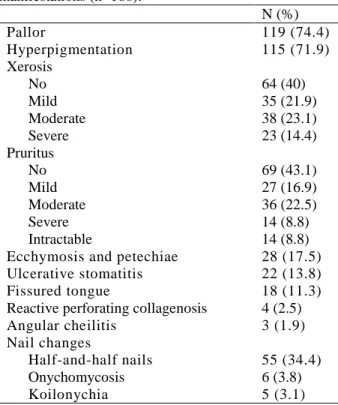
In our study at least one cutaneous manifestation was present in 100% of patients. Table 1 shows the frequency of different dermatoses in this study. Pallor and hyperpigmentation were the most frequent findings, present in 119 (74.4%) and 115 (71.9%) patients, respectively. Pruritus was present mildly in 27 (16.9%) cases, moderately in 36 (22.5%) cases, severely in 14 (8.8%) cases while intractable in 14 (8.8%) cases. Xerosis was present in majority (60% of cases), mildly present in 35 (21.9%) cases, moderately in 38 (23.8%) whereas severely in 23 (14.4%) cases.
Table 1 Frequency of different dermatological manifestations (n=160).
N (%)
Pallor 119 (74.4)
Hyperpigmentation 115 (71.9)
Xerosis
No 64 (40)
Mild 35 (21.9)
Moderate 38 (23.1)
Severe 23 (14.4)
Pruritus
No 69 (43.1)
Mild 27 (16.9)
Moderate 36 (22.5)
Severe 14 (8.8)
Intractable 14 (8.8)
Ecchymosis and petechiae 28 (17.5)
Ulcerative stomatitis 22 (13.8)
Fissured tongue 18 (11.3)
Reactive perforating collagenosis 4 (2.5)
Angular cheilitis 3 (1.9)
Nail changes
Half-and-half nails 55 (34.4)
Onychomycosis 6 (3.8)
Koilonychia 5 (3.1)
Amongst less frequent conditions, ecchymosis and petechiae were seen in 28 (17.5%), ulcerative stomatitis in 22 (13.8%), fissured tongue in 18 (11.3%), reactive perforating collagenosis in 4 (1.9) and angular cheilitis in 3 (1.9%) patients. Nail changes seen included half-and-half nails in 55 (34.4%) patients, onychomycosis in 6 (3.8%) and koilonychias in 5 (3.1%) patients.
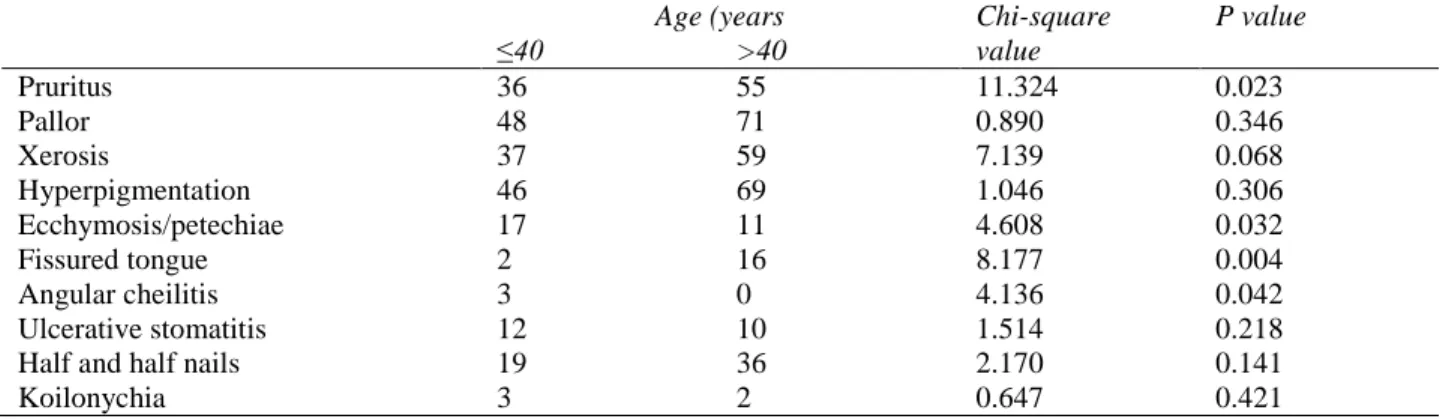
266 Table 2 Comparison of manifestations in different age groups (n=160).
Age (years Chi-square value
P value
≤40 >40
Pruritus 36 55 11.324 0.023
Pallor 48 71 0.890 0.346
Xerosis 37 59 7.139 0.068
Hyperpigmentation 46 69 1.046 0.306
Ecchymosis/petechiae 17 11 4.608 0.032
Fissured tongue 2 16 8.177 0.004
Angular cheilitis 3 0 4.136 0.042
Ulcerative stomatitis 12 10 1.514 0.218
Half and half nails 19 36 2.170 0.141
Koilonychia 3 2 0.647 0.421
Table 3 Comparison of manifestations in both genders (n=160).
Sex Chi-square
value
P value
Male Female
Pruritus 50 41 5.697 0.223
Pallor 65 54 0.500 0.479
Xerosis 52 44 4.164 0.244
Hyperpigmentation 67 48 0.672 0.412
Ecchymosis/petechiae 7 21 13.468 0.000
Fissured tongue 14 4 3.819 0.051
Angular cheilitis 1 2 0.652 0.419
Ulcerative stomatitis 7 15 6.187 0.013
Half-and-half nails 30 25 0.099 0.753
Koilonychias 2 3 0.554 0.457
Table 4 Comparison of manifestations according to duration of chronic kidney disease duration (n=160). Duration of disease Chi-square
value
P value ≥3years <3 years
Pruritus 60 31 6.645 0.156
Pallor 81 38 0.826 0.363
Xerosis 66 30 2.498 0.476
Hyperpigmentation 74 41 6.220 0.013
Ecchymosis/petechiae 20 8 0.033 0.856
Fissured tongue 14 4 0.584 0.445
Angular cheilitis 3 0 1.310 0.252
Ulcerative stomatitis 18 4 1.696 0.193
Half-and-half nails 33 22 3.991 0.046
Koilonychia 3 2 0.246 0.620
Considering the gender distribution of various manifestations (Table 3), pruritus, pallor, xerosis, hyperpigmentation, fissured tongue and nail changes showed more or less equal frequency in both sexes (P>0.05); however, ecchymosis/petechiae, angular stomatitis and ulcerative stomatitis were more frequent in female patients (P<0.05).
Table 4 shows the correlation between cutaneous manifestations and duration of CKD.
It was noted that only hyperpigmentation and half-and-half nails were more frequent in patients with CKD of ≥3 year duration (P<0.05).
Discussion
267 The purpose of all renal replacement techniques
including hemodialysis is to mimic the excretory functions of the normal kidney. These include excretion of nitrogenous wastes, maintenance of normal electrolyte concentrations and extracellular volume in the body.12,13
There is higher prevalence of cutaneous changes reported in patients undergoing hemodialysis. In our study at least one cutaneous manifestation was present in 100% of patients. A prospective study conducted on ‘dermatological manifestations in chronic renal failure patients on hemodialysis in Civil hospital, Karachi by Mirza et al.9 showed cutaneous changes in 96% of patients.
In present study, pallor (74.4%) was found to be the most common skin manifestation among CKD patients. In a study carried out by Udayakumar et al.14 pallor was observed in 60% of Indian patients, while only 45% of Egyptian patients in a study by Sultan et al.8 were pale. Pallor in CKD is due to anemia. Anemia is primarily the result of inadequate erythropoietin production by the failing kidneys. Other contributory factors of anemia in CKF patients include iron, folic acid or vitamin B12 deficiencies and decreased erythrocyte survival. The difference in frequency of pallor in our study may be due to different patient factors. Loss of appetite due to CKD may potentiate nutritional deficiencies. Socioeconomic conditions can be responsible for availability of erythropoietin, blood transfusions and a healthy diet in our region.
In our study, hyperpigmentation was seen in 71.9% of CKD patients. Mirza et al.9 and Sultan
et al.8 reported hyperpigmentation in 54% of patients in each study. Other studies reported a prevalence of hyperpigmentation 20-22%.15,16 In the present study, result of hyperpigmentation was higher than similar studies. Diffuse
hyperpigmentation seen on sun-exposed areas is attributed to an increase in melanin in the basal layer and superficial dermis due to failure of the kidneys to excrete beta melanocyte stimulating hormone (β-MSH). Sun exposure induced pigmentation is modified to some extent by socioeconomic, cultural, educational and living conditions. Exposure to hakeem medication may be a contributing factor.
Xerosis, in our study was observed in 60% of CKD patients while it was the most common cutaneous abnormality (79%) in study done by Udayakumar et al.14 Prevalence of xerosis observed in previous reports (46-90%)16,17,18 is comparable with our findings. While study by Mirza et al.9 demonstrated prevalence of xerosis in 96%, being the most common finding in that study. The factors that contribute to xerosis included a reduction in size and functional abnormalities of eccrine sweat glands, high doses of diuretics and alteration of vitamin A metabolism. The variation in finding can possibly be explained by different geographic, as well as, environmental conditions such as humidity and temperature.
In present study, pruritus was observed in 56.9% of patients. Pruritus was the most common cutaneous abnormality (55%) in Egyptian CKD patients on hemodialysis seen by Sultan et al.8 In Udayakumar et al.14 study, 53% of patients complained of pruritus. Our results are comparable with previous reports of pruritus. It is one of the most characteristic and annoying cutaneous symptoms of CRF. The etiology is multifactorial. It is not present in acute renal failure and does not necessarily subside with dialysis but improves to variable extent with kidney transplantation.
268 13.6% of patients by Mirza et al.9 The causes
may be due to defects in primary hemostasis like increased vascular fragility, abnormal platelet function and the use of heparin during dialysis.
Mucosal changes like ulcerative stomatitis was seen in 13.8% of our patients which was higher than the percentage (9%) seen in Egyptian patients by Sultan et al.8 Udayakumar et al.14 described 29% of patients with ulcerative stomatitis. Bad oral hygiene may contribute to mucosal changes in patients.
Fissured tongue was seen in 11.3% patients of our study, a feature not seen by Sultan et al.8 and Mirza et al.9 Angular chelitis was seen in only 1.9% of our patients while higher percentages were seen in Udayakumar et al.14 and Sultan et
al.8 as 12% and 15%, respectively.
In current study half-and-half nails were present in 34.4% of patients which is consistent with the finding in the study of Mirza et al.9 demonstrated half-and-half nail in 36.7% patients. 28% patients showed Lindsay nails in Egyptian patients in Sultan et al.8 study. The white appearance of proximal nail bed is due to nail bed edema associated with dilated capillaries.
Koilonychia was seen only in 3.1% of our patients. While 39% of patients had spoon shaped nails in study by Sultan et al.8
Other less common, specific manifestations of CKD patients on hemodialysis like acquired perforating disorders (1.3 % by Mirza et al.9), calciphylaxis (2% by Mirza et al.9), porphyria cutanea tarda and few others that were described in literature, only reactive perforating collagenosis was seen in our study in 2.7% frequency, 3.7% patients had onychomycosis. Further stratification has shown that RPC are more often seen in males and with relatively longer duration of CKD.
Conclusion
Chronic kidney disease is associated with a complex array of cutaneous manifestations caused either by the disease or by treatment. Pallor, hyperpigmentation and xerosis were the most common among patients with CKD, so early recognition of cutaneous signs could relieve suffering and decrease morbidity.
References
1. Goddard J, Turner AN, Stewart LH. Kidney and urinary tract disease. In: colledge NR, Brian RW, Ralston SH, eds. Davidson’s Principles and Practice of Medicine. 21st ed. Edinburgh; Churchill Livingstone, Elsevier; 2010. P. 459-519.
2. Watnick S, Dirkx T. Kidney disease. In:Papadakis M, Mcphee SJ, eds. Current Medical Diagnosis and Treatment. New York: McGraw-Hill; 2013. P. 898-936. 3. Sanai M, Aman S, Nadeem M, Kazmi AH.
Dermatologic manifestations in patients of renal disease on hemodialysis. J Pak Assoc Dermatol. 2010;20:163-8.
4. Luqman N, Khalid M, Shaheen JA. Cutaneous manifestations of chronic renal failure in Bahawalpur, Pakistan. J Pak Assoc Dermatol. 2012;22:219-23.
5. Deshmukh SP, Sharma YK, Dash K,
Chaudhari NC, Deo KS.
Clinicoepidemiological study of skin manifestations in patients of chronic renal failure on hemodialysis. Indian Dermatol Online J. 2013;4(1):18-21.
6. Markova A, Lester J, Wang J, Robinson‐ Bostom L. Diagnosis of common dermopathies in dialysis patients: a review and update. Semin Dial. 2012;25:408-18. 7. Hajheydari Z, Makhlough A. Cutaneous and
mucosal manifestations in patients on maintenance hemodialysis. Iran J Kidney Dis. 2008;2:86-90.
8. Sultan M, Mansour H, Wahby I, Houdry A. Cutaneous manifestations in Egyptian patients with chronic renal failure on regular hemodialysis. J Egypt Women Dermatol Soc. 2010;7:49-55.
269 10. Molin S, Ruzicka T. The skin and disorders
of the kidney and urinary tract. In: Griffiths CEM, Barker J, Bleiker T, Chalmers R, Creamer D, editors. Rook's Textbook of Dermatology, Eighth Edition. 2010:153.1-153.56.
11. Wesseling C, Crowe J, Hogstedt C, Jakobsson K, Lucas R, Wegman DH. The epidemic of chronic kidney disease of unknown etiology in Mesoamerica: a call for interdisciplinary research and action. Am J Public Health. 2013;103:1927-30.
12. Daugirdas J, Blake P, Ing T. Handbook of Dialysis, 3rd ed. Philadelphia: Lippincott Williams & Wilkins; 2001.
13. Sweeney S, Cropley T. Cutaneous changes in renal disorders. In: Freedberg I, Eisen A, Wolf K, Austen K, Goldsmith L, Katz S, editors. Fitzpatrick’s Dermatology in General Medicine, 6th edn. New York: McGraw-Hill; 2003. P. 1622-4.
14. Udayakumar P, Balasubramanian S, Ramalingam K, Lakshmi C, Srinivas C, Mathew AC. Cutaneous manifestations in patients with chronic renal failure on hemodialysis. Indian J Dermatol Venereol Leprol. 2006;72:119-25.
15. Pico M, Somolinos A. Cutaneous alterations in patients with chronic renal failure. Int J Dermatol. 1992;31:860-3.
16. Morton C, Lafferty M, Hau C, Henderson I, Jones M, Lowe J. Pruritus and skin hydration during dialysis. Nephron Dial Transplant. 1996;11:2031-6
17. Tawade N, Gokhale B, Dermatological manifestation of chronic renal failure. Indian J Dermatol Venerol Leprol. 1996;62:155-6. 18. Siddappa K, Nair B, Ravindra K, Siddesh E.