A Study on Indian Demonetization and its Impact
on Inflation
Ms. Pallabi Mukherjee
1, & Dr. Anita Ahuja
21
Assistant Prof, IPS Academy, IBMR, Indore, India
2,
Assistant Prof, IPS Academy, IBMR, Indore, India Abstract
This paper aims to identify the general impact of demonetization in the Indian Economy with special reference to its impact in the price level. Actual and expected trends of rural urban and combined along with index of agricultural laborer food group consumers price index were shown and concluded that deviations were there. During later part the residuals portrayed that actual indexes were less than the expected. The study was done mainly concerning around three hypotheses and the null hypothesis was put to test using paired and unequal variances “t” test. The study thus concluded that there was significant impact of demonetization on the agricultural laborer food group but not so significant impact on the combined consumers price index. Nevertheless results portrayed significant differences in means of consumers prices index among rural and urban India.
Key Words: Demonetization, Inflation, Consumers Price Index, Indian Legal Tender money.
Introduction
Demonetization has been a topic of discussion for one and all since it was implemented in November 2016. The withdrawal of the 500 and 1000 currency notes from the circulation by the Indian government created a shortage of cash in the market. It will not be inappropriate to call it the “scrapping” of certain currency notes from the system. As the Indian economy depends more on cash transactions the trade and consumption was greatly affected. The shortage of cash in the market created a lot of discomfort to the general masses. The daily wage workers, small business men and households had to struggle the most. It
P a g e | 409
supported this national mission whereas that was not totally true in the case of 1978.Shri IG Patel in his famous book “ Glimpses of Indian Economic Policy: an Insider’s View” has written the cons of the policy changes. In more extension of the past later, Rs. 500 and Rs. 1000 came into being in October 1987 and November 2000, respectively. This introduction of currency noted was justified as an attempt to contain the volume of banknotes in circulation due to inflation. The “shock doctrine” of Prime Minister Narendra Modi which was introduced in November 2016 was to cleanse the country from the black market and further digitize the economy. More than eighty six percent of the currency was in attempt of being converted into legitimate, taxable and visible currency by the government.
An instantaneous public anger emerged in contradiction of the mishandled and impromptu banking system. The banks didn’t have sufficient of the afresh devised banknotes (Rs 500 and Rs 2000) to allocate in altercation for the irrecoverable notes. The insertion of newly printed notes of 500 and 2000 denomination were slow in the market and it affected the cash depended Indian economy in many ways. Currently a lot of debate is going on regarding the real impact of demonetization on the Indian Economy and it is too early to decide or estimate the final impact of demonetization on the Indian Economy. Every economic event whether or not deliberate has both positive and negative impact. This move has definitely hit hard the Indian
commerce and informal economy. The real estate has been affected great deal including other demand and consumption scenario. Trade across sectors has also been affected with an impact o agriculture etc. Statistics has given proof of job losses for the mass poor due to their involvement in the informal sector that is majorly cash driven. Illegal activities like hawala and terrorist bankrolling has been stopped specially after the announcement on 8th November 2016.This was for sure a sharp yet repairing move for the Economy. One of the main expectations by the government is the reduction in black marketing, corruption and tax evasion by the people washing the economic dirt and augmenting transparency. In general impact real estate, inflation construction and fast moving consumer goods have been a little effected with the deferring consumption requirements of the consumers.
Some Striking Features
Vedashree Mali,2016 in her study stated the general impact of Demonetization in the Indian Economy and assured that in spite of short term adverse effects in the Economy Demonetization will ultimately benefit the country and hence its impacts should be very well assessed in the long term.
Kukreja and Mukherjee , 2017 in their study stated the impact of demonetization in the Real Estate and the Prime Ministers prime motive of the policy implication.Their study showed long term impact of demonetization on the real estate wil be positive for the mass population and will further decrease the prices of the property in the country and hence fulfill once of the goalmouths of Shri Narendra Modi that is Housing For All.
Sandeep Kaur,2016 has given an arithmetic of demonetization in the Indian Economy and has shown its impact specially on balck money, corruption, real estate and elections.He has further shown impacts on the Bullion market, digital payments ,interest rates , inflation and GDP respectively. The author further concluded that this economic event should be supported by all and will in the long term positively impact the economy.
Deepak Joshi, 2016 has discussed the elimination of forged currency through the process of demonetization in the Indian Economy .The author further stated how demonetization would lead to existence of a strong banking structure and further increase the tax collection of the Indian Government and
enable transparency in the Economy.Government is looking for more financial inclusions and wants to make rupee strong legal tender.
Impact of Demonetization on the Indian Inflation
The general price increase in the economy in one world is considered to be inflation in the economy which was preciously measured by calculating the Wholesale Price Index (WPI) in Indian Economy. The RBI later in 2011 started using the Consumers Price Index (CPI) as the main gauge for measuring inflation in the economy. The Reserve Bank is responsible to maintain price stability in the economy or put the inflation on check and hence is responsible for policy changes in turn to enable stability in prices in the Economy. In his speech Shri Arvind Panagariya (Vice Chairman of NITI Aayog) stated that the governments decision to demonetize economy will bring down inflation in the economy as a whole. The sucking of liquidity from the economy accompanied by shortage of cash will in turn affect the consumption and demand in the economy and hence supply remaining the same the prices will automatically go down.
Data And Analysis
P a g e | 411
Rural, Urban and combined indexes. Further the indexes of agricultural food
group is also shown for the same time period.
Fig 1:Source: Data Compiled from RBI, Handbook on Indian Economy,2016
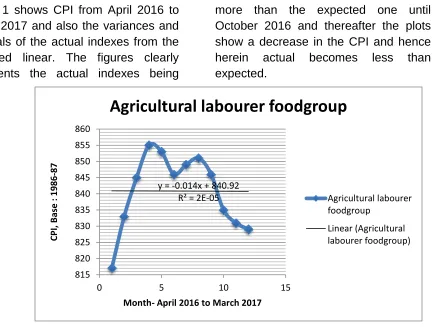
Figure 1 shows CPI from April 2016 to march 2017 and also the variances and residuals of the actual indexes from the expected linear. The figures clearly represents the actual indexes being
more than the expected one until October 2016 and thereafter the plots show a decrease in the CPI and hence herein actual becomes less than expected.
Fig 2:Source: Data Compiled from RBI, Handbook on Indian Economy,2016 y = 0.2297x + 130.93
R² = 0.3348
y = 0.1486x + 126.93 R² = 0.2748 y = 0.2056x + 128.95
R² = 0.3463
124 125 126 127 128 129 130 131 132 133 134 135
0 2 4 6 8 10 12 14
CPI,
B
ase:
2012
-
100
Month-April 2016 to March 2017
Consumers Price Index
Rural
Urban
Combined
Linear (Rural)
Linear (Urban)
Linear (Combined)
y = -0.014x + 840.92 R² = 2E-05
815 820 825 830 835 840 845 850 855 860
0 5 10 15
CPI,
B
ase
:
1986
-87
Month- April 2016 to March 2017
Agricultural labourer foodgroup
Agricultural labourer foodgroup
The data has been plotted from April 2016 to march 2017 and trends show an increase in agricultural food group index and a significant decrease thereafter.
It is although too early to estimate the impact of demonetization on Indian Inflation but further in this paper we have estimated the impact of demonetization on the consumers price index.To do the Following we have formulated three hypothesis.
Hypothesis
1) H : There is no significant impact of Demonetization on the combined CPI.
H : There is significant impact of Demonetization on the combined CPI.
2) H : There is no significant impact of Demonetization on the Agricultural laborer food group.
H : There is Significant impact of Demonetization on the Agricultural laborer food group.
3) H : There is no significant difference between in Rural and Urban Indian CPI.
H : There is significant difference between in Rural and Urban Indian CPI.
1) To test null hypothesis one we have applied paired T test estimating the rates from April 2016 to October 2016 and further from November 2016 to March 2017 respectively.
Result 1:
Table 1
t-Test: Paired Two Sample for
Means 128.2 131.2
Mean 130.92 130.58
Variance 0.242 0.052
t Stat 1.730554435
t Critical two-tail 2.776445105
“t” calculated value is less than “t” book value and hence we accept the null hypothesis and conclude that there is no significant impact of demonetization on the combined CPI of India.
2) To test the null hypothesis two we have applied paired T test estimating the rates from April 2016 to October 2016 and further from November 2016 to March 2017 respectively.
P a g e | 413 Table 2
t-Test: Paired Two Sample for
Means Column1 Column2
833 851
Mean 849.6 833.6
Variance 18.8 56.8
t Stat 3.68034965
t Critical two-tail 2.776445105
“t” calculated value is greater than “t” book value and hence we reject the null hypothesis and accept the alternative hypothesis and conclude that there is significant impact of Demonetization on the Agricultural laborer food group.
3) To test the null hypothesis three we have applied T test of unequal variances between the changes in Consumers Price Index amongst the rural and urban India. The time period taken was from April 2016 to March 2017 respectively
4) .
Result 3:
Table 3
t-Test: Two-Sample Assuming Unequal
Variances Column1 Column2
129 125.3
Mean 132.7363636 128.1272727
Variance 0.974545455 0.416181818
t Stat 12.96255557
t Critical two-tail 2.109815578
“t” calculated value is greater than “t” book value and hence we reject the null hypothesis and accept the alternative hypothesis and conclude that there is significant difference between in Rural and Urban Indian Consumers Price Index.
Conclusion
The epic economic event has shaken the nation yet its very slowly showing its
altogether. There has been some decrease in prices and the current inflation in India is 3.2% approximately. Yet the major limitation of the paper is not enough data has been put to analysis because it is too early to discover and decide the true impact of demonetization on Indian Inflation. Yet with limited data and scope it is evident that maybe not very significant but somewhat changes have been noticed in price levels and prices have decreased in the Indian Economy after Demonetization. Further the paper also estimates that there has been notably significant differences in agricultural laborer food group before and after demonetization and also there exists differences in consumer price indexes in case of rural and urban India which is calculated for one year time period or twelve months. Nevertheless we need to wait and watch more to reap the fruits and actually determine the impact of demonetization in the Indian Economy altogether.
References:
[1] IG Patel , “ Glimpses of Indian Economic Policy: an Insider’s View” 15th Dec , 2003.
[2] Investopediahttp://www.investopedia .com/terms/d/demonetization.asp#ix zz4PhFwOAeH .
[3] http://www.dnaindia.com/analysis/col umn-this-is-a-new-indian-sunrise-2273153
[4] Sandeep Kaur, “Demonetization and Its Impacts in India,” in International Journal of Research (IJR) ISSN (Online) 2348-6848.
[5] http://economictimes.indiatimes.com/ news/economy/policy/move-to- demonetize-economy-will-help-bring-
down-inflation-arvind-panagariya/articleshow/55368242.c ms
[6] https://fronteranews.com/investing/c onsumption-inflation-bear-brunt-demonetization-india/
[7] www.rbi.org.in, handbook on Indian Economic statistics