ISSN 2286-4822 www.euacademic.org
Impact Factor: 3.4546 (UIF) DRJI Value: 5.9 (B+)
Adaptive Contourlet transform and Wavelet
transform based image Steganography using
Singular Value Decomposition
RAHUL MANE MANISH SHARMA Dept. of E&TC, D. Y. Patil College of Engineering
Akurdi, Pune India
Abstract:
Steganography is the science that deals with hiding of secret data in some carrier media which may be image, audio, formatted text or video. Different techniques are used for image steganography such as, one-dimensional Fourier and wavelet transforms, in capturing the geometry of image edges are well known and two-dimensional contourlet transform that can capture the intrinsic geometrical structure. This paper presents different techniques of image Steganography using Singular Value Decomposition (SVD). The measurement of the quality of the stego image depends on the PSNR, MSE and correlation for measuring the similarity between the cover image and the stego image. According to the experimental results, the PSNR value is improved due to the use of SVD.
Key words: Steganography, Fourier transform, Wavelet Transform,
Contourlet Transform, SVD.
I. Introduction:
that hides the presence of message itself. Data hiding can be achieved using various file formats such as image, text, audio, video etc. However, image is the most popular carrier for data hiding as it possesses high degree of redundancy. Image used for data embedding is known as cover image and the image with embedded data is stego image. The data to be embedded is known as payload. Steganography identifies the redundant bits in cover image. In this, cover image is modified without changing its integrity. Steganography is used in secure communications, owner identification, authentication and data embedding. When implementing a steganograph system, several properties must be observed, which are:
Imperceptibility: an embedded steganograph is truly imperceptible if a user cannot distinguish original from the steganographed version.
Robustness: It should not be possible to remove or alter the steganograph without compromising the quality of the host data.
Payload: the amount of information that can be stored in a steganograph.
Security: according to Kirckhoff‟s assumption, the choice of key governs the security of the encryption techniques. This assumption is also valid for steganograph techniques.
more robust compared to spatial domain ones. Transform domain techniques includes Discrete Cosine Transform (DCT), Discrete Fourier Transform (DFT), Discrete Wavelet Transform (DWT) etc. DWT is broadly used for digital Steganography.
The Contourlet transform [1] was proposed by M. N. Do and M. Vetterli. The contourlet transform provides a multi scale and multi-directional representation of an image. In [4], the authors introduced a new image decomposition scheme called CT which is more effective in representing smooth contours in different directions of an image than DWT. The study in [8] proposed a blind steganography algorithm in the translation invariant circular semantic contourlet transform (TICSCT) domain. Experimentation shows that this domain has higher capacity than wavelet and special domain and robustness and imperceptibility are improved.
Researchers developed a new filter bank based on non subsample contourlet and wavelet hybrid transform (NSCWHT) and study its application in [9]. They proposed a new image steganography based on developed NSCWHT. The work in [10] investigated the role of CT versus DWT in providing robust image steganography. Two measures are utilized in the comparison between wavelet based and contourlet based methods, peak signal to noise ratio (PSNR) and normalized cross correlation (NCC). A blind steganography algorithm is proposed in [6] in which extraction algorithm was designed as per maximum likelihood estimation. This paper carried on the static analysis to the high frequency subband coefficient of wavelet and contourlet transform. The extraction does not need original image neither does it need the original steganograph information.
transform, by using this transform in an image coding system, one can obtain better visual results.
II. Frequency Domain Techniques
In contrast to the special domain, frequency domain technique can embed more bits of steganograph and more robust to attacks, thus they are more attractive than special domain techniques.
a) Wavelet transform:
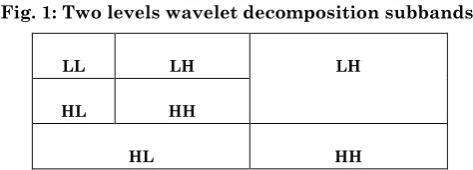
DWT for digital image is a mathematical formula which converts an image from special domain to frequency domain. The basic idea DWT of an image is described by decomposing a given image into four subbands (LL, HL, LH, and HH). LL is the lower resolution approximation image as well as horizontal HL, vertical LH and diagonal HH detail components. To obtain the next wavelet level for example the LL is further decomposed into another four subbands (LL, HL, LH, and HH). This decomposition can be repeated several times. Fig. shows the example of two levels wavelet decomposition subbband.
Fig. 1: Two levels wavelet decomposition subbands.
b) Contourlet Transform:
The Contourlet Transform (CT), proposed by Do and Vetterli [1][11], consists of a double iterated filter bank. First the Laplacian Pyramid (LP) is used to detect the discontinuities of the image and then a Directional Filter Bank (DFB) to link point discontinuities into linear structures. The general idea behind this image analysis scheme is the use of a wavelet-like
LL LH LH
HL HH
transform to detect the edges of an image and then the utilization of a local directional transform for contour segment detection. Contourlet decomposition is shown in Fig. 2.
Fig. 2. Contourlet decomposition, laplacian pyramid followed by directional filter bank.
The Directional Filter Bank implementation utilizes an l -level binary tree decomposition and leads to 2l directional subbands with wedge-shaped frequency partitioning. The Directional Filter Bank was designed to capture the high frequency content of an image, which represents its directionality.
c)SVD:
Singular value decomposition (SVD) can be looked at from three mutually compatible points of view. SVD is a method for identifying and ordering the dimensions along which data points exhibit the most variation. SVD can be seen as a method for data reduction.
SVD is based on a theorem from linear algebra which says that a rectangular matrix A can be broken down into the product of three matrices - an orthogonal matrix U, a diagonal matrix S, and the transpose of an orthogonal matrix V. The theorem is usually presented something like this:
*
*
TAmn
Umn Smm V nm
where UTU = I, VTV = I; the columns of U are orthonormal
eigenvectors of AAT , the columns of V are orthonormal
eigenvectors of ATA, and S is a diagonal matrix containing the
square roots of eigenvalues from U or V in descending order.
III. Proposed System
Embedding Algorithm Based on CT and SVD:
Step1: Read original image and decompose it by applying CT to get subbands. Choose one of subbands to embed steganograph image on it.
Step2: Read the secrete image and convert it into gray scale image.
Step3: Apply SVD on both original and secrete image.
Step4: To hide a secrete image into original image, embedding formula with alfa factor is used.
( ,1)
( ,1) (
( ,1) * )
Tds i
Cs i
Ls i
Extracting Algorithm Based on CT and SVD:
Step1: Decompose steganographed image which is obtained from embedding algorithm by applying ICT.
Step2: Read the steganograph image and apply SVD on it.
( , )
(
( ,1)
( ,1)) /
Es i i
Ws i
Cs i
Step 3: Stego image quality is evaluated using the following parameters:
1. Root mean square error (RMSE): RMSE is one the ways to quantify the difference between cover image C(i, j) and stego image S(i, j). It is given by:
21 1
1 N M
ij ij i j
RMSE C S
MN
where N × M=image size, Cij = cover image, Sij=stego image.
quality of stego image. Here, the signal is original cover image and the noise is the error introduced due to embedding. It is given by,
10
255
20
log
PSNR dB
RMSE
Step 4: Compare it with the wavelet transform.
IV. Simulation Results:
To evaluate performance of this method number of simulations were carried out. The original image is 512x512 gray scale images. For the contourlet transform, in the LP stage uses the “9-7” filters. Choose “9-7” biorthogonal filters because they have been shown to provide the best results for images, partly because they are linear phase and are close to being orthogonal.
cover image(512 X 512) Hidden image (256 X 256)
Fig. 3: Original image and Cover image
Retained coefficients
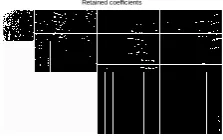
Fig. 4: Position of the retained coefficients
Fig.3. The image is transformed by contourlet transform to obtain a decomposition level in Fig.4.
Original image (512 X 512)
Hidden image (256 X 256)
CT Reconstructed image ( PSNR :93.010592)
Fig.5: Steganography for the original image
WT watermarked image (PSNR :10.808284)
CT watermarked image (PSNR = 12.166923 dB)
Fig.6: Nonlinear approximation analysis using wavelet and Contourlet
(a). image1
WT watermarked image (PSNR :10.438284)
CT watermarked image (PSNR = 13.090670 dB)
Fig.7: Nonlinear approximation analysis using wavelet and Contourlet
WT watermarked image (PSNR :11.438284)
CT watermarked image (PSNR = 14.444596 dB)
Fig.6: Nonlinear approximation analysis using wavelet and Contourlet
(c). image3
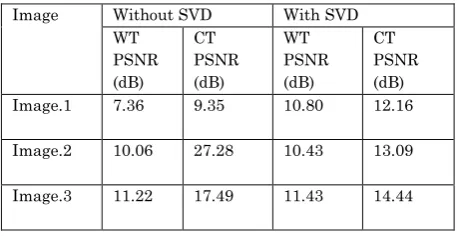
The Peak Signal to Noise Ratio (PSNR) is popularly used to measure the similarity between the original image and the watermarked image, while higher PSNR usually implies higher fidelity of the watermarked image. The watermarked image obtained using proposed scheme have a PSNR value of 12.16dB which is higher than the value obtained using wavelet transform method fig.6.
Table 1 gives the Peak Signal to Noise Ratio of the proposed method tested with various host images.
Conclusion:
This paper presents WT and CT techniques of image steganography and comparing that techniques based on quality
Image Without SVD With SVD WT
PSNR (dB)
CT PSNR (dB)
WT PSNR (dB)
CT PSNR (dB) Image.1 7.36 9.35 10.80 12.16
Image.2 10.06 27.28 10.43 13.09
of stego image. Embedding encrypted steganograph to high frequency subbands allows high performance steganograph extraction. By increasing the levels of decomposition for the steganographed image, the resistance against the attacks & the quality of extracted steganograph can be improved. Contourlet transform provides multiscale and multiresolution expansion for images with smooth contours and rich in directional details. The contourlet transform uses the directional filter bank and provide shift invariant directional multi resolution. The contourlet transform and SVD achieve a better enhancement result.
Acknowledgement:
I would like to specially thank Head of Department, E&TC, Dr. D. G. Khairnar for his whole hearted co-operation, suggestion and technical guidance throughout the work.
REFERENCES:
[1] M. N. Do, M. Vetterli, “The contourlet transform: An efficient directional multiresolution image representation”, IEEE Trans. On Image Processing, vol. 14, no. 6, pp. 760-769, 2005.
[2] P. J. Burt and E. H. Adelson, “The Laplacian pyramid as a compact image code”,IEEE Trans. Commun., vol. 31, no. 4, pp. 532540 Apr. 1983.
[3] R. H. Bamberger and M. J. T. Smith. “A filter bank for the directional decomposition of images: theory and design”, IEEE Trans. on Signal.Processing, 40:882-893, April 1992.
[5] Rosanne English, “Comparison of High Capacity Steganography Techniques”, IEEE, International Conference of Soft Computing and Pattern Recognition, 978-1-4244-7896-2, 2010.
[6] S.K.Muttoo,Sushil Kumar, “A Multilayered Secure, Robust and High Capacity Image Steganographic Algorithm”, IEEE, 3rd International Conference on Communication Systems Software and Middleware and Workshops, COMSWARE, 2008. [7] C. Liu and S. Liao, “High-performance JPEG steg-anography using complementary embedding strategy”, Pattern Recognition, Vol. 41, pp. 2945–2955, 2008.
[8] Zaynab Najeeb Abdulhameed, Prof. Maher K. Mahmood, “high capacity steganography based on chaos and contourlet transform for hiding multimedia data”, (IJECET), Volume 5, Issue 1, 2014.
[9] Seyyed Mohammad Reza Farschi · H. Farschi, “A novel chaotic approach for information hiding in image”, Nonlinear Dyn, Springer, 2012.
[10] Minh N. Do and Martin Vetterli, ( Fellow IEEE), “The Contourlet Transform: An Efficient Directional Multiresolution Image Representation”, IEEE Transactions On Image processing, Vol.14, No.12, December 2005.
[11] Duncan D.-Y. Po and Minh N. Do( Member IEEE), “Directional Multiscale Modeling of Images using the Contourlet Transform”, Vol.15, Issue 6, IEEE Transactions On Image Processing, 2006.