EVALUATION OF LOGICAL FRAMEWORK APPROACH AND ITS EFFECT ON STAKEHOLDER PARTICIPATION IN THE DESIGN AND EXECUTION OF PROJECTS. (A Case of Economic Stimulus Programmes in Nairobi County)
LUCY lVIUTHONJ NUTHU D53/0L120843/2010
A Research Project Submitted in Partial Fulfillment for the Requirements for the Award of Degree of Master of Business Administration (Project Management), School ofBusiness, Kenyatta University
JUNE 2013 Nuthu,Lucy Muthoni Evaluation oflogical framework approach
DE CLARA TION
This research project is my original work and has not been presented for
a
degree in any other university or for any other award.Signature:~---,~ Date: LUCY MUTRONI NUTHU
This research project has been submitted with my approval as the university supervisor.
Signature: ~.
Ms ROSEMARY JAMES
Date:~·
Department of Management Science School of Business
Kenyatta University
This research project has been approved by the department of management science on behalf of the School of Business.
\
Signature: -=~'_..:_""__ __
GLADYS KlMUT
AI Chairperson,
Department of Management ScienceDEDICATION
ACKNOWLEDGEMENT
I would like to acknowledge my Supervisor Ms Rosemary James for having given me helpful instructions and guidance on how to develop this project report. I acknowledge also my
colleague Mr Daniel Makori for his useful advice on research methodology and interpretation of research concepts.
ABSTRACT
Table of Contents
Declaration '" (ii)
Dedication , , (iii)
Acknowledgement (iv)
Abstract , (v)
Table ofcontents '" (vi- viii)
List of tables '" (ix)
List offigures '" ... ... ... ... .... .. ... (x)
Acronymns , .., , (xi)
Chapter 1: Introduction
1.0
Background of the study1
1.1.1 Economic Stimulus Programmes 4
1.2 Problem Statement.. 5
1.3 Objectives of the study '" 6
1.4Research Questions 7
1.5Significance of the Study... 8
1.6 Scope of the study. ... ... ... ... ... ... ... . ... .. ... ... ... ... ... ... . ... 8
1.7 Limitations of the Study , 8
1.8 Assumptions of the Study 8
1.9Organisation of the study 9
Chapter 2. Literature Review ...•...•...•....•....••...•..•..•...•••.••..••.••... 10
2.0 Introduction 10
2.1
Theoretical framework. "... 102.1.1
Logic Models 102.1.2 Logframe matrix '" 12
2.1.3 Monitoring and Evaluation theory '"
16
2.1.4 Goal Setting theory '" : 18
2.1.5
Management by Objectives " .."." '" "." ,,,.,, , "18
2.1.6
Stakeholder Theory2
0
2.1
.7
Community Empowerment and Capacity Development... .... .. .. .21
2.2Empirical Studies , ., 24
2.3 Summary 27
2.4 Critical Review and research gaps 27
2.5 Conceptual Framework 27
Chapter 3:Research Methodology
...•...
.
...
30
3.0 Introduction , '" 30
3.1 Research design '" '" .30
3.2 Target population 30
3.3 Sampling design , ..31
3.4Data collection Instruments : 32
3.4.1 Validity and Reliability
3.5 Data analysis and presentation '" ., '" .33
Chapter 4: Data Analysis, Presentation and Interpretation ...•...•....••.•..••••
•
..
_
.
.3
4
4.0Introduction 34
4.1 Quantitative Analysis , , , , .34-53
4.2 Qualitative Analysis 54-55
Chapter 5: Summary of Fi
n
dings
,
Co
nc
l
us
io
n
and Recommendations ...••••.
•
•.
•
...•..
•
..
56
5.1 Summary of Findings 56-57
5.2 Conclusion 57
5.3 Recommendations 58
5.4 Suggestions for further research '" 59
References 60-62
Appendices
Appendix 1:Questionnaire 63-67
Appendix 2:Letter of authorization for data collection
List of Tables
Table 3.2: Target population 31
Table 3.3: Sampling matrix , '" '" __ 32
Table 4.1 response rate '" 34
Table 4.2 time duration in committee 35
Table 4.3 Age of respondent.. 36
Table 4A Respondents role '" , .37
Table 4.5 Type of project.. 38
Table 4.6 Opinion on whether project meets community needs 39
Table 4.7 Local Community Involvement. AO
Table 4.8 Project location .41
Table 4.9 Project Suitability , ..'" ..42
Table 4.10 Involvement of general population 43
Table 4.11 Community knowledge and skills '" A4
Table 4.12 Agreement of stakeholders '" A5
Table 4.13 Schedule performance '" : 47
Table 4.14 Project milestones , '" A7
Table 4.15 Community involvement.. , '" ...48
Table 4.16 Review of milestones A9
Table 4.17 Changing of milestones .50
Table 4.18 Project Logframe '" 51
Table 4.19 Items in project framework '" '" 52
Table 4.20 Logfame in M&E , ". .. 52
List of Figures
Figure 2.1.1: Logic Models , 10
Figure 2.1.2: Logframe matrix __ 15
Figure 2.1.6: Stakeholder typology , 20
Figure 2.5: Conceptual Framework , 29
Figure 4.1 Response rate 35
Figure 4.2 time duration in committee '" 35
Figure 4.3 Age of respondent.. 36
Figure 4.4 Respondents role , 38
Figure 4.5 Type of project , 39
Figure 4.6 Opinion on whether project meets community needs .40
Figure 4.7 Local Community Involvement.. .40
Figure 4.8 Project location , '" , '" ,...42
Figure 4.9 Project Suitability : , .43
Figure 4.10 Involvement of general population , , .44
Figure 4.11 Community knowledge and skills 45
Figure 4.12 Agreement of stakeholders .46
Figure 4.13 Schedule performance '" .47
Figure 4.14 Project milestones .47
Figure 4.15 Community involvement 49
Figure 4.16 Review of milestones .49
Figure 4.17 Changing of milestones 50
Figure 4.18 Project Logframe "' 51
Figure 4.19 Items in project framework. ; , .52
Figure 4.20 Logfame in M&E 53
ABBREVIA TIONS AND ACRONThINS
AusAID Australian Government Overseas Aid Program
CIDA ,'" Canadian International Development Agency
DANIDA Danish International Development Agency
DFID Department for International Development- United Kingdom
ESP Economic Stimulus Programmes or package
IFAD , International Fund for Agricultural Development
KARl. Kenya Agricultural Research Institute
LFA Logical Framework Approach
OEeD Organisation for Economic Co-operation and Development
OOPP Objective Oriented Project Planning
PSR&DS The Public Service Reform and Development Secretariat
RBM Results Based Management
ROA Results Oriented Assistance
RRI Rapid Results Initiatives
SIDA , '" Sweetish International Development Agency
UNDAF United Nations Development Assistance Fund
UNDP United Nations Development Programme
CHAPTER ONE:
INTRODUCTION
1.1 Background of the Study
Project management is the application of knowledge,
skills, tools and techniques to project
activities to meet project requirements (Kloppenborg,
2009).
One of these tools is the Logical
Framework Approach (LFA).
Project management tools are devices for keeping track of activities,
performance, risks,
schedules!
deadlines,
budgets and resources on a project.
They're usually visual tools designed to
represent the goals and activities of a project and responsibilities of those working on various
stages of a project.
(Milosevic,
2003)
Project management tools will be used at all the phases of the project which include initiation,
planning, execution,
monitoring and control, and lastly project close.
There are those tools that
will be used at the initiation stage to enable legitimate project mandate and design, others at the
planning stage to determine the project scope, schedules, project resource/budget.
At the
execution stage are tools used for effective team management, project risk management,
project
communication and stakeholder management, project monitoring,
control and evaluation, and
project change management.
At the closing phase,
tools
are used to enable effective feedback on
the project undertaking, acceptance and handover ofthe project to the clients of beneficiaries and
to docmnent on lessons learned.
LFA is a valuable and versatile tool as it will be used in all the phases of the project cycle.
It is a
versatile tool of managing projects because it can be used to structure complex projects and
ensure consistency in planning of complex projects,
itbecomes a reference point in
implementation, highlights linkages between project elements and external factors and
stakeholders and provides a basis for systematic monitoring and evaluation of the effects of
L
F
A is a Result Ba
s
ed
Ma
nagement
(
REM
)
tool for the s
y
stematic management o
f
project
s a
nd
pro
g
rammes
.
It focuses not only on activ
i
ties like other tools
,
but also on results
.
LFA pro
v
id
e
s
th
e
tool for logica
l
ly estab
l
ishing project objectives and defining their causal relationships
.
It
de
scri
bes e
x
t
e
rnal factors that influence success
:
as
s
umptions for implementation and
the
risks
confronting the project
/
programm
e
.
T
h
e
toola
l
so supports r
e
gular monitoring and e
v
aluat
i
on
t
hrough the identi
f
ication of
ver
i
fi
able
a
nd measur
a
ble ind
i
c
a
tor
s
that help d
e
t
e
rmine
w
hether
objec
tiv
es have in fact been met
.
It also entails st
a
keholder in
v
olvement to ensure proje
c
t or
programme relevance and su
s
tainab
i
lity
.
(Ortengren
,
2004
)
.
The Log
i
cal
F
ramework Approach is a project desi
g
n
methodologythat in
v
olves problem
an
a
l
y
s
i
s
;
anal
y
sin
g
of an existing problem
,
its l
i
nkages to other problems and i
ts
rea
s
o
n
s and
e
f
fects
.
Stakeholder analys
i
s
;
an over
v
iew of all persons
,
g
r
oup
s,
institutions that a
r
e affect
e
d b
y
th
e
project
.
Goal and objectiv
e
s analy
s
i
s;
a d
e
script
i
on of the
f
u
t
ur
e
situa
t
ion and d
ev
elop
i
ng a
n
obj
e
ctive hierarchy
,
and selecting a preferred implementation strategy
.(
Dale
,
2003
)
.
The product
of th
is a
n
a
l
y
tical approach is the matrix (the Logframe), which summarises wbat the project
intends to do and how
,
what the key a
s
sumptions are
,
and how outputs and outcomes will be
mon
i
tored and e
v
aluated
.
The logical framework or log
f
rame d
e
ri
v
es its name from the logi
c
al
lin
ka
g
es
set out by the plann
e
r to connect a project
'
s inputs with it
s
ends
.
The
logframe
w
as
'
o
ri
ginall
y
de
v
e
l
oped
in th
e
e
a
rly 1
960
' s by the U
ni
t
ed
State
s D
epartm
e
nt of
Defense to enhance its capability in monitoring and evaluation of humanitari
a
n assistance
programs a
s
a response to the need to reduce the department
'
s budget without jeopardizing
secur
i
ty
. I
t was later adopted by the United States Agency for International Developme
n
t i
n
the
late 1960s as a standardiz
e
d planning mod
e
l
.
Th
is
was in response to poor plann
i
ng a
n
d
monitoring of development projects
.
Since then
,
it has been applied and modified b
y m
a
ny
bilateral donors, including Germany, the United Kingdom, the
E
uropean Union
,
Canad
a
,
and
Australia
.
It is used by a number of development agencies
,
such as the European Union
,
the US
A
ge
nc
y
for International Development (USAID
)
,
the U
K's
Department
f
or Intern
a
t
i
o
n
a
l
De
v
elopment
(
D
F
ID
),
the
Canadian International
De
v
elopment
Agenc
y
(
CID
A),
the
Evaluation and the Australian Government Overseas Aid Program (Ausi\lD) the UN agencies
and many others for effective planning, design, implementation, monitoring and evaluation of
projects/programs. (Gasper, 2000)
Since the 1960's LFA has evolved from a simple framework for structuring project objectives to
a more sophisticated, process-orientated approach for involving stakeholders in project design
and management.
Many international donors require projects they fund to be designed according to a Logical
framework approach. According to Swedish international development Agency (SIDA 2004), the
Logical Framework Approach (LFA) is important and useful tool because it is analytical,
presentational and helps planners and managers to, analyse the existing situation during project
preparation, and to establish a logical hierarchy of means by which objectives wiJlbe reached.
According to the World Bank logframe Handbook, (2000) the logical framework should be used
as a core reference document throughout the entire project management cycle. The framework
has been used at the world bank since 1997 when it became a standard attachment to the project
appraisal document for investment operations.
The Kenyan Government adopted the Rapid Results Initiative (RRI) approach as one of the key
. - .
tools in implementing Results Based Management in the Public Service in 2004. (Obong'o
2007). This was out of the need to improve service delivery and demonstrate reform gains from
the implementation of the Economic Recovery Strategy. This strategy came into being in 2003
with the National Rainbow Coalition (NARC) government as an initiative to reverse decades of
slow and stagnant economic growth.
RRl
was first introduced in Kenya on a pilot basis in 2004through partnership between the Government of Kenya and the World Bank. The Public Service
Reform and Development Secretariat (PSR&DS) was established in 2004 with the mandate to
coordinate all public sector reforms and mainstream Results Based Management (RBM) in the
Public Service.(Obong'o 2007) The LFA has increasingly been used by the government and
consultants in many devolved funds projects undertakings to ensure logical and orderly
implementation of the RRI and RBM. The ESPs particularly have adopted the use of LFA for
e
asi
er managemen
t
of the project
s w
hich are e
x
pected to be
a
c
co
mpl
is
hed
w
ith
in a
sho
rt ti
m
e
frame of one
y
ear
.
1.1.1 Economic Stimulus Programmes or Packages
E
conomic stimulus is a term used to define a situation
w
he
r
e the go
v
ernment ch
ang
es its fiscal
pol
i
cy of spending and taxation in order to bolster and re
v
i
v
e an economy that is in
a
recess
i
on
.
The gove
r
nment initiates measures designed to help the economy by encouraging con
s
umer
spend
ing.
The underlying theory is that when con
s
umers spend more, a recessio
n c
an be
reversed
.
These investments focu
s
on sectors that will gen
e
rate maximum bene
fi
t and creat
e
employment
.
The government of Kenya under the
2009/2010budget initiated an
E
conomic
Stimu
l
us
P
rogramme that sought to re
v
italize the econom
y
at the constituency level
.
T
he budget
titled
'
Overcoming Tod
ay
'
s Ch
a
llenges for a Better
K
en
y
a
T
omorrow
',
aimed
at
urgentl
y
j
umps
t
art
i
ng the Kenyan econom
y
towards long-term gro
w
th and development part
i
cularly in the
wake o
f
the
2007/08post-el
e
ction violence that negati
ve
l
y
affected the Ken
y
an econo
my
,
t
he
pro
l
onged drought, decline o
f
remittances from Kenyans in th
e
Diaspora
,
the
2008/09g
lobal
economic rec
e
ssion which had n
e
gative shocks on economie
s
,
Keny
a includ
e
d
.
T
h
e
government
allocated a total budget of Kshs
.
22billion for the Economic stimulus programme
.
The s
t
imulus
wa
s
aimed at adjusting the decline in the economic growth rate from 7
.
1% in 2007
t
o
1
.
7
%
in
.
2
00
9.
(GOK 200
9).
Th
e E
SP proj
e
cts
we
re t
o
be ma
n
a
g
ed
usi
ng the a
l
read
y ex
i
stin
g
st
r
uct
ur
al
framework of the Community Development Fund Committee (CDFC)
The object
i
ve of the stimulus were to; boost the country
'
s economic reco
v
ery
,
return
e
conom
y
to
the envisioned medium term growth path
,
invest in long term solutions to food s
e
curity
,
e
x
pand
rural economic opportunities for employment creation
,
promote re
g
ional development fo
r
equit
y
and soc
ia
l stabil
i
ty, improve infrastructure, quality of education, healthcare for all
K
en
y
ans
,
in
v
est in en
v
ironmental conservation
,
expand access
t
o and bui
l
d
l
eT capac
i
ty
in
ord
er
to
e
xpand econom
i
c opportunit
ie
s and accelerate econom
i
c
g
ro
w
th.
Acti
vi
ties co
v
ered under the
E
SP include expansion of irriga
ti
on-ba
s
ed agricul
t
ure
,
co
nst
ruc
t
ion
centers and roads
,
tapping into human capital resources to contribute to social welfare
impro
v
ement and achievement of the Millenium development goals.(MDGs)
The ESP governance structure consists of
;
the Ministry of Finance that coordinates at the
national level
,
ministry of public works in charge of all construction
.
At constituency level
.
projects are managed either by the District Infrastructure Coordination Team for all education
projects
,
or the Stimulus Project Management Committee [SPMC] which manages projects in all
the other sectors
.
The SPMC is constituted by the CD
F
C
.
The SPMC is responsible for identifying the appropriate location
of the
project;
making
recommendations for payments in consultation with relevant and technical Ministries to the
Distri
c
t Accountant,
through
the Constituency Development fund committee (CDFC)
;
and
Monitoring the implementation of ESP projects.
The SPMC is composed of the Member of Parliament as the patron, District Commissioner
,
District Development Officer, The District Public Works Officer, The CDFC
Chairperson,
CDFC Secretary and CDFC Treasurer, District Accountant,
all Departmental Heads under
whose docket the various projects fall
,
one
person representing religious organizations in that
constituency, two men representatives from that constituency, two women representatives from
that constituency, two persons representing the youth, and the CDFC Fund Account Manager as
'
the focal point for information regarding ESP projects
.
1
.
2 Problem
Statement
Since the Kenyan government introduced the Results Based approach in the management of its
projects and programs LFA has been increasingly adopted as a tool of managing the projects
howe
v
er
,
in some cases it has not been appropriately utilized as is the case with ESP
projects
.
(Omolo, 2010)
Problems have been experienced in community stakeholder involvement, their contribution in
the setting and review of project objectives
,
and their participation in the design of elaborate
logframesto guide in monitoring and evaluation of the projects
.
Challenges have been experienced when incorporating all the views and interests of the ESP
stakeholders who like in many other public sector development projects may be very diverse.
According to The Institute of Social Accountability TISA,
(2010), there is low community
awareness and involvement
in
the projects funded by ESP.
The origin of this problem can be
traced from the national office where initial plans
were
drawn without wide consultation with
organs representing the people.
Additionally, the ESP governance structure that was developed
does not adequately provide for citizens involvement in the projects.
Setting of goals and objectives for ESP projects becomes complicated due to the differing
perceptions among stakeholders as to what problems the project seeks to address. Additionally,
the objectives set have not been regularly reviewed in order to make adjustments occasioned by
changes in the external environment and shifting priorities of the stakeholders. (Ufadhili Trust,
Shelter Forum 2010)
There have been difficulties for the stakeholders in the monitoring and evaluation of the projects
due to lack of verifiable indicators of project progress. This is common in many ESP
implementation frameworks where the main objective or results is broadly stated
and the
monitoring team is expected to draw its smaller monitoring frameworks (ESP manual
2009/2010) which may not be congruent with the main intended achievements at different
stages. Lack of elaborate logframes has contributed to this
.
Presently some of the ESP projects that were actually launched in the year 2010 have not been
completed. (Ufadhili
et al)The study therefore sought to evaluate the effect of the Logical Framework Approach on
1.3 Objectives of the Stud)'
1.3.1General Objective
The general objective of the study was to evaluate the effect of the logical framework approach
in the design and execution of Economic Stimulus Projects (ESP).
1.3.2 Specific objectives
1. To assess the effect of stakeholders participation on project design and execution of ESP.
ll. To determine the effect of objective setting and review on project design and execution of
ESP.
111. To examine the influence of logframe matrix in project design and execution of ESP.
1.4 Research Questions
1. To what extent does stakeholder participation affect project design and execution of ESP?
11. What is the effect of objective setting and review on project design and execution of
ESP?
Ill. To what extent does the logframe matrix influence project design and execution of ESP?
1.5 Significance of the Study
The study findings were aimed to benefit various categories of people and organizations who
include and not limited to the foJlowing;
Staff in all the ESP implementing ministries; the findings are significant to managers as it will
assist them in strategy formulation of future projects. Other staff members will get a better
insight to the complexities of project design and execution.
ESP Committees; These will benefit from the findings and will use it as a reference and guide on
how to go about management of public sector projects in their constituencies.
The Kenyan Citizens; These would find the study beneficial as it reveals to them their role in the management of ESP projects and also raises stakeholder and citizenry activism.
Other researchers; the study can guide other prospective researchers in the same field or subject.
Future researchers will identify the gaps not addressed by this study and they are encouraged to undertake studies in order to fill up the gaps.
Donors and development aid partners of public sector projects; these agencies stand to benefit from the study in that they can gain contextual information about framework systems of the ESP projects and project management 'Africa Perspective' and they will be in a position to make informed decisions on the prospect of funding such initiatives.
Related institutions and agencies; the study is of relevance to other organisations practicing
forms of results based management or objective oriented management of their projects.
1.6 Scope of the Study
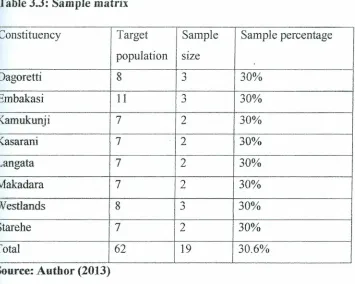
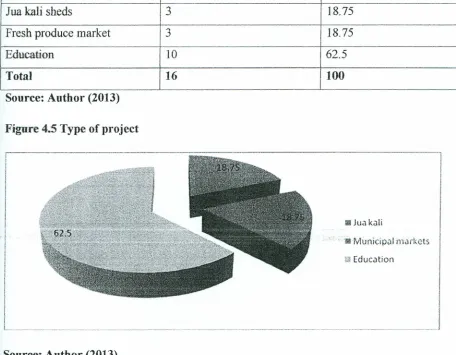
The study aimed at evaluating the logical framework approach and its effect on project design and execution of ESP projects in Nairobi County. These projects included school upgrading (education), fresh produce municipal markets(local government) and Jua Kali projects(industrialization) under the Economic Stimulus Programmes.
1.7 Limitations of the Study
1.7 Assumptions
of the
StudyThe assumptions of this study was that the management of ESP projects has adequate
, knowledge and experience in logical framework approach and /results based management
approaches. It also assumed that respondents would cooperate and provide the information
sought for in the study, and that the study would be completed within the projected time.
The results of the study were assumed to be capable of being generalized to all ESP
programmes.
1.8 Organisation of the Study
This research project this is organized in five chapters. Chapter one provides the background of
the study, the problem statement, the objectives of the study, significance of the study, the scope
of the study, and the assumptions and limitations of the study.
In chapter two, a review of the relevant literature to the study, both theoretical and empirical is
given. It also includes the critical review, research gaps and conceptual framework. Chapter three
outlines the research design used, the population and sampling design, the methods of data
collection and the methods that were used to analyse data from the study. Chapter four presents
the research findings and analyses data in two sections namely quantitative and qualitative
analysis. Chapter five provides a summary of the findings, conclusion and recommendations.
CHAPTER TWO:
LIT
E
RATUR
E
REVIE\V
2.0-Inu·oduction
T
h
i
s chapter
i
ncludes a theoret
i
cal re
vi
e
w
of pa
s
t
s
tudies b
y
other
a
uthor
s
and
s
chol
a
rs
an
d
empi
ri
cal rev
i
ew of other people
'
s studies, experiences and observation
.
The conceptua
l
f
r
am
ew
ork of the s
t
udy is also presented
.
2.1 Theoretical Review
2.1.1 Logic Models
Logi
ca
l framework is based on logic models and provides
.a pract
i
cal tool for the analy
s
is
,
design
,
managemen
t,
and refinement o
f
programm
e
s
.
Logic mod
e
ls seek to descr
i
be programme
theory
.
Chen
(
1990
)
describes programme theor
y
as
"
a specification of
w
hat mu
s
t be done to
achieve the desired goals
,
what other important impacts may also be anticipated
,
and how
t
hes
e
goals and impacts would be generated." Owen
,
(1999) notes that central to the no
t
ion o
f
log
i
c
models is the id
e
a o
f
programm
e
cau
s
ality
,
the ord
e
r
i
ng of e
v
ent
s
in such a
w
a
y
tha
t th
e p
resence
of one event or action leads to, or causes, a subsequent event or action
.
While this im
p
l
i
e
s a
.
l
in
ea
rity t
h
at
is i
n
co
ns
is
t
ent w
i
t
h
t
h
e co
mp
le
xities
o
f pro
g
r
a
m
me
des
i
g
n
and
i
m
ple
mentati
o
n
,
causa] thinking is th
e
basis for programme planning
,
wi
thout which th
e
re would
be n
o ba
s
is
f
o
r
developing interventions
.
Figure 2.1.1: General components of a logic model
Plenned inlllalille Intended results dinliative
Resource$/l
.
I---
-
i
I
H
Short-term Intermediate Lont'!. -terrnActivities
I
.
Outputs "Impacts ,.inputs
I
L--.J
I
I
outcomes outcomes outcomesLo
gic
mode
ls
graphicall
y
illu
s
trate pro
g
ram compon
e
nt
s,
a
n
d
creating
o
ne
h
elp
s pro
ject
sta
k
eho
l
d
e
rs clearly identif
y
outcomes
, i
nputs and activit
i
e
s.
Logi
c
Model
s
requ
i
r
e i
d
e
nt
i
f
ying
pr
og
r
a
m components
,
so you can see at a glance if outcome
s a
re out of s
y
nc with inp
ut
s
and
act
ivit
i
es,
b
ut t
he
y
don
'
t s
h
ow
w
h
y
acti
vi
t
ies a
r
e
expected to produ
c
e
out
comes
. Log
ic
models
a
re t
y
picall
y
diagram
s, fl
ow
s
he
e
ts
,
or some other t
y
p
e
o
f
vi
s
ua
l s
ch
e
mat
i
c
t
ha
t c
on
veys
relat
i
on
s
hips between contextual factors and programmatic input
s,
process
e
s
,
and out
c
o
me
s
(Owen, 1999).
Log
i
c mode
l
s can co
me
in al
l
shapes and sizes
:
bo
x
es
w
ith
c
onn
e
ct
i
n
g li
nes
t
ha
t are read from
le
f
t
to ri
ght (or top to botto
m);
circul
a
r loops with arrow
s
going
i
n or
o
ut
;
or
othe
r
vis
ua
l
meta
p
hor
s
and d
e
vice
s.
What these schemata ha
v
e in common are the
y
attempt to sho
w
t
he links
in a c
hain
of reasonin
g
about what causes what
,
in relationship to the desi
r
ed outco
me or goa
l
.
The des
i
red outcome or go
a
l is usuall
y
shown as the last
linkin the model
.
The ge
ner
al purpose of logic model
s
i
s
to provide a summary of the underlying log
ica
l
f
l
ow
related
to
thepl
a
nning
,
de
v
elopment
,
implementation, and
/
or evaluation of a
n i
ni
tiative
.
Accord
i
n
g
to W
.K
Kellog
L
o
g
ic model
guide(2001)
,
a program lo
g
ic m
o
d
e
l is a p
ict
ur
e
o
f how
the program works; the theor
y
and assumptions underlying th
e
program
.
The logic mod
el
pro
vi
d
e
s
a r
oadmap of the program
,
highlighting how it is expected to work
,
what ac
ti
v
i
t
ie
s
need
t
o
come bef
o
r
e ot
h
e
r
s
,
an
d how
de
si
red outcom
es a
r
e
a
c
hie
ved
Th
ey id
e
ntify an intervention
'
s
concep
t
u
a
l and operati
o
na
l
elements
,
and
i
ts intended outcom
e
s.
Application of logic models in the logical framework technique
The logical framewo
r
k technique
is
an e
x
ercise in structuring the
c
ompone
nt
e
l
e
m
ent
s
o
f a
project and analysing the internal and external coherence of the project
.
The product o
f thi
s
technique
,
the logical framework
,
is a formal matrix presentat
i
on of t
h
e interna
l
funct
ioning
of
the project
,
of the means fo
r
verifying the achievement of the
g
oal
, a
nd of the
int
ern
a
l
an
d
external factors conditioning its success
.
A
cc
o
r
ding to the Kellog
g
Found
a
tion
, (
2001
)
the logic mod
e
l has b
ec
o
m
e a use
fu
l
, gr
ap
hi
c
progra
m
management and e
va
luation tool in a world that ba
s
become increasingl
y vis
ua
l.
Logi
c
models can help project practitioners demonstrate the need for their programs, think through
what resources will be required to implement plans, and develop an evaluation process. A logic
model can also create a common language among program stakeholders - the program designers,
staff or practitioners, funders, participants, and community residents who have a stake in a
particular program.
By
creating logic models, project decision makers can gather informationand learn about programs as they evolve, and funders can better understand the logic behind a
grantee's program concept, the potential for its success, and the possible benefits of investment.
The logical framework (Logframe) helps to clarify objectives of any project, program, or policy.
It
aids in the identification of the expected causallinks; the program logic in the following resultchain: inputs, process, outputs including coverage or reach across beneficiary groups, outcomes
and impact.
It
leads to the identification of performance indicators at each stage in this chain, aswell as risks which might impede the attainment of objectives. The Logframe is also a vehicle
for engaging partners in clarifying objectives and designing activities. During implementation
the Logframe serves as a useful tool to review progress and take corrective action.
Kareko J and Sigel (2003) assert that the Logical Framework Approach (LFA) is an objective
oriented approach and depending on the agency or organistion may be refered by other terms
such as Objective Oriented Project Planning (OOPP) approaches, Results Based Management
(RB.1X1or Results Oriented Assistance)
(ROAt-
.
now being used by donor such as USAID andCanadian CIDA; such approaches place as much emphasis on management, monitoring and
evaluation of a project as it does on design. The key points of these methods are that they require
the participation of all key stakeholders and those who will be involved in implementing the
plan, they are objective and/or results oriented, i.e, they focus on what it is to be achieved, as well as on the immediate things that need to be done.
2.1.2 THE WGFRAME MATRIX
The logframe makes it possible to sum manse a complex project into a one or two page
document, making it clear for all stakeholders to understand the logic behind the intervention.
Stakeholder analysis: An overview of all persons, groups, institutions that are affected by the
project (direct and indirect beneficiaries, target groups, project staff, etc.). Problem analysis:
Analysis of an existing problem, its linkages to other problems and its reasons and etTects. A problem tree can be used as a visualisation method. Stakeholders give their contributions as to what they
th
i
nk
are the problems and theircausa
l
-
effe
ct
relationships; Goal analysis:A
description of the future situation. This analysis translates the negative situation outlined in the problem analysis into positive sentences or goals. Stakeholders provide their expectations or results to be achieved by the project intervention in solving the problem. These outcomes or
results expected are bound on and constrained by time frames; Alternative strategies analysis: This assesses different project strategies and helps to choose the most feasible approach. The analysis determines the activities to be undertaken in the project.
The logframe summarises the project and its context in a logical manner, so that the connection
between the activities (sometimes known as inputs) and the expected results (sometimes called outputs) can be seen.
According to Kareko and Sigel, (2003) the logical framework has both a vertical and a horizontal
logic. The vertical logic shows what the project intends to do, the relationships between what
will done and what will be achieved; the 'means to the ends', and it specifies the main risks and ,..assumptions. The vertical logic is an 'if'logic; it argues that ifwe.commit these inputs into this
activity and if the conditions remain the same as per our assumptions, then we will be able to achieve the intended output. The horizontal logic defines or shows how progress and performance will be monitored, and the sources of information for doing this.
Farrington and Nelson (1997) contends that an important aspect of using the logframe is knowing how to test its underlying logic. This is done by reading the logframe from bottom to top to
anal
y
ze the coherence of
itsarguments,
Fo
r
e
x
ample
,
the linkages betweenth
e
components of the matrix would be read as follows: if activities (as listed in column 1) are implemented, and the relevant assumptions are valid (4 column), then the project will achieve the outputs (column 1). If outputs are achieved and the related assumption remain valid the project
will achieve its purpose. If the purpose is achieved and the related assumption holds, then the
overall goal is achie
v
ed
.
The middle columns (2 and 3) show
w
hat and how to measure the
achievement of the summary at each level (see figure below), these are indicators and means of
verification
;
respectively
.
If at any point
,
the statements of inputs, activities, outputs, purpose
,
or
goal are not clearly related, or if essential information is missing, the logframe will fail in its
logic
.
The logical framework document is a (4 column by 4 row) matrix. The cells of the matri
x
contain text that describes the most important features of a project as shown in figure 2
.
The vertical logic presents an objective hierarchy that describes the project in a logical sequence.
It is broken down into the following components:
Goal or Long Term Objective
:
This is the expected
longterm impact of the
project.T
he Goal
describes a desired situation for the environment and/or people that the project
",;11
help to
achieve
.
Tbe
project will not
in
itself be able to achieve this goal
;
it will only contribute towards
it
.
Purpose (or Short-term Objective)
:
This describes the situations, conditions or bebaviour that
needs to be changed in order to contribute to the goal
.
This statement is what will be achieved by
the project
.
Outputs (sometimes referred to as Results): These are the tangible products or
services to be delivered, and for which those implementing the project can be held directly
accountable for producing. Activities: these are specific actions that must be undertaken to
achieve particular outputs e.g. baseline surveys, training courses, staff recruitment
,
infrastructure
de
v
elopmen
t
Inputs
:
The resources th
at a
r
e r
equired to carr
y
out acti
vit
i
e
s,
i
.
e
.
tech
n
olo
g
y,
Figure 2.1.2: The Log frame matrix
Intervention logic Objectively verifiable
indicatol"s(OVl)
to
are the What
Activities conditions
Sources and
means of
verification(MOV)
Assumptions
Overallobjectives What IS the overaU
objective to which the
project will
contribute(long term
impact)
What are the key
indicators related to the
overall objectives? The
quantitative and
qualitative indications
that objective is being
achieved.
Sources of
information for
these indicators
(evaluation
system)
Purpose What specific
objectives is the
project intended to
achieve? (effect)
Quantitative and
qualitative indicators that
purpose is being
achieved.
Sources of Which external
information that conditions are
exist or can be necessary to achieve
collected to show the objective?
that purpose IS Which risks should
being achieved be taken into
(evaluation consideration
system)
Output/expected
results
Expected results that Indicators related
lead to achievement of achievementof outputs
purpose (milestones
that need to be
achieved inthe life of
the project)
What activities will
lead toachievement of
the output and in
which sequence will
theybeundertaken?
Means/inputs
What means are required
to carry these activities.
Inputs eg supplies
equipment, personnel
Sources and
methods to be used
to collect the
,~,:!-r,
information
What external pre
-conditions must be
met to achieve
activities
The horizontal logic for a given level of objective (equivalent to a honzontal row of cells)shows how the achievement of the objective will be measured or verified, how this information will be
obtained, .and the external factors that could prevent the project manager .and staff from
achieving the next level objective. The rows depict the following: -(monitoring
system)
What
sources of have to be met
information about before
activity progress implementation of
(monitoring the project
system)
I
nd
i
cators: These are used to measure
t
he e
x
tent to
w
hich the di
f
ferent compo
n
en
t
s of
t
he
objecti
v
e h
i
erarchy are being ach
i
eved. Means of Verification
: T
hes
e
includ
e
the sources of
information that will show whether the indicators h
a
ve been achieved
.
This column
, w
i
t
h the
indi
c
ators colu
m
n
,
provides the basis for developing the monitoring and evaluat
i
on progra
mm
e
for the project.
Risks and Assumptions: These may af
f
ect whether the objecti
v
es are ac
hi
eved
.
Arisk is an external factor that may negatively influence the realization of objective(s
) w
h
ile an
as
s
ump
tion i
s the underl
y
ing hypothesis on which the cause-effect re
l
ationsh
i
p
i
s ba
s
ed
.
Ident
i
f
y
ing ris
k
s and assumptions helps to determin
e w
hat
is
under the dire
ct c
ontro
l of
management
,
what require
s
collaboration
w
ith other
s,
and what
i
s beyond the
i
n
f
lu
e
nc
e
o
f
t
h
e
managers and its stakeholders
.
Risks may be of two types
,
those that can be managed and tho
s
e
that a
r
e beyond the influence of managers.
2.1.3 Monitoring and Evaluation theory
A
cco
r
d
i
ng to Shapiro
J.(
2001) mon
i
tor
i
ng and eval
u
at
i
on are d
i
fferent Monito
ri
n
g is
t
he
systematic collection and analysis of information as a project progresses
.
It
is
aimed a
t
impro
v
ing the efficiency and effectiveness of a project or organisation.
It is based on target
s
set
and activ
i
ties planned during the planning phases of work It helps to keep the work on tr
a
c
k, a
nd
can let management know when things are going wrong
.
If done properly
,
it is an
inv
aluab
le to
o
l
f
or good managem
ent,
and
it
pro
vi
des
a
.
u
sef
u
l
b
ase
.
f
o
r eva
l
ua
t
i
o
n
.
.
.
I
t
,
e
n
a
b
les to determine
whether the resources available are suff
i
cient and is being wen used
,
whether the capacity
i
s
sufficient and appropriate
,
and whether practitioners are doing what they planned to do.
Evaluation is the comparison of actual project impacts against the agreed strat
e
gic plan
s.
It looks
at what was set out to do
,
what has been accomplished
,
and how it was accompl
i
shed
.
It c
a
n be
fo
r
mat
i
ve: taking place during the life of a project
,
with the intentio
n
of impro
v
ing the s
t
rat
e
g
y
or way of functioning of the project.
It can also be summat
iv
e
;
drawing le
ar
n
i
n
g f
rom
a
completed project that is no longer functioning
.
What monitoring and evaluat
i
on ha
v
e in
common is that they are geared towards focusing on eff
i
ciency, effectiveness and
i
mpact.
Throu
g
h monitoring and e
v
al
u
ation,
progress can be
r
e
vi
ewed
,
p
r
oblems in p
l
an
n
ing a
n
d
/
o
r
The Log Frame as anessential tool of monitoring and evaluation
Goodstadt (2005) contends that there is a strong relationship between planning and evaluation.
He argues that
program evaluation is so closely related to program planning
.thatevaluation can
be viewed as the "flip side' of program planning. That is,
program evaluation should directly
follow the program logic model that underlies the planning of an initiative.
Evaluation should
assess success in achieving the initiative's goals and objectives, success of its constituent
activities and processes
,
and the inter-relationships among an initiative's elements
,
as specified
in
its program logic model.
The Iogframe does prove to be an important tool in monitoring and evaluation
due to the
following reasons:
Column 3 on Information Sources: provides the evaluator with information as to how, where and
when data can be obtained.
Column 2 on OVI; indicates the qualitative and quantitative signals
that must exist or be experienced to indicate attainment of expected results i.e.
the input, process,
output and impact indicators to help arrive at verifiable conclusions on the projects progress
,
success or failure.
Column 4 on Assumptions; indicates to the evaluator the risks that could
affect the project.
This helps the evaluator to make informed inferences because he/she will be in
a position to understand whether the results obtained may be as a result of other external
interfering factors that are remote
to the project.
The first two Columns provide a comprehensive
overview of the logical order of occurrences and linkages of the goals and objectives intended
.
This assists the evaluator to get a whole picture and make sense of the projects activities and
outputs. The matrix shows how the project and its environment are interdependent.
When all
stakeholders are involved the evaluator is able to understand the roles and expectations of all
stakeholders and can therefore evaluate accordingly on which stakeholders have done their part
well and who has failed
.
2.1.4 GoaJ Setting Theory and Project Goals
In the goal-setting theories it is assumed that behavior reflects conscious goals and intentions.
According to Locke and Latham (2002) goal setting involves establishing specific, measurable,
achievable, realistic and time-targeted (S.M.A.R T ) goals.
In project management these goals take the form of indicators. When formulating indicators it
should be paid attention that the indicators are Specific, in regard to quality, quantity, target group,time! period and place (the 5 dimensions of an indicator).They should also be Measurable.
The column on objectively verifiable indicators provides the means and sources of data for
measurement and assessment. They are Realistic in the sense that they are objectively verifiable
this means every evaluator would be able to come up with similar data in the monitoring and
evaluation process and realistic also because they are formulated in consideration of certain
factors that may constraint the project as provided for in the colwnn of asswnptions and possible
risks to the project. These indicators are Achievable because they are directly related to the intervention, one outcome leads to another until the main goal is achieved. They are Time bound
because the results expected are on the basis of specified time periods. The CPM and PERT
analysis in project planning
are
time bound.2.1.5 Management by Objectives Theory
Project management is an evolution of Management by Objectives (MBO) theory. Logical
framework antecedents are in management by objectives. MBO was introduced to businesses in
the1950s as a system called "management by objectives and self-control" by Peter Drucker
(1954). Drucker stated that the basis for this system is that an organisation will be more
successful if all their efforts pull in the same direction, and their contributions fit together to
produce a whole without gaps, friction, and without unnecessary duplication of effort This focus
on goal alignment as a way to improve organisational performance was, at the time, thought to
provide the best path to increased profitability.
As a term, Management by Objectives was first used by Drucker (1954). As a management
Douglas McGregor (1960) and other scholars. Essentially, MBO should be a process or system designed for supervisory managers in which a manager and his or her subordinate sit down and
jointly set specific objectives to be accomplished within a set time frame and for which the
subordinate is then held directly responsible.
Drucker's initial ideas about organizational goal congruence were extended and put into practice
as a managerial performance system used by McGregor (1960). McGregor's practical use of this
goal congruence system was tied to his own development of a managerial assumption about
human behaviour which he called Theory Y. The theory assumes that the average person finds
work as natural as play or rest. Based on this theory, McGregor argued that an employee, if
directly involved in the goal setting process, can be relied upon for self-control. Therefore
productivity can best be improved by clarifying strategically aligned goals, coupled with related
rewards for achievement. In other words, a system such as MBO which is based on goal
congruency should improve employee productivity if used collaboratively.
Application of MBO in Project Interventions
MBO principles contained many precursors to the basic building blocks used by current project
management practices. Project management approaches concur with the basic MBO principles
which according to Drucker (1955) included; establishing a set of top level strategic goals,
creating a cascade of organizational goals that are supported by lower level definitive objectives
and action plans, developing an organizational role and mission statement, as well as specific
objectives and action plans for each member, often in a manner that involved participative
decision
making.11
also includedestablishing
key resuJts and/or performance standards for eachobjective, and conducting periodic measurement/assessment of the status or outcome of the
goals.
Edward Deming (1986) concurs with Drucker and McGregor and affirms that the assumptive
strength behind the 1;ffiO model, as commonly practiced, is the notion that if a desired outcome
is defined as a goal and progress is measured towards reaching that goal, then the chances of
reaching that outcome are enhanced. This is the premise in project management as is evidenced
b
y
goal, objectives and outcomes expected out of every intervention. Managers will align their work targets to these to ensure goal congruency or goal correspondence in their operations.2.1.6 Stakeholder Theory
According to Edward Freeman (1984) a stakeholder is any group or individual that can affect or
be
a
f
fec
ted
bya company's purpose.Freeman (1984) proposed the concept of stakeholder theory in the management of businesses.
This is a theory of organizational management and business ethics that addresses morals and
values in managing an organization. The theory says that for any business to be successful it has
to create value for customers, suppliers, employees, communities and financiers (shareholders,
banks.. Freeman argued that these stakes cannot be looked at in isolation. Their interests have to
go together. The job of a manager or an entrepreneur is to figure out how the interest of
customers, suppliers, communities, employees, and financiers go in the same direction. The
practitioners duty is to put the stakeholders needs first, and to increase value for them.
Stakeholder Analysis
Once the stakeholders have been identified, a matrix can be used to rank the stakeholders
according to their stake in the process versus their influence. This helps to rank stakeholder
salience ~the degree to which managers give priority
to
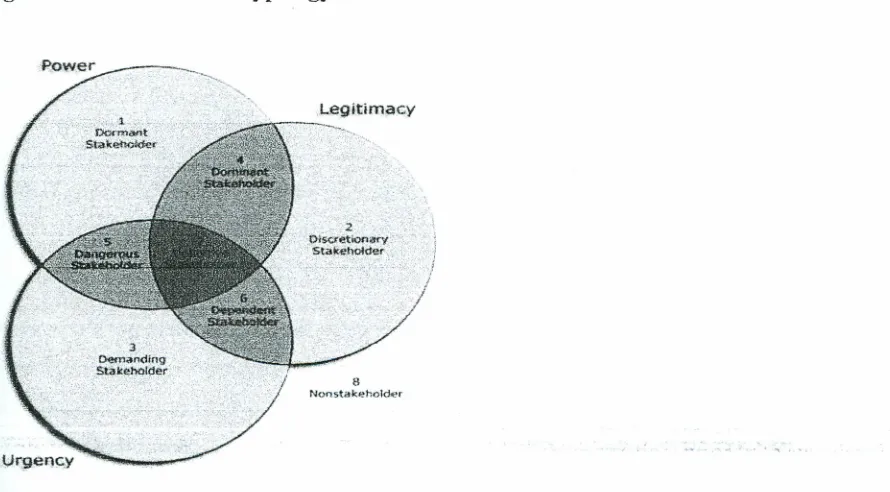
stakeholder claim. (Figure 3: below)Mitchell, Agle, & Wood (1997) identified three factors that are considered when mapping out
stakeholder relationships i.e power; defined as the ability to influence the actions of other
stakeholders and to bring out the desired outcomes. The other is Importance/urgency; the degree
to which stakeholder claims call for immediate attention. Legitimacy; a rightful claim to be
involved. Based on this analysis Mitchell et al.(1977) came up with eight different stakeholder groups namely: Dormant stakeholders (power, no legitimacy and no urgency), Discretionary
stakeholders (Legitimacy, but no power and no urgency), Demanding stakeholders (Urgency, but
no legitimacy and no power), Dominant stakeholders (power and legitimacy, but no urgency),
(Legitimacy and urgency, but no power),Definite stakeholders (Power, legitimacy and urgency), Non stakeholders (No power, no legitimacy and no urgency)
The -definitive stakeholder placed innermost in the intersection of the circles is the most
important stakeholder whose interest should be prioritized. Project interventions through the
theory and process of change should create value to satisfy their needs and interests. Other crucial ones are the dangerous stakeholder, dependent stakeholder and dominant stakeholder. Figure 2.1.6: stakeholder typology
8 Nonstak~holde,.
2.1.7 Community Empowerment and Capacity Development in project interventions
Community empowerment refers to the process of enabling communities to increase control over
their lives. Communities are groups of people that mayor may not be spatially connected, but
who share common interests, concerns or identities. These communities could be local, national or international, with specific or broad interests (Laverack, 2008). Empowerment refers to the process by which people gain control over the factors and decisions that shape their lives. It is the process by which they increase their assets and attributes and build capacities to gain access,
different forms (Lave rack, 2008). Empowerment assumes that people are their own assets, and the role of the external agent is to catalyse, facilitate or accompany the community in acquiring
power.
The United Nations Development Programme (UNDP, 2008) defines capacity development as
the process through which individuals, organisations, and societies obtain, strengthen, and
maintain the capabilities to set and achieve their own development objectives over time.
Capacity development takes place at three different levels: the individual level, the
organizational level and the societal level. These three levels are interlinked and interdependent.
An investment in capacity development must design and account for impact at these multiple
levels.
The Canadian International Development Agency (CIDA) defines capacity development as the
activities, approaches, strategies, and methodologies which help organizations, groups and
individuals to improve their performance, generate development benefits and achieve their
objectives. Capacity development is about who, how and where the decisions are made,
management takes place, services are delivered and results are monitored and evaluated. It is
primarily an endogenous process, and whilst supported and facilitated by the international
development community, it cannot be owned or driven from the outside. At the end of the day, it
is about capable and transformational states, which enable capable and resilient societies to
achieve their own development objectives over time.
The logical framework approach in community empowerment and capacity development
The
stakeholder analysis in the logical framework process ultimately enhances capacitydevelopment and/or community empowerment of the groups concerned. Public sector projects
have a wide spectrum of stakeholders consisting of eg donors, governments, and community
groups. All these groups may have divergent viewpoints about the project and these can be
harnessed as strength to achieve capacity development and community empowerment.