Hybrid Memory Systems to Improve the Performance of
PCM
C Mariveedu Suresh
1& K Madanna
21
M-Tech Dept of ECE, Geethanjali Engineering College NANNUR-V, KURNOOL-DIST
2
Assistant Professor Dept ECE, Geethanjali Engineering College NANNUR-V, KURNOOL
DIST Mail Id:[email protected]
Abstract
Modern servers require large main memories, which so far have been enabled by improvements
in DRAM density. However, the scalability of DRAM is approaching its limit, so Phase-Change
Memory (PCM) is being considered as an alternative technology. PCM is denser, more scalable,
and consumes lower idle power than DRAM, while exhibiting byte-addressability and access
times in the nanosecond range. Unfortunately, PCM is also slower than DRAM and has limited
endurance. These characteristics prompted the study of hybrid memory systems, combining a
small amount of DRAM and a large amount of PCM. In this paper, we leverage hybrid memories
to improve the performance of cooperative memory caches in server clusters. Our approach
entails a novel policy that exploits popularity information in placing objects across servers and
memory technologies. Our results show that (1) DRAM-only and PCM-only memory systems do
not perform well in all cases; and (2) when managed properly, hybrid memories always exhibit
the best or close-to-best performance, with significant gains in many cases, without increasing
energy consumption.
Keywords-Cooperative memory caches, persistent memory, Phase-Change Memory
(PCM).
1. INTRODUCTION
The concept of using the amorphous to
crystalline phase transition of chalcogenides
for an electronic memory technology has
been pursued for many years [1]–[2]. While
the early work disclosed many of the
fundamental concepts of the phase change
memory (PCM), it is only in the past 10–15
years that advances in materials and device
technology have made it possible to
demonstrate PCMs that rival incumbent
technologies such as Flash [3]. The
approximate that of the dynamic random
access memory (DRAM) and the Flash
memory [4]. Reports on PCM have grown
rapidly in recent years. The worldwide
research and development effort on
emerging memory devices and PCM in
particular can be understood from two
perspectives. First, from a system point of
view, processor performance is increasingly
limited by memory access and power
consumption of the memory subsystem.
Recent efforts in extending the scalability of
SRAM and incorporating embedded DRAM
in advanced technologies are evidence of the
importance of the memory technology. The
emergence of Flash as a potential solid-state
replacement for the hard disk drive (HDD)
for selected applications has highlighted the
enormous potential of a high-density,
embedded memory technology within the
memory hierarchy. At the same time,
memory device research has had a
renaissance of new ideas [5], [6]. New
memory devices, most of them nonvolatile,
have been explored and some have
progressed beyond the observation of a
hysteresis effect to device-level
demonstrations. These new memory devices,
such as PCM, have
read/write/retention/endurance
characteristics different from conventional
static random access memory (SRAM),
DRAM, and Flash. The very high density
offered by some of the new device
technologies may also lead to the
replacement of the HDD by solid-state
devices for some applications [7], [8]. There
is an enormous opportunity to completely
rethink the design of the memory subsystem
to gain orders of magnitude improvements
in speed and/or power consumption. A
revolution in the memory subsystem will
bring about a fundamental change in how
one can extract performance out of
technology improvements.
Memory capacity is becoming a
scarce resource in server systems, as the
number of CPU cores increases, application
and thread concurrency escalate, and
consolidated virtual machines require
co-locating large working sets simultaneously
in main memory. Current trends suggest that
meeting these capacity requirements using
DRAM will not be ideal. DRAM exhibits
low access times, but consumes significant
amounts of energy (idle, refresh, and
precharge energies). As a result, the amount
of energy consumed by the memory is
approaching (and sometimes surpassing)
that consumed by the processors in many
face scalability issues below the 20nm
fabrication process, which would limit the
capacity of future DRAM chips. For these
reasons, architects have started to consider
Phase-Change Memory (PCM) as a potential
replacement for DRAM. PCM is
byte-addressable, consumes little idle energy,
does not require refreshing or precharging
(its contents are persistent), and exhibits
access times in the nanosecond range.
Furthermore, PCM cells have feature size
comparable to DRAM cells, but can store
more information in the same area. PCM is
also expected to scale further than DRAM
(beyond 9nm) [10, 9]. However, compared
to DRAM, PCM has worse read/write times,
read/write energies, and write endurance.
2. RELETED WORK
Server Memory System: Typically, a
server’s memory system is composed of a
memory controller (MC), a few memory
channels, and multiple dual-inline memory
modules (DIMMs). Each DIMM includes
multiple memory devices (chips), each of
which containing a memory cell array and
peripheral circuitry. In our technical report
[11], we detail these components and the
DRAM technology.
PCM: A PCM cell is composed of an access
transistor and a storage resistor made of a
chalcogenide alloy. With the application of
heat, the alloy can be transitioned between
physical states with particular resistances,
used to represent binary values. Via thermal
induction, PCM cells can transition between
a high electrical resistance state (logical 0)
and a low one (logical 1). PCM can interface
with most CMOS peripheral circuitry used
in DRAM [12]. Unlike in DRAM, PCM’s
reads are non-destructive and cells can retain
data for several years. On the downside,
PCM cells exhibit worse access performance
than DRAM.
Assumptions for PCM: We assume that,
when PCM chips for servers become
available, they will be 4x denser than
DRAM. For easier adoption, we expect that
the peripheral circuitry for PCM (e.g., row
buffers, row and column decoders, DIMM
interface) will be equivalent to that for
DRAM. Thus, we assume this circuitry to
have the same performance and power
characteristics for PCM and DRAM.
Moreover, only written cache lines in a row
buffer are written back to the PCM cell array
(DRAM needs the entire buffer to be written
PCM does not require cell refreshing
or precharging, thereby lowering
background energy relative to DRAM and
eliminating precharge energy. However,
PCM increases activation and termination
energies, since its activations (actual cell
accesses) are slower than with DRAM. Our
assumptions for peripheral circuitry imply
that row buffer read/write energy is the same
for DRAM and PCM.
Cooperative Caching: To meet their
performance requirements, modern Internet
services aggressively cache Web objects. In
fact, they often use a middleware layer that
creates a large cluster-wide cooperative
cache to which each server contributes some
amount of main memory. The middleware
directs each object request to the server
likely to be caching the object.
Tackling PCM’s endurance problem:
Many previous works focused extensively
on the work arounds needed to mitigate this
problem. Our design for RaCC is orthogonal
to these techniques. In fact, it can be
combined with one or more of them to
improve PCM’s lifetime, hence, we aim at
improving PCM’s performance without
increasing energy consumption.
3. IMPLEMENTATION
Object ranking: RaCC tracks the
popularity of objects stored in the
cooperative cache, and uses that knowledge
in placing them. Specifically, RaCC tracks
the frequency and recency of references to
the cached objects. To dynamically rank
objects, each server builds two private
Multi-Queue (MQ) structures [15] locally:
PMQ and DMQ, updated as requests for
content arrive at the servers. PMQ ranks the
objects stored solely in PCM, and DMQ
ranks those stored solely in DRAM. No
object spans both memory regions.
Algorithm 1: RaCC’s local placement
Each MQ structure stores object
descriptors into M LRU queues, numbered
from 0 to M−1. Each descriptor holds the
object number, a reference counter (RC),
and a logical expiration time (LET). We
measure logical time in number of accesses
to objects, and accumulate the total into
CurrentTime (CT). On the first access to an
object, MQ places its descriptor in the tail of
queue 0 and sets its LET to CT+λ, where λ
is a constant. The object expires if not
accessed until time CT+λ + 1. On every new
access to the object, we increment its RC,
reset its LET to CT+λ and move its
descriptor to the tail of its current queue. If
the descriptor is currently in queue i, it will
be upgraded to queue i + 1 (if i + 1 < M)
when its RC reaches 2i+1. Conversely, on
each access, we check the descriptors at the
heads of all M queues for expiration
(CT>LET). We place an expired descriptor
at the tail of the immediately inferior queue,
and set its LET to CT+λ. When an object
cached in PCM reaches the queue ρ of
PMQ, it is considered popular. In our
simulations, we set M to 16, λ to 32, and ρ
to 8, as these values showed good empirical
results.
Server-level object placement: RaCC
manages memory as shown in Algorithm 1.
RaCC first tries to allocate objects in
DRAM, then in PCM, if they have free
frames available. The function cacheObject
maps the newly cached object to free virtual
pages and copies the object’s content from
the storage device into a corresponding set
of physical memory pages. When neither
memory region (DRAM or PCM) has free
space, the replacement algorithm evicts as
many unpopular objects as necessary to
make room for the new object (function
ensureRoom). However, because RaCC will
cache the new object in a single memory
region, all unpopular objects must be evicted
either from DRAM or from PCM (note that
objects in DRAM may become unpopular
over time, thus becoming potential victims
for popular objects in PCM.) To select the
victim region, RaCC finds the set of least
popular objects in both DMQ and PMQ
(lines 9- 10). Within each group of
unpopular objects, RaCC finds a “pivot”
(the most popular object), then it compares
the popularity of both pivots (line 11). If the
pivots occupy different queues in DMQ and
PMQ, RaCC selects the region with the
lowest-ranked pivot. Otherwise, RaCC
Algorithm 2: RaCC for PRESS. The
highlighted lines were modified or added to PRESS.
Algorithm 2 depicts the PRESS behavior
upon receiving a request, when augmented
with RaCC. The modifications introduced
by RaCC (highlighted) are: the search for
opportunities to migrate popular objects in
DRAM, and the forwarding of requests
preferably to servers already caching the
requested object in DRAM.
HTTP requests arrive via standard
round-robin DNS to any server. The server that
initially receives the request (called “initial
server”) parses it, inspects its content, and
decides where it should be served. The
initial server itself serves requests for
objects that are (1) larger than the maximum
cacheable size – 1MByte in our simulations
seen (2) for the first time, or (3) already
cached locally in DRAM or PCM.
Otherwise, the initial server tries to forward
the request to another server while balancing
load. Using the GD, PRESS finds the least
loaded server that already has the object in
memory. If that server is not overloaded,
PRESS forwards the request to it. RaCC
breaks this step into two. First, it looks for a
server that has the object in DRAM. If that
server is not found, RaCC looks for a server
caching the object in PCM. If none of those
are found, the initial server tries to cache the
object in its own memory, as long as it is not
overloaded. Otherwise, again using the GD,
the initial server looks for the least loaded
server in the cluster. If that server is not
overloaded, the initial server forwards the
request to it. If none of the previous cases is
satisfied, RaCC forwards the request to the
server that has the object in DRAM, despite
overloading. Upon receiving a forwarded
cache, and then send the cached object to the
initial server. Whenever a server starts
caching the requested object, it broadcasts
that fact to all servers, updating the GD, just
like PRESS. In that case, the server also
adds a corresponding entry to DMQ or
PMQ, depending on which memory region
the object is placed.
4. EXPERIMENTAL RESULTS
Figure 1(a) shows the latency per request
served by a PRESS cluster, where each
server uses an SSD for persistent storage.
The bars represent the average latency per
request across different RBHRs (1%, 6%,
and 12%). The upper and lower ends of the
error bars represent the highest and the
lowest latencies across RBHRs,
respectively. In general, as expected, the
relative performance advantage of DRAM
over PCM is higher in the presence of low
RBHRs, because they expose more of the
raw performance of the memory devices to
the service. High RBHRs hide the
performance disadvantage of PCM. In fact,
all maximum latencies correspond to the
lowest RBHRs, whereas the minimum
latencies correspond to the highest RBHRs.
(a) Request latency (PRESS+SSD)
(b) Request latency (PRESS+HDD)
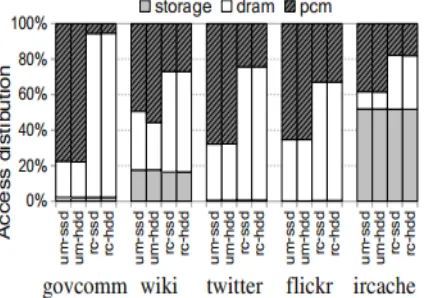
Figure 1. (a,b) Average latency per
served request, normalized to
Unmanaged. (c) Percentage of
requests served from each memory
and storage device.
Figure 1(a,b) shows the latency per request
served from PRESS with HDD-based
servers. In this setup, RaCC performs better
than DRAM-only, PCM-only, and
Unmanaged, respectively by 87%, 23%, and
21% on average. Because random HDD
reads are two orders of magnitude slower
than SSD reads, the severe penalty of
cooperative cache misses makes the hybrid
and PCM-only systems much more
attractive than DRAM-only. In fact,
DRAMonly presents significantly lower
performance compared to the others for
twitter and flickr, despite being within 5% of
the cache hit ratio of the other systems.
RaCC performs better than PCM-only in all
variations, except in wiki and ircache.
However, the gain of PCM-only is small
(10% and 2%, respectively) in those cases.
As shown in Figure 1(c), RaCC is able to
serve more requests from DRAM than
Unmanaged, thus presenting better average
performance. Using HDDs, the number of
objects that RaCC migrates is also less than
1% of the objects requested in each
workload, thereby not impacting the service
latency noticeably. Additionally, we observe
that, without the hinting feature in PRESS,
RaCC would perform poorly. The reason is
that sets of popular objects are often
responsible for a high load and, as a result,
they tend to be replicated across many
servers. Without hints, the replicated objects
often replace cached content in PCM, then
become popular and require migration into
DRAM.
5. CONCLUSION
We introduced RaCC, an object placement
policy for server clusters that use hybrid
DRAM+PCM main memories in
cooperative caches. RaCC ranks, migrates,
and replaces objects to improve the cache’s
performance. Our results show that the
combination of hybrid memories and
intelligent object placement can produce
efficient and robust clusters without
increasing energy consumption.
6. REFERENCES
[1] S. R. Ovshinsky, BSymmetrical current
controlling device,[ U.S. Patent 3 271
591,1966
[2] S. R. Ovshinsky, BReversible
structures,[ Phys. Rev. Lett., vol. 21,pp.
1450–1453, 1968.
[3] S. Lai, BCurrent status of the phase
change memory and its future,[ in Proc.
IEEE Int. Electron Devices Meeting,
2003,pp. 10.1.1–10.1.4.
[4] International Technology Roadmap for
Semiconductors (ITRS), 2009. [Online].
Available: http://public.itrs/net Available:
http://public.itrs/net
[5] K. Kim, BFuture memory
technology:Challenges and opportunities,[ in
Proc. Symp. Very Large Scale Integr.
Technol.Syst. Appl., 2008, pp. 5–9.
[6] K. Galatsis, K. Wang, Y. Botros, Y.
Yang,Y.-H. Xie, J. F. Stoddart, R. B. Kaner,
C. Ozkan, J. Liu, M. Ozkan, C. Zhou, and K.
W. Kim, BEmerging memory devices,[IEEE
Circuits Devices Mag., vol. 22, no. 3,pp. 12–
21, May/Jun. 2006.
[7] G. W. Burr, B. N. Kurdi, J. C. Scott,C.
H. Lam, K. Gopalakrishnan, and R. S.
Shenoy, BOverview of candidate device
technologies for storage-class memory,[
IBM J. Res. Develop.,
vol. 52, no. 4, pp. 449–464, 2008.
[8] M. H. Kryder and C. S. Kinm, BAfter
hard drivesVWhat comes next?’’ IEEE
Trans. Magn., vol. 45, no. 10, pp. 3406–
3413,Oct. 2009.
[9] InfiniBand Trade Association.
InfiniBand Roadmap, 2011.
www.infinibandta.org/content/pages.php?
pg=technology overview.
[10] ITRS. Emerging Research Devices,
2009.
www.itrs.net/links/2009itrs/2009chapters
2009tables/2009 PIDS.pdf.
[11] L. Ramos and R. Bianchini. Exploiting
Phase-Change Memory in Server Clusters,
2011. Tech. Rep. DCS-TR-692, Rutgers
University.
[12] W. Zhang and T. Li. Exploring
Phase-Change Memory and 3D DieStacking for
Power/Thermal Friendly, Fast and Durable
Memory Architectures. In PACT, 2009.
[13] B. Lee et al. Architecting Phase-change
Memory as a Scalable DRAM Architecture.
In ISCA, 2009.
[14] P. Zhou et al. A Durable and Energy
Efficient Main Memory Using
Phase-Change Memory Technology. In ISCA,
2009.
[15] Y. Zhou, P. Chen, and K. Li. The
Second-Level Buffer Caches. In USENIX,