ISSN (Print) : 2320 – 3765 ISSN (Online): 2278 – 8875
I
nternational
J
ournal of
A
dvanced
R
esearch in
E
lectrical,
E
lectronics and
I
nstrumentation
E
ngineering
(An ISO 3297: 2007 Certified Organization)
Vol. 3, Issue 12, December 2014
An Efficient Method for Locating Distributed
Generation to Provide Reactive Support in
Microgrid
A.Sheela1, Dr.S.Vijayachitra2, V.Dhivya3
Assistant Professor, Dept. of EEE, Kongu Engineering College,Perundurai , Tamilnadu, India 1 Assistant Professor, Dept. of EIE, Kongu Engineering College,Perundurai , Tamilnadu, India 2
PG Student [AE], Dept. of EEE, Kongu Engineering College,Perundurai , Tamilnadu, India 3
ABSTRACT: The increase in power demand and limited sources for electric power has resulted in the existence of
microgrid. Microgrid is a complex interconnected system which comprises of reactive power compensators nearer to the load and are used to operate the power system closer to the limits of stability. Reactive power support groups reduce voltage instability which is mainly associated with reactive power imbalance. Bus loadability also depends on the reactive power support that the bus can receive from the system. The serious type of voltage instability is voltage collapse which will lead to the complete blackout. Voltage collapse can be effectively prevented by reducing or by adding reactive power support prior to the point of voltage collapse. Locations of the reactive power compensators is the challenging task since in a multi bus system voltage collapse may occur in any bus. This paper focuses on the determination of the effective locations of reactive power compensators in the distribution system and also to analyze how the compensators connected at those buses are controlled. Hybrid approach is used for grouping the buses across which reactive support has to be provided. Voltage fluctuations get eliminated in the distribution grid through end user reactive power capable devices. The ability to provide real and reactive power support can be achieved at the end-user level itself.
KEYWORDS:Microgrid, voltage collapse, reactive power compensators, distributed generation
I.INTRODUCTION
The world is facing severe energy crisis and it is expected to increase in the forthcoming years. Worldwide, the power generation is majorly done using conventional energy sources and its energy reserve is very much limited, expected to disappear after few decades. The shortage of conventional energy resources and the necessity to reduce the environmental impact have led to significant interest in renewable energy resources and their efficient utilization [1-2]. Hence there is a renewed interest in the power generating technologies based on renewable energy resources as it is everlasting and eco-friendly. The only means to increase the generation capacity is by increasing the renewable energy generation. Distibuted Generation (DG) is the group of renewable energy sources connected in parallel.One important application of smart grid technology is microgrid, which comprises of DG systems.
ISSN (Print) : 2320 – 3765 ISSN (Online): 2278 – 8875
I
nternational
J
ournal of
A
dvanced
R
esearch in
E
lectrical,
E
lectronics and
I
nstrumentation
E
ngineering
(An ISO 3297: 2007 Certified Organization)
Vol. 3, Issue 12, December 2014
additional reactive power prior to reaching the point of voltage collapse. Voltage collapse is a process whereby voltages gradually refuse until it is no longer possible to maintain steady operating voltages. DG’s like PV cells, hybrid vehicle connected nearer to the load acts as reactive power compensators.
Overbye in [9],[10] used damped Newton method for convergence for restoring system stability during severe contingency. Linear approximation method is used to locate the power system solvability boundary in [11] for fast occurrence of faults. Granville in [12] used the direct interior point method for computing minimum load shedding to restore the power flow solvability. Wang et al.in [13] applied the direct interior point method to solve corrective control problems. Also the present work have the control in substation level and corrective control is mostly discussed.
This paper presents the idea to mitigate the voltage collapse with the available reactive power resources in the residential level devices as preventive control. The occurrence of voltage violations in the residential level devices are eliminated with the help of the reactive power resources. Suppose when a problem is detected in the distribution system, the particular low voltage buses are identified and it is reduced or eliminated with the help of the reactive power resources in order to restore the system voltages. The available reactive power resources can be used to compensate the voltages and thus make the system less susceptible to voltage instability. Corrective control and preventive control are possible, among which preventive control is better since it restores the system voltage before it actually occurs. Generally voltage violation in the load is corrected by the command received from the Central Management Unit (CMU). But here a method is proposed in which the load voltage violations are met by the end user reactive power compensators. Reactive power controlled buses need to be identified for effectively placing reactive power compensating devices. Based on the sensitivities and voltage optimization problem the target of identification and location of reactive power compensators are achieved.
II. FLOW CHART
The work flow is given in figure 1. The detailed description is given in the following subsections.
Figure 1Flow chart
(i)Load flow and Voltage optimization problem
Load Flow Problem
Identification of Weakest Bus
Calculation of VSM
Reactive Support groups Classification of loads
Selection of Q-Cbuses
Voltage Optimization Problem
Reactive Power Sensitivity Index
If Nominal Voltage Stop
ISSN (Print) : 2320 – 3765 ISSN (Online): 2278 – 8875
I
nternational
J
ournal of
A
dvanced
R
esearch in
E
lectrical,
E
lectronics and
I
nstrumentation
E
ngineering
(An ISO 3297: 2007 Certified Organization)
Vol. 3, Issue 12, December 2014
The objective function of the voltage optimization problem is to minimize the cost function f1 given by equation 1 .
---1
where, n is the number of bus voltages to be controlled. To carry out this optimization problem primarily load flow analysis has to be done. Voltage, real and reactive power flow at various buses is calculated. Newton Raphson method is chosen in this work which has powerful convergence characteristics when compared to other methods. The aim of solving this objective function is to determine the amount of reactive power compensation to be provided so as to maintain the voltage profile within bounds.
(ii)Sensitivity index and Voltage Stability Margin(VSM)
Sensitivity index defines the reactive power injections which have high impact on the voltage. This index evaluation is the basis for determining the location and amount of reactive power to be compensated. Real and reactive power from load flow analysis is given by equation 2.
1 2 3 4
J
J
P
J
J
Q
V
---2Where, 2 2 2 1 2 n n n n P P J P P 2 2 2 1 2 1 2 2 1 2 1 p p p p n n n n n n P P V V V V J P P V V V V 2 2 2 3 1 1 2 p p n n n n Q Q J Q Q 2 2 2 1 2 1 4 1 1 2 1 2 1 p p p p p p n n n n n n Q Q V V V V J Q Q V V V V
Jacobian matrix J2 and J3 can be set to zero because real power and reactive power are less sensitive to voltage and phase angle respectively. Strongest bus and weakest bus are identified from maximum and minimum value of J4. P-V and Q-V curves are plotted for identifying voltage collapse point. Voltage collapse point is the point after which load flow problem will not be converged.
Voltage Stability Margin of a power system is the measure to estimate the available power transfer capacity and it defines the security level of the bus. VSM is defined as the difference or ratio between the bus voltage at normal operating point and Voltage Collapse Point(VCP).
Wbase Wcritical Wcritical
V
V
VSM
V
---3VWbase , VWcritical = bus voltage of the system at normal operating condition and voltage collapse point. (iii)Classification of loads and reactive power controlled (Q-C)buses
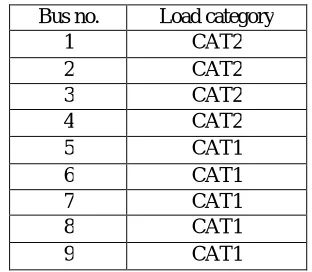
Selection of reactive power controlled buses requires the additional information on classification of load buses. Load buses can be classified based on its controllability of reactive power as most controllable bus and non-controllable bus. Controllable bus is described as CAT1 (category 1) and non-non-controllable bus is described as CAT2 (category 2). The slack bus and the PV buses are considered as CAT2 buses since their reactive power cannot be controlled. Buses with zero reactive power can also be categorized as CAT2.The PQ buses are considered as CAT1. Partially controlled and priority in which buses can be controlled are not considered in this paper.
Buses with higher sensitivities are identified as the members Q-C buses. Buses with lower values will have no control over voltage when reactive power is varied. So, they are not considered as reactive power controlled bus. (iv) Reactive power support groups
Buses are to be grouped to control the voltage by adjusting the reactive power. Various algorithms are described for grouping the buses. Hybrid approach is used in this paper.
ISSN (Print) : 2320 – 3765 ISSN (Online): 2278 – 8875
I
nternational
J
ournal of
A
dvanced
R
esearch in
E
lectrical,
E
lectronics and
I
nstrumentation
E
ngineering
(An ISO 3297: 2007 Certified Organization)
Vol. 3, Issue 12, December 2014
In this method buses are grouped based on hierarchy. Either bottom-up approach or top-down approach is followed which is named as agglomerative hierarchical clustering algorithm or divisive hierarchical clustering algorithm respectively. Agglomerative hierarchical algorithm is adopted in this paper.
Each element in the J4-1 matrix is considered as a single cluster and closest elements are merged. At the highest level all the elements are clustered into single cluster. Agglomerative clustering depends on the use of a distance matrix D. Elements Dij gives the distance between row i and j of J4-1.From the distance matrix pair of clusters
with the shortest distance are merged. The shortest distance pair is then removed from the matrix and both are merged. All distances are evaluated and new clusters are formed and the process is repeated until the distance matrix is reduced to a single element.
(b)Voltage Coupling Index (VCI) Algorithm
An index called as voltage Coupling Index (VCI) is used to describe the ability of line flows and also be used to control the voltages by reactive power injections. Buses are grouped based on the sensitivity of reactive power generations to reactive power demands.
where, SG represents the sensitivity of reactive power generations to voltage magnitudes at load buses SL represents the sensitivity of reactive power demands to voltage magnitudes at load buses.
Elements of matrix [S] represent sensitivity of reactive power generations to reactive power demands. Load buses with closer reactive power sensitivity values have been merged together to form voltage control areas.
(c)Hybrid Approach
Hybrid approach combines the algorithms and it is the efficient approach for identifying the reactive support groups.
III. RESULTS AND DISCUSSION
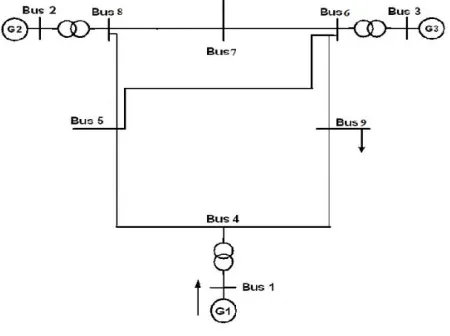
IEEE 9 bus system is considered for the simulation. The single line diagram for IEEE 9 bus system is shown in figure 2. The line and bus specifications are given in table 1 and 2.
Figure 2 .IEEE 9 bus system
S
S
GS
L 1
ISSN (Print) : 2320 – 3765 ISSN (Online): 2278 – 8875
I
nternational
J
ournal of
A
dvanced
R
esearch in
E
lectrical,
E
lectronics and
I
nstrumentation
E
ngineering
(An ISO 3297: 2007 Certified Organization)
Vol. 3, Issue 12, December 2014
Table 1.Line specifications Table 2.Bus specifications Table 3.Sensitivity of PQ buses
The sensitivity values of the buses are estimated from jacobian matrix and are tabulated in table 3
Weakest bus is identified from the sensitivity values. 5th bus is identified as the weakest bus and 9th bus is identified as the next weakest bus.
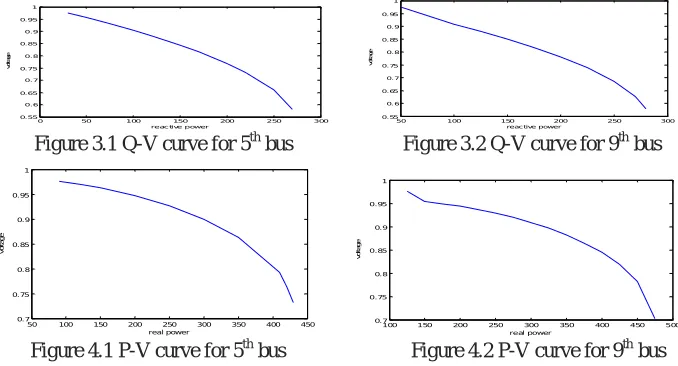
The Q-V curve and the P-V curve are plotted for both the buses to identify the Voltage Collapse Point(VCP). Q-V curve is plotted by keeping real power as constant and increasing reactive power till knee point occurs. Similarly P-V curve is drawn for constant reactive power. Figure 3.1 and 3.2 shows the Q-V curve for bus 5 and 9. Figure 4.1 and 4.2 shows the P-V curve for bus 5 and 9.
0 50 100 150 200 250 300
0.55 0.6 0.65 0.7 0.75 0.8 0.85 0.9 0.95 1
reac ti ve power
v
olt
a
g
e
50 100 150 200 250 300
0. 55 0. 6 0. 65 0. 7 0. 75 0. 8 0. 85 0. 9 0. 95 1
reac tive power
vo
lt
a
g
e
Figure 3.1 Q-V curve for 5th bus Figure 3.2 Q-V curve for 9th bus
50 100 150 200 250 300 350 400 450 0.7
0.75 0.8 0.85 0.9 0.95 1
real power
v
o
lt
a
g
e
100 150 200 250 300 350 400 450 500 0.7
0.75 0.8 0.85 0.9 0.95 1
real power
v
o
lt
a
g
e
Figure 4.1 P-V curve for 5th bus Figure 4.2 P-V curve for 9th bus
VCP is identified for both the buses from the Q-V and P-V curves and VSM as calculated using equation 3. The values are tabulated in table 4.The loads are classified as CAT1 and CAT2 as explained and it is shown in table5
Bus No.
P (MW)
Q (MV ar)
V (volt) Type
1 - - 1.06+j0 Slack 2 0 0 1.04+j0 PV 3 0 0 1.04+j0 PV 4 0 0 1.0+j0 PQ 5 90 30 1.0+j0 PQ 6 10 10 1.0+j0 PQ 7 100 35 1.0+j0 PQ 8 0 0 1.0+j0 PQ 9 125 50 1.0+j0 PQ
Line no
R in p.u. X in p.u.
1-4 0 0.0576 4-5 0.017 0.092 5-6 0.039 0.17 3-6 0 0.0586 6-7 0.0119 0.1008 7-8 0.0085 0.012 8-2 0 0.0625 8-9 0.032 0.161 9-4 0.01 0.085
Bus no. Senstivity values 4 37.76622
5 15.06693
6 31.30336 7 22.76625 8 34.76311
ISSN (Print) : 2320 – 3765 ISSN (Online): 2278 – 8875
I
nternational
J
ournal of
A
dvanced
R
esearch in
E
lectrical,
E
lectronics and
I
nstrumentation
E
ngineering
(An ISO 3297: 2007 Certified Organization)
Vol. 3, Issue 12, December 2014
Table 4. Voltage collapse point and Voltage stability margin values Table 5 Classification of buses
Based upon the hierarchical clustering algorithm and voltage coupling index algorithm the reactive support groups are identified and the various groups are tabulated in table 6. Reactive power support is provided for all the combinations as listed in table 6 and the sensitivities and the voltages are listed in table 7.
Table 6. Reactive support groups Table 7. Voltage and sensitivities
Q-C bus 8-9 is selected as the effective location for placing reactive power compensator since the minimum objective function is obtained for that combination. The reactive power compensation is provided between buses 8-9 and voltage profile is plotted for all the buses. Figure 6 shows the voltage profile of all the buses.
Figure 5. Voltage profile
Bus no. Load category
1 CAT2
2 CAT2
3 CAT2
4 CAT2
5 CAT1
6 CAT1
7 CAT1
8 CAT1
9 CAT1
BUS NO.
VCP(Q) VCP(P) VSM(Q) VSM(P)
5 0.581 0.732 0.6798 0.3333
9 0.579 0.703 0.6856 0.3883
Reactive support group
Coupled buses
1 7,8
2 7,8,6
3 4,9
4 4,9,5
5 7,8,6,4,9,5
Bus no 7-8 voltage /sensitiv ity 6-7 Voltage/s ensitivity 5-6 voltage/s ensitivity 4-5 voltage/se nsitivity 8-9 voltage/se nsitivity 9-4 voltage/s ensitivity
4 1.10/ 37.76 1.10/ 37.76 1.16/ 37.76 1.10/ 27.93 1.08/ 37.76 1.17/ 25.18 5 1.13/
15.06 1.14/ 15.06 1.29/ 9.03 1.20/ 5.23 1.13/ 15.06 1.19/ 15.06 6 1.07/
31.30 1.10/ 21.50 1.09/ 25.27 1.057/31.3 0 1.07/ 31.30 1.08/ 31.30 7 1.07/
11.41 1.09/ 12.97 1.08/ 22.76 1.05/ 22.76 1.04/ 22.76 1.09/ 22.76 8 1.10/
23.40 1.07/ 34.76 1.07/ 34.76 1.05/ 34.76 1.03/ 89.09 1.10/ 34.76 9 1.09/
ISSN (Print) : 2320 – 3765 ISSN (Online): 2278 – 8875
I
nternational
J
ournal of
A
dvanced
R
esearch in
E
lectrical,
E
lectronics and
I
nstrumentation
E
ngineering
(An ISO 3297: 2007 Certified Organization)
Vol. 3, Issue 12, December 2014
It is clear from the figure that the voltage profile is improved for the weakest bus as well as for the other buses after compensation is provided.
IV.CONCLUSION
This paper presents a method for effectively locating reactive power compensator in the smart grid. Co-ordination of multiple reactive power devices is allowed near the local loads. When local load voltage deviates from the nominal value command from the central control unit is not required. Without any communication link voltage deviation is rectified by proper addition or removal of reactive power. The objective of restoring the voltages by effective placement is achieved.
Restoration of system voltages is the prime objective, but this can be efficiently applicable for any power system crisis in which the distributed compensators will respond quickly. Constant loads are considered at present and the work can be extended for dynamic loads in future.
REFERENCES
[1] K. M. Rogers, R. Klump, H. Khurana, and T. J. Overbye, “ Smart-grid-enabled load and distributed generation as a reactive resource,” presented at the IEEE PES Conf. Innovative Smart Grid Technol., Gaithersburg, MD, Jan. 2010.
[2] Z. Feng, V. Ajjarapu, and D. J. Maratukulam, “A comprehensive approach for preventive and corrective control to mitigate voltage collapse, ”IEEE Trans. Power Syst., vol. 15, no. 2, pp. 791–797, May 2000.
[3] T. J. Overbye, “Computation of a practical method to restore power flow solvability,” IEEE Trans. Power Syst., vol. 10, no. 1, pp. 280–287,Feb. 1995
[4] Angel A. Aquino-Lugo,RayKlump, and Thomas J. Overbye, Fellow, “A Control Framework for the Smart Grid for Voltage Support Using Agent-Based Technologies”, IEEE Trans. Smart Grid vol. 2, no. 1, March 2011
[5] R. A. Schlueter, I.-P Hu, M.-W. Chang, J. C. Lo, and A. Costi, “Methods for determining proximity to volt. collapse,” IEEE Trans. Power Syst., vol. 6, no. 2, pp. 258–292, Feb. 1991
[6] R. A. Schlueter, J. C. Lo, T. Lie, T. Y. Guo, and I. Hu, “A fast accurate method for midterm transient stability simulation of voltage collapse in power systems,” in Proc. 28th Annu. Conf. Decision and Control ,Dec. 1989, pp. 340–344
[7] Kabir Chakraborty, Sangita Das Biswas,“An Offline Simulation Method to Identify the Weakest Bus and its Voltage Stability Margin in a Multi-bus Power network” Proceeding of International Conference,2010
[8] Overbye,,“An Authenticated Control Framework for Distributed Voltage Support on the Smart Grid”, IEEE Transactions On Smart Grid, Vol.No.11,2010
[9] T. J. Overbye, “A power flow measure for unsolvable cases,” IEEE Trans. on Power Systems, vol. PWRS-9, pp. 1359–1365, August 1994. [10] T. J. Overbye, “Computation of a practical method to restore power flow solvability,” IEEE Trans. on Power Systems, vol. PWRS-10, pp. 280–287, February 1995.
[11] T. Van. Cutsem, “An approach to corrective control of voltage instability using simulation and sensitivity,” IEEE Trans. on Power Systems, vol. PWRS-10, pp. 616–622, May 1995.
[12] S. Granville, J. C. O. Mello, and A. C. G. Melo, “Application of interior point methods to power flow unsolvability,” IEEE Trans. on Power Systems, vol. PWRS-11, pp. 1096–1103, May 1990.