Auto-I-mation of Home Appliances using
Internet of Things
R.V. Borkar1, Akshay Masal2, Jayesh Raundal3, Sakshi Zagade4, Ashwini Nawalkhede5
Assistant Professor, Dept. of Electrical Engg., PES’s Modern College of Engg. Pune, India1
UG Student,Dept. of Electrical Engg., PES’s Modern College of Engg. Pune, India2
UG Student, Dept. of Electrical Engg., PES’s Modern College of Engg. Pune, India3
UG Student, Dept. of Electrical Engg., PES’s Modern College of Engg. Pune, India4
UG Student, Dept. of Electrical Engg., PES’s Modern College of Engg. Pune, India5
ABSTRACT:“IOT” means Internet of Things which is proposed by Kevin Ashton. Due to this physical world is connected to hardware devices through internet; therefore the controlling of hardware device is possible. The implementation of home automation using Global System for Communication modem i.e. GSM for mobile is used here to control home appliances such as Bulb, Fan and Door locking - opening system etc. through security system which notifies to user via mail. These IOT based technology is implemented by using Arduino Uno microcontroller which is the heart of the whole system. We are converting conventional technology into modern technology with IOT for more ease and accuracy of control home appliances. Therefore as technology is advancing houses are also getting smarter. Using this system we can control home appliances from miles and observe the status of appliances through mobile with the help of internet.
KEYWORDS:Internet, home appliances, IOT, mobile
I. INTRODUCTION
Home automation is a handling and controlling of home appliances by using micro controller or new computer technologies like IOT. Now a day IOT is becoming more popular day by day because of numerous advantages. Automation provides us security, reliability and fully controlled devices. IOT works on microcontroller and different sensors are getting used in IOT, those sense the status of appliances and update to web server. If operator is far from appliances he can make switches on/off, he can get notification when door gets open or closed or any other settings which we set in the system. User can use any pc to connect with IOT system. IOT is described as a connection of various “things” or “objects” around us, like, sensors, mobile phones, Radio Frequency Identification (RFID tags) which work through a unique addressing system with which these things are able communicate with each other and complete their tasks successfully[1, 2].
I
nternational
J
ournal of
A
dvanced
R
esearch in
E
lectrical,
E
lectronics and
I
nstrumentation
E
ngineering
(A High Impact Factor, Monthly, Peer Reviewed Journal)
Website: www.ijareeie.com
Vol. 7, Issue 5, May 2018
internet through IP (internet protocol) address. With help of GSM control action from mobile is given to Arduino Uno microcontroller and controls the different appliances through Relay module.
Figure 1: Block diagram of Home Auto-i-mation system
II. HARDWARE
Elements include under hardware are given below:
Arduino Uno: It is the main part of the system this contains 14 input/output ports of analog /digital, USB connection, reset button and more. Therefore it simply connects to a computer with the help of USB or power device such as AC-DC adapter or battery then it will operate.
Figure 2: Project hardware model
switch that opens and closes by another electrical circuit. In original form, switch is operated by an electromagnet to open or close one or many sets of contact.
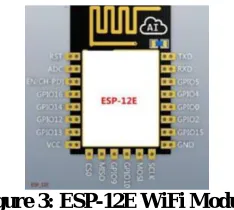
ESP-12E WiFi Module: Core processor ESP8266 is smaller size of module encapsulates Tensilica L106 Integrates industry-leading ultra-low power 32 bit MCU micro, with the 16 bit short mode, clock speed support 80MHz,160MHz and many more things. ESP8266 is high integration wireless SOCs, that is designed for space and power constrained mobile platform designers.
Figure 3: ESP-12E WiFi Module
LCD Screen: It is used to display the present status for web page. It displays the IP address but these IP address is different for different user, which is fix for that user with specific last digits of IP address.
III. SOFTWARE
Web server: It has IP address which is displayed by LCD Screen e.g:192.168.43.XXX then these indicated IP address is used for the opening the web page which includes the operational table of output devices in the form of ON/OFF. This operational table is built through HTML programming.
As we are developing web server through which we are operating Bulb, Fan and door open-close system. Therefore when web server is opens the user will able to control these hardware devices i.e. user is authenticated. By using software user can change and check status of any of the device and access from any location. Software provides security, easy access, accuracy with the help of programming and system performance. In this we are using Arduino software.
IV. ADVANTAGES
We can control home appliances reliably.
Security enhanced because of IOT.
It is convenient and very cheap.
Save time.
We can save electricity when there is no need.
V. DISADVANTAGES
If some another equipment need to control than used different programming is needed
Programming is lengthy.
If the output ports are more than 8 we should require combining of another microcontroller.
I
nternational
J
ournal of
A
dvanced
R
esearch in
E
lectrical,
E
lectronics and
I
nstrumentation
E
ngineering
(A High Impact Factor, Monthly, Peer Reviewed Journal)
Website: www.ijareeie.com
Vol. 7, Issue 5, May 2018
VI. DESIGN AND IMPLEMENTATON
Figure 4: Design of Home Auto-i-mation Kit
The system consists of both hardware and software the hardware part is GSM, Arduino Uno microcontroller and relay. The software part which need to programme the microcontroller to control the various devices Such as fan, opening or closing the door, illumination system, power devices, TV etc. It is possible to control the system by remote. For programming the Arduino Integrated Development Environment (IDE) Software is used which is cross platform application written in the programming language java or C++.The program written for Arduino is called as text files with the file extension. The program include control task which perform control action as per our requirement.
In March 2015, the Internet Architecture Board (IAB) released a guiding architectural document for networking of smart objects (RFC 7452), [2] which outlines a framework of four common communication models used by IOT devices.
VII.DEVICE TO DEVICE COMMUNICATION
In this, two or more devices can directly connect and communicate with each other rather than through intermediate application server. They can communicate using different types of networks and this used wireless network which is Wi-Fi to establish direct device-to-device. This communication model is commonly used in applications like home automation systems, which typically use small data packets of information to communicate between devices with relatively low data rate requirements. But this device-to-device communication approach illustrates many of the interoperability challenges. The above technology is modified based on server using internet. Throughout the world we can control our appliances manually.
VIII. GSM BASED HOME AUTOMATION SYSTEM
A smart home automation system is implemented by using Global System for Mobile communication (GSM) [5]. The hardware architecture of the system contains GSM modem, smartphone and PIC16F887 microcontroller. The system with GSM modem is to control all the electric appliances through SMS request. PIC16F887 microcontroller interfaced with a GSM modem and it is used to read and decode the received SMS to execute the specific command. Home appliances are connected with PIC16F887 microcontroller via relays. RS232 is used for serial communication between GSM modem and PIC16F887 microcontroller [6]. The GSM modem response time is less than 500 microseconds. The whole process of sending and receiving commands is processed within 2 seconds. One of the advantages of this automated system is that users will get feedback status of household appliances via SMS on their smartphones. This system was implemented in hardware and achieved 98% accuracy. Due to the wide coverage of GSM network users can get access to appliances from anywhere in the world. It is concluded that the usage of GSM in the home automation system provides maximum security and reliability.
IX. STEPS INVOLVED IN AUTOMATION KIT
1. First we connect our devices to the kit as per our requirement. Here we are using Fan, Three Bulb which we are connecting through relays to the kit.
2. This kit is placed in the room with available room Wi-Fi with highest speed network.
3. Firstly we have set the network ID which is “IOT” and the password as “project1234”in the Arduino based program and also in the users operating device.
4. Now when we switch on the kit then LCD displays IP address 192.168.43.XXX which is different for different user.
5. We have to insert this displayed IP address in the URL then a web page is opened and shows operational table which will show the status and controlling of connected output devices.
6. This web page is formed with the help of HTML programming due to which the operating table is displayed in the web page.
7. Therefore we can switch ON/OFF the devices from step-5 also we can see the status of the devices by LCD screen which is placed on the kit.
8. In this way the whole operation of controlling home appliances is to be done.
X. CONCLUSION
In future IOT based controlling scheme is implemented everywhere. Everything will be connected through internet as this project is based on IOT. Though this concept of controlling home appliances is one step towards advanced technology of Automation. Due to this the human efforts are reduced so increases the safety and save the time.
REFERENCES
1]. G. Santucci, From Internet of Data to Internet of Things, Paper for the International Conference on Future Trends of the Internet, 2009. 2]. D. Giusto, A. Iera, G. Morabito and L. Atzori, editors. The Internet of Things, Springer, 2010.
3]. International Journal of Advanced Research in Computer and Communication Engineering Vol. 5, Internet of Things (IoT) : Challenges and Future Directions Ms.Yogita Pundir1, Ms. Nancy Sharma2, Dr.Yaduvir Singh3 Research Scholar , M.tech (CS), Ideal Institute of Technology, Ghaziabad, India 1
4]. International Journal of Science and Research (IJSR), India Online ISSN: 2319 7064 Volume 2 Issue 4, April 2013 www.ijsr.net Overview of Automation Systems and Home Appliances Control using PC and Microcontroller HariCharan Tadimeti1, ManasPulipati
5]. R. Teymourzadeh, Salah Addin Ahmed, KokWai Chan and MokVeeHoong, "Smart GSM based Home Automation System," Systems, Process & Control (ICSPC), 2013 IEEE Conference on, Kuala Lumpur, 2013, pp. 306-309.