ISSN 2286-4822 www.euacademic.org
Impact Factor: 3.4546 (UIF) DRJI Value: 5.9 (B+)
On the Hamiltonicity of Product Graph G □ Sm, for
a Graph G of Order n, and Star Graph Sm, n ≥ m
AUREA Z. ROSAL
Polytechnic University of the Philippines Sta. Mesa, Manila The Philippines
Abstract:
Given two graphs G and H , the Cartesian product, G □ H is the graph whose vertex set is V (G) × V (H ) and the set {(u1 , v1 ), (u2 ,
v2 )} is an edge if and only if exactly one of the following is true.
(i) u1 = u2 and {v1 , v2 } is an edge in H .
(ii) v1 = v2 and {u1 , u2 } is an edge in G.
A star graph Sm , also known as a complete bipartite graph K1,m , is
a graph whose vertex set consists of two disjoint sets V1 = {c} and V2
= {v1 , v2 , . . . , vm }, known as partites, such that no two vertices in V2
are adjacent but all of them are adjacent to c. A hamiltonian graph is a graph that contains a cycle containing all its vertices. Clearly, Sm is not hamiltonian for all m ≥ 1.
In this paper the following shall be proven:
Let G be a hamiltonian graph, Cn be a cycle graph and Kn be a complete graph, all of orders n, and Sm be a star graph, m ≥ 1, then
1. Cn □ Sm is hamiltonian if and only if n ≥ m, n ≥ 3 2. Kn □ Sm is hamiltonian if and only if n ≥ m, n ≥ 2 3. G □ Sm is hamiltonian if and only if n ≥ m.
A graph Γ consists of an ordered pair (V (Γ), E(Γ)) where V (Γ) is a non empty set and E(Γ) is either a set of two element subsets of V (Γ) or is empty. The elements of V (Γ) are called vertices and the elements of E(Γ) are called edges. If {u, v} is an edge of Γ then we say that u and v are adjacent to one another.
The number of vertices of a graph is known as its order and the number of edges is called size. We usually symbolize by p(Γ) and q(Γ) respectively. The degree of a vertex u, deg(u) is the number of vertices in Γ adjacent to u.
The complete graph Kn is a graph whose order is n and every distinct vertices are adjacent to one another. Thus, the degree of every vertex in Kn is n − 1. The complete bipartite Kr,m is a graph whose vertex set V (Kr,m ) is a union of two disjoint sets V1 and V2 , known as the partites such that if two vertices are in the same partite then, they are not adjacent. Furthermore, every vertex in one partite is adjacent to every vertex of the other partite. K1,m is also known as star graph and is denoted by Sm . Let V (Sm) = V1 ∪ V2,
where V1 = {c} and V2 = {v1 , v2 . . . , vm } be the distinct partites of Sm, then we shall call c as the center of Sm.
A graph may be illustrated as follows: small circles or dots may represent the vertices, and the edges may be represented by lines or curves joining vertices which are adjacent to one another.
2 Cartesian Product of Graphs
Given graphs G and H , a new graph may be formed known as the Cartesian product of G and H written as G □ H . If Γ = G □ H , then
V (Γ) = V (G) × V (H) and the set {(u1 , v1 ), (u2 , v2 )} is an edge if and only if exactly one of the following is true:
1. u1 = u2 and {v1 , v2 } is an edge in H , or 2. v1 = v2 and {u1 , u2 } is an edge in G.
Intuitively, the cartesian product G □ Sm is a graph formed by “replacing” each vertex of Sm with G and edges are formed according to definition.
Example 2.1.
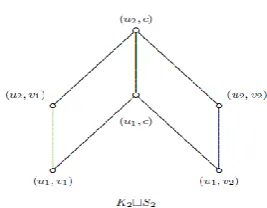
Consider Γ = K2 □ S2 .
Let V (K2 ) = {u1 , u2 } and V (S2 ) = {v1 , v2 } ∪ {c}. Then,
V (Γ) ={(u1 , v1 )(u1 , v2 )(u1 , c)(u2 , v1 )(u2 , v2 )(u2 , c)}
E(Γ) ={{(u1 , v1 ), (u1 , c)}, {(u1 , v2 )(u1 , c)}, {(u2 , v1 ), (u2 , c)}, {(u2 , v2 ), (u2 , c)}, {(u1 , v1 ),
(u2 , v1 )}, {(u1 , v2 ), (u2 , v2 )}, {(u1 , c), (u2 , c)}}
Fig. 2 Complete graph K2 and star graph S2
Fig. 3 Cartesian product of K2 □ S2
3 Hamiltonian Graph
A path Pk of a graph is sequence of adjacent vertices u1 , u2 , . . . uk such that no one vertex is repeated. A closed path or cycle is a sequence of adjacent vertices u1 , u2 , . . . uk , uk+1 such that u1 = uk+1 and no other vertex is repeated in the se- quence. A cycle graph or n- cycle Cn is a graph of order n and whose vertices form a cycle.
Figure 4: Graph of the cycle raph C5
A graph H is said to be hamiltonian if we can find a cycle in H that contains all its vertices. This cycle is known as a hamiltonian cycle or a spanning cycle. Notice that a complete graph Kn , n ≥ 3 is Hamiltonian while a star graph is not.
Let G be a hamiltonian graph, Cn be a cycle graph and Kn be a complete graph, all of orders n, and Sm be a star graph, m ≥ 1, then
1. Cn □ Sm is hamiltonian if and only if n ≥ m, n ≥ 3 2. Kn □ Sm is hamiltonian if and only if n ≥ m, n ≥ 2 3. G □ Sm is hamiltonian if and only if n ≥ m.
Proposition 3.1. The cartesian product Cn Sm, m ≥ 1 is hamiltonian if and only if n ≥ m for n ≥ 3.
Proof.
Let Γ = Cn Sm . Without loss of generality, assume V (Cn ) = {u1 , u2 , . . . , un } and that u1 , u2 , . . . , un , u1 is its cycle. Also, let V (Sm ) = {c} ∪ {v1 , v2 , . . . , vm }, where c is the
center of Sm . Then:
Suppose Γ is hamiltonian, then there exists a cycle C that contains all the vertices of Γ. Consequently, C will contain a path that will pass through all the vertices of Γ. Notice that all paths connecting vertices with second coordinates vi and vj (distinct), must contain a vertex (u, c) for some u ∈ V (Cn ).
Thus, there exists n −m vertices with second coordinate c that will be left “unvisited”, after any path connecting vertices with second coordinates v1 , v2 , . . . vm have been constructed. It follows that n − m ≥ 0 or n ≥ m. Since Cn is a cycle, then n ≥ 3.
Using the above table as guide, we now form the following cycle:
(u1 , v1 ), (u2 , v1 ), (u3 , v1 ), . . . , (un , v1 )(un , c), (un , v2 ), (u1 , v2 ), (u2 , v3 ), . . . ,
(un−1 , v2 )(un−1 , c)(un−1 , v3 ), (un , v3 ), (u1 , v3 ), . . . (un−2 , c), . . . , (um , c), (um , vm ),
(um+1 , vm ), (um+2 , vm ) . . . , (un−(m−1) , c), (un−m , c), . . . , (u1 , c), (u1 , v1 )
Clearly, above is a spanning cycle of Γ and thus, it is hamiltonian.
-qed.-
We now consider the case of Kn Sm. For n = 1, 2, Kn does not contain a cycle. We shall prove however that for n ≥ 2 and n ≥ m, the cartesian product is hamiltonian.
Proposition 3.2. The product graph Kn □ Sm , m ≥ 1, is hamiltonian if and only if n ≥ m and n ≥ 2.
Proof.
Let V (Kn ) = {u1 , u2 , . . . , un } and V (Sm ) = {v1 , v2 , . . . , vm}
∪ {c}, c = vk for all k. Note that for all i = j, ui is adjacent to uj and the elements of {v1 , v2 , . . . , vm } are not adjacent to any vertex in the set but all of them are adjacent to c.
Let Γ = Kn Sm be hamiltonian. If n = 1 and m ≥ 1 then K1 is simply a single vertex and K1 □ Sm ∼= Sm , which is
P artites c
v1 u1 u2 u3 . . . un
v2 un u1 u2 . . . un−1
v3 un−1 un u1 . . . un−2
. . . . . .
vm um um+1 um+2 . . . un−(m−1)
un−m
not Hamiltonian. This contradicts the assumption that Γ is hamiltonian. For Γ = K2 □ S1 , it is simply C4 . Clearly this is Hamiltonian. Thus, n ≥ 2. Also, since Γ is hamiltonian, then there exists a cycle C that contains all the vertices of Γ. From proof of previous theorem, it follows that n ≥ m.
Conversely, let n ≥ 2, and n ≥ m. If n = 2, then m = 1, 2. Now, K2 S1 is C4 and thus hamiltonian. K2 □ S2 is just the graph
The cycle (u1 , v1 ), (u1 , c ), (u1 , v2 ), (u2 , v2 ), (u2 , c), (u2 , v1 ), (u1 , v1 ) is the required hamiltonian cycle.
For n ≥ 3, Kn is hamiltonian and thus contains a spanning cycle. From the proof of previous proposition, there exists a spanning cycle for Kn □ Sm . It follows that the graph is hamiltonian. Therefore, Kn □ Sm is hamiltonian whenever n ≥ 2.
–qed– Example 3.1.
Fig. 6 Cartesian product of K3 and S2
Proposition 3.3. Let G be a hamiltonian graph of order n. Then G □Sm , m ≥ 1 is hamiltonian if and only if n ≥ m and n ≥ 3.
Proof.
If G is hamiltonian, then G contains a spanning cycle. Hence, its order n must be greater than or equal to 3. We can now apply Proposition 3.1 and thus theorem is proved.
–qed–
Conclusion
From the propositions presented in this study, one could see that the Cartesian product of two graphs which are not Hamiltonian may be Hamiltonian. Also, that the Cartesian product of a Hamiltonian graph with the star graph is always Hamiltonian.
Recommendation
Currently, work on the Cartesian product of a Hamiltonian graph with Kr,s is being studied where neither r nor s is 1.
REFERENCES
[1] Chartrand, Gary and Linda Lesniak: Graphs and Digraphs, Wadsworth Inc., California (1986)