A General Study On Lifecycle Analysis Of Roads
Yaram Rajasekhar Reddy
&
T.Venkateswara Reddy
1M. Tech Student, Department of civil, Nalanda Institute of Engineering and Technology, Village Kantepudi, Mandal Sattenapalli, District Guntur, Andhra Pradesh, India
2Associate Professor, Department of civil, Nalanda Institute of Engineering and Technology, Village Kantepudi, Mandal Sattenapalli, District Guntur, Andhra Pradesh, India
ABSTRACT
Road infrastructure has been considered as one of the most expensive and extensive infrastructure assets of the built environment globally. This asset also impacts the natural environment significantly during different phases of life e.g. construction, use, maintenance and end-of-life. The growing emphasis for sustainable development to meet the needs of future generations requires mitigation of the environmental impacts of road infrastructure during all phases of life e.g. construction, operation and end-of-life disposal (as required).Life-cycle analysis (LCA), a method of quantification of all stages of life, has recently been studied to explore all the environmental components of road projects due to limitations of generic environmental assessments. The LCA ensures collection and assessment of the inputs and outputs relating to any potential environmental factor of any system throughout its life. However, absence of a defined system boundary covering all potential environmental components restricts the findings of the current LCA studies. A review of the relevant published LCA studies has identified that environmental components such as rolling resistance of pavement, effect of solar radiation on pavement (albedo), traffic congestion during construction, and roadway lighting & signals are not considered by most of the studies. These components have potentially higher weightings for environment damage than several commonly considered components such as materials, transportation and equipment. This paper presents the findings of literature review, and suggests a system boundary model for LCA study of road infrastructure projects covering potential environmental components Transport infrastructures such as roads are assets for the society as they not only ensure mobility but also strengthen society’s economy. Considerable amount of energy and materials, that include bitumen, aggregates and asphalt, are required to build and maintain roads. Improper utilization of energy and/or use of materials may lead to more waste and higher costs. The impact on the environment cannot be neglected either. Life cycle assessment (LCA) as a method can be used to assess the environmental impacts of a road system over its entire life time. Studying the life cycle perspective
properties used in a pavement design and therefore be closely linked to the performance of the road in its life cycle.From the different case studies, it was found that asphalt production and transportation of materials are usually highest in the energy and GHG emissions chain. It is highly favorable to have the quarry site, the asphalt plant and the construction site not far from each other and to use the electricity that has been produced in an efficient way. Based on the laboratory test results, it is shown that the effects of chemical warm mix asphalt additives (WMAA)s must be evaluated on a case by case basis since WMAA interaction with the aggregate surface mineralogy appears to play a significant role and thus affects its long term structural behavior. Using the material properties obtained from the Superpave indirect tensile test (IDT) results, pavement thickness design was done in which Arlanda aggregate based asphalt mixtures resulted in thinner pavements as compared to Skärlunda aggregate based asphalt mixtures for the same design life period. Energy (feedstock and expended) saving and reduction in GHG emissions were also seen with addition of WMAA, for both aggregate type cases, based on the data used. Importantly, the results presented illustrate the importance of a systems based LCA approach for evaluating the sustainability for different design and construction options. In this context, having actual pavement material properties as the key attributes in the LCA enables a pavement focused assessment of environmental costs associated with different design options.
In the debate of climate change and mitigation of greenhouse gases, the issue of energy use is closely related. Several political aims concern the need to reduce the overall energy demand in the society, where transportation is an important contributor. In the transport sector, major efforts have been concentrated on developing more fuel efficient engines and vehicles.However, the road infrastructure, its operation and maintenance also use energy and do havean effect on traffic fuel consumption and emissions. It is therefore important to also take the infrastructure into consideration when addressing the energy issue for traffic and use a broader perspective. The objective of this study is to estimate the total energy use in a life cycle perspective of a road infrastructure investment and the impact of different phases of theroads life time. Keywords: Sustainability, Environmental Indicators, Life Cycle Analysis (LCA), Global Asphalt roads; life cycle assessment; feedstock energy; warm mix asphalt additives; green procurement; decision support; laboratory investigation; pavement design. Warming Potential (GWP), System Boundary ,energy use, road infrastructure and traffic.
INTRODUCTION
Life cycle impacts are being used increasingly as a selection criterion for products and materials both in industry and in other activities. Assessment and calculation methods have developed since the early days of LCA, and the scope of its application has grown enormously.
The present study aims at quantifying the environmental impact of motorways. As well as pavement construction, the ecological impact of a motorway under traffic as well as the effect of maintenance over a period of 30 years have been analysed systematically using the LCA methodology according to ISO 14040. All input and output values for the individual processes in the production and use of pavement for a motorway section were taken into account. this included the production of materials, provision of energy, manufacture of the necessary products, transport services and the employment and disposal of the individual products.
Emissions into air, water and soil were determined and, using the Dutch CmL method, assigned to the impact categories global warming potential (GWP), ozone depletion potential (ODP), photochemical ozone creation potential (POCP), acidification potential (AP) and eutrophication potential (EP). the Swiss database “ecoinvent” was used. Processes not available in the database were analysed and modelled on the basis of existing upstream-processes. the data were evaluated with the LCA software “SimaPro”. Possible reductions in environmental impact were determined by considering various scenarios.
The nation’s roadway system is one part of a transportation network that provides mobility and access to a range of users (e.g., access to schools, services, and work; leisure
tons and dollar value (BTS/FHWA, 2014). More than 300,000 people were employed in the road and bridge industry in 2014, and even more were employed before recent cuts in transportation infrastructure funding. Most of these jobs do not require a college degree and typically offer higher wages than jobs requiring similar educational backgrounds (Bureau Of Labor Statistics, 2014).
The impact of traffic on society and environment has been the object of extensive
investigation activity during a relatively long period of time. One condition for the development of traffic and transport systems has been a wide extension of the infrastructure that is being used by vehicles. The road system includes a nation-wide system with different geo-technical and meteorological conditions.
A road network contains many different components from direct materials in the road itself to peripheral equipment such as lighting, traffic lights, game fences, road signs, bridges, tunnels etc. The production of materials for the road system represents an entire industrial sector in the Swedish economy.
The construction, operation and maintenance of the road network have in many cases, from an environmental point of view, been regarded as less significant compared to the impact of vehicles using the road during its lifetime. Any unambiguous evidence of this or any quantification of the conditions have not been presented, especially not seen from a life cycle assessment perspective which includes a system of direct road work, materials, transportation and peripheral equipment etc.
This work is a preliminary study, where the road system has been studied in terms of a
life cycle assessment methodology. The complete life cycle of a road has been studied
here, including the extraction of raw materials, the production of construction products and the construction process, the maintenance and operation of the road and finally the disposal/reuse of the road at the end of the life cycle. The contribution from traffic during the same time period is not included in
the study. However, as a brief comparison, the contribution from the traffic has been roughly calculated and compared with the road system.
The first phase of the life cycle of a road is the projection and construction phase. In this phase, the road and any related peripheral equipment is constructed. It includes several heavy work elements such as excavation in order to obtain the desired routing of the road, foundation reinforcement work and other efforts. These elements do not normally reoccur at a later stage in the lifetime of a road. After the construction phase the road moves on to a usage phase, which contains the operation and maintenance phases. The operation includes elements such as winter road maintenance, clearing/mowing of verges, maintenance of peripheral equipment, etc. The maintenance of the road is related to the wear of the carriageway and the road structure, and includes replacement of the wearing course on the carriageway and replacement of the road structure, etc. Both the operation and the maintenance are events that reoccur during the lifetime of the road. The operation and maintenance periods are determined by the desired road standard, the desired density of traffic and so on.
A schematic picture of the life cycle of a road is presented in figure 1.1.
Normally a road does not have a final end. The road is built and thereafter used
year after year. Through continuous maintenance of the road, the materials used in the
road are successively replaced. Old roads that are given a new routing are often left without being demolished.
RESULTS
Model objects and input data
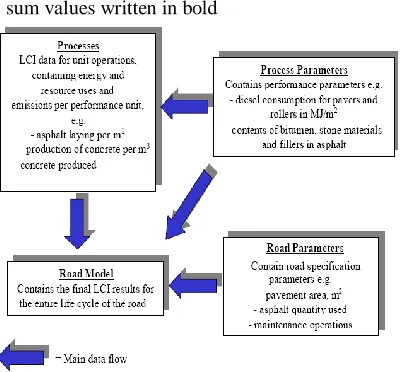
The study is based on a developed Road Model. The computer model calculates the energy use, resource use and the emissions from the life cycle of a road. The model is written in Excel from Microsoft. The model is build up of different worksheets for different input and output of data. The data in the different worksheets are linked together in the calculation formulas for each cell. The main data flow in the model is shown in figure 5.1.1. Thus, if input values are changed, the entire model is recalculated and the new results are shown. There are three different types of data in the calculation worksheets (Road Model and Processes). These are:
- direct input values written in italic
- calculated data for the different processes written in normal style
- sum values written in bold
Figure 5.1.1. Main data flow in the LCI Road computer model.
The sum values are shown above the corresponding process. In the Road Model worksheet there are also values showing the sum of initial construction of the road, the sum of maintenance during the studied time period, the sum of operation activities during the studied time period and the total sum of the entire system, all marked in bold blue.
Only direct input values, written in italic, and parameters in the pavement and process
parameters worksheets can be changed. Other cells contain formulas and cannot be changed without redesign of the model. However, the model can easily be redesigned with the Excel formulas to meet other production procedures or the use of other materials.
The computer model gives the possibility to analyse and vary a number of different activities within a road system. The model simulation that has taken place within the framework of this study can be seen as an example of the existing possibilities of analysis. A central technical question is the decision regarding which type of paving to use on the road. The question is complex both from a technical and economic point of view and has been the subject of previous investigations. The direct environmental and energy aspects have, however, not been analysed from a life cycle assessment perspective. For the present model simulation, therefore, we have chosen to analyse three different surface materials; asphalt road using hot mixed method, asphalt road using cold mixed method and a concrete road.
emission, the sulphur content in the fuel is the deciding parameter, which is why an increased part low sulphur containing fuel has been assumed in the operation of the low emission engines, representing a halving of the sulphur emission.
The choice of input data to the model is an important component in the model work. When analyzing the results it is important to notice that all road sites are unique even if the processes are similar. Thus, the model results are only valid for this particular road defined in the model. However, for road sites with similar conditions more general conclusion can be drawn from the information but the conclusions should be handled with great care. A few general assumptions regarding length of life times for different process alternatives must be made. The choice of length of the studied period can also be vital and in this case a time period of 40 years has been chosen for the study. The section of road concerned is 1 km long. The total width of the road is 13 m.
One part of the road has been assumed to be in a cutting, which means it has anexcavation volume of 100000 m3. A sub-base of a thickness of 1 m and a base course of the thickness 0.5 m has also been assumed. The road has been assumed to be lit and to have certain traffic regulations. In the choice of input data there has been a desire to keep the parameters as similar as possible between the different alternatives.
In the choice of final functional unit for the analysis of the roadwork, it has emergedthat a section of the road itself (Road object) is the simplest and the most representative functional unit. A further analysis can show the more complex application of the transportation work as functional unit. The choice of amount of transportation work is very sensitive and will make a big impact on the total analysis. The total life cycle relationships between the transportation work and maintenance intervals, construction techniques, etc. have not been fully investigated.
5.2 Results
The results here are based on vehicles and maintenance vehicles with low emission engines. Furthermore, model simulations have been run on two different engine alternatives for vehicles andmaintenance vehicles: low emission engines and today’s standard vehicles with a conventional diesel engine.
An overview of the total energy consumption divided between construction, operation
and maintenance from a life cycle assessment perspective, is shown in figure 5.2.1. In addition, the inherent energy bonded in the asphalt layer is also shown in the same figure. The inherent energy is however not a direct energy use due to the fact that the bitumen material is not combusted and the energy is thus not released. The inherent energy use can be treated as a resource use of bitumen. The figure shows the situation without asphalt recycling. An asphalt recycling process can reduce the resource use of bitumen.
the system in operation using low emission engines is shown in figure 5.2.2. The most prominent energy sources are oil, coal, uranium and hydropower.
The consumption of uranium and hydropower canbe linked to the production of electrical energy for primarily lighting and traffic regulation. The consumption of biomass fuel and peat can also be related to the Swedish average electricity production. The consumption of oil is relatively similar for the different paving alternatives. The consumption of coal, however, is significantly higher for the concrete road than for the asphalt alternatives. This is connected with the fact that the production of asphalt is oil based, whereas the production of cement is coal based, as the cement kilns are driven by coal powder. Almost the whole difference in total energy consumption (4 TJ) between asphalt paving and concrete paving can be related to road concrete (cement) for around 3 TJ of coal. The main part of the coal consumption can be related to the operation of the cement kilns in the production of cement.
A rough estimate of the energy consumption for traffic on the section of road during a
corresponding 40-year period, shows a total consumption of 229.2 TJ with the assumption of 5000 cars/24hours and with a total energy consumption including precombustion addition of 0.1 litre petrol/km and vehicle. In table 5.2.1 the calculations of the contribution of the road to energy consumption, in relation to the energy consumption of the traffic, is presented. A vehicle intensity of 5000 cars/24 hours has been assumed and calculations have been done both with and without the electricity consumption for lighting and traffic regulation as these elements make up a significant part of the total energy consumption. Most Swedish rural roads are not lit and lack this energy consumption.
Table 5.2.1 The energy use of the road as a percentage of the energy used from traffic with a traffic intensity of 5000 vehicles/day with and without road lights and traffic control.
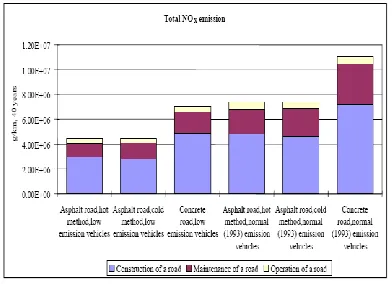
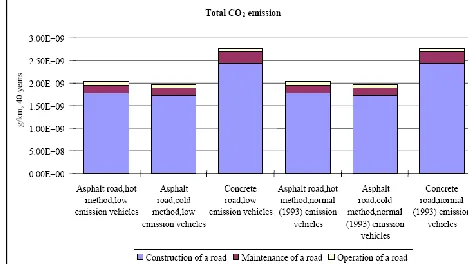
The emissions of NOx, SO2 and CO2 for the system divided between construction,operation and maintenance are shown in figures 5.2.3 - 5.2.5. The calculations of the emissions for the different engine alternatives; low emission engine and today’s conventional engine respectively is based on the assumption that the NOxemission increases by a factor of 2 for today’s standard engine compared to a low emission engine. The SO2 emission has also been assumed to increase by a factor of 2 even if this increase is more related to a decrease in the sulphur content in the types of fuelused, than changes in the construction of the engine. The CO2 emission has been assumed to be constant for both engine alternatives because of the unchanged energy consumption. Figure 5.2.5.shows the situation without the slow long-term processes such as uptake of CO2 in concrete (carbonation, see chapter 4.2.15 to 4.2.17) and inair
Oxidation of bitumen. These processes are very slow and can occur during several hundreds or thousands of years usually as waste processes and have not been covered in the study. If these processes are included the CO2 emission from concrete roads can be reduced and the CO2 emission from asphalt roads can be increased.
Regarding the emissions of NOx, SO2 and CO2, these are dominated by the emissions
road stands for only a small part of the emissions. This is because electricity production in Sweden mainly us hydro and nuclear energy, which have low emission levels of the traditional substances.
Figure 5.2.1 Total energy consumed for three different road surface materials and two different engine alternatives for construction vehicles divided into road construction, road maintenance and road operation for a 1 km long road during 40 years of operation. Dotted lines show inherent energy bonded in the road materials but not released as energy. Of the energy used for operation, approximately 12 TJ is consumed by road lights and traffic control.
In connection with the analysis of the results it should be pointed out that theconditions are very complex and that this study only reflects one type of case, namely those which are described by the input data that has been used. The analysis is also a first application of a complex model which should be regarded as a first research model of the conditions which are present in a road system seen from a life cycle assessment perspective.
Fig 5.2.2 Total energy distribution for three different paving alternatives using vehicles/maintenance machines with low emission engines for 1 km road during 40 years of operation. Inherent energy is not shown.
Figure 5.2.4 Total SO2 emission for three different road surface materials and two different engine alternatives for construction vehicles divided into road construction, road maintenance and road operation for a 1 km long road during 40 years of operation.
Figure 5.2.5 Total CO2 emission for three different road surface materials and two different engine alternatives for construction vehicles divided into road construction, road maintenance and road operation for a 1 km long road during 40 years of operation. The figure shows the situation without the slow long term processes such as uptake of CO2 in concrete and in-air oxidation of bitumen.
CONCLUSIONS
The Excel-based life cycle inventory analysis program for road constructions which has been developed on the basis of the study’s results covers all the work stages from material production to road
maintenance as well as the materials most commonly used in the structural courses of road constructions. The environmental loadings of the constructions and structural components made from the materials within the scope of the program can becalculated simply using only the dimensions of the construction and thicknesses of the structural courses as input data. The simplicity of the inventory analysis program makes it suitable for use by structural designers and other groups not isfamiliar with LCIA methodology. In the interests of simplicity of use it has been necessary to place some limits on the amount of input data and the selection possibilities. For this reason structural materials that may not be included in the program’s data program cannot be directly integrated into it at the touch of a button.
However, the program has an extensive basis database and the addition of missing elements is possible by linking a worksheet containing the functions required by the material to the main work file. The handling of individual materials and the work stages of construction must both be analysed separately because they vary depending on the material and structural course concerned. Special alternatives can also be calculated using the program's data as separate entities without adding them to the program.
assessment method suitable for road construction could be continued, for example, as a wider international co-operation project.
So far energy has not been an important decision factor concerning decision aboutinfrastructure investments, which is also implied in this study. Our results shows that building the bypass increases the total energy use with approximately 60 % (1 550 TJ), mainly because of increased fuel use of traffic where higher speed and longer travel distance are the crucial factors. Thus the infrastructure investment is in opposition of the energy efficiency goal and, as long as fossil fuels are used, also the objective to reduce emission of greenhouse gases.
The main objective for the bypass was to relieve the thoroughfare of traffic, to increase accessibility and traffic safety, which also are goals in the transport sector. The results furthersuggests that there are conflicts between the different transport political goals where solutions promoting accessibility, shortening of travel time and reduced impact of traffic in populated areas are sometimes, as this case indicates, seen as more important than energy efficiency. Also regarding the common knowledge that new roads leads to more traffic, one may question how long it will take before the thoroughfare has the same traffic volume again, which thereby would lead to a similar situation as the one the aim was to avoid.
The absence of some environmental data and uncertainties associated withthe available data complicated some aspects of the inventory calculation. For example, this applies to the utilisation of the by-products in road construction, which is not yet well established. Similarly, of the environmental loadings, data on dust emissions in particular is only available in the case of some materials and work stages. The choice of average emission factors, construction methods and other basic data will always limit the accuracy of the calculations. However, the effects when comparing constructions are not particularly great because the
assumptions made in the calculations are largely the same.
The inventory analysis program is limited at this stage to calculating andcomparing the environmental loadings of constructions only. Activities associated with the construction, use and maintenance of roads that are presently beyond the scope of the program include bridge construction, land clearance works, road-marking work, the construction and maintenance of equipment necessary for traffic control, road lighting, and regular or seasonal road maintenance work (salting, sanding, snow ploughing, etc.). The creation of procedures for calculating the environmental loadings of such factors would be important for assessing the impacts of material selections and the total loadings of road usage.
pavement design and therefore be closely linked to the performance of the road in its life cycle.
REFERENCES
[1] .Baumann, H., Ekvall, T., Eriksson, E., Kullman, M., Rydberg, T., Ryding, S.-O., Steen, B.
ochSvensson, G. (1993a):
Miljömässigaskillnadermellanåtervinning/återanvänd ningochförbränning/deponering.FoU nr 79. StiftelsenReforsk, Malmö.
[2] Baumann, H. and Rydberg, T. (1992): Life Cycle Assessment: A comparison of threemethods for Impact Analysis and Valuation. I "Product Life Cycle Assessment -Principles and Methodology",
281-288, Nord 1992:9,
NordiskaMinisterrådet.AllmännaFörlaget, Stockholm.
[3] Baumann, H. and Rydberg, T. (1993): Life Cycle Assessment: A comparison of three methods for Impact Analysis and Valuation. Submitted to Journal of Cleaner Technology. Ocksåsom appendix i Baumann et al (1993b).
[4] Bousted, I. (1992): Eco-balance methodology for commodity thermoplastics. PWMI, Bryssel.
[5] Anon. 1996a. Vejen mod etbedremiljo. Vejdirektoratetsmiljostrategi 1996 - 2000. Vejdirektoratet Rapport nr. 44. 38 s.
[6] Anon. 1996b.
Tielaitoskestävällätiellä.Tielaitoksenympäristöohjelm a 1996.(Environmental program of Finnish Road Association). 12 s.
[7] Besluiten 567. 1995.
Bouwstoffenbesluitbodem- en
oppervlakwaterenbescherming.Staatsblad van het Koninkrijk der Nederlanden. 92 s.
[8] Blomberg, T. 1998.
Bitumienjaasfaltinelinkaariarviot. (Life-cycleassessment of bitumen and asphalt). Seminaarissa: Elinkaariarviointikäytännöntyökaluna, Neste/VTT, Keilalampi 6.5.1998.
[9] Blomster, D. 1989.
Pitkäsuontäyttösuunnitelma.ImatranVoimaOy. Vantaa.9 s.
[10] Broers, J., Hoefnagels, F. &Roskamp, H. 1994. Life cycle assessment ofroad embankment in