ISSN (Print) : 2320 – 3765 ISSN (Online): 2278 – 8875
I
nternational
J
ournal of
A
dvanced
R
esearch in
E
lectrical,
E
lectronics and
I
nstrumentation
E
ngineering
(A High Impact Factor, Monthly, Peer Reviewed Journal)
Website: www.ijareeie.com
Vol. 7, Issue 5, May 2018
Adaptive Headlight Using Driver Assistive
Controller
Prof.P.R.Sonawane, Kaustubh Kathale, Sanket Sonawane, Hardeepsingh Dhillon
Assistant Professor, Dept. of E&TC Engg, P.C.C.O.E Akurdi, Pune, India1 B. E Student, Dept. of E&TC Engg, P.C.C.O.E Akurdi, Pune, India 2, 3, 4
ABSTRACT:Today society strongly depends on transportability of both people and goods and is expected to grow further in the future. Along with this growth in number of vehicles on road, need of safety increases. By various analysis it was found that improper visual at sharp turns during night time may lead to accidents. Active safety systems can be designed to avoid these types of accidents and increase degree of safety in automobiles. In order to facilitate all the vehicles running on road with dynamic lighting system, this work aims to design and develop a cheap and effective Universal Automatic Headlight System. This system will try to control the beam angle using LED’s based on Steering Wheel rotation. This will be done by a relay circuit that switches the LED bulbs glow from 10, 20 and 30 deg. LED bulbs will be used due to their low power consumption and high power output characteristic. This system is easily implemented on the bumper and will also take care of the glare problem faced by the opposite vehicle driver.
This project focuses on the design and working of a microcontroller based Adaptive Headlight System (AHS) for automobiles. The main purpose of this system is to present a cost effective technique to illuminate blind spots while driving in the night and during the times when the visibility is reduced significantly so as to make the objects visible in those darkened locations and thereby prevent accidents. The system functions in accordance to the controlled input from ATmega32 microcontroller unit which drives the dc motors connected to the headlights. The system is also designed to receive input from the indicator switch wherein a full turn is achieved by the headlight mirror when the indicator input is given. Also, the adaptive headlights are automatically switched on when the amount of light measured by a photo diode falls below a threshold, thereby eliminating the need for the driver to switch on the headlights.
KEYWORDS: ATmega 32, Adaptive Headlights, Ultrasonic Sensor, LDR Sensor, DC Motor
I.INTRODUCTION
Accidents during night have become very common in the current scenario. Automobiles have headlights that lights up the road in front of the vehicle and fails to provide illumination at bends. Reasons like lack of visibility, inability to view objects at the corner of a turn have plagued automobile drivers during late night travel. To overcome these situations, several mechanisms have been sought after to mitigate once an accident occurs but there were not much solutions proposed to prevent an accident even before it occurs.
ISSN (Print) : 2320 – 3765 ISSN (Online): 2278 – 8875
I
nternational
J
ournal of
A
dvanced
R
esearch in
E
lectrical,
E
lectronics and
I
nstrumentation
E
ngineering
(A High Impact Factor, Monthly, Peer Reviewed Journal)
Website: www.ijareeie.com
Vol. 7, Issue 5, May 2018
Temporary blindness of the driver can occur due to dazzling of headlamps. Dazzling occurs when the headlights of the vehicle coming in the opposite direction falls directly into the eyes of the driver. This result in the driver being blinded for some time and in turn increase the probability of accidents. This problem is more prevalent when the road is curved. A vehicle with normal headlights sends the light rays tangential to the curve. Thus, the probability of dazzling of lights in the eyes of the driver of the vehicle coming in the opposite direction is very high. This driver, with his eyes momentarily blinded, can go off the curve and off the road and create a major accident, hence, killing him and others on the road. There are also instances where the driver fails to switch on the head lamp during night or when the visibility is not sufficient to guarantee safe driving, accidents occur especially in highways. Hence a mechanism to ensure that the head lamps are turned on automatically is required. This mechanism again is incorporated only in high end cars like BMW, Audi, Volvo etc. In order to incorporate this mechanism in low end cars, a cost effective and efficient method is the need of the hour. This can be incorporated by mounting a photo diode on the windshield behind the internal rear view mirror. Thus, there must be a cost effective mechanism to address the problems of blind spots, dazzling of head lights and low visibility. In this paper, the proposed system is one such solution that helps in preventing an accident by providing proper visibility to drivers by illuminating curves and bent paths
II.LITERATURE SURVEY
S. N.
Name of
Author Title Publication Methodology
1
MeftahHrairi and Anwar B. Abu Bakar
IEEE Transaction on
Computer and
Communication Engineering (ICCCE),
International Conference On Chemical and Chemistry Engineering
Development
of an Adaptive Headlamp Systems
2
T. Hacıbekir, S. Karaman, E. Kural, E.S. Öztür
IEEE International Conference on Control Applications Munich, Germany
International Conference On Control Applications (ICCA)
Adaptive Headlight System Design Using Hardware-In-The-Loop
Simulation
3
C .K Chan, W.E.Cheng, S. Lho and T.M. Fung,
IEEE Transaction on Power
Electronics Systems and Applications
International Journal of Advanced Research in Electrical, Electronics and Instrumentation Engineering
Simulation of the Control Method for the Adaptive
Front Lighting System
4
Guo Dong , Wang Hongpei , Gao Song and Wang Jing
Adaptive Headlights System
Transportation, Mechanical, and Electrical Engineering (TMEE)
Study On Adaptive Front Lighting System Of
Automobile Based On Microcontroller
5 Rajeev Shorey Smart Vehicles IEEE New York Emerging Trends in Vehicular
III.ADAPTIVE HEADLIGHT SYSTEM
ISSN (Print) : 2320 – 3765 ISSN (Online): 2278 – 8875
I
nternational
J
ournal of
A
dvanced
R
esearch in
E
lectrical,
E
lectronics and
I
nstrumentation
E
ngineering
(A High Impact Factor, Monthly, Peer Reviewed Journal)
Website: www.ijareeie.com
Vol. 7, Issue 5, May 2018
Fig. 3.1: Block Diagram of Adaptive Headlight System
In the adaptive headlight ,light during the curvature road will take input from ultrasonic sensor which is having input voltage of 5V supplied through common power supply to both ultrasonic as well as ATmega32 processor. The ultrasonic sensor send echo pulses in speed of sound which get reflected back from plate1and plate 2 during this all process data of echo pulses is send back to processor for calibrating the change distance using formula. Distance =velocity of sound (340ms) * number of echo pulses generated (time)
ISSN (Print) : 2320 – 3765 ISSN (Online): 2278 – 8875
I
nternational
J
ournal of
A
dvanced
R
esearch in
E
lectrical,
E
lectronics and
I
nstrumentation
E
ngineering
(A High Impact Factor, Monthly, Peer Reviewed Journal)
Website: www.ijareeie.com
Vol. 7, Issue 5, May 2018
Formula Used In Program For Calculating Required PWM Width
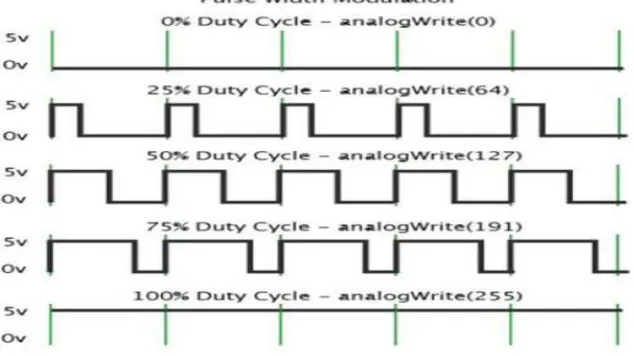
Vertical pulse pwm = 18000 + (150 - (ultrasonic cnt - 50)) * 60
(1) PWM waveform for vertical servo motor depends upon ultrasonic count. Ultrasonic sensor gives minimum width of 50 and maximum of 200. We have shifted down the lower limit to 0 by subtracting 50 from all the values. Now the range becomes 0 to 150. To preserve the relation that when object is at far distance headlight angle is up and if the object is nearer then headlight should be lowered, obtained count is subtracted from 150. Multiplication of 60 brings this count in the range of thousands and ensures full vertical span of motor is covered. 18000 counts bring motor to lowermost point and any addition of remaining factor brings it to upper angle by some proportional amount.
Horizontal pulse pwm= (1024 – adcread(0,3)) *(1024/280)
IV. FLOWCHART
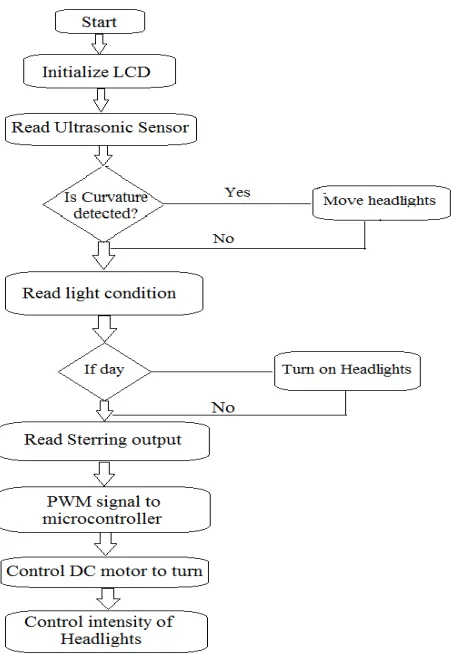
Fig 2: Flowchart of System
V. APPLICATIONS
ISSN (Print) : 2320 – 3765 ISSN (Online): 2278 – 8875
I
nternational
J
ournal of
A
dvanced
R
esearch in
E
lectrical,
E
lectronics and
I
nstrumentation
E
ngineering
(A High Impact Factor, Monthly, Peer Reviewed Journal)
Website: www.ijareeie.com
Vol. 7, Issue 5, May 2018
VI. EXPERIMENTAL RESULTS
Fig.3 Power Supply
ISSN (Print) : 2320 – 3765 ISSN (Online): 2278 – 8875
I
nternational
J
ournal of
A
dvanced
R
esearch in
E
lectrical,
E
lectronics and
I
nstrumentation
E
ngineering
(A High Impact Factor, Monthly, Peer Reviewed Journal)
Website: www.ijareeie.com
Vol. 7, Issue 5, May 2018
VII. CONCLUSION
Universal adaptive headlight system serves as a reliable and efficient system for efficient driving at sharp turns during night. The system is inexpensive, simple and dependable assembly. This system provides the ability to illuminate the road at sharp turns or corners continuously corresponding to the angular rotation of sensor which is attached to the steering. An advantage of the developed headlight system is in its high adaptability as it can be easily configured to fit on the bumper in variety of vehicle designs. Simple comparator based circuit is used which uses very simple logic and makes it most economical to use. More advanced and compact version can be developed using microcontrollers and dedicated steering angle sensors without much increase in cost. Adaptive headlight system thus can be used as accessory in all running vehicles for proper illumination of road according the driving situation. This ensures higher degree of active safety in vehicles and assistance to driver.
REFERENCES
1. www.bmw-motorrad.com/AdaptiveHeadlightSystem-lightingtheway.pdf
2. T. Hacıbekir, S. Karaman, E. Kural, E.S. Öztürk, M. Demirci and B. AksunGüvenç, ]“Adaptive Headlight System Design Using Hardware-InThe-Loop Simulation.” Automotive Control and Mechatronics Research Center, ,Proceedings of the 2006 IEEE International Conference on Control Applications. Munich, Germany, October 4-6, 2006.
3. MeftahHrairi and Anwar B. Abu Bakar, “Development of an Adaptive Headlamp Systems.” International Conference on Computer and Communication Engineering (ICCCE 2010), Kuala Lumpur, Malaysia, 11-13 May 2010.
4. Hacibekir, T.Karaman, S.Kural, E.Ozturk, E.S. Demirci, M.AksunGuvene, B. "Adaptive headlight system design using hardware-inthe-loop simulation," Computer Aided Control System Design, 2006 IEEE International conference on Control Applications, 2006 IEEE International Symposium on Intelligent Control, 2006 IEEE , vol., no., pp.915,920, 4-6 Oct. 2006.
5. Intelligent and Adaptive Headlight with Electronic Controlled Power Steering System (IAEPS) Authors: HarshalMohite, BhushanMahangade ,Sandip Kumar Journal :International Journal of Current Engineering and Technology. Year:April (2015)
6. Adaptive headlight system for four wheelers. Authors:Mr.S.M.Sheikh, Mr.R.S.KothariJournal:International journal for engineering applications and technology.