International Journal of Research (IJR)
e-ISSN: 2348-6848, p- ISSN: 2348-795X Volume 2, Issue 07, July 2015Available at http://internationaljournalofresearch.org
OFDM –DWT & BPSK Using QPSK & 16PSK
B.Sreekar
1& D. Vijay Kumar
21M.Tech, Dept of ECE ,Vijaya Engineering College, Telangana, India.
Email: [email protected]
2Associate Professor, HOD, Dept of ECE ,Vijaya Engineering college, Telangana,India,
Email: [email protected]
Abstract
Orthogonal Frequency Division Multiplexing (OFDM) hasbecome the most widely adopted technology for varioushigh data rate wireless communication systems due to thespectral bandwidth efficiency and robustness to frequencyselective fading channels. This paper examines theperformance degradation of conventional OrthogonalFrequency Division Multiplexing (OFDM) and DiscreteWavelet Transform based OFDM (DWT-OFDM) systemswhen the signals are passed through a nonlinear High PowerAmplifier (HPA). In the case of DWT OFDM, severalwavelets such as Daubechies, Symlet and Biorthogonal areevaluated. Computer Simulation result shows that DWTOFDMspecifically Haar (db1) is more robust againstnonlinearity in comparison to DFT-OFDM.
Keywords: OFDM; DWT; BPSK; QPSK; 16PSK
1.
Introduction
Multicarrier Modulation (MCM) is an efficientmodulation scheme which divides the incominghigh rate data into lower rate data. The duration ofsymbols is increased by simultaneously transmittingN data symbols which leads to robustnessagainst channels fading, impulsive noise, and InterSymbol Interference (ISI).OFDM is a multicarrier scheme commonly usednowadays.
OFDM has been widely adopted andstandardized across the world. A number ofapplications and standards which use OFDMinclude Digital Audio Broadcasting
International Journal of Research (IJR)
e-ISSN: 2348-6848, p- ISSN: 2348-795X Volume 2, Issue 07, July 2015Available at http://internationaljournalofresearch.org
disadvantages such asreducing the spectral containment of the channel,power consumption, etc. [2].
Wavelet transformation has recently emerged asa strong candidate for digital communications [3].In DFT-OFDM systems, signals only overlap in thefrequency domain while DWT-OFDM signalsoverlap both in the time and frequency domains, sothere is no need for the CP as in the DFT-OFDMcase. Therefore, by using this transformation, thespectral containment of the channel is improved[4].
Performance of MCM communication systems ishighly sensitive to nonlinear distortions arisingmainly from the HPA [5-7]. To achieve moreoutput power, transmission power should beincreased, which in turn causes the HPA to operatein saturation region. Hence, it seems necessary toassess and compare the DFT-OFDM and DWTDFT-OFDMsystem performances in the presence of theHPA.
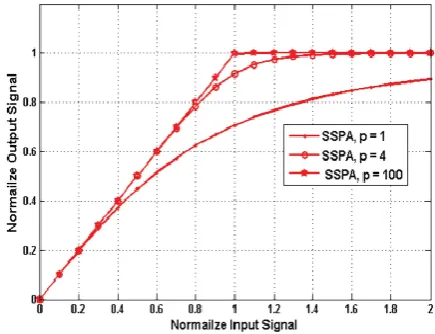
This paper aims to evaluate the impact of thedistortion introduced by the nonlinear behavior of aSolid State Power Amplifier (SSPA), as an HPA,which is commonly used in cellular systems. In thisstudy, the Rapp model is used both in DFT-OFDMand DWT-OFDM systems. The Rapp model ischaracterized by [8]:
Where Vinis the magnitude of the input signal,
pis smoothness factor, FAM/AM is the magnitude ofthe output signal, and Vsatis the output saturationlevel. The smoothness factor controls transition forthe amplitude gain as the output amplitudeapproaches saturation. Fig. 1 shows input-outputcharacteristics for various smoothness factors p.Also, the phase transfer function is almost zero.
Fig 1: Input-output characteristic of the Rapp model.
The paper is organized as follows. Section II introduces block diagrams of DFT- OFDM andDWT-OFDM systems, respectively. Section IIIconsiders the PAPR (peak to average power ratio)performance in DFT-OFDM and DWT-DFT-OFDMsystems. Section IV and V evaluate the Bit ErrorRate (BER) performance without SSPA, in thepresence of fading channel and with SSPA,respectively. Finally VI concludes the paper.
International Journal of Research (IJR)
e-ISSN: 2348-6848, p- ISSN: 2348-795X Volume 2, Issue 07, July 2015Available at http://internationaljournalofresearch.org
2.1 Block diagrams of DFT-OFDM and DWT-OFDM systems:
DFT-OFDM and DWT-OFDM
transceiversystems are shown in Fig. 2. In DFT-OFDM, thedata bit-stream is first mapped onto QAMconstellation to form a complex symbol followedby a S/P. Then it is
modulated onto orthogonalsubcarriers using IDFT. After P/S, a CP (that is25% of each symbol in practical systems) iswrapped to the symbols. Then the signals arepassed through the HPA followed by channel. Atthe receiver, the CP is discarded. The resultingsignal is demodulated to recover the original databits.
Fig 2: DFT-OFDM and DWT-OFDM transceiver block diagrams.
International Journal of Research (IJR)
e-ISSN: 2348-6848, p- ISSN: 2348-795X Volume 2, Issue 07, July 2015Available at http://internationaljournalofresearch.org
Wavelet Transform (WT) is a class of generalizedFourier transforms with basis function beinglocalized well both in the time and frequencydomains. They are constructed by means ofQuadrature Mirror Filter (QMF) pairs [9-10]. It hasbeen shown that DWT-OFDM is more robust tonarrowband interference and multipath propagationloss than DFT-OFDM [11]. In DWT-OFDMtransmitter, the incoming signal is first convertedfrom serial to parallel. In the case of DWT-OFDM,the number of iterations can be expressed by:
Number of Iteration = 2 log (Number of Subcarriers) (2)
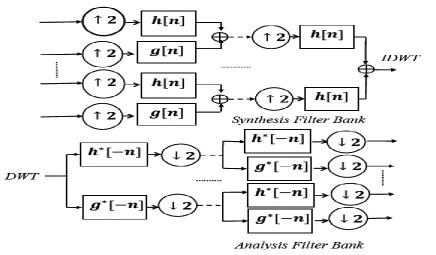
Fig.3 shows DWT and inverse DWT (IDWT)blocks. IDWT (as the synthesis filter bank) andDWT (as the analysis filter bank) are used in placeof IDFT and DFT, respectively, at the transmitterand receiver. Any iteration of IDWT upsamplestwo signals and filters one with a High Pass (HP)Finite Impulse Response (FIR) filter and the otherone with a Low Pass (LP) FIR filter. The outputs ofthe HP and LP filters are then subsequently added[12]. Consequently, DWT-OFDM does not requireP/S in the transmitter and S/P in the receiver. In ourstudy, several wavelets such as dbN, symN, biorNr,Nd are evaluated. When analysis bank is exchangedwith the synthesis bank, the system will be still aperfect reconstruction (PR) [13]. Accordingly, ifthese
wavelets preserve orthogonality between thesymbols, it is expected that the Bit Error Rare(BER) plot lies on the theoretical BER plot.
Fundamentally, DFT-OFDM and DWT-OFDMhave many similarities as both use orthogonalwaveforms as subcarrier. The main differencebetween DFT-OFDM and DWT-OFDM lies on theshape of the subcarrier and in the way they arecreated. One important property of wavelet is thatthe waveforms being used in general are longerthan the transform duration of each symbol [14-15].This causes DWT-OFDM symbols to overlap in thetime domain.
The multicarrier symbols of DFT-OFDM do notoverlap each other as IDFT and DFT transforms arecarried out for each group of subcarriersindependently. The use of longer waveforms inDWT-OFDM, on the other hand, allows betterfrequency localization of subcarriers while in DFTOFDMthe rectangular shape of the DFT windowgenerates large side lobes [16].
International Journal of Research (IJR)
e-ISSN: 2348-6848, p- ISSN: 2348-795X Volume 2, Issue 07, July 2015Available at http://internationaljournalofresearch.org
3.
Implementation
3.1 PAPR in DFT-OFDM and DWT-OFDM systems:
One of main drawbacks of OFDM is its highPAPR. Signals with large peaks may be obtained as aresult of constructive superposition of subcarriers.PAPR is defined as the ratio between the maximumpowers occurring in OFDM symbol to the averagepower of the same OFDM symbol:
Fig 4: CDFs of the PAPR for different schemes.
Where E[. ] denotes expectation. PAPR dependslinearly on the number of subcarriers, but in systemswith a large number of subcarriers, the probability ofa symbol with a large PAPR is small and vice versa.This leads to use CDF (Cumulative DistributionFunction) to describe PAPR distribution. High peakpower is a disadvantage of HPAs. Due to
amplifierimperfection, peaks are distorted nonlinearly. Theresult can be interpreted as an ICI (Inter-CarrierInterference) in the system. In general, PAPR isevaluated from the discrete time samples byoversampling. PAPR can take values in a range thatis proportional to the number of subcarriers. In thisstudy, the DFT-OFDM and DWT-DFT-OFDM schemeswith 64 subcarriers, each modulated with QAM, werecompared in terms of CDF. Fig. 4 shows that whileDWT (db1)-OFDM has a comparable PAPRperformance, other wavelets exhibit inferiorperformance in comparison to DFT-OFDM.
3.2 Simulation without power amplifier:
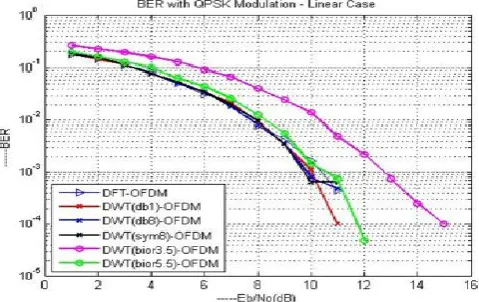
Fig 5: Performance of DFT-OFDM and DWT-OFDM for the linearcase.
International Journal of Research (IJR)
e-ISSN: 2348-6848, p- ISSN: 2348-795X Volume 2, Issue 07, July 2015Available at http://internationaljournalofresearch.org
DWT-OFDM and DFT-OFDM arethe same except for bior3.5, andbior5.5. Thesewavelets are not orthogonal and thus theorthogonality between subcarriers is destroyed. Thedifference between dbN and symN is not significant,because they do not use any nonlinear element suchas HPA and the model is perfectly reconstructive.This validates the simulations.
4.
Experimental Results
4.1 Results in the presence of the SSPA:
An HPA is usually identified by two parametersknown as Input Back Off (IBO) and Output BackOff (OBO), defined in decibel as:
IBO =10 log10(Pimax/Pi) and OBO = 10
log10(Pomax/Po), respectively,
Where Pimaxand Pomaxarethe mean power of
the input and output signals ofthe HPA.
Pomaxis the maximum output
power(saturation power), and Pimaxis the input
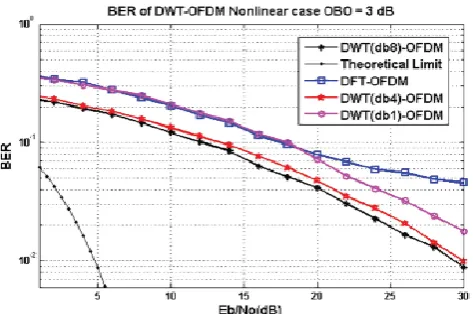
powercorresponding to the maximum output power [19].A pictorial description of OBO and IBO is shownin Fig. 6 and defined (on a logarithmic scale) asthe difference between the maximum output powerand the output power at the quiescent point. Fig.7shows the BER performance of DFT-OFDM andDWT-OFDM when Rapp model is applied withsmoothness factor p=1at OBO=3 dB. In
this FigureDWT-OFDM outperforms DFT-OFDM. As shown
in Fig.7, by decreasing the order of Daubechiesfilters, performance of DWT-OFDM system will bedegraded. This behavior is more obvious atEb/Novalues larger than 20dB.
Fig 6: AM-AM characteristic.
Fig 7: Performance of DFT-OFDM and DWT-OFDMin the presence of SSPA and fading channel.
5.
Conclusion
DWT-International Journal of Research (IJR)
e-ISSN: 2348-6848, p- ISSN: 2348-795X Volume 2, Issue 07, July 2015Available at http://internationaljournalofresearch.org
OFDM in the presence of SSPA –asan HPA- were evaluated using Rapp model. The Simulationresult shows that the BER performance of DWT-OFDM isthe same as DFT-OFDM in AWGN channel for the linearsystem i.e. without SSPA as a nonlinear block. InDaubechies and Symlet families, the BER and TDperformances were degraded when the length of the filterwas increased. The result showed that just db1 (Haar)wavelet for the DWT-OFDM system achieved better BERand TD performances compared to DFT-OFDM. The aboveresults were confirmed for the corresponding equalizedschemes as well. Also, some DWT-OFDM schemes showedsuperior PAPR performances than that DFT-OFDM.
6. References
[1] S.Weinstein, P. Ebert, “Data transmission by frequency division multiplexing using the discrete Fourier transform,” IEEE Trans. on Communications, COM-19, 5:628-634, Oct 1971.
[2] K. Abdullah, Z. M. Hussain, “Studies on DWT-OFDM and FFT-OFDM systems,” International Conference on Communication, Computer and Power (ICCCP’09), MUSCAT, pp. 15-18, Feb 2009.
[3] M. K. Lakshmanan and H. Nikookar, “A review of wavelets for digital wireless communication,” Journal on Wireless Personal
Communication, vol. 37, no.3-4, pp. 387-420,Springer, May 2006.
[4] R. Dilmirghani, M. Ghavami, “Wavelet Vs Fourier based UWB systems,”18th IEEE International Symposium on Personal, Indoor and Mobile Radio Communications, pp.1- 5, Sep 2007.
[5] E. Costa, S. Pupolin, “M-QAM-OFDM system performance in the presence of a nonlinear amplifier and phase noise,” IEEE Trans. on Communications, vol. 50, no.3, Mar 2002.
[6] V.A. Bohara, and S.H. Ting, “Theoretical analysis of OFDM signals in nonlinear polynomial models,” 6th International Conference on Information, Communications & Signal Processing, pp. 1 – 5, 10-13 Dec. 2007.
[7] N.Y. Ermolova, “Nonlinear amplifier effects on clipped filtered multicarrier signals,” IEEE Proc. Communication, vol.153,no.2, pp.213-218 Apr. 2006.
[8] C. Rapp, “Effects of HPA-nonlinearity on a 4DPSK/OFDMsignal for a digital sound broadcasting
system, “in Proceedings of the Second European Conference on Satellite Communications, pp. 179-
International Journal of Research (IJR)
e-ISSN: 2348-6848, p- ISSN: 2348-795X Volume 2, Issue 07, July 2015Available at http://internationaljournalofresearch.org
[9] A. R. Lindsey, “Wavelet packet modulation: a generalized method for orthogonally multiplexed communications,” in IEEE 27th Southeastern Symposium on System Theory, pp. 392–396, 1995.
[10] D. Daly, C. Heneghan, A. Fagan, and M. Vetterli, “Optimal wavelet packet modulation under finite complexity constraint,” in Proc. ICASP, vol. 3, pp. 2789–2792,2002.
Authors Profiles
B.SREEKAR pursuing his M.Tech, from Vijaya Engineering College, Telangana, India. Email: [email protected] m