Digital Video Watermarking Using DWT-DFT
Transforms and SVD Technique
1 Supriya Hasarmani, 2 Mangal Patil, 3 P. R. Naregalkar
1,2,3
Department of Electronics, BVUCOE Pune, Maharashtra, India
Abstract - In modern years there is no difficulty to make perfect copies which guide extensive unauthorized copying, which is an immense concern to the film, music, software and book publishing industries. Because of this unease over copyright issues, many technologies are developed to defend against illegal copying. Use of digital watermarks is one of these technologies. Watermarking does the embedding an ownership signal into the data directly. So that, the signal is always present with the data (image, audio, video). DWT-DFT-SVD techniques are used in the proposed scheme to improve the robustness and overall computation requirements. The proposed algorithm is tested using three video sequences of different format. In this approach achieved PSNR of the original and watermarked video signal is more than 60 dB. The proposed scheme shows high robustness against several attacks.
Keywords - Digital Video Watermarking, Discrete Fourier Transform (DFT), Discrete Wavelet Transform (DWT), Singular Value Decomposition (SVD).
1.
Introduction
Digital video watermarking is done by embedding watermark in a video sequence so as to defend the video from illegal copying [1]. Video sequencing consists of motionless images which are uninterrupted and evenly time spaced. Image watermarking techniques can be used for video watermarking, but there are many challenges that video watermarking techniques needs to meet in reality [2, 3]. Watermarked video is very much sensitive to plagiarize attacks such as digital-analog (AD/DA) conversion, frame swapping, frame averaging, lossy compressions and statistical analysis [4]. Video watermarking has many security related applications such as ownership identification, Copy control, taper resistance, authentication, fingerprinting, etc [5]. It also has value added applications such as digital video broadcast monitoring, legacy system enhancement, Media Bridge, video tagging, database linking etc [6]. Aside from robustness, imperceptibility, reliability, the video
watermarking algorithms must address issues like real time algorithm complexity, synchronization recovery, localized detection, power dissipation etc [7, 8]. The proposed algorithm is divided into two parts. First is Embedding and second is Extraction. DWT-DFT-SVD techniques are used for video watermarking. To check the robustness of proposed method must undergo through various attacks like Gaussian noise, salt & pepper noise, median filter, rotation attack, image sharpening etc.
The rest of this paper is prearranged as the following. At first, in Section 2 we demonstrate the literature survey of digital video watermarking, in Section 3 we describe the Theoretical Background of proposed video watermarking scheme. The proposed video watermarking algorithm is briefly depicted in section 4. The experimental results of proposed scheme are provided in section 5, followed by conclusion in section 6.
2.
Literature Survey
Various video watermarking techniques have been developed on wavelet domain. Few of them are:
Nisreen I. Yassin et. al. [11] introduced QIM blind video watermarking method which is based on wavelet transform and principal component analysis. The proposed technique used three videos of size 256× 256 and watermark binary image of size 32× 32. The PSNR and NC are evaluated with different values of impact factor α and quantization steps ∆. The computed average PSNR exceeds 45 dB. This scheme shows high robustness against several attacks. Effect of mother wavelets on this scheme is tested, such as, Haar, dB3, Bior 2.2, sym 3, coif 1, Rabio 2.2. Comparison between blind and non-blind experiment is done by comparing PSNR, NC, average elapsed time.
Prachi V. Powar and S.S. Agrawal [12] implemented digital video watermarking scheme based on FPGA. The system is at first simulated and tested for a variety of attacks in MATLAB/ Simulink® and then prototyped on VERTEX-6 FPGA using VHDL. There is no differentiation between original and watermarked video. It gives average PSNR of 46 dB.
A colour video watermarking based on DWT-DFT transforms and SVD technique which is robust non-blind watermarking technique is introduced by Nandeesh B et. al. [13].
In this method the Fibonacci series is used for selection of frames from the original video, which enhance security and also maintain the superiority of original video. For watermark encryption Arnold transform is used, which scramble the watermark. The robustness of this technique is measured by applying geometric as well as non-geometric attacks to watermarked video. The watermarked video quality is calculated using PSNR and NC, this shows the likeness between the original and extracted watermark. This scheme used the videos having resolution 720 x 1280 uncompressed .avi format and a colour watermark have size of 512 x 512.
3.
Theoretical Background
3.1 YCbCr Colour System
YCbCr is family of colour spaces and used as a part of colour image pipeline in video and digital photography systems. Where Y is the luma component and remaining Cb, Cr are the blue-difference and red-difference chroma components. The RGB format contains many redundant values; therefore it is more resourceful to make conversion to YCbCr colour space [13]. Conversion to YCbCr from RGB can be done by the following method [1].
0.299 0.587 0.114 0.169 0.331 0.500 0.500 0.419 0.081
(1)
3.2 Discrete Wavelet Transform
An image is continuously decomposes by Discrete wavelet transform (DWT) which is the multi-resolution explanation of an image. Signal is allocated in high and low frequency components by DWT [14]. High frequency part contains the edge components information. The low frequency part is again get divided into high and low frequency parts. An input image is decomposed using DWT into four sub-bands those are LL, HL, LH and HH. There is different level of decomposition; again DWT is applied to LL band for the purpose of doing next level of decomposition. [15, 16]. Figure 2 describes the 2-level DWT sub-bands.
Fig.1- 2-level DWT sub-bands
3.3 Discrete Fourier Transform (DFT)
Transformation of continuous time function into its frequency elements is done by DFT. It gives high scale of robustness against some geometric attacks such as rotation, scaling, cropping etc [17]. DFT shows conversion invariance. Spatial shifts of image do not influence the magnitude representation but it affects the phase demonstration [1, 18].
3.4 Singular Value Decomposition
Image can be represented in a matrix by using SVD. It also used in many application of image processing. The singular value decomposition of a complex matrix X is given by following equation (2).
∑ ∗ (2)
conserves most energy and it also gives better quality result after applying various attacks [20].
4.
Proposed Algorithm
The robustness of the proposed work is enhanced by combining the properties of DWT, DFT, and SVD. DFT is strong against different attacks such as Gaussian noise, shift invariance, image sharpening. Embedding watermark using DWT increases the robustness of watermark and it does not affect an image quality. Singular values are very steady and they can resist smaller perturbations. The proposed algorithm is divided into 2 stages, watermark embedding and watermark extraction respectively.
Fig.2- watermark embedding process
Fig.3- watermark extraction process
Embedding process for proposed scheme is depicted in fig.2 and explained as follows:
Step 1: converted host video signal into YCbCr format from RGB.
Step 2: DWT transformation is performed on Y luma component of input video. DWT decomposes input video frames into four components namely LL, LH, HL, HH.
Step 3: From those four components LL is selected for embedding process.
Step 4: DFT is applied on LL sub-band and SVD technique is performed on output results of DFT.
Step 5: Selected watermark image and converted it into YCbCr colour space from RGB format. Step 2, 3and 4 is also performed on watermark image.
Watermark
YCbCr Conversion
DWT
DFT
SVD
ISVD
IDFT
IDWT
Combine Y, Cb, Cr
Watermarked Video Original
Video Stream
YCbCr Conversion
DWT
DFT
SVD
Watermarked Video Stream
YCbCr Conversion
DWT
DFT
SVD
(Sw-S)/alpha
ISVD
IDFT
IDWT
Y, Cb, Cr Concatenation
Step 6: SVD results of video frame and watermark image is combined. ISVD is performed on combined result.
Step 7: IDFT and IDWT is applied on output of ISVD. Y, Cb, Cr components are combined and converted back to RGB format. Finally we get the watermarked video. Extraction process for proposed scheme is depicted in fig.3 and explained as follows:
Step 8: Perform step 1, 2, 3, 4 on watermarked video stream until the S matrix is obtained for all frames of Watermarked video signal.
Step 9: Singular matrix (S*) of watermark is obtained by the following equation
∗
(3)
Where is output of SVD from step 8 and alpha is taken 0.1 in this work
Step 10: Perform ISVD on singular matrix output matrix of watermark. Then apply IDFT and IDWT on resulting ISVD.
Step 11: Y component is concatenated with Cb and Cr and again converted back to RGB which gives the original watermark.
5.
Experimented Results
.
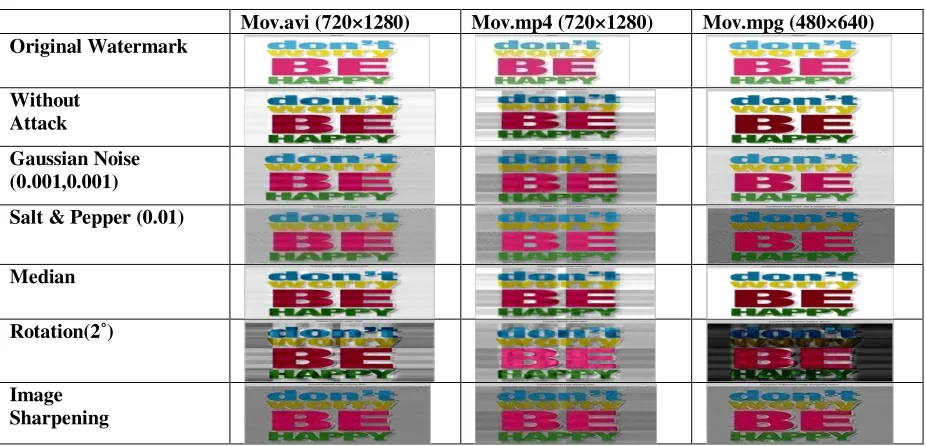
Assessment of proposed algorithm is done using Matlab10. Three Videos were chosen of different resolutions with different format (.avi, .mp4, .mpg). Colour watermark of size 240 × 320 of .jpg format have been chosen.
Table 1- Results of extracted watermark with and without attack for three video samples
Mov.avi (720×1280) Mov.mp4 (720×1280) Mov.mpg (480×640) Original Watermark
Without Attack
Gaussian Noise (0.001,0.001)
Salt & Pepper (0.01)
Median
Rotation(2˚)
Image Sharpening
Table 1 illustrate the extracted watermark images for all video samples when applied by different attacks as well as without attack. It shows correlation between original and extracted watermark. Results of HD videos having resolution 720×1280 is more better than video having resolution 480×640, whereas video Mov.mpg has good result for extracted watermark without attack and for median filtering attack as compared to remaining two videos.
To ensure the reliability of video, peak-signal-to-noise ratio (PSNR) is measured. PSNR depends on MSE. MSE is calculated by taking into account the dissimilarity
between values inferred by an estimator and the true values of the quantity being estimated.
"# $%&1(', )) &2(', ))*" × ,
-.,/
(4)
Where I1 and I2 is the original frame and extracted frame.
It is given by Eq. [5]. Where M and N are rows and
columns of an image. 0, 10 log456
-"#7 (5)
Table 2- different attack with resulting PSNR and NC for different videos
Mov.avi (720×1280) Mov.mp4 (720×1280) Mov.mpg (480×640)
PSNR (dB) NC PSNR (dB) NC PSNR (dB) NC
Without Attack
72.65 0.9877 73.42 0.9395 65.54 0.9968
Gaussian Noise (0.001,0.001)
72.62 0.9638 73.39 0.8769 65.47 0.9820
Salt & Pepper (0.01)
72.60 0.8935 73.36 0.7839 65.49 0.8045
Median 72.58 0.9836 73.40 0.9337 65.52 0.9960
Rotation(2˚) 72.61 0.9303 73.33 0.9209 65.50 0.3633
Image Sharpening
72.62 0.9050 73.39 0.8514 65.50 0.9222
We can noticeably examine the PSNR and NC values from table 2. PSNR value is greater than 60 dB and NC value is varying for different videos, still average result of NC is more than 0.90. Comparison between PSNR and NC values of three videos which differ in resolution, format and length is shown. Table 3 conclude that the HD video (720×1280) has PSNR value greater than 70 dB.
(a)
(b)
(c)
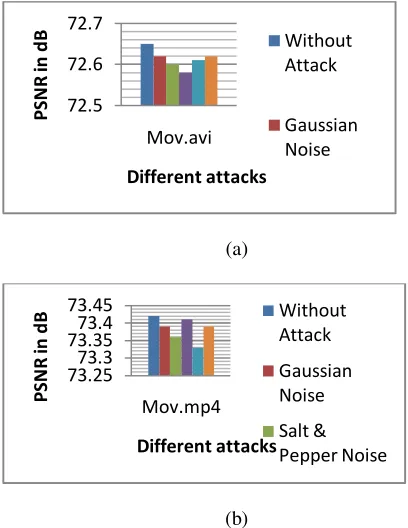
Fig.4- PSNR with and without attacks for different videos
Various attacks were applied on different videos to test the robustness of the proposed algorithm. Figure 4[(a), (b), (c)] describes the PSNR with and without attacks for three different video samples. Where fig. 4(a) is showing results for video Mov.avi, fig. 4(b) and 4(c) are showing the results for videos Mov.mp4 and Mov.mpg respectively. Different attacks like Gaussian noise, Salt and pepper noise, rotation attack, median filtering attack, image sharpening have been applied and we have obtained great values of NC and PSNR
6.
Conclusion
Proposed Algorithm uses DWT, DFT and SVD for video Watermarking Process. This is tested for different video samples. Simulation results of this algorithm shows robustness against different attacks such as Gaussian noise, salt & pepper noise, median filter attack, rotation 72.5
72.6 72.7
Mov.avi
P
S
N
R
i
n
d
B
Different attacks
Without Attack
Gaussian Noise
73.25 73.3 73.3573.4 73.45
Mov.mp4
P
S
N
R
i
n
d
B
Different attacks
Without Attack
Gaussian Noise
Salt & Pepper Noise
65.46 65.51 65.56
Mov.mpg
P
S
N
R
i
n
d
B
Different attacks
Without Attack
Gaussian Noise
attack and image sharpening attack. We have proved that proposed method gives improved PSNR [More than 60dB] without compromising the video quality.
References
[1] Prabhishek Singh, R S Chadha, “A survey of digital watermarking techniques, applications and attacks”, International Journal of Engineering and Innovative Technology, vol. 2, issue 9, Mar. 2013.
[2] khorasani M. K., Sheikholeslami M. M., “An DWT-SVD Based Digital Image Watermarking Using a Novel Wavelet Analysis Function”, IEEE, Computational Intelligence, Communication Systems and Networks (CICSyN), 2012 Fourth International Conference , ISBN: 978-1-4673-2640-7 , 24-26 July 2012, pp. 254- 256.
[3] L.Agilandeeswari, K.Muralibabu, “A novel block based video in video watermarking algorithm using discrete wavelet transform and singular value decomposition”, International Journal of Advanced Research in Computer Science and Software Engineering, volume 3, issue 4, Apr. 2013.
[4] Jadhav Shubhashri N, V.N.Ghodke, “Data hiding in digital video by watermarking”, International Journal of Engineering Trends and Technology, vol. 13, no. 5, Jul. 2014.
[5] Prabakaran G. , Bhavani R. , Ramesh M ,“A robust QR-Code video watermarking scheme based on SVD and DWT composite domain”, IEEE, Pattern Recognition, Informatics and Mobile Engineering (PRIME), 2013 International Conference , ISBN: 978-1-4673-5843-9, 21-22 Feb. 2013, pp. 251-257. [6] Farooq Husain, “A survey of digital watermarking
techniques for multimedia data”, MIT International Jouranal of Electronics and Communication engineering, vol. 2, no. 1, Jan. 2012, pp. 37-43. [7] B. Sridhar, C. Arun, “Security enhancement in video
watermarking using wavelet transform”, Journal of Theoretical and Applied Information Technology, vol. 62, no.3, 30th Apr. 2014.
[8] T.Jayamalar, Dr. V. Radha, “Survey on digital video watermarking techniques and attacks on watermarks”, International Journal of Engineering Science and Technology,Vol. 2, no. 12, 2010, pp. 6963-6967. [9] Meena Kumari, Dr. Pankaj Kumar Verma, “A digital
video watermarking technique based on frame extraction in 5-level DWT”, International Journal Of Engineering Sciences & Research Technology, Jun. 2014.
[10] De Li, Yingying ji and JongWeon Kim, “A video watermarking scheme based on 2d DWT and pseudo 3d DCT”, 2012 International Conference on Information and Computer Applications, Singapore, 2012.
[11] Nisreen I. Yassin, Nancy M. Salem, Mohamed I. EI Adawy, “QIM blind video watermarking scheme based on wavelet transform and principal component analysis”, ELSEVIER, Alexandria Engineering Journal, Jul. 2014.
[12] Prachi V. Powar, S. S. Agrawal, “Implementation of digital video watermarking scheme based on FPGA”, irdindia, vol. 1, issue 1, 2013.
[13] Nandeesh B, Lohit S Meti, Manjunath G K, “A robust non-blind watermarking technique for color video based on combined DWT-DFT transforms and SVD technique”, I. J. Information Technology and Computer Science,2014, pp. 59-65.
[14] Aparna J. R. , Ayyappan S. ,“Comparison of digital watermarking techniques”, IEEE, Computation of Power, Energy, Information and Communication (ICCPEIC), 2014 International Conference , ISBN: 978-1-4799-3826-1, 16-17 April 2014, pp. 87-92. [15] Divecha N. , Jani N.N. ,“Implementation and
performance analysis of DCT-DWT-SVD based watermarking algorithms for color images”, IEEE, Intelligent Systems and Signal Processing (ISSP), 2013 International Conference , ISBN: 978-1-4799-0316-0, 1-2 March 2013, pp. 204-208
[16] Chitrank Jha , Agya Mishra, “Digital video watermarking using cascaded stages of discrete wavelet transforms”, International Journal of Engineering and Innovative Technology, vol. 4, issue 3, Sept. 2014.
[17] Nitin A. Shelke, Dr. P. N.Chatur, “A survey on various digital video watermarking schemes”, International Journal of Computer Science & Engineering Technology, vol. 4, no. 12, Dec. 2013.
[18] Gopika V Mane, G. G. Chiddarwar, “Review paper on video watermarking techniques”, International Journal of Scientific and Research Publications, vol. 3, issue 4, Apr. 2013.
[19] Rao Y. R., Nagabhooshanam E., Prathapani N., “Robust video watermarking algorithms based on Svd transform”, IEEE, Information Communication and Embedded Systems (ICICES), 2014 International Conference , ISBN: 978-1-4799-3835-3, 27-28 Feb. 2014, pp.1-5.