International Journal of Research (IJR)
e-ISSN: 2348-6848, p- ISSN: 2348-795X Volume 2, Issue 3, March 2015Available at http://internationaljournalofresearch.org
Numerical Investigation of Reactant Gases Pressure Distribution at
Gas Diffusion Layer in High Temperature PEM Fuel Cell with
Single Flow Channel Configuration
1K.A.Rameshkumar; 2R.Girimurugan; 3M.M.Jegan
1Associate Professor, 2Assistant Professors, Department of Mechanical Engineering, Nandha College of Technology, Erode, Tamilnadu, India-638052
Abstract
Performance of Proton Exchange Membrane Fuel Cell (PEMFC) is greatly affected by the design and operating
parameters. Operating conditions like
pressure, temperature, velocity etc.is the key factors which are mostly affect the PEMFC performance. In this study PEMFC with single flow channel configuration is selected to analyze the effect of pressure distribution inside the flow channel with respect to the increasing temperatures by using COMSOL Multiphysics software. In this analysis five different operating temperatures like 463K, 473K, 483K, and 493K were taken into account to investigate the effect of reactant gases pressure distribution at Gas Diffusion Layer (GDL) inside the flow channel. The numerical results show that the PEMFC with an operating temperature of 493K has gives the better pressure distribution inside the flow channel among the other three operating parameters.
Keywords: High Temperature PEMFC; Single Flow Channel; GDL Pressure distribution; COMSOL
1. Introduction
The energy demand worldwide is growing at an alarming rate. This demand is responded by an increase in the combustion of fossil fuels, with the entailed problems of pollutant emissions, greenhouse effect and acid rain. Besides, the
natural reserves of fossil fuels are diminishing and a substantial increase in their price can be expected in the foreseeable future. In view of this situation, hopes have been deposited in fuel cells as a key solution for the 21st century energy problems, enabling clean and efficient production of heat and power from a diversity of primary sources [1]. Fuel cells are devices that generate electricity by a chemical reaction. Despite the general belief that they represent a new technology, their basic working principles have been known for centuries. The efficiency in energy conversion achieved in PEM fuel cells is higher than that in power plants or internal combustion engines. This efficiency can be reached as the result of a set of complex physical and chemical processes occurring simultaneously, which are strongly dependent on the fuel and oxygen fluid dynamics inside the fuel cell. It is easy to understand that optimization of PEM fuel cells performance requires a deep comprehension of the current density behavior as a function of the operational conditions. Many factors have effects on the PEM fuel cell performance with water management being one of the most
important factors [2-3]. The water
International Journal of Research (IJR)
e-ISSN: 2348-6848, p- ISSN: 2348-795X Volume 2, Issue 3, March 2015Available at http://internationaljournalofresearch.org
flooding has been identified as one of the main current-limiting processes, understanding and improving liquid water transport throughout the cell is critical in improving PEMFC performance.
The „flooding‟ of a gas diffusion layer is a phenomenon often observed when cell performance decreases at higher current densities [5-7]. Mainly, the cathode gas diffusion layer causes a decrease in performance of fuel cell when the process is mass transport limited. The liquid water formation from the electrochemical reaction results in water flooding of the porous media, especially the cathode gas diffusion layer, which obstructs the reactant gas that is flowing to the catalytic electrodes [8-10]. There is a reduction of mass transfer through the porous layers, as well as a reduction of available catalytic sites, and thus a loss of the apparent catalytic surface area. This problem directly affects the cathode over potential, particularly at high current densities. The water management in the PEM fuel cell system is very important. Therefore, there were many studies that focused on the way to improve water management. They developed a novel gas diffusion layer used for maintaining the membrane-electrode assembly (MEA) with a satisfactory water content and distribution. A novel gas diffusion layer (GDL) was designed by inserting a water management layer (WML) between the traditional GDL and the catalyst layer of PEM [11]. The WML was a non-uniform layer designed with gradients in the structures between the inlet and outlet wells of flow channel. It provides some additional interesting possibilities for water management within a PEMFC. The micro porous layer on the GDL with PTFE loading or hydrophobic treatment was developed to improve water management in the cathode gas diffusion layer leading to improved performance [12-14]. They demonstrated an anode water removal technique. This technique was achieved by creating higher water concentration gradient
between cathode and anode gas diffusion layer interfaces by applying the pressure drop between the inlet and outlet of the anode flow channels in order to increase the abilities of the water removal by the fuel stream due to the pressure gradient. However, this technique is limited because the pressure drop between the anode and cathode gas diffusion layers interfaces leads to degradation and failure of the electrolytic membrane [15].
2. Problem formulation
Based on the above literature study PEM Fuel Cell performance is mostly affected by the water generation on cathode side of the cell. So in this analysis numerical analysis has been carried to investigate the effect of reactant gases pressure distribution at Gas Diffusion Layer (GDL) in high temperature PEM fuel cell with single flow channel to reduce the water generation level at cathode side of the cell.
3. Geometric model creation
Three dimensional model of the high temperature PEMFC with single flow channel configuration is created by using the Solid works 3D modeling software package. Different design parameters like channel height, length, channel width, GDL width, porous electrode thickness and membrane thickness are given as input to create the entire 3D model of the single flow channel PEMFC. After the successful 3D model creation the entire model is imported into COMSOL Multiphysics software. Different boundary conditions were given
4. Analysis
International Journal of Research (IJR)
e-ISSN: 2348-6848, p- ISSN: 2348-795X Volume 2, Issue 3, March 2015Available at http://internationaljournalofresearch.org
different geometrical parameters domains. The selection of different operating temperatures were done by execute the “selection domains” (temperature). After that material properties were assigned to “PEMFC adding domains” to
execute and initialize the fluid transportation,
mass transportation phenomena, and porous media. These all material properties enhance the results from the model entire model was meshed by using “mesh creation domain” with tedra-hectral meshing. After that “study commands” were initialized to assign the required output parameters like (Fluid flow, Gas Diffusion Layer pressure, cathode current density, Oxygen & Hydrogen mass fraction). Finally different output parameter results were obtained by using “compute adding domain” in terms of contour plot. The cathode voltage has been fixed as 0.4 V.
5. Results and discussions
The following numerical results have been obtained from COMSOL Multiphysics software which was carried out in High temperature PEMFC with single flow channel configuration to investigate the effect reactant gases pressure distribution at Gas Diffusion Layer (GDL) with four different operating temperatures.
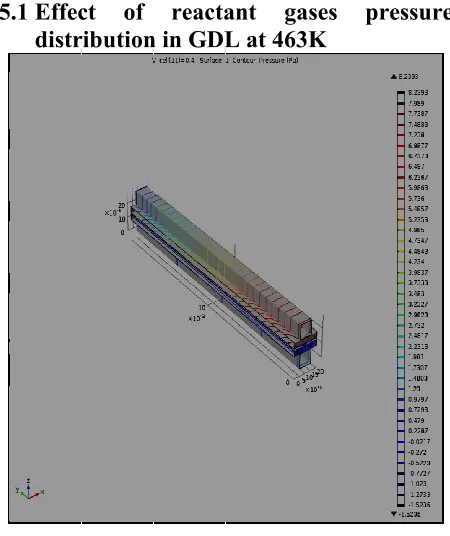
5.1Effect of reactant gases pressure
distribution in GDL at 463K
Figure 1 Reactant gases pressure distribution in GDL at 463K
International Journal of Research (IJR)
e-ISSN: 2348-6848, p- ISSN: 2348-795X Volume 2, Issue 3, March 2015Available at http://internationaljournalofresearch.org
5.2Effect of reactant gases pressure
distribution in GDL at 473K
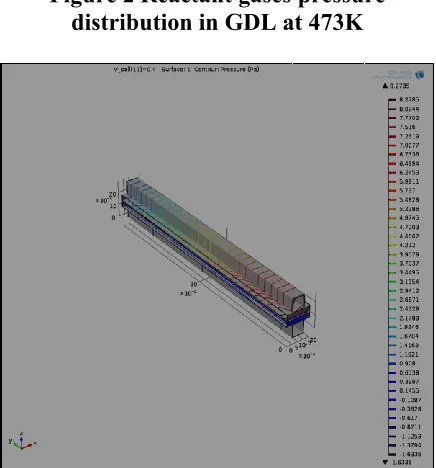
Figure 2 Reactant gases pressure distribution in GDL at 473K
Figure 3 Reactant gases pressure distribution in GDL at 483K
Reactant gases pressure distribution at Gas Diffusion Layer (GDL) with an operating temperature of 473K is shown in figure.2. Distribution of reactant gases pressure is initially very high at the inlet of the cell then it is drastically reduced towards the outlet of the cell. Because at the inlet of the cell the reactant gases concentration and velocity is high after
sometimes its pressure gets reduced. In this case the maximum and minimum reactant gases pressure distribution obtained is -1.579 Pa and 8.2591 Pa respectively.
5.3Effect of reactant gases pressure
distribution in GDL at 483K
Reactant gases pressure distribution at Gas Diffusion Layer (GDL) with an operating temperature of 483K is shown in figure.3. Distribution of reactant gases pressure is initially very high at the inlet of the cell then it is drastically reduced towards the outlet of the cell. Because at the inlet of the cell the reactant gases concentration and velocity is high after sometimes its pressure gets reduced. In this case the maximum and minimum reactant gases pressure distribution obtained is -1.6336 Pa and 8.2785 Pa respectively.
Figure 4 Reactant gases pressure distribution in GDL at 493K
5.4 Effect of reactant gases pressure distribution in GDL at 493K
International Journal of Research (IJR)
e-ISSN: 2348-6848, p- ISSN: 2348-795X Volume 2, Issue 3, March 2015Available at http://internationaljournalofresearch.org
cell. Because at the inlet of the cell the reactant gases concentration and velocity is high after sometimes its pressure gets reduced. In this case the maximum and minimum reactant gases pressure distribution obtained is -1.6876 Pa and 8.2977 Pa respectively.
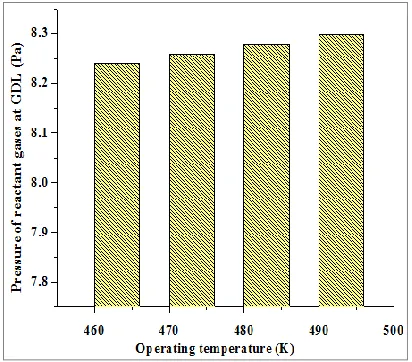
Figure 5 Effect of reactant gases pressure distribution at different operating
temperatures
6. Summary
High temperature PEMFC with single flow channel configuration has been chosen to carry out the numerical analysis for investigates the pressure distribution of reactant gases at Gas Diffusion Layer by using COMSOL Multiphysics software under the four different operating temperatures. The following conclusions have been made based on the numerical results which were obtained from the COMSOL Multiphysics software at four different operating temperatures. High temperature PEM fuel cell with an operating temperature of 493K gives the effective reactant gases pressure distribution (8.2977 Pa) at gas diffusion layer compared with other three operating temperatures. Thus the result clearly shows that the effective distribution of
reactant gases pressure is increased when the PEMFC operate at high temperature level.
References
[1] Hydrogen, Energy and Fuel Cells—A
vision for our future, High Level Group for Hydrogen and Fuel Cells, Summary Report, June 2003.
[2] Perry ML, Kotso S. A back-up power
solution with no batteries, In: INTELEC 2004 Proceedings; 2004. p. 210-7.
[3] Thoben B, Siebke A. Influence of
different gas diffusion layers on the water management of the PEFC cathode. Journal of New Materials for Electrochemical Systems 2004; 7:13-20.
[4] Lee W.K, Shimpalee S, Van Zee J.W,
Naseri-Neshat H. Experimental technique for PEM fuel cells. In: Proceedings of the 36th Intersociety Energy Conversion Engineering Conference, Savannah, Georgia, IECEC2001-ET-11; 2001.
[5] Yan W, Chu H, Chen J, Soong C, Chen
F. Transient analysis of water transport in PEM fuel cells. Journal of Power Sources 2006; 162:1147-56.
[6] Theodorakakos A, Ous T, Gavaises M,
Nouri JM, Nikolopoulos N, Yanagihara H. Dynamics of water droplets detached from porous surfaces of relevance to PEM fuel cells. Journal of Colloid and Interface Science 2006; 300:673-87.
[7] Lee C, Chu H. Effects of cathode
humidification on the gas-liquid interface location in a PEM fuel cell. Journal of Power Sources 2006; 161:949-56.
[8] He W, Nguyen TV. A new diagnostic
International Journal of Research (IJR)
e-ISSN: 2348-6848, p- ISSN: 2348-795X Volume 2, Issue 3, March 2015Available at http://internationaljournalofresearch.org
cells using interdigitated flow fields. Chemical & Petroleum Engineering Department, the University of Kansas Lawrence; 2002. KS 66045.
[9] Su A, Weng F-B, Hsu C-Y, Chen Y-M.
Studies on flooding in PEM fuel cell cathode channels. International Journal of Hydrogen Energy 2006; 31:1031-9.
[10] Cheng B, Minggao O, Baolian Y.
Analysis of water management in proton exchange membrane fuel cells. 1007-0214 10/21. Tsinghua Science and Technology February 2006; vol 11(1):54-64.
[11] Chen J, Matsuura T, Hori M. Novel gas
diffusion layer with water management function for PEMFC. Journal of Power Sources 2004; 131:155-61.
[12] Qi Z, Kaufman A. Improvement of
water management by a micro porous sub layer for PEM fuel cells. Journal of Power Sources 2002; 109:38-46.
[13] Carrette L, Friedrich KA, Stimming U.
Fuel cells- fundamentals and application. Fuel Cell 2001; 1:5-39.
[14] Hakenjos A, Muenter H, Wittstadt U,
Hebling C. A PEM fuel cell for combined measurement of current and temperature distribution, and flow field flooding, Journal of Power Sources 2004; 131:213-6.
[15] Voss HH, Wilkinson DP, Pickup PG,